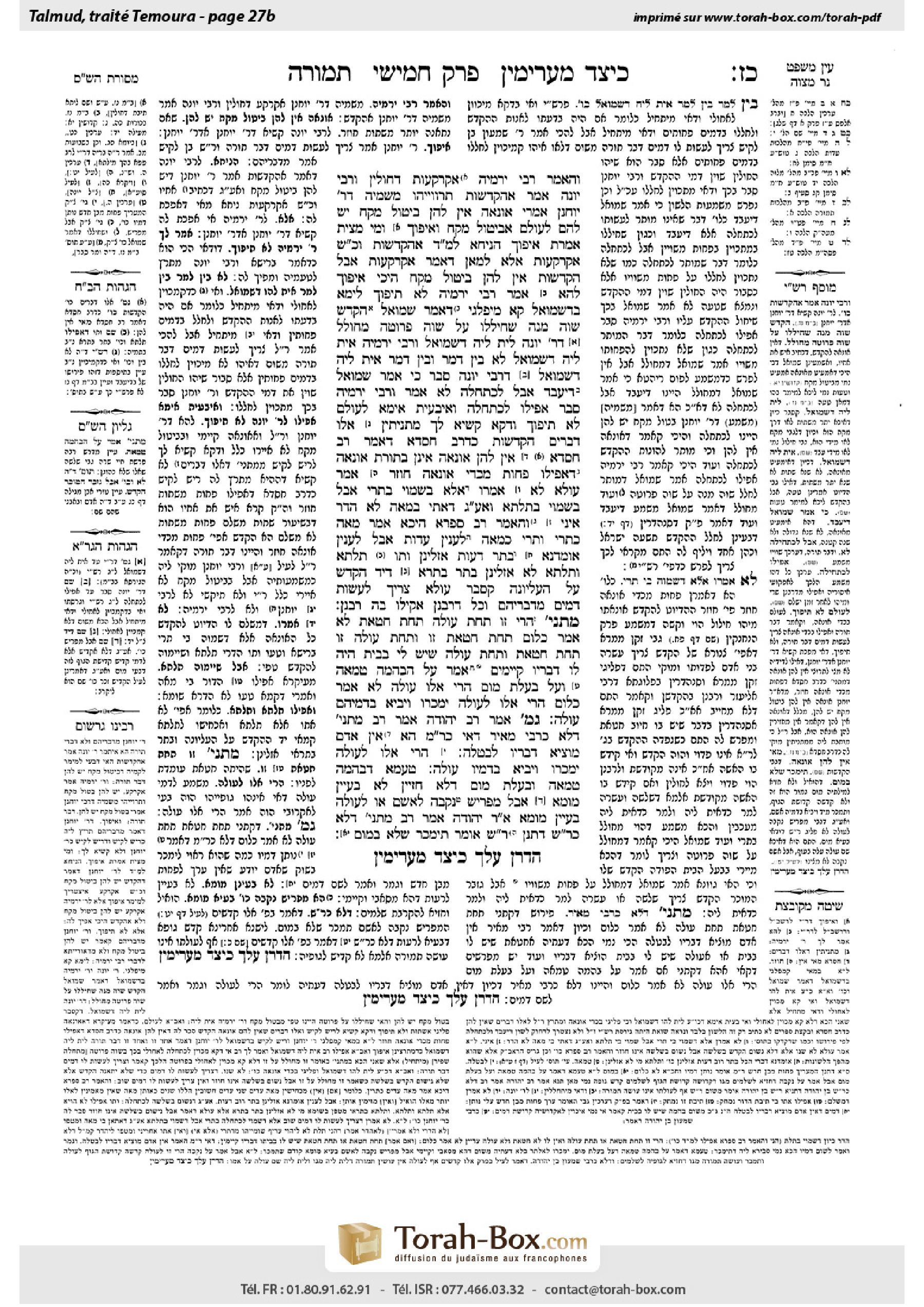
Temurah 27b: Talmud study for Daf Yomi
Daf Yomi is the daily study of one Talmud folio. Explore 37 tractates with scans, Hebrew text, Sefaria English and AI-generated French translations where annotated.
Passage selection and English or AI-generated French translation are available where the scan has annotations. Daf Study is independent of Torah-Box and Sefaria.
Browse Temurah · תמורה · All tractatesTemurah 27b text and translations
This page of Temurah includes the Aramaic text, an English translation and an AI-generated French translation, alongside the scan above.
תמורה כ״ז ב · Aramaic and Hebrew text
וְהָאָמַר רַבִּי יִרְמְיָה אַקַּרְקָעוֹת דְּחוּלִּין, וְרַבִּי יוֹנָה אָמַר אַהֶקְדֵּשׁוֹת, תַּרְוַויְיהוּ מִשְּׁמֵיהּ דְּרַבִּי יוֹחָנָן אָמְרִי: אוֹנָאָה אֵין לָהֶן, בִּיטּוּל מִקָּח יֵשׁ לָהֶם!
לְעוֹלָם אַבִּיטּוּל מִקָּח, וְאֵיפוֹךְ.
וּמִי מָצֵית אָמְרַתְּ אֵיפוֹךְ? הָנִיחָא לְמַאן דְּאָמַר אַהֶקְדֵּשׁוֹת, וְכׇל שֶׁכֵּן אַקַּרְקָעוֹת.
אֶלָּא לְמַאן דְּאָמַר אַקַּרְקָעוֹת, אֲבָל הֶקְדֵּשׁוֹת אֵין לָהֶן בִּיטּוּל מִקָּח, הֵיכִי אֵיפוֹךְ לְהָא?
אָמַר רַבִּי יִרְמְיָה: לָא תֵּיפוֹךְ.
לֵימָא בְּדִשְׁמוּאֵל קָא מִיפַּלְגִי, דְּאָמַר שְׁמוּאֵל: הֶקְדֵּשׁ שָׁוֶה מָנֶה שֶׁחִילְּלוֹ עַל שָׁוֶה פְּרוּטָה מְחוּלָּל. דְּרַבִּי יוֹנָה לֵית לֵיהּ דִּשְׁמוּאֵל, וְרַבִּי יִרְמְיָה אִית לֵיהּ דִּשְׁמוּאֵל.
לָא, בֵּין דְּמָר וּבֵין דְּמָר — אִית לֵיהּ דִּשְׁמוּאֵל, דְּרַבִּי יוֹנָה סָבַר: כִּי אָמַר שְׁמוּאֵל — דִּיעֲבַד, אֲבָל לְכַתְּחִלָּה לָא אָמַר, וְרַבִּי יִרְמְיָה סָבַר: אֲפִילּוּ לְכַתְּחִלָּה.
וְאִיבָּעֵית אֵימָא, לְעוֹלָם לָא תֵּיפוֹךְ, וּדְקָא קַשְׁיָא לָךְ מַתְנִיתִין ״אֵלּוּ דְּבָרִים... הֶקְדֵּשׁוֹת״ — כִּדְרַב חִסְדָּא.
דְּאָמַר רַב חִסְדָּא: אֵין לָהֶן אוֹנָאָה — אֵינָן בְּתוֹרַת אוֹנָאָה, דַּאֲפִילּוּ פָּחוֹת מִכְּדֵי אוֹנָאָה חוֹזֵר.
אָמַר עוּלָּא: לָא אָמְרוּ אֶלָּא בְּשָׁמוּי בִּתְרֵי, אֲבָל בְּשָׁמוּי בִּתְלָתָא, וְאַף עַל גַּב דְּאָתֵי בְּמֵאָה — לָא הָדַר.
אִינִי? וְהָאָמַר רַב סָפְרָא: הֵיכָא אָמְרִינַן מְאָה כִּתְרֵי וּתְרֵי כִּמְאָה? לְעִנְיַן עֵדוּת, אֲבָל לְעִנְיַן אוּמְדָּנָא — בָּתַר דֵּעוֹת אָזְלִינַן.
וְתוּ תְּלָתָא וּתְלָתָא, לָא אָזְלִינַן בָּתַר בָּתְרָא? דְּיַד הֶקְדֵּשׁ עַל הָעֶלְיוֹנָה!
קָסָבַר עוּלָּא: צָרִיךְ לַעֲשׂוֹת דָּמִים מִדִּבְרֵיהֶם, וְכֹל דְּרַבָּנַן אַקִּילוּ בֵּהּ רַבָּנַן.
מַתְנִי׳ ״הֲרֵי זוֹ תַּחַת עוֹלָה״, ״תַּחַת חַטָּאת״ — לֹא אָמַר כְּלוּם. ״תַּחַת חַטָּאת זוֹ״, וְ״תַחַת עוֹלָה זוֹ״, ״תַּחַת חַטָּאת וְתַחַת עוֹלָה שֶׁיֵּשׁ לִי בַּבַּיִת״ — הָיָה לוֹ, דְּבָרָיו קַיָּימִים.
אָמַר עַל הַבְּהֵמָה טְמֵאָה וְעַל בַּעֲלַת מוּם ״הֲרֵי אֵלּוּ עוֹלָה״ — לֹא אָמַר כְּלוּם. ״הֲרֵי אֵלּוּ לְעוֹלָה״ — יִמָּכְרוּ, וְיָבִיא בִּדְמֵיהֶם עוֹלָה.
גְּמָ׳ אָמַר רַב יְהוּדָה אָמַר רַב: מַתְנִיתִין דְּלָא כְּרַבִּי מֵאִיר, דְּאִי כְּרַבִּי מֵאִיר — הָא אֵין אָדָם מוֹצִיא דְּבָרָיו לְבַטָּלָה.
״הֲרֵי אֵלּוּ לְעוֹלָה״ — יִמָּכְרוּ וְיָבִיא בִּדְמֵיהֶן עוֹלָה. טַעְמָא דִּבְהֵמָה טְמֵאָה וּבַעֲלַת מוּם, דְּלָא חַזְיָין — לָא בָּעֲיָין מוּמָא, אֲבָל מַפְרִישׁ נְקֵבָה לְאָשָׁם אוֹ לְעוֹלָה — בָּעֲיָין מוּמָא.
אָמַר רַב יְהוּדָה, אָמַר רַב: מַתְנִיתִין דְּלָא כְּרַבִּי שִׁמְעוֹן, דִּתְנַן, רַבִּי שִׁמְעוֹן אוֹמֵר: תִּימָּכֵר שֶׁלֹּא בְּמוּם.
הֲדַרַן עֲלָךְ כֵּיצַד מַעֲרִימִין.
Temurah 27b · English translation
But didn’t Rabbi Yirmeya say this ruling with regard to non-sacred lands, and Rabbi Yona said it with regard to consecrated property, and both of them said it in the name of Rabbi Yoḥanan: They are not subject to the halakhot of exploitation, in the case of a disparity of one-sixth. But they are subject to nullification of a transaction, in the case of a greater disparity. If so, according to the opinion of Rabbi Yona, Rabbi Yoḥanan maintains that when the disparity between the value and the payment is greater than one-sixth, the transaction is nullified by Torah law. But in that case, why would Rabbi Yoḥanan rule here that only by rabbinic law is he required to calculate the difference and pay its value?
The Gemara answers: Actually, they disagree in a case of nullification of a transaction, i.e., more than one-sixth, and one should reverse attribution of the opinions; the opinion previously attributed to Rabbi Yoḥanan is actually that of Reish Lakish, and the opinion attributed to Reish Lakish is the ruling of Rabbi Yoḥanan.
The Gemara asks: But how can you say that one should reverse the attribution of the opinions of Rabbi Yoḥanan and Reish Lakish? This works out well according to the one who says that Rabbi Yoḥanan holds that consecrated property is not subject to the halakhot of exploitation if the disparity between the value and the payment is one-sixth, but it is subject to nullification of the transaction if the disparity between the value and the payment is greater than one-sixth. According to this opinion, that of Rabbi Yona, it is apparent all the more so that lands are subject to nullification if the disparity is greater than one-sixth.
But according to the one who said that Rabbi Yoḥanan holds that only lands are subject to nullification if the disparity is greater than one-sixth, but with regard to consecrated property there is no nullification of a transaction, i.e., Rabbi Yirmeya, how can he reverse attribution of that opinion, and claim that Rabbi Yoḥanan maintains that he is required to pay the difference in value by Torah law?
Rabbi Yirmeya said: According to my opinion, do not reverse attribution of the opinions of Rabbi Yoḥanan and Reish Lakish. In other words, Rabbi Yoḥanan maintains that he is required to pay the difference in value by rabbinic law. This is consistent with Rabbi Yirmeya’s ruling that Rabbi Yoḥanan holds that there is no nullification of a transaction in the case of consecrated property. Only Rabbi Yona would reverse attribution of the opinions of Rabbi Yoḥanan and Reish Lakish in order for Rabbi Yoḥanan’s opinion to be consistent with his statement, as cited by Rabbi Yona, that there is nullification of a transaction in the case of consecrated property.
It has been established that Rabbi Yona maintains that according to Rabbi Yoḥanan consecrated property is subject to nullification of a transaction, whereas Rabbi Yirmeya disputes that claim. The Gemara suggests: Shall we say that they disagree with regard to a statement of Shmuel, as Shmuel said: Consecrated property worth one hundred dinars [maneh] that one desacralized, with its sanctity transferred to a coin worth one peruta, is desacralized. Since consecrated property is not subject to nullification of a transaction, it is desacralized by coins worth any sum. The suggestion is that Rabbi Yona is not of the opinion that the halakha follows the ruling of Shmuel, and Rabbi Yirmeya is of the opinion that the halakha follows the ruling of Shmuel.
The Gemara rejects this suggestion: No; both this Sage and that Sage are of the opinion that the halakha follows the ruling of Shmuel. The difference between them is that Rabbi Yona maintains that when Shmuel stated his halakha, he was referring to consecrated property that one desacralized after the fact, but he did not say that one may do so ab initio; and Rabbi Yirmeya maintains that Shmuel rules that it is permitted to desacralize consecrated property with coins worth any sum, even ab initio.
If you wish, say instead, with regard to the dispute between Reish Lakish and Rabbi Yoḥanan: Actually, do not reverse the attribution of their respective opinions. In fact, they disagree with regard to a disparity of one-sixth, and Reish Lakish holds that one is required to pay the difference value by Torah law. And as for that which poses a difficulty for you with regard to the opinion of Reish Lakish, that it is taught in the mishna: These are matters that are not subject to the halakhot of exploitation: Slaves, documents, lands, and consecrated property, which indicates that one is required to pay the difference in value by rabbinic law, that mishna should be understood in accordance with the explanation of Rav Ḥisda.
As Rav Ḥisda said: What is the meaning of the phrase: Are not subject to the halakhot of exploitation? This means that they are not subject to the standard principles of exploitation at all; rather, more stringent halakhot apply in these cases. As, even if the disparity is less than the measure of exploitation, i.e., less than one-sixth, one may renege on the transaction, and in the case of consecrated property he is required to pay the value of the disparity.
§ With regard to a case in which there was a disparity between the assessed value of property and its actual value, where one must pay the difference to the Temple treasury, Ulla said: The Sages said that one must pay the value of the disparity to the Temple treasury only if the value of the consecrated property was initially assessed by only two people and afterward three other people determined that the consecrated property was worth more. But in a case where the value of the consecrated property was initially assessed by three people, as required by halakha, and that amount was paid to the Temple treasury, even if afterward one hundred people came and assessed the value of the consecrated property at a higher value, one need not return the disparity of value to the Temple treasury.
The Gemara asks: Is that so? But didn’t Rav Safra say: Where did one say the ruling that one hundred witnesses are like two witnesses, and two witnesses are like one hundred witnesses? That principle applies specifically to the matter of testimony. But with regard to the matter of assessments, we follow the majority of opinions. If so, in Ulla’s case, one should follow the assessment of the one hundred and pay the disparity to the Temple treasury.
And furthermore, even in a case where three people initially assessed the value of the consecrated property, and afterward three other people assessed the consecrated property at a higher value, don’t we follow the latter assessment? Isn’t there is a principle that the Temple treasury of consecrated property always has the advantage?
The Gemara answers: Ulla holds that the halakha that the owner is required to conduct an appraisal, to ascertain the relative value of the two animals and to pay the difference to the Temple treasury, applies by rabbinic law, not by Torah law, and the Sages were lenient with regard to all rabbinic laws. Therefore, even if one hundred people assessed the value of the consecrated property at a higher value than the earlier assessment, one is not required to pay the disparity in value to the Temple treasury.
MISHNA: If one said: This non-sacred animal is hereby in place of a burnt offering, or: It is in place of a sin offering, he has said nothing, as he did not say that it was in place of a specific offering. If he said: It is in place of this sin offering, or: It is in place of this burnt offering, or if he said: It is in place of a sin offering that I have in the house, or: It is in place of a burnt offering that I have in the house, and he had that offering in his house, his statement stands, i.e., is effective.
If he said with regard to a non-kosher animal and with regard to a blemished animal: These animals are hereby designated as a burnt offering, he has said nothing. If he said: These animals are hereby designated for a burnt offering, the animals should be sold, and he brings a burnt offering purchased with the money received from their sale.
GEMARA: The mishna teaches that if one said: This non-sacred animal is hereby in place of a burnt offering, he has said nothing. Rav Yehuda said that Rav said: The mishna is not in accordance with the opinion of Rabbi Meir, as, if it is in accordance with the opinion of Rabbi Meir, didn’t Rabbi Meir say: A person does not utter a statement for naught. In other words, if one issues a statement that cannot be fulfilled as stated, it is interpreted in a manner that renders it relevant. Consequently, when he said: This non-sacred animal is in place of a burnt offering, he must have been referring to a burnt offering that he had in his house.
§ The mishna teaches: If he said with regard to a non-kosher animal and with regard to a blemished animal: These animals are hereby designated for a burnt offering, the animals should be sold, and he brings a burnt offering purchased with the money received from their sale. The Gemara infers: The reason that these animals are sold is that they are non-kosher and blemished animals, which are not fit to be sacrificed, and therefore they do not require the development of a blemish for them to be sold. But in the case of one who separates a female animal for a guilt offering or for a burnt offering, which may be brought only from males, since a female animal is fit to be sacrificed as a different type of offering, the animal does require the development of a blemish for it to be sold.
Consequently, Rav Yehuda said that Rav said: The mishna is not in accordance with the opinion of Rabbi Shimon, as we learned in a mishna (19b) that Rabbi Shimon says: In the case of one who designates a female animal for a guilt offering, since a female is unfit to be sacrificed as that offering, its halakhic status is like that of a blemished animal in the sense that it does not become inherently sacred; rather, only its value is sacred. Therefore, it may be sold without it having developed a blemish, and a guilt offering is purchased with the money received from its sale.
Temurah 27b · Traduction française (IA)
Mais Rabbi Yirmeya n’a-t-il pas énoncé cette décision au sujet des biens profanes, tandis que Rabbi Yona l’a énoncée au sujet des biens consacrés, et que tous deux l’ont rapportée au nom de Rabbi Yoḥanan : ils ne sont pas soumis aux lois de la fraude lorsqu’il y a un écart d’un sixième, mais la transaction est annulée lorsque l’écart est supérieur ? Si tel est le cas, selon Rabbi Yona, Rabbi Yoḥanan estime que, lorsque l’écart entre la valeur et le prix payé dépasse un sixième, la transaction est annulée en vertu de la Torah. Pourquoi Rabbi Yoḥanan aurait-il alors statué ici que l’obligation de calculer la différence et d’en payer la valeur relève seulement d’une règle rabbinique ?
La Guemara répond : En réalité, leur désaccord porte sur l’annulation d’une transaction, c’est-à-dire lorsque l’écart dépasse un sixième, et il faut inverser l’attribution des opinions : celle qui était précédemment attribuée à Rabbi Yoḥanan est en fait celle de Reish Lakish, et celle qui était attribuée à Reish Lakish est en fait celle de Rabbi Yoḥanan.
La Guemara demande : Mais comment peut-on dire qu’il faut inverser l’attribution des opinions de Rabbi Yoḥanan et de Reish Lakish ? Cela convient selon celui qui dit que Rabbi Yoḥanan estime que les biens consacrés ne sont pas soumis aux lois de la fraude lorsque l’écart entre la valeur et le prix payé est d’un sixième, mais que la transaction est annulée si l’écart dépasse un sixième. Selon cette opinion, celle de Rabbi Yona, il est d’autant plus évident que les terrains sont soumis à l’annulation de la transaction lorsque l’écart dépasse un sixième.
Mais selon celui qui dit que, d’après Rabbi Yoḥanan, seuls les terrains sont soumis à l’annulation de la transaction si l’écart dépasse un sixième, tandis qu’il n’y a pas d’annulation de transaction pour les biens consacrés — c’est-à-dire Rabbi Yirmeya —, comment peut-il inverser l’attribution des opinions et affirmer que Rabbi Yoḥanan estime que l’obligation de payer la différence de valeur relève de la Torah ?
Rabbi Yirmeya dit : Selon mon opinion, n’inversez pas l’attribution des opinions de Rabbi Yoḥanan et de Reish Lakish. Autrement dit, Rabbi Yoḥanan estime que l’obligation de payer la différence de valeur relève d’une règle rabbinique. Cela concorde avec l’avis de Rabbi Yirmeya, selon lequel Rabbi Yoḥanan estime qu’il n’y a pas d’annulation de transaction dans le cas des biens consacrés. Seul Rabbi Yona inverserait l’attribution des opinions de Rabbi Yoḥanan et de Reish Lakish, afin que l’opinion de Rabbi Yoḥanan concorde avec ce qu’il rapporte en son nom, à savoir qu’il y a annulation de transaction dans le cas des biens consacrés.
Il est établi que, selon Rabbi Yona, Rabbi Yoḥanan estime que les biens consacrés sont soumis à l’annulation de transaction, tandis que Rabbi Yirmeya conteste cette affirmation. La Guemara suggère : Faut-il dire qu’ils sont en désaccord au sujet d’une déclaration de Shmuel ? Shmuel a en effet dit : Des biens consacrés d’une valeur de cent dinars [maneh] que l’on a désacralisés en transférant leur sainteté sur une pièce d’une valeur d’une perouta sont désacralisés. Puisque les biens consacrés ne sont pas soumis à l’annulation de transaction, ils peuvent être désacralisés contre une pièce de n’importe quelle valeur. On suggérerait donc que Rabbi Yona ne pense pas que la halakha suive la décision de Shmuel, tandis que Rabbi Yirmeya pense qu’elle la suit.
La Guemara rejette cette suggestion : Non, ces deux Sages pensent que la halakha suit la décision de Shmuel. Leur désaccord porte sur le sens de cette décision : Rabbi Yona estime que, lorsque Shmuel a énoncé sa halakha, il parlait de biens consacrés qui avaient été désacralisés après coup, mais qu’il n’a pas dit qu’on pouvait procéder ainsi a priori ; tandis que Rabbi Yirmeya estime que, selon Shmuel, il est permis de désacraliser des biens consacrés contre une pièce de n’importe quelle valeur, même a priori.
Si tu le souhaites, on peut proposer une autre réponse au sujet du désaccord entre Reish Lakish et Rabbi Yoḥanan : en réalité, il ne faut pas inverser l’attribution de leurs opinions respectives. En fait, leur désaccord porte sur un écart d’un sixième, et Reish Lakish estime que l’obligation de payer la différence de valeur relève de la Torah. Quant à la difficulté que soulève l’opinion de Reish Lakish, à savoir qu’il est enseigné dans la Michna : « Voici les choses qui ne sont pas soumises aux lois de la fraude : les esclaves, les actes écrits, les terrains et les biens consacrés », ce qui indique que l’obligation de payer la différence de valeur relève d’une règle rabbinique, il faut comprendre cette Michna conformément à l’explication de Rav Ḥisda.
Car Rav Ḥisda a dit : Que signifie l’expression « ne sont pas soumis aux lois de la fraude » ? Cela signifie qu’ils ne sont pas du tout soumis aux règles ordinaires de la fraude ; au contraire, des règles plus strictes s’appliquent dans ces cas. En effet, même si l’écart est inférieur au seuil de la fraude, c’est-à-dire inférieur à un sixième, on peut se rétracter de la transaction ; et, dans le cas des biens consacrés, il est tenu de payer la valeur de l’écart.
§ Au sujet d’un cas où il y a un écart entre la valeur estimée d’un bien et sa valeur réelle, et où il faut verser la différence au Trésor du Temple, Oulla dit : Les Sages ont dit qu’il faut verser au Trésor du Temple la valeur de l’écart uniquement si la valeur des biens consacrés a d’abord été estimée par deux personnes, puis que trois autres personnes ont établi que ces biens valaient davantage. Mais si la valeur des biens consacrés a d’abord été estimée par trois personnes, comme l’exige la halakha, et que cette somme a été versée au Trésor du Temple, même si cent personnes viennent ensuite estimer les biens consacrés à une valeur supérieure, il n’est pas nécessaire de verser la différence de valeur au Trésor du Temple.
La Guemara demande : En est-il ainsi ? Rav Safra n’a-t-il pas dit : Dans quel domaine a-t-on énoncé la règle selon laquelle cent témoins équivalent à deux témoins, et deux témoins équivalent à cent témoins ? Cette règle s’applique spécifiquement en matière de témoignage. Mais en matière d’estimation, on suit l’avis de la majorité. Si tel est le cas, dans celui d’Oulla, il faudrait suivre l’estimation des cent personnes et verser la différence au Trésor du Temple.
De plus, même dans le cas où trois personnes ont d’abord estimé la valeur des biens consacrés, puis où trois autres personnes les ont estimés à une valeur supérieure, ne suit-on pas la seconde estimation ? N’existe-t-il pas un principe selon lequel le Trésor du Temple a toujours l’avantage lorsqu’il s’agit de biens consacrés ?
La Guemara répond : Oulla estime que l’obligation du propriétaire de faire procéder à une estimation, afin d’établir la valeur relative des deux animaux et de verser la différence au Trésor du Temple, relève d’une règle rabbinique et non de la Torah, et que les Sages ont adopté une attitude indulgente à l’égard de toutes les règles rabbiniques. Par conséquent, même si cent personnes ont estimé les biens consacrés à une valeur supérieure à celle de la première estimation, il n’est pas tenu de verser la différence de valeur au Trésor du Temple.
MICHNA : Si quelqu’un dit : « Cet animal profane est à la place d’un holocauste », ou : « Il est à la place d’un sacrifice expiatoire », sa déclaration est sans effet, car il n’a pas dit qu’il était à la place d’un sacrifice déterminé. S’il dit : « Il est à la place de ce sacrifice expiatoire », ou : « Il est à la place de ce holocauste », ou encore : « Il est à la place d’un sacrifice expiatoire que j’ai chez moi », ou : « Il est à la place d’un holocauste que j’ai chez moi », et qu’il possède ce sacrifice chez lui, sa déclaration est valable, c’est-à-dire qu’elle prend effet.
S’il dit au sujet d’un animal non cachère et d’un animal atteint d’un défaut : « Ces animaux sont désormais désignés comme holocauste », sa déclaration est sans effet. S’il dit : « Ces animaux sont désormais désignés pour un holocauste », les animaux doivent être vendus, et il apporte un holocauste acheté avec le produit de leur vente.
GUEMARA : La Michna enseigne que si quelqu’un dit : « Cet animal profane est à la place d’un holocauste », sa déclaration est sans effet. Rav Yehuda a dit au nom de Rav : La Michna n’est pas conforme à l’opinion de Rabbi Meïr, car, si elle était conforme à celle de Rabbi Meïr, celui-ci n’a-t-il pas dit qu’une personne ne prononce pas de déclaration en vain ? Autrement dit, si quelqu’un fait une déclaration qui ne peut être accomplie telle quelle, on l’interprète d’une manière qui lui donne un sens. Par conséquent, lorsqu’il a dit : « Cet animal profane est à la place d’un holocauste », il devait parler d’un holocauste qu’il avait chez lui.
§ La Michna enseigne : S’il dit au sujet d’un animal non cachère et d’un animal atteint d’un défaut : « Ces animaux sont désormais désignés pour un holocauste », les animaux doivent être vendus, et il apporte un holocauste acheté avec le produit de leur vente. La Guemara en déduit que si ces animaux sont vendus, c’est parce qu’ils sont non cachères et atteints d’un défaut, donc inaptes à être sacrifiés, et qu’ils n’ont par conséquent pas besoin de développer un défaut pour pouvoir être vendus. Mais, dans le cas de celui qui met à part un animal femelle pour un sacrifice de culpabilité ou pour un holocauste, qui ne peuvent être apportés que par des mâles, comme un animal femelle peut être sacrifié pour un autre type d’offrande, il faut qu’il développe un défaut pour pouvoir être vendu.
Par conséquent, Rav Yehuda a dit au nom de Rav : La Michna n’est pas conforme à l’opinion de Rabbi Shimon, car nous avons appris dans une Michna (19b) que Rabbi Shimon dit : Dans le cas de celui qui désigne un animal femelle pour un sacrifice de culpabilité, puisque la femelle ne peut pas être sacrifiée pour ce type d’offrande, son statut halakhique est celui d’un animal atteint d’un défaut, en ce sens qu’elle ne devient pas intrinsèquement sacrée ; seule sa valeur est sacrée. Elle peut donc être vendue sans avoir développé de défaut, et un sacrifice de culpabilité est acheté avec le produit de sa vente.
Traduction française générée par IA à partir de l’édition anglaise de Sefaria. Vérifie toujours un passage avec le texte source.
Text from Sefaria: William Davidson Edition - Vocalized Aramaic (CC BY NC); William Davidson Edition - English (CC BY NC).