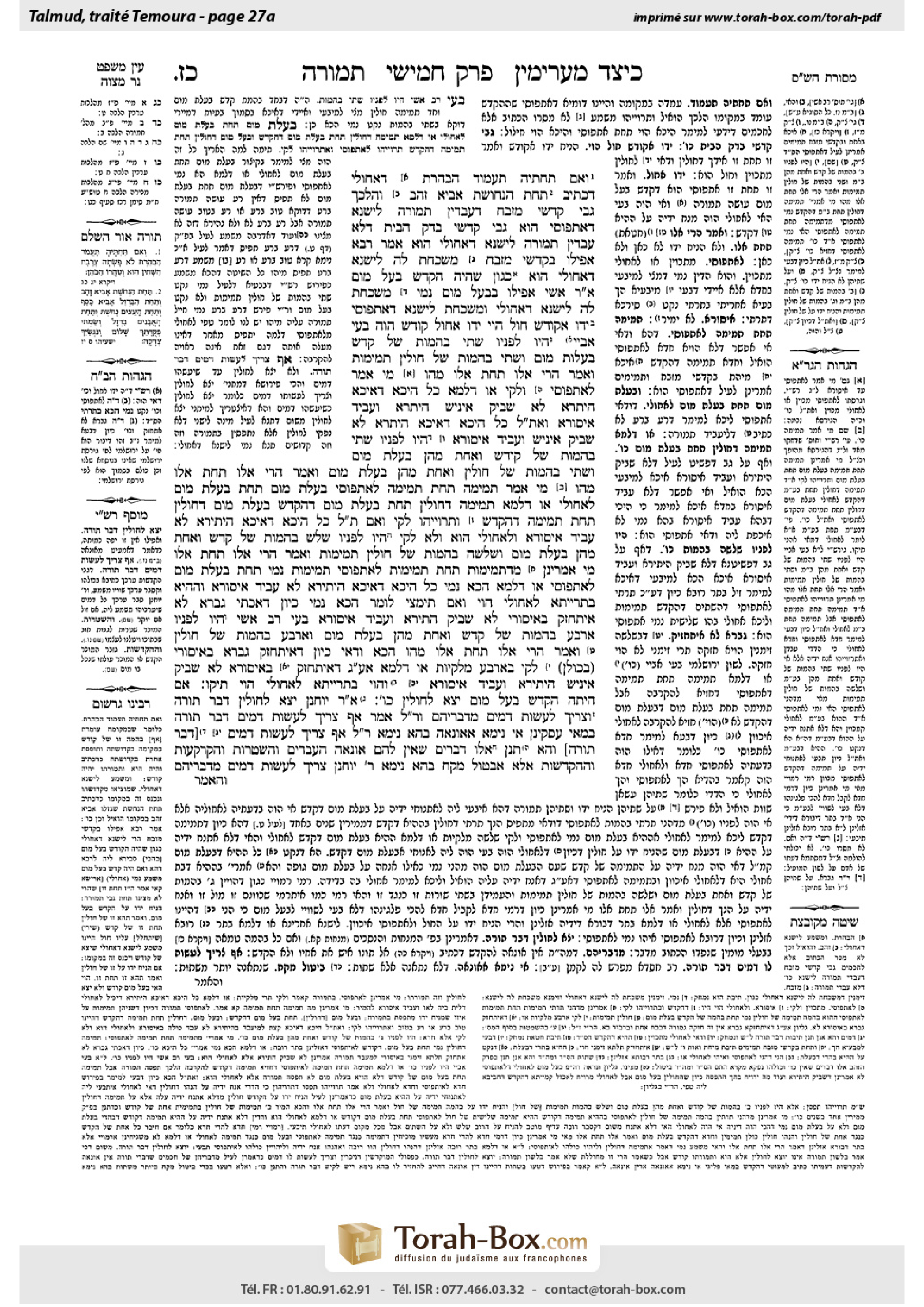
Temurah 27a: Talmud study for Daf Yomi
Daf Yomi is the daily study of one Talmud folio. Explore 37 tractates with scans, Hebrew text, Sefaria English and AI-generated French translations where annotated.
Passage selection and English or AI-generated French translation are available where the scan has annotations. Daf Study is independent of Torah-Box and Sefaria.
Browse Temurah · תמורה · All tractatesTemurah 27a text and translations
This page of Temurah includes the Aramaic text, an English translation and an AI-generated French translation, alongside the scan above.
תמורה כ״ז א · Aramaic and Hebrew text
״וְאִם תַּחְתֶּיהָ תַּעֲמוֹד הַבַּהֶרֶת״.
דְּאַחוֹלֵי, דִּכְתִיב: ״תַּחַת הַנְּחוֹשֶׁת אָבִיא זָהָב״, וְהִלְכָּךְ, גַּבֵּי קׇדְשֵׁי מִזְבֵּחַ דְּעָבְדִין תְּמוּרָה — לִישָּׁנָא דְּאַתְפּוֹסֵי הוּא, גַּבֵּי קׇדְשֵׁי בֶּדֶק הַבַּיִת דְּלָא עָבְדִין תְּמוּרָה — לִישָּׁנָא דְּאַחוֹלֵי הוּא.
אָמַר רָבָא: אֲפִילּוּ בְּקׇדְשֵׁי מִזְבֵּחַ מַשְׁכַּחַתְּ לַהּ לִישָּׁנָא דְּאַחוֹלֵי הוּא, כְּגוֹן שֶׁהָיָה הֶקְדֵּשׁ בַּעַל מוּם.
אָמַר רַבִּי אָשֵׁי: אֲפִילּוּ בְּבַעַל מוּם נָמֵי מַשְׁכַּחַתְּ לַהּ לִישָּׁנָא דְּאַחוֹלֵי, וּמַשְׁכַּחַת לִישָּׁנָא דְּאַתְפּוֹסֵי. יָדוֹ אַקּוֹדֶשׁ — חוֹל הָוֵי, יָדוֹ אַחוֹל — קוֹדֶשׁ הָוֵי.
בָּעֵי אַבָּיֵי: הָיוּ לְפָנָיו שְׁתֵּי בְּהֵמוֹת שֶׁל קֹדֶשׁ בַּעֲלוֹת מוּם, וּשְׁתֵּי בְּהֵמוֹת שֶׁל חוּלִּין תְּמִימוֹת, וְאָמַר ״הֲרֵי אֵלּוּ תַּחַת אֵלּוּ״, מַהוּ?
מִי אָמַר לְאַתְפּוֹסֵי וְלָקֵי, אוֹ דִלְמָא: כֹּל הֵיכָא דְּאִיכָּא הֶיתֵּרָא — לָא שָׁבֵיק אִינִישׁ הֶיתֵּרָא וְעָבֵיד אִיסּוּרָא?
וְאִם תִּמְצֵי לוֹמַר, כֹּל הֵיכָא דְּאִיכָּא הֶיתֵּרָא לָא שָׁבֵיק אִינִישׁ וְעָבֵיד אִיסּוּרָא, הָיוּ לְפָנָיו שְׁתֵּי בְּהֵמוֹת שֶׁל קוֹדֶשׁ, וְאַחַת מֵהֶן בַּעֲלַת מוּם, וּשְׁתֵּי בְּהֵמוֹת שֶׁל חוּלִּין, וְאַחַת מֵהֶן בַּעֲלַת מוּם, וְאָמַר ״הֲרֵי אֵלּוּ תַּחַת אֵלּוּ״, מַהוּ?
מִי אָמַר: תְּמִימָה תַּחַת תְּמִימָה — לְאַתְפּוֹסֵי, בַּעֲלַת מוּם תַּחַת בַּעֲלַת מוּם — לְאַחוֹלֵי.
אוֹ דִלְמָא, תְּמִימָה דְּחוּלִּין תַּחַת בַּעֲלַת מוּם דְּהֶקְדֵּשׁ, בַּעֲלַת מוּם דְּחוּלִּין תַּחַת תְּמִימָה דְּהֶקְדֵּשׁ, וְתַרְוַיְיהוּ לָקֵי?
וְאִם תִּמְצֵי לוֹמַר, כֹּל הֵיכָא דְּאִיכָּא הֶיתֵּירָא — לָא עָבֵיד אִיסּוּרָא, וּלְאַחוֹלֵי הוּא, וְלָא לָקֵי. הָיוּ לְפָנָיו שָׁלֹשׁ בְּהֵמוֹת שֶׁל קֹדֶשׁ, וְאַחַת מֵהֶן בַּעֲלַת מוּם, וְשָׁלֹשׁ בְּהֵמוֹת שֶׁל חוּלִּין תְּמִימוֹת, וְאָמַר: ״הֲרֵי אֵלּוּ תַּחַת אֵלּוּ״.
מִי אָמְרִינַן, מִדִּתְמִימוֹת תַּחַת תְּמִימוֹת לְאַתְפּוֹסֵי, תְּמִימוֹת נָמֵי תַּחַת בַּעֲלַת מוּם לְאַתְפּוֹסֵי? אוֹ דִלְמָא, הָכָא נָמֵי, כֹּל הֵיכָא דְּאִיכָּא הֶיתֵּירָא לָא עָבֵיד אִיסּוּרָא, וְהַהִיא בָּתְרָיְיתָא לְאַחוֹלֵי הָוֵי.
וְאִם תִּימְצֵי לוֹמַר, הָכָא נָמֵי, כֵּיוָן דְּאַכַּתִּי גַּבְרָא לָא אִיתַּחְזַק בְּאִיסּוּרֵי, לָא שָׁבֵיק הֶתֵּירָא וְעָבֵיד אִיסּוּרָא. בָּעֵי רַב אָשֵׁי: הָיוּ לְפָנָיו אַרְבַּע בְּהֵמוֹת שֶׁל קֹדֶשׁ וְאַחַת מֵהֶן בַּעֲלַת מוּם, וְאַרְבַּע בְּהֵמוֹת שֶׁל חוּלִּין, וְאָמַר ״הֲרֵי אֵלּוּ תַּחַת אֵלּוּ״, מַהוּ?
הָכָא וַדַּאי, כֵּיוָן דְּאִיתַּחְזַק גַּבְרָא בְּאִיסּוּרֵי (בְּכוּלָּן), לָקֵי בְּאַרְבַּע מַלְקִיּוֹת.
אוֹ דִלְמָא, אַף עַל גַּב דְּאִיתַּחְזַק בְּאִיסּוּרָא, לָא שָׁבֵיק אִינִישׁ הֶיתֵּירָא וְעָבֵיד אִיסּוּרָא, וְהָוֵי בָּתְרָיְיתָא לְאַחוֹלֵי הָוֵי? תֵּיקוּ.
אִם הָיָה הֶקְדֵּשׁ בַּעַל מוּם יֹצֵא לְחוּלִּין כּוּ׳.
אָמַר רַבִּי יוֹחָנָן: יֹצֵא לְחוּלִּין דְּבַר תּוֹרָה, וְצָרִיךְ לַעֲשׂוֹת דָּמִים מִדִּבְרֵיהֶם, וְרֵישׁ לָקִישׁ אָמַר: אַף צָרִיךְ לַעֲשׂוֹת דָּמִים דְּבַר תּוֹרָה.
בְּמַאי עָסְקִינַן? אִי נֵימָא אַאוֹנָאָה, בְּהָא נֵימָא רֵישׁ לָקִישׁ אַף צָרִיךְ לַעֲשׂוֹת דָּמִים דְּבַר תּוֹרָה?
וְהָא תְנַן: אֵלּוּ דְּבָרִים שֶׁאֵין לָהֶם אוֹנָאָה: הָעֲבָדִים, וְהַשְּׁטָרוֹת, וְהַקַּרְקָעוֹת, וְהַהֶקְדֵּשׁוֹת!
אֶלָּא, אַבִּטּוּל מִקָּח בְּהָא נֵימָא רַבִּי יוֹחָנָן צָרִיךְ לַעֲשׂוֹת דָּמִים מִדִּבְרֵיהֶם?
Temurah 27a · English translation
“But if the white leprous spot stays in its place [taḥteha]” (Leviticus 13:23). In this verse, the word “taḥteha” indicates that the white leprous spot remains in its place. This usage of the word is fitting for substitution, since when sanctity is transferred by substitution from a consecrated animal to a non-sacred animal, the sanctity of the consecrated animal remains in place, despite the fact that the non-sacred animal is also consecrated.
Yet taḥat is also a term that indicates desacralization, as it is written: “In place of [taḥat] brass I will bring gold, and in place of iron I will bring silver, and in place of wood brass, and in place of stones iron” (Isaiah 60:17). In this verse, taḥat means replacement, which is what occurs in desacralization, where one item is replaced by another. And therefore, the term should be understood in accordance with the context: With regard to animals consecrated for sacrifice upon the altar, which render a non-sacred animal for which they are exchanged a substitute, taḥat is a term that indicates the associating of one sanctity with another. With regard to animals consecrated for Temple maintenance, which do not render a non-sacred animal for which they are exchanged a substitute, taḥat is a term that indicates desacralization.
Rava said: Even with regard to animals consecrated for sacrifice upon the altar, which render a non-sacred animal for which they are exchanged a substitute, you can find that taḥat is a term that indicates desacralization. For example, in a case where a consecrated animal was blemished and can be desacralized because it is unfit to be sacrificed, and one placed that consecrated animal next to a non-sacred animal and said: This animal is in place of [taḥat] that animal. Although the blemished sacred animal can render a non-sacred animal for which it is exchanged consecrated as a substitute, in this context the term taḥat means desacralization.
Rabbi Ashi said: Even in the case of a blemished animal, mentioned by Rava, sometimes you find that taḥat is a term that indicates desacralization and sometimes you find that taḥat is a term that indicates the associating of one sanctity with another. If the owner’s hand is resting on the consecrated animal and he says: This animal is in place of [taḥat] that animal, it is a term of desacralization, as the placement of his hand indicates that his intention is to desacralize the consecrated animal, with its sanctity transferred to that non-sacred animal. If the owner’s hand is resting on the non-sacred animal when he says: This animal is in place of that animal, then taḥat is a term of substitution, as the placement of his hand indicates that his intention is for the non-sacred animal to be consecrated with the same sanctity as the consecrated animal.
Abaye raises a dilemma: If there were standing before him two sacrificial animals that were blemished and two non-sacred animals that were unblemished,and, without placing his hands on any animal, he says: These animals are hereby in place of [taḥat] those animals, what is the halakha?
The Gemara explains the dilemma: Did he intend to say taḥat as association, i.e., to consecrate the two non-sacred animals as substitutes, and therefore he is flogged two sets of lashes for the two violations of the prohibition against consecrating an animal as a substitute? Or perhaps, does one say that since anywhere that there exists both a permitted and a prohibited manner to perform an action, a person does not cast aside the permitted manner and perform the prohibition? If so, here too his intention was to desacralize the two blemished animals, and therefore he is not flogged.
And if you say that anywhere that there exists both a permitted and a prohibited manner to perform an action, a person does not cast aside the permitted manner and perform the prohibition, in a case where there were standing before him two sacrificial animals, one of which was blemished and one of which was unblemished, and two non-sacred animals, one of which was blemished and one of which was unblemished, and he said: These animals are hereby in place of [taḥat] those animals, what is the halakha? Although he certainly intended to transfer the sanctity of the unblemished sacrificial animal to a non-sacred animal by substitution, it is unclear which of the two non-sacred animals he intended to consecrate as a substitute.
Once again, the Gemara explains the dilemma: Did he intend to say that the unblemished non-sacred animal should be consecrated as a substitute in place of the unblemished consecrated animal, and with regard to this pairing he intended to associate the sanctity by substitution, while the blemished non-sacred animal should be consecrated in place of the blemished consecrated animal, and for this pairing he intended to desacralize the consecrated animal. If so, he is flogged only for the first pairing and not for the second pairing.
Or perhaps, he intended that the unblemished non-sacred animal should be consecrated as a substitute in place of the blemished consecrated animal, and the blemished non-sacred animal should be consecrated as a substitute in place of the unblemished consecrated animal, and since he intended to perform substitution in both cases he is flogged for both pairings.
And if you say that anywhere that there exists both a permitted and a prohibited manner to perform an action, one does not perform the prohibition, this would resolve the previous dilemma, as his intention must have been to desacralize the blemished consecrated animal, and therefore he is not flogged two sets of lashes, one can raise the following dilemma: In a case where there were three sacrificial animals before him, one of which was blemished while the other two were unblemished, and three non-sacred animals, all of which were unblemished, and he said: These animals are hereby in place of [taḥat] those animals, what is the halakha?
The Gemara explains the dilemma: Do we say that since he intended for the unblemished non-sacred animals to be consecrated as substitutes in place of the unblemished consecrated animals, i.e., to associate their sanctity, so too he intended to consecrate the unblemished non-sacred animal as a substitute in place of the blemished consecrated animal, i.e., to associate its sanctity, and he therefore is flogged three sets of lashes? Or perhaps, here too one applies the principle that anywhere that there exists both a permitted and a prohibited manner to perform an action, a person does not perform the prohibition. If so, his intention with regard to this latter blemished consecrated animal was to desacralize it, and therefore he is not flogged for transferring its sanctity to a substitute.
And if you say that here too, since this man has not yet been established as one who regularly transgresses a prohibition, until he has done so three times, therefore it is assumed that he does not cast aside the permitted manner and perform the prohibition, Rav Ashi therefore raises the following dilemma: If there were four sacrificial animals standing before him, one of which was blemished and the other three were unblemished, and four non-sacred animals, all of which were unblemished, and he said: These animals are hereby in place of [taḥat] those animals, what is the halakha?
Again, the Gemara clarifies the dilemma: Here, since it is certain that he intended for three unblemished non-sacred animals to be consecrated as substitutes in place of the three unblemished consecrated animals, this man has been established as one who regularly transgresses a prohibition. Therefore, it is assumed that he also intended for one of the unblemished non-sacred animals to be consecrated as a substitute in place of the blemished consecrated animal, which means he is liable to be flogged four sets of lashes for the four substitutions.
Or perhaps, even though in this case he has been established as one who transgresses the prohibition, nevertheless even such a person does not cast aside the permitted manner and perform the prohibition. And if so, his intention with regard to this latter blemished animal was to desacralize it. The Gemara concludes that all of these dilemmas shall stand unresolved.
§ The mishna teaches: If the consecrated animal was blemished, and he said: This consecrated animal is desacralized, with its sanctity transferred to that non-sacred animal, the consecrated animal is desacralized. The owner is required to conduct an appraisal to ascertain the relative value of the two animals, and if the consecrated animal was worth more than the non-sacred animal, he must pay the difference to the Temple treasury.
Rabbi Yoḥanan says: The consecrated animal is desacralized by Torah law even if the consecrated animal was worth one hundred dinars and the non-sacred animal was worth only one peruta. But by rabbinic law, the owner is required to conduct an appraisal to ascertain the relative value of the two animals and to pay the difference to the Temple treasury, so that the Temple treasury not suffer a loss. And Reish Lakish says: Even the requirement to conduct an appraisal, to ascertain the relative value of the two animals and to pay the difference to the Temple treasury, applies by Torah law.
What are we dealing with here, i.e., what is the case that is subject to the disagreement between Rabbi Yoḥanan and Reish Lakish? If we say that they disagree in a case where the difference in value between the two animals was exactly one-sixth, which is the difference in value that constitutes exploitation by Torah law, and the halakha is that such a transaction is valid but one must return the difference in value, would Reish Lakish say that even in such a case the requirement to conduct an appraisal to ascertain the relative value of the two animals applies by Torah law?
But didn’t we learn in a mishna (Bava Metzia 56a): These are matters that, even if the disparity between the value and the payment is one-sixth, are not subject to the halakhot of exploitation: Slaves, documents, lands, and consecrated property.Since consecrated property is not subject to the halakhot of exploitation, why would Reish Lakish say that one must repay the difference in value between the two animals to the Temple treasury by Torah law?
Rather, Rabbi Yoḥanan and Reish Lakish disagree with regard to a case of nullification of a transaction, i.e., where the difference in value between the two animals was greater than one-sixth. Would Rabbi Yoḥanan say in such a case that one is required to conduct an appraisal to ascertain the relative value of the two animals by rabbinic law?
Temurah 27a · Traduction française (IA)
« Mais si la tache blanche lépreuse reste à sa place [taḥteha] » (Lévitique 13,23). Dans ce verset, le mot « taḥteha » indique que la tache blanche lépreuse demeure à sa place. Cet emploi du mot convient à la substitution, car lorsque la sainteté est transférée par substitution d’un animal consacré à un animal non consacré, la sainteté de l’animal consacré demeure en place, bien que l’animal non consacré soit lui aussi consacré.
Cependant, taḥat est également un terme qui indique la désacralisation, comme il est écrit : « À la place [taḥat] du cuivre, j’apporterai de l’or ; à la place du fer, de l’argent ; à la place du bois, du cuivre ; et à la place des pierres, du fer » (Isaïe 60,17). Dans ce verset, taḥat signifie remplacement, ce qui se produit lors d’une désacralisation, où un objet en remplace un autre. Le terme doit donc être compris selon le contexte : pour les animaux consacrés aux sacrifices sur l’autel, qui font de l’animal non consacré contre lequel ils sont échangés un substitut, taḥat désigne l’association d’une sainteté à une autre. Pour les animaux consacrés à l’entretien du Temple, qui ne font pas de l’animal non consacré contre lequel ils sont échangés un substitut, taḥat désigne la désacralisation.
Rava dit : même au sujet des animaux consacrés aux sacrifices sur l’autel, qui font de l’animal non consacré contre lequel ils sont échangés un substitut, on peut trouver que taḥat désigne la désacralisation. Par exemple, si un animal consacré était atteint d’un défaut et pouvait être désacralisé, puisqu’il était impropre au sacrifice, et que l’on plaçait cet animal consacré à côté d’un animal non consacré en disant : « Cet animal est à la place [taḥat] de cet animal », alors, bien que l’animal sacré atteint d’un défaut puisse rendre consacré, comme substitut, l’animal non consacré contre lequel il est échangé, dans ce contexte, le terme taḥat signifie désacralisation.
Rabbi Ashi dit : même dans le cas d’un animal atteint d’un défaut, évoqué par Rava, taḥat désigne parfois la désacralisation et parfois l’association d’une sainteté à une autre. Si le propriétaire pose la main sur l’animal consacré et dit : « Cet animal est à la place [taḥat] de cet animal », le terme désigne la désacralisation, car le fait qu’il pose la main sur l’animal consacré indique qu’il a l’intention de le désacraliser, en transférant sa sainteté à cet animal non consacré. Si, lorsqu’il dit : « Cet animal est à la place de cet animal », le propriétaire pose la main sur l’animal non consacré, taḥat désigne alors la substitution, car le fait qu’il pose la main sur celui-ci indique qu’il a l’intention de consacrer l’animal non consacré avec la même sainteté que l’animal consacré.
Abayé soulève un dilemme : s’il y avait devant lui deux animaux sacrificiels atteints d’un défaut et deux animaux non consacrés sans défaut, et qu’il dise, sans poser la main sur aucun animal : « Ces animaux sont désormais à la place [taḥat] de ces animaux », quelle est la halakha ?
La Guemara explique le dilemme : avait-il l’intention d’employer taḥat au sens d’association, c’est-à-dire de consacrer les deux animaux non consacrés comme substituts, auquel cas il reçoit deux séries de coups de fouet pour les deux transgressions de l’interdiction de consacrer un animal comme substitut ? Ou bien dit-on que, partout où il existe une manière permise et une manière interdite d’accomplir une action, une personne ne délaisse pas la manière permise pour commettre l’interdit ? Si tel est le cas, ici aussi, son intention était de désacraliser les deux animaux atteints d’un défaut, et il ne reçoit donc pas de coups de fouet.
Et si tu dis que, partout où il existe une manière permise et une manière interdite d’accomplir une action, une personne ne délaisse pas la manière permise pour commettre l’interdit, alors, dans le cas où se tenaient devant lui deux animaux sacrificiels, dont l’un était atteint d’un défaut et l’autre sans défaut, et deux animaux non consacrés, dont l’un était atteint d’un défaut et l’autre sans défaut, et où il dit : « Ces animaux sont désormais à la place [taḥat] de ces animaux », quelle est la halakha ? Bien qu’il ait certainement eu l’intention de transférer par substitution la sainteté de l’animal sacrificiel sans défaut à un animal non consacré, on ne sait pas lequel des deux animaux non consacrés il avait l’intention de consacrer comme substitut.
La Guemara expose de nouveau le dilemme : avait-il l’intention de consacrer l’animal non consacré sans défaut comme substitut de l’animal consacré sans défaut, associant ainsi la sainteté par substitution dans cette paire, et de consacrer l’animal non consacré atteint d’un défaut à la place de l’animal consacré atteint d’un défaut, avec l’intention, dans cette seconde paire, de désacraliser l’animal consacré ? Si tel est le cas, il ne reçoit des coups de fouet que pour la première paire, et non pour la seconde.
Ou bien avait-il l’intention de consacrer l’animal non consacré sans défaut comme substitut de l’animal consacré atteint d’un défaut, et l’animal non consacré atteint d’un défaut comme substitut de l’animal consacré sans défaut ? Puisqu’il avait l’intention de procéder à une substitution dans les deux cas, il reçoit des coups de fouet pour les deux paires.
Et si tu dis que, partout où il existe une manière permise et une manière interdite d’accomplir une action, on ne commet pas l’interdit, cela résoudrait le dilemme précédent : son intention devait être de désacraliser l’animal consacré atteint d’un défaut, et il ne reçoit donc pas deux séries de coups de fouet. On peut alors soulever le dilemme suivant : s’il y avait devant lui trois animaux sacrificiels, dont l’un était atteint d’un défaut et les deux autres sans défaut, ainsi que trois animaux non consacrés, tous sans défaut, et qu’il dise : « Ces animaux sont désormais à la place [taḥat] de ces animaux », quelle est la halakha ?
La Guemara explique le dilemme : dit-on que, puisqu’il avait l’intention de consacrer les animaux non consacrés sans défaut comme substituts des animaux consacrés sans défaut, c’est-à-dire d’associer leurs saintetés, il avait également l’intention de consacrer l’animal non consacré sans défaut comme substitut de l’animal consacré atteint d’un défaut, c’est-à-dire d’associer sa sainteté, et qu’il reçoit donc trois séries de coups de fouet ? Ou bien applique-t-on ici aussi le principe selon lequel, partout où il existe une manière permise et une manière interdite d’accomplir une action, une personne ne commet pas l’interdit ? Si tel est le cas, son intention concernant ce dernier animal consacré atteint d’un défaut était de le désacraliser, et il ne reçoit donc pas de coups de fouet pour avoir transféré sa sainteté à un substitut.
Et si tu dis qu’ici aussi, puisque cet homme n’a pas encore été établi comme quelqu’un qui transgresse régulièrement une interdiction — il faut pour cela qu’il l’ait fait trois fois —, on présume qu’il ne délaisse pas la manière permise pour commettre l’interdit, Rav Ashi soulève donc le dilemme suivant : s’il y avait devant lui quatre animaux sacrificiels, dont l’un était atteint d’un défaut et les trois autres sans défaut, ainsi que quatre animaux non consacrés, tous sans défaut, et qu’il dise : « Ces animaux sont désormais à la place [taḥat] de ces animaux », quelle est la halakha ?
La Guemara précise de nouveau le dilemme : ici, puisqu’il est certain qu’il avait l’intention de consacrer trois animaux non consacrés sans défaut comme substituts des trois animaux consacrés sans défaut, cet homme a été établi comme quelqu’un qui transgresse régulièrement une interdiction. On présume donc qu’il avait également l’intention de consacrer l’un des animaux non consacrés sans défaut comme substitut de l’animal consacré atteint d’un défaut, ce qui signifie qu’il est passible de quatre séries de coups de fouet pour les quatre substitutions.
Ou bien, même s’il a été établi dans ce cas qu’il transgresse l’interdiction, une telle personne ne délaisse néanmoins pas la manière permise pour commettre l’interdit. Dans ce cas, son intention concernant ce dernier animal atteint d’un défaut était de le désacraliser. La Guemara conclut que tous ces dilemmes restent sans réponse.
§ La Michna enseigne : si l’animal consacré était atteint d’un défaut et que son propriétaire dise : « Cet animal consacré est désacralisé, sa sainteté étant transférée à cet animal non consacré », l’animal consacré est désacralisé. Le propriétaire doit faire procéder à une estimation afin d’établir la valeur relative des deux animaux et, si l’animal consacré valait plus que l’animal non consacré, il doit verser la différence au trésor du Temple.
Rabbi Yoḥanan dit : l’animal consacré est désacralisé selon la Torah, même s’il valait cent dinars et que l’animal non consacré ne valait qu’une perouta. Mais, selon le droit rabbinique, le propriétaire doit faire procéder à une estimation afin d’établir la valeur relative des deux animaux et verser la différence au trésor du Temple, pour que celui-ci ne subisse aucune perte. Et Reish Lakish dit : même l’obligation de faire procéder à une estimation, d’établir la valeur relative des deux animaux et de verser la différence au trésor du Temple s’applique selon la Torah.
De quoi s’agit-il ici, c’est-à-dire quel est le cas qui fait l’objet du désaccord entre Rabbi Yoḥanan et Reish Lakish ? Supposons qu’ils soient en désaccord dans un cas où la différence de valeur entre les deux animaux était exactement d’un sixième, ce qui constitue, selon la Torah, une différence de valeur relevant de la fraude, et où la transaction est valide, mais la différence doit être restituée. Reish Lakish dirait-il que, même dans un tel cas, l’obligation de faire procéder à une estimation afin d’établir la valeur relative des deux animaux s’applique selon la Torah ?
Mais n’avons-nous pas appris dans une Michna (Bava Metsia 56a) : voici les choses qui, même lorsque l’écart entre leur valeur et le prix payé est d’un sixième, ne sont pas soumises aux lois de la fraude : les esclaves, les documents, les terrains et les biens consacrés ? Puisque les biens consacrés ne sont pas soumis aux lois de la fraude, pourquoi Reish Lakish dirait-il qu’il faut, selon la Torah, verser au trésor du Temple la différence de valeur entre les deux animaux ?
Mais Rabbi Yoḥanan et Reish Lakish sont en désaccord dans le cas d’une transaction annulable, c’est-à-dire lorsque la différence de valeur entre les deux animaux dépassait un sixième. Rabbi Yoḥanan dirait-il que, dans un tel cas, il faut, selon le droit rabbinique, faire procéder à une estimation afin d’établir la valeur relative des deux animaux ?
Traduction française générée par IA à partir de l’édition anglaise de Sefaria. Vérifie toujours un passage avec le texte source.
Text from Sefaria: William Davidson Edition - Vocalized Aramaic (CC BY NC); William Davidson Edition - English (CC BY NC).