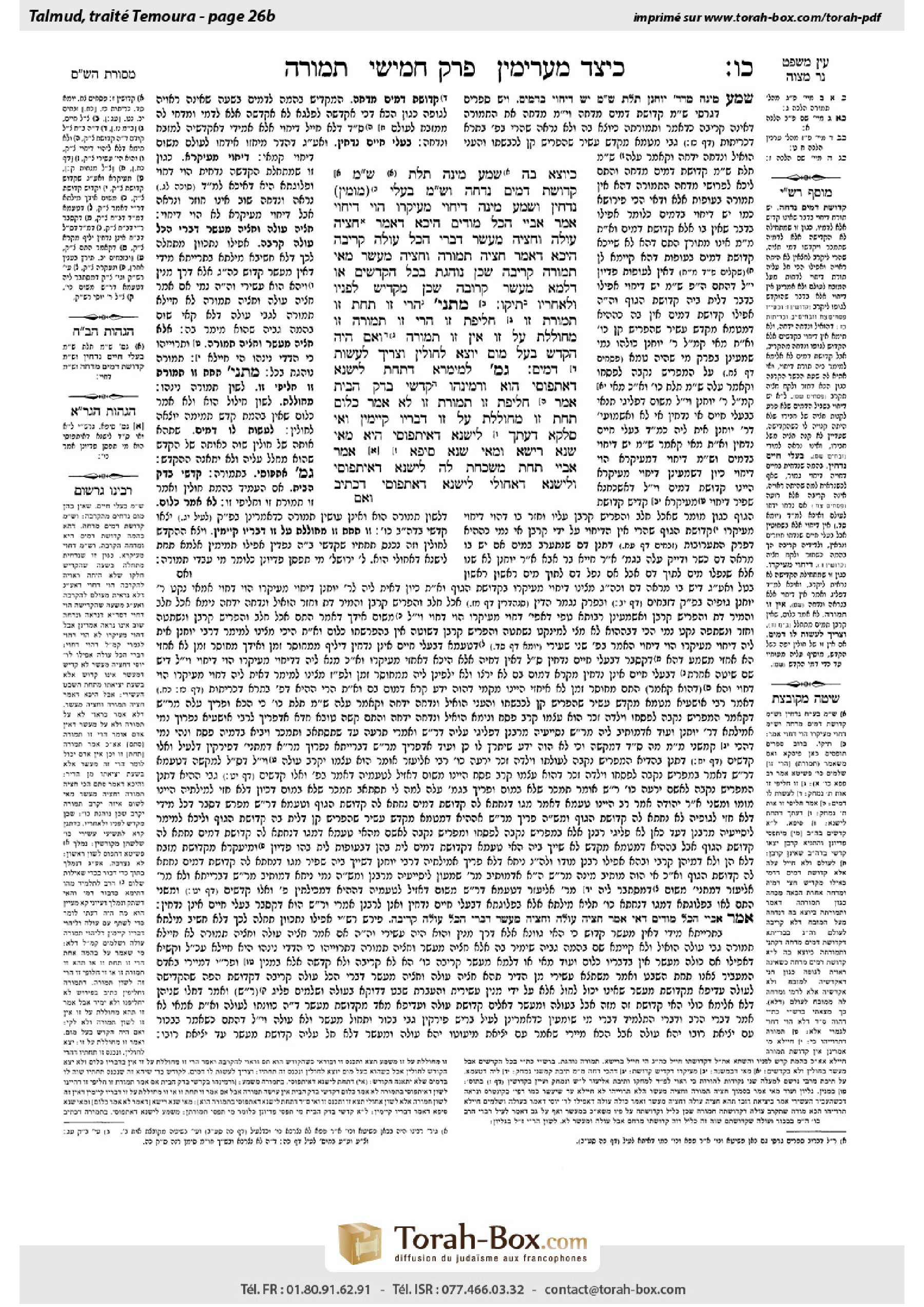
Temurah 26b: Talmud study for Daf Yomi
Daf Yomi is the daily study of one Talmud folio. Explore 37 tractates with scans, Hebrew text, Sefaria English and AI-generated French translations where annotated.
Passage selection and English or AI-generated French translation are available where the scan has annotations. Daf Study is independent of Torah-Box and Sefaria.
Browse Temurah · תמורה · All tractatesTemurah 26b text and translations
This page of Temurah includes the Aramaic text, an English translation and an AI-generated French translation, alongside the scan above.
תמורה כ״ו ב · Aramaic and Hebrew text
כַּיּוֹצֵא בָּהּ. שְׁמַע מִינָּה תְּלָת: שְׁמַע מִינָּה קְדוּשַּׁת דָּמִים (נִדְחָה) [מְדַחָה].
וּשְׁמַע מִינָּה, בַּעֲלֵי (מוּמִין) [חַיִּים] נִדְחִין, וּשְׁמַע מִינַּהּ דִּיחוּי מֵעִיקָּרוֹ הָוֵי דִּיחוּי.
אָמַר אַבָּיֵי: הַכֹּל מוֹדִים הֵיכָא דְּאָמַר ״חֶצְיָהּ עוֹלָה וְחֶצְיָהּ מַעֲשֵׂר״ — דִּבְרֵי הַכֹּל עוֹלָה קְרֵיבָה.
הֵיכָא דְּאָמַר ״חֶצְיָהּ תְּמוּרָה וְחֶצְיָהּ מַעֲשֵׂר״, מַאי?
תְּמוּרָה קְרֵיבָה, שֶׁכֵּן נוֹהֶגֶת בְּכׇל הַקֳּדָשִׁים, אוֹ דִלְמָא מַעֲשֵׂר קְרֵיבָה, שֶׁכֵּן מַקְדִּישׁ לְפָנָיו וּלְאַחֲרָיו? תֵּיקוּ.
מַתְנִי׳ ״הֲרֵי זוֹ תַּחַת זוֹ״, ״תְּמוּרַת זוֹ״, ״חֲלִיפַת זוֹ״ — הֲרֵי זוֹ תְּמוּרָה. ״זוֹ מְחוּלֶּלֶת עַל זוֹ״ — אֵין זוֹ תְּמוּרָה.
וְאִם הָיָה הֶקְדֵּשׁ בַּעַל מוּם — יוֹצֵא לְחוּלִּין, וְצָרִיךְ לַעֲשׂוֹת דָּמִים.
גְּמָ׳ לְמֵימְרָא דְּתַחַת לִישָּׁנָא דְּאַתְפּוֹסֵי הוּא, וּרְמִינְהוּ: קׇדְשֵׁי בֶּדֶק הַבַּיִת, אָמַר ״חֲלִיפַת זוֹ״ ״תְּמוּרַת זוֹ״ — לֹא אָמַר כְּלוּם.
״תַּחַת זוֹ״, ״מְחוּלֶּלֶת עַל זוֹ״ — דְּבָרָיו קַיָּימִין.
וְאִי סָלְקָא דַעְתָּךְ לִישָּׁנָא דְּאִיתְּפוֹסֵי הִיא, מַאי שְׁנָא רֵישָׁא וּמַאי שְׁנָא סֵיפָא?
אָמַר אַבָּיֵי: ״תַּחַת״ מַשְׁכַּחַתְּ לַהּ לִישָּׁנָא דְּאִיתְּפוֹסֵי וְלִישָּׁנָא דְּאַחוֹלֵי. לִישָּׁנָא דְּאַתְפּוֹסֵי, דִּכְתִיב:
Temurah 26b · English translation
is treated like it, as it too is consecrated but not sacrificed. Conclude three halakhot from this statement of Rabbi Yoḥanan: Conclude from it that an animal that was consecrated with a sanctity that inheres in its value is deferred. One who consecrates only half an animal has consecrated that animal with a sanctity that inheres in its value but not with an inherent sanctity, as the animal cannot be sacrificed.
And second, conclude from it that not only can an offering that has already been slaughtered become permanently deferred from the altar, but also living animals that cannot be sacrificed for whatever reason are permanently deferred. And finally, conclude from it that deferral at the outset, when the animal is first consecrated, is considered a permanent disqualification. Not only is an animal that was fit to be sacrificed when initially consecrated and only later disqualified permanently deferred, but the same applies to an animal that was disqualified from the outset, when it was initially consecrated, e.g., if only half of it was initially consecrated.
§ With regard to the consecration of an animal with two sanctities, Abaye said: Everyone concedes that in a case where one said: Half the animal is designated as a burnt offering and half of it is designated as an animal tithe, everyone agrees that this animal is consecrated and sacrificed entirely as a burnt offering, not as a tithed animal. The animal tithe is consecrated when it is the tenth of a group of animals that are passed underneath a rod, which is not the case here.
But in a case where one said with regard to his non-sacred animal: Half of this animal is designated as a substitute and half of it is designated as an animal tithe, which consecration takes effect? Both consecrations are invalid: Consecration as a substitute is valid when a consecrated animal is standing before the substitute, which is not the case here, and consecration as an animal tithe is valid through the process of passing a group of animals underneath a rod. What is the status of the animal in this case?
The Gemara explains the dilemma: Is the animal sacrificed as a substitute, as the sanctity of substitution applies to all sacrificial animals? Or perhaps the animal is sacrificed as an animal tithe, as the consecration of the animal tithe is more comprehensive, since if one mistakenly counted the ninth animal to pass underneath the rod as the tenth or the eleventh as the tenth, he consecrates those animals that passed before and after the tenth. The Gemara states that the dilemma shall stand unresolved.
MISHNA: This mishna discusses the language that serves to effect substitution. If one said: This non-sacred animal is hereby in place of that consecrated animal, or if he said: It is the substitute of that consecrated animal, or if one said: It is the exchange for that consecrated animal, that non-sacred animal is a substitute. If he said: This consecrated animal is desacralized, with its sanctity transferred to that non-sacred animal, that non-sacred animal is not a substitute.
And if the consecrated animal was blemished, and he said: This consecrated animal is desacralized, with its sanctity transferred to that non-sacred animal, the consecrated animal is desacralized and assumes non-sacred status, by Torah law. By rabbinic law, the owner is required to conduct an appraisal to ascertain the relative value of the two animals. If the consecrated animal was worth more than the non-sacred animal, he must pay the difference to the Temple treasury.
GEMARA: The mishna teaches that if one said: This non-sacred animal is hereby in place of that consecrated animal, that non-sacred animal is a substitute. The Gemara asks: Is this to say that the phrase: In place of [taḥat], is a term that indicates the associating of one sanctity with another, i.e., the transference of substitution? And the Gemara raises a contradiction from a baraita: In a case where one’s non-sacred animal was standing before a consecrated animal belonging to Temple maintenance, and he said: This non-sacred animal is hereby the exchange for that consecrated animal, or if he said: It is the substitute of that consecrated animal, he has not said anything, as these terms indicate the transfer of sanctity via substitution, and substitution does not apply to consecrated animals belonging to the Temple maintenance.
But if he said: This non-sacred animal is hereby in place of [taḥat] that consecrated animal, or if he said: This consecrated animal is desacralized, with its sanctity transferred to that non-sacred animal, his statement takes effect, as these terms indicate desacralization, and a consecrated animal belonging to the Temple maintenance can be desacralized, with its sanctity transferred to a non-sacred animal.
The Gemara explains the apparent contradiction: And if it enters your mind that the term taḥat is a term that indicates the associating of one sanctity with another, and therefore it effects substitution, as taught in the mishna, what is different in the first clause of the baraita, which states that the terms exchange and substitute are terms that do not effect desacralization, and what is different in the latter clause of the baraita, which teaches that the term taḥat effects desacralization despite the fact that it indicates substitution?
Abaye said, in response: You find that the term: In place of [taḥat], is sometimes a term that indicates the associating of one sanctity with another, and it is sometimes a term that indicates desacralization. It is a term that indicates the associating of one sanctity with another, as it is written:
Temurah 26b · Traduction française (IA)
est traité comme lui, car lui aussi est consacré, mais n’est pas sacrifié. On peut tirer trois halakhot de cette déclaration de Rabbi Yoḥanan. Premièrement, un animal consacré avec une sainteté qui porte sur sa valeur est définitivement écarté. Celui qui ne consacre que la moitié d’un animal lui confère une sainteté qui porte sur sa valeur, mais non une sainteté intrinsèque, puisque l’animal ne peut pas être sacrifié.
Deuxièmement, on peut en conclure que non seulement une offrande déjà abattue peut être définitivement écartée de l’autel, mais aussi que les animaux vivants qui ne peuvent être sacrifiés, pour quelque raison que ce soit, sont définitivement écartés. Enfin, on peut en conclure qu’une mise à l’écart dès le départ, au moment où l’animal est consacré pour la première fois, est considérée comme une disqualification permanente. Un animal apte au sacrifice lors de sa consécration initiale, mais disqualifié seulement par la suite, est définitivement écarté ; il en va de même d’un animal disqualifié dès le départ, au moment de sa consécration initiale, par exemple lorsqu’on n’en a consacré que la moitié.
§ Concernant la consécration d’un animal sous deux statuts de sainteté, Abayé a dit : tous reconnaissent que, si quelqu’un dit : « La moitié de cet animal est désignée comme holocauste et l’autre moitié comme animal de la dîme », l’animal entier est consacré et sacrifié comme holocauste, et non comme animal de la dîme. En effet, un animal ne reçoit le statut d’animal de la dîme que lorsqu’il est le dixième d’un groupe d’animaux que l’on fait passer sous une baguette, ce qui n’est pas le cas ici.
Mais si quelqu’un dit au sujet de son animal non consacré : « La moitié de cet animal est désignée comme substitut et l’autre moitié comme animal de la dîme », laquelle de ces consécrations prend effet ? Aucune des deux : le statut de substitut ne s’applique que lorsqu’un animal consacré se trouve devant l’animal qui lui est substitué, ce qui n’est pas le cas ici ; et le statut d’animal de la dîme ne s’applique que par le procédé consistant à faire passer un groupe d’animaux sous une baguette. Quel est donc le statut de cet animal ?
La Guemara expose le dilemme : l’animal est-il sacrifié comme substitut, puisque la sainteté du substitut s’applique à tous les animaux destinés au sacrifice ? Ou bien est-il sacrifié comme animal de la dîme, puisque la consécration de l’animal de la dîme a une portée plus large : si quelqu’un compte par erreur le neuvième animal qui passe sous la baguette comme étant le dixième, ou le onzième comme étant le dixième, il consacre également les animaux passés avant et après le dixième. La Guemara laisse le dilemme sans solution.
MICHNA : Cette Michna traite des termes qui entraînent une substitution. Si quelqu’un dit : « Cet animal non consacré est désormais à la place de cet animal consacré », ou : « Il est le substitut de cet animal consacré », ou encore : « Il est l’échange de cet animal consacré », l’animal non consacré devient un substitut. Mais s’il dit : « Cet animal consacré est désacralisé, sa sainteté étant transférée à cet animal non consacré », ce dernier ne devient pas un substitut.
Si l’animal consacré était atteint d’un défaut et que quelqu’un ait dit : « Cet animal consacré est désacralisé, sa sainteté étant transférée à cet animal non consacré », l’animal consacré est désacralisé et acquiert le statut d’un animal non consacré selon la Torah. En vertu du droit rabbinique, le propriétaire doit faire procéder à une estimation afin de déterminer la valeur respective des deux animaux. Si l’animal consacré valait plus que l’animal non consacré, il doit verser la différence au Trésor du Temple.
GUEMARA : La Michna enseigne que si quelqu’un dit : « Cet animal non consacré est désormais à la place de cet animal consacré », l’animal non consacré devient un substitut. La Guemara demande : Faut-il en déduire que l’expression « à la place de » [taḥat] désigne l’association d’une sainteté à une autre, c’est-à-dire le transfert par substitution ? La Guemara oppose à cela une baraïta : si l’animal non consacré d’une personne se trouve devant un animal consacré appartenant au Trésor du Temple et qu’elle dise : « Cet animal non consacré est désormais l’échange de cet animal consacré », ou : « Il est le substitut de cet animal consacré », elle n’a rien dit, car ces termes désignent le transfert de sainteté par substitution, or la substitution ne s’applique pas aux animaux consacrés appartenant au Trésor du Temple.
Mais si elle dit : « Cet animal non consacré est désormais à la place de [taḥat] cet animal consacré », ou : « Cet animal consacré est désacralisé, sa sainteté étant transférée à cet animal non consacré », sa déclaration prend effet, car ces termes désignent une désacralisation ; or un animal consacré appartenant au Trésor du Temple peut être désacralisé, sa sainteté étant transférée à un animal non consacré.
La Guemara explique la contradiction apparente : si l’on envisage que le terme taḥat désigne l’association d’une sainteté à une autre et entraîne donc une substitution, comme l’enseigne la Michna, en quoi la première partie de la baraïta, qui affirme que les termes « échange » et « substitut » n’entraînent pas de désacralisation, diffère-t-elle de la dernière partie, qui enseigne que le terme taḥat entraîne une désacralisation, alors même qu’il désigne une substitution ?
Abayé répond : le terme « à la place de » [taḥat] désigne parfois l’association d’une sainteté à une autre, et parfois une désacralisation. Il désigne l’association d’une sainteté à une autre, comme il est écrit :
Traduction française générée par IA à partir de l’édition anglaise de Sefaria. Vérifie toujours un passage avec le texte source.
Text from Sefaria: William Davidson Edition - Vocalized Aramaic (CC BY NC); William Davidson Edition - English (CC BY NC).