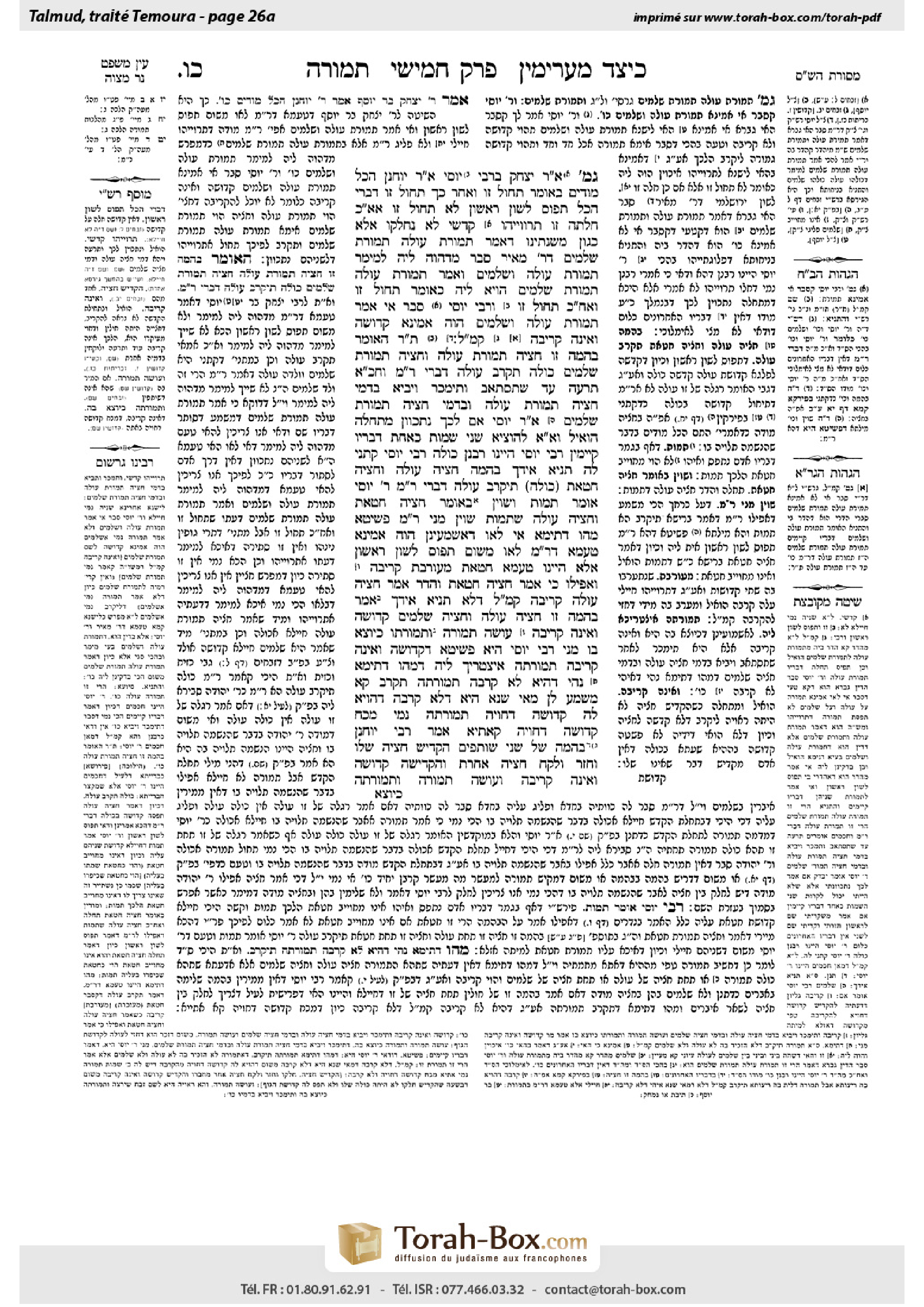
Temurah 26a: Talmud study for Daf Yomi
Daf Yomi is the daily study of one Talmud folio. Explore 37 tractates with scans, Hebrew text, Sefaria English and AI-generated French translations where annotated.
Passage selection and English or AI-generated French translation are available where the scan has annotations. Daf Study is independent of Torah-Box and Sefaria.
Browse Temurah · תמורה · All tractatesTemurah 26a text and translations
This page of Temurah includes the Aramaic text, an English translation and an AI-generated French translation, alongside the scan above.
תמורה כ״ו א · Aramaic and Hebrew text
גְּמָ׳ אָמַר רַבִּי יִצְחָק בְּרַבִּי יוֹסֵי אָמַר רַבִּי יוֹחָנָן: הַכֹּל מוֹדִים בְּאוֹמֵר ״תָּחוּל זוֹ״ וְאַחַר כָּךְ ״תָּחוּל זוֹ״ — דִּבְרֵי הַכֹּל תְּפוֹס לָשׁוֹן רִאשׁוֹן.
״לֹא תָּחוּל זוֹ אֶלָּא אִם כֵּן חָלְתָה זוֹ״ — תַּרְוַויְיהוּ קָדְשִׁי.
לֹא נֶחְלְקוּ אֶלָּא כְּגוֹן מִשְׁנָתֵינוּ, דְּאָמַר ״תְּמוּרַת עוֹלָה תְּמוּרַת שְׁלָמִים״, דְּרַבִּי מֵאִיר סָבַר: מִדַּהֲוָה לֵיהּ לְמֵימַר ״תְּמוּרַת עוֹלָה וּשְׁלָמִים״, וְאָמַר ״תְּמוּרַת עוֹלָה תְּמוּרַת שְׁלָמִים״ — הָוְיָא לֵיהּ כְּאוֹמֵר ״תָּחוּל זוֹ וְאַחַר כָּךְ תָּחוּל זוֹ״.
וְרַבִּי יוֹסֵי סָבַר, אִי אָמַר ״תְּמוּרַת עוֹלָה וּשְׁלָמִים״, הֲוָה אָמֵינָא קְדוֹשָׁה וְאֵינָהּ קְרֵיבָה, קָא מַשְׁמַע לַן.
תָּנוּ רַבָּנַן: הָאוֹמֵר ״בְּהֵמָה זוֹ חֶצְיָהּ תְּמוּרַת עוֹלָה וְחֶצְיָהּ תְּמוּרַת שְׁלָמִים״ — כּוּלָּהּ תִּקְרַב עוֹלָה, דִּבְרֵי רַבִּי מֵאִיר. וַחֲכָמִים אוֹמְרִים: תִּרְעֶה עַד שֶׁתִּסְתָּאֵב, וְתִימָּכֵר, וְיָבִיא בִּדְמֵי חֶצְיָהּ תְּמוּרַת עוֹלָה וּבִדְמֵי חֶצְיָהּ תְּמוּרַת שְׁלָמִים.
אָמַר רַבִּי יוֹסֵי: אִם לְכָךְ נִתְכַּוֵּון מִתְּחִלָּה, הוֹאִיל וְאִי אֶפְשָׁר לְהוֹצִיא שְׁנֵי שֵׁמוֹת כְּאַחַת — דְּבָרָיו קַיָּימִין. רַבִּי יוֹסֵי הַיְינוּ רַבָּנַן! כּוּלָּהּ רַבִּי יוֹסֵי קָתָנֵי לַהּ.
תַּנְיָא אִידַּךְ: ״בְּהֵמָה, חֶצְיָהּ עוֹלָה וְחֶצְיָהּ חַטָּאת״ — כּוּלָּהּ תִּיקְרַב עוֹלָה, דִּבְרֵי רַבִּי מֵאִיר.
רַבִּי יוֹסֵי אוֹמֵר: תָּמוּת, וְשָׁוִין בְּאוֹמֵר ״חֶצְיָהּ חַטָּאת וְחֶצְיָהּ עוֹלָה״ שֶׁתָּמוּת.
שָׁוִין — מַנִּי? רַבִּי מֵאִיר. פְּשִׁיטָא!
מַהוּ דְּתֵימָא: אִי לָאו דְּאַשְׁמְעִינַן, הֲוָה אָמֵינָא טַעְמָא דְּרַבִּי מֵאִיר לָאו מִשּׁוּם ״תְּפוֹס לָשׁוֹן רִאשׁוֹן״, אֶלָּא הַיְינוּ טַעְמָא — חַטָּאת מְעוֹרֶבֶת קְרֵיבָה.
וַאֲפִילּוּ כִּי אָמַר ״חֶצְיָהּ חַטָּאת״, וַהֲדַר אָמַר ״חֶצְיָהּ עוֹלָה״, קְרֵיבָה — קָא מַשְׁמַע לַן דְּלָא.
תַּנְיָא אִידַּךְ: אָמַר ״בְּהֵמָה זוֹ חֶצְיָהּ עוֹלָה וְחֶצְיָהּ שְׁלָמִים״ — קְדוֹשָׁה, וְאֵינָהּ קְרֵיבָה, עוֹשָׂה תְּמוּרָה, וּתְמוּרָתָהּ כַּיּוֹצֵא בָּהּ.
מַנִּי? רַבִּי יוֹסֵי הִיא, פְּשִׁיטָא דִּקְדוֹשָׁה וְאֵינָהּ קְרֵיבָה!
תְּמוּרָתָהּ אִיצְטְרִיךְ לֵיהּ, דְּמַהוּ דְּתֵימָא: נְהִי דְּהִיא לָא קָרְבָה — תְּמוּרָתָהּ תִּקְרַב, קָא מַשְׁמַע לַן. מַאי שְׁנָא הִיא דְּלָא קָרְבָה — דְּהָוְיָא לַהּ קְדוּשָּׁה דְּחוּיָה, תְּמוּרָתָהּ נָמֵי מִכֹּחַ קְדוּשָּׁה דְּחוּיָה קָאָתְיָא.
אָמַר רַבִּי יוֹחָנָן: בְּהֵמָה שֶׁל שְׁנֵי שׁוּתָּפִים, הִקְדִּישׁ חֶצְיָהּ שֶׁלּוֹ, וְחָזַר וְלָקַח חֶצְיָהּ אַחֶרֶת וְהִקְדִּישָׁהּ — קְדוֹשָׁה וְאֵינָהּ קְרֵיבָה, וְעוֹשֶׂה תְּמוּרָה, וּתְמוּרָתָהּ
Temurah 26a · English translation
GEMARA: Rabbi Yitzḥak, son of Rabbi Yosei, says that Rabbi Yoḥanan says, with regard to the disagreement between Rabbi Meir and Rabbi Yosei: Everyone concedes in a case where one says: The consecration of this animal as a substitute for a burnt offering will take effect and afterward the consecration of this animal as a substitute for a peace offering will take effect. In this case, everyone agrees that one attends only to the first statement, i.e., the sanctity of the burnt offering takes effect but the sanctity of the peace offering does not take effect.
Likewise, everyone agrees that in a case where one says: Consecration of this animal as a substitute for a burnt offering shall not take effect unless the consecration of this animal as a substitute for a peace offering shall also take effect, the animal is consecrated as both a burnt offering and a peace offering.
Rabbi Meir and Rabbi Yosei disagree only with regard to a case such as the one in our mishna, where one said: This animal is the substitute of the burnt offering, the substitute of the peace offering. As Rabbi Meir holds: Since if he wanted both sanctities to take effect, he should have said: The substitute of the burnt offering and the peace offering, but instead he said: The substitute of the burnt offering, the substitute of the peace offering, he is considered like one who says: The consecration of this animal as a substitute for a burnt offering will take effect and afterward the consecration of this animal as a substitute for a peace offering will take effect. Therefore, according to Rabbi Meir only the first sanctity takes effect; the second sanctity cannot take effect because the animal is already consecrated.
And Rabbi Yosei holds that from the outset he intended for both sanctities to take effect, and he did not say: The substitute of the burnt offering and the peace offering, because he reasoned that if he said that, one would say that he intends for the animal to be consecrated with two sanctities, half as a substitution of the burnt offering and half as a substitution of the peace offering. And if so, the animal cannot be sacrificed in the Temple, because it is impossible to sacrifice half the animal as one type of offering and half as another type of offering. Therefore, Rabbi Yosei teaches us that when he says: The substitute of the burnt offering the substitute of the peace offering, he intends for the animal to be both entirely a burnt offering and entirely a peace offering, as he mistakenly thinks that such an animal can be sacrificed in the Temple. But since he intended for both types of sanctity to take effect, the animal is half a burnt offering and half a peace offering.
§ The Sages taught in a baraita: In the case of one who had two animals standing before him, one a burnt offering and one a peace offering, and he said with regard to one of his non-sacred animals: This animal, half of it is the substitute of the burnt offering, and half of it is the substitute of the peace offering, that animal is the substitute of the burnt offering and is therefore entirely sacrificed as a burnt offering. This is the statement of Rabbi Meir. And the Rabbis say: It is left to graze until it becomes blemished, and then it is sold, and the owner brings a substitute burnt offering with the payment for half the animal and a substitute peace offering with the payment for half the animal.
The baraita concludes: Rabbi Yosei said: If that was his intent from the outset, then since it is impossible to call two designations simultaneously, his statement stands, and the animal is half a burnt offering and half a peace offering. The Gemara objects: The opinion of Rabbi Yosei is identical to the opinion of the Rabbis. The Gemara explains: Rabbi Yosei taught the entire baraita, and the opinion of the Rabbis in the baraita is Rabbi Yosei’s opinion.
It is taught in another baraita: In a case where one says: This animal, half of it is designated as a burnt offering and half of it is designated as a sin offering, Rabbi Meir holds that we attend only to the first statement that he uttered, and therefore half of the animal becomes consecrated as a burnt offering. Since the animal cannot live if half of its body were removed, the sanctity spreads to the entire animal and it is sacrificed entirely as a burnt offering. This is the statement of Rabbi Meir.
Rabbi Yosei says: Both sanctities take effect, and as an animal cannot be sacrificed as two offerings, it must be left to die. The baraita adds: And Rabbi Meir and Rabbi Yosei agree in a case where one says: Half of this animal is designated as a sin offering and half of it is designated as a burnt offering, that the animal must be left to die.
The Gemara clarifies: That case with regard to which the baraita states that Rabbi Meir and Rabbi Yosei agree, who is conceding to whom? Clearly Rabbi Meir concedes to Rabbi Yosei that in that case the halakha is that the animal must be left to die. The Gemara asks: Isn’t it obvious that Rabbi Meir concedes in that case? Just as in the first case of the baraita where one mentioned the burnt offering first and the sin offering second, Rabbi Meir holds that only the first expression takes effect, so too if one mentioned the sin offering first and the burnt offering second, only the first expression takes effect; this means that the animal is a sin offering, and therefore it must be left to die, as he is not obligated to bring a sin offering.
The Gemara explains that the ruling of the baraita is necessary, lest you say: If it hadn’t taught us the opinion of Rabbi Meir in the latter case, I would say that the reason for the ruling of Rabbi Meir in the first clause of the mishna is not that we attend only to the first statement. Rather, I would say that this is Rabbi Meir’s reason: In a case of the sanctity of a sin offering that is mixed with another sanctity in the same animal, the animal is sacrificed, and that is the reason Rabbi Meir rules that the animal is sacrificed as a burnt offering despite the fact that the sanctity of a sin offering is also mixed with it.
And if that is Rabbi Meir’s reasoning, then even if one said: Half of this animal is designated as a sin offering, and then said: Half of it is designated as a burnt offering, the animal is sacrificed. Therefore, the baraita teaches us that this is not the reason for Rabbi Meir’s opinion. Rather, his ruling is due to the principle that we attend only to the first statement, and therefore Rabbi Meir and Rabbi Yosei agree in the latter clause of the baraita that the animal must be left to die.
It is taught in another baraita: In the case of one who said: This animal, half of it is designated as a burnt offering and half of it is designated as a peace offering, the animal is consecrated but is not sacrificed. The animal grazes until it becomes blemished, at which point it is sold, and the owner brings a burnt offering with the money of half the animal and a peace offering with the money of half the animal. This animal renders a non-sacred animal that it is exchanged for consecrated as a substitute, and its substitute is treated like it, i.e., it is not sacrificed; rather, it grazes until it becomes blemished, and it is then sold, and the owner brings a burnt offering with the money of half the animal and a peace offering with the money of half the animal.
The Gemara asks: In accordance with whose opinion is the baraita taught? It is in accordance with the opinion of Rabbi Yosei, who holds one accountable for both expressions that he uttered. The Gemara asks: Isn’t it obvious that Rabbi Yosei holds that in that case the animal is consecrated but is not sacrificed? Why is it necessary to teach this?
The Gemara answers: It was necessary for the baraita to teach that its substitute is also not sacrificed. Lest you say: Granted that the animal itself is not sacrificed, but its substitute is sacrificed, therefore the baraita teaches us that the substitute is also not sacrificed. The Gemara explains the ruling of the baraita: What is different about the animal itself, that it is not sacrificed? It is not sacrificed because its sanctity is deferred from the altar, since it is neither entirely a burnt offering nor fully a peace offering. So too its substitute, whose sanctity comes from the force of deferred sanctity, as it was the substitution of an animal whose sanctity was deferred, may not be sacrificed either.
§ Rabbi Yoḥanan says: With regard to an animal that belongs to two partners, if one of the partners consecrated his half of the animal, and then he acquired the other half of the animal from his partner and consecrated it, the animal is consecrated but is not sacrificed. When he originally consecrated his half of the animal, the animal was not fit for sacrifice, as only half of it was consecrated. Although the animal is now fully consecrated, it can never again become fit for sacrifice, since it was once disqualified. And this animal renders a non-sacred animal that it is exchanged for it consecrated as a substitute, and its substitute
Temurah 26a · Traduction française (IA)
GUEMARA : Rabbi Yitzḥak, fils de Rabbi Yosei, rapporte au nom de Rabbi Yoḥanan, au sujet du désaccord entre Rabbi Meïr et Rabbi Yosei : tous reconnaissent que, si quelqu’un dit : « La consécration de cet animal comme substitut d’un holocauste prendra effet, puis celle de cet animal comme substitut d’un sacrifice de paix prendra effet », on ne tient compte que de la première déclaration ; autrement dit, la sainteté de l’holocauste prend effet, mais pas celle du sacrifice de paix.
De même, tous reconnaissent que, si quelqu’un dit : « La consécration de cet animal comme substitut d’un holocauste ne prendra effet que si celle de cet animal comme substitut d’un sacrifice de paix prend également effet », l’animal est consacré à la fois comme holocauste et comme sacrifice de paix.
Rabbi Meïr et Rabbi Yosei ne sont en désaccord que dans un cas comme celui de notre Michna, où quelqu’un dit : « Cet animal est le substitut de l’holocauste, le substitut du sacrifice de paix. » Rabbi Meïr considère que, s’il avait voulu que les deux saintetés prennent effet, il aurait dû dire : « Le substitut de l’holocauste et du sacrifice de paix. » Mais puisqu’il a dit : « Le substitut de l’holocauste, le substitut du sacrifice de paix », il est considéré comme ayant dit : « La consécration de cet animal comme substitut d’un holocauste prendra effet, puis celle de cet animal comme substitut d’un sacrifice de paix prendra effet. » Par conséquent, selon Rabbi Meïr, seule la première sainteté prend effet ; la seconde ne peut prendre effet, puisque l’animal est déjà consacré.
Rabbi Yosei considère, lui, qu’il avait dès le départ l’intention que les deux saintetés prennent effet. Il n’a pas dit : « Le substitut de l’holocauste et du sacrifice de paix », car il pensait que, s’il disait cela, on comprendrait qu’il entend consacrer l’animal sous deux saintetés, pour moitié comme substitut de l’holocauste et pour moitié comme substitut du sacrifice de paix. Or, dans ce cas, l’animal ne pourrait pas être sacrifié dans le Temple, puisqu’il est impossible d’en sacrifier une moitié comme un type d’offrande et l’autre moitié comme un autre type d’offrande. Rabbi Yosei nous enseigne donc que, lorsqu’il dit : « Le substitut de l’holocauste, le substitut du sacrifice de paix », il entend que l’animal soit entièrement un holocauste et entièrement un sacrifice de paix, croyant à tort qu’un tel animal peut être sacrifié dans le Temple. Mais, puisqu’il entendait que les deux types de sainteté prennent effet, l’animal est pour moitié un holocauste et pour moitié un sacrifice de paix.
§ Les Sages ont enseigné dans une baraïta : si un homme a devant lui deux animaux, l’un destiné à un holocauste et l’autre à un sacrifice de paix, et qu’il dit au sujet de l’un de ses animaux profanes : « Cet animal, pour moitié, est le substitut de l’holocauste et, pour moitié, le substitut du sacrifice de paix », l’animal devient le substitut de l’holocauste et est donc entièrement sacrifié comme holocauste. Telle est l’opinion de Rabbi Meïr. Les Sages disent : on le laisse paître jusqu’à ce qu’il devienne atteint d’un défaut, puis on le vend ; son propriétaire apporte alors un holocauste avec le produit de la vente correspondant à la moitié de l’animal et un sacrifice de paix avec le produit correspondant à l’autre moitié.
La baraïta conclut : Rabbi Yosei a dit : « Si telle était son intention dès le départ, alors, puisqu’il est impossible de prononcer simultanément deux désignations, sa déclaration est valable, et l’animal est pour moitié un holocauste et pour moitié un sacrifice de paix. » La Guemara objecte : l’opinion de Rabbi Yosei est identique à celle des Sages. La Guemara explique : Rabbi Yosei a enseigné toute la baraïta, et l’opinion des Sages qui y figure est celle de Rabbi Yosei.
Il est enseigné dans une autre baraïta : si quelqu’un dit : « Cet animal, pour moitié, est désigné comme holocauste et, pour moitié, comme sacrifice expiatoire », Rabbi Meïr considère qu’on ne tient compte que de la première déclaration prononcée ; par conséquent, la moitié de l’animal est consacrée comme holocauste. Puisque l’animal ne peut vivre si la moitié de son corps est retirée, la sainteté s’étend à l’animal entier, qui est sacrifié entièrement comme holocauste. Telle est l’opinion de Rabbi Meïr.
Rabbi Yosei dit : les deux saintetés prennent effet et, puisqu’un animal ne peut être sacrifié au titre de deux offrandes, il faut le laisser mourir. La baraïta ajoute : Rabbi Meïr et Rabbi Yosei reconnaissent que, si quelqu’un dit : « La moitié de cet animal est désignée comme sacrifice expiatoire et l’autre moitié comme holocauste », il faut laisser l’animal mourir.
La Guemara précise : dans ce cas où la baraïta indique que Rabbi Meïr et Rabbi Yosei sont d’accord, lequel des deux concède à l’autre ? Il est clair que Rabbi Meïr concède à Rabbi Yosei que, dans ce cas, la halakha veut que l’animal soit laissé à mourir. La Guemara demande : n’est-il pas évident que Rabbi Meïr concède dans ce cas ? De même que, dans le premier cas de la baraïta, où l’on a mentionné l’holocauste en premier et le sacrifice expiatoire en second, Rabbi Meïr considère que seule la première expression prend effet, si l’on mentionne le sacrifice expiatoire en premier et l’holocauste en second, seule la première expression prend également effet. Cela signifie que l’animal est un sacrifice expiatoire et qu’il faut donc le laisser mourir, puisque son propriétaire n’est pas tenu d’apporter un sacrifice expiatoire.
La Guemara explique que la décision de la baraïta est nécessaire, de crainte que l’on dise : si elle ne nous avait pas enseigné l’opinion de Rabbi Meïr dans le dernier cas, j’aurais dit que, dans la première clause de la Michna, Rabbi Meïr ne décide pas ainsi parce qu’on ne tient compte que de la première déclaration. J’aurais plutôt dit que son raisonnement est le suivant : lorsqu’une sainteté de sacrifice expiatoire est mêlée à une autre sainteté dans un même animal, l’animal est sacrifié. C’est pourquoi Rabbi Meïr décide que l’animal est sacrifié comme holocauste, bien que la sainteté d’un sacrifice expiatoire soit également mêlée à la sienne.
Et si tel était le raisonnement de Rabbi Meïr, alors, même si quelqu’un disait : « La moitié de cet animal est désignée comme sacrifice expiatoire », puis ajoutait : « La moitié de cet animal est désignée comme holocauste », l’animal serait sacrifié. La baraïta nous enseigne donc que ce n’est pas la raison de l’opinion de Rabbi Meïr. Sa décision repose plutôt sur le principe selon lequel on ne tient compte que de la première déclaration ; ainsi, dans le dernier cas de la baraïta, Rabbi Meïr et Rabbi Yosei sont d’accord qu’il faut laisser l’animal mourir.
Il est enseigné dans une autre baraïta : si quelqu’un dit : « Cet animal, pour moitié, est désigné comme holocauste et, pour moitié, comme sacrifice de paix », l’animal est consacré, mais il n’est pas sacrifié. On le laisse paître jusqu’à ce qu’il devienne atteint d’un défaut ; il est alors vendu, et son propriétaire apporte un holocauste avec le produit de la vente correspondant à la moitié de l’animal et un sacrifice de paix avec le produit correspondant à l’autre moitié. Cet animal rend consacré comme substitut l’animal profane contre lequel il est échangé, et son substitut est traité comme lui, c’est-à-dire qu’il n’est pas sacrifié ; on le laisse plutôt paître jusqu’à ce qu’il devienne atteint d’un défaut, puis on le vend, et son propriétaire apporte un holocauste avec le produit de la vente correspondant à la moitié de l’animal et un sacrifice de paix avec le produit correspondant à l’autre moitié.
La Guemara demande : selon l’opinion de qui cette baraïta est-elle enseignée ? Elle suit l’opinion de Rabbi Yosei, qui tient quelqu’un pour responsable des deux expressions qu’il a prononcées. La Guemara demande : n’est-il pas évident que, selon Rabbi Yosei, dans ce cas, l’animal est consacré mais n’est pas sacrifié ? Pourquoi est-il nécessaire de l’enseigner ?
La Guemara répond : la baraïta devait enseigner que son substitut non plus n’est pas sacrifié. De crainte que tu dises : « Certes, l’animal lui-même n’est pas sacrifié, mais son substitut, lui, l’est », la baraïta nous enseigne que le substitut n’est pas non plus sacrifié. La Guemara explique la décision de la baraïta : pourquoi l’animal lui-même n’est-il pas sacrifié ? Parce que sa sainteté est écartée de l’autel, puisqu’il n’est ni entièrement un holocauste ni entièrement un sacrifice de paix. De même, son substitut, dont la sainteté découle de cette sainteté écartée — puisqu’il remplace un animal dont la sainteté a été écartée —, ne peut pas non plus être sacrifié.
§ Rabbi Yoḥanan dit : au sujet d’un animal appartenant à deux associés, si l’un des associés consacre sa moitié de l’animal, puis acquiert auprès de son associé l’autre moitié et la consacre, l’animal est consacré, mais il n’est pas sacrifié. Lorsqu’il a consacré sa moitié de l’animal au départ, celui-ci n’était pas apte au sacrifice, puisque seule la moitié en était consacrée. Même si l’animal est maintenant entièrement consacré, il ne pourra jamais plus être apte au sacrifice, car il a déjà été disqualifié. Cet animal rend consacré comme substitut l’animal profane contre lequel il est échangé, et son substitut
Traduction française générée par IA à partir de l’édition anglaise de Sefaria. Vérifie toujours un passage avec le texte source.
Text from Sefaria: William Davidson Edition - Vocalized Aramaic (CC BY NC); William Davidson Edition - English (CC BY NC).