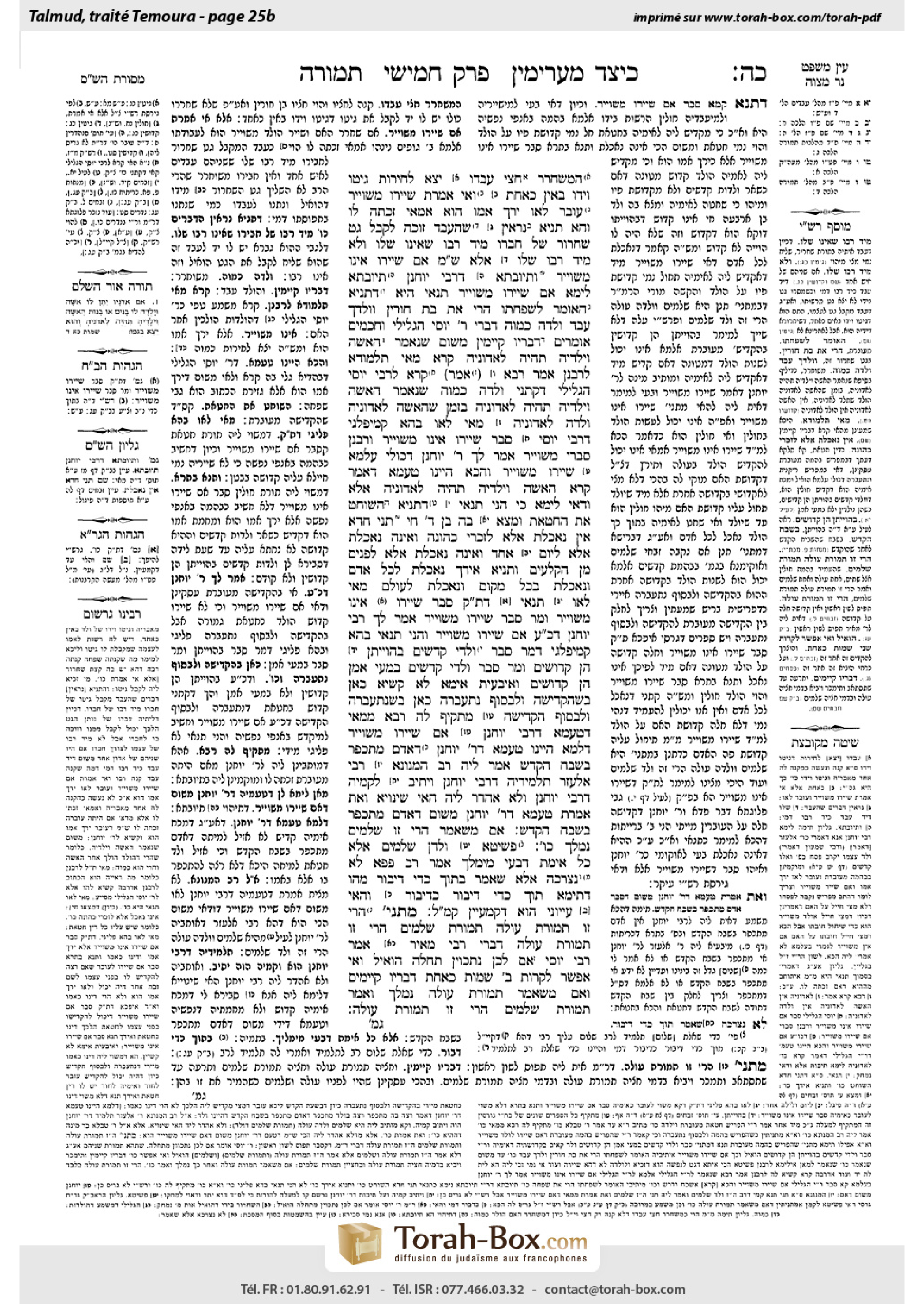
Temurah 25b: Talmud study for Daf Yomi
Daf Yomi is the daily study of one Talmud folio. Explore 37 tractates with scans, Hebrew text, Sefaria English and AI-generated French translations where annotated.
Passage selection and English or AI-generated French translation are available where the scan has annotations. Daf Study is independent of Torah-Box and Sefaria.
Browse Temurah · תמורה · All tractatesTemurah 25b text and translations
This page of Temurah includes the Aramaic text, an English translation and an AI-generated French translation, alongside the scan above.
תמורה כ״ה ב · Aramaic and Hebrew text
הַמְשַׁחְרֵר חֲצִי עַבְדּוֹ יָצָא לְחֵירוּת, גִּיטּוֹ וְיָדוֹ בָּאִין כְּאֶחָת.
וְאִי אָמְרַתְּ: שִׁיְּירוֹ מְשׁוּיָּיר, עוּבָּר לָאו יֶרֶךְ אִמּוֹ הוּא, אַמַּאי זָכְתָה לוֹ? וְהָא תַּנְיָא: נִרְאִין שֶׁהָעֶבֶד זוֹכֶה לְקַבֵּל גֵּט שִׁחְרוּר שֶׁל חֲבֵרוֹ מִיָּד רַבּוֹ שֶׁאֵינוֹ שֶׁלּוֹ, וְלֹא מִיַּד רַבּוֹ שֶׁלּוֹ. אֶלָּא שְׁמַע מִינָּה: אִם שִׁיְּירוֹ אֵינוֹ מְשׁוּיָּיר, וּתְיוּבְתָּא דְּרַבִּי יוֹחָנָן תְּיוּבְתָּא.
לֵימָא אִם שִׁיְּירוֹ מְשׁוּיָּיר תַּנָּאֵי הִיא? דְּתַנְיָא: הָאוֹמֵר לְשִׁפְחָתוֹ ״הֲרֵי אַתְּ בַּת חוֹרִין וּוְלָדֵךְ עֶבֶד״ — וְלָדָהּ כָּמוֹהָ, דִּבְרֵי רַבִּי יוֹסֵי הַגְּלִילִי. וַחֲכָמִים אוֹמְרִים: דְּבָרָיו קַיָּימִין, מִשּׁוּם שֶׁנֶּאֱמַר ״הָאִשָּׁה וִילָדֶיהָ תִּהְיֶה לַאדוֹנֶיהָ״.
קְרָא מַאי תַּלְמוּדָא לְרַבָּנַן? אָמַר רָבָא: אָמַר קְרָא לְרַבִּי יוֹסֵי הַגְּלִילִי, דְּקָתָנֵי וְלָדָהּ כָּמוֹהָ, שֶׁנֶּאֱמַר: ״הָאִשָּׁה וִילָדֶיהָ תִּהְיֶה לַאדוֹנֶיהָ״ — בִּזְמַן שֶׁהָאִשָּׁה לַאֲדוֹנֶיהָ, וְלָדָהּ לַאֲדוֹנֶיהָ.
מַאי לַָאו בְּהָא קָמִיפַּלְגִי, דְּרַבִּי יוֹסֵי סָבַר: שִׁיְּירוֹ — אֵינוֹ מְשׁוּיָּיר, וְרַבָּנַן סָבְרִי: מְשׁוּיָּיר?
אָמַר לָךְ רַבִּי יוֹחָנָן: דְּכוּלֵּי עָלְמָא שִׁיְּירוֹ — מְשׁוּיָּיר, וְהָכָא הַיְינוּ טַעְמָא דְּאָמַר קְרָא ״הָאִשָּׁה וִילָדֶיהָ תִּהְיֶה לַאֲדוֹנֶיהָ״.
אֶלָּא וַדַּאי לֵימָא כִּי הָנֵי תַּנָּאֵי, דְּתַנְיָא: הַשּׁוֹחֵט אֶת הַחַטָּאת וּמָצָא בָּהּ בֶּן אַרְבָּעָה חַי, תָּנֵי חֲדָא: אֵין נֶאֱכֶלֶת אֶלָּא לְזִכְרֵי כְהוּנָּה, וְאֵינָהּ נֶאֱכֶלֶת אֶלָּא לְיוֹם אֶחָד, וְאֵינָהּ נֶאֱכֶלֶת אֶלָּא לִפְנִים מִן הַקְּלָעִים.
וְתַנְיָא אִידַּךְ: נֶאֱכֶלֶת לְכׇל אָדָם, וְנֶאֱכֶלֶת בְּכׇל מָקוֹם, וְנֶאֱכֶלֶת לְעוֹלָם.
מַאי לָאו תַּנָּאֵי, דְּתַנָּא קַמָּא סָבַר: ״שִׁיְּירוֹ״ — אֵינוֹ מְשׁוּיָּיר, וּמָר סָבַר: ״שִׁיְּירוֹ״ — מְשׁוּיָּיר.
אָמַר לָךְ רַבִּי יוֹחָנָן: דְּכוּלֵּי עָלְמָא אִם שִׁיְּירוֹ — מְשׁוּיָּיר, וְהָנֵי תַּנָּאֵי בְּהָא קָמִיפַּלְגִי, דְּמָר סָבַר: וַלְדֵי קָדָשִׁים בַּהֲוָיָיתָן הֵן קְדוֹשִׁים, וּמָר סָבַר: וַלְדֵי קָדָשִׁים בִּמְעֵי אִמָּן הֵן קְדוֹשִׁים.
וְאִיבָּעֵית אֵימָא: לָא קַשְׁיָא, כָּאן — בְּשֶׁהִקְדִּישָׁהּ וּלְבַסּוֹף נִתְעַבְּרָה,
כָּאן — בְּשֶׁנִּתְעַבְּרָה וּלְבַסּוֹף הִקְדִּישָׁהּ.
מַתְקֵיף לַהּ רָבָא: מִמַּאי דְּטַעְמָא דְּרַבִּי יוֹחָנָן אִם שִׁיְּירוֹ מְשׁוּיָּיר? דִלְמָא הַיְינוּ טַעְמָא דְּרַבִּי יוֹחָנָן דְּאָדָם מִתְכַּפֵּר בְּשֶׁבַח הֶקְדֵּשׁ.
אֲמַר לֵיהּ רַב הַמְנוּנָא: רַבִּי אֶלְעָזָר תַּלְמִידֵיהּ דְּרַבִּי יוֹחָנָן, וְיָתֵיב לְקַמֵּיהּ דְּרַבִּי יוֹחָנָן, וְלָא אַהְדַּר לֵיהּ הַאי שִׁינּוּיָא, וְאַתְּ אָמְרַתְּ טַעְמָא דְּרַבִּי יוֹחָנָן מִשּׁוּם דְּאָדָם מִתְכַּפֵּר בְּשֶׁבַח הֶקְדֵּשׁ?!
אִם מִשֶּׁאָמַר ״הֲרֵי זוֹ שְׁלָמִים״ נִמְלַךְ כּוּ׳. פְּשִׁיטָא וְלָדָן שְׁלָמִים, אֶלָּא כֹּל אֵימַת דְּבָעֵי מִימְּלֵךְ?
אָמַר רַב פָּפָּא: לֹא נִצְרְכָה אֶלָּא שֶׁאָמַר בְּתוֹךְ כְּדֵי דִּיבּוּר, מַהוּ דְּתֵימָא תּוֹךְ כְּדֵי דִיבּוּר כְּדִיבּוּר, וְהַאי עַיּיוֹנֵי הוּא דְּקָמְעַיֵּין — קָא מַשְׁמַע לַן.
מַתְנִי׳ ״הֲרֵי זוֹ תְּמוּרַת עוֹלָה תְּמוּרַת שְׁלָמִים״ — הֲרֵי זוֹ תְּמוּרַת עוֹלָה, דִּבְרֵי רַבִּי מֵאִיר.
אָמַר רַבִּי יוֹסֵי: אִם לְכֵן נִתְכַּוֵּין תְּחִלָּה, הוֹאִיל וְאִי אֶפְשָׁר לִקְרוֹת שְׁנֵי שֵׁמוֹת כְּאַחַת — דְּבָרָיו קַיָּימִים, וְאִם מִשֶּׁאָמַר ״תְּמוּרַת עוֹלָה״ נִמְלַךְ וְאָמַר ״תְּמוּרַת שְׁלָמִים״ — הֲרֵי זוֹ תְּמוּרַת עוֹלָה.
Temurah 25b · English translation
With regard to a master who emancipates half of his slave, half of the slave is emancipated, and he is a half-slave half-freeman. Although a slave does not have the ability to acquire items, in this case he does acquire his freedom because his bill of manumission and his ability to acquire himself come at the same time.
But if you say that if one reserved a consecration it is considered reserved, and a fetus is not considered the thigh of its mother, but the mother and the fetus are separate entities, why does the mother acquire freedom for the fetus in a case where the master freed the fetus but not the mother? The Gemara continues: And isn’t it taught in a baraita: It appears to be the case that a slave can acquire a bill of manumission for another slave from the hand of his fellow’s master who is not also his own master, but not from the hand of his own master, i.e., not if both of them are enslaved to the same person. Here too, how can the mother receive the bill of manumission for the fetus from the hand of their shared master? Rather, conclude from it that if he reserved a consecration it is not considered reserved, and the refutation of the opinion of Rabbi Yoḥanan is indeed a conclusive refutation.
The Gemara suggests: Shall we say that the claim that if one reserved a consecration it is reserved is subject to a dispute between tanna’im? As it is taught in a baraita: With regard to one who says to his pregnant Canaanite maidservant: You are hereby a free woman but your offspring shall remain a slave, the offspring is emancipated like her. This is the statement of Rabbi Yosei HaGelili. And the Rabbis say: His statement is upheld. This is because it is stated: “The woman and her children shall be her master’s” (Exodus 21:4).
The Gemara expresses surprise at this ruling: What is the derivation of the verse here that indicates support for the opinion of the Rabbis, who rule in this case that the child of a freed maidservant remains a slave? Rava said: The verse does not support the opinion of the Rabbis; rather, the verse that the baraita states is cited as support for the opinion of Rabbi Yosei HaGelili, as it teaches, i.e., the baraita should be understood as follows: The offspring is emancipated like her, as it is stated: “The woman and her children shall be her master’s,” which indicates that when the woman belongs to the master her offspring likewise belongs to the master, but if the woman is freed the offspring is also freed.
What, is it not correct to say that the Sages disagree over this point, that Rabbi Yosei HaGelili holds that if he reserved it, it is not considered reserved, and therefore the mother and the fetus are treated as one entity, and the Rabbis maintain that it is considered reserved. If so, this would mean that Rabbi Yoḥanan’s opinion is the subject of a dispute between tanna’im.
The Gemara rejects this suggestion: Rabbi Yoḥanan could have said to you that everyone holds that if he reserved it, it is considered reserved, and here this is the reason that Rabbi Yosei HaGelili rules that the offspring is freed with the mother, as Rabbi Yosei HaGelili himself explains: It is that the verse states: “The woman and her children shall be her master’s.” This verse teaches that the status of the offspring follows the status of the mother with regard to slavery, but not because the fetus is considered a part of its mother.
Rather, certainly we shall say that the opinion that if he reserved it, it is reserved, is subject to a dispute between these tanna’im, as it is taught that there are two baraitot that discuss the case of one who slaughters a sin offering, which is assumed to have been consecrated when it was pregnant, and he found a four-month-old fetus alive inside. It is taught in one baraita: The slaughter of the mother is also considered a slaughter with regard to the fetus, and therefore the fetus is considered a sin offering. This means that its meat is eaten only by males of the priesthood, and it is eaten only for one day, and it is eaten only inside the curtains. In the Tabernacle in the wilderness this area was surrounded by curtains. The corresponding area in the Temple is the courtyard.
And it is taught in another baraita: The slaughter of the mother is also considered a slaughter for the fetus to the extent that it permits it to be eaten, but the fetus is non-sacred, and therefore it may be eaten by any person, and may be eaten in any place, and may be eaten forever, with no time limit.
What, is it not correct to say that these tanna’im disagree over this point, that the first tanna holds: If he reserved it, it is not considered reserved, and therefore the mother and the fetus are considered one entity and the status of the mother applies to the fetus; and the Sage in the second baraita holds: If he reserved it, it is considered reserved, which means that the fetus is considered an independent entity and is non-sacred. If so, Rabbi Yoḥanan’s opinion is the subject of a dispute between tanna’im.
The Gemara rejects this suggestion: Rabbi Yoḥanan could say to you that everyone holds that if he reserved it, it is considered reserved, and therefore a person can consecrate an animal while reserving the fetus as non-sacred. And these tanna’im disagree over this following point: In the case of an animal that was consecrated as a sin offering and only then became pregnant, one Sage holds: The offspring of sacrificial animals become consecrated when they are born and come into being, and as that fetus which was found alive inside the mother was never born, it never became consecrated. And one Sage holds: The offspring of sacrificial animals become consecrated in the womb of their mother, which means that the fetus that was found alive inside the mother was already consecrated.
If you wish, say instead an alternative explanation of the dispute between these two baraitot: It is not difficult for Rabbi Yoḥanan. Everyone holds that if he reserved it, it is considered reserved, and everyone also maintains that offspring of sacrificial animals become consecrated when they are born. Rather, these two baraitot are discussing two different cases. Here, the second baraita is referring to a case where the owner consecrated the animal before it became pregnant and only afterward it became pregnant. Consequently, the offspring is non-sacred, as it was not in the womb when the mother was consecrated, and as it was never born, it was not consecrated at the moment of birth either.
By contrast, there, the first baraita is referring to a case where the animal first became pregnant and afterward the owner consecrated it. Since the owner did not reserve the fetus from the consecration of the mother, the fetus was consecrated as a sin offering together with the mother.
Rava objects to this claim: From where is it known that the reason for the opinion of Rabbi Yoḥanan is that if he reserved it, it is considered reserved? Perhaps Rabbi Yoḥanan maintains that if he reserved it, it is not considered reserved, and this is the reason for the ruling of Rabbi Yoḥanan: It is that one can achieve atonement with the offspring of a pregnant animal he set aside as a sin offering, as he maintains that a person can achieve atonement with the enhancement of consecrated property, and the fetus is considered an enhancement of consecrated property.
Rav Hamnuna said to Rava: Rabbi Elazar was the pupil of Rabbi Yoḥanan, and he sat before Rabbi Yoḥanan, and Rabbi Elazar assumed that the reason for the opinion of Rabbi Yoḥanan was that he held that if he reserved it, it is considered reserved, and he questioned Rabbi Yoḥanan himself about his statement based on that assumption. And Rabbi Yoḥanan did not answer him with this answer, i.e., that the real reason for his opinion is that a person can achieve atonement with an enhancement of consecrated property. And if so, how can you say that the reason for the opinion of Rabbi Yoḥanan is that a person can achieve atonement with the enhancement of consecrated property? Therefore, it must be that the reason for the opinion of Rabbi Yoḥanan is that he held that if he reserved it, it is considered reserved.
§ The mishna teaches: And if it was only after he said: This animal is hereby a peace offering, that he reconsidered and said: Its offspring is a burnt offering, that offspring is a peace offering, as before he reconsidered the offspring had already assumed the status of the offspring of a peace offering. The Gemara asks: If he reconsidered after saying: This animal is a peace offering, it is obvious that he cannot remove the status he already applied to the animal, and that the offspring remains a peace offering. Can one change his mind anytime that he wants?
Rav Pappa said: This halakha is necessary only in a case where he reconsidered and said: Its offspring is a burnt offering, within the time required for speaking a short phrase. Lest you say: The halakhic status of a pause that lasts less than the time required for speaking a short phrase is like that of continuous speech, and therefore the offspring is a burnt offering, and that time he was merely prolonging his thought but not changing his mind; consequently, the mishna teaches us that he changed his mind and it is not considered continuous speech.
MISHNA: If one had two animals standing before him, one a burnt offering and the other a peace offering, and he said with regard to a third, non-sacred animal: This animal is hereby the substitute of the burnt offering, the substitute of the peace offering, that animal is the substitute of the burnt offering. This is the statement of Rabbi Meir. Once he designated it as the substitute of the burnt offering, his initial statement takes effect and the animal assumes the sanctity of the burnt offering.
Rabbi Yosei said: If that was his intent from the outset, when he said that the animal is the substitute of the burnt offering, to state that the animal is also the substitute of the peace offering, then since it is impossible to call two designations simultaneously, i.e., one must first say one designation and then the other, his statement stands, and the animal is half a burnt offering and half a peace offering. And if it was only after he said: This animal is hereby the substitute of the burnt offering, that he reconsidered and said: The substitute of the peace offering, that entire animal is the substitute of the burnt offering.
Temurah 25b · Traduction française (IA)
À propos d’un maître qui affranchit la moitié de son esclave, la moitié de l’esclave est affranchie, et celui-ci devient à moitié esclave et à moitié homme libre. Bien qu’un esclave ne puisse pas acquérir de biens, dans ce cas, il acquiert sa liberté, car son acte d’affranchissement et sa capacité à s’acquérir lui-même prennent effet au même moment.
Mais si tu dis que lorsqu’on réserve une partie d’une consécration, cette partie est considérée comme réservée, et qu’un fœtus n’est pas considéré comme la cuisse de sa mère, mais que la mère et le fœtus sont des entités distinctes, pourquoi la mère acquiert-elle la liberté pour le fœtus dans le cas où le maître a affranchi le fœtus, mais pas la mère ? La Guemara poursuit : Et n’est-il pas enseigné dans une baraïta : Il semble qu’un esclave puisse acquérir un acte d’affranchissement pour un autre esclave auprès du maître de celui-ci, qui n’est pas également son propre maître, mais pas auprès de son propre maître, c’est-à-dire lorsque tous deux sont esclaves de la même personne. Ici aussi, comment la mère peut-elle recevoir l’acte d’affranchissement du fœtus de leur maître commun ? Conclus plutôt de là que lorsqu’on réserve une partie d’une consécration, cette partie n’est pas considérée comme réservée, et que la réfutation de l’opinion de Rabbi Yoḥanan est donc bel et bien concluante.
La Guemara suggère : Peut-on dire que la question de savoir si une partie réservée d’une consécration est considérée comme réservée fait l’objet d’un désaccord entre tannaïm ? Car il est enseigné dans une baraïta : Celui qui dit à sa servante cananéenne enceinte : « Tu es désormais une femme libre, mais ton enfant restera esclave », affranchit également l’enfant. Telle est l’opinion de Rabbi Yosei HaGelili. Et les Sages disent : Sa déclaration est maintenue. Car il est dit : « La femme et ses enfants seront à son maître » (Exode 21, 4).
La Guemara s’étonne de cette décision : En quoi le verset cité ici justifie-t-il l’opinion des Sages, qui statuent dans ce cas que l’enfant d’une servante affranchie reste esclave ? Rava dit : Le verset ne justifie pas l’opinion des Sages ; au contraire, le verset cité dans la baraïta appuie l’opinion de Rabbi Yosei HaGelili, comme l’enseigne la baraïta, c’est-à-dire qu’il faut comprendre ainsi : L’enfant est affranchi comme elle, car il est dit : « La femme et ses enfants seront à son maître », ce qui indique que lorsque la femme appartient au maître, son enfant lui appartient également, mais que si la femme est affranchie, son enfant l’est aussi.
N’est-il pas juste de dire que les Sages sont en désaccord sur ce point : Rabbi Yosei HaGelili considère que lorsqu’on réserve une partie, celle-ci n’est pas considérée comme réservée, et que la mère et le fœtus sont donc traités comme une seule entité, tandis que les Sages soutiennent qu’elle est considérée comme réservée ? Si tel est le cas, cela signifierait que l’opinion de Rabbi Yoḥanan fait l’objet d’un désaccord entre tannaïm.
La Guemara rejette cette suggestion : Rabbi Yoḥanan aurait pu te répondre que tous considèrent que lorsqu’on réserve une partie, celle-ci est considérée comme réservée, et que si Rabbi Yosei HaGelili statue ici que l’enfant est affranchi avec sa mère, c’est pour la raison qu’il explique lui-même : le verset dit : « La femme et ses enfants seront à son maître. » Ce verset enseigne que le statut de l’enfant suit celui de sa mère en matière d’esclavage, mais non que le fœtus est considéré comme une partie de sa mère.
Il faut plutôt dire, assurément, que la question de savoir si une partie réservée est considérée comme réservée fait l’objet d’un désaccord entre ces tannaïm. En effet, deux baraïtot traitent du cas où quelqu’un égorge un sacrifice expiatoire, supposé avoir été consacré alors qu’il était gestant, et trouve à l’intérieur un fœtus vivant âgé de quatre mois. Une baraïta enseigne : L’égorgement de la mère vaut également égorgement pour le fœtus, qui est donc considéré comme un sacrifice expiatoire. Cela signifie que sa viande ne peut être consommée que par des hommes parmi les prêtres, uniquement pendant un jour et uniquement à l’intérieur des tentures. Dans le Tabernacle du désert, cette zone était entourée de tentures. La zone correspondante dans le Temple est la cour.
Et une autre baraïta enseigne : L’égorgement de la mère vaut également égorgement pour le fœtus, dans la mesure où il permet de le manger ; toutefois, le fœtus n’est pas consacré et peut donc être mangé par n’importe qui, en tout lieu et sans limite de temps.
N’est-il pas juste de dire que ces tannaïm sont en désaccord sur ce point : le premier tanna considère que lorsqu’on réserve une partie, celle-ci n’est pas considérée comme réservée, et que la mère et le fœtus forment donc une seule entité, de sorte que le statut de la mère s’applique au fœtus ; tandis que le Sage de la seconde baraïta considère que lorsqu’on réserve une partie, celle-ci est considérée comme réservée, ce qui signifie que le fœtus est une entité indépendante et n’est pas consacré ? Si tel est le cas, l’opinion de Rabbi Yoḥanan fait l’objet d’un désaccord entre tannaïm.
La Guemara rejette cette suggestion : Rabbi Yoḥanan pourrait te répondre que tous considèrent que lorsqu’on réserve une partie, celle-ci est considérée comme réservée, et qu’une personne peut donc consacrer un animal tout en réservant le fœtus comme non consacré. Le désaccord entre ces tannaïm porte sur le point suivant : dans le cas d’un animal consacré comme sacrifice expiatoire, qui devient ensuite gestant, un Sage considère que la descendance des animaux consacrés est consacrée au moment de la naissance et de sa venue au monde ; comme le fœtus trouvé vivant à l’intérieur de la mère n’est jamais né, il n’a jamais été consacré. Un autre Sage considère que la descendance des animaux consacrés est consacrée dans le ventre de sa mère, ce qui signifie que le fœtus trouvé vivant dans le ventre de sa mère était déjà consacré.
Si tu le souhaites, donne plutôt une autre explication du désaccord entre ces deux baraïtot : cela ne pose pas de difficulté à Rabbi Yoḥanan. Tous considèrent qu’une partie réservée est considérée comme réservée, et tous estiment également que la descendance des animaux consacrés est consacrée au moment de la naissance. La seconde baraïta traite d’un cas où le propriétaire a consacré l’animal avant qu’il ne devienne gestant, et où celui-ci n’est devenu gestant qu’ensuite. Par conséquent, l’enfant n’est pas consacré, puisqu’il n’était pas dans le ventre de sa mère au moment où celle-ci a été consacrée ; et comme il n’est jamais né, il n’a pas non plus été consacré au moment de sa naissance.
En revanche, la première baraïta traite d’un cas où l’animal est d’abord devenu gestant, puis a été consacré par son propriétaire. Puisque celui-ci n’a pas réservé le fœtus lors de la consécration de la mère, le fœtus a été consacré comme sacrifice expiatoire avec sa mère.
Rava objecte à cette affirmation : D’où sait-on que la raison de l’opinion de Rabbi Yoḥanan est que lorsqu’on réserve une partie, celle-ci est considérée comme réservée ? Peut-être Rabbi Yoḥanan considère-t-il que lorsqu’on réserve une partie, celle-ci n’est pas considérée comme réservée, et que sa décision s’explique ainsi : on peut obtenir l’expiation grâce à la descendance d’un animal gestant que l’on a désigné comme sacrifice expiatoire, car il estime qu’on peut obtenir l’expiation grâce à l’accroissement d’un bien consacré, et que le fœtus est considéré comme un accroissement d’un bien consacré.
Rav Hamnuna dit à Rava : Rabbi Elazar était l’élève de Rabbi Yoḥanan et siégeait devant lui. Rabbi Elazar supposait que la raison de l’opinion de Rabbi Yoḥanan était que celui-ci considérait qu’une partie réservée était considérée comme réservée ; sur la base de cette supposition, il interrogea Rabbi Yoḥanan lui-même au sujet de sa déclaration. Or Rabbi Yoḥanan ne lui répondit pas que la véritable raison de son opinion était qu’on peut obtenir l’expiation grâce à l’accroissement d’un bien consacré. Dès lors, comment peux-tu dire que la raison de l’opinion de Rabbi Yoḥanan est qu’on peut obtenir l’expiation grâce à l’accroissement d’un bien consacré ? Il faut donc que la raison de son opinion soit qu’il considère qu’une partie réservée est considérée comme réservée.
§ La Michna enseigne : Et si ce n’est qu’après avoir dit : « Cet animal est désormais une offrande de paix » qu’il a changé d’avis et dit : « Sa descendance est un holocauste », cette descendance est une offrande de paix, car avant qu’il ne change d’avis, elle avait déjà acquis le statut de descendance d’une offrande de paix. La Guemara demande : S’il a changé d’avis après avoir dit : « Cet animal est une offrande de paix », il est évident qu’il ne peut pas retirer le statut qu’il a déjà attribué à l’animal et que sa descendance reste une offrande de paix. Peut-on changer d’avis quand on le souhaite ?
Rav Pappa dit : Cette halakha n’est nécessaire que dans le cas où il a changé d’avis et dit : « Sa descendance est un holocauste » dans le laps de temps nécessaire pour prononcer une courte phrase. De peur que tu dises que le statut halakhique d’une pause inférieure au temps nécessaire pour prononcer une courte phrase est celui d’une parole ininterrompue, et que la descendance est donc un holocauste, tandis qu’il ne faisait alors que prolonger sa pensée sans changer d’avis, la Michna nous enseigne qu’il a changé d’avis et que ce n’est pas considéré comme une parole ininterrompue.
MICHNA : Si quelqu’un avait devant lui deux animaux, l’un destiné à un holocauste et l’autre à une offrande de paix, et qu’il dit à propos d’un troisième animal non consacré : « Cet animal est désormais le substitut de l’holocauste, le substitut de l’offrande de paix », puis : « Cet animal est le substitut de l’holocauste », telle est l’opinion de Rabbi Meir. Dès qu’il l’a désigné comme substitut de l’holocauste, sa déclaration initiale prend effet et l’animal acquiert le statut sacré d’un holocauste.
Rabbi Yosei dit : Si telle était son intention dès le départ, lorsqu’il a dit que l’animal était le substitut de l’holocauste, à savoir que l’animal était également le substitut de l’offrande de paix, alors, puisqu’il est impossible d’énoncer deux désignations simultanément — il faut d’abord énoncer l’une, puis l’autre —, sa déclaration est valide, et l’animal est pour moitié un holocauste et pour moitié une offrande de paix. Et si ce n’est qu’après avoir dit : « Cet animal est désormais le substitut de l’holocauste » qu’il a changé d’avis et dit : « Le substitut de l’offrande de paix », l’animal entier est le substitut de l’holocauste.
Traduction française générée par IA à partir de l’édition anglaise de Sefaria. Vérifie toujours un passage avec le texte source.
Text from Sefaria: William Davidson Edition - Vocalized Aramaic (CC BY NC); William Davidson Edition - English (CC BY NC).