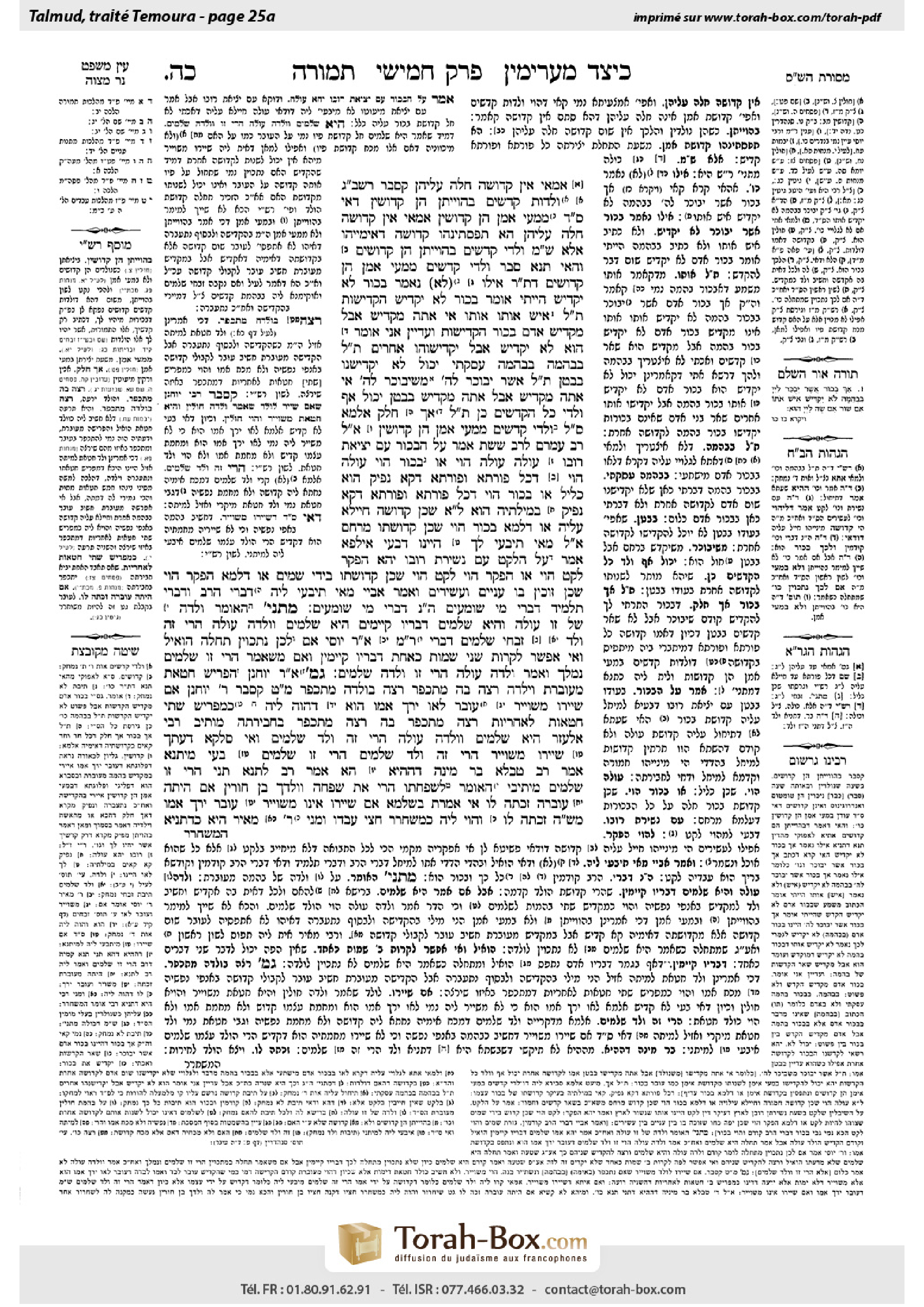
Temurah 25a: Talmud study for Daf Yomi
Daf Yomi is the daily study of one Talmud folio. Explore 37 tractates with scans, Hebrew text, Sefaria English and AI-generated French translations where annotated.
Passage selection and English or AI-generated French translation are available where the scan has annotations. Daf Study is independent of Torah-Box and Sefaria.
Browse Temurah · תמורה · All tractatesTemurah 25a text and translations
This page of Temurah includes the Aramaic text, an English translation and an AI-generated French translation, alongside the scan above.
תמורה כ״ה א · Aramaic and Hebrew text
אַמַּאי אֵין קְדוּשָּׁה חָלָה עֲלֵיהֶן? קָסָבַר רַבָּן שִׁמְעוֹן בֶּן גַּמְלִיאֵל: וַלְדוֹת קָדָשִׁים בַּהֲוָיָיתָן הֵן קְדוֹשִׁין, דְּאִי סָלְקָא דַעְתָּךְ מִמְּעֵי אִמָּן הֵן קְדוֹשִׁין — אַמַּאי אֵין קְדוּשָּׁה חָלָה עֲלֵיהֶן? הָא תְּפַסְתִּינְהוּ קְדוּשָּׁה דְּאִימַּיְיהוּ! אֶלָּא שְׁמַע מִינָּה: וַלְדֵי קָדָשִׁים בַּהֲוָיָיתָן הֵן קְדוֹשִׁים.
וְהַאי תַּנָּא סָבַר וַלְדֵי קָדָשִׁים מִמְּעֵי אִמָּן הֵן קְדוֹשִׁים, דְּתָנוּ רַבָּנַן: אִילּוּ לֹא נֶאֱמַר ״בְּכוֹר לֹא יַקְדִּישׁ״ הָיִיתִי אוֹמֵר בְּכוֹר לֹא יַקְדִּישׁ הֶקְדֵּישׁוֹת, תַּלְמוּד לוֹמַר ״אִישׁ אוֹתוֹ״ — אוֹתוֹ אִי אַתָּה מַקְדִּישׁ, אֲבָל מַקְדִּישׁ אָדָם בְּכוֹר הֶקְדֵּישׁוֹת.
וַעֲדַיִין אֲנִי אוֹמֵר: הוּא לֹא יַקְדִּישׁ, אֲבָל יַקְדִּישׁוּהוּ אֲחֵרִים. תַּלְמוּד לוֹמַר ״בִּבְהֵמָה״ — בִּבְהֵמָה עָסַקְתִּי.
יָכוֹל לֹא יַקְדִּישֶׁנּוּ בַּבֶּטֶן? תַּלְמוּד לוֹמַר ״אֲשֶׁר יְבֻכַּר לַה׳״ — מִשֶּׁיְּבוּכַּר לַה׳ אִי אַתָּה מַקְדִּישׁ, אֲבָל אַתָּה מַקְדִּישׁ בַּבֶּטֶן.
יָכוֹל אַף וַלְדֵי כׇּל הַקֳּדָשִׁים כֵּן, תַּלְמוּד לוֹמַר ״אַךְ״ — חָלַק, אַלְמָא סְבִירָא לֵיהּ וַלְדֵי קָדָשִׁים מִמְּעֵי אִמָּן הֵן קְדוֹשִׁין.
אֲמַר לֵיהּ רַב עַמְרָם לְרַב שֵׁשֶׁת: אָמַר עַל הַבְּכוֹר ״עִם יְצִיאַת רוּבּוֹ — עוֹלָה״, עוֹלָה הָוֵי אוֹ בְּכוֹר הָוֵי?
עוֹלָה הָוֵי, דְּכׇל פּוּרְתָּא וּפוּרְתָּא דְּקָא נָפֵיק הָוֵי כָּלִיל, אוֹ בְּכוֹר הָוֵי, דְּכׇל פּוּרְתָּא וּפוּרְתָּא דְּקָא נָפֵיק בְּמִילְּתֵיהּ הוּא?
לִישָּׁנָא אַחְרִינָא: שֶׁכֵּן קְדוּשָּׁה חָיְילָא עֲלֵיהּ, אוֹ דִלְמָא בְּכוֹר הָוֵי — שֶׁכֵּן קְדוּשָּׁתוֹ מֵרֶחֶם.
אֲמַר לֵיהּ: מַאי תִּיבְּעֵי לָךְ? הַיְינוּ דְּבָעֵי אִילְפָא: אָמַר עַל הַלֶּקֶט ״עִם נְשִׁירַת רוּבּוֹ — יְהֵא הֶפְקֵר״, לֶקֶט הָוֵי אוֹ הֶפְקֵר הָוֵי?
לֶקֶט הָוֵי, שֶׁכֵּן קְדוּשָּׁתוֹ בִּידֵי שָׁמַיִם, אוֹ דִלְמָא הֶפְקֵר הָוֵי, שֶׁכֵּן זוֹכִין בּוֹ עֲנִיִּים וַעֲשִׁירִים?
וְאָמַר אַבָּיֵי: מַאי תִּיבְּעֵי לֵיהּ? דִּבְרֵי הָרַב וְדִבְרֵי תַּלְמִיד — דִּבְרֵי מִי שׁוֹמְעִים? הָכִי נָמֵי: דִּבְרֵי מִי שׁוֹמְעִים?
מַתְנִי׳ הָאוֹמֵר ״וְלָדָהּ שֶׁל זוֹ עוֹלָה, וְהִיא שְׁלָמִים״ — דְּבָרָיו קַיָּימִים. ״הִיא שְׁלָמִים, וּוְלָדָהּ עוֹלָה״ — הֲרֵי זֶה וְלַד זִבְחֵי שְׁלָמִים, דִּבְרֵי רַבִּי מֵאִיר.
אָמַר רַבִּי יוֹסֵי: אִם לְכֵן נִתְכַּוֵּין תְּחִלָּה, הוֹאִיל וְאִי אֶפְשָׁר לִקְרוֹת שְׁנֵי שֵׁמוֹת כְּאַחַת — דְּבָרָיו קַיָּימִין, וְאִם מִשֶּׁאָמַר ״הֲרֵי זוֹ שְׁלָמִים״ נִמְלַךְ וְאָמַר ״וְלָדָהּ עוֹלָה״ — הֲרֵי זוֹ וְלָדָהּ שְׁלָמִים.
גְּמָ׳ אָמַר רַבִּי יוֹחָנָן: הִפְרִישׁ חַטָּאת מְעוּבֶּרֶת וְיָלְדָה — רָצָה בָּהּ מִתְכַּפֵּר, רָצָה בִּוְלָדָהּ מִתְכַּפֵּר.
מַאי טַעְמָא? קָסָבַר רַבִּי יוֹחָנָן: אִם שִׁיְּירוֹ — מְשׁוּיָּיר.
עוּבָּר לָאו יֶרֶךְ אִמּוֹ הוּא, דְּהָוֵה לֵיהּ כְּמַפְרִישׁ שְׁתֵּי חַטָּאוֹת לְאַחְרָיוּת — רָצָה מִתְכַּפֵּר בָּהּ, רָצָה מִתְכַּפֵּר בַּחֲבֶירְתָּהּ.
מוֹתֵיב רַבִּי אֶלְעָזָר: ״הִיא שְׁלָמִים וּוְלָדָהּ עוֹלָה״ — הֲרֵי זֶה וְלַד שְׁלָמִים, וְאִי סָלְקָא דַעְתָּךְ שִׁיְּירוֹ מְשׁוּיָּיר, ״הֲרֵי זֶה וְלַד שְׁלָמִים״ — ״הֲרֵי זוֹ שְׁלָמִים״ בָּעֵי מִיתְנָא!
אָמַר רַב טַבְלָא: בַּר מִינַּהּ דְּהַהִיא, הָא אָמַר רַב לְתַנָּא: תְּנִי ״הֲרֵי זוֹ שְׁלָמִים״.
מֵיתִיבִי: הָאוֹמֵר לְשִׁפְחָתוֹ ״הֲרֵי אֶת שִׁפְחָה, וּוְלָדֵךְ בֶּן חוֹרִין״, אִם הָיְתָה עוּבָּרָה — זָכְתָה לוֹ.
אִי אָמְרַתְּ בִּשְׁלָמָא אִם שִׁיְּירוֹ אֵינוֹ מְשׁוּיָּיר, עוּבָּר יֶרֶךְ אִמּוֹ, מִשּׁוּם הָכִי זָכְתָה לוֹ, וְהָוֵי לֵיהּ כִּמְשַׁחְרֵר חֲצִי עַבְדּוֹ. וּמַנִּי? רַבִּי מֵאִיר הִיא, כִּדְתַנְיָא:
Temurah 25a · English translation
The Gemara asks: Why aren’t they imbued with the sanctity of the mother? The Gemara answers: Rabban Shimon ben Gamliel holds that the offspring of sacrificial animals are imbued with sanctity only as they come into being, i.e., from the moment they are born. As, if it enters your mind that they are sanctified already in the womb of their mother, why are they not imbued with the sanctity of the mother? After all, the sanctity of their mother has taken hold of them. Rather, learn from it that the offspring of sacrificial animals are sanctified only as they come into being.
And this tanna disagrees with Rabban Shimon ben Gamliel and holds that the offspring of sacrificial animals are sanctified in the womb of their mother. As the Sages taught in a baraita: It is written with regard to a firstborn: “But the firstborn among animals, which is born as a firstling to the Lord, man shall not consecrate it” (Leviticus 27:26). If that verse were not complete but merely stated: The firstborn shall not consecrate, I would have said that the verse is teaching that a firstborn man shall not consecrate non-sacred items. Therefore, the verse states: “Man shall not consecrate it,” i.e., you may not consecrate it, a firstborn animal, but a firstborn man may consecrate non-sacred items.
But still, I would say that specifically a firstborn man may not consecrate a firstborn animal with a different sanctity, but others who are not firstborns may consecrate a firstborn animal. Therefore, the verse states: “Among animals,” indicating that I am dealing with firstborn animals, not firstborn men, i.e., the verse is teaching that all people are prohibited to consecrate a firstborn animal with a different sanctity that that of a firstborn.
The baraita continues: One might have thought that one also cannot consecrate the fetus of an animal pregnant with its firstborn while the fetus is still in the womb of its mother. Therefore, the verse states: “Which is born as a firstling to the Lord,” indicating that from the time the animal is born and consecrated to the Lord as a firstborn you cannot consecrate it with a different sanctity, but you may consecrate it with a different sanctity while it is still in the womb.
One might have thought that even with regard to the offspring of all other consecrated animals it is so, that one may consecrate them with a different sanctity when they are still in the womb. Therefore, the verse states: “But [akh],” which distinguished between a firstborn animal, which one may consecrate with a different sanctity while it is still in the womb, and the offspring of other consecrated animals, which one may not consecrate with a different sanctity even when they are in the womb. Evidently, this tanna holds that the offspring of sacrificial animals are sanctified in the womb of their mother.
§ The mishna teaches that one may employ artifice to circumvent the obligation to give the firstborn to the priest by consecrating the fetus as a burnt offering before the time of birth, which is the point at which the animal becomes sanctified as a firstborn. Rav Amram said to Rav Sheshet: If an owner said with regard to the fetus of an animal pregnant with its firstborn: This fetus will be consecrated as a burnt offering at the same time that the sanctity of the firstborn takes effect, which is when the majority of the animal leaves the womb, what is the status of the offspring? Is the offspring a burnt offering or is it a firstborn?
The Gemara explains the dilemma: Is it a burnt offering, as the sanctity of a burnt offering is more stringent than the sanctity of a firstborn and therefore each and every bit that exits the womb becomes a burnt offering, which is entirely consumed upon the altar? Or perhaps it is a firstborn, because normally the sanctity of the firstborn takes effect at the moment of birth, and therefore with regard to each and every bit of the animal that exits the womb, its status is that of a firstborn.
The Gemara cites another version of the explanation of the dilemma: Is it a burnt offering because it is imbued with the more stringent sanctity of a burnt offering? Or perhaps it is a firstborn because God declared its sanctity as a firstborn upon exiting from the womb.
Rav Sheshet said to Rav Amram: What is your dilemma? Your dilemma is the same as that dilemma which Ilfa raised: With regard to the gleanings left for the poor, which the wealthy may not take, if the owner of a field at the harvest time said: This grain that is now on the stalk will become ownerless property, meaning that even the wealthy can acquire it, at precisely the same time as the halakha of gleanings left for the poor takes effect, which is when the majority of the grain falls off the stalk, what is the status of the grain after it falls off the stalk? Is it gleanings left for the poor or is it ownerless property that even the wealthy may take?
The Gemara explains the dilemma: Is it gleanings, as its sanctity is dictated by the hand of Heaven at the moment that the grain falls off the stalk? Or perhaps it is ownerless property, because that status is more inclusive, as both the poor and the wealthy may acquire the grain.
And Abaye said in response to Ilfa’s dilemma: What is your dilemma? When there is a conflict between the statement of the Master, i.e., God, who commanded that the grain become gleanings for the poor, and the statement of the student, the one who declared the grain to be ownerless property that may be acquired even by the wealthy, to whose statement should one listen? So too, with regard to Rav Amram’s dilemma, when there is a conflict between the statement of God and the statement of the student, to whose statement should one listen? Accordingly, the fetus is consecrated with the sanctity of a firstborn, not that of a burnt offering.
MISHNA: One who says: The offspring of this non-sacred animal is a burnt offering and the animal itself is a peace offering, his statement stands, i.e., is effective. If he says: The animal itself is a peace offering and its offspring is a burnt offering, then since consecration of the mother preceded consecration of the offspring, it is the offspring of a peace offering, whose halakhic status is that of a peace offering; this is the statement of Rabbi Meir.
Rabbi Yosei said: If that was his intent from the outset, to designate the offspring as a burnt offering when he designated the mother as a peace offering, then since it is impossible to call it by two designations simultaneously, his statement stands, and the mother is a peace offering and the offspring a burnt offering. And if it was only after he said: This animal is hereby a peace offering, that he reconsidered and said: Its offspring is a burnt offering, that offspring is a peace offering, as before he reconsidered, the offspring had already assumed the status of the offspring of a peace offering.
GEMARA: Rabbi Yoḥanan says: In the case of one who separated a pregnant animal as a sin offering and that animal later gave birth to a female, both animals are consecrated as sin offerings. If he wishes he may achieve atonement by sacrificing the mother itself, and if he wishes he may achieve atonement by sacrificing the offspring. Since he consecrated the animal when it was already pregnant, his act of consecration took effect with regard to both the mother and the offspring.
What is the reason for this halakha? Rabbi Yoḥanan holds that in the case of one who consecrated a pregnant animal, if he reserved the fetus and designated it as non-sacred, e.g., he said: The fetus is non-sacred and the animal itself is designated as a sin offering, then the offspring is considered reserved and is non-sacred, despite the fact that the mother is consecrated.
The reason is that Rabbi Yoḥanan holds that a fetus is not considered the thigh, i.e., a part, of its mother. Therefore, just as one can reserve the fetus from being consecrated with its mother, so too, one can consecrate the fetus with a separate sanctity than that of the mother. Consequently, this case is like that of one who separates two sin offerings as a guarantee; if he wishes he may gain atonement with one of them, and if he wishes he may gain atonement with the other.
Rabbi Elazar raises an objection from the mishna: If one says: The animal itself is a peace offering and its offspring is a burnt offering, then it is the offspring of a peace offering. And if it enters your mind that if one reserved the fetus from the consecration of the mother it is considered reserved, and its sanctity is independent from that of the mother, why does the mishna state with regard to the offspring that it is the offspring of a peace offering, which indicates that it receives its sanctity from that of the mother? The mishna should teach that the offspring is a peace offering with an independent sanctity.
Rav Tavla said: The discussion of this topic should be held apart from this version of the mishna, as it is incorrect. Didn’t Rav say to the tanna who was reciting mishnayot that he should not recite the mishna with the phrase: It is the offspring of a peace offering, but rather, he should teach: It is a peace offering.
The Gemara raises another objection to Rabbi Yoḥanan’s statement from a baraita: One who says to his Canaanite maidservant: You are hereby still a maidservant but your unborn child is a freeman, and he writes a bill of manumission for the child and places it in her hand, if she was pregnant at that time, then she acquired freedom for the unborn child.
The Gemara explains the objection: Granted, if you say that if one reserved a certain consecration it is not considered reserved, and therefore the sanctity of the mother takes effect on her offspring, and likewise that a fetus is considered the thigh of its mother, it is due to that reason that she acquired freedom for the unborn child. And the explanation is that this case is like that of one who emancipates half of his slave, as that half is thereby emancipated. And whose opinion is this? It is the opinion of Rabbi Meir, as it is taught in a baraita:
Temurah 25a · Traduction française (IA)
La Guemara demande : Pourquoi ne sont-ils pas investis de la sainteté de leur mère ? La Guemara répond : Rabban Shimon ben Gamliel considère que les petits des animaux consacrés ne sont investis de sainteté qu’au moment où ils viennent au monde, c’est-à-dire dès leur naissance. En effet, si l’on pensait qu’ils sont déjà sanctifiés dans le ventre de leur mère, pourquoi ne sont-ils pas investis de la sainteté de leur mère ? Après tout, la sainteté de leur mère les a atteints. Il faut donc en conclure que les petits des animaux consacrés ne sont sanctifiés qu’au moment où ils viennent au monde.
Et ce tanna est en désaccord avec Rabban Shimon ben Gamliel et considère que les petits des animaux consacrés sont sanctifiés dans le ventre de leur mère. En effet, les Sages ont enseigné dans une baraïta : À propos du premier-né, il est écrit : « Mais le premier-né parmi les animaux, qui naît le premier pour le Seigneur, nul ne le consacrera » (Lévitique 27,26). Si le verset n’était pas formulé de manière complète et disait seulement : « Le premier-né ne consacrera pas », j’aurais dit qu’il enseigne qu’un homme premier-né ne peut pas consacrer des biens non consacrés. C’est pourquoi le verset précise : « Nul ne le consacrera », c’est-à-dire : tu ne peux pas le consacrer, lui, un animal premier-né, mais un homme premier-né peut consacrer des biens non consacrés.
Mais je pourrais encore dire que seul un homme premier-né ne peut pas consacrer un animal premier-né en lui attribuant une autre sainteté, tandis que ceux qui ne sont pas premiers-nés peuvent consacrer un animal premier-né. C’est pourquoi le verset précise : « Parmi les animaux », indiquant que le sujet est les animaux premiers-nés, et non les hommes premiers-nés ; autrement dit, le verset enseigne qu’il est interdit à toute personne de consacrer un animal premier-né en lui attribuant une sainteté différente de celle d’un premier-né.
La baraïta poursuit : On aurait pu penser qu’on ne peut pas non plus consacrer le fœtus d’un animal qui porte son premier-né, tant que celui-ci se trouve encore dans le ventre de sa mère. C’est pourquoi le verset précise : « Qui naît le premier pour le Seigneur », indiquant qu’à partir du moment où l’animal est né et consacré au Seigneur comme premier-né, on ne peut pas le consacrer en lui attribuant une autre sainteté, mais qu’on peut le faire tant qu’il est encore dans le ventre.
On aurait pu penser qu’il en va de même pour les petits de tous les autres animaux consacrés, et qu’on peut leur attribuer une autre sainteté alors qu’ils sont encore dans le ventre de leur mère. C’est pourquoi le verset précise : « Mais [akh] », distinguant ainsi un animal premier-né, auquel on peut attribuer une autre sainteté alors qu’il est encore dans le ventre, des petits des autres animaux consacrés, auxquels on ne peut pas attribuer une autre sainteté, même lorsqu’ils sont dans le ventre. Il apparaît donc que ce tanna considère que les petits des animaux consacrés sont sanctifiés dans le ventre de leur mère.
§ La Michna enseigne qu’on peut recourir à un subterfuge pour contourner l’obligation de donner le premier-né au prêtre, en consacrant le fœtus comme holocauste avant sa naissance, moment où l’animal devient saint en tant que premier-né. Rav Amram dit à Rav Sheshet : Si le propriétaire a dit à propos du fœtus d’un animal qui porte son premier-né : « Ce fœtus sera consacré comme holocauste au moment même où la sainteté du premier-né prend effet », c’est-à-dire lorsque la majeure partie de l’animal est sortie du ventre, quel est le statut du petit ? Est-il un holocauste ou un premier-né ?
La Guemara explique le dilemme : Est-ce un holocauste, parce que la sainteté d’un holocauste est plus rigoureuse que celle d’un premier-né et que, par conséquent, chaque parcelle qui sort du ventre devient un holocauste, entièrement consumé sur l’autel ? Ou peut-être est-ce un premier-né, car normalement la sainteté du premier-né prend effet au moment de la naissance ; ainsi, chaque parcelle de l’animal qui sort du ventre a le statut de premier-né.
La Guemara donne une autre formulation du dilemme : Est-ce un holocauste, parce qu’il est investi de la sainteté plus rigoureuse d’un holocauste ? Ou peut-être est-ce un premier-né, parce que Dieu a déclaré qu’il serait saint en tant que premier-né dès sa sortie du ventre.
Rav Sheshet dit à Rav Amram : Quel est ton dilemme ? C’est le même que celui soulevé par Ilfa : à propos des épis laissés aux pauvres, que les riches ne peuvent pas prendre, si le propriétaire d’un champ a dit, au moment de la moisson : « Ce grain qui se trouve maintenant sur la tige deviendra un bien sans propriétaire », de sorte que même les riches pourront l’acquérir, précisément au moment où la halakha des épis laissés aux pauvres prend effet, c’est-à-dire lorsque la majeure partie du grain tombe de la tige, quel est le statut du grain une fois tombé ? Est-ce un épi laissé aux pauvres ou un bien sans propriétaire que même les riches peuvent prendre ?
La Guemara explique le dilemme : Est-ce un épi laissé aux pauvres, puisque son statut est imposé par la main du Ciel au moment où le grain tombe de la tige ? Ou peut-être est-ce un bien sans propriétaire, car ce statut est plus inclusif, puisque les pauvres comme les riches peuvent acquérir le grain.
Et Abaye répondit au dilemme d’Ilfa : Quel est ton dilemme ? Lorsqu’il y a conflit entre la parole du Maître, c’est-à-dire Dieu, qui a ordonné que le grain devienne un épi laissé aux pauvres, et celle de l’élève, qui a déclaré que le grain serait un bien sans propriétaire pouvant être acquis même par les riches, à quelle parole faut-il obéir ? De même, dans le dilemme de Rav Amram, lorsqu’il y a conflit entre la parole de Dieu et celle de l’élève, à quelle parole faut-il obéir ? Par conséquent, le fœtus est consacré avec la sainteté du premier-né, et non avec celle d’un holocauste.
MICHNA : Celui qui dit : « Le petit de cet animal non consacré sera un holocauste et l’animal lui-même un sacrifice de paix », sa déclaration est valide, c’est-à-dire qu’elle prend effet. S’il dit : « L’animal lui-même sera un sacrifice de paix et son petit un holocauste », alors, puisque la consécration de la mère a précédé celle du petit, celui-ci est le petit d’un sacrifice de paix et a le statut halakhique d’un sacrifice de paix. Telle est l’opinion de Rabbi Meïr.
Rabbi Yossi dit : Si telle était son intention dès le départ, à savoir désigner le petit comme holocauste au moment où il a désigné la mère comme sacrifice de paix, alors, puisqu’il est impossible de lui attribuer deux désignations simultanément, sa déclaration prend effet : la mère est un sacrifice de paix et le petit un holocauste. Mais si ce n’est qu’après avoir dit : « Cet animal est désormais un sacrifice de paix » qu’il a changé d’avis et dit : « Son petit sera un holocauste », alors ce petit est un sacrifice de paix, car, avant qu’il ne change d’avis, le petit avait déjà acquis le statut de petit d’un sacrifice de paix.
GUEMARA : Rabbi Yoḥanan dit : Si quelqu’un a mis à part un animal gravide comme sacrifice expiatoire et que celui-ci a ensuite donné naissance à une femelle, les deux animaux sont consacrés comme sacrifices expiatoires. S’il le souhaite, il peut obtenir l’expiation en sacrifiant la mère elle-même ; s’il le souhaite, il peut l’obtenir en sacrifiant le petit. Puisqu’il a consacré l’animal alors qu’il était déjà gravide, son acte de consécration a pris effet à la fois pour la mère et pour le petit.
Quelle est la raison de cette halakha ? Rabbi Yoḥanan considère que, lorsqu’une personne a consacré un animal gravide, si elle a réservé le fœtus en le désignant comme non consacré — par exemple, si elle a dit : « Le fœtus est non consacré et l’animal lui-même est désigné comme sacrifice expiatoire » —, alors le petit est considéré comme ayant été réservé et n’est pas consacré, bien que sa mère soit consacrée.
La raison en est que Rabbi Yoḥanan considère qu’un fœtus n’est pas considéré comme la cuisse, c’est-à-dire une partie, de sa mère. Par conséquent, de même qu’on peut réserver le fœtus afin qu’il ne soit pas consacré avec sa mère, on peut aussi le consacrer avec une sainteté distincte de celle de sa mère. Ce cas est donc comparable à celui d’une personne qui met à part deux sacrifices expiatoires à titre de garantie : si elle le souhaite, elle peut obtenir l’expiation par l’un, et si elle le souhaite, par l’autre.
Rabbi Elazar soulève une objection à partir de la Michna : Si quelqu’un dit : « L’animal lui-même est un sacrifice de paix et son petit un holocauste », alors celui-ci est le petit d’un sacrifice de paix. Et si l’on pensait que, lorsqu’on réserve le fœtus à l’écart de la consécration de sa mère, il est considéré comme réservé et que sa sainteté est indépendante de celle de sa mère, pourquoi la Michna dit-elle que le petit est le petit d’un sacrifice de paix, ce qui indique qu’il reçoit sa sainteté de celle de sa mère ? La Michna devrait enseigner que le petit est un sacrifice de paix doté d’une sainteté indépendante.
Rav Tavla dit : Il faut écarter de cette discussion cette version de la Michna, car elle est incorrecte. Rav n’a-t-il pas dit au tanna qui récitait les Michnayot de ne pas réciter la Michna avec la formule : « Il est le petit d’un sacrifice de paix », mais plutôt d’enseigner : « Il est un sacrifice de paix » ?
La Guemara soulève une autre objection à l’encontre de l’affirmation de Rabbi Yoḥanan à partir d’une baraïta : Celui qui dit à sa servante cananéenne : « Tu restes une servante, mais ton enfant à naître est un homme libre », puis rédige un acte d’affranchissement pour l’enfant et le place dans la main de la servante, si celle-ci était enceinte à ce moment-là, a affranchi l’enfant à naître.
La Guemara explique l’objection : Il est cohérent de dire que, si l’on considère qu’une réserve de consécration n’est pas valable et que, par conséquent, la sainteté de la mère prend effet sur son petit, et si l’on considère aussi qu’un fœtus est comme la cuisse de sa mère, c’est pour cette raison que l’enfant à naître a été affranchi. Cela s’explique par le fait que ce cas est comparable à celui d’une personne qui affranchit la moitié de son esclave : cette moitié est alors affranchie. Et de qui est-ce l’opinion ? De Rabbi Meïr, comme l’enseigne une baraïta :
Traduction française générée par IA à partir de l’édition anglaise de Sefaria. Vérifie toujours un passage avec le texte source.
Text from Sefaria: William Davidson Edition - Vocalized Aramaic (CC BY NC); William Davidson Edition - English (CC BY NC).