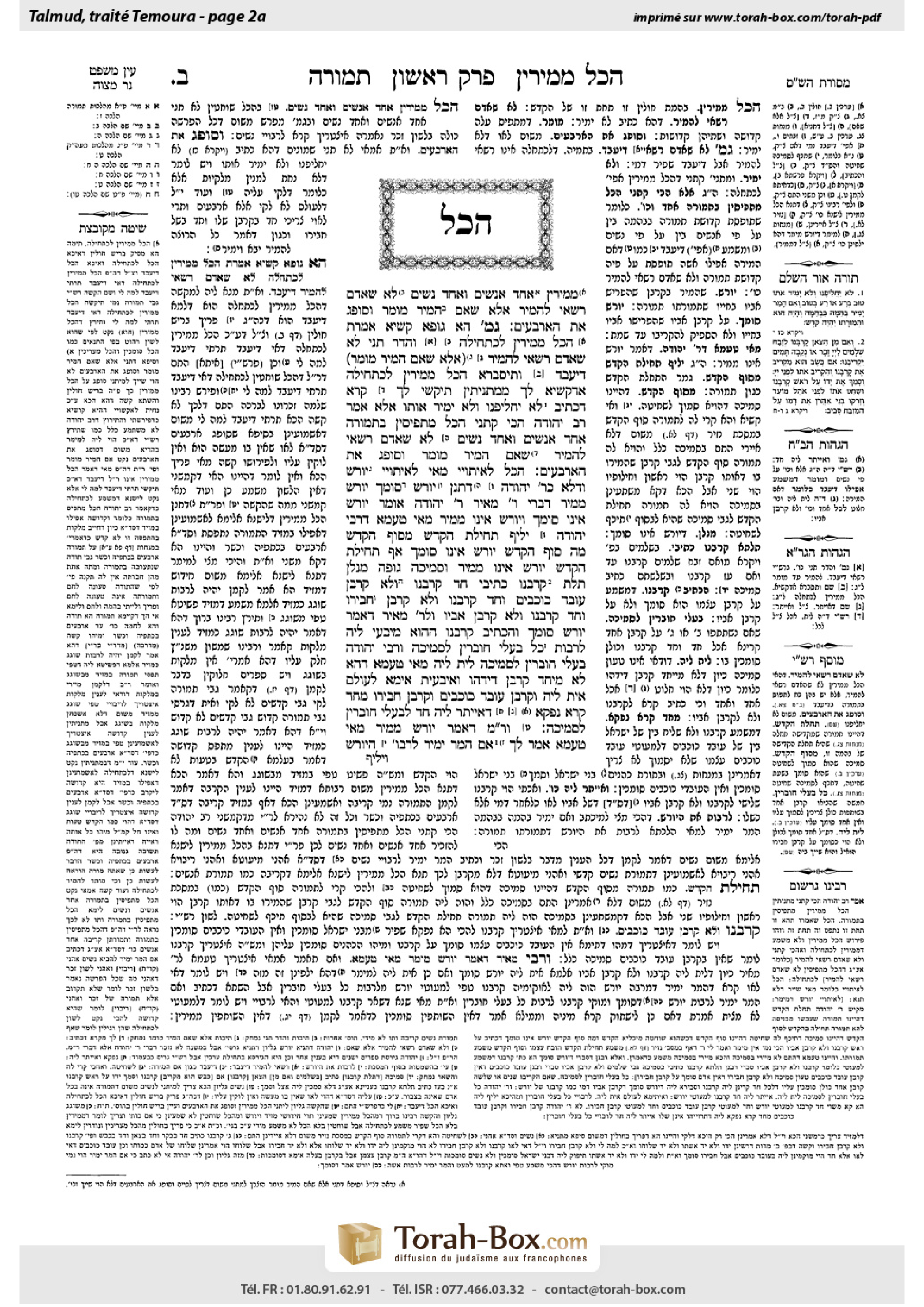
Temurah 2a: Talmud study for Daf Yomi
Daf Yomi is the daily study of one Talmud folio. Explore 37 tractates with scans, Hebrew text, Sefaria English and AI-generated French translations where annotated.
Passage selection and English or AI-generated French translation are available where the scan has annotations. Daf Study is independent of Torah-Box and Sefaria.
Browse Temurah · תמורה · All tractatesTemurah 2a text and translations
This page of Temurah includes the Aramaic text, an English translation and an AI-generated French translation, alongside the scan above.
תמורה ב׳ א · Aramaic and Hebrew text
מַתְנִי׳ הַכֹּל מְמִירִין, אֶחָד אֲנָשִׁים וְאֶחָד נָשִׁים. לֹא שֶׁאָדָם רַשַּׁאי לְהָמִיר, אֶלָּא שֶׁאִם הֵמִיר — מוּמָר, וְסוֹפֵג אֶת הָאַרְבָּעִים.
גְּמָ׳ הָא גוּפָא קַשְׁיָא: אָמְרַתְּ ״הַכֹּל מְמִירִין״ — לְכַתְּחִילָּה, וַהֲדַר תָּנֵי ״לֹא שֶׁאָדָם רַשַּׁאי לְהָמִיר אֶלָּא שֶׁאִם הֵמִיר מוּמָר״ — דִּיעֲבַד!
וְתִיסְבְּרָא ״הַכֹּל מְמִירִין״ — לְכַתְּחִילָּה? אַדְּקַשְׁיָא לָךְ מִמַּתְנִיתִין, תִּיקְשֵׁי לָךְ קְרָא! דִּכְתִיב ״לֹא יַחֲלִיפֶנּוּ וְלֹא יָמִיר אֹתוֹ״.
אֶלָּא אָמַר רַב יְהוּדָה: הָכִי קָתָנֵי — הַכֹּל מַתְפִּיסִין בִּתְמוּרָה, אֶחָד אֲנָשִׁים וְאֶחָד נָשִׁים, לֹא שֶׁאָדָם רַשַּׁאי לְהָמִיר, שֶׁאִם הֵמִיר — מוּמָר, וְסוֹפֵג אֶת הָאַרְבָּעִים.
הַכׇּל לְאֵיתוֹיֵי מַאי? לְאֵיתוֹיֵי יוֹרֵשׁ, וּדְלָא כְּרַבִּי יְהוּדָה.
דִּתְנַן: יוֹרֵשׁ סוֹמֵךְ, יוֹרֵשׁ מֵמִיר — דִּבְרֵי רַבִּי מֵאִיר. רַבִּי יְהוּדָה אוֹמֵר: יוֹרֵשׁ אֵינוֹ סוֹמֵךְ, וְיוֹרֵשׁ אֵינוֹ מֵמִיר.
מַאי טַעְמָא דְּרַבִּי יְהוּדָה? — יָלֵיף תְּחִילַּת הֶקְדֵּשׁ מִסּוֹף הֶקְדֵּשׁ: מָה סוֹף הֶקְדֵּשׁ — יוֹרֵשׁ אֵינוֹ סוֹמֵךְ, אַף תְּחִילַּת הֶקְדֵּשׁ — יוֹרֵשׁ אֵינוֹ מֵמִיר.
וּסְמִיכָה גּוּפַהּ מְנָלַן? תְּלָת ״קׇרְבָּנוֹ״ כְּתִיבִי: חַד — ״קׇרְבָּנוֹ״ וְלֹא קׇרְבַּן גּוֹי, וְחַד — ״קׇרְבָּנוֹ״ וְלֹא קׇרְבַּן חֲבֵירוֹ, וְחַד — ״קׇרְבָּנוֹ״ וְלֹא קׇרְבַּן אָבִיו.
וּלְרַבִּי מֵאִיר דְּאָמַר יוֹרֵשׁ סוֹמֵךְ, וְהָכְתִיב ״קׇרְבָּנוֹ״! הַהוּא מִיבְּעֵי לֵיהּ לְרַבּוֹת כׇּל בַּעֲלֵי חוֹבְרִין לִסְמִיכָה.
וְרַבִּי יְהוּדָה, בַּעֲלֵי חוֹבְרִין לִסְמִיכָה לֵית לֵיהּ. מַאי טַעְמָא? דְּהָא לָא מְיַחַד קׇרְבָּן דִּידְהוּ. וְאִיבָּעֵית אֵימָא: לְעוֹלָם אִית לֵיהּ, וְקׇרְבַּן גּוֹי וְקׇרְבַּן חֲבֵירוֹ מֵחַד קְרָא נָפְקָא, דְּאִיַּיתַּר לֵיהּ חַד לְבַעֲלֵי חוֹבְרִין לִסְמִיכָה.
וְרַבִּי מֵאִיר דְּאָמַר יוֹרֵשׁ מֵמִיר, מַאי טַעְמָא? אָמַר לָךְ: ״אִם הָמֵר יָמִיר״ לְרַבּוֹת הַיּוֹרֵשׁ,
Temurah 2a · English translation
MISHNA: Everyone substitutes a non-sacred animal for a consecrated animal, both men and women. That is not to say that it is permitted for a person to effect substitution; rather, it means that if one substituted a non-sacred animal for a consecrated animal, the substitution takes effect, and the non-sacred animal becomes consecrated, and the consecrated animal remains sacred. And the one who substituted the non-sacred animal incurs the forty [sofeg et ha’arba’im] lashes.
GEMARA: The Gemara notes an apparent contradiction in the mishna: This mishna itself is difficult: You say that everyone substitutes a non-sacred animal for a consecrated one, which indicates that substitution may be performed ab initio. And then you teach: That is not to say that it is permitted for a person to effect substitution; rather, it means only that if one unlawfully substituted a non-sacred animal for a consecrated animal, the substitution takes effect, indicating that it is effective only after the fact.
The Gemara responds: And can you understand the phrase: Everyone substitutes, as indicating that substitution may be performed ab initio? If so, before the mishna poses a difficulty for you, the verse should pose a difficulty for you, as it is written: “He shall not alter it, nor substitute it” (Leviticus 27:10). The verse clearly states that it is prohibited to perform substitution.
Rather, Rav Yehuda says: This is what the mishna is teaching: Everyone can apply the status of a consecrated animal to a non-sacred animal by the act of substitution, both men and women. But that is not to say that it is permitted for a person to effect substitution, as, if one did effect substitution, the substitution takes effect only after the fact, and he incurs the forty lashes.
§ The mishna teaches: Everyone substitutes a non-sacred animal for a consecrated animal. The Gemara asks: What does the comprehensive term: Everyone, serve to include? The Gemara answers: It serves to include an inheritor, and accordingly, this mishna is not in accordance with the opinion of Rabbi Yehuda.
As we learned in a baraita: An inheritor who inherited a consecrated animal places his hands on the head of the offering when he sacrifices it as would the original owner, and likewise an inheritor is able to substitute a non-sacred animal for the consecrated one that he inherited. This is the statement of Rabbi Meir. Rabbi Yehuda says: An inheritor does not place his hands on the head of the offering when he sacrifices it, and an inheritor does not substitute a non-sacred animal for a consecrated one that he inherited. These acts may be performed only by the one who initially consecrated the animal. The mishna indicates that an inheritor is able to effect substitution, contrary to the opinion of Rabbi Yehuda.
The Gemara asks: What is the reasoning of Rabbi Yehuda? The Gemara explains: He derives the halakhot of the animal’s initial consecration from the end of the consecration, i.e., the sacrifice of the consecrated animal, as follows: Just as with regard to the end of a consecrated animal, an inheritor does not place his hands on the head of the offering before slaughter, so too, with regard to the initial consecration, an inheritor does not effect substitution to consecrate the animal.
The Gemara asks: And from where do we derive the halakha of placing hands itself? The Gemara answers: The term “his offering” is written three times in the passage discussing a peace offering, in connection with the placing of hands (Leviticus 3:2, 8, 12). One instance teaches that the requirement of placing hands applies to his offering but not the offering of a gentile. And one instance teaches that it applies to his offering but not the offering of another, as only the owner places his hands on the offering. And one instance teaches that it applies to his offering but not the offering of his father, as an inheritor does not place his hands on an offering he inherited.
The Gemara asks: But according to Rabbi Meir, who said that an inheritor places his hands on the head of the offering when he sacrifices it, isn’t the term “his offering” written in the verse? How does he interpret the third instance of that term? The Gemara explains: He requires that term to include all joint owners [ba’alei ḥoverin] in the halakha of placing hands, to teach that they all must place their hands on the offering’s head.
The Gemara notes: And as for Rabbi Yehuda, he does not accept that joint owners are included in the requirement of placing hands. What is the reason for this? The reason is that their offering is not specific to one person and is therefore not included in the term “his offering.” And if you wish, say instead that actually, he accepts that one instance of “his offering” serves to include joint owners, and he derives both the halakha of the offering of a gentile and that of the offering of another from one verse, so that one instance of the term “his offering” remains for him to include joint owners in the requirement of placing hands on the head of an offering, and the third instance serves to teach that an inheritor does not place hands on the offering of his father.
The Gemara asks: And what is the reasoning of Rabbi Meir, who said that an inheritor can effect substitution? The Gemara answers: Rabbi Meir could say to you that the repetition of the verb in the verse: “And if he shall at all substitute [hamer yamir] animal for animal” (Leviticus 27:10), serves to include the inheritor.
Temurah 2a · Traduction française (IA)
MICHNA : Tous, hommes et femmes, peuvent substituer un animal non consacré à un animal consacré. Cela ne signifie pas qu’il est permis d’effectuer une substitution ; cela signifie plutôt que si quelqu’un substitue un animal non consacré à un animal consacré, la substitution prend effet : l’animal non consacré devient consacré, tandis que l’animal consacré reste sacré. Celui qui a effectué la substitution encourt les quarante coups [sofeg et ha’arba’im].
GUEMARA : La Guemara relève une apparente contradiction dans la Michna : cette Michna elle-même pose problème. Tu dis que tous peuvent substituer un animal non consacré à un animal consacré, ce qui indique qu’on peut effectuer une substitution a priori. Puis tu enseignes : cela ne signifie pas qu’il est permis d’effectuer une substitution ; cela signifie seulement que si quelqu’un substitue illégalement un animal non consacré à un animal consacré, la substitution prend effet, ce qui indique qu’elle n’est efficace qu’a posteriori.
La Guemara répond : Peut-on comprendre l’expression « tous substituent » comme indiquant qu’on peut effectuer une substitution a priori ? Dans ce cas, avant même que la Michna ne te pose problème, le verset devrait t’en poser un, car il est écrit : « Il ne le changera pas et ne le remplacera pas » (Lévitique 27:10). Le verset dit clairement qu’il est interdit d’effectuer une substitution.
Rav Yehouda dit plutôt : Voici ce que la Michna enseigne : tous, hommes et femmes, peuvent conférer à un animal non consacré le statut d’animal consacré par l’acte de substitution. Mais cela ne signifie pas qu’il est permis d’effectuer une substitution ; si quelqu’un en effectue une, celle-ci ne prend effet qu’a posteriori, et il encourt les quarante coups.
§ La Michna enseigne : Tous peuvent substituer un animal non consacré à un animal consacré. La Guemara demande : Que vient inclure le terme général « tous » ? La Guemara répond : Il vient inclure un héritier ; par conséquent, cette Michna ne suit pas l’opinion de Rabbi Yehouda.
En effet, nous avons appris dans une baraïta : Un héritier qui a hérité d’un animal consacré pose ses mains sur la tête de l’offrande lorsqu’il le sacrifie, comme le ferait le propriétaire initial. De même, un héritier peut substituer un animal non consacré à l’animal consacré dont il a hérité. Telle est la déclaration de Rabbi Meïr. Rabbi Yehouda dit : Un héritier ne pose pas ses mains sur la tête de l’offrande lorsqu’il le sacrifie, et il ne substitue pas un animal non consacré à un animal consacré dont il a hérité. Ces actes ne peuvent être accomplis que par celui qui a initialement consacré l’animal. La Michna indique qu’un héritier peut effectuer une substitution, contrairement à l’opinion de Rabbi Yehouda.
La Guemara demande : Quel est le raisonnement de Rabbi Yehouda ? La Guemara explique : Il déduit les règles relatives à la consécration initiale de l’animal de la phase finale de sa consécration, c’est-à-dire du sacrifice de l’animal consacré, comme suit : de même que, lors de la phase finale concernant un animal consacré, un héritier ne pose pas ses mains sur la tête de l’offrande avant l’abattage, de même, lors de la consécration initiale, un héritier ne peut pas effectuer de substitution pour consacrer l’animal.
La Guemara demande : Et d’où déduit-on la halakha de l’imposition des mains elle-même ? La Guemara répond : L’expression « son offrande » figure trois fois dans le passage consacré à l’offrande de paix, à propos de l’imposition des mains (Lévitique 3:2, 8, 12). Une occurrence enseigne que l’obligation d’imposer les mains concerne son offrande, mais non l’offrande d’un non-Juif. Une autre enseigne qu’elle concerne son offrande, mais non celle d’un autre, car seul le propriétaire impose les mains sur l’offrande. La troisième enseigne qu’elle concerne son offrande, mais non celle de son père, car un héritier n’impose pas les mains sur une offrande dont il a hérité.
La Guemara demande : Mais selon Rabbi Meïr, qui a dit qu’un héritier pose ses mains sur la tête de l’offrande lorsqu’il la sacrifie, l’expression « son offrande » ne figure-t-elle pas dans le verset ? Comment interprète-t-il la troisième occurrence de cette expression ? La Guemara explique : Il a besoin de cette occurrence pour inclure tous les copropriétaires [ba’alei ḥoverin] dans l’obligation d’imposer les mains, afin d’enseigner qu’ils doivent tous poser leurs mains sur la tête de l’offrande.
La Guemara relève que Rabbi Yehouda n’admet pas que les copropriétaires soient inclus dans l’obligation d’imposer les mains. Pour quelle raison ? Parce que leur offrande n’est pas propre à une seule personne et n’est donc pas incluse dans l’expression « son offrande ». Ou bien, si tu préfères, dis plutôt qu’en réalité, il admet qu’une occurrence de « son offrande » sert à inclure les copropriétaires, et qu’il déduit d’un seul verset à la fois la règle concernant l’offrande d’un non-Juif et celle concernant l’offrande d’un autre. Il lui reste ainsi une occurrence de l’expression « son offrande » pour inclure les copropriétaires dans l’obligation d’imposer les mains sur la tête d’une offrande, tandis que la troisième occurrence enseigne qu’un héritier n’impose pas les mains sur l’offrande de son père.
La Guemara demande : Et quel est le raisonnement de Rabbi Meïr, qui a dit qu’un héritier peut effectuer une substitution ? La Guemara répond : Rabbi Meïr pourrait te dire que la répétition du verbe dans le verset « et s’il substitue effectivement [hamer yamir] un animal à un animal » (Lévitique 27:10) sert à inclure l’héritier.
Traduction française générée par IA à partir de l’édition anglaise de Sefaria. Vérifie toujours un passage avec le texte source.
Text from Sefaria: William Davidson Edition - Vocalized Aramaic (CC BY NC); William Davidson Edition - English (CC BY NC).