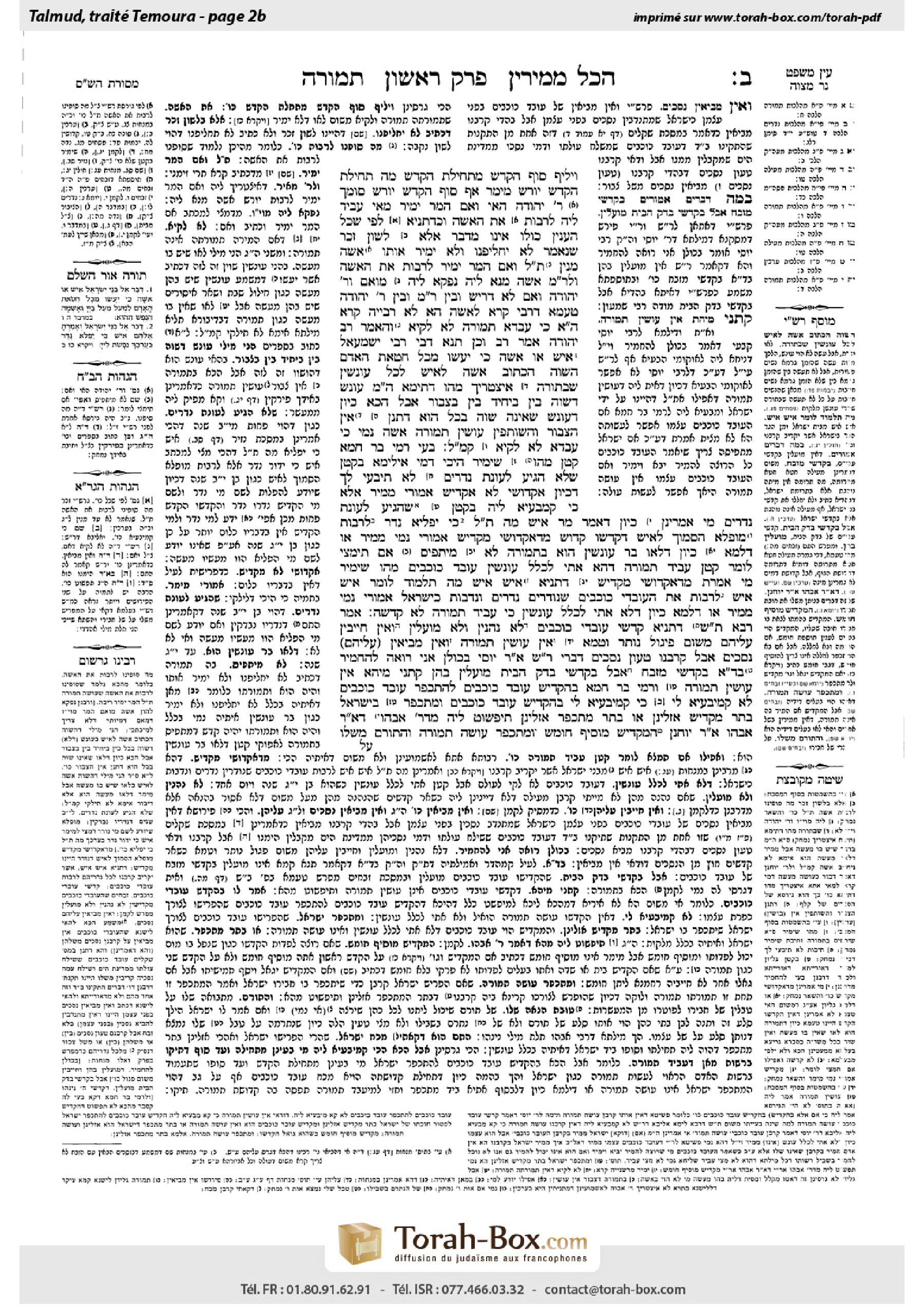
Temurah 2b: Talmud study for Daf Yomi
Daf Yomi is the daily study of one Talmud folio. Explore 37 tractates with scans, Hebrew text, Sefaria English and AI-generated French translations where annotated.
Passage selection and English or AI-generated French translation are available where the scan has annotations. Daf Study is independent of Torah-Box and Sefaria.
Browse Temurah · תמורה · All tractatesTemurah 2b text and translations
This page of Temurah includes the Aramaic text, an English translation and an AI-generated French translation, alongside the scan above.
תמורה ב׳ ב · Aramaic and Hebrew text
וְיָלֵיף סוֹף הֶקְדֵּשׁ מִתְּחִילַּת הֶקְדֵּשׁ, מָה תְּחִילַּת הֶקְדֵּשׁ יוֹרֵשׁ מֵימִר, אַף סוֹף הֶקְדֵּשׁ יוֹרֵשׁ סוֹמֵךְ.
רַבִּי יְהוּדָה, הַאי ״וְאִם הָמֵר יָמִיר״ מַאי עָבֵיד לֵיהּ? לְרַבּוֹת אֶת הָאִשָּׁה. וְכִדְתַנְיָא: לְפִי שֶׁכׇּל הָעִנְיָן כּוּלּוֹ אֵינוֹ מְדַבֵּר אֶלָּא לְשׁוֹן זָכָר, שֶׁנֶּאֱמַר: ״לֹא יַחֲלִיפֶנּוּ וְלֹא יָמִיר אֹתוֹ״, אִשָּׁה מִנַּיִן? תַּלְמוּד לוֹמַר: ״וְאִם הָמֵר יָמִיר״ לְרַבּוֹת אֶת הָאִשָּׁה.
וּלְרַבִּי מֵאִיר, אִשָּׁה מְנָא לֵיהּ? נָפְקָא לֵיהּ מִ״וְּאִם״. וְרַבִּי יְהוּדָה, ״וְאִם״ לָא דָּרֵישׁ.
וּבֵין רַבִּי מֵאִיר וּבֵין רַבִּי יְהוּדָה, טַעְמָא דְּרַבִּי קְרָא לְאִשָּׁה, הָא לָא רַבְּיַיהּ קְרָא — הֲוָה אָמֵינָא: כִּי עָבְדָא תְּמוּרָה לָא לָקְיָא. וְהָאָמַר רַב יְהוּדָה אָמַר רַב, וְכֵן תָּנָא דְּבֵי רַבִּי יִשְׁמָעֵאל: ״אִישׁ אוֹ אִשָּׁה כִּי יַעֲשׂוּ מִכׇּל חַטֹּאת הָאָדָם״ — הִשְׁוָה הַכָּתוּב אִשָּׁה לְאִישׁ לְכׇל עֳונָשִׁין שֶׁבַּתּוֹרָה!
אִיצְטְרִיךְ, מַהוּ דְּתֵימָא: הָנֵי מִילֵּי עוֹנֶשׁ דְּשָׁוֶה בֵּין בְּיָחִיד בֵּין בְּצִבּוּר, אֲבָל הָכָא, כֵּיוָן דְּעוֹנֶשׁ שֶׁאֵינוֹ שָׁוֶה בַּכֹּל הוּא, דִּתְנַן: אֵין הַצִּבּוּר וְהַשּׁוּתָּפִין עוֹשִׂין תְּמוּרָה — אִשָּׁה נָמֵי כִּי עָבְדָא לָא לָקְיָא, קָא מַשְׁמַע לַן.
בָּעֵי רָמֵי בַּר חָמָא: קָטָן מַהוּ שֶׁיָּמִיר? הֵיכִי דָמֵי? אִילֵּימָא בְּקָטָן שֶׁלֹּא הִגִּיעַ לְעוֹנַת נְדָרִים — לָא תִּיבְּעֵי לָךְ, דְּכֵיוָן אַקְדּוֹשֵׁי לָא אַקְדֵּישׁ, אֲמוֹרֵי מֵמַיר? אֶלָּא כִּי קָמִבַּעְיָא לֵיהּ — בְּקָטָן שֶׁהִגִּיעַ לְעוֹנַת נְדָרִים.
מִי אָמְרִינַן, כֵּיוָן דְּאָמַר מָר: ״אִישׁ״, מָה תַּלְמוּד לוֹמַר ״כִּי יַפְלִיא נֶדֶר״ — לְרַבּוֹת מוּפְלָא הַסָּמוּךְ לְאִישׁ, דְּקׇדְשׁוֹ קָדוֹשׁ. מִדְּאַקְדּוֹשֵׁי מַקְדֵּישׁ, אֲמוֹרֵי נָמֵי מֵמַיר, אוֹ דִלְמָא: כֵּיוָן דְּלָאו בַּר עוּנְשִׁין הוּא, בִּתְמוּרָה לָא מִיתְּפִיס?
אִם תִּימְצֵי לוֹמַר קָטָן עָבֵיד תְּמוּרָה, דְּהָא אָתֵי לִכְלַל עֳונָשִׁין, גּוֹי מַהוּ שֶׁיָּמִיר? מִי אָמְרַתְּ מִדְּאַקְדּוֹשֵׁי מַקְדֵּישׁ, דְּתַנְיָא: ״אִישׁ אִישׁ״, מָה תַּלְמוּד לוֹמַר ״אִישׁ אִישׁ״? לְרַבּוֹת אֶת הַגּוֹיִם, שֶׁנּוֹדְרִים נְדָרִים וּנְדָבוֹת כְּיִשְׂרָאֵל, אֲמוֹרֵי נָמֵי מֵמַיר. אוֹ דִלְמָא: כֵּיוָן דְּלָא אָתֵי לִכְלַל עֳונָשִׁין, כִּי עָבֵיד תְּמוּרָה לָא קָדְשָׁה?
אָמַר רָבָא: תָּא שְׁמַע, דְּתַנְיָא: קׇדְשֵׁי גוֹיִם — לֹא נֶהֱנִין וְלֹא מוֹעֲלִין, וְאֵין חַיָּיבִין עֲלֵיהֶם מִשּׁוּם פִּיגּוּל, נוֹתָר וְטָמֵא, אֵין עוֹשִׂין תְּמוּרָה, וְאֵין מְבִיאִין עֲלֵיהֶם נְסָכִים, אֲבָל קׇרְבָּנוֹ טָעוּן נְסָכִים, דִּבְרֵי רַבִּי שִׁמְעוֹן.
אָמַר רַבִּי יוֹסֵי: בְּכוּלָּן אֲנִי רוֹאֶה לְהַחְמִיר. בַּמֶּה דְּבָרִים אֲמוּרִים? בְּקׇדְשֵׁי מִזְבֵּחַ, אֲבָל בְּקׇדְשֵׁי בֶּדֶק הַבַּיִת מוֹעֲלִין בָּהֶן. קָתָנֵי מִיהָא: אֵין עוֹשִׂין תְּמוּרָה!
וְרָמֵי בַּר חָמָא, בְּהִקְדִּישׁ גּוֹי לְהִתְכַּפֵּר גּוֹי — לָא קָמִיבַּעְיָא לִי, כִּי קָמִיבַּעְיָא לִי — בְּהִקְדִּישׁ גּוֹי וּמִתְכַּפֵּר בְּיִשְׂרָאֵל: בָּתַר מַקְדִּישׁ אָזְלִינַן, אוֹ בָּתַר מִתְכַּפֵּר אָזְלִינַן?
תִּיפְשׁוֹט לֵיהּ מִדְּרַבִּי אֲבָהוּ, דְּאָמַר רַבִּי אֲבָהוּ אָמַר רַבִּי יוֹחָנָן: הַמַּקְדִּישׁ מוֹסִיף חוֹמֶשׁ, וּמִתְכַּפֵּר עוֹשֶׂה תְּמוּרָה, וְהַתּוֹרֵם מִשֶּׁלּוֹ
Temurah 2b · English translation
And he derives the halakhot of the end of a consecrated animal from the initial consecration of the animal, as follows: Just as with regard to the initial state of consecration of the animal, an inheritor can effect substitution, so too, with regard to the end of the consecrated animal, an inheritor places his hands on its head.
The Gemara asks: According to Rabbi Yehuda, who holds that an inheritor is not able to effect substitution, what does he do with this repetitive language in the verse: “And if he shall at all substitute”? How does he interpret it? The Gemara answers: It serves to include a woman as able to effect substitution and to incur the penalty of forty lashes for doing so. And this is as it is taught in a baraita: Since the verses concerning the entire matter of substitution speak only in the masculine, as it is stated: “He shall not exchange it, nor substitute it” (Leviticus 27:10), from where is it derived that a woman is included? The verse states: “And if he shall at all substitute,” to include a woman.
The Gemara asks: And according to Rabbi Meir, who derives a different halakha from that verse, from where does he derive that a woman is included? The Gemara answers: He derives it from the addition of the conjunction “and” in the verse: “And if he shall at all substitute.” And Rabbi Yehuda does not interpret the term “and if” as having any special significance.
The Gemara analyzes this dispute. And according to both the opinion of Rabbi Meir and the opinion of Rabbi Yehuda, the reason why a woman is included is that the verse explicitly includes a woman, either by adding a conjunction or by repetition of the verb. The Gemara asks: Should one infer that if the verse did not include a woman, I would say that when a woman performs an act of substitution she is not flogged? But didn’t Rav Yehuda say that Rav says, and so too the school of Rabbi Yishmael taught, that when the verse states: “When a man or woman shall commit any sin that people commit” (Numbers 5:6), the verse equates a woman with a man with regard to all punishments of the Torah? Why, then, is there a need for the verse to include women in the prohibition against substitution?
The Gemara answers: It was necessary for the verse to include women specifically, lest you say that this statement that equates women with men in general refers only to a punishment that applies equally to an individual and to the public. But here, since it is a punishment that does not apply equally to all, as we learned in a mishna (13a): The public and partners do not render an animal a substitute, one could claim that a woman as well, when she performs an act of substitution, is not flogged. The verse therefore teaches us that she is in fact liable.
§ Rami bar Ḥama raises a dilemma: With regard to a minor, what is the halakha? Is he able to effect substitution or not? The Gemara clarifies: What are the circumstances where this question arises? If we say that it is referring to a minor who has yet to reach the age of responsibility for his vows, i.e., twelve years and one day, you should not raise the dilemma, as since he cannot consecrate an animal by means of a vow, can he effect substitution? Rather, when he raises this dilemma, it is with regard to a minor who has reached the age of responsibility for his vows.
The Gemara explains the dilemma: Do we say that a minor can effect substitution, since the Master said with regard to consecration: The verse states: “When a man shall clearly utter a vow” (Leviticus 27:2). What is the meaning when the verse states the unusual formulation: Shall clearly utter [yafli] a vow, instead of the more conventional term: Shall take a vow [yiddor]? This serves to include a discriminating minor [mufla] on the brink of adulthood, teaching that his consecration takes effect. Perhaps, from the fact that he can consecrate an animal, he can also effect substitution. Or perhaps, since no minor is subject to punishments, he cannot apply sanctity to an animal by an act of substitution, which would incur a punishment.
And even if you say that a minor can perform substitution, as he will come to an age when he is subject to punishments, what is the halakha as to whether a gentile can effect substitution? Do you say that he can do so from the fact that his consecration takes effect, as it is taught in a baraita: The verse states: “Any man [ish ish]…that brings his offering.” What is the meaning when the verse states repetitively “ish ish”? This serves to include gentiles, teaching that they can take vows to bring vow offerings and gift offerings as a Jew can. Since the consecration of a gentile takes effect, perhaps he can effect substitution as well. Or perhaps, since he will not come to a time when he is subject to punishments, therefore when he performs an act of substitution, the animal is not consecrated.
Rava says: Come and hear, as it is taught in a baraita (Tosefta, Zevaḥim 5:6): With regard to animals consecrated by gentiles, one may not derive benefit from them ab initio, but if one derived benefit from them, he is not liable for misuse of consecrated property after the fact. And if one consumes them one is not liable for committing a transgression with regard to the prohibitions of piggul if they were sacrificed with the intent to consume them beyond their designated time, of notar if he consumed them beyond their designated time, and of consuming ritually impure offerings if he was impure. Gentiles cannot render a non-sacred animal a substitute for one they consecrate. And one does not bring libations for the offerings of a gentile as independent offerings, but his offering requires libations. This is the statement of Rabbi Shimon.
Rabbi Yosei said: With regard to all of them I see fit to be stringent. In what case is this statement, that Rabbi Shimon exempts animals consecrated by gentiles from liability for misuse, said? It is said with regard to animals consecrated for the altar, i.e., offerings; but with regard to animals consecrated for Temple maintenance, one who derives benefit from them is liable for misuse of consecrated property. Rava notes: In any event, the baraita teaches that gentiles cannot render an animal a substitute for his offering.
The Gemara responds: And Rami bar Ḥama can say: I do not raise a dilemma in a case where a gentile consecrated an animal as an offering for a gentile such as himself to achieve atonement. In this case the baraita rules explicitly that he cannot effect substitution. When I raise the dilemma, it is in a case where a gentile consecrated an animal as an offering and a Jew achieves atonement with it. In this situation, do we follow the one who consecrated it, in which case the gentile cannot effect substitution, or do we follow the one achieving atonement, in which case he can?
The Gemara suggests: Solve this dilemma by invoking a statement of Rabbi Abbahu, as Rabbi Abbahu said that Rabbi Yoḥanan says: If one consecrates an animal as an offering to be brought by another, and the animal develops a blemish disqualifying it for sacrifice, if the one who consecrated it desires to redeem it, he adds one-fifth to its value, just as he would were it his own offering. By contrast, if the one achieving atonement with the offering desires to redeem it, he does not need to add one-fifth. But the one achieving atonement with the offering can render another animal a substitute for it as if he had consecrated it. And if one separates teruma, the portion of produce designated for a priest, from his own produce
Temurah 2b · Traduction française (IA)
Et il déduit les halakhot relatives à la fin de la consécration d’un animal de celles qui concernent sa consécration initiale, comme suit : de même qu’au moment de la consécration initiale de l’animal, un héritier peut effectuer une substitution, de même, à la fin de la consécration de l’animal, un héritier pose les mains sur sa tête.
La Guemara demande : selon Rabbi Yehouda, qui estime qu’un héritier ne peut pas effectuer de substitution, que fait-il de cette formulation répétitive dans le verset : « Et s’il substitue effectivement » ? Comment l’interprète-t-il ? La Guemara répond : elle sert à inclure une femme, qui peut effectuer une substitution et encourir la peine de quarante coups de fouet pour l’avoir fait. C’est ce qui est enseigné dans une baraïta : puisque les versets concernant toute la question de la substitution ne parlent qu’au masculin, comme il est dit : « Il ne l’échangera pas et ne le substituera pas » (Lévitique 27, 10), d’où sait-on qu’une femme est incluse ? Le verset dit : « Et s’il substitue effectivement », afin d’inclure une femme.
La Guemara demande : et selon Rabbi Meïr, qui déduit de ce verset une autre halakha, d’où déduit-il qu’une femme est incluse ? La Guemara répond : il le déduit de l’ajout de la conjonction « et » dans le verset : « Et s’il substitue effectivement ». Quant à Rabbi Yehouda, il ne considère pas l’expression « et si » comme ayant une signification particulière.
La Guemara analyse cette controverse. Selon Rabbi Meïr comme selon Rabbi Yehouda, une femme est incluse parce que le verset l’inclut explicitement, soit par l’ajout d’une conjonction, soit par la répétition du verbe. La Guemara demande : faut-il en déduire que, si le verset n’avait pas inclus la femme, j’aurais dit qu’une femme qui effectue une substitution ne reçoit pas de coups de fouet ? Pourtant, Rav Yehouda a dit au nom de Rav, et l’école de Rabbi Yishmaël a enseigné elle aussi, que lorsque le verset dit : « Si un homme ou une femme commet l’un des péchés que les humains commettent » (Nombres 5, 6), il met la femme sur le même plan que l’homme pour toutes les peines de la Torah. Pourquoi le verset doit-il donc inclure les femmes dans l’interdiction de substitution ?
La Guemara répond : il était nécessaire que le verset inclue spécifiquement les femmes, de peur que tu ne dises que cette règle, qui met généralement les femmes sur le même plan que les hommes, ne concerne qu’une peine qui s’applique également à un individu et au public. Mais ici, puisqu’il s’agit d’une peine qui ne s’applique pas également à tous, comme nous l’avons appris dans une Michna (13a) : le public et les associés ne rendent pas un animal substitut, on aurait pu soutenir qu’une femme également, lorsqu’elle effectue une substitution, ne reçoit pas de coups de fouet. Le verset nous enseigne donc qu’elle est bien passible de cette peine.
§ Rami bar Ḥama soulève une question : quelle est la halakha concernant un mineur ? Peut-il effectuer une substitution ou non ? La Guemara précise : dans quelles circonstances cette question se pose-t-elle ? Si l’on dit qu’il s’agit d’un mineur qui n’a pas encore atteint l’âge où il est responsable de ses vœux, c’est-à-dire douze ans et un jour, il n’y a pas lieu de soulever la question, car, puisqu’il ne peut pas consacrer un animal par un vœu, pourrait-il effectuer une substitution ? La question se pose plutôt au sujet d’un mineur qui a atteint l’âge où il est responsable de ses vœux.
La Guemara explique la question : dira-t-on qu’un mineur peut effectuer une substitution, puisque le Maître a dit au sujet de la consécration : le verset dit : « Lorsqu’un homme formulera clairement un vœu » (Lévitique 27, 2). Pourquoi le verset emploie-t-il la formulation inhabituelle « formulera clairement » [yafli] un vœu, plutôt que le terme plus courant « fera un vœu » [yiddor] ? Cela sert à inclure un mineur au discernement précoce [mufla], à la veille de sa majorité, et enseigne que sa consécration prend effet. Peut-être peut-il donc aussi effectuer une substitution, puisqu’il peut consacrer un animal. Ou peut-être, puisqu’aucun mineur n’est passible de peines, ne peut-il pas conférer la sainteté à un animal par un acte de substitution, lequel entraînerait une peine.
Et même si tu dis qu’un mineur peut effectuer une substitution, puisqu’il atteindra un âge où il sera passible de peines, quelle est la halakha concernant un non-Juif : peut-il effectuer une substitution ? Diras-tu qu’il le peut parce que sa consécration prend effet, comme l’enseigne une baraïta : le verset dit : « Tout homme [ish ish]… qui apporte son offrande. » Pourquoi le verset répète-t-il « ish ish » ? Cela sert à inclure les non-Juifs et enseigne qu’ils peuvent faire des vœux pour apporter des sacrifices votifs et des offrandes volontaires, comme un Juif. Puisque la consécration d’un non-Juif prend effet, peut-être peut-il également effectuer une substitution. Ou peut-être, puisqu’il n’atteindra jamais un âge où il sera passible de peines, l’animal n’est-il pas consacré lorsqu’il effectue une substitution.
Rava dit : Viens et entends, comme l’enseigne une baraïta (Tossefta, Zevaḥim 5, 6) : concernant les animaux consacrés par des non-Juifs, il est interdit a priori d’en tirer profit, mais si quelqu’un en a tiré profit, il n’est pas passible, a posteriori, pour détournement de biens consacrés. Si quelqu’un en consomme, il n’est pas passible d’une transgression liée à l’interdiction de piggul, s’ils ont été sacrifiés avec l’intention de les consommer après le délai prescrit, de notar, s’il les a consommés après le délai prescrit, ni de consommation d’offrandes rituellement impures, s’il était impur. Les non-Juifs ne peuvent pas rendre substitut un animal non consacré à la place de celui qu’ils consacrent. On n’apporte pas de libations pour les offrandes d’un non-Juif comme offrandes indépendantes, mais son offrande requiert des libations. Telle est la déclaration de Rabbi Shimon.
Rabbi Yossei a dit : pour toutes ces questions, je considère qu’il convient d’être rigoureux. Dans quel cas cette déclaration de Rabbi Shimon, qui exonère de la responsabilité pour détournement de biens consacrés les animaux consacrés par des non-Juifs, a-t-elle été faite ? Elle concerne les animaux consacrés pour l’autel, c’est-à-dire les offrandes ; mais pour les animaux consacrés à l’entretien du Temple, celui qui en tire profit est passible pour détournement de biens consacrés. Rava fait remarquer : en tout état de cause, la baraïta enseigne que les non-Juifs ne peuvent pas rendre substitut un animal à la place de leur offrande.
La Guemara répond : Rami bar Ḥama pourrait dire : je ne soulève pas de question dans le cas où un non-Juif a consacré un animal comme offrande afin qu’un non-Juif tel que lui-même obtienne l’expiation. Dans ce cas, la baraïta statue explicitement qu’il ne peut pas effectuer de substitution. Lorsque je soulève la question, c’est dans le cas où un non-Juif a consacré un animal comme offrande et où un Juif obtient l’expiation grâce à lui. Dans cette situation, suit-on celui qui l’a consacré, auquel cas le non-Juif ne peut pas effectuer de substitution, ou suit-on celui qui obtient l’expiation, auquel cas il le peut ?
La Guemara suggère : résolvons cette question en invoquant une déclaration de Rabbi Abbahou, car Rabbi Abbahou a dit au nom de Rabbi Yoḥanan : si quelqu’un consacre un animal comme offrande destinée à être apportée par une autre personne, et que l’animal développe un défaut qui le rend impropre au sacrifice, si celui qui l’a consacré souhaite le racheter, il ajoute un cinquième à sa valeur, comme il le ferait s’il s’agissait de sa propre offrande. En revanche, si celui qui obtient l’expiation grâce à l’offrande souhaite la racheter, il n’a pas besoin d’ajouter un cinquième. Mais celui qui obtient l’expiation grâce à l’offrande peut rendre un autre animal substitut de celle-ci, comme s’il l’avait lui-même consacrée. Et si quelqu’un prélève la terouma, la part de la récolte désignée pour un prêtre, sur sa propre récolte
Traduction française générée par IA à partir de l’édition anglaise de Sefaria. Vérifie toujours un passage avec le texte source.
Text from Sefaria: William Davidson Edition - Vocalized Aramaic (CC BY NC); William Davidson Edition - English (CC BY NC).