Temurah 3a: Talmud study for Daf Yomi
Daf Yomi is the daily study of one Talmud folio. Explore 37 tractates with scans, Hebrew text, Sefaria English and AI-generated French translations where annotated.
Passage selection and English or AI-generated French translation are available where the scan has annotations. Daf Study is independent of Torah-Box and Sefaria.
Browse Temurah · תמורה · All tractatesTemurah 3a text and translations
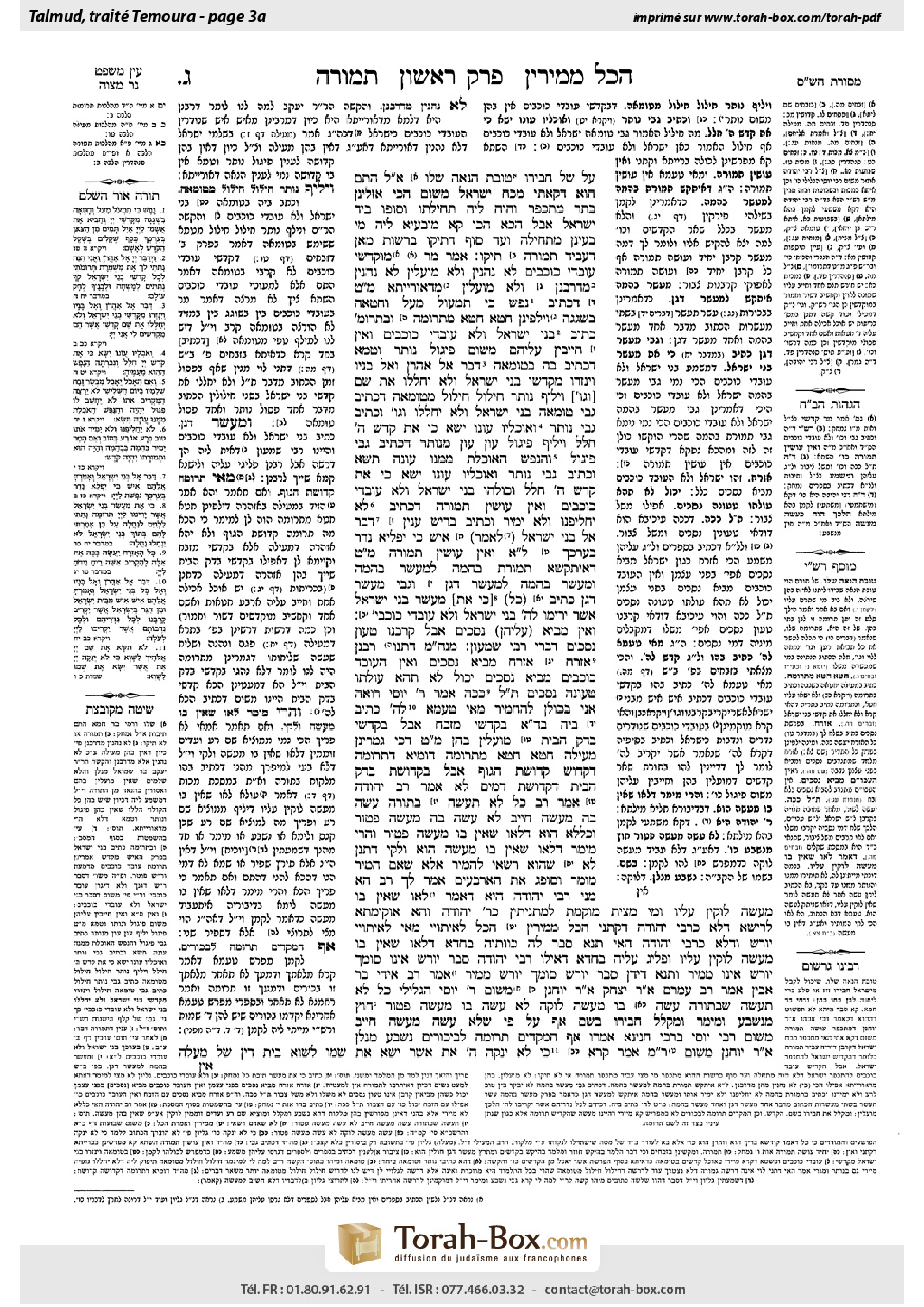
This page of Temurah includes the Aramaic text, an English translation and an AI-generated French translation, alongside the scan above.
תמורה ג׳ א · Aramaic and Hebrew text
עַל שֶׁל חֲבֵירוֹ — טוֹבַת הֲנָאָה שֶׁלּוֹ!
אֲמַר לֵיהּ: הָתָם הוּא דְּקָאָתֵי מִכֹּחַ יִשְׂרָאֵל, מִשּׁוּם הָכִי אָזְלִינַן בָּתַר מִתְכַּפֵּר, וְהָוֵה לֵיהּ תְּחִילָּתוֹ וְסוֹפוֹ בְּיַד יִשְׂרָאֵל. אֲבָל הָכָא, הָכִי קָא מִיבַּעְיָא לֵיהּ: מִי בָּעֵינַן מִתְּחִילָּה וְעַד סוֹף דְּתֵיקוּ בִּרְשׁוּת מַאן דְּעָבֵיד תְּמוּרָה? תֵּיקוּ.
אָמַר מָר: מוּקְדְּשֵׁי גּוֹיִם לֹא נֶהֱנִין וְלֹא מוֹעֲלִין. לֹא נֶהֱנִין — מִדְּרַבָּנַן, וְלֹא מוֹעֲלִין — מִדְּאוֹרָיְיתָא.
מַאי טַעְמָא? דִּכְתִיב: ״נֶפֶשׁ כִּי תִּמְעֹל מַעַל וְחָטְאָה בִּשְׁגָגָה״, וְיָלְפִינַן ״חֵטְא״ ״חֵטְא״ מִתְּרוּמָה, וּבִתְרוּמָה כְּתִיב: ״בְּנֵי יִשְׂרָאֵל״, וְלֹא גּוֹיִם.
וְאֵין חַיָּיבִין עֲלֵיהֶם, מִשּׁוּם פִּיגּוּל, נוֹתָר, וְטָמֵא, דִּכְתִיב בַּהּ בְּטוּמְאָה: ״דַּבֵּר אֶל אַהֲרֹן וְאֶל בָּנָיו וְיִנָּזְרוּ מִקׇּדְשֵׁי בְנֵי יִשְׂרָאֵל וְלֹא יְחַלְּלוּ אֶת שֵׁם וְגוֹ׳״.
וְיָלֵיף נוֹתָר ״חִילּוּל״ ״חִילּוּל״ מִטּוּמְאָה, דִּכְתִיב גַּבֵּי טוּמְאָה: ״בְנֵי יִשְׂרָאֵל וְלֹא יְחַלְּלוּוְגוֹ׳״, וּכְתִיב גַּבֵּי נוֹתָר: ״וְאוֹכְלָיו עֲוֹנוֹ יִשָּׂא כִּי אֶת קֹדֶשׁ ה׳ חִלֵּל״.
וְיָלֵיף פִּיגּוּל ״עָוֹן״ ״עָוֹן״ מִנּוֹתָר, דִּכְתִיב גַּבֵּי פִּיגּוּל: ״וְהַנֶּפֶשׁ הָאוֹכֶלֶת מִמֶּנּוּ עֲוֹנָהּ תִּשָּׂא״, וּכְתִיב גַּבֵּי נוֹתָר: ״וְאוֹכְלָיו עֲוֹנוֹ יִשָּׂא כִּי אֶת קֹדֶשׁ ה׳ חִלֵּל״, וְכוּלְּהוּ בְּנֵי יִשְׂרָאֵל וְלֹא גּוֹיִם.
וְאֵין עוֹשִׂין תְּמוּרָה, דִּכְתִיב: ״לֹא יַחֲלִיפֶנּוּ וְלֹא יָמִיר״, וּכְתִיב בְּרֵישׁ עִנְיָן: ״דַּבֵּר אֶל בְּנֵי יִשְׂרָאֵל לֵאמֹר אִישׁ כִּי יַפְלִיא נֶדֶר בְּעֶרְכְּךָ״.
לִישָּׁנָא אַחֲרִינָא: וְאֵין עוֹשִׂין תְּמוּרָה, מַאי טַעְמָא? דְּאִיתַּקַּשָׁא תְּמוּרַת בְּהֵמָה לְמַעְשַׂר בְּהֵמָה, וּמַעְשַׂר בְּהֵמָה לְמַעֲשֵׂר דָּגָן. וְגַבֵּי מַעְשַׂר דָּגָן כְּתִיב: ״(כֹּל) [כִּי אֶת] מַעְשַׂר בְּנֵי יִשְׂרָאֵל אֲשֶׁר יָרִימוּ לַה׳... בְּנֵי יִשְׂרָאֵל״ — וְלֹא גּוֹיִם.
וְאֵין מֵבִיא (עֲלֵיהֶן) נְסָכִים, אֲבָל קׇרְבָּנוֹ טָעוּן נְסָכִים, דִּבְרֵי רַבִּי שִׁמְעוֹן. מְנָא הָנֵי מִילֵּי? דְּתָנוּ רַבָּנַן: ״אֶזְרָח״ — אֶזְרָח מֵבִיא נְסָכִים וְאֵין הַגּוֹי מֵבִיא נְסָכִים. יָכוֹל לֹא תְּהֵא עוֹלָתוֹ טְעוּנָה נְסָכִים? תַּלְמוּד לוֹמַר ״כָּכָה״.
אָמַר רַבִּי יוֹסֵי: רוֹאֶה אֲנִי בְּכוּלָּן לְהַחְמִיר. מַאי טַעְמָא? ״לַה׳״ כְּתִיב בֵּיהּ.
בַּמֶּה דְּבָרִים אֲמוּרִים — בְּקׇדְשֵׁי מִזְבֵּחַ, אֲבָל בְּקׇדְשֵׁי בֶּדֶק הַבַּיִת — מוֹעֲלִין בָּהֶן. מַאי טַעְמָא? דְּכִי גָּמְרִינַן מְעִילָה ״חֵטְא״ ״חֵטְא״ מִתְּרוּמָה, דֻּומְיָא דִּתְרוּמָה (דקדוש) [דִּקְדוֹשָׁה] קְדוּשַּׁת הַגּוּף, אֲבָל בקדשי בֶּדֶק הַבַּיִת דִּקְדוּשַּׁת דָּמִים — לָא.
אָמַר רַב יְהוּדָה, אָמַר רַב: כׇּל ״לֹא תַעֲשֶׂה״ בַּתּוֹרָה, עָשָׂה (בָּהּ) מַעֲשֶׂה — חַיָּיב, לֹא עָשָׂה (בָּהּ) מַעֲשֶׂה — פָּטוּר.
וּכְלָלָא הוּא דְּלָאו שֶׁאֵין בּוֹ מַעֲשֶׂה פָּטוּר? וַהֲרֵי מֵימֵר, דְּלָאו שֶׁאֵין בּוֹ מַעֲשֶׂה הוּא, וְלָקֵי, דִּתְנַן: ״לֹא שֶׁהוּא רַשַּׁאי לְהָמִיר, אֶלָּא שֶׁאִם הֵמִיר מוּמָר, וְסוֹפֵג אֶת הָאַרְבָּעִים״.
אָמַר לְךָ רַב: הָא מַנִּי? רַבִּי יְהוּדָה הִיא, דְּאָמַר: לָאו שֶׁאֵין בּוֹ מַעֲשֶׂה — לוֹקִין עָלָיו.
וּמִי מָצֵית מוֹקְמַתְּ לְמַתְנִיתִין כְּרַבִּי יְהוּדָה? וְהָא אוֹקֵימְתַּאּ לְרֵישָׁא דְּלָא כְּרַבִּי יְהוּדָה, דְּקָתָנֵי ״הַכֹּל מְמִירִין״, ״הַכֹּל״ לְאֵיתוֹיֵי מַאי? לְאֵיתוֹיֵי יוֹרֵשׁ, וּדְלָא כְּרַבִּי יְהוּדָה!
הַאי תַּנָּא סָבַר לַהּ כְּוָותֵיהּ בַּחֲדָא — דְּלָאו שֶׁאֵין בּוֹ מַעֲשֶׂה לוֹקִין עָלָיו, וּפְלִיג עֲלֵיהּ בַּחֲדָא — דְּאִילּוּ רַבִּי יְהוּדָה סָבַר: יוֹרֵשׁ אֵינוֹ סוֹמֵךְ, יוֹרֵשׁ אֵינוֹ מֵמִיר, וְתַנָּא דִידַן סָבַר: יוֹרֵשׁ סוֹמֵךְ, יוֹרֵשׁ מֵמִיר.
אָמַר רַב אִידִי בַּר אָבִין, אָמַר רַב עַמְרָם, אָמַר רַבִּי יִצְחָק, אָמַר רַבִּי יוֹחָנָן מִשּׁוּם רַבִּי יוֹסֵי הַגְּלִילִי: כׇּל לֹא תַעֲשֶׂה שֶׁבַּתּוֹרָה, עָשָׂה בּוֹ מַעֲשֶׂה — לוֹקֶה, לֹא עָשָׂה בּוֹ מַעֲשֶׂה — פָּטוּר, חוּץ מִנִּשְׁבָּע, וּמֵימֵר, וּמְקַלֵּל חֲבֵירוֹ בַּשֵּׁם, אַף עַל פִּי שֶׁלֹּא עָשָׂה מַעֲשֶׂה — חַיָּיב. מִשּׁוּם רַבִּי יוֹסֵי בְּרַבִּי חֲנִינָא אָמְרוּ: אַף הַמַּקְדִּים תְּרוּמָה לְבִיכּוּרִים.
נִשְׁבָּע מְנָלַן? אָמַר רַבִּי יוֹחָנָן מִשּׁוּם רַבִּי מֵאִיר: אָמַר קְרָא ״כִּי לֹא יְנַקֶּה ה׳ אֵת אֲשֶׁר יִשָּׂא אֶת שְׁמוֹ לַשָּׁוְא״, בֵּית דִּין שֶׁל מַעְלָה
Temurah 3a · English translation
for the purpose of exempting the produce of another, the benefit of discretion as to which priest or Levite will receive it is his. Apparently, the halakhot of substitution follow the one achieving atonement.
Rami bar Ḥama could say to this: There, in Rabbi Yoḥanan’s statement, the offering comes on behalf of the Jew who consecrated it. Due to that reason, we follow the one atoning, and during both the initial consecration of the offering and its ultimate sacrifice the animal is in the possession of a Jew, who is able to effect substitution. But here, where a gentile consecrated the animal, this is how he raises the dilemma: Do we require that from the initial consecration of the offering until the ultimate act of sacrifice it must be in the possession of one who is able to effect substitution or not? The Gemara concludes: The dilemma shall stand [teiku] unresolved.
§ The Master said in the baraita cited on the previous amud: With regard to animals consecrated by gentiles, one may not derive benefit ab initio, but if one benefited from them after the fact, he is not liable for misusing consecrated property. The Gemara explains: The halakha that one may not benefit from them ab initio is by rabbinic law. And that halakha that if one benefited from them after the fact he is not liable for misusing consecrated property is by Torah law.
What is the reason that one is not liable for misuse? As it is written with regard to misuse of consecrated property: “If anyone commit a trespass, and sin through error, in the holy items of the Lord” (Leviticus 5:15). And we derive a verbal analogy from the use of the word “sin” in this verse and the word “sin” used in the context of teruma: “They shall therefore keep My charge, lest they bear sin for it” (Leviticus 22:9). And with regard to teruma it is written explicitly: “Even of all the hallowed items of the children of Israel” (Numbers 18:8), from which one can infer: But not of gentiles. The halakhot of misuse as well, therefore, do not apply to animals consecrated by gentiles.
The baraita continues: And if one consumes them, i.e., animals consecrated by gentiles, one is not liable for committing a transgression, with regard to the prohibitions of piggul, notar, or consuming offerings while ritually impure. The source for this is a verse, as it is written with regard to ritual impurity: “Speak to Aaron and to his sons, that they separate themselves from the holy items of the children of Israel, which they hallow unto Me, and that they profane not My holy name” (Leviticus 22:2). This verse explicitly mentions items consecrated by the children of Israel, to emphasize that the halakha of distancing oneself from consecrated items while in a state of ritual impurity does not include items consecrated by gentiles.
And one derives the exemption from notar by drawing a verbal analogy between the word “profane” used in the context of notar and the word “profane” used in the context of ritual impurity. As it is written in the verse cited above with regard to ritual impurity: “That they separate themselves from the holy items of the children of Israel, which they hallow unto Me, and that they profane not My holy name.” And it is written with regard to notar: “But every one that eats it shall bear his iniquity, because he has profaned the holy item of the Lord” (Leviticus 19:8). Since the prohibition against consuming consecrated items while impure does not apply to the offerings of gentiles, neither does the prohibition of notar.
And the tanna of the baraita derives the gentiles’ exemption from piggul by verbal analogy between the word “iniquity” used in the context of piggul and the word “iniquity” used in the context of notar, as it is written with regard to piggul: “And the soul that eats of it shall bear his iniquity” (Leviticus 7:18), and it is written with regard to notar: “But everyone that eats it shall bear his iniquity, because he has profaned the holy item of the Lord” (Leviticus 19:8). And based on these two verbal analogies, one concludes that with regard to all of them, i.e., piggul, notar, and ritually impure offerings, the prohibition against consumption applies only to offerings of the children of Israel, but not to those of gentiles.
The baraita continues: And a gentile cannot render a non-sacred animal a substitute for one he has consecrated. The Gemara cites the source for this halakha: As it is written with regard to substitutions: “He shall not exchange it, nor substitute it” (Leviticus 27:10), and it is written at the beginning of the matter: “Speak to the children of Israel, and say to them: When a man shall clearly utter a vow of persons to the Lord, according to your valuation” (Leviticus 27:2). Since the passage specifically addresses the children of Israel, the halakhot of substitution apply only to them, not to gentiles.
The Gemara presents another version of the source for this halakha: The baraita states: And a gentile cannot render a non-sacred animal a substitute for one he has consecrated. What is the reason? The reason is that the substitution of consecrated animals is juxtaposed with the animal tithe (see Leviticus 27:32), and the animal tithe is juxtaposed with the grain tithe. And with regard to the grain tithe it is written: “For the tithe of the children of Israel, which they set apart as a gift to the Lord, I have given to the Levites for an inheritance” (Numbers 18:24), indicating that the halakhot of the grain tithe apply only to the children of Israel, but not to gentiles. From the juxtapositions, one derives that the same holds for substitution.
The baraita continues: And one does not bring libations for a gentile as an independent offering, but his offering requires libations. This is the statement of Rabbi Shimon. The Gemara explains: From where are these matters derived? They are derived from a verse, as the Sages taught in a baraita: The verse states with regard to libations: “All that are homeborn shall do these after this manner, in presenting an offering made by fire, of a sweet savor to the Lord” (Numbers 15:13). One who is homeborn, i.e., a Jew, brings libations, but a gentile does not bring libations. One might have thought that a gentile’s burnt offering should not require libations; therefore, the verse states: “So shall it be done for each bull, or for each ram, or for each of the lambs, or of the goats” (Numbers 15:10–11). This teaches that every burnt offering, even that of a gentile, requires libations.
The baraita continues: Rabbi Yosei said: I see the logic of the opinion that in all of these cases it is correct to be stringent about the offerings of gentiles. The Gemara explains: What is the reason? With regard to the offering of a gentile, it is written: “Whosoever he be of the house of Israel, or of the strangers in Israel, that brings his offering, whether it be any of their vows, or any of their gift offerings, which are brought to the Lord for a burnt offering” (Leviticus 22:18). The verse equates the offerings of gentiles, “the strangers in Israel,” with those of Jews, and indicates that the consecrated status of the former is identical to that of the latter.
The baraita continues: In what case is this statement said? It is said with regard to animals consecrated for the altar, but with regard to animals consecrated for Temple maintenance, one who benefits from them is liable for misusing consecrated property. The Gemara explains: What is the reason? The reason is that when we learn that items consecrated by gentiles are not subject to liability for misuse by the verbal analogy between the word sin and another instance of the word sin from the context of teruma, this applies only to consecrated property that is similar to teruma, which is consecrated with inherent sanctity. But with regard to an item that has the sanctity of the Temple maintenance, whose sanctity inheres in its value, as it will ultimately be sold and the proceeds used for Temple maintenance, the analogy does not apply.
§ The mishna teaches that one who effects substitution receives lashes. Rav Yehuda says that Rav says: With regard to any prohibition in the Torah, if one performed an action to transgress it, he is liable to receive lashes. But if he did not perform an action to transgress it, he is exempt from receiving lashes.
The Gemara asks: But is it an established principle that one who transgresses a prohibition that does not involve an action is exempt? But there is the prohibition of substitution, which is a prohibition that does not involve an action, and one is flogged for transgressing it, as we learned in the mishna: That is not to say that it is permitted for a person to effect substitution; rather, it means that if one substituted a non-sacred animal for a consecrated animal, the substitution takes effect, and the one who substituted the non-sacred animal incurs the forty lashes.
The Gemara answers: Rav could have said to you: In accordance with whose opinion is this mishna written? It is in accordance with that opinion of Rabbi Yehuda, who said: With regard to a prohibition that does not involve an action, one is flogged for transgressing it. The Rabbis, however, disagree.
The Gemara counters: But can you establish the mishna as being in accordance with the opinion of Rabbi Yehuda? But we established the first clause of the mishna as not being in accordance with the opinion of Rabbi Yehuda, as it teaches: Everyone substitutes a non-sacred animal for a consecrated animal, and the Gemara added (2a): What does the expansive term everyone serve to include? It serves to include an inheritor, and accordingly, this mishna is not in accordance with the opinion of Rabbi Yehuda, who holds that an inheritor cannot effect substitution.
The Gemara answers: The tanna of this mishna holds in accordance with the opinion of Rabbi Yehuda with regard to one matter, that one is flogged for transgressing a prohibition that does not involve an action, and disagrees with him with regard to one other matter, as Rabbi Yehuda holds that an inheritor does not place his hands on the head of the offering when he sacrifices it, and an inheritor is not able to substitute a non-sacred animal for a consecrated one that he inherited; and the tanna of our mishna holds that an inheritor places his hands on the head of the offering when he sacrifices it, and an inheritor is able to substitute a non-sacred animal for a consecrated one that he inherited.
Rav Idi bar Avin says that Rav Amram says that Rabbi Yitzḥak says that Rabbi Yoḥanan says in the name of Rabbi Yosei HaGelili: With regard to every prohibition in the Torah, if one performed an action to transgress it, he is flogged. But if he did not perform an action to transgress it, he is exempt from lashes, except for one who takes an oath, and one who effects substitution, and one who curses another using the name of God. For these three transgressions, even though he did not perform an action, he is liable to receive lashes. They said in the name of Rabbi Yosei, son of Rabbi Ḥanina: Also one who separates teruma prior to designating the first fruits is flogged, even though teruma can be separated by intention alone, without an action.
The Gemara discusses the sources for these exceptions. From where do we derive that one who takes an oath using the name of God is flogged? Rabbi Yoḥanan says in the name of Rabbi Meir that the verse states: “For the Lord will not hold him guiltless that takes His name in vain” (Exodus 20:7). One can infer: The higher, i.e., heavenly, court
Temurah 3a · Traduction française (IA)
afin d’exempter les produits d’autrui, il lui revient de choisir le prêtre ou le Lévite qui les recevra. Apparemment, les halakhot de la substitution suivent celui qui obtient l’expiation.
Rami bar Ḥama pouvait lui répondre : Là, dans la déclaration de Rabbi Yoḥanan, l’offrande est apportée au nom du Juif qui l’a consacrée. Pour cette raison, nous suivons celui qui obtient l’expiation ; tant au moment de la consécration initiale de l’offrande qu’au moment de son sacrifice final, l’animal est en possession d’un Juif, qui peut effectuer une substitution. Mais ici, où un non-Juif a consacré l’animal, voici le dilemme qu’il soulève : exige-t-on que, depuis la consécration initiale de l’offrande jusqu’à l’acte final du sacrifice, elle soit en possession de quelqu’un qui peut effectuer une substitution, ou non ? La Guemara conclut : Le dilemme reste sans réponse [teiku].
§ Le Maître a déclaré dans la baraïta citée sur le daf précédent : En ce qui concerne les animaux consacrés par des non-Juifs, il est interdit a priori d’en tirer profit, mais si quelqu’un en a tiré profit après coup, il n’est pas passible pour détournement d’un bien consacré. La Guemara explique : L’interdiction a priori d’en tirer profit relève de la loi rabbinique. Quant à la règle selon laquelle celui qui en a tiré profit après coup n’est pas passible pour détournement d’un bien consacré, elle relève de la Torah écrite.
Pour quelle raison n’est-on pas passible pour détournement ? Car il est écrit à propos du détournement d’un bien consacré : « Si quelqu’un commet une infidélité et pèche par erreur à l’égard des choses saintes de l’Éternel » (Lévitique 5:15). Nous établissons une analogie verbale entre le mot « péché » employé dans ce verset et le mot « péché » employé au sujet de la terouma : « Ils observeront donc ce que je leur ai confié, afin qu’ils ne portent pas de péché à ce sujet » (Lévitique 22:9). Or, à propos de la terouma, il est explicitement écrit : « Même de toutes les choses consacrées des enfants d’Israël » (Nombres 18:8), ce qui permet de déduire : mais pas celles des non-Juifs. Les halakhot relatives au détournement ne s’appliquent donc pas non plus aux animaux consacrés par des non-Juifs.
La baraïta poursuit : Et si quelqu’un les consomme, c’est-à-dire des animaux consacrés par des non-Juifs, il n’est pas passible pour avoir transgressé les interdictions relatives au piggul, au notar ou à la consommation d’offrandes en état d’impureté rituelle. La source en est un verset, car il est écrit à propos de l’impureté rituelle : « Parle à Aaron et à ses fils, afin qu’ils se tiennent à l’écart des choses saintes des enfants d’Israël, qu’ils consacrent pour moi, et qu’ils ne profanent pas mon saint nom » (Lévitique 22:2). Ce verset mentionne explicitement les choses consacrées par les enfants d’Israël, pour souligner que la halakha imposant de se tenir à l’écart des choses consacrées lorsqu’on est en état d’impureté rituelle ne concerne pas celles consacrées par des non-Juifs.
On déduit également l’exemption concernant le notar en établissant une analogie verbale entre le mot « profaner », employé à propos du notar, et le mot « profaner », employé à propos de l’impureté rituelle. En effet, il est écrit dans le verset cité plus haut au sujet de l’impureté rituelle : « Qu’ils se tiennent à l’écart des choses saintes des enfants d’Israël, qu’ils consacrent pour moi, et qu’ils ne profanent pas mon saint nom. » Et, à propos du notar, il est écrit : « Celui qui en mangera portera la faute, car il a profané une chose sainte de l’Éternel » (Lévitique 19:8). Puisque l’interdiction de consommer des choses consacrées en état d’impureté ne s’applique pas aux offrandes des non-Juifs, l’interdiction du notar ne s’y applique pas non plus.
Le tanna de la baraïta déduit l’exemption des non-Juifs concernant le piggul en établissant une analogie verbale entre le mot « faute », employé à propos du piggul, et le mot « faute », employé à propos du notar. En effet, il est écrit à propos du piggul : « La personne qui en mangera portera sa faute » (Lévitique 7:18), et il est écrit à propos du notar : « Celui qui en mangera portera la faute, car il a profané une chose sainte de l’Éternel » (Lévitique 19:8). Sur la base de ces deux analogies verbales, on conclut que, dans tous ces cas — le piggul, le notar et les offrandes consommées en état d’impureté rituelle —, l’interdiction de consommer ne s’applique qu’aux offrandes des enfants d’Israël, et non à celles des non-Juifs.
La baraïta poursuit : Un non-Juif ne peut pas substituer un animal non consacré à l’un de ceux qu’il a consacrés. La Guemara cite la source de cette halakha : Car il est écrit à propos des substitutions : « Il ne le changera pas et ne le remplacera pas » (Lévitique 27:10), et il est écrit au début du passage : « Parle aux enfants d’Israël et dis-leur : Quand un homme prononcera clairement un vœu concernant des personnes à l’Éternel, selon ton estimation » (Lévitique 27:2). Puisque le passage s’adresse spécifiquement aux enfants d’Israël, les halakhot de la substitution ne s’appliquent qu’à eux, et non aux non-Juifs.
La Guemara présente une autre version de la source de cette halakha. La baraïta énonce : Un non-Juif ne peut pas substituer un animal non consacré à l’un de ceux qu’il a consacrés. Pour quelle raison ? Parce que la substitution des animaux consacrés est mise en relation avec la dîme animale (voir Lévitique 27:32), et que la dîme animale est mise en relation avec la dîme des céréales. Or, à propos de la dîme des céréales, il est écrit : « Car la dîme des enfants d’Israël, qu’ils prélèvent comme offrande à l’Éternel, je l’ai donnée aux Lévites en héritage » (Nombres 18:24), ce qui indique que les halakhot de la dîme des céréales ne s’appliquent qu’aux enfants d’Israël, et non aux non-Juifs. À partir de ces mises en relation, on déduit qu’il en va de même pour la substitution.
La baraïta poursuit : On n’apporte pas de libations pour un non-Juif comme offrande indépendante, mais son offrande exige des libations. Telle est la déclaration de Rabbi Shimon. La Guemara explique : D’où ces règles sont-elles déduites ? Elles sont déduites d’un verset, comme les Sages l’ont enseigné dans une baraïta : Le verset énonce à propos des libations : « Tous ceux qui sont nés dans le pays feront ainsi, lorsqu’ils présenteront une offrande consumée par le feu, d’une agréable odeur pour l’Éternel » (Nombres 15:13). Celui qui est né dans le pays, c’est-à-dire un Juif, apporte des libations, mais un non-Juif n’en apporte pas. On aurait pu penser qu’un holocauste offert par un non-Juif n’exige pas de libations ; le verset énonce donc : « Il en sera ainsi pour chaque taureau, pour chaque bélier, pour chacun des agneaux ou des chevreaux » (Nombres 15:10-11). Cela enseigne que tout holocauste, même celui d’un non-Juif, exige des libations.
La baraïta poursuit : Rabbi Yosei a dit : Je considère comme logique l’opinion selon laquelle il convient, dans tous ces cas, d’être strict à l’égard des offrandes des non-Juifs. La Guemara explique : Pour quelle raison ? À propos de l’offrande d’un non-Juif, il est écrit : « Quiconque appartient à la maison d’Israël, ou aux étrangers qui séjournent en Israël, et apporte son offrande, qu’il s’agisse d’un de leurs vœux ou d’un de leurs dons, offerts à l’Éternel en holocauste » (Lévitique 22:18). Le verset assimile les offrandes des non-Juifs, « les étrangers qui séjournent en Israël », à celles des Juifs et indique que leur statut consacré est identique à celui des offrandes de ces derniers.
La baraïta poursuit : Dans quel cas cette déclaration a-t-elle été faite ? Elle concerne les animaux consacrés pour l’autel ; mais pour les animaux consacrés à l’entretien du Temple, celui qui en tire profit est passible pour détournement d’un bien consacré. La Guemara explique : Pour quelle raison ? Lorsque nous déduisons, par l’analogie verbale entre le mot « péché » et une autre occurrence du mot « péché » dans le contexte de la terouma, que les choses consacrées par des non-Juifs n’entraînent pas de responsabilité pour détournement, cela ne s’applique qu’aux biens consacrés comparables à la terouma, qui possède une sainteté intrinsèque. Mais pour une chose ayant la sainteté de l’entretien du Temple, dont la sainteté réside dans sa valeur, puisqu’elle sera finalement vendue et que le produit de la vente servira à l’entretien du Temple, l’analogie ne s’applique pas.
§ La Michna enseigne que celui qui effectue une substitution reçoit la flagellation. Rav Yehouda dit au nom de Rav : Pour toute interdiction de la Torah, si quelqu’un accomplit un acte pour la transgresser, il est passible de la flagellation. Mais s’il ne commet aucun acte pour la transgresser, il est exempt de la flagellation.
La Guemara demande : Mais est-il établi comme principe que celui qui transgresse une interdiction ne comportant pas d’acte en est exempt ? Pourtant, il y a l’interdiction de substitution, qui ne comporte pas d’acte, et celui qui la transgresse est flagellé, comme nous l’avons appris dans la Michna : Cela ne signifie pas qu’il est permis à quelqu’un d’effectuer une substitution ; cela signifie plutôt que si quelqu’un a substitué un animal non consacré à un animal consacré, la substitution prend effet, et celui qui a substitué l’animal non consacré encourt les quarante coups.
La Guemara répond : Rav aurait pu te dire : Selon l’opinion de qui cette Michna est-elle rédigée ? Elle suit l’opinion de Rabbi Yehouda, qui a dit : Celui qui transgresse une interdiction ne comportant pas d’acte est flagellé. Les Rabbins, toutefois, ne sont pas d’accord avec lui.
La Guemara objecte : Mais peut-on établir que la Michna suit l’opinion de Rabbi Yehouda ? Or, nous avons établi que la première partie de la Michna ne suit pas l’opinion de Rabbi Yehouda, puisqu’elle enseigne : Tous peuvent substituer un animal non consacré à un animal consacré. Et la Guemara a ajouté (2a) : Que vient inclure le terme général « tous » ? Il vient inclure un héritier ; par conséquent, cette Michna ne suit pas l’opinion de Rabbi Yehouda, qui estime qu’un héritier ne peut pas effectuer de substitution.
La Guemara répond : Le tanna de cette Michna suit l’opinion de Rabbi Yehouda sur un point — celui qui transgresse une interdiction ne comportant pas d’acte est flagellé — et il est en désaccord avec lui sur un autre point. En effet, Rabbi Yehouda estime qu’un héritier ne pose pas ses mains sur la tête de l’offrande lorsqu’il la sacrifie et qu’un héritier ne peut pas substituer un animal non consacré à un animal consacré dont il a hérité. Le tanna de notre Michna, lui, estime qu’un héritier pose ses mains sur la tête de l’offrande lorsqu’il la sacrifie et qu’un héritier peut substituer un animal non consacré à un animal consacré dont il a hérité.
Rav Idi bar Avin dit que Rav Amram dit que Rabbi Yitzḥak dit que Rabbi Yoḥanan dit au nom de Rabbi Yosei HaGelili : Pour toute interdiction de la Torah, si quelqu’un accomplit un acte pour la transgresser, il est flagellé. Mais s’il ne commet aucun acte pour la transgresser, il est exempt de la flagellation, à l’exception de celui qui prononce un serment, de celui qui effectue une substitution et de celui qui maudit autrui en employant le nom de Dieu. Pour ces trois transgressions, même sans accomplir d’acte, on est passible de la flagellation. On a rapporté au nom de Rabbi Yosei, fils de Rabbi Ḥanina : Celui qui prélève la terouma avant d’avoir désigné les prémices est lui aussi flagellé, même si la terouma peut être prélevée par la seule intention, sans aucun acte.
La Guemara examine les sources de ces exceptions. D’où déduit-on que celui qui prononce un serment en employant le nom de Dieu est flagellé ? Rabbi Yoḥanan dit au nom de Rabbi Meir que le verset énonce : « Car l’Éternel ne tiendra pas pour innocent celui qui prononce son nom en vain » (Exode 20:7). On peut en déduire : le tribunal supérieur, c’est-à-dire céleste
Traduction française générée par IA à partir de l’édition anglaise de Sefaria. Vérifie toujours un passage avec le texte source.
Text from Sefaria: William Davidson Edition - Vocalized Aramaic (CC BY NC); William Davidson Edition - English (CC BY NC).