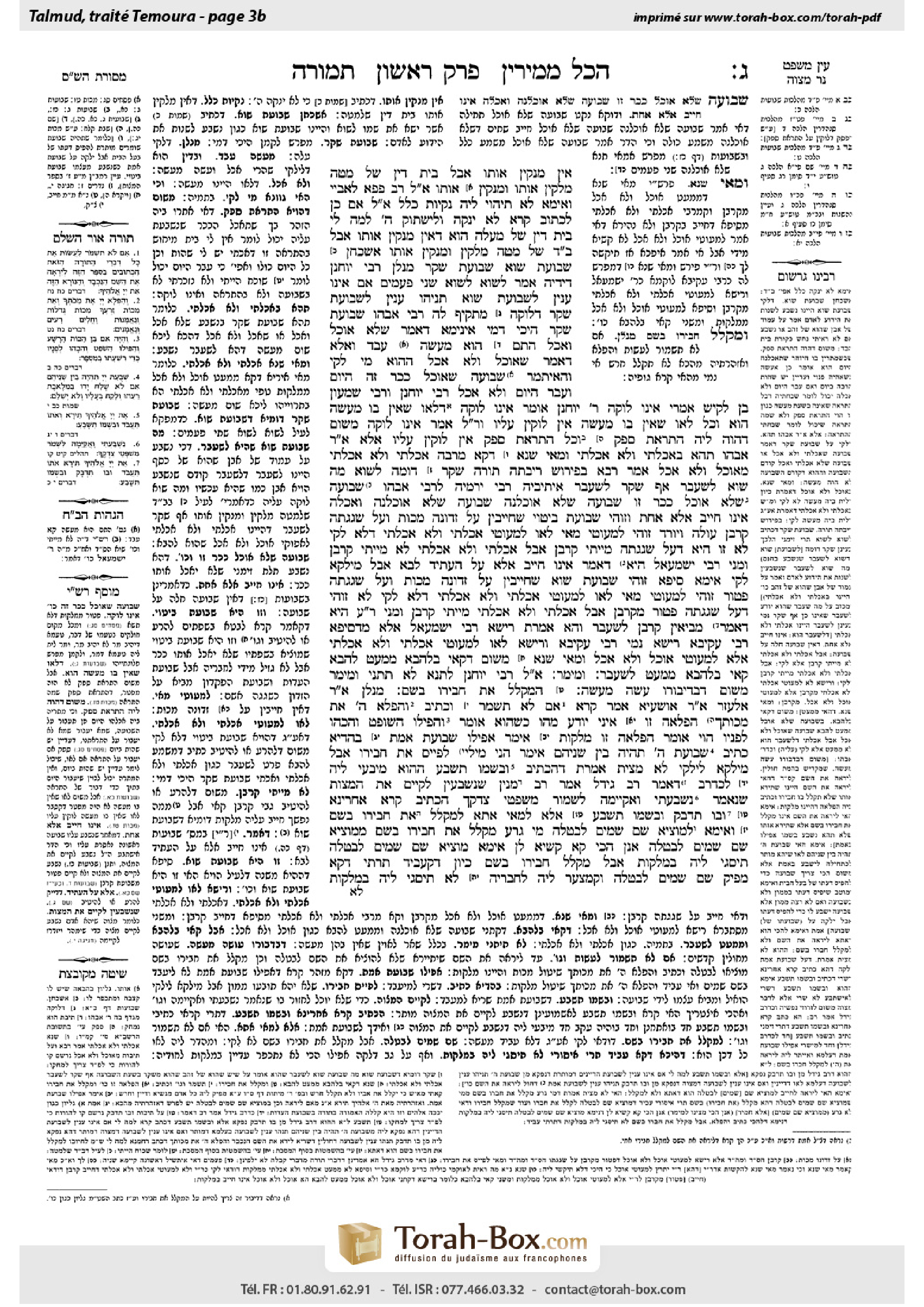
Temurah 3b: Talmud study for Daf Yomi
Daf Yomi is the daily study of one Talmud folio. Explore 37 tractates with scans, Hebrew text, Sefaria English and AI-generated French translations where annotated.
Passage selection and English or AI-generated French translation are available where the scan has annotations. Daf Study is independent of Torah-Box and Sefaria.
Browse Temurah · תמורה · All tractatesTemurah 3b text and translations
This page of Temurah includes the Aramaic text, an English translation and an AI-generated French translation, alongside the scan above.
תמורה ג׳ ב · Aramaic and Hebrew text
אֵין מְנַקִּין אוֹתוֹ, אֲבָל בֵּית דִּין שֶׁל מַטָּה מַלְקִין אוֹתוֹ וּמְנַקִּין אוֹתוֹ.
אֲמַר לֵיהּ רַב פָּפָּא לְאַבָּיֵי: וְאֵימָא לָא תִּיהְוֵי לֵיהּ נְקִיּוּת כְּלָל! אֲמַר לֵיהּ: אִם כֵּן, לִכְתּוֹב קְרָא ״לֹא יִנָּקֶה״ וְלִישְׁתּוֹק, ״ה׳״ לְמָה לִי? בֵּית דִּין שֶׁל מַעְלָה הוּא דְּאֵין מְנַקִּין אוֹתוֹ, אֲבָל בֵּית דִּין שֶׁל מַטָּה מַלְקִין וּמְנַקִּין אוֹתוֹ.
אַשְׁכְּחַן שְׁבוּעַת שָׁוְא, שְׁבוּעַת שֶׁקֶר מְנָלַן? רַבִּי יוֹחָנָן דִּידֵיהּ אָמַר: ״לַשָּׁוְא״ ״לַשָּׁוְא״ שְׁנֵי פְּעָמִים, אִם אֵינוֹ עִנְיָן לִשְׁבוּעַת שָׁוְא — תְּנֵיהוּ עִנְיָן לִשְׁבוּעַת שֶׁקֶר, דְּלוֹקֶה.
מַתְקֵיף לַהּ רַבִּי אֲבָהוּ: שְׁבוּעַת שֶׁקֶר הֵיכִי דָּמֵי? אִי נֵימָא דַּאֲמַר ״שֶׁלֹּא אוֹכַל״ וַאֲכַל — הָתָם (הוּא) מַעֲשֵׂה עֲבַד, וְאֶלָּא דְּאָמַר ״שֶׁאוֹכַל״ וְלָא אֲכַל — הָהוּא מִי לָקֵי? וְהָאִיתְּמַר: ״שְׁבוּעָה שֶׁאוֹכַל כִּכָּר זֶה הַיּוֹם״ וְעָבַר הַיּוֹם וְלֹא אָכַל — רַבִּי יוֹחָנָן וְרַבִּי שִׁמְעוֹן בֶּן לָקִישׁ אָמְרִי: אֵינוֹ לוֹקֶה.
רַבִּי יוֹחָנָן אוֹמֵר: אֵינוֹ לוֹקֶה, דְּלָאו שֶׁאֵין בּוֹ מַעֲשֶׂה הוּא, וְכׇל לָאו שֶׁאֵין בּוֹ מַעֲשֶׂה אֵין לוֹקִין עָלָיו. וְרֵישׁ לָקִישׁ אָמַר: אֵינוֹ לוֹקֶה, מִשּׁוּם דְּהָוֵה לֵיהּ הַתְרָאַת סָפֵק, וְכׇל הַתְרָאַת סָפֵק אֵין לוֹקִין עָלָיו!
אֶלָּא אָמַר רַבִּי אֲבָהוּ: תְּהֵא בְּ״אָכַלְתִּי״ וְ״לֹא אָכַלְתִּי״.
וּמַאי שְׁנָא דְּקָא מְרַבֵּה ״אָכַלְתִּי״ וְ״לֹא אָכַלְתִּי״ מֵ״אוֹכַל״ וְלֹא אָכַל? אָמַר רָבָא: בְּפֵירוּשׁ רִיבְּתָה תּוֹרָה שֶׁקֶר דּוֹמֶה לְשָׁוְא, מָה שָׁוְא לְשֶׁעָבַר, אַף שֶׁקֶר לְשֶׁעָבַר.
אֵיתִיבֵיהּ רַבִּי יִרְמְיָה לְרַבִּי אֲבָהוּ: ״שְׁבוּעָה שֶׁלֹּא אוֹכַל כִּכָּר זוֹ״, ״שְׁבוּעָה שֶׁלֹּא אוֹכְלֶנָּה״, ״שְׁבוּעָה שֶׁלֹּא אוֹכְלֶנָּה״, וַאֲכָלָהּ — אֵינוֹ חַיָּיב אֶלָּא אַחַת. וְזוֹהִי שְׁבוּעַת בִּיטּוּי, שֶׁחַיָּיבִין עַל זְדוֹנָהּ מַכּוֹת, וְעַל שִׁגְגָתָהּ קׇרְבָּן עוֹלֶה וְיוֹרֵד. זוֹהִי לְמַעוֹטֵי מַאי? לָאו לְמַעוֹטֵי ״אָכַלְתִּי״ וְלֹא ״אָכַלְתִּי״, דְּלָא לָקֵי?
לֹא, זוֹ הִיא דְּעַל שִׁגְגָתָהּ מַיְיתֵי קׇרְבָּן, אֲבָל ״אָכַלְתִּי״ וְ״לֹא אָכַלְתִּי״ לָא מַיְיתֵי קׇרְבָּן. וּמַנִּי? רַבִּי יִשְׁמָעֵאל הִיא, דְּאָמַר: אֵינוֹ חַיָּיב אֶלָּא עַל הֶעָתִיד לָבֹא, אֲבָל מִילְקָא לָקֵי.
אֵימָא סֵיפָא: זוֹהִי שְׁבוּעַת שָׁוְא שֶׁחַיָּיבִין עַל זְדוֹנָהּ מַכּוֹת, וְעַל שִׁגְגָתָהּ פָּטוּר. ״זוֹהִי״ לְמַעוֹטֵי מַאי? לָאו לְמַעוֹטֵי ״אָכַלְתִּי״ וְ״לֹא אָכַלְתִּי״, דְּלָא לָקֵי?
לֹא, זוֹהִי דְּעַל שִׁגְגָתָהּ פָּטוּר מִקׇּרְבָּן, אֲבָל ״אָכַלְתִּי״ וְ״לֹא אָכַלְתִּי״ — מַיְיתֵי קׇרְבָּן. וּמַנִּי? רַבִּי עֲקִיבָא הִיא, דְּאָמַר: מְבִיאִין קׇרְבָּן לְשֶׁעָבַר.
וְהָא אָמְרַתְּ רֵישָׁא רַבִּי יִשְׁמָעֵאל! אֶלָּא, מִדְּסֵיפָא רַבִּי עֲקִיבָא — רֵישָׁא נָמֵי רַבִּי עֲקִיבָא, וְרֵישָׁא לָאו לְמַעוֹטֵי ״אָכַלְתִּי״ וְ״לֹא אָכַלְתִּי״, אֶלָּא לְמַעוֹטֵי ״אוֹכַל״ וְלֹא אָכַל.
וּמַאי שְׁנָא, מִשּׁוּם דְּקָאֵי בִּלְהַבָּא — מְמַעֵט לְהַבָּא, קָאֵי בִּלְהַבָּא — מְמַעֵט לְשֶׁעָבַר?
וּמֵימֵר. אֲמַר לֵיהּ רַבִּי יוֹחָנָן לְתַנָּא: לָא תִּתְנִי ״וּמֵימֵר״, מִשּׁוּם דִּבְדִיבּוּרוֹ עָשָׂה מַעֲשֶׂה.
הַמְקַלֵּל אֶת חֲבֵירוֹ בַּשֵּׁם. מְנָלַן? אָמַר רַבִּי אֶלְעָזָר, אָמַר רַבִּי אוֹשַׁעְיָא: אָמַר קְרָא ״אִם לֹא תִשְׁמֹר״, וּכְתִיב ״וְהִפְלָא ה׳ אֶת מַכּוֹתְךָ״. הַפְלָאָה זוֹ אֵינִי יוֹדֵעַ מַהוּ, כְּשֶׁהוּא אוֹמֵר ״וְהִפִּילוֹ הַשּׁוֹפֵט וְהִכָּהוּ לְפָנָיו״ — הֱוֵי אוֹמֵר: הַפְלָאָה זוֹ מַלְקוֹת.
אֵימַר: אֲפִילּוּ שְׁבוּעַת אֱמֶת? בְּהֶדְיָא כְּתִיב: ״שְׁבוּעַת ה׳ תִּהְיֶה בֵּין שְׁנֵיהֶם״.
אֵימַר הָנֵי מִילֵּי לְפַיֵּיס אֶת חֲבֵירוֹ, אֲבָל מִילְקָא לִילְקֵי? לָא מָצֵית אָמְרַתְּ, דְּהָכְתִיב ״וּבִשְׁמוֹ תִּשָּׁבֵעַ״.
הָהוּא מִיבְּעֵי לֵיהּ לְכִדְרַב, דְּאָמַר רַב גִּידֵּל אָמַר רַב: מִנַּיִן שֶׁנִּשְׁבָּעִין לְקַיֵּים אֶת הַמִּצְוֹת? שֶׁנֶּאֱמַר: ״נִשְׁבַּעְתִּי וָאֲקַיֵּמָה לִשְׁמוֹר מִשְׁפְּטֵי צִדְקֶךָ״. הָכְתִיב קְרָא אַחֲרִינָא: ״וּבוֹ תִדְבָּק וּבִשְׁמוֹ תִּשָּׁבֵעַ״.
אֶלָּא לְמַאי אֲתָא — לִמְקַלֵּל אֶת חֲבֵירוֹ בַּשֵּׁם. וְאֵימָא — לְמוֹצִיא שֵׁם שָׁמַיִם לְבַטָּלָה? מִי גָּרַע מְקַלֵּל אֶת חֲבֵירוֹ בַּשֵּׁם מִמּוֹצִיא שֵׁם שָׁמַיִם לְבַטָּלָה?
אֲנַן, הָכִי קָא קַשְׁיָא לַן: אֵימָא מוֹצִיא שֵׁם שָׁמַיִם לְבַטָּלָה — תִּיסְגֵּי לֵיהּ בְּמַלְקוֹת, אֲבָל מְקַלֵּל חֲבֵירוֹ בַּשֵּׁם, כֵּיוָן דְּקָעָבֵיד תַּרְתֵּי, דְּקָא מַפֵּיק שֵׁם שָׁמַיִם לְבַטָּלָה וְקָמְצַעַר לֵיהּ לְחַבְרֵיהּ — לָא תִּיסְגֵּי לֵיהּ בְּמַלְקוֹת!
Temurah 3b · English translation
does not hold him guiltless, as repentance alone will not atone for the sin, but the lower, i.e., earthly, court flogs him, thereby allowing him to atone, and absolves him of guilt.
Rav Pappa said to Abaye: But why not say that the verse means he cannot be absolved of guilt at all? Abaye said to him: If so, let the verse write only: “Will not hold him guiltless,” and be silent. Why do I need the verse to specify: “For the Lord will not hold him guiltless”? This serves to teach that it is the higher court that will not hold him guiltless, but the lower court flogs him and absolves him of guilt.
§ The Gemara continues: We found a source for the halakha that one who takes an oath in vain using the name of God is flogged. From where do we derive that the same holds for a false oath? The Gemara answers: Rabbi Yoḥanan himself says the derivation: The verse states with regard to an oath taken in vain: “You shall not take the name of the Lord your God in vain; for the Lord will not hold him guiltless that takes His name in vain” (Exodus 20:7). It says: “In vain…in vain,” twice in this verse. If the second instance of the term is not necessary for the matter of an oath taken in vain, which is derived from the first instance, apply it to the matter of a false oath, to teach that one who takes such an oath is flogged.
Rabbi Abbahu objects to this explanation of Rabbi Yoḥanan: What are the circumstances of the false oath under discussion? If we say that the one taking the oath said: I take an oath that I will not eat a certain item, and he then ate that item; there he performed an action to violate his oath by eating the item, and the prohibition would then involve an action. And if it was rather a case where he said: I take an oath that I will eat a certain item, and he did not eat that item; is that individual flogged? But wasn’t it stated: If one says: I take an oath that I will eat this loaf today, and the day passed and he had not eaten it, Rabbi Yoḥanan and Rabbi Shimon ben Lakish both say: He is not flogged.
Rabbi Yoḥanan says that he is not flogged, as it is a prohibition that does not involve an action, and one is not flogged for any prohibition that does not involve an action. And Reish Lakish says that he is not flogged, as there was only an uncertain forewarning for the transgressor. One must be warned immediately before the transgression to be held liable, but here there was no single moment of transgression, and one is not flogged for any transgression that follows an uncertain forewarning. If Rabbi Yoḥanan holds he is not flogged, to what case is he referring when he states that one is flogged for a false oath even though no action is involved?
Rather, Rabbi Abbahu says: Let the case be where one says: I take an oath that I ate a certain item, and in fact he did not eat it; or he said: I take an oath that I did not eat a certain item, and in fact he did eat it. In these cases, he transgresses the prohibition by speech alone, without an action.
The Gemara asks: And what is different about an oath concerning the past, that the verse includes one who takes an oath of: I ate, or: I did not eat, as liable to be flogged, more than one who takes an oath of: I will eat, and then did not eat? In both cases, there is no action performed. Rava says: The Torah explicitly includes a case of a false oath that is similar to a case of an oath taken in vain: Just as an oath taken in vain refers to the past, so too, the false oath for which one is flogged must pertain to the past.
Rabbi Yirmeya raised an objection to Rabbi Abbahu from a mishna (Shevuot 27b): If one says: I take an oath that I will not eat this loaf; I take an oath that I will not eat it; I take an oath that I will not eat it, and he then ate it, he is liable for only one violation. And this is the oath of an utterance for which one is liable to receive lashes for its intentional violation, and to bring a sliding-scale offering for its unwitting violation. Rabbi Yirmeya asks: When the mishna uses the limiting term: This is the oath, what does it serve to exclude? Is it not to exclude a case where one said: I take an oath that I ate a certain item, when in fact he did not eat it, or: I take an oath that I did not eat a certain item, when he did eat it, to teach that he is not flogged in those cases? This would contradict the explanation of Rabbi Abbahu.
The Gemara answers: No, in both cases one is flogged for violating the prohibition intentionally. Rather, the phrase means: This is the oath for which one brings an offering for its unwitting violation, but in a case where one unwittingly said: I ate a certain item, when he in fact did not eat it, or: I did not eat a certain item, when he did eat it, he does not bring an offering. And whose opinion does this mishna represent? It is the opinion of Rabbi Yishmael, who said: One is liable to bring an offering only for an oath that refers to the future, but one is flogged even for an oath that pertains to the past.
The Gemara counters: But say the latter clause of the mishna (Shevuot 29a): If one takes an oath that a stone is gold or some similar absurdity, this is the oath taken in vain, for which one is liable to receive lashes if he utters it intentionally and for which one is exempt from bringing an offering if he utters it unwittingly. What does the limiting term: This is the oath, used by the mishna serve to exclude? Does it not serve to exclude a case where one said: I ate a certain item, when he in fact did not eat it, or: I did not eat a certain item, when he did eat it, to teach that he is not flogged in those cases?
The Gemara answers: No, in both cases one is flogged for violating the prohibition intentionally. Rather, the phrase means: This is the oath for which one is exempt from bringing an offering if he utters it unwittingly, but in a case where one said: I ate a certain item, when he in fact did not eat it, or: I did not eat a certain item, when he did eat it, he brings an offering. And whose opinion does this represent? It is the opinion of Rabbi Akiva, who said: One brings an offering even for the violation of an oath that refers to the past.
The Gemara protests: But didn’t you say earlier that the first clause represents the opinion of Rabbi Yishmael, that one does not bring an offering for a false oath pertaining to the past? Rather, from the fact that the latter clause represents the opinion of Rabbi Akiva, it follows that the first clause must represent the opinion of Rabbi Akiva as well. And one must therefore suggest an alternative explanation of the first clause. The phrase: This is the oath, employed there does not, as previously claimed, serve to exclude a case where one said: I ate a certain item, or: I did not eat a certain item. Rather, it serves to exclude a case where one said: I will eat a certain item, and he did not subsequently eat it.
The Gemara asks: And what is different about an oath pertaining to the future, that the mishna should exclude it specifically? The Gemara responds: Since this clause of the mishna deals with an oath that pertains to the future, it stands to reason that it would exclude an oath pertaining to the future. If it deals with an oath that pertains to the future, why would it exclude an oath pertaining to the past? In summary, the entire mishna is in accordance with the opinion of Rabbi Akiva. The first clause excludes from the punishment of lashes the passive violation of an oath pertaining to the future, and the latter clause includes in the obligation to bring an offering a false oath pertaining to the past if he uttered it unwittingly. Neither clause contradicts the explanation of Rabbi Abbahu.
§ In listing those who incur the punishment of lashes even though they did not perform an action in their transgression, Rabbi Yosei HaGelili was cited above as including: And one who effects substitution. The Gemara adds: Rabbi Yoḥanan said to the tanna who would recite the baraitot in his academy: Do not teach: And one who effects substitution, in this regard, because one who effects substitution performs an action of consecration by his speech.
§ Rabbi Yosei HaGelili also lists one who curses another using the name of God as liable to be flogged. The Gemara asks: From where do we derive this? Rabbi Elazar says that Rabbi Oshaya says: The verse states: “If you will not observe to perform all the words of this law that are written in this book, that you may fear this glorious and awesome name, the Lord your God” (Deuteronomy 28:58). This refers to one who curses using the name of God. And it is written immediately thereafter: “Then the Lord will make your plagues wondrous [vehifla]” (Deuteronomy 28:59). With regard to this term hafla’a, I do not know what its meaning is. When it says: “And the judge shall cause him to lie down [vehippilo] and to be beaten before him” (Deuteronomy 25:2), you must say that the term hafla’a is referring to lashes.
The Gemara asks: Why not say that even one who utters a true oath is flogged, as this too could be considered exhibiting insufficient fear of God’s name? The Gemara answers: It is written explicitly that a bailee may take an oath in court, as the verse states: “The oath of the Lord shall be between them both, to see whether he has not damaged his neighbor’s goods” (Exodus 22:10).
The Gemara counters: Why not say that this statement in the verse means only that a bailee is able to appease the other, i.e., the owner, and exempt himself from payment for the damaged goods, but he should nevertheless be flogged? The Gemara answers: You cannot say this, as it is written: “You shall fear the Lord your God, and Him you shall serve, and by His name you shall swear” (Deuteronomy 6:13). This verse clearly indicates that it is permitted to take a truthful oath using the name of God.
The Gemara asks: Isn’t that verse required as a source for the halakha of Rav? As Rav Giddel said that Rav said: From where is it derived that it is permitted for one to take an oath obligating himself to fulfill the mitzvot? It is derived from a verse, as it is stated: “I have sworn, and have confirmed it, to observe Your righteous ordinances” (Psalms 119:106). The Gemara counters that there is another source: Isn’t another verse written: “You shall fear the Lord your God; Him you shall serve; and to Him you shall cleave, and by His name you shall swear” (Deuteronomy 10:20). This second verse teaches that it is permitted for one to take a truthful oath.
The Gemara resumes the discussion of one who curses another: Rather, the term vehifla in Deuteronomy 28:59 comes to teach what? It comes to teach that one who curses another using the name of God is flogged. The Gemara asks: But why not say that that verse refers to one who pronounces the name of Heaven in vain? The Gemara answers: Even if it does, is cursing another using the name of God any less of a sin than pronouncing the name of Heaven in vain? If one is flogged for the latter, certainly one is flogged for the former.
The Gemara clarifies its question: This is what is difficult for us: One can say that for one who pronounces the name of Heaven in vain, it is sufficient for him to receive lashes to atone for his act, but in the case of one who curses another using the name of God, since he has performed two improper acts, first that he pronounces the name of Heaven in vain, and second that he inflicts pain on another, it should not be sufficient for him to receive lashes to atone for his act.
Temurah 3b · Traduction française (IA)
ne le tient pas pour innocent, car la repentance seule n’expie pas le péché ; mais le tribunal inférieur, c’est-à-dire terrestre, le flagelle, lui permettant ainsi d’expier et le déchargeant de sa culpabilité.
Rav Pappa dit à Abaye : Mais pourquoi ne pas dire que le verset signifie qu’il ne peut en aucun cas être déchargé de sa culpabilité ? Abaye lui dit : Si tel était le cas, que le verset écrive seulement : « Ne le tiendra pas pour innocent », et s’arrête là. Pourquoi le verset doit-il préciser : « Car le Seigneur ne le tiendra pas pour innocent » ? Cela enseigne que c’est le tribunal supérieur qui ne le tiendra pas pour innocent, tandis que le tribunal inférieur le flagelle et le décharge de sa culpabilité.
§ La Guemara poursuit : Nous avons trouvé une source pour la halakha selon laquelle celui qui prête un serment vain en employant le nom de Dieu est flagellé. D’où déduisons-nous qu’il en va de même pour un faux serment ? La Guemara répond : Rabbi Yoḥanan lui-même donne l’explication : le verset dit au sujet d’un serment vain : « Tu ne prononceras pas le nom du Seigneur ton Dieu en vain, car le Seigneur ne tiendra pas pour innocent celui qui prononce son nom en vain » (Exode 20:7). L’expression « en vain… en vain » apparaît deux fois dans ce verset. Si la seconde occurrence n’est pas nécessaire pour le cas du serment vain, qui se déduit de la première, applique-la au cas du faux serment, afin d’enseigner que celui qui prête un tel serment est flagellé.
Rabbi Abbahu objecte à cette explication de Rabbi Yoḥanan : Dans quelles circonstances s’applique le faux serment dont il est question ? Si l’on suppose que celui qui prête serment a dit : « Je jure que je ne mangerai pas tel aliment », puis l’a mangé, il a alors accompli un acte qui viole son serment en mangeant cet aliment ; l’interdit implique donc un acte. Et s’il s’agissait plutôt du cas où il a dit : « Je jure que je mangerai tel aliment », mais ne l’a pas mangé, cet homme est-il flagellé ? Pourtant, il a été enseigné : Si quelqu’un dit : « Je jure que je mangerai cette miche aujourd’hui », que le jour s’écoule sans qu’il l’ait mangée, Rabbi Yoḥanan et Rabbi Shimon ben Lakish disent tous deux : il n’est pas flagellé.
Rabbi Yoḥanan dit qu’il n’est pas flagellé, car il s’agit d’un interdit qui n’implique pas d’acte, et on n’est flagellé pour aucun interdit qui n’implique pas d’acte. Reish Lakish dit qu’il n’est pas flagellé, car le transgresseur n’a reçu qu’un avertissement incertain. Il faut avertir quelqu’un immédiatement avant la transgression pour le tenir responsable ; or, ici, il n’y a pas eu de moment précis de transgression, et on n’est pas flagellé pour une transgression précédée d’un avertissement incertain. Si Rabbi Yoḥanan considère qu’il n’est pas flagellé, à quel cas se réfère-t-il lorsqu’il affirme que l’on est flagellé pour un faux serment, bien qu’aucun acte ne soit impliqué ?
Rabbi Abbahu dit plutôt : Prenons le cas où quelqu’un dit : « Je jure que j’ai mangé tel aliment », alors qu’en réalité il ne l’a pas mangé ; ou bien il dit : « Je jure que je n’ai pas mangé tel aliment », alors qu’en réalité il l’a mangé. Dans ces cas, il transgresse l’interdit par la parole seule, sans accomplir d’acte.
La Guemara demande : En quoi un serment portant sur le passé diffère-t-il, de sorte que le verset inclut celui qui jure : « J’ai mangé » ou « Je n’ai pas mangé » parmi ceux qui sont passibles de flagellation, plutôt que celui qui jure : « Je mangerai », puis ne mange pas ? Dans les deux cas, aucun acte n’est accompli. Rava dit : La Torah inclut explicitement un cas de faux serment semblable à un cas de serment vain : de même qu’un serment vain porte sur le passé, le faux serment pour lequel on est flagellé doit lui aussi porter sur le passé.
Rabbi Yirmeya soulève une objection à Rabbi Abbahu à partir d’une Michna (Shevouot 27b) : Si quelqu’un dit : « Je jure que je ne mangerai pas cette miche ; je jure que je ne la mangerai pas ; je jure que je ne la mangerai pas », puis la mange, il n’est responsable que d’une seule transgression. Et il s’agit du serment d’énoncé dont la violation intentionnelle rend passible de flagellation et dont la violation involontaire impose d’apporter un sacrifice à valeur variable. Rabbi Yirmeya demande : Que vient exclure la formule restrictive de la Michna : « C’est là le serment » ? N’exclut-elle pas le cas où quelqu’un a dit : « Je jure que j’ai mangé tel aliment », alors qu’en réalité il ne l’a pas mangé, ou : « Je jure que je n’ai pas mangé tel aliment », alors qu’il l’a mangé, pour enseigner qu’il n’est pas flagellé dans ces cas ? Cela contredirait l’explication de Rabbi Abbahu.
La Guemara répond : Non, dans les deux cas, on est flagellé pour avoir transgressé l’interdit intentionnellement. La formule signifie plutôt : « C’est là le serment » pour la violation involontaire duquel on apporte un sacrifice ; mais dans le cas où quelqu’un a dit involontairement : « J’ai mangé tel aliment », alors qu’en réalité il ne l’a pas mangé, ou : « Je n’ai pas mangé tel aliment », alors qu’il l’a mangé, il n’apporte pas de sacrifice. Et de qui cette Michna exprime-t-elle l’opinion ? De Rabbi Yishmael, qui a dit que l’on n’est tenu d’apporter un sacrifice que pour un serment portant sur l’avenir, mais que l’on est flagellé même pour un serment portant sur le passé.
La Guemara objecte : Mais considérons la clause suivante de la Michna (Shevouot 29a) : Si quelqu’un jure qu’une pierre est en or, ou profère une absurdité semblable, il s’agit d’un serment vain ; s’il le prononce intentionnellement, il est passible de flagellation, et s’il le prononce involontairement, il est dispensé d’apporter un sacrifice. Que vient exclure la formule restrictive « C’est là le serment » employée par la Michna ? Ne sert-elle pas à exclure le cas où quelqu’un a dit : « J’ai mangé tel aliment », alors qu’en réalité il ne l’a pas mangé, ou : « Je n’ai pas mangé tel aliment », alors qu’il l’a mangé, pour enseigner qu’il n’est pas flagellé dans ces cas ?
La Guemara répond : Non, dans les deux cas, on est flagellé pour avoir transgressé l’interdit intentionnellement. La formule signifie plutôt : « C’est là le serment » pour lequel on est dispensé d’apporter un sacrifice lorsqu’on le prononce involontairement ; mais dans le cas où quelqu’un a dit : « J’ai mangé tel aliment », alors qu’en réalité il ne l’a pas mangé, ou : « Je n’ai pas mangé tel aliment », alors qu’il l’a mangé, il apporte un sacrifice. Et de qui cette opinion est-elle celle ? De Rabbi Akiva, qui a dit que l’on apporte un sacrifice même pour la violation d’un serment portant sur le passé.
La Guemara proteste : Mais n’as-tu pas dit plus tôt que la première clause exprime l’opinion de Rabbi Yishmael, selon laquelle on n’apporte pas de sacrifice pour un faux serment portant sur le passé ? Puisque la clause suivante exprime l’opinion de Rabbi Akiva, il s’ensuit que la première clause doit elle aussi exprimer l’opinion de Rabbi Akiva. Il faut donc proposer une autre explication de la première clause. La formule « C’est là le serment » qui y est employée ne sert pas, comme on l’avait affirmé, à exclure le cas où quelqu’un a dit : « J’ai mangé tel aliment » ou « Je n’ai pas mangé tel aliment ». Elle sert plutôt à exclure le cas où quelqu’un a dit : « Je mangerai tel aliment », mais ne l’a pas mangé par la suite.
La Guemara demande : En quoi un serment portant sur l’avenir diffère-t-il, pour que la Michna l’exclue précisément ? La Guemara répond : Puisque cette clause de la Michna traite d’un serment portant sur l’avenir, il est logique qu’elle exclue un serment portant sur l’avenir. Si elle traite d’un serment portant sur l’avenir, pourquoi exclurait-elle un serment portant sur le passé ? En résumé, toute la Michna suit l’opinion de Rabbi Akiva. La première clause exclut de la peine de flagellation la violation passive d’un serment portant sur l’avenir, et la clause suivante inclut dans l’obligation d’apporter un sacrifice un faux serment portant sur le passé, lorsqu’il a été prononcé involontairement. Aucune des deux clauses ne contredit l’explication de Rabbi Abbahu.
§ Dans l’énumération de ceux qui encourent la peine de flagellation même s’ils n’ont pas accompli d’acte lors de leur transgression, Rabbi Yosei HaGelili a été cité comme incluant « celui qui effectue une substitution ». La Guemara ajoute : Rabbi Yoḥanan dit au tanna qui récitait les baraïtot dans son académie : Ne cite pas, dans ce contexte, « celui qui effectue une substitution », car celui qui effectue une substitution accomplit un acte de consécration par sa parole.
§ Rabbi Yosei HaGelili mentionne également celui qui maudit autrui en employant le nom de Dieu comme passible de flagellation. La Guemara demande : D’où déduisons-nous cela ? Rabbi Elazar dit au nom de Rabbi Oshaya : Le verset dit : « Si tu ne veilles pas à mettre en pratique toutes les paroles de cette loi, écrites dans ce livre, en craignant ce nom glorieux et redoutable, le Seigneur ton Dieu » (Deutéronome 28:58). Cela désigne celui qui maudit en employant le nom de Dieu. Et il est écrit immédiatement après : « Alors le Seigneur rendra tes plaies extraordinaires [vehifla] » (Deutéronome 28:59). Quant au terme hafla’a, j’ignore ce qu’il signifie. Mais lorsqu’il est dit : « Le juge le fera coucher [vehippilo] et lui fera donner des coups devant lui » (Deutéronome 25:2), il faut conclure que le terme hafla’a fait référence à la flagellation.
La Guemara demande : Pourquoi ne pas dire que même celui qui prononce un serment véridique est flagellé, puisque cela pourrait également être considéré comme une crainte insuffisante du nom de Dieu ? La Guemara répond : Il est explicitement écrit qu’un dépositaire peut prêter serment devant un tribunal, comme le dit le verset : « Le serment du Seigneur interviendra entre eux deux, pour déterminer s’il n’a pas porté atteinte aux biens de son prochain » (Exode 22:10).
La Guemara objecte : Pourquoi ne pas dire que cette déclaration du verset signifie seulement qu’un dépositaire peut apaiser l’autre, c’est-à-dire le propriétaire, et se dispenser de payer les biens endommagés, mais qu’il devrait néanmoins être flagellé ? La Guemara répond : On ne peut pas dire cela, car il est écrit : « Tu craindras le Seigneur ton Dieu, tu le serviras et tu prêteras serment par son nom » (Deutéronome 6:13). Ce verset indique clairement qu’il est permis de prêter un serment véridique en employant le nom de Dieu.
La Guemara demande : Ce verset n’est-il pas nécessaire comme source de la halakha de Rav ? Car Rav Giddel a dit au nom de Rav : D’où déduit-on qu’il est permis de prêter serment en s’engageant à accomplir les mitsvot ? On le déduit d’un verset, comme il est dit : « J’ai juré et je l’ai confirmé, d’observer tes justes jugements » (Psaumes 119:106). La Guemara objecte qu’il existe une autre source : un autre verset n’est-il pas écrit : « Tu craindras le Seigneur ton Dieu ; tu le serviras ; tu t’attacheras à lui et tu prêteras serment par son nom » (Deutéronome 10:20) ? Ce second verset enseigne qu’il est permis de prêter un serment véridique.
La Guemara reprend la discussion au sujet de celui qui maudit autrui : Que vient donc enseigner le terme vehifla en Deutéronome 28:59 ? Il vient enseigner que celui qui maudit autrui en employant le nom de Dieu est flagellé. La Guemara demande : Mais pourquoi ne pas dire que ce verset concerne celui qui prononce en vain le nom du Ciel ? La Guemara répond : Même si c’est le cas, celui qui maudit autrui en employant le nom de Dieu commet-il un péché moins grave que celui qui prononce en vain le nom du Ciel ? Si ce dernier est flagellé, à plus forte raison le premier l’est-il.
La Guemara précise sa question : Voici ce qui nous pose problème : On peut dire que, pour celui qui prononce en vain le nom du Ciel, il suffit de recevoir la flagellation pour expier son acte ; mais, dans le cas de celui qui maudit autrui en employant le nom de Dieu, puisqu’il a commis deux actes répréhensibles — d’abord prononcer en vain le nom du Ciel, ensuite faire souffrir autrui —, la flagellation ne devrait pas suffire à expier son acte.
Traduction française générée par IA à partir de l’édition anglaise de Sefaria. Vérifie toujours un passage avec le texte source.
Text from Sefaria: William Davidson Edition - Vocalized Aramaic (CC BY NC); William Davidson Edition - English (CC BY NC).