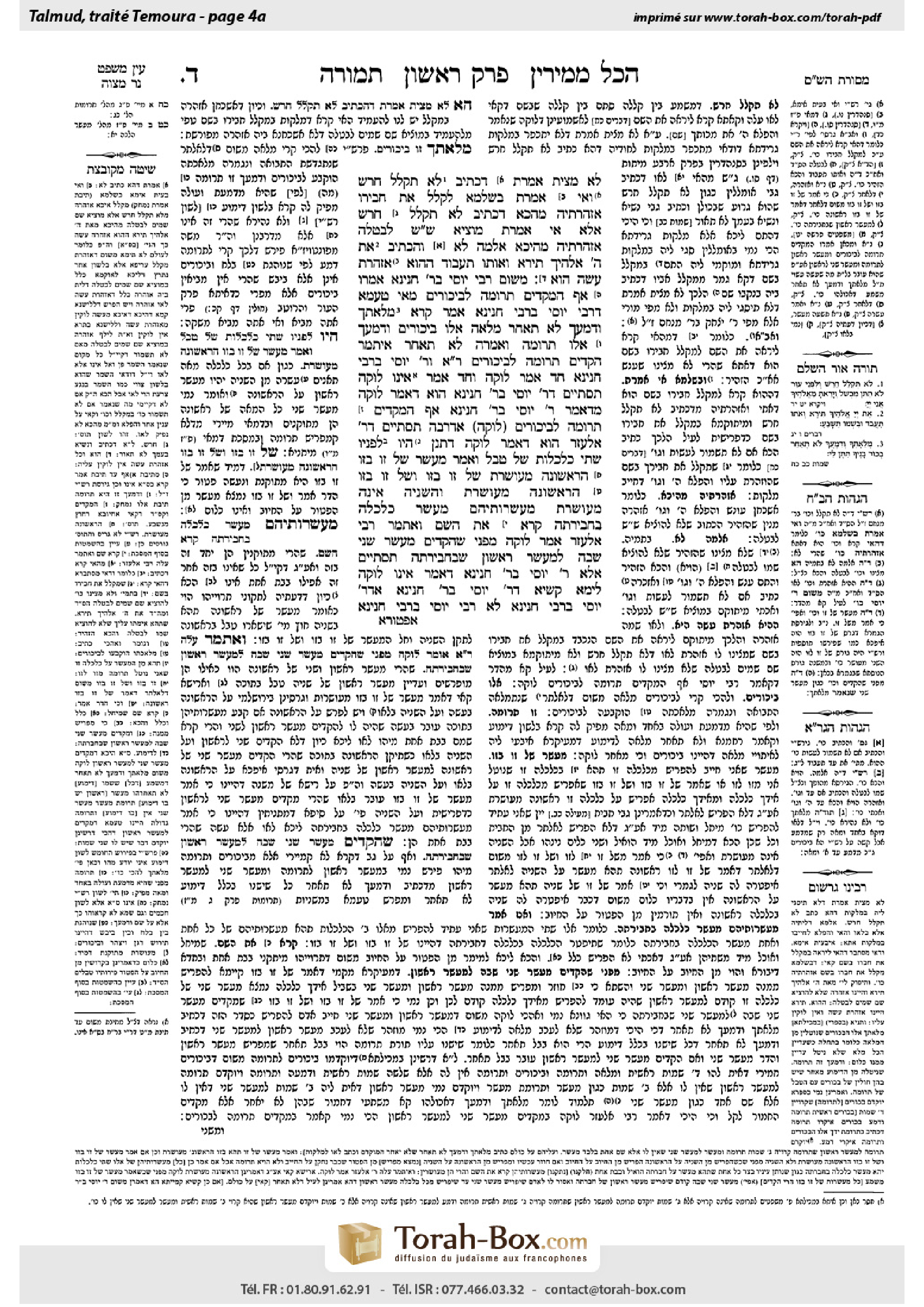
Temurah 4a: Talmud study for Daf Yomi
Daf Yomi is the daily study of one Talmud folio. Explore 37 tractates with scans, Hebrew text, Sefaria English and AI-generated French translations where annotated.
Passage selection and English or AI-generated French translation are available where the scan has annotations. Daf Study is independent of Torah-Box and Sefaria.
Browse Temurah · תמורה · All tractatesTemurah 4a text and translations
This page of Temurah includes the Aramaic text, an English translation and an AI-generated French translation, alongside the scan above.
תמורה ד׳ א · Aramaic and Hebrew text
לָא מָצֵית אָמְרַתְּ, דִּכְתִיב ״לֹא תְקַלֵּל חֵרֵשׁ״, וְאִי אָמְרַתְּ בִּשְׁלָמָא לְקַלֵּל אֶת חֲבֵירוֹ — אַזְהַרְתֵּיהּ מֵהָכָא דִּכְתִיב ״לֹא תְקַלֵּל חֵרֵשׁ״, אֶלָּא אִי אָמְרַתְּ מוֹצִיא שֵׁם שָׁמַיִם לְבַטָּלָה — אַזְהַרְתֵּיהּ מֵהֵיכָא?
אַלְּמָה לָא? וְהָכְתִיב: ״אֶת ה׳ אֱלֹהֶיךָ תִּירָא וְאֹתוֹ תַעֲבוֹד״! הָהוּא אַזְהָרַת עֲשֵׂה הוּא.
מִשּׁוּם רַבִּי יוֹסֵי בְּרַבִּי חֲנִינָא אָמְרוּ: אַף הַמַּקְדִּים תְּרוּמָה לְבִיכּוּרִים. מַאי טַעְמָא דְּרַבִּי יוֹסֵי בְּרַבִּי חֲנִינָא? אָמַר קְרָא: ״מְלֵאָתְךָ וְדִמְעֲךָ לֹא תְאַחֵר״ — ״מְלֵאָה״ אֵלּוּ בִּיכּוּרִים, ״וְדִמְעֲךָ״ אֵלּוּ תְּרוּמָה, וְאָמְרַתְּ ״לֹא תְאַחֵר״.
אִיתְּמַר: הִקְדִּים תְּרוּמָה לְבִיכּוּרִים, רַבִּי אֶלְעָזָר וְרַבִּי יוֹסֵי בְּרַבִּי חֲנִינָא, חַד אָמַר: לוֹקֶה, וְחַד אָמַר: אֵינוֹ לוֹקֶה. תִּסְתַּיֵּים דְּרַבִּי יוֹסֵי בְּרַבִּי חֲנִינָא הוּא דְּאָמַר לוֹקֶה, מִדְּאָמַר רַבִּי יוֹסֵי בְּרַבִּי חֲנִינָא: אַף הַמַּקְדִּים תְּרוּמָה לְבִיכּוּרִים לוֹקֶה.
אַדְּרַבָּה, תִּסְתַּיֵּים דְּרַבִּי אֶלְעָזָר הוּא דְּאָמַר לוֹקֶה, דִּתְנַן: הָיוּ לְפָנָיו שְׁתֵּי כַּלְכַּלּוֹת שֶׁל טֶבֶל, וְאָמַר: ״מַעֲשֵׂר שֶׁל זוֹ בָּזוֹ״ — הָרִאשׁוֹנָה מְעוּשֶּׂרֶת.
״שֶׁל זוֹ בָּזוֹ וְשֶׁל זוֹ בָּזוֹ״ — הָרִאשׁוֹנָה מְעוּשֶּׂרֶת, וְהַשְּׁנִיָּה אֵינָהּ מְעוּשֶּׂרֶת. ״מַעַשְׂרוֹתֵיהֶם מַעְשַׂר כַּלְכַּלָּה בַּחֲבֶירְתָּהּ״ — קְרָא אֶת הַשֵּׁם.
וְאִתְּמַר, רַבִּי אֶלְעָזָר אָמַר: לוֹקֶה, מִפְּנֵי שֶׁהִקְדִּים מַעֲשֵׂר שֵׁנִי שֶׁבָּהּ לְמַעֲשֵׂר רִאשׁוֹן שֶׁבַּחֲבֶירְתָּהּ. תִּסְתַּיֵּים.
אֶלָּא רַבִּי יוֹסֵי בְּרַבִּי חֲנִינָא, דְּאָמַר אֵינוֹ לוֹקֶה, לֵימָא קַשְׁיָא דְּרַבִּי יוֹסֵי בְּרַבִּי חֲנִינָא אַדְּרַבִּי יוֹסֵי בְּרַבִּי חֲנִינָא!
לָא, רַבִּי יוֹסֵי בְּרַבִּי חֲנִינָא
Temurah 4a · English translation
The Gemara responds: You cannot say that Deuteronomy 28:59 is referring to one who pronounces the name of Heaven in vain, as it is written: “You shall not curse the deaf” (Leviticus 19:14), which prohibits all curses, even those using God’s name. Granted, if you say that Deuteronomy 28:59 is referring to cursing another, one can say that the separate warning of punishment for this prohibition is from here, as it is written: “You shall not curse the deaf.” One verse articulates the prohibition, and the other indicates liability for punishment. But if you say that Deuteronomy 28:59 is referring to pronouncing the name of Heaven in vain, from where is the warning of this prohibition? A prohibition requires two verses to include liability for punishment.
The Gemara counters: Why not, i.e., what is the difficulty? But isn’t it written: “You shall fear the Lord your God, and Him you shall serve” (Deuteronomy 6:13)? Fearing God certainly includes not pronouncing His name in vain, and this verse can therefore serve as the warning. The Gemara answers: That verse is a warning stated as a positive mitzva. In order to qualify as a warning, the verse must prohibit, not command.
§ It was stated (3a): They said in the name of Rabbi Yosei, son of Rabbi Ḥanina: Also one who separates teruma prior to the separation of the first fruits is liable to be flogged. The Gemara explains: What is the reason for the prohibition mentioned by Rabbi Yosei, son of Rabbi Ḥanina? The verse states: “You shall not delay to offer of the fullness of your harvest and the outflow of your presses” (Exodus 22:28). When the verse states: The fullness of the harvest, these are the first fruits; and when the verse states: “And the outflow of your presses,” this is teruma. And the verse says: “You shall not delay,” i.e., do not delay the separation of the first fruits by separating teruma beforehand.
It was stated: If one separated teruma prior to the separation of the first fruits, Rabbi Elazar and Rabbi Yosei, son of Rabbi Ḥanina, disagreed. One said that he is flogged, and one said that he is not flogged. The Gemara suggests: It may be concluded that it is Rabbi Yosei, son of Rabbi Ḥanina, who said that he is flogged, from the fact that Rabbi Yosei, son of Rabbi Ḥanina, said earlier: Also one who separates teruma prior to the separation of the first fruits is flogged.
The Gemara suggests: On the contrary, it may be concluded that it is Rabbi Elazar who said that he is flogged, as we learned in a mishna (Demai 7:6): If two baskets of untithed produce were before someone, and he said: The tithe of this basket is in that basket, then the produce of the first basket is thereby tithed. And when he separates sufficient tithe from the second basket to exempt both baskets, the produce of the second basket will be considered tithed as well.
If he said: The tithe of this basket is in that basket, and the tithe of that basket is in this basket, the produce of the first basket is tithed, as stated, but the produce of the second basket is not tithed. Since the produce of the first basket had just been tithed, it could not be used to tithe the second, since the tithe may be separated only from untithed produce. If he said: Their tithes should be separated as tithe, each basket in the other, he has declared the assignation of tithe concurrently, and the produce of both baskets is thereby tithed.
And it was stated with regard to the first clause of that mishna that Rabbi Elazar said: He is flogged, because he separated the second tithe of the produce of the first basket prior to the separation of the first tithe of the other basket. One must always separate tithes in order, the first tithe before the second tithe. If Rabbi Elazar holds that one is flogged for separating tithes in the wrong order, he presumably also holds that one is flogged for separating teruma before first fruits. The Gemara affirms: It may be concluded that Rabbi Elazar is the one who said he is flogged.
The Gemara asks: But if that is so, it follows that it is Rabbi Yosei, son of Rabbi Ḥanina, who said that he is not flogged. Shall we say then that the statement of Rabbi Yosei, son of Rabbi Ḥanina, here poses a difficulty to the earlier statement of Rabbi Yosei, son of Rabbi Ḥanina, that one who separates teruma before separating first fruits is flogged?
The Gemara answers: No, when Rabbi Yosei, son of Rabbi Ḥanina, stated simply: Even one who separates teruma prior to the separation of the first fruits,
Temurah 4a · Traduction française (IA)
La Guemara répond : On ne peut pas dire que Deutéronome 28:59 se rapporte à celui qui prononce le Nom du Ciel en vain, car il est écrit : « Tu ne maudiras pas le sourd » (Lévitique 19:14), ce qui interdit toute malédiction, même lorsqu’on emploie le nom de Dieu. Certes, si l’on dit que Deutéronome 28:59 se rapporte au fait de maudire autrui, on peut dire que l’avertissement distinct relatif à cette interdiction se trouve ici, puisqu’il est écrit : « Tu ne maudiras pas le sourd. » Un verset énonce l’interdiction, et l’autre indique qu’elle entraîne une peine. Mais si l’on dit que Deutéronome 28:59 se rapporte au fait de prononcer le Nom du Ciel en vain, d’où tire-t-on l’avertissement relatif à cette interdiction ? Il faut deux versets pour qu’une interdiction entraîne une peine.
La Guemara objecte : Pourquoi pas ? Autrement dit, quelle est la difficulté ? N’est-il pas écrit : « Tu craindras le Seigneur ton Dieu, et tu Le serviras » (Deutéronome 6:13) ? Craindre Dieu implique certainement de ne pas prononcer Son nom en vain ; ce verset peut donc servir d’avertissement. La Guemara répond : Ce verset énonce un avertissement sous la forme d’une mitsva positive. Pour constituer un avertissement, le verset doit interdire, et non ordonner.
§ Il a été rapporté (3a) : On a dit au nom de Rabbi Yosei, fils de Rabbi Ḥanina : Celui qui prélève la terouma avant les prémices est lui aussi passible de flagellation. La Guemara explique : Quel est le fondement de l’interdiction mentionnée par Rabbi Yosei, fils de Rabbi Ḥanina ? Le verset dit : « Tu ne tarderas pas à offrir le produit abondant de ta moisson et ce qui s’écoule de tes pressoirs » (Exode 22:28). L’expression « le produit abondant de ta moisson » désigne les prémices, et « ce qui s’écoule de tes pressoirs » désigne la terouma. Puis le verset dit : « Tu ne tarderas pas », c’est-à-dire : ne retarde pas le prélèvement des prémices en prélevant la terouma avant elles.
Il a été rapporté : Si quelqu’un prélève la terouma avant les prémices, Rabbi Elazar et Rabbi Yosei, fils de Rabbi Ḥanina, sont en désaccord. L’un dit qu’il est passible de flagellation, l’autre qu’il ne l’est pas. La Guemara suggère : On peut conclure que c’est Rabbi Yosei, fils de Rabbi Ḥanina, qui dit qu’il est passible de flagellation, puisque Rabbi Yosei, fils de Rabbi Ḥanina, a dit précédemment : Celui qui prélève la terouma avant les prémices est lui aussi passible de flagellation.
La Guemara suggère : Au contraire, on peut conclure que c’est Rabbi Elazar qui dit qu’il est passible de flagellation, comme nous l’avons appris dans une Michna (Demai 7:6) : Si deux paniers de produits non dîmés se trouvent devant quelqu’un et qu’il dit : « La dîme de ce panier se trouve dans cet autre panier », les produits du premier panier sont alors dîmés. Lorsqu’il prélève ensuite, dans le second panier, une quantité suffisante pour acquitter les deux paniers, les produits du second panier sont eux aussi considérés comme dîmés.
S’il dit : « La dîme de ce panier se trouve dans cet autre panier, et la dîme de cet autre panier se trouve dans celui-ci », les produits du premier panier sont dîmés, comme indiqué, mais ceux du second panier ne le sont pas. Puisque les produits du premier panier venaient d’être dîmés, ils ne pouvaient pas servir à dîmer ceux du second, car la dîme ne peut être prélevée que sur des produits non dîmés. S’il dit : « Que leurs dîmes soient prélevées comme dîme, chaque panier dans l’autre », il en a désigné les dîmes simultanément, et les produits des deux paniers sont alors dîmés.
À propos de la première clause de cette Michna, il a été rapporté que Rabbi Elazar a dit : Il est passible de flagellation, car il a prélevé la seconde dîme des produits du premier panier avant la première dîme des produits de l’autre panier. Il faut toujours prélever les dîmes dans l’ordre : la première dîme avant la seconde dîme. Si Rabbi Elazar estime qu’on est passible de flagellation lorsqu’on prélève les dîmes dans le mauvais ordre, il estime vraisemblablement aussi qu’on est passible de flagellation lorsqu’on prélève la terouma avant les prémices. La Guemara confirme : On peut conclure que c’est Rabbi Elazar qui a dit qu’il est passible de flagellation.
La Guemara demande : Mais si tel est le cas, il s’ensuit que c’est Rabbi Yosei, fils de Rabbi Ḥanina, qui a dit qu’il n’est pas passible de flagellation. Faut-il donc dire que la déclaration de Rabbi Yosei, fils de Rabbi Ḥanina, faite ici contredit sa déclaration antérieure, selon laquelle celui qui prélève la terouma avant les prémices est passible de flagellation ?
La Guemara répond : Non. Lorsque Rabbi Yosei, fils de Rabbi Ḥanina, a déclaré simplement : « Celui qui prélève la terouma avant les prémices est lui aussi passible de flagellation… »
Traduction française générée par IA à partir de l’édition anglaise de Sefaria. Vérifie toujours un passage avec le texte source.
Text from Sefaria: William Davidson Edition - Vocalized Aramaic (CC BY NC); William Davidson Edition - English (CC BY NC).