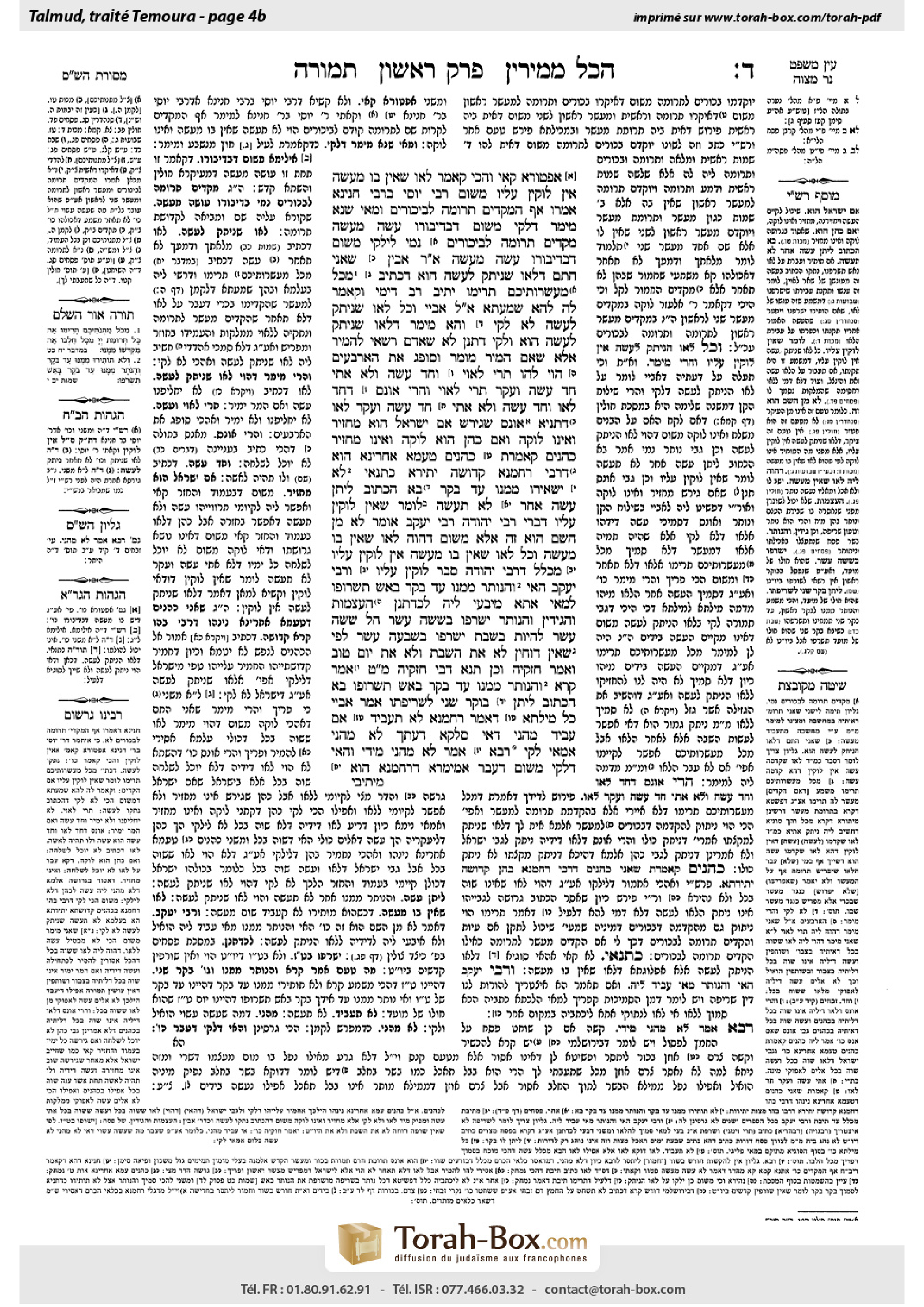
Temurah 4b: Talmud study for Daf Yomi
Daf Yomi is the daily study of one Talmud folio. Explore 37 tractates with scans, Hebrew text, Sefaria English and AI-generated French translations where annotated.
Passage selection and English or AI-generated French translation are available where the scan has annotations. Daf Study is independent of Torah-Box and Sefaria.
Browse Temurah · תמורה · All tractatesTemurah 4b text and translations
This page of Temurah includes the Aramaic text, an English translation and an AI-generated French translation, alongside the scan above.
תמורה ד׳ ב · Aramaic and Hebrew text
אַפְּטוּרָא קָאֵי, וְהָכִי קָאָמַר: לָאו שֶׁאֵין בּוֹ מַעֲשֶׂה אֵין לוֹקִין עָלָיו. מִשּׁוּם רַבִּי יוֹסֵי בְּרַבִּי חֲנִינָא אָמְרוּ: אַף הַמַּקְדִּים תְּרוּמָה לְבִיכּוּרִים.
וּמַאי שְׁנָא מֵימֵר דְּלָקֵי, מִשּׁוּם דִּבְדִיבּוּרוֹ עָשָׂה מַעֲשֶׂה? מַקְדִּים תְּרוּמָה לְבִיכּוּרִים נָמֵי לִילְקֵי, מִשּׁוּם דִּבְדִיבּוּרוֹ עָשָׂה מַעֲשֶׂה!
אָמַר רַבִּי אָבִין: שָׁאנֵי הָתָם, דְּלָאו שֶׁנִּיתָּק לַעֲשֵׂה הוּא, דִּכְתִיב: ״מִכֹּל מַעְשְׂרוֹתֵיכֶם תָּרִימוּ״.
יָתֵיב רַב דִּימִי וְקָאָמַר לַהּ לְהָא שְׁמַעְתָּא, אֲמַר לֵיהּ אַבָּיֵי: וְכֹל לָאו שֶׁנִּיתָּק לַעֲשֵׂה לָא לָקֵי?
וְהָא מֵימֵר, דְּלָאו שֶׁנִּיתָּק לַעֲשֵׂה הוּא, וְלָקֵי, דִּתְנַן: לֹא שֶׁאָדָם רַשַּׁאי לְהָמִיר, אֶלָּא שֶׁאִם הֵמִיר — מוּמָר, וְסוֹפֵג אֶת הָאַרְבָּעִים.
הָוֵי לְהוּ תְּרֵי לָאוֵי וְחַד עֲשֵׂה, וְלָא אָתֵי חַד עֲשֵׂה וְעָקַר תְּרֵי לָאוֵי.
וַהֲרֵי אוֹנֵס, דְּחַד לָאו וְחַד עֲשֵׂה, וְלָא אָתֵי חַד עֲשֵׂה וְעָקַר לָאו, דְּתַנְיָא: אוֹנֵס שֶׁגֵּירַשׁ — אִם יִשְׂרָאֵל הוּא מַחְזִיר וְאֵינוֹ לוֹקֶה, וְאִם כֹּהֵן הוּא לוֹקֶה וְאֵינוֹ מַחְזִיר!
כֹּהֲנִים קָאָמְרַתְּ?! כֹּהֲנִים — טַעְמָא אַחְרִינָא הוּא, דְּרַבִּי רַחֲמָנָא קְדוּשָּׁה יַתִּירָא.
כְּתַנָּאֵי: ״לֹא יַשְׁאִירוּ מִמֶּנּוּ עַד בֹּקֶר״ — בָּא הַכָּתוּב לִיתֵּן עֲשֵׂה אַחַר לֹא תַעֲשֶׂה, לוֹמַר שֶׁאֵין לוֹקִין עָלָיו, דִּבְרֵי רַבִּי יְהוּדָה.
רַבִּי יַעֲקֹב אוֹמֵר: לֹא מִן הַשֵּׁם הוּא זֶה, אֶלָּא מִשּׁוּם דְּהָוֵה לָאו שֶׁאֵין בּוֹ מַעֲשֶׂה, וְכׇל לָאו שֶׁאֵין בּוֹ מַעֲשֶׂה — אֵין לוֹקִין עָלָיו. מִכְּלָל דְּרַבִּי יְהוּדָה סָבַר לוֹקִין עָלָיו.
וְרַבִּי יַעֲקֹב, הַאי ״וְהַנֹּתָר מִמֶּנּוּ עַד בֹּקֶר בָּאֵשׁ תִּשְׂרוֹפוּ״ לְמַאי אֲתָא?
מִיבְּעֵי לֵיהּ לִכְדִתְנַן: הָעֲצָמוֹת, וְהַגִּידִין, וְהַנּוֹתָר — יִשָּׂרְפוּ בְּשִׁשָּׁה עָשָׂר. חָל שִׁשָּׁה עָשָׂר לִהְיוֹת בַּשַּׁבָּת — יִשָּׂרְפוּ בְּשִׁבְעָה עָשָׂר, לְפִי שֶׁאֵין דּוֹחִין לֹא אֶת הַשַּׁבָּת וְלֹא אֶת יוֹם טוֹב.
וְאָמַר חִזְקִיָּה, וְכֵן תָּנָא דְּבֵי חִזְקִיָּה: מַאי טַעְמָא? אָמַר קְרָא ״וְהַנּוֹתָר מִמֶּנּוּ עַד בֹּקֶר בָּאֵשׁ תִּשְׂרוֹפוּ״ — בָּא הַכָּתוּב לִיתֵּן בּוֹקֶר שֵׁנִי לִשְׂרֵיפָתוֹ.
אָמַר אַבָּיֵי: כֹּל מִילְּתָא דְּאָמַר רַחֲמָנָא לָא תַּעֲבֵיד, אִם עָבֵיד — מַהֲנֵי, דְּאִי סָלְקָא דַּעְתָּךְ לָא מַהֲנֵי — אַמַּאי לָקֵי? רָבָא אָמַר: לָא מַהֲנֵי מִידֵּי, וְהַאי דְּלָקֵי — מִשּׁוּם דַּעֲבַר אַמֵּימְרָא דְּרַחֲמָנָא הוּא.
Temurah 4b · English translation
he was referring not to liability for lashes, but to the exemption from lashes stated in the name of Rabbi Yoḥanan (3a). And this is what he is saying: One is not flogged for transgressing a prohibition that does not involve an action…They said in the name of Rabbi Yosei, son of Rabbi Ḥanina, that also one who separates teruma prior to the separation of the first fruits is not flogged, since he performs no action.
The Gemara asks: And what is different about one who effects substitution, that he is flogged despite not having performed an action? Is it because he has performed an action with his speech, by consecrating the animal? If so, one who separates teruma prior to the separation of the first fruits should be flogged as well, because he has performed an action with his speech, by consecrating the produce.
Rabbi Avin said: It is different there, in the case of one who tithes produce in the wrong order, as it is a prohibition whose violation can be rectified by fulfilling a positive mitzva. As a rule, if the Torah specifies a positive mitzva to be performed after transgressing a prohibition to rectify it, that prohibition does not carry a punishment of lashes. This is the case here, as it is written: “Out of all of your tithes you shall set apart all of that which is due to the Lord” (Numbers 18:29), which teaches that one who separated tithes in the incorrect order or who separated teruma before separating the first fruits, must still separate the earlier tithes even after the later tithes, or the first fruits even after the teruma.
§ Rav Dimi was sitting and saying this halakha, that one who separates teruma prior to separating the first fruits is not flogged because it is a prohibition whose violation can be rectified. Abaye said to him: And is it correct that one is not flogged for transgressing any prohibition whose violation can be rectified by fulfilling a positive mitzva?
But there is the case of one who effects substitution, which is a prohibition whose violation can be rectified by fulfilling a positive mitzva, as the verse states: “He shall not exchange it, nor substitute it, a good for a bad, or a bad for a good; and if he shall at all change animal for animal, then both it and that for which it is changed shall be holy” (Leviticus 27:10). And even so, one who effects substitution is flogged, as we learned in the mishna (2a): That is not to say that it is permitted for a person to effect substitution; rather, it means that if one substituted a non-sacred animal for a consecrated animal, the substitution takes effect and the one who substituted the non-sacred animal incurs the punishment of the forty lashes.
Rav Dimi answered: There are two prohibitions specified in the verse as transgressed by one who effects substitution: “He shall not exchange it,” and: “Nor substitute it.” But there is only one positive mitzva: “Both it and that for which it is changed shall be holy.” And one positive mitzva does not come and uproot two prohibitions. Therefore, although generally, one who transgresses a prohibition that can be rectified is not flogged, one who effects substitution is flogged.
The Gemara counters: But there is the case of the rapist who forces himself upon a virgin, who is obligated to marry the victim if she wishes and is then prohibited from divorcing her. As here the verse states one prohibition: “He may not send her away all his days,” and one positive mitzva: “And she shall be his wife” (Deuteronomy 22:29). This teaches that he can rectify the transgression of divorcing her by remarrying her. And yet, the one positive mitzva does not come and uproot the prohibition, as it is taught in a baraita: With regard to a rapist who married and then divorced his victim, if he is an Israelite, who is permitted to marry a divorcée, he remarries her and he is not flogged. But if he is a priest, who is prohibited from marrying a divorcée, he is flogged and he does not remarry her.
The Gemara answers: You say that a case that concerns priests challenges the principle that a rectifiable transgression does not make one liable for flogging. But in the case of priests there is another reason why they are flogged, as the Merciful One increased the severity of their transgressions, for they have greater holiness. By contrast, one who transgresses a prohibition unrelated to the priesthood will not be flogged if its violation can be rectified by fulfilling a positive mitzva.
§ Which prohibitions carry the punishment of lashes is subject to a dispute between tanna’im, as it is taught in a baraita: The verse states concerning the Paschal offering: “And you shall let nothing of it remain until the morning, but that which remains of it until the morning you shall burn with fire” (Exodus 12:10). The verse comes to place a positive mitzva after the prohibition in order to say that one is not flogged for transgressing it. This is the statement of Rabbi Yehuda.
Rabbi Ya’akov says: He is not exempt from lashes for that reason, but rather because it is a prohibition that does not involve an action, and one is not flogged for transgressing any prohibition that does not involve an action. The Gemara comments: By inference, it may be concluded that Rabbi Yehuda holds that one is flogged for transgressing a prohibition that does not involve an action.
The Gemara asks: And according to Rabbi Ya’akov, who holds that the exemption from lashes stems from the prohibition’s not involving an action, for what purpose does the clause “but that which remains of it until the morning you shall burn with fire” come?
The Gemara answers: He requires it for that which we learned in a mishna (Pesaḥim 83a): The bones of the Paschal offering that contain edible marrow but cannot be eaten because it is prohibited to break the bones of the Paschal offering, and the sinews, and the leftover meat must all be burned on the sixteenth of Nisan, immediately after the first day of the Festival. If the sixteenth occurs on Shabbat, they must be burned on the seventeenth, because the mitzva to burn them does not override Shabbat or the Festival. Therefore, they are burned on the first weekday.
And Ḥizkiyya says, and so it is taught in the school of Ḥizkiyya: What is the reason for this? The verse states: “And you shall let nothing of it remain until the morning, but that which remains of it until the morning you shall burn with fire.” By using the word “morning” twice, the verse comes to provide a second morning for the offering’s burning if the first morning falls on Shabbat or a Festival.
§ Abaye said: With regard to any matter that the Merciful One states in the Torah not to perform, if one performed it, his action is effective, but the violator is flogged. As, if it enters your mind that it is not effective, why would he be flogged for accomplishing nothing? Rava said: If one performed it, it is not effective at all. And this is the reason that he is flogged: Because he transgressed the statement of the Merciful One.
Temurah 4b · Traduction française (IA)
Il ne faisait pas référence à la responsabilité d’encourir la flagellation, mais à l’exemption de flagellation rapportée au nom de Rabbi Yoḥanan (3a). Voici ce qu’il dit : On ne flagelle pas celui qui transgresse une interdiction qui n’implique pas d’action… On a rapporté au nom de Rabbi Yosei, fils de Rabbi Ḥanina, que celui qui prélève la terouma avant les prémices n’est pas non plus flagellé, puisqu’il n’accomplit aucune action.
La Guemara demande : En quoi le cas de celui qui effectue une substitution est-il différent, puisqu’il est flagellé bien qu’il n’ait accompli aucune action ? Est-ce parce qu’il a accompli une action par la parole, en consacrant l’animal ? Si tel est le cas, celui qui prélève la terouma avant les prémices devrait lui aussi être flagellé, puisqu’il a accompli une action par la parole, en consacrant les produits.
Rabbi Avin dit : Le cas de celui qui prélève les dîmes dans le mauvais ordre est différent, car il s’agit d’une interdiction dont la transgression peut être réparée par l’accomplissement d’une mitsva positive. En règle générale, si la Torah prescrit l’accomplissement d’une mitsva positive après la transgression d’une interdiction afin de réparer celle-ci, cette interdiction n’est pas passible de flagellation. C’est le cas ici, car il est écrit : « De toutes vos dîmes, vous prélèverez tout ce qui revient à l’Éternel » (Nombres 18:29). Cela enseigne que celui qui a prélevé les dîmes dans le mauvais ordre, ou qui a prélevé la terouma avant les prémices, doit néanmoins prélever les dîmes antérieures après les dîmes ultérieures, ou les prémices après la terouma.
§ Rav Dimi était assis et énonçait cette halakha : celui qui prélève la terouma avant les prémices n’est pas flagellé, car il s’agit d’une interdiction dont la transgression peut être réparée. Abaye lui dit : Est-il exact que l’on ne soit pas flagellé pour avoir transgressé toute interdiction dont la transgression peut être réparée par l’accomplissement d’une mitsva positive ?
Mais il y a le cas de celui qui effectue une substitution : il s’agit d’une interdiction dont la transgression peut être réparée par l’accomplissement d’une mitsva positive, comme l’indique le verset : « Il ne l’échangera pas et ne le substituera pas, un bon à un mauvais, ni un mauvais à un bon ; et si jamais il remplace un animal par un autre, les deux, lui et celui pour lequel il a été remplacé, seront saints » (Lévitique 27:10). Pourtant, celui qui effectue une substitution est flagellé, comme nous l’avons appris dans la Michna (2a) : cela ne signifie pas qu’il soit permis à quelqu’un d’effectuer une substitution ; cela signifie plutôt que si quelqu’un substitue un animal profane à un animal consacré, la substitution prend effet et celui qui a substitué l’animal profane encourt la peine de quarante coups.
Rav Dimi répondit : Le verset énonce deux interdictions transgressées par celui qui effectue une substitution : « Il ne l’échangera pas » et « ne le substituera pas ». Mais il n’énonce qu’une mitsva positive : « Les deux […] seront saints. » Or, une seule mitsva positive ne peut abolir deux interdictions. Par conséquent, bien qu’en général celui qui transgresse une interdiction dont la transgression peut être réparée ne soit pas flagellé, celui qui effectue une substitution est flagellé.
La Guemara objecte : Mais il y a le cas du violeur qui force une vierge, et qui est tenu de l’épouser si elle le souhaite ; il lui est alors interdit de divorcer d’elle. En effet, le verset énonce ici une interdiction : « Il ne pourra pas la renvoyer tous les jours de sa vie », et une mitsva positive : « Elle sera sa femme » (Deutéronome 22:29). Cela enseigne qu’il peut réparer la transgression consistant à divorcer d’elle en la reprenant pour épouse. Pourtant, la mitsva positive ne vient pas abolir l’interdiction, comme l’enseigne une baraïta : si un violeur a épousé sa victime puis a divorcé d’elle, s’il est Israélite, donc autorisé à épouser une femme divorcée, il la reprend pour épouse et n’est pas flagellé. Mais s’il est prêtre, à qui il est interdit d’épouser une femme divorcée, il est flagellé et ne la reprend pas pour épouse.
La Guemara répond : Tu invoques le cas des prêtres pour contester le principe selon lequel une transgression réparable n’entraîne pas la flagellation. Mais, dans le cas des prêtres, il y a une autre raison pour laquelle ils sont flagellés : le Miséricordieux a rendu leurs transgressions plus graves, puisqu’ils ont une sainteté supérieure. En revanche, celui qui transgresse une interdiction sans rapport avec la prêtrise n’est pas flagellé si sa transgression peut être réparée par l’accomplissement d’une mitsva positive.
§ Les interdictions passibles de flagellation font l’objet d’un désaccord entre les tannaïm, comme l’enseigne une baraïta : à propos du sacrifice pascal, le verset dit : « Vous n’en laisserez rien jusqu’au matin ; ce qui en restera jusqu’au matin, vous le brûlerez par le feu » (Exode 12:10). Le verset place une mitsva positive après l’interdiction afin d’enseigner que l’on n’est pas flagellé pour l’avoir transgressée. Telle est la déclaration de Rabbi Yehuda.
Rabbi Ya’akov dit : Il est exempt de flagellation non pas pour cette raison, mais parce qu’il s’agit d’une interdiction qui n’implique pas d’action ; or, on ne flagelle pas celui qui transgresse une interdiction n’impliquant aucune action. La Guemara fait remarquer : On peut en déduire que, selon Rabbi Yehuda, on est flagellé pour avoir transgressé une interdiction qui n’implique pas d’action.
La Guemara demande : Selon Rabbi Ya’akov, qui considère que l’exemption de flagellation découle du fait que l’interdiction n’implique pas d’action, à quoi sert la clause « ce qui en restera jusqu’au matin, vous le brûlerez par le feu » ?
La Guemara répond : Il en a besoin pour ce que nous avons appris dans une Michna (Pesaḥim 83a) : les os du sacrifice pascal qui contiennent de la moelle comestible, mais que l’on ne peut manger parce qu’il est interdit de briser les os du sacrifice pascal, ainsi que les tendons et la viande restante, doivent tous être brûlés le seize Nissan, immédiatement après le premier jour de la fête. Si le seize tombe un Chabbat, ils doivent être brûlés le dix-sept, car la mitsva de les brûler ne repousse ni le Chabbat ni la fête. Ils sont donc brûlés le premier jour de semaine.
Et Ḥizkiyya dit, comme on l’enseigne aussi dans l’école de Ḥizkiyya : Quelle en est la raison ? Le verset dit : « Vous n’en laisserez rien jusqu’au matin ; ce qui en restera jusqu’au matin, vous le brûlerez par le feu. » En employant deux fois le mot « matin », le verset prévoit un second matin pour brûler le sacrifice au cas où le premier matin tomberait un Chabbat ou un jour de fête.
§ Abaye dit : Pour toute chose que le Miséricordieux interdit dans la Torah, si quelqu’un la fait, son acte prend effet, mais le transgresseur est flagellé. En effet, si l’on pensait que son acte ne prenait pas effet, pourquoi serait-il flagellé pour n’avoir rien accompli ? Rava dit : Si quelqu’un le fait, son acte ne prend absolument pas effet. Et voici pourquoi il est flagellé : parce qu’il a transgressé la parole du Miséricordieux.
Traduction française générée par IA à partir de l’édition anglaise de Sefaria. Vérifie toujours un passage avec le texte source.
Text from Sefaria: William Davidson Edition - Vocalized Aramaic (CC BY NC); William Davidson Edition - English (CC BY NC).