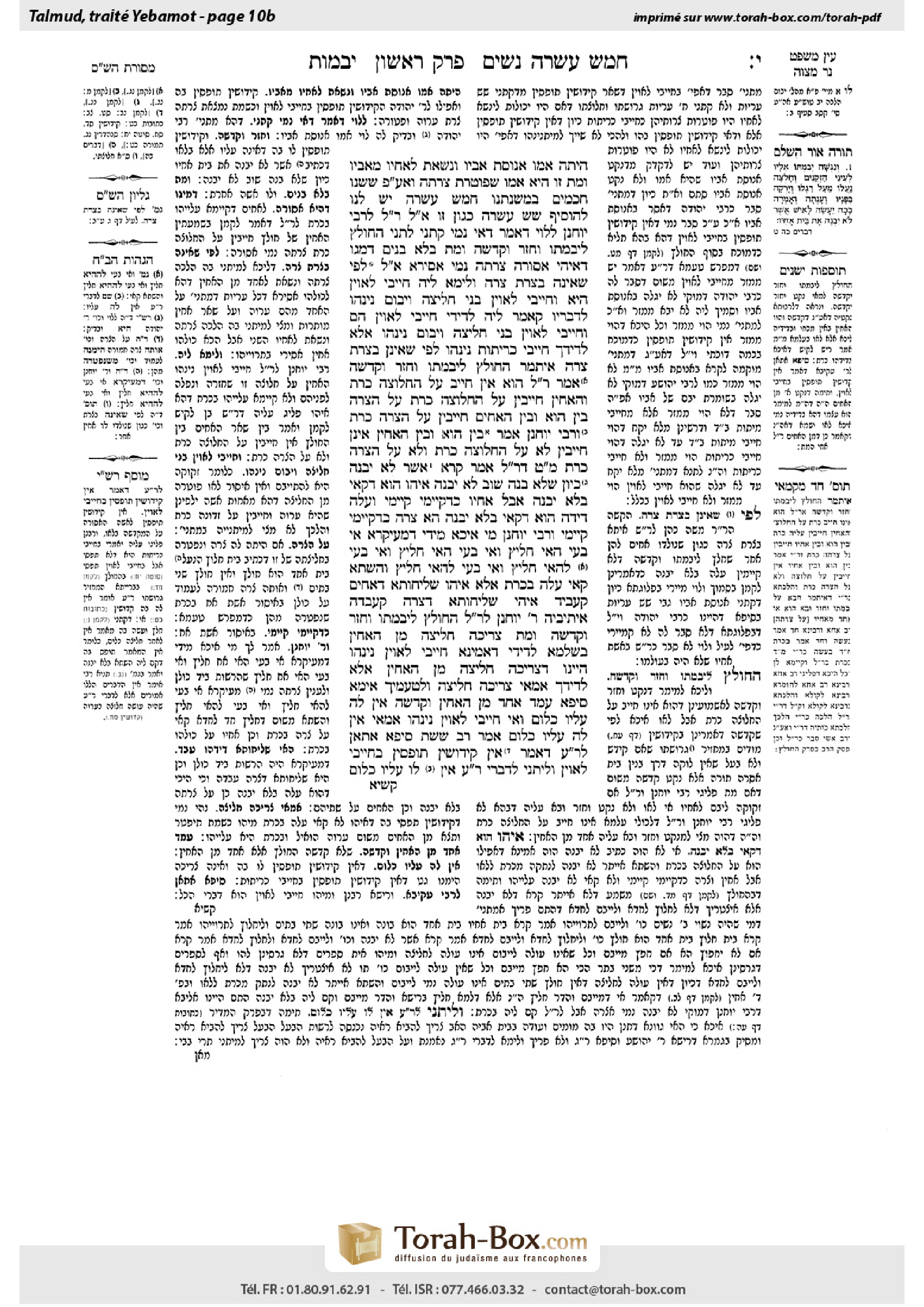
Yevamot 10b: Talmud study for Daf Yomi
Daf Yomi is the daily study of one Talmud folio. Explore 37 tractates with scans, Hebrew text, Sefaria English and AI-generated French translations where annotated.
Passage selection and English or AI-generated French translation are available where the scan has annotations. Daf Study is independent of Torah-Box and Sefaria.
Browse Yevamot · יבמות · All tractatesYevamot 10b text and translations
This page of Yevamot includes the Aramaic text, an English translation and an AI-generated French translation, alongside the scan above.
יבמות י׳ ב · Aramaic and Hebrew text
הָיְתָה אִמּוֹ אֲנוּסַת אָבִיו, וְנִשֵּׂאת לְאָחִיו מֵאָבִיו, וּמֵת — זוֹ הִיא אִמּוֹ שֶׁפּוֹטֶרֶת צָרָתָהּ.
וְאַף עַל פִּי שֶׁשָּׁנוּ חֲכָמִים בְּמִשְׁנָתֵנוּ ״חֲמֵשׁ עֶשְׂרֵה״, יֵשׁ לָנוּ לְהוֹסִיף שֵׁשׁ עֶשְׂרֵה כְּגוֹן זוֹ. אֲמַר לֵיהּ רֵישׁ לָקִישׁ לְרַבִּי יוֹחָנָן: לְלֵוִי דַּאֲמַר ״דְּאִי״ נָמֵי קָתָנֵי — לִתְנֵי: הַחוֹלֵץ לִיבִמְתּוֹ וְחָזַר וְקִדְּשָׁהּ, וּמֵת בְּלֹא בָּנִים, דְּמִגּוֹ דְּאִיהִי אֲסוּרָה — צָרָתָהּ נָמֵי אֲסִירָא!
אֲמַר לֵיהּ: לְפִי שֶׁאֵינָהּ בְּצָרַת צָרָה.
וְלֵימָא לֵיהּ: חַיָּיבֵי לָאוִין הִיא, וְחַיָּיבֵי לָאוִין בְּנֵי חֲלִיצָה וְיִבּוּם נִינְהוּ.
לִדְבָרָיו קָאָמַר לֵיהּ: לְדִידִי — חַיָּיבֵי לָאוִין הֵם, וְחַיָּיבֵי לָאוִין בְּנֵי חֲלִיצָה וְיִבּוּם נִינְהוּ. אֶלָּא לְדִידָךְ — חַיָּיבֵי כָּרֵיתוֹת נִינְהוּ. לְפִי שֶׁאֵינָן בְּצָרַת צָרָה.
אִיתְּמַר: הַחוֹלֵץ לִיבִמְתּוֹ וְחָזַר וְקִדְּשָׁהּ, אָמַר רֵישׁ לָקִישׁ: הוּא — אֵין חַיָּיב עַל הַחֲלוּצָה כָּרֵת,
וְהָאַחִין — חַיָּיבִין עַל הַחֲלוּצָה כָּרֵת. עַל הַצָּרָה, בֵּין הוּא וּבֵין הָאַחִים — חַיָּיבִין עַל הַצָּרָה כָּרֵת.
וְרַבִּי יוֹחָנָן אָמַר: בֵּין הוּא וּבֵין הָאַחִין אֵינָן חַיָּיבִין לֹא עַל הַחֲלוּצָה כָּרֵת, וְלֹא עַל הַצָּרָה כָּרֵת. מַאי טַעְמָא דְּרֵישׁ לָקִישׁ? אָמַר קְרָא: ״אֲשֶׁר לֹא יִבְנֶה״, כֵּיוָן שֶׁלֹּא בָּנָה — שׁוּב לֹא יִבְנֶה.
אִיהוּ הוּא דְּקָאֵי בְּ״לֹא יִבְנֶה״, אֲבָל אֶחָיו — כִּדְקָיְימִי קָיְימִי.
וַעֲלֵהּ דִּידַהּ, הוּא דְּקָאֵי בְּ״לֹא יִבְנֶה״, הָא צָרָה — כִּדְקָיְימָא קָיְימָא.
וְרַבִּי יוֹחָנָן: מִי אִיכָּא מִידֵּי דְּמֵעִיקָּרָא אִי בָּעֵי הַאי — חָלֵיץ, וְאִי בָּעֵי הַאי — חָלֵיץ, וְאִי בָּעֵי — לְהַאי חָלֵיץ, וְאִי בָּעֵי — לְהַאי חָלֵיץ, וְהַשְׁתָּא קָאֵי עֲלַהּ בְּכָרֵת?
אֶלָּא, אִיהוּ שְׁלִיחוּתָא דְאַחִים קָעָבֵיד, אִיהִי שְׁלִיחוּתָא דְצָרָה קָעָבְדָה.
אֵיתִיבֵיהּ רַבִּי יוֹחָנָן לְרֵישׁ לָקִישׁ: הַחוֹלֵץ לִיבִמְתּוֹ, וְחָזַר וְקִדְּשָׁהּ, וּמֵת — צְרִיכָה חֲלִיצָה מִן הָאַחִין. בִּשְׁלָמָא לְדִידִי, דְּאָמֵינָא חַיָּיבֵי לָאוִין נִינְהוּ, הַיְינוּ דִּצְרִיכָה חֲלִיצָה מִן הָאַחִין.
אֶלָּא לְדִידָךְ, אַמַּאי צְרִיכָה חֲלִיצָה?
וּלְטַעְמָיךְ, אֵימָא סֵיפָא: עָמַד אֶחָד מִן הָאַחִין וְקִדְּשָׁהּ, אֵין לָהּ עָלָיו כְּלוּם. וְאִי חַיָּיבֵי לָאוִין נִינְהוּ, אַמַּאי אֵין לָהּ עָלָיו כְּלוּם?
אָמַר רַב שֵׁשֶׁת: סֵיפָא אֲתָאן לְרַבִּי עֲקִיבָא, דְּאָמַר: אֵין קִידּוּשִׁין תּוֹפְסִין בְּחַיָּיבֵי לָאוִין. וְלִיתְנֵי: לְדִבְרֵי רַבִּי עֲקִיבָא אֵין לוֹ עָלָיו כְּלוּם!
Yevamot 10b · English translation
If, however, his mother was a woman who was raped by his father and subsequently married his paternal brother, and the brother died, this is a case of his mother who exempts her rival wife. According to the opinion of the Rabbis this marriage is permitted, and even according to the opinion of Rabbi Yehuda the marriage is valid despite the transgression. Consequently, both the mother and her rival wife come before the son for levirate marriage. Since the mother is a forbidden relation to him, her rival wife is exempt as well.
And although the Sages taught in the mishna: Fifteen women, we must add a sixteenth case, for example, the situation described above. Reish Lakish said to Rabbi Yoḥanan: According to the opinion of Levi, who said that the mishna teaches even cases of: What if, which involve a transgression, let the mishna also teach the case of one who performs ḥalitza with his yevama and went back and betrothed her, and then died childless. His betrothal is a transgression, as after ḥalitza the yevama is permanently forbidden to him. As, in this case, since she is forbidden to all the brothers, due to the ḥalitza performed by the deceased yavam, her rival wife is also forbidden. This is an additional case of a woman who exempts her rival wife.
Rabbi Yoḥanan said to Reish Lakish: This example is not cited because the case does not include the possibility of a rival wife of a rival wife. All of the other cases listed in the mishna involve both rival wives and rival wives of rival wives. Here, however, this is impossible, as the same prohibition applies equally to all of the brothers, and therefore none of them may marry her.
The Gemara asks: And let Rabbi Yoḥanan say a different answer to Reish Lakish, as he could simply have pointed out that marriage to a woman who had performed ḥalitza is not a violation that incurs karet, neither for the one who performed the ḥalitza nor for his brothers if they marry her after he dies. Rather, it is an act for which they are liable for violating a regular prohibition, and those liable for violating a prohibition are obligated in ḥalitza and levirate marriage. In these cases the mitzva of levirate marriage still applies, and although the woman should be released by ḥalitza, she is not entirely exempt from levirate marriage, and therefore her rival wife is not exempt either.
The Gemara responds that Rabbi Yoḥanan is speaking in accordance with the statement of Reish Lakish, as follows: According to my opinion your question is groundless, as they are liable for violating a prohibition, and those liable for violating a prohibition are obligated in ḥalitza and levirate marriage. However, according to your opinion, those brothers who marry a yevama who had performed ḥalitza are liable to receive karet, and therefore you must resolve the difficulty by saying that the mishna did not teach this case because it does not include the possibility of a rival wife of a rival wife.
The Gemara discusses the dispute alluded to in the previous paragraph. It was stated: With regard to one who performs ḥalitza with his yevama and went back and betrothed her, Reish Lakish said: The brother who earlier performed ḥalitza is not liable to receive karet for returning to the yevama who performed ḥalitza [ḥalutza]. She is no longer forbidden as a brother’s wife, although she is forbidden by a regular prohibition.
And the brothers who did not actually perform the ḥalitza are liable to receive karet for having relations with a ḥalutza. In their case, the woman retains her status as a forbidden brother’s wife even after the ḥalitza. With regard to the rival wife of the ḥalutza, although she too is released from the levirate bond, since the act of ḥalitza itself was not performed with her, both the brother who performed the ḥalitza and the other brothers are liable to receive karet for having relations with the rival wife, as she retains her forbidden status as a brother’s wife.
And Rabbi Yoḥanan said: Neither he nor the other brothers are liable to receive karet, neither for the ḥalutza nor for having relations with the rival wife. The Gemara explains: What is the rationale of Reish Lakish? The verse states with regard to one who performs ḥalitza with his yevama: “Who does not build up his brother’s house” (Deuteronomy 25:9), which teaches that since he did not build his brother’s house by entering into levirate marriage, opting instead for ḥalitza, he shall never build it again. This statement is understood not only as a negative description of events, but also as a prohibition against marrying this woman at any point in the future.
However, it is the man who performed the act of ḥalitza who stands liable to receive punishment for violating this prohibition of: Does not build up, i.e., the prohibition against marrying his ḥalutza. For him the prohibition involving karet has been replaced by the regular prohibition of: Who does not build up his brother’s house. However, with regard to his brothers, where they stood before, they stand now. In other words, just as before the mitzva of levirate marriage applied to them this woman was forbidden to them as a brother’s wife, once the obligation of levirate marriage has been removed they remain bound by the same prohibition. Consequently, she is forbidden to the brothers on pain of karet.
And furthermore, only with regard to her, the ḥalutza, does he stand liable for: Does not build up, but as for the rival wife, who did not perform ḥalitza, where all the brothers stood before, they stand now. Just as before her rival wife performed ḥalitza she was forbidden on pain of karet, the same applies after the ḥalitza, both for the man who performed ḥalitza and his brothers.
And Rabbi Yoḥanan claims: Is there anything of this kind in halakha? After all, at the outset, before the ḥalitza, if this brother wanted he could perform ḥalitza, and if that brother wanted he could perform ḥalitza, and if he wanted he could perform ḥalitza with this woman and if he wanted he could perform ḥalitza with that woman. All the deceased brother’s wives were included in the levirate obligation of marriage or ḥalitza, and therefore the prohibition proscribing a brother’s wife was negated for all of them at that time. And now, after the ḥalitza, they stand to incur karet for having relations with her? How can the prohibition proscribing a brother’s wife return after it was nullified by the death of the childless brother?
Rather, he who performs ḥalitza performs the agency of the other brothers, and therefore he also releases her from the levirate bond of his brothers. Similarly, she who performs ḥalitza performs the agency of the rival wife, as the ḥalitza of one wife serves to release the other one as well. Consequently, it is as though all of the brothers released all of the wives, and there is no longer any prohibition that incurs karet.
§ The Gemara cites the ensuing discussion between the two disputing Sages. Rabbi Yoḥanan raised an objection to the opinion of Reish Lakish from a baraita: In the case of one who performs ḥalitza with his yevama and went back and betrothed her, and then died, she requires ḥalitza from one of the brothers. Granted, this makes sense according to my opinion, as I say that brothers who marry a ḥalutza are liable only for violating a prohibition, and that is why she requires ḥalitza from the other brothers. The principle is that a woman with whom relations are forbidden by a regular prohibition that does not incur karet may not enter into levirate marriage, but she must undergo ḥalitza.
However, according to your opinion that the penalty of karet does apply here, why does she require ḥalitza at all? The penalty of karet indicates that the betrothal did not take effect at all, and therefore she is not bound to the brothers with regard to the requirement of ḥalitza.
Reish Lakish answered: And according to your reasoning, how would you state and explain the latter clause of the baraita: If one of the brothers arose and betrothed her, she has no claims on him, i.e., the marriage does not take effect at all and she does not require a bill of divorce from him? But if the brothers are liable only for violating a prohibition, why does she have no claim on him? After all, in cases of regular prohibitions a betrothal is valid. According to my opinion that these brothers are liable to receive karet the matter is clear, as the betrothal is invalid. This indicates that there is a contradiction between the first and latter clauses of the baraita. How, then, can Rabbi Yoḥanan cite a proof from an apparently flawed baraita?
Rav Sheshet said in resolution of this contradiction: In the latter clause of the baraita we have come to a different opinion, that of Rabbi Akiva, who said: Betrothal with those who are forbidden as they are liable for violating a prohibition is not valid. In Rabbi Akiva’s opinion there is no difference between regular prohibitions and prohibitions that incur karet in this regard, as in both cases the betrothals are invalid. The Gemara raises a difficulty: But if the first clause of the baraita is in accordance with the opinion of the Rabbis, while the latter clause is in accordance with a different opinion, let the mishna teach explicitly: According to the statement of Rabbi Akiva she has no claims on him, as this represents a different opinion.
Yevamot 10b · Traduction française (IA)
Toutefois, si sa mère était une femme que son père avait violée et qui avait ensuite épousé son oncle paternel, lequel était mort, c’est le cas d’une mère qui dispense sa rivale du lévirat. Selon les Rabbins, ce mariage est permis et, même selon Rabbi Yehuda, le mariage est valide malgré la transgression. Par conséquent, la mère et sa rivale se présentent toutes deux devant le fils pour le lévirat. Puisque sa mère est une parente qui lui est interdite, sa rivale en est également dispensée.
Bien que les Sages aient enseigné dans la Michna : « Quinze femmes », il faut ajouter un seizième cas, par exemple celui décrit ci-dessus. Reish Lakish dit à Rabbi Yoḥanan : « Selon l’opinion de Levi, qui affirme que la Michna enseigne aussi des cas de “Et si…”, impliquant une transgression, que la Michna enseigne également le cas de celui qui accomplit la ḥalitsa avec sa yevama, puis la fiance de nouveau et meurt sans enfant. Ces secondes fiançailles constituent une transgression, car après la ḥalitsa, la yevama lui est définitivement interdite. En effet, dans ce cas, puisqu’elle est interdite à tous les frères en raison de la ḥalitsa accomplie par le yavam défunt, sa rivale est également interdite. Il s’agit d’un cas supplémentaire de femme qui dispense sa rivale du lévirat. »
Rabbi Yoḥanan dit à Reish Lakish : « Cet exemple n’est pas mentionné parce que le cas ne comporte pas la possibilité qu’une rivale ait elle-même une rivale. Tous les autres cas énumérés dans la Michna concernent à la fois des rivales et des rivales de rivales. Ici, cependant, c’est impossible, car la même interdiction s’applique à tous les frères et aucun d’eux ne peut donc épouser cette femme. »
La Guemara demande : Rabbi Yoḥanan n’aurait-il pas pu donner une autre réponse à Reish Lakish ? Il aurait simplement pu lui faire remarquer qu’épouser une femme avec laquelle on a accompli la ḥalitsa n’est pas une transgression passible de karet, ni pour celui qui a accompli la ḥalitsa ni pour ses frères s’ils l’épousent après sa mort. Il s’agit plutôt d’un acte qui les rend passibles de la peine prévue pour la violation d’une interdiction ordinaire ; or ceux qui sont passibles de cette peine sont tenus d’accomplir la ḥalitsa ou le lévirat. Dans ces cas, la mitsva du lévirat reste applicable et, bien que la femme doive être libérée par la ḥalitsa, elle n’est pas entièrement dispensée du lévirat ; sa rivale n’en est donc pas non plus dispensée.
La Guemara répond que Rabbi Yoḥanan parle selon le raisonnement de Reish Lakish, comme suit : « Selon mon opinion, ta question est sans fondement, car ils sont passibles de la peine prévue pour la violation d’une interdiction, et ceux qui encourent cette peine sont tenus d’accomplir la ḥalitsa ou le lévirat. Cependant, selon ton opinion, ces frères qui épousent une yevama avec laquelle on a accompli la ḥalitsa sont passibles de karet. Tu dois donc résoudre la difficulté en disant que la Michna n’a pas enseigné ce cas parce qu’il ne comporte pas la possibilité qu’une rivale ait elle-même une rivale. »
La Guemara examine le désaccord évoqué dans le paragraphe précédent. Il a été enseigné : au sujet de celui qui accomplit la ḥalitsa avec sa yevama, puis la fiance de nouveau, Reish Lakish a dit : le frère qui a accompli la ḥalitsa n’est pas passible de karet s’il reprend la yevama avec laquelle il a accompli la ḥalitsa [ḥalutza]. Elle n’est plus interdite à lui en tant qu’épouse de son frère, bien qu’elle reste interdite par une interdiction ordinaire.
Quant aux frères qui n’ont pas eux-mêmes accompli la ḥalitsa, ils sont passibles de karet s’ils ont des relations avec une ḥalutza. Dans leur cas, la femme conserve son statut d’épouse interdite de leur frère, même après la ḥalitsa. Quant à la rivale de la ḥalutza, bien qu’elle soit elle aussi libérée du lien léviratique, puisque la ḥalitsa n’a pas été accomplie avec elle, le frère qui l’a accomplie et les autres frères sont tous passibles de karet s’ils ont des relations avec cette rivale, car elle conserve son statut d’épouse interdite de leur frère.
Et Rabbi Yoḥanan a dit : ni lui ni les autres frères ne sont passibles de karet, ni pour des relations avec la ḥalutza ni pour des relations avec sa rivale. La Guemara explique : quel est le raisonnement de Reish Lakish ? Le verset dit au sujet de celui qui accomplit la ḥalitsa avec sa yevama : « qui ne bâtit pas la maison de son frère » (Deutéronome 25,9). Cela enseigne que, puisqu’il n’a pas bâti la maison de son frère en contractant un mariage léviratique, mais a opté pour la ḥalitsa, il ne la bâtira plus jamais. Cette formule est comprise non seulement comme une description négative des faits, mais aussi comme une interdiction d’épouser cette femme à quelque moment que ce soit par la suite.
Toutefois, seul l’homme qui a accompli la ḥalitsa est passible de la peine prévue pour la violation de l’interdiction « ne bâtit pas », c’est-à-dire l’interdiction d’épouser sa ḥalutza. Pour lui, l’interdiction passible de karet a été remplacée par l’interdiction ordinaire exprimée par les mots « qui ne bâtit pas la maison de son frère ». En revanche, pour ses frères, leur situation reste la même qu’auparavant. Autrement dit, avant que la mitsva du lévirat ne leur incombe, cette femme leur était interdite en tant qu’épouse de leur frère ; une fois l’obligation du lévirat levée, ils restent soumis à la même interdiction. Par conséquent, elle leur est interdite sous peine de karet.
En outre, seule cette femme, la ḥalutza, est concernée par l’interdiction « ne bâtit pas ». Quant à sa rivale, avec laquelle la ḥalitsa n’a pas été accomplie, les frères restent dans la même situation qu’auparavant. De même qu’avant que sa rivale n’accomplisse la ḥalitsa, elle leur était interdite sous peine de karet, il en va de même après la ḥalitsa, tant pour l’homme qui l’a accomplie que pour ses frères.
Et Rabbi Yoḥanan objecte : « Existe-t-il quelque chose de semblable en halakha ? En effet, au départ, avant la ḥalitsa, tel frère pouvait accomplir la ḥalitsa s’il le voulait, tel autre frère pouvait également l’accomplir s’il le voulait ; et chacun pouvait accomplir la ḥalitsa avec cette femme ou, s’il le voulait, avec l’autre. Toutes les épouses du frère défunt étaient soumises à l’obligation du mariage léviratique ou de la ḥalitsa ; l’interdiction relative à l’épouse d’un frère était donc alors levée pour chacune d’elles. Et maintenant, après la ḥalitsa, ils seraient passibles de karet s’ils avaient des relations avec elle ? Comment l’interdiction relative à l’épouse d’un frère pourrait-elle revenir après avoir été annulée par la mort du frère sans enfant ? »
Au contraire, celui qui accomplit la ḥalitsa agit au nom des autres frères et la libère donc également du lien léviratique à leur égard. De même, celle avec laquelle on accomplit la ḥalitsa agit au nom de sa rivale, car la ḥalitsa accomplie avec une épouse libère également l’autre. Par conséquent, c’est comme si tous les frères avaient libéré toutes les épouses, et il ne subsiste plus aucune interdiction passible de karet.
§ La Guemara rapporte la suite de la discussion entre les deux Sages en désaccord. Rabbi Yoḥanan soulève une objection contre l’opinion de Reish Lakish à partir d’une baraïta : dans le cas de celui qui accomplit la ḥalitsa avec sa yevama, puis la fiance de nouveau et meurt, elle doit recevoir la ḥalitsa de l’un des frères. Cela se comprend selon mon opinion, car, selon moi, les frères qui épousent une ḥalutza ne sont passibles que de la peine prévue pour la violation d’une interdiction ; c’est pourquoi elle doit recevoir la ḥalitsa des autres frères. Le principe est qu’une femme avec laquelle les relations sont interdites par une interdiction ordinaire, qui n’entraîne pas de karet, ne peut pas contracter de mariage léviratique, mais doit subir la ḥalitsa.
Cependant, selon ton opinion, d’après laquelle la peine de karet s’applique ici, pourquoi devrait-elle recevoir la ḥalitsa ? La peine de karet indique que les fiançailles n’ont absolument pas pris effet ; elle n’est donc pas liée aux frères par l’obligation de ḥalitsa.
Reish Lakish répondit : « Et selon ton raisonnement, comment expliquerais-tu la clause finale de la baraïta : si l’un des frères s’est présenté et l’a fiancée, elle n’a aucun droit à faire valoir contre lui, c’est-à-dire que le mariage ne prend absolument pas effet et qu’elle n’a pas besoin d’un acte de divorce de sa part ? Mais si les frères ne sont passibles que de la peine prévue pour la violation d’une interdiction, pourquoi n’a-t-elle aucun droit à faire valoir contre lui ? En effet, dans les cas d’interdictions ordinaires, les fiançailles sont valides. Selon mon opinion, d’après laquelle ces frères sont passibles de karet, la chose est claire, puisque les fiançailles sont invalides. Cela indique qu’il y a une contradiction entre la première et la dernière clause de la baraïta. Comment Rabbi Yoḥanan peut-il donc tirer une preuve d’une baraïta apparemment incohérente ? »
Rav Sheshet résout cette contradiction : dans la clause finale de la baraïta, nous en venons à une autre opinion, celle de Rabbi Akiva, qui a dit que les fiançailles avec des femmes interdites par une interdiction ordinaire ne sont pas valides. Selon Rabbi Akiva, il n’y a pas de différence à cet égard entre les interdictions ordinaires et celles passibles de karet, car, dans les deux cas, les fiançailles sont invalides. La Guemara soulève une difficulté : mais si la première clause de la baraïta est conforme à l’opinion des Rabbins, tandis que la dernière est conforme à une autre opinion, que la Michna enseigne explicitement : « Selon l’opinion de Rabbi Akiva, elle n’a aucun droit à faire valoir contre lui », puisqu’il s’agit là d’une opinion différente.
Traduction française générée par IA à partir de l’édition anglaise de Sefaria. Vérifie toujours un passage avec le texte source.
Text from Sefaria: William Davidson Edition - Vocalized Aramaic (CC BY NC); William Davidson Edition - English (CC BY NC).