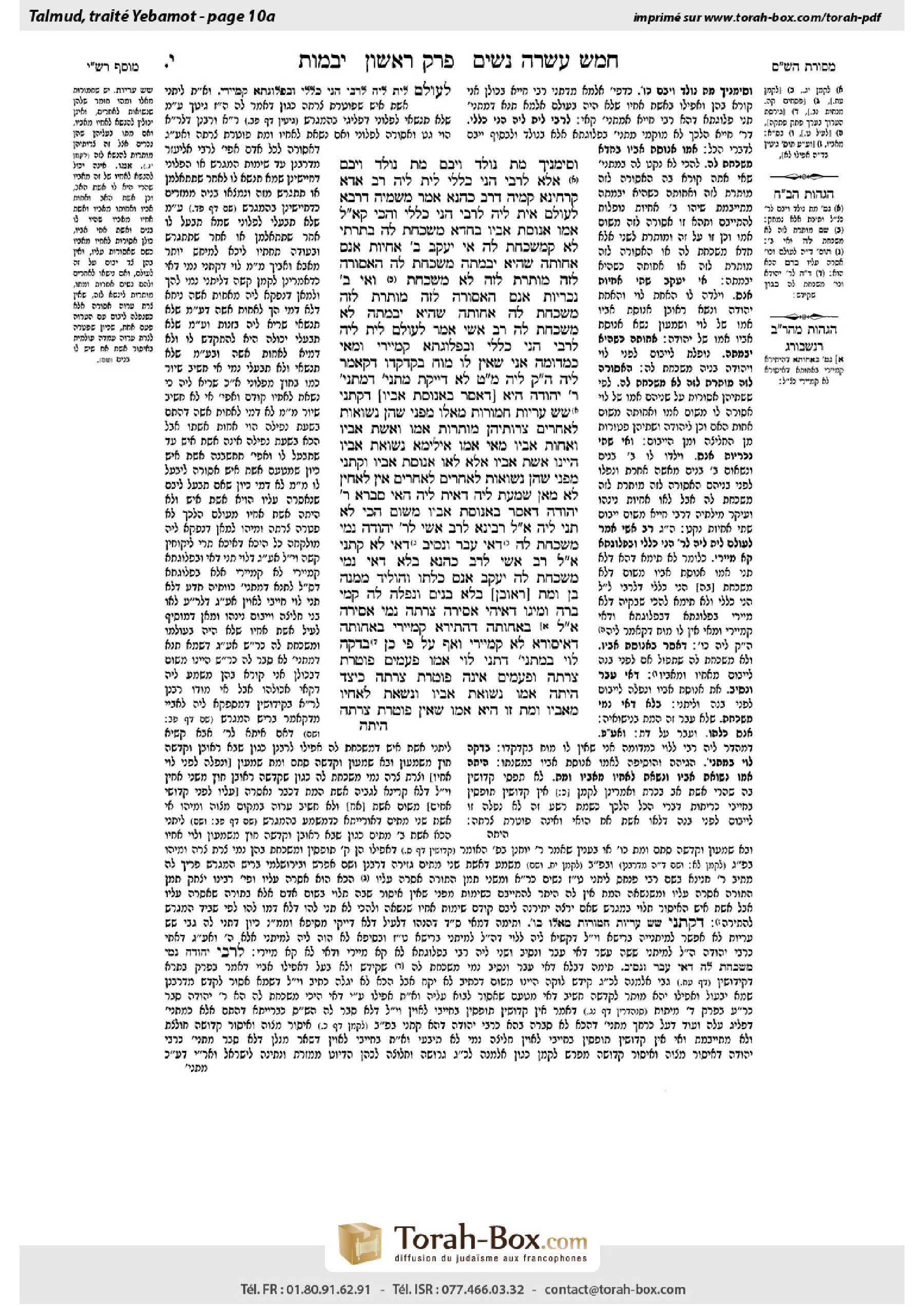
Yevamot 10a: Talmud study for Daf Yomi
Daf Yomi is the daily study of one Talmud folio. Explore 37 tractates with scans, Hebrew text, Sefaria English and AI-generated French translations where annotated.
Passage selection and English or AI-generated French translation are available where the scan has annotations. Daf Study is independent of Torah-Box and Sefaria.
Browse Yevamot · יבמות · All tractatesYevamot 10a text and translations
This page of Yevamot includes the Aramaic text, an English translation and an AI-generated French translation, alongside the scan above.
יבמות י׳ א · Aramaic and Hebrew text
וְסִימָנָיךְ: מֵת, נוֹלַד, וְיִבֵּם. מֵת, נוֹלַד, וְיִבֵּם.
אֶלָּא לְרַבִּי הָנֵי כְּלָלֵי לֵית לֵיהּ. רַב אַדָּא קַרְחִינָא קַמֵּיהּ דְּרַב כָּהֲנָא אָמַר מִשְּׁמֵיהּ דְּרָבָא: לְעוֹלָם אִית לֵיהּ לְרַבִּי הָנֵי כְּלָלֵי, וְהָכִי קָאָמַר לֵיהּ: אִמּוֹ אֲנוּסַת אָבִיו — בַּחֲדָא מַשְׁכַּחַתְּ לַהּ, בְּתַרְתֵּי לָא קָמַשְׁכַּחַתְּ לַהּ.
אִי יַעֲקֹב שְׁתֵּי אֲחָיוֹת אָנַס, אֲחוֹתָהּ שֶׁהִיא יְבִמְתָּהּ — מַשְׁכַּחַתְּ לַהּ, הָאֲסוּרָה לָזֶה מוּתֶּרֶת לָזֶה — לָא מַשְׁכַּחַתְּ.
וְאִי שְׁתֵּי נׇכְרִיּוֹת אָנַס, הָאֲסוּרָה לָזֶה מוּתֶּרֶת לָזֶה — מַשְׁכַּחַתְּ לַהּ, אֲחוֹתָהּ שֶׁהִיא יְבִמְתָּהּ — לָא מַשְׁכַּחַתְּ לַהּ.
רַב אָשֵׁי אָמַר: לְעוֹלָם לֵית לֵיהּ לְרַבִּי הָנֵי כְּלָלֵי, וּבִפְלוּגְתָּא קָמַיְירֵי, וּמַאי ״כִּמְדוּמֶּה אֲנִי שֶׁאֵין לוֹ מוֹחַ בְּקׇדְקֳדוֹ״ דְּקָאָמַר לֵיהּ —
הָכִי קָאָמַר לֵיהּ: מַאי טַעְמָא לָא דָּיְיקַתְּ מַתְנִיתִין? דְּמַתְנִיתִין רַבִּי יְהוּדָה הִיא [דְּאָסַר בַּאֲנוּסַת אָבִיו].
דְּקָתָנֵי: שֵׁשׁ עֲרָיוֹת חֲמוּרוֹת מֵאֵלּוּ, מִפְּנֵי שֶׁהֵן נְשׂוּאוֹת לַאֲחֵרִים צָרוֹתֵיהֶן מוּתָּרוֹת: אִמּוֹ, וְאֵשֶׁת אָבִיו, וַאֲחוֹת אָבִיו. מַאי אִמּוֹ? אִילֵּימָא נְשׂוּאַת אָבִיו — הַיְינוּ אֵשֶׁת אָבִיו!
אֶלָּא לָאו — אֲנוּסַת אָבִיו. וְקָתָנֵי: מִפְּנֵי שֶׁהֵן נְשׂוּאוֹת לַאֲחֵרִים: לַאֲחֵרִים אִין, לָאַחִין לָא. מַאן שָׁמְעַתְּ לֵיהּ דְּאִית לֵיהּ הַאי סְבָרָא — רַבִּי יְהוּדָה, דְּאָסַר בַּאֲנוּסַת אָבִיו. מִשּׁוּם הָכִי לָא תָּנֵי לֵיהּ.
אֲמַר לֵיהּ רָבִינָא לְרַב אָשֵׁי: לְרַבִּי יְהוּדָה נָמֵי מַשְׁכַּחַתְּ לַהּ — דְּאִי עֲבַר וּנְסֵיב? ״דְּאִי״ לָא קָתָנֵי.
אֲמַר לֵיהּ רַב אָשֵׁי לְרַב כָּהֲנָא, בְּלָא ״דְּאִי״ נָמֵי מַשְׁכַּחַתְּ לַהּ: יַעֲקֹב אָנַס כַּלָּתוֹ וְהוֹלִיד מִמֶּנָּה בֵּן, וּמֵת [רְאוּבֵן] בְּלֹא בָּנִים. וּנְפַלָה לַהּ קַמֵּי בְּרַהּ, וּמִיגּוֹ דְּאִיהִי אֲסִירָה — צָרָתָהּ נָמֵי אֲסִירָה.
אֲמַר לֵיהּ: בְּאַחְוָתָה דְּהֶתֵּירָא קָמַיְירֵי, בְּאַחְוָתָה דְּאִיסּוּרָא לָא קָמַיְירֵי. וְאַף עַל פִּי כֵן, בַּדְקַהּ לֵוִי בְּמַתְנִיתֵיהּ.
דְּתָנֵי לֵוִי: אִמּוֹ, פְּעָמִים פּוֹטֶרֶת צָרָתָהּ, וּפְעָמִים אֵינָהּ פּוֹטֶרֶת צָרָתָהּ. כֵּיצַד? הָיְתָה אִמּוֹ נְשׂוּאַת אָבִיו, וְנִשֵּׂאת לְאָחִיו מֵאָבִיו, וּמֵת — זוֹ הִיא אִמּוֹ שֶׁאֵין פּוֹטֶרֶת צָרָתָהּ.
Yevamot 10a · English translation
And your mnemonic to remember how this might occur is as follows: Died, was born, entered into levirate marriage, died, was born, entered into levirate marriage. In other words, there were several brothers, and one, Reuven, died, before another, Yissakhar, was born, and another brother, Shimon, entered into levirate marriage with the deceased’s wife, and there was another brother, Levi, who died as well, and yet another brother, Zevulun, was born, and a sixth brother, Yehuda, entered into levirate marriage with the deceased’s wife. In this case, if Shimon and Yehuda were to die childless, their wives would come before the surviving brothers, Yissakhar and Zevulun, for levirate marriage. To one of them, Yissakhar, the wife of the first brother, Reuven, is prohibited, and for the other brother, Zevulun, the wife of the second brother, Levi, is likewise prohibited.
This is an example of the type of case analyzed in the third chapter, in which the ruling is that the woman who is forbidden to this brother is permitted to that one, and she who is forbidden to this one is permitted to that one. In any case, Rabbi Ḥiyya incorporates the opinion of Rabbi Shimon into this principle, as he maintains that this scenario can apply to each case stated in the mishna. If so, the mishna evidently does deal with disputed legal rulings. How, then, can Rabbi Yehuda HaNasi claim that the cases of the mishna are unanimous?
§ Rather, Rabbi Yehuda HaNasi does not hold in accordance with these general statements applied by Rabbi Ḥiyya, and therefore he maintains that no issue subject to dispute was taught in the mishna. Rav Adda Karḥina, who was sitting before Rav Kahana, said in the name of Rava: Actually, one can explain that Rabbi does hold in accordance with these general statements laid out by Rabbi Ḥiyya. And this is what he said to Levi: In the case of his mother who had been raped by his father, you find this case with only one of the women; however, you cannot find it with two. In other words, the terms mentioned by Rabbi Ḥiyya above: She who is forbidden to this one is permitted to that one, and: A sister who is a sister-in-law performs either ḥalitza or levirate marriage, apply only partly to this complex case.
The Gemara elaborates: If Ya’akov, the father, raped two sisters who gave birth to two sons, and he had two other sons who married these raped sisters and died, in this scenario you find a case of her sister who is her sister-in-law, as there is a yevama who comes before one of the brothers who is a forbidden relative and also a sister and a sister-in-law of another yevama. However, you cannot find the principle of: She who is forbidden to this one is permitted to that one. Although it is possible that one’s brother’s wife who is one’s mother might come before one for levirate marriage, just as he is forbidden to his mother, he is likewise forbidden to his mother’s sister.
And if the father raped two unrelated women, who gave birth to two sons and then married two other sons of the same father who subsequently died, you find the case of: She who is forbidden to this one is permitted to that one, as each of the two raped women comes before one of the brothers for levirate marriage while she is forbidden to the other as his mother. However, you do not find a situation of: Her sister who is her sister-in-law. Therefore, the case of one’s mother who was raped by one’s father cannot be included in the list of the mishna, as the characteristics stated by Rabbi Ḥiyya do not apply to this case.
§ Rav Ashi stated a different explanation: Actually, Rabbi Yehuda HaNasi does not hold in accordance with these general statements of Rabbi Ḥiyya, and the mishna does deal with halakhot that are in dispute. According to his opinion, what is the meaning of the phrase: It seems to me that he has no brain in his head, that Rabbi Yehuda HaNasi said to Levi?
According to Rav Ashi, this is what Rabbi Yehuda HaNasi said to Levi: What is the reason that you were not precise in your interpretation of the mishna? As the mishna is in accordance with the opinion of Rabbi Yehuda, who prohibited the case of a woman who was raped by one’s father. Accordingly, the rulings of the mishna cannot be attributed to any opinion that is not in line with that of Rabbi Yehuda. What is the proof that this mishna is indeed in accordance with the opinion of Rabbi Yehuda?
As it teaches in the next mishna: Six women with whom relations are forbidden are more severe than these enumerated in the previous mishna, because they may marry only others and can never be married to any of the brothers, and therefore their rival wives are permitted. These women include: His mother, his father’s wife, and his father’s sister. Rav Ashi infers: What is the meaning of: His mother? If we say that this mother is married to his father, then this is the same case as: His father’s wife, which would mean that the mishna lists only five cases, not six.
Rather, is it not referring to a woman raped by his father? And it is taught in the mishna that the halakhot of levirate marriage do not apply to them because they may marry only others, which indicates: Others, yes; the brothers, no. Since each of the brothers are sons of the same father, each one is prohibited from marrying the mother of one of the other brothers, as although she is not his mother, she is nevertheless a woman raped by his father, whom one may not marry. Who did you hear who holds in accordance with this conclusion that a woman raped by one’s father is prohibited to all his sons? It is Rabbi Yehuda who prohibits a woman raped by his father. Due to that reason the case of a woman raped by one’s father was not taught in the first mishna.
Ravina said to Rav Ashi: Even according to the opinion of Rabbi Yehuda you can find this possibility that a woman raped by a father comes before the son for levirate marriage. What if one of the brothers transgressed and married a woman raped by his father? Even Rabbi Yehuda concedes that this is a violation of a regular prohibition that does not incur karet, and therefore the marriage is valid. Consequently, if this brother died childless, this woman would come before her son for levirate marriage. The Gemara rejects this proof: The tanna does not teach cases of what if, i.e., the mishna does not cite an example that could result only from a transgression.
Rav Ashi said to Rav Kahana: Even without a hypothetical: What if, you can find an example of a woman raped by a father who is not forbidden to the son in marriage. How so? Ya’akov, the father, raped his daughter-in-law, from whom he fathered a son. And the son, Reuven, the husband of the daughter-in-law, died childless. And as Ya’akov had two sons, the deceased Reuven and a son by Reuven’s wife whom Ya’akov had raped, Reuven’s wife would then come before her son for levirate marriage. And since she is forbidden, her rival wife is also forbidden. Consequently, a case of this kind is possible without the levirate marriage resulting from an illicit marriage.
Rav Kahana said to Rav Ashi: The mishna deals with cases of legitimate brothers, whereas it does not deal with cases of illegitimate brothers. The offspring of a man who rapes his daughter-in-law is a mamzer, and cases of this kind are not discussed in the mishna. The Gemara comments: Nevertheless, despite Rabbi Yehuda HaNasi’s criticism, Levi established this additional possibility of a woman raped by one’s father in his mishnayot.
As Levi taught in his baraita: With regard to the case of his mother, at times she exempts her rival wife, and at other times she does not exempt her rival wife. How so? If his mother was married to his father and after his father’s death she illicitly married her son’s paternal brother, who then died, this is a case of: His mother who does not exempt her rival wife. The reason is that her marriage to his brother does not take effect at all, as it was forbidden on pain of karet. Since this marriage never occurred, only the other wife, the so-called rival wife, is considered a wife of the brother, and she may enter into levirate marriage.
Yevamot 10a · Traduction française (IA)
Et votre mnémotechnique pour retenir comment cela pourrait se produire est la suivante : Mort, naissance, entrée en mariage lévirat, mort, naissance, entrée en mariage lévirat. Autrement dit, il y avait plusieurs frères, et l'un d'eux, Reuven, mourut avant qu'un autre, Yissakhar, ne soit né, et un autre frère, Shimon, entra en mariage lévirat avec la femme du défunt, et il y avait un autre frère, Levi, qui mourut également, et un autre frère, Zevulun, naquit, et un sixième frère, Yehuda, entra en mariage lévirat avec la femme du défunt. Dans ce cas, si Shimon et Yehuda venaient à mourir sans enfants, leurs épouses se présenteraient devant les frères survivants, Yissakhar et Zevulun, pour un mariage lévirat. Pour l'un d'entre eux, Yissakhar, l'épouse du premier frère, Reuven, lui est interdite, et pour l'autre frère, Zevulun, l'épouse du deuxième frère, Levi, lui est également interdite. C'est un exemple du type de cas analysé dans le troisième chapitre, dans lequel la décision est que la femme qui est interdite à ce frère est permise à celui-là, et celle qui est interdite à celui-ci est permise à celui-là. En tout cas, Rabbi Ḥiyya intègre l'opinion de Rabbi Shimon dans ce principe, car il soutient que ce scénario peut s'appliquer à chaque cas énoncé dans la Michna. Si tel est le cas, la Michna traite manifestement de décisions juridiques disputées. Comment, alors, Rabbi Yehuda HaNasi peut-il affirmer que les cas de la Michna sont unanimes ?
§ En réalité, Rabbi Yehuda HaNasi ne souscrit pas à ces principes généraux appliqués par Rabbi Ḥiyya, et par conséquent, il soutient qu'aucune question sujette à dispute n'a été enseignée dans la Michna. Rav Adda Karḥina, qui était assis devant Rav Kahana, a dit au nom de Rava : En réalité, on peut expliquer que Rabbi souscrit à ces principes généraux exposés par Rabbi Ḥiyya. Et voici ce qu'il a dit à Levi : Dans le cas de sa mère qui avait été violée par son père, vous trouvez ce cas avec seulement l'une des femmes ; cependant, vous ne pouvez pas le trouver avec deux. Autrement dit, les termes mentionnés par Rabbi Ḥiyya ci-dessus : Celle qui est interdite à celui-ci est permise à celui-là, et : Une sœur qui est belle-sœur effectue soit la ḥalitza, soit le mariage lévirat, ne s'appliquent que partiellement à ce cas complexe.
La Guemara développe : Si Ya’akov, le père, a violé deux sœurs qui ont donné naissance à deux fils, et qu'il a eu deux autres fils qui ont épousé ces sœurs violées et sont morts, dans ce scénario, vous trouvez un cas de sa sœur qui est sa belle-sœur, car il y a une yevama qui se présente devant l'un des frères qui est un parent interdit et qui est également la sœur et la belle-sœur d'une autre yevama. Cependant, vous ne pouvez pas trouver le principe de : Celle qui est interdite à celui-ci est permise à celui-là. Bien qu'il soit possible que l'épouse de son frère qui est sa mère se présente devant lui pour un mariage lévirat, de même qu'il lui est interdit de se marier avec sa mère, il lui est également interdit de se marier avec la sœur de sa mère.
Et si le père a violé deux femmes sans lien de parenté, qui ont donné naissance à deux fils, et que ces deux fils ont ensuite épousé deux autres fils du même père, qui sont ensuite morts, vous trouvez le cas de : « Celle qui est interdite à celui-ci est permise à celui-là », car chacune des deux femmes violées se présente devant l'un des frères pour le mariage lévirat, tandis qu'elle est interdite à l'autre en tant que sa mère. Cependant, vous ne trouvez pas la situation de : « Sa sœur qui est sa belle-sœur ». Par conséquent, le cas d'une mère violée par son père ne peut pas être inclus dans la liste de la Michna, car les caractéristiques énoncées par Rabbi Ḥiyya ne s'appliquent pas à ce cas.
§ Rav Ashi a formulé une explication différente : En réalité, Rabbi Yehuda HaNasi ne souscrit pas à ces déclarations générales de Rabbi Ḥiyya, et la Michna traite de halakhot qui font l'objet d'un débat. Selon son opinion, quelle est la signification de la phrase : « Il me semble qu'il n'a pas de cerveau dans sa tête », que Rabbi Yehuda HaNasi a dite à Levi ?
Selon Rav Ashi, voici ce que Rabbi Yehuda HaNasi a dit à Levi : Quelle est la raison pour laquelle vous n'avez pas été précis dans votre interprétation de la Michna ? Car la Michna est conforme à l'opinion de Rabbi Yehuda, qui a interdit le cas d'une femme violée par le père. En conséquence, les décisions de la Michna ne peuvent pas être attribuées à une opinion qui ne suit pas celle de Rabbi Yehuda. Quelle est la preuve que cette Michna est effectivement conforme à l'opinion de Rabbi Yehuda ?
Comme l'enseigne la Michna suivante : Six femmes avec qui les relations sont interdites sont plus sévères que celles énumérées dans la Michna précédente, car elles ne peuvent épouser que d'autres hommes et ne peuvent jamais être mariées à l'un des frères, et par conséquent, leurs rivales sont permises. Ces femmes incluent : Sa mère, l'épouse de son père, et la sœur de son père. Rav Ashi en déduit : Quelle est la signification de : Sa mère ? Si nous disons que cette mère est mariée à son père, alors c'est le même cas que : L'épouse de son père, ce qui signifierait que la Michna ne liste que cinq cas, et non six.
Plutôt, ne fait-elle pas référence à une femme violée par son père ? Et il est enseigné dans la Michna que les halakhot du mariage lévirat ne s'appliquent pas à elles parce qu'elles ne peuvent épouser que d'autres, ce qui indique : D'autres, oui ; les frères, non. Puisque chacun des frères est fils du même père, chacun est interdit de se marier avec la mère de l'un des autres frères, car bien qu'elle ne soit pas sa mère, elle est néanmoins une femme violée par son père, avec laquelle on ne peut pas se marier. Qui avez-vous entendu qui soutient cette conclusion selon laquelle une femme violée par le père est interdite à tous ses fils ? C'est Rabbi Yehuda qui interdit une femme violée par son père. Pour cette raison, le cas d'une femme violée par le père n'a pas été enseigné dans la première Michna.
Ravina dit à Rav Ashi : Même selon l'opinion de Rabbi Yehuda, on peut trouver cette possibilité qu'une femme violée par un père se présente devant le fils pour le yiboum. Que se passerait-il si l'un des frères avait transgressé et épousé une femme violée par son père ? Même Rabbi Yehuda concède que cela constitue une violation d'une interdiction ordinaire qui n'entraîne pas la peine de karet, et par conséquent le mariage est valide. Ainsi, si ce frère est mort sans postérité, cette femme se présenterait devant son fils pour le yiboum. La Guemara rejette cette preuve : le tanna n'enseigne pas des cas hypothétiques, c'est-à-dire que la Michna ne cite pas un exemple qui ne pourrait résulter que d'une transgression.
Rav Ashi dit à Rav Kahana : Même sans un cas hypothétique : que se passerait-il, on peut trouver un exemple d'une femme violée par un père qui n'est pas interdite au fils en mariage. Comment cela ? Ya'akov, le père, a violé sa belle-fille, de qui il a eu un fils. Et le fils, Reuven, l'époux de la belle-fille, est mort sans postérité. Et comme Ya'akov avait deux fils, le défunt Reuven et un fils de la femme de Reuven que Ya'akov avait violée, la femme de Reuven se présenterait alors devant son fils pour le yiboum. Et comme elle est interdite, sa rivale est également interdite. Par conséquent, un cas de ce type est possible sans que le yiboum ne résulte d'un mariage illicite.
Rav Kahana dit à Rav Ashi : La Michna traite des cas de frères légitimes, tandis qu'elle ne traite pas des cas de frères illégitimes. La descendance d'un homme qui viole sa belle-fille est un mamzer, et les cas de ce type ne sont pas discutés dans la Michna. La Guemara commente : Néanmoins, malgré la critique de Rabbi Yehuda HaNasi, Levi a établi cette possibilité supplémentaire d'une femme violée par le père dans ses Michnayot.
Comme Levi l'a enseigné dans sa baraïta : En ce qui concerne le cas de sa mère, parfois elle dispense sa femme rivale, et à d'autres moments elle ne la dispense pas. Comment cela ? Si sa mère était mariée à son père et qu'après la mort de son père elle a illicitement épousé le frère paternel de son fils, qui est ensuite mort, il s'agit du cas de : Sa mère qui ne dispense pas sa femme rivale. La raison est que son mariage avec son frère n'a aucun effet, car il était interdit sous peine de karet. Puisque ce mariage n'a jamais eu lieu, seule l'autre femme, la dite femme rivale, est considérée comme l'épouse du frère, et elle peut entrer dans le yiboum.
Traduction française générée par IA à partir de l’édition anglaise de Sefaria. Vérifie toujours un passage avec le texte source.
Text from Sefaria: William Davidson Edition - Vocalized Aramaic (CC BY NC); William Davidson Edition - English (CC BY NC).