Yevamot 9b: Talmud study for Daf Yomi
Daf Yomi is the daily study of one Talmud folio. Explore 37 tractates with scans, Hebrew text, Sefaria English and AI-generated French translations where annotated.
Passage selection and English or AI-generated French translation are available where the scan has annotations. Daf Study is independent of Torah-Box and Sefaria.
Browse Yevamot · יבמות · All tractatesYevamot 9b text and translations
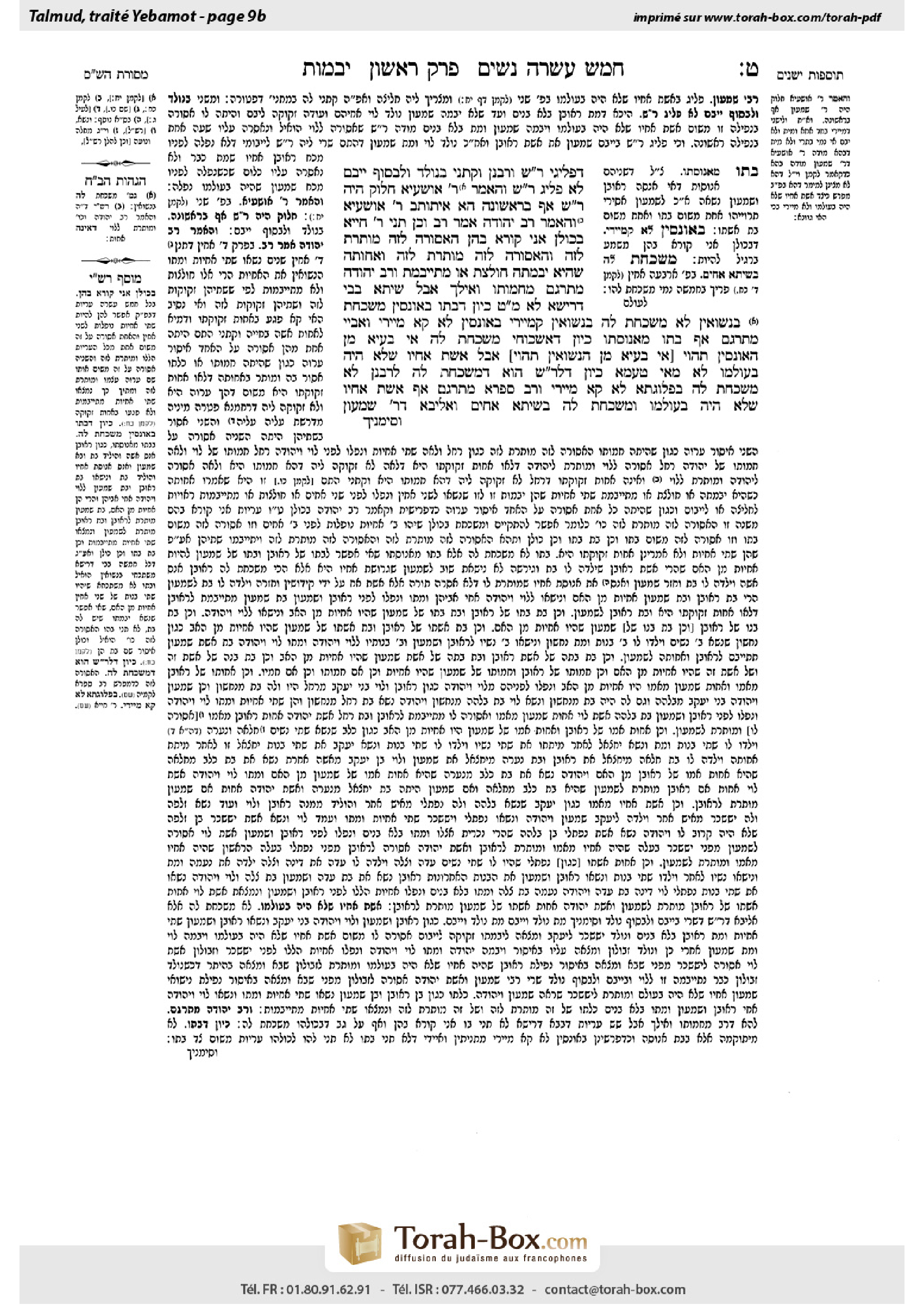
This page of Yevamot includes the Aramaic text, an English translation and an AI-generated French translation, alongside the scan above.
יבמות ט׳ ב · Aramaic and Hebrew text
דִּפְלִיגִי רַבִּי שִׁמְעוֹן וְרַבָּנַן, וְקָתָנֵי!
בְּנוֹלַד וּלְבַסּוֹף יִיבֵּם — לָא פְּלִיג רַבִּי שִׁמְעוֹן.
וְהָאָמַר רַבִּי אוֹשַׁעְיָא: חָלוּק הָיָה רַבִּי שִׁמְעוֹן אַף בָּרִאשׁוֹנָה!
הָא אִיתּוֹתַב רַבִּי אוֹשַׁעְיָא.
וְהָאָמַר רַב יְהוּדָה אָמַר רַב, וְכֵן תָּנֵי רַבִּי חִיָּיא: בְּכוּלָּן אֲנִי קוֹרֵא בָּהֶן הָאֲסוּרָה לָזֶה — מוּתֶּרֶת לָזֶה, וְהָאֲסוּרָה לָזֶה — מוּתֶּרֶת לָזֶה, וַאֲחוֹתָהּ שֶׁהִיא יְבִמְתָּהּ חוֹלֶצֶת אוֹ מִתְיַיבֶּמֶת.
וְרַב יְהוּדָה מְתַרְגֵּם מֵחֲמוֹתוֹ וְאֵילָךְ. אֲבָל שִׁיתָּא בָּבֵי דְּרֵישָׁא — לָא. מַאי טַעְמָא?
כֵּיוָן דְּבִתּוֹ
בְּאוּנְסִין מַשְׁכַּחַתְּ, בְּנִשּׂוּאִין לָא מַשְׁכַּחַתְּ לַהּ. בְּנִשּׂוּאִין קָמַיְירֵי, בְּאוּנְסִין לָא קָא מַיְירֵי.
וְאַבָּיֵי מְתַרְגֵּם אַף בִּתּוֹ מֵאֲנוּסָתוֹ — כֵּיוָן דְּאַשְׁכּוֹחֵי מַשְׁכַּחַתְּ לַהּ, אִי בָּעֲיָא מִן הָאוּנְסִין תִּהְוֵי, [אִי בָּעֲיָא מִן הַנִּשּׂוּאִין תִּהְוֵי]. אֲבָל אֵשֶׁת אָחִיו שֶׁלֹּא הָיָה בְּעוֹלָמוֹ — לָא. מַאי טַעְמָא?
כֵּיוָן דִּלְרַבִּי שִׁמְעוֹן הוּא דְּמַשְׁכַּחַתְּ לַהּ, לְרַבָּנַן לָא מַשְׁכַּחַתְּ לַהּ — בִּפְלוּגְתָּא לָא קָא מַיְירֵי.
וְרַב סָפְרָא מְתַרְגֵּם אַף אֵשֶׁת אָחִיו שֶׁלֹּא הָיָה בְּעוֹלָמוֹ, וּמַשְׁכַּחַתְּ לַהּ בְּשִׁיתָּא אַחִים, וְאַלִּיבָּא דְּרַבִּי שִׁמְעוֹן.
Yevamot 9b · English translation
This is a case concerning which Rabbi Shimon and the Rabbis disagree, and yet it is taught. If this halakha is taught, evidently this mishna does deal with matters subject to dispute. The Gemara answers that Rabbi Shimon does not disagree with the Rabbis concerning all cases of a wife of a brother with whom he did not coexist. If this yavam was born after his brother’s death, he concedes that the obligation of levirate marriage does not apply to the newborn yavam. Rather, the yevama is prohibited to him as his brother’s wife.
Furthermore, in a case where he was born and at the end, i.e., afterward, a second older brother entered into levirate marriage with the yevama and subsequently died as well, and the same woman again came before that same younger brother, Rabbi Shimon did not disagree with the opinion of the Rabbis here either, as he admits that this woman is permanently forbidden to him because when he was born she was classified as the wife of a brother with whom he did not coexist.
In fact, Rabbi Shimon disagreed only with regard to a different case, when there were two brothers, one of whom died, and the second took the yevama in levirate marriage. If a third brother was subsequently born and afterward the second brother died, Rabbi Shimon maintains that the youngest brother may enter into levirate marriage with this woman because she was never forbidden to him, as what occurred prior to his birth is of no relevance. Since even in Rabbi Shimon’s opinion it is possible to find a case in which the wife of a brother with whom he did not coexist is forbidden to him, it can be claimed that the mishna is taught in accordance with all opinions.
The Gemara raises a difficulty: But didn’t Rabbi Oshaya say that Rabbi Shimon disagreed even with regard to the first case? In other words, Rabbi Shimon disagreed not only in the case of a woman who entered into levirate marriage before the young brother was born, but even if the young brother was born before the initial levirate marriage took place.
The Gemara rejects this suggestion: This statement of Rabbi Oshaya was conclusively refuted. Consequently, it remains possible to say that the mishna does not deal with disputes.
The Gemara raises a difficulty from another angle. The third chapter discusses a case involving four brothers, two of whom passed away after they were married to two sisters. As a result, the two sisters simultaneously came before the surviving brothers for levirate marriage or ḥalitza. The Sages ruled that in this case the brothers may not enter into levirate marriage with the sisters, as it is as though the two sisters came before each brother individually, and due to the levirate bond each sister was, in a sense, considered married to each brother to a certain extent.
Consequently, for each brother the other sister is viewed as his wife’s sister, as it were, and is forbidden to him. Since this occurs to both sisters simultaneously, it is prohibited for both of them to enter into levirate marriage. However, the Sages further said that if one of these sisters was a forbidden relation to one of the surviving brothers, e.g., if he had married her daughter or some other relative, the second sister, to whom he is not a close relative, is permitted to him. If the same applies to the other brother and the second sister, the two brothers could perform ḥalitza with the two sisters or even enter into levirate marriage with them.
With this in mind, the Gemara states its objection: And didn’t Rav Yehuda say that Rav said, and likewise Rabbi Ḥiyya taught in a baraita: With regard to all of those fifteen women enumerated in the mishna, it is possible to find a scenario in which I would call them: The woman who is forbidden to this brother is permitted to that brother, and the one who is forbidden to this brother is permitted to that brother. And consequently, her sister who is her sister-in-law performs ḥalitza or enters into levirate marriage. This complex situation can be demonstrated with regard to each of the women enumerated in the mishna, e.g., if one sister is the mother-in-law of one brother, and the second sister is the mother-in-law of the second brother, and so on.
And Rav Yehuda explains that this is not true of all of the women listed in the mishna. Only from the case of his mother-in-law and onward, until the end of the list, is it possible for one sister to be a forbidden relation to one brother and the other sister not to be forbidden at all. However, in the first six cases, no, this option does not apply. What is the reason for this?
Since, for example, in the case of one’s daughter, although it is possible that one of the sisters is the daughter of one of the brothers, her mother is prohibited to all of the brothers as their brother’s wife, and therefore she could not possibly have a daughter from another brother. This case is possible only if one brother raped a woman who subsequently gave birth to his daughter. Since the prohibition with regard to a brother’s wife applies only in the case of marriage, this same woman is not forbidden to a different brother. If another brother came and raped her as well and she gave birth to his daughter too, and these two daughters later married two other brothers, each of these sisters who are sisters-in-law is forbidden to one of the brothers but permitted to the other.
Accordingly, in the case of rape you can find this scenario, but in the case of marriage you cannot find it. However, the mishna cannot be interpreted as referring to a case of this kind, as it deals with marriage and it does not deal with rape.
And Abaye explains differently, as he would include in this scenario even his daughter from the woman he raped. Why would he include this case? Since you can find this possibility, if you wish it can be by rape, and if you wish it can be by marriage, i.e., regardless of the details, this situation can occur. However, the last case, that of a wife of a brother with whom he did not coexist, he would not include. What is the reason for this?
Since it is only according to the opinion of Rabbi Shimon that you find this potential scenario, as he permits a yevama to her yavam in a case where he was born after she first entered levirate marriage, it is therefore possible that one sister might be forbidden to one brother if he was born before his brother took her in levirate marriage. Likewise, another sister might be forbidden to another brother for the same reason, although the first woman would be permitted to him, as in his lifetime she was never the wife of a brother with whom he did not coexist. According to the opinion of the Rabbis, however, you cannot find this scenario, and the mishna does not deal with disputes but only with those cases that are accepted by all opinions.
But Rav Safra explains that the possibility of one brother permitted only to one woman and another brother likewise permitted only to one woman exists even in the case of a wife of a brother with whom he did not coexist, and you can find this scenario in a case involving six brothers, and this is in accordance with the opinion of Rabbi Shimon.
Yevamot 9b · Traduction française (IA)
Il s’agit d’un cas sur lequel Rabbi Shimon et les Sages sont en désaccord, et pourtant il est enseigné. Si cette halakha est enseignée, il est évident que cette Michna traite de sujets faisant l’objet d’une controverse. La Guemara répond que Rabbi Shimon n’est pas en désaccord avec les Sages dans tous les cas où il s’agit de la femme d’un frère avec lequel il n’a pas coexisté. Si ce yavam est né après la mort de son frère, il concède que l’obligation du mariage léviratique ne s’applique pas au yavam nouveau-né. La yevama lui est plutôt interdite en tant que femme de son frère.
De plus, dans le cas où il est né et où, plus tard, un deuxième frère aîné a contracté un mariage léviratique avec la yevama, puis est mort à son tour, si la même femme se présente de nouveau devant ce même frère cadet, Rabbi Shimon n’est pas non plus en désaccord avec les Sages. Il reconnaît en effet que cette femme lui est interdite à jamais, car, au moment de sa naissance, elle était considérée comme la femme d’un frère avec lequel il n’avait pas coexisté.
En réalité, Rabbi Shimon n’est en désaccord que dans un autre cas : il y avait deux frères, l’un mourut et le second prit la yevama en mariage léviratique. Si un troisième frère naquit ensuite, puis que le deuxième frère mourut, Rabbi Shimon soutient que le frère cadet peut contracter un mariage léviratique avec cette femme, car elle ne lui a jamais été interdite : ce qui s’est passé avant sa naissance n’a aucune pertinence. Puisqu’il est possible de trouver un cas où, même selon Rabbi Shimon, la femme d’un frère avec lequel il n’a pas coexisté lui est interdite, on peut affirmer que la Michna est enseignée conformément à toutes les opinions. La Guemara soulève une difficulté : Rabbi Oshaïa n’a-t-il pas dit que Rabbi Shimon était en désaccord même dans le premier cas ? Autrement dit, Rabbi Shimon n’était pas seulement en désaccord dans le cas d’une femme qui avait contracté un mariage léviratique avant la naissance du frère cadet, mais même si celui-ci était né avant que le premier mariage léviratique ait lieu.
La Guemara rejette cette proposition : cette déclaration de Rabbi Oshaïa a été réfutée de manière décisive. Il reste donc possible de dire que la Michna ne traite pas de désaccords. La Guemara soulève une difficulté sous un autre angle. Le troisième chapitre traite d’un cas impliquant quatre frères, dont deux moururent alors qu’ils étaient mariés à deux sœurs. Les deux sœurs se présentèrent donc simultanément devant les frères survivants pour le mariage léviratique ou la ḥalitsa. Les Sages statuèrent que, dans ce cas, les frères ne peuvent pas contracter de mariage léviratique avec les sœurs, car c’est comme si chacune des deux sœurs s’était présentée individuellement devant chacun des frères et que, du fait du lien léviratique, chacune était, dans une certaine mesure, considérée comme mariée à chacun des frères. Par conséquent, pour chaque frère, l’autre sœur est considérée, pour ainsi dire, comme la sœur de sa femme et lui est interdite. Puisque cette situation concerne simultanément les deux sœurs, il est interdit à toutes deux de contracter un mariage léviratique. Cependant, les Sages ont également dit que si l’une de ces sœurs était une parente interdite à l’un des frères survivants — par exemple, s’il avait épousé sa fille ou une autre parente —, la seconde sœur, qui n’est pas une proche parente de ce frère, lui est permise. Si la même chose s’applique à l’autre frère et à la seconde sœur, les deux frères pourraient accomplir la ḥalitsa avec les deux sœurs, voire contracter avec elles un mariage léviratique.
Dans cette optique, la Guemara formule son objection : Rav Yehouda n’a-t-il pas dit au nom de Rav, et Rabbi Ḥiyya n’a-t-il pas également enseigné dans une baraïta : parmi ces quinze femmes énumérées dans la Michna, il est possible, pour chacune, de trouver une situation où l’on pourrait dire : « Celle qui est interdite à ce frère est permise à cet autre frère, et celle qui est interdite à ce frère est permise à cet autre frère. » Par conséquent, sa sœur, qui est sa belle-sœur, accomplit la ḥalitsa ou contracte un mariage léviratique. On peut illustrer cette situation complexe pour chacune des femmes énumérées dans la Michna, par exemple si l’une des sœurs est la belle-mère d’un frère et l’autre sœur la belle-mère du second frère, et ainsi de suite.
Rav Yehouda explique que cela ne s’applique pas à toutes les femmes énumérées dans la Michna. Ce n’est qu’à partir du cas de sa belle-mère, et jusqu’à la fin de la liste, qu’il est possible que l’une des sœurs soit une parente interdite à un frère, tandis que l’autre ne lui soit pas interdite du tout. En revanche, cette possibilité ne s’applique pas aux six premiers cas. Pour quelle raison ?
Par exemple, dans le cas de sa fille, bien qu’il soit possible que l’une des sœurs soit la fille de l’un des frères, sa mère est interdite à tous les frères en tant que femme de leur frère ; elle ne peut donc pas avoir eu de fille d’un autre frère. Ce cas n’est possible que si un frère a violé une femme qui a ensuite donné naissance à sa fille. Puisque l’interdiction liée à la femme d’un frère ne s’applique qu’en cas de mariage, cette même femme n’est pas interdite à un autre frère. Si un autre frère vient lui aussi la violer et qu’elle donne également naissance à sa fille, puis que ces deux filles épousent plus tard deux autres frères, chacune de ces sœurs, qui sont belles-sœurs l’une de l’autre, est interdite à l’un des frères mais permise à l’autre.
Ainsi, on peut trouver cette situation dans le cas d’un viol, mais pas dans celui d’un mariage. Toutefois, la Michna ne peut pas être interprétée comme se référant à un cas de ce genre, puisqu’elle traite du mariage et non du viol.
Abayé explique les choses autrement : il inclurait également sa fille née de la femme qu’il a violée. Pourquoi inclurait-il ce cas ? Puisqu’on peut trouver cette possibilité, elle peut, si l’on veut, résulter d’un viol ou, si l’on veut, d’un mariage ; autrement dit, cette situation peut se présenter quels qu’en soient les détails. Il n’inclurait toutefois pas le dernier cas, celui de la femme d’un frère avec lequel il n’a pas coexisté. Pour quelle raison ?
Car ce cas potentiel ne se présente que selon l’opinion de Rabbi Shimon, qui permet à une yevama d’épouser son yavam lorsque celui-ci est né après qu’elle a contracté pour la première fois un mariage léviratique. Il est donc possible qu’une sœur soit interdite à un frère parce qu’il est né avant que son frère ne la prenne en mariage léviratique. De même, une autre sœur peut être interdite à un autre frère pour la même raison, bien que la première femme lui soit permise, puisqu’au cours de sa vie elle n’a jamais été la femme d’un frère avec lequel il n’avait pas coexisté. En revanche, selon l’opinion des Sages, on ne peut pas trouver cette situation ; la Michna ne traite pas des désaccords, mais uniquement des cas admis par toutes les opinions.
Rav Safra explique toutefois qu’on peut trouver, même dans le cas de la femme d’un frère avec lequel il n’a pas coexisté, une situation où un frère n’a qu’une seule femme qui lui soit permise, et où il en va de même pour un autre frère. Ce cas peut se présenter avec six frères, conformément à l’opinion de Rabbi Shimon.
Traduction française générée par IA à partir de l’édition anglaise de Sefaria. Vérifie toujours un passage avec le texte source.
Text from Sefaria: William Davidson Edition - Vocalized Aramaic (CC BY NC); William Davidson Edition - English (CC BY NC).