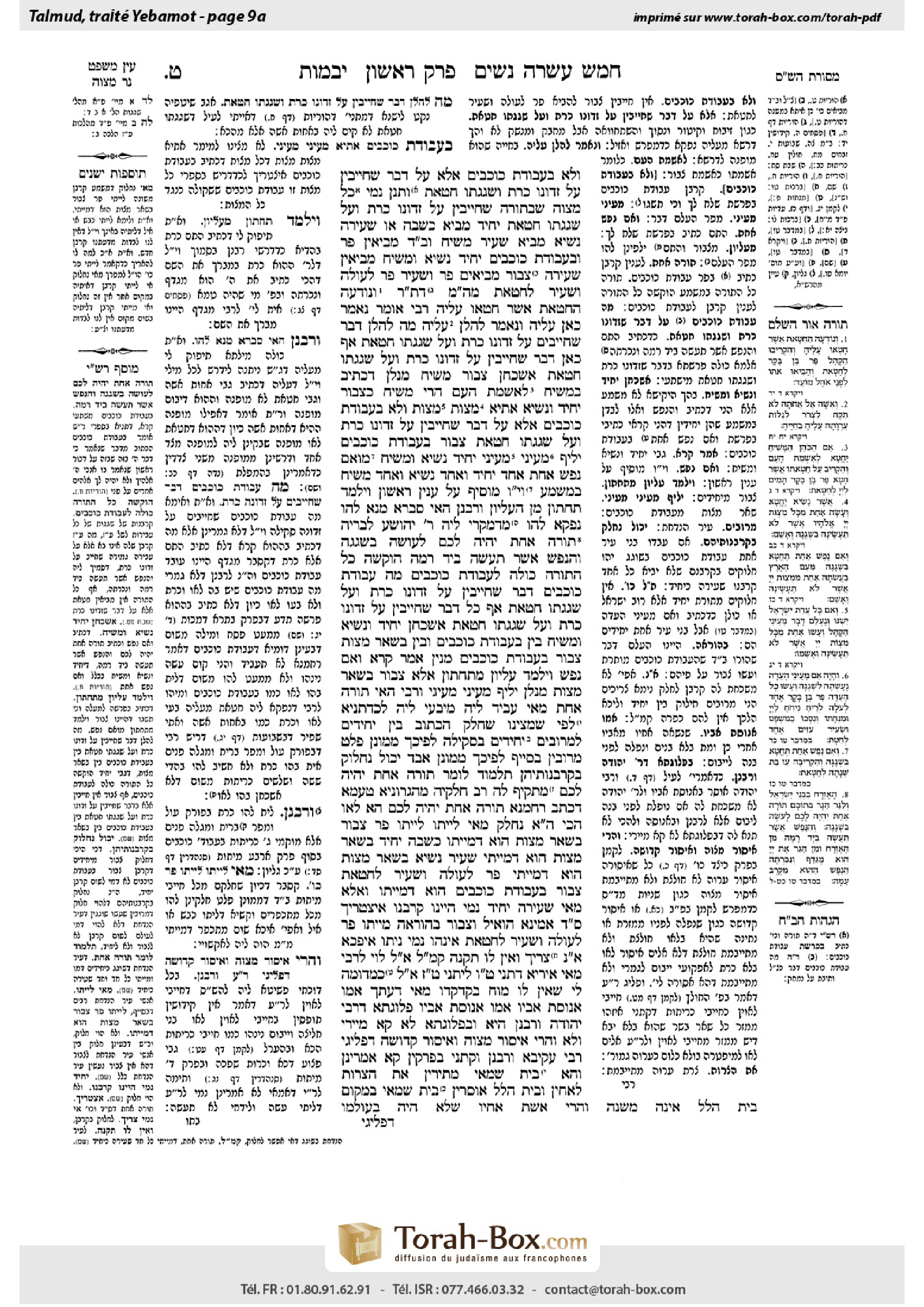
Yevamot 9a: Talmud study for Daf Yomi
Daf Yomi is the daily study of one Talmud folio. Explore 37 tractates with scans, Hebrew text, Sefaria English and AI-generated French translations where annotated.
Passage selection and English or AI-generated French translation are available where the scan has annotations. Daf Study is independent of Torah-Box and Sefaria.
Browse Yevamot · יבמות · All tractatesYevamot 9a text and translations
This page of Yevamot includes the Aramaic text, an English translation and an AI-generated French translation, alongside the scan above.
יבמות ט׳ א · Aramaic and Hebrew text
וְלֹא בַּעֲבוֹדָה זָרָה, אֶלָּא עַל דָּבָר שֶׁחַיָּיבִין עַל זְדוֹנוֹ כָּרֵת וְשִׁגְגָתוֹ חַטָּאת. וּתְנַן נָמֵי: כׇּל מִצְוָה שֶׁבַּתּוֹרָה שֶׁחַיָּיבִין עַל זְדוֹנוֹ כָּרֵת וְעַל שִׁגְגָתוֹ חַטָּאת, יָחִיד — מֵבִיא כִּשְׂבָּה אוֹ שְׂעִירָה, נָשִׂיא — מֵבִיא שָׂעִיר, מָשִׁיחַ וּבֵית דִּין — מְבִיאִין פַּר.
וּבַעֲבוֹדָה זָרָה, יָחִיד נָשִׂיא וּמָשִׁיחַ — מְבִיאִין שְׂעִירָה, צִבּוּר — מְבִיאִים פַּר וְשָׂעִיר, פַּר לְעוֹלָה וְשָׂעִיר לְחַטָּאת. מְנָא הָנֵי מִילֵּי?
דְּתָנוּ רַבָּנַן: ״וְנוֹדְעָה הַחַטָּאת אֲשֶׁר חָטְאוּ עָלֶיהָ״, רַבִּי אוֹמֵר: נֶאֱמַר כָּאן ״עָלֶיהָ״, וְנֶאֱמַר לְהַלָּן ״עָלֶיהָ״. מָה לְהַלָּן דָּבָר שֶׁחַיָּיבִים עַל זְדוֹנוֹ כָּרֵת וְעַל שִׁגְגָתוֹ חַטָּאת, אַף כָּאן דָּבָר שֶׁחַיָּיבִין עַל זְדוֹנוֹ כָּרֵת וְעַל שִׁגְגָתוֹ חַטָּאת.
אַשְׁכְּחַן צִבּוּר, מָשִׁיחַ מְנָלַן? דִּכְתִיב בְּמָשִׁיחַ: ״לְאַשְׁמַת הָעָם״, הֲרֵי מָשִׁיחַ כְּצִבּוּר.
יָחִיד וְנָשִׂיא — אָתְיָא ״מִצְוֹת״ ״מִצְוֹת״.
וְלֹא בַּעֲבוֹדָה זָרָה אֶלָּא עַל דָּבָר שֶׁחַיָּיבִין עַל זְדוֹנוֹ כָּרֵת וְעַל שִׁגְגָתוֹ חַטָּאת. צִבּוּר בַּעֲבוֹדָה זָרָה יָלֵיף מֵ״עֵינֵי״ ״מֵעֵינֵי״.
יָחִיד, נָשִׂיא וּמָשִׁיחַ מִ״וְּאִם נֶפֶשׁ אַחַת״ — אֶחָד יָחִיד וְאֶחָד נָשִׂיא וְאֶחָד מָשִׁיחַ בַּמַּשְׁמָע. וָיו מוֹסִיף עַל עִנְיָן רִאשׁוֹן,
וְיִלְמַד תַּחְתּוֹן מִן הָעֶלְיוֹן.
וְרַבָּנַן, הַאי סְבָרָא מְנָא לְהוּ? נָפְקָא לְהוּ, מִדְּמַקְרֵי לֵיהּ רַבִּי יְהוֹשֻׁעַ לִבְרֵיהּ: ״תּוֹרָה אַחַת יִהְיֶה לָכֶם לָעוֹשֶׂה בִּשְׁגָגָה״, ״וְהַנֶּפֶשׁ אֲשֶׁר תַּעֲשֶׂה בְּיָד רָמָה״ —
הוּקְּשָׁה כָּל הַתּוֹרָה כּוּלָּהּ לַעֲבוֹדָה זָרָה: מָה עֲבוֹדָה זָרָה — דָּבָר שֶׁחַיָּיבִין עַל זְדוֹנוֹ כָּרֵת וְעַל שִׁגְגָתוֹ חַטָּאת, אַף כׇּל דָּבָר שֶׁחַיָּיבִין עַל זְדוֹנוֹ כָּרֵת וְעַל שִׁגְגָתוֹ חַטָּאת.
אַשְׁכְּחַן יָחִיד וְנָשִׂיא וּמָשִׁיחַ, בֵּין בַּעֲבוֹדָה זָרָה וּבֵין בִּשְׁאָר מִצְוֹת. צִבּוּר בַּעֲבוֹדָה זָרָה מִנַּיִן? אָמַר קְרָא: ״וְאִם נֶפֶשׁ״, וְיִלְמַד עֶלְיוֹן מִתַּחְתּוֹן.
אֶלָּא, צִבּוּר בִּשְׁאָר מִצְוֹת מְנָלַן? יָלֵיף ״מֵעֵינֵי״ ״מֵעֵינֵי״. וְרַבִּי, הַאי ״תּוֹרָה אַחַת״ מַאי עָבֵיד לֵיהּ? מִיבְּעֵי לֵיהּ לְכִדְתַנְיָא: לְפִי שֶׁמָּצִינוּ שֶׁחִלֵּק הַכָּתוּב בֵּין יְחִידִים לִמְרוּבִּים,
יְחִידִים בִּסְקִילָה — לְפִיכָךְ מָמוֹנָן פָּלֵט, מְרוּבִּין בְּסַיִיף — לְפִיכָךְ מָמוֹנָן אָבֵד.
יָכוֹל נַחְלוֹק בְּקׇרְבְּנוֹתֵיהֶן — תַּלְמוּד לוֹמַר: ״תּוֹרָה אַחַת יִהְיֶה לָכֶם״.
מַתְקֵיף לַהּ רַב חִלְקִיָּה מֵהַגְרוֹנְיָא: טַעְמָא דִּכְתַב רַחֲמָנָא ״תּוֹרָה אַחַת יִהְיֶה לָכֶם״, הָא לָאו הָכִי, הֲוָה אָמֵינָא נַחְלֹק. מַאי לַיְיתוֹ? לַיְיתוֹ פַּר — צִבּוּר בִּשְׁאָר מִצְוֹת הוּא דְּמַיְיתוּ.
כִּשְׂבָּה — יָחִיד בִּשְׁאָר מִצְוֹת הוּא דְּמַיְיתֵי, שְׂעִיר — נָשִׂיא בִּשְׁאָר מִצְוֹת הוּא דְּמַיְיתֵי. פַּר לְעוֹלָה וְשָׂעִיר לְחַטָּאת — צִבּוּר בָּעֲבוֹדָה זָרָה הוּא דְּמַיְיתוּ, וְאֶלָּא מַאי, שְׂעִירָה — יָחִיד נָמֵי הַיְינוּ קׇרְבָּנוֹ!
אִיצְטְרִיךְ, סָלְקָא דַּעְתָּךְ אָמֵינָא: הוֹאִיל וְצִבּוּר בְּהוֹרָאָה מַיְיתוּ פַּר לְעוֹלָה וְשָׂעִיר לְחַטָּאת, אִינְהוּ נָמֵי נַיְתוֹ אִיפְּכָא.
אִי נָמֵי, צָרִיךְ וְאֵין לוֹ תַּקָּנָה קָא מַשְׁמַע לַן.
אֲמַר לֵיהּ לֵוִי לְרַבִּי: מַאי אִירְיָא דְּתָנֵי חֲמֵשׁ עֶשְׂרֵה? לִיתְנֵי שֵׁשׁ עֶשְׂרֵה! אֲמַר לֵיהּ: כִּמְדוּמֶּה לִי שֶׁאֵין לוֹ מוֹחַ בְּקׇדְקֳדוֹ.
מַאי דַּעְתָּךְ, אִמּוֹ אֲנוּסַת אָבִיו?
אִמּוֹ אֲנוּסַת אָבִיו — פְּלוּגְתָּא דְּרַבִּי יְהוּדָה וְרַבָּנַן הִיא, וּבִפְלוּגְתָּא לָא קָא מַיְירֵי.
וְלָא? וַהֲרֵי אִיסּוּר מִצְוָה וְאִיסּוּר קְדוּשָּׁה,
דִּפְלִיגִי רַבִּי עֲקִיבָא וְרַבָּנַן — וְקָתָנֵי!
בְּפִרְקִין קָא אָמְרִינַן. וְהָא בֵּית שַׁמַּאי מַתִּירִין אֶת הַצָּרוֹת לָאַחִין, וּבֵית הִלֵּל אוֹסְרִין!
בֵּית שַׁמַּאי בִּמְקוֹם בֵּית הִלֵּל אֵינָהּ מִשְׁנָה. וַהֲרֵי אֵשֶׁת אָחִיו שֶׁלֹּא הָיָה בְּעוֹלָמוֹ,
Yevamot 9a · English translation
And a community brings a bull for an unwitting communal sin for idolatrous worship only if the act of idolatry involved a matter that for its intentional violation one is liable to receive karet and for its unwitting violation one is liable to bring a sin-offering. And we also learned in a mishna: With regard to any mitzva in the Torah for whose intentional violation one is liable to receive karet and for its unwitting violation one is liable to bring a sin-offering, if a private individual sinned unwittingly, he brings a ewe or a she-goat. If it was a Nasi, he brings a goat for a sin of this kind, and if the sinner was an anointed High Priest or the court, they bring a bull.
And if they unwittingly sinned in a matter involving idolatrous worship, a private individual, a Nasi, and an anointed High Priest bring a she-goat, whereas a community brings a bull and a goat, the bull as a burnt-offering and the goat as a sin-offering. The Gemara asks: From where are these matters, that one must bring a sin-offering for this transgression, derived?
The Gemara answers: As the Sages taught with regard to an unwitting communal sin offering: “And the sin by which they have sinned is known” (Leviticus 4:14). Rabbi Yehuda HaNasi says: It is stated here, with regard to a sin-offering: “By which [aleha],” and it is stated there, with regard to the prohibition with regard to a wife’s sister: “Unto [aleha].” This teaches by verbal analogy: Just as there, in the case of a wife’s sister, it is a matter that for its intentional violation one is liable to receive karet and for its unwitting violation one is liable to bring a sin-offering, so too here, the offering is brought for a matter that for its intentional violation one is liable to receive karet and for its unwitting violation one is liable to bring a sin-offering.
The Gemara continues: We found a source for the halakha that the offering brought by the community is a sin-offering; from where do we derive that an anointed High Priest also brings a sin-offering for this transgression? As it is written with regard to an anointed High Priest: “If the anointed priest shall sin so as to bring guilt on the people” (Leviticus 4:3), which indicates that an anointed High Priest brings an offering like the community.
From where is it derived that a private individual and a Nasi bring sin-offerings only for a severe transgression of this kind? This is derived by verbal analogy between the words “mitzvot” and “mitzvot” that are stated three times, with regard to the community’s sin-offering, a private individual’s sin-offering, and the sin-offering of a Nasi: “Any of the mitzvot of the Lord that He has commanded not to be done” (Leviticus 4:2, 13, 22).
And it was stated above that this halakha applies to idolatrous worship only if it involved a matter that for its intentional violation one is liable to receive karet and for its unwitting violation one is liable to bring a sin-offering. The halakha of a community that was guilty of idolatrous worship is derived by a verbal analogy between the phrases “from the eyes” and “from the eyes.” With regard to the bull for an unwitting communal sin, the verse states: “From the eyes of the assembly” (Leviticus 4:13), while concerning an unwitting sin of idol worship, it says: “From the eyes of the congregation” (Numbers 15:24). This verbal analogy teaches that a congregation brings a sin-offering for idolatrous worship only if it involved a transgression that incurs karet when performed intentionally.
The cases of a private individual, a Nasi, and an anointed High Priest are derived from a verse that deals with an unwitting sin of idolatry: “And if one person sin” (Numbers 15:27). All of these, a private individual, a Nasi, and an anointed High Priest, are included in this verse. In this case the principle: The letter vav adds to the previous matter, applies. When a phrase begins with the conjunction vav, meaning: And, it is a continuation of the previous matter rather than a new topic. Based on this principle, these two halakhot are connected with one another.
And therefore let the lower, i.e., the second, subject, a private individual, be derived from the upper issue, the community. Just as a community brings this offering only for a transgression whose intentional violation incurs karet, the same is true of a private individual. The verbal analogy stated in this baraita is Rabbi Yehuda HaNasi’s inference from the phrase “with her.”
§ The Gemara asks: And with regard to the Rabbis, who interpret “with her” with regard to rival wives, from where do they derive this conclusion that one is liable to bring the offering for idolatrous worship only for a transgression whose intentional violation incurs karet? The Gemara answers: They derive it from that which Rabbi Yehoshua ben Levi read out to his son to teach him the verses that summarize the case of unwitting idol worship: “You shall have one law [Torah] for him that does unwittingly. But the soul that does with a high hand, whether he be home born or a stranger, he blasphemes the Lord; and that soul shall be cut off from among his people” (Numbers 15:29–30).
In this manner, the entire Torah is juxtaposed with idolatrous worship. Just as in the case of idolatrous worship there is no obligation to bring an offering unless it is a matter that for its intentional violation one is liable to receive karet and for its unwitting violation one is liable to bring a sin-offering, as indicated by the verse: “That soul shall be cut off from among his people,” so too, the same applies to any matter that for its intentional violation one is liable to receive karet and for its unwitting violation one is liable to bring a sin-offering.
The Gemara comments: We found a source for a private individual, a Nasi, and an anointed High Priest, whether with regard to idolatrous worship or with regard to the other mitzvot. From where is it derived that a community is liable only for an unwitting transgression of idolatrous worship of this kind? The verse states: “And if one person sin” (Numbers 15:27). Once again, the letter vav teaches that these two cases are connected, and let the upper, the first, issue of a community, be derived from the lower case, that of a private individual.
However, from where do we derive that a community brings an offering for other mitzvot only if the intentional violation of the prohibition incurs karet? The Gemara responds: He derives it from the aforementioned verbal analogy between “from the eyes” and “from the eyes.” The Gemara asks: And what does Rabbi Yehuda HaNasi do with this verse: “One law”? The Gemara answers: He requires it for that which is taught in a baraita: Since we find that the Torah differentiates between private individuals who sinned and the many who sinned in idol worship.
The baraita elaborates: Private individuals who worshipped idols are sentenced to stoning, and therefore their money is spared from destruction. Although the sinner is put to death, his possessions are not destroyed. By contrast, the many are condemned to the lighter death penalty of decapitation by sword, the punishment for those who worshipped idols in an idolatrous city, and therefore their money is forfeited, as by Torah law all possessions belonging to the residents of an idolatrous city must be burned.
Due to this difference, one might have thought that we should likewise differentiate between their offerings, i.e., if an individual and a community unwittingly practiced idolatrous worship, different offerings are brought in the two cases. Therefore, the verse states: “One law for you.” The word: “you” is in the plural, which indicates that an individual and a community that worshipped idols are subject to the same halakha.
Rav Ḥilkiya from the city of Hagronya strongly objects to this: The reason for this ruling is that the Merciful One specifically writes: “One law for you,” from which it may be inferred that if that were not so, I would say that we should differentiate between the offerings of an individual and a community. If so, it is appropriate to ask: What offering would they bring if we were to differentiate? You cannot say they would bring a bull, as it is a community that sinned unwittingly in transgressing other mitzvot who bring a bull, and as this case is written separately, clearly its halakha is different.
Likewise, you cannot say that they should bring a ewe, as it is an individual who sinned in transgressing the other mitzvot who brings a ewe. Nor can you say that they bring a goat, as it is a Nasi who sinned in transgressing the other mitzvot who brings a goat. And you cannot say that they would bring a bull as a burnt-offering and a goat as a sin-offering, as it is the community, i.e., the majority of Jews, who sinned in performing idolatrous worship who bring these. Rather, what might they bring? If one were to suggest a she-goat, that would not be appropriate, because this is the offering of a private individual as well, since an individual brings a ewe or a she-goat as a sin-offering. Apparently there is no need for a special inference in this case, as there are no other possibilities.
The Gemara answers: It is necessary for a verse to teach that there is no difference between the offerings of an individual and a community, as it might enter your mind to say: Since a community that sinned by the erroneous instruction of the court that it is permitted to practice idolatry brings a bull as a burnt-offering and a goat as a sin-offering, then, when a community sins of its own accord they too should bring these animals, but the opposite, i.e., a bull as a sin-offering and a goat as a burnt-offering.
Alternatively, it could be argued: Theoretically a community must bring a different form of atonement from that of an individual, yet they have no remedy, as the Torah did not specify which offering is brought for a sin of the many. Therefore, the verse teaches us by means of the phrase “one law for you” that there is indeed an offering for the many who practiced idol worship.
§ After discussing different interpretations of the relevant verses, the Gemara addresses the details of the halakhot of the mishna. It first considers the numbers that comprise the structure of the mishna as a whole. The Sage Levi said to Rabbi Yehuda HaNasi: Why does the tanna specifically teach the cases of fifteen women? Let him teach the cases of sixteen women, including the case of a rival wife of a forbidden relation. Rabbi Yehuda HaNasi said to him: Judging by his question, it seems to me that this Sage has no brain in his head.
Rabbi Yehuda HaNasi proceeded to explain the question and the answer himself: What is your thinking? Is it that the tanna should have included the case of his mother who had been raped by his father? In the opinion of the Rabbis, a woman raped by one’s father is permitted in marriage to another of his sons. Consequently, it is possible that she might give birth to a son and later marry one of the other sons of the rapist. If her husband subsequently died childless, this woman would come before the brother of the deceased for levirate marriage, who is in this case her son. If so, there are in fact sixteen women with whom relations are forbidden.
However, continued Rabbi Yehuda HaNasi, this is incorrect, as the case of his mother raped by his father is a matter of dispute between Rabbi Yehuda and the Rabbis. According to Rabbi Yehuda, a woman raped by one’s father could never come before him for levirate marriage, as it is prohibited for her to marry his brothers. And the tanna of this mishna does not deal with disputed cases. The mishna enumerates only those cases that are accepted by all opinions, not those that are a matter of dispute.
The Gemara asks: And does the tanna really not mention disputed cases? But there are the cases of a prohibition resulting from a mitzva of the Sages, and a prohibition stemming from sanctity. In other words, the tanna does refer to the cases of a woman who one is prohibited to marry by decree of the Sages, e.g., a distant secondary forbidden relation, and one who is prohibited due to a regular prohibition that preserves the sanctity of the Jewish people or the priesthood.
These are cases concerning which Rabbi Akiva and the Rabbis disagree whether these women are entirely exempt from both levirate marriage and ḥalitza like a forbidden relation, or whether the mitzva of levirate marriage does in fact apply but since the yavam may not marry her in practice, she must be released by ḥalitza. And yet these disputed cases are taught in the mishna.
The Gemara responds: When we say that only accepted halakhot are included in the mishna, we are referring only to our present chapter, whereas the dispute between Rabbi Akiva and the Rabbis is stated in the second chapter. The Gemara raises a difficulty: But in this chapter it is stated that Beit Shammai permit rival wives to the brothers, as they hold that there is no prohibition against rival wives of those with whom relations are forbidden, and Beit Hillel prohibit this. Evidently, the first chapter does deal with disputed cases.
The Gemara answers: When Beit Shammai express an opinion where Beit Hillel disagree, their opinion is considered as if it were not in the mishna, i.e., it is completely disregarded, as it is commonly accepted that the opinion of Beit Shammai is rejected and not ruled as halakha. Therefore, this cannot be considered a true dispute. The Gemara raises a further difficulty: But there is the case of a wife of a brother with whom he did not coexist, i.e., the yavam was not alive at the time of his brother’s death.
Yevamot 9a · Traduction française (IA)
Et une communauté apporte un taureau pour une faute collective involontaire liée au culte idolâtre uniquement si l’acte d’idolâtrie portait sur une transgression dont la commission intentionnelle entraîne le karet et dont la commission involontaire oblige à apporter un sacrifice expiatoire. Nous avons également appris dans une Michna : pour toute mitsva de la Torah dont la transgression intentionnelle entraîne le karet et dont la transgression involontaire oblige à apporter un sacrifice expiatoire, si un particulier a fauté involontairement, il apporte une brebis ou une chèvre. Si c’est un nassi qui a fauté, il apporte un bouc pour une faute de cette nature ; et si le fautif est un grand prêtre oint ou le tribunal, ils apportent un taureau.
Et s’ils ont fauté involontairement dans le domaine du culte idolâtre, un particulier, un nassi et un grand prêtre oint apportent une chèvre, tandis qu’une communauté apporte un taureau et un bouc : le taureau en holocauste et le bouc en sacrifice expiatoire. La Guemara demande : D’où tire-t-on qu’il faut apporter un sacrifice expiatoire pour cette transgression ?
La Guemara répond : Les Sages ont enseigné au sujet du sacrifice expiatoire communautaire pour une faute involontaire : « Et la faute qu’ils ont commise sera connue » (Lévitique 4,14). Rabbi Yehouda HaNassi dit : Il est écrit ici, au sujet d’un sacrifice expiatoire, « à son sujet [aleha] », et il est écrit là, au sujet de l’interdit concernant la sœur de son épouse : « avec elle [aleha] ». Cela établit une analogie verbale : de même que là, dans le cas de la sœur de son épouse, il s’agit d’une transgression dont la commission intentionnelle entraîne le karet et dont la commission involontaire oblige à apporter un sacrifice expiatoire, de même ici, le sacrifice est apporté pour une transgression dont la commission intentionnelle entraîne le karet et dont la commission involontaire oblige à apporter un sacrifice expiatoire.
La Guemara poursuit : Nous avons trouvé une source établissant que le sacrifice apporté par la communauté est un sacrifice expiatoire. D’où déduit-on qu’un grand prêtre oint apporte lui aussi un sacrifice expiatoire pour cette transgression ? Car il est écrit au sujet d’un grand prêtre oint : « Si le prêtre oint commet une faute, entraînant ainsi la culpabilité du peuple » (Lévitique 4,3), ce qui indique que le grand prêtre oint apporte un sacrifice comme la communauté.
D’où déduit-on qu’un particulier et un nassi n’apportent un sacrifice expiatoire que pour une transgression grave de cette nature ? On le déduit par analogie verbale entre les termes « mitsvot » et « mitsvot », énoncés trois fois au sujet du sacrifice expiatoire de la communauté, de celui d’un particulier et de celui d’un nassi : « Toute mitsva de l’Éternel qu’Il a ordonné de ne pas faire » (Lévitique 4,2.13.22).
Il a été dit plus haut que cette halakha s’applique au culte idolâtre uniquement si celui-ci portait sur une transgression dont la commission intentionnelle entraîne le karet et dont la commission involontaire oblige à apporter un sacrifice expiatoire. La halakha concernant une communauté coupable de culte idolâtre est déduite par analogie verbale entre les expressions « des yeux » et « des yeux ». Au sujet du taureau pour une faute collective involontaire, le verset dit : « des yeux de l’assemblée » (Lévitique 4,13), tandis qu’au sujet d’une faute involontaire liée au culte idolâtre, il est dit : « des yeux de la communauté » (Nombres 15,24). Cette analogie verbale enseigne qu’une communauté n’apporte un sacrifice expiatoire pour le culte idolâtre que si celui-ci portait sur une transgression qui entraîne le karet lorsqu’elle est commise intentionnellement.
Les cas du particulier, du nassi et du grand prêtre oint sont déduits d’un verset qui traite d’une faute involontaire liée au culte idolâtre : « Et si une personne faute » (Nombres 15,27). Tous ces cas — celui du particulier, du nassi et du grand prêtre oint — sont inclus dans ce verset. En l’occurrence, le principe selon lequel la lettre vav ajoute à ce qui précède s’applique. Lorsqu’une expression commence par la conjonction vav, qui signifie « et », elle prolonge le sujet précédent au lieu d’en introduire un nouveau. Selon ce principe, ces deux halakhot sont liées l’une à l’autre.
Et par conséquent, que le sujet inférieur, c’est-à-dire le second, celui du particulier, soit déduit du sujet supérieur, celui de la communauté. De même qu’une communauté n’apporte ce sacrifice que pour une transgression dont la commission intentionnelle entraîne le karet, il en va de même pour un particulier. L’analogie verbale citée dans cette baraïta est l’inférence de Rabbi Yehouda HaNassi à partir de l’expression « avec elle ».
§ La Guemara demande : Et les Rabbins, qui interprètent « avec elle » au sujet des épouses rivales, d’où tirent-ils la conclusion que l’on n’est tenu d’apporter un sacrifice pour le culte idolâtre que pour une transgression dont la commission intentionnelle entraîne le karet ? La Guemara répond : Ils le déduisent de ce que Rabbi Yehoshoua ben Lévi a lu à son fils pour lui enseigner les versets qui résument le cas du culte idolâtre involontaire : « Vous aurez une seule loi [Torah] pour celui qui agit involontairement. Mais la personne qui agit avec audace, qu’elle soit née dans le pays ou étrangère, blasphème l’Éternel ; cette personne sera retranchée du milieu de son peuple » (Nombres 15,29-30).
De cette manière, toute la Torah est mise en parallèle avec le culte idolâtre. De même que, dans le cas du culte idolâtre, on n’est pas tenu d’apporter un sacrifice à moins qu’il ne s’agisse d’une transgression dont la commission intentionnelle entraîne le karet et dont la commission involontaire oblige à apporter un sacrifice expiatoire, comme l’indique le verset : « Cette personne sera retranchée du milieu de son peuple », de même cela s’applique à toute transgression dont la commission intentionnelle entraîne le karet et dont la commission involontaire oblige à apporter un sacrifice expiatoire.
La Guemara fait remarquer : Nous avons trouvé une source concernant un particulier, un nassi et un grand prêtre oint, qu’il s’agisse du culte idolâtre ou des autres mitsvot. D’où déduit-on qu’une communauté n’est tenue d’apporter un sacrifice que pour une faute involontaire liée au culte idolâtre de cette nature ? Le verset dit : « Et si une personne faute » (Nombres 15,27). Une fois encore, la lettre vav enseigne que ces deux cas sont liés ; que le sujet supérieur, le premier, celui de la communauté, soit déduit du cas inférieur, celui d’un particulier.
Cependant, d’où déduit-on qu’une communauté n’apporte un sacrifice pour les autres mitsvot que si la commission intentionnelle de l’interdit entraîne le karet ? La Guemara répond : Il le déduit de l’analogie verbale mentionnée plus haut entre « des yeux » et « des yeux ». La Guemara demande : Et que fait Rabbi Yehouda HaNassi de ce verset : « Une seule loi » ? La Guemara répond : Il en a besoin pour ce qui est enseigné dans une baraïta : nous constatons que la Torah distingue les particuliers qui ont fauté de la multitude qui a fauté dans le domaine du culte idolâtre.
La baraïta développe : Les particuliers qui ont adoré des idoles sont condamnés à la lapidation ; leurs biens sont donc épargnés. Bien que le fautif soit mis à mort, ses biens ne sont pas détruits. En revanche, la multitude est condamnée à la peine capitale plus légère de la décapitation par l’épée, peine infligée à ceux qui ont adoré des idoles dans une ville idolâtre ; ses biens sont donc confisqués, car, selon la Torah, tous les biens appartenant aux habitants d’une ville idolâtre doivent être brûlés.
En raison de cette différence, on aurait pu penser qu’il faut également distinguer leurs sacrifices, c’est-à-dire que, si un particulier et une communauté ont pratiqué involontairement le culte idolâtre, des sacrifices différents sont apportés dans les deux cas. Le verset dit donc : « Une seule loi pour vous. » Le mot « vous » est au pluriel, ce qui indique qu’un particulier et une communauté qui ont adoré des idoles sont soumis à la même halakha.
Rav Ḥilkiya, de la ville de Hagronya, objecte vivement : La raison de cette décision est que le Miséricordieux écrit expressément : « Une seule loi pour vous », d’où l’on peut déduire que, sans cela, j’aurais dit qu’il faut distinguer les sacrifices d’un particulier et ceux d’une communauté. Dans ce cas, il convient de demander : Quel sacrifice apporteraient-ils si nous faisions cette distinction ? On ne peut pas dire qu’ils apporteraient un taureau, car c’est une communauté qui a fauté involontairement en transgressant d’autres mitsvot qui apporte un taureau ; et puisque ce cas est énoncé séparément, il est clair que sa halakha est différente.
De même, on ne peut pas dire qu’ils devraient apporter une brebis, car c’est un particulier qui a fauté en transgressant les autres mitsvot qui apporte une brebis. On ne peut pas non plus dire qu’ils apporteraient un bouc, car c’est un nassi qui a fauté en transgressant les autres mitsvot qui apporte un bouc. On ne peut pas davantage dire qu’ils apporteraient un taureau en holocauste et un bouc en sacrifice expiatoire, car ce sont les membres de la communauté — c’est-à-dire la majorité des Juifs — qui ont fauté en pratiquant le culte idolâtre qui apportent ces animaux. Alors, que pourraient-ils apporter ? Si l’on proposait une chèvre, cela ne conviendrait pas, car c’est aussi le sacrifice d’un particulier, puisque celui-ci apporte une brebis ou une chèvre en sacrifice expiatoire. Il apparaît donc qu’il n’est pas nécessaire de produire une déduction particulière dans ce cas, puisqu’il n’existe pas d’autre possibilité.
La Guemara répond : Un verset est nécessaire pour enseigner qu’il n’y a pas de différence entre les sacrifices d’un particulier et ceux d’une communauté, car on aurait pu penser : puisqu’une communauté qui a fauté à la suite d’une instruction erronée du tribunal, selon laquelle il est permis de pratiquer le culte idolâtre, apporte un taureau en holocauste et un bouc en sacrifice expiatoire, lorsqu’une communauté faute de sa propre initiative, elle devrait elle aussi apporter ces animaux, mais dans l’ordre inverse, c’est-à-dire un taureau en sacrifice expiatoire et un bouc en holocauste.
Autre possibilité : on pourrait soutenir qu’en théorie une communauté doit apporter une forme d’expiation différente de celle d’un particulier, mais qu’elle n’a aucun recours, car la Torah n’a pas précisé quel sacrifice doit être apporté pour une faute commise par la multitude. Le verset vient donc nous enseigner, au moyen de l’expression « une seule loi pour vous », qu’il existe bien un sacrifice pour la multitude qui a pratiqué le culte idolâtre.
§ Après avoir examiné différentes interprétations des versets concernés, la Guemara aborde les détails des halakhot de la Michna. Elle commence par considérer les nombres qui composent la structure de la Michna dans son ensemble. Le sage Lévi dit à Rabbi Yehouda HaNassi : Pourquoi le tanna enseigne-t-il précisément le cas de quinze femmes ? Qu’il enseigne celui de seize femmes, en incluant le cas d’une épouse rivale d’une parente interdite. Rabbi Yehouda HaNassi lui dit : À en juger par sa question, il me semble que ce sage n’a pas de cervelle dans la tête.
Rabbi Yehouda HaNassi entreprit lui-même d’exposer la question et la réponse : À quoi penses-tu ? Le tanna aurait-il dû inclure le cas de sa mère, qui avait été violée par son père ? Selon les Rabbins, une femme violée par son père peut épouser un autre de ses fils. Il est donc possible qu’elle donne naissance à un fils, puis épouse l’un des autres fils de son violeur. Si son mari meurt ensuite sans enfant, cette femme se présenterait devant le frère du défunt pour le mariage léviratique ; or, dans ce cas, ce frère est son fils. Il y aurait donc, en fait, seize femmes avec lesquelles les relations sont interdites.
Cependant, poursuivit Rabbi Yehouda HaNassi, ce raisonnement est incorrect, car le cas de sa mère violée par son père fait l’objet d’un désaccord entre Rabbi Yehouda et les Rabbins. Selon Rabbi Yehouda, une femme violée par le père d’un homme ne pourrait jamais se présenter devant lui pour le mariage léviratique, car il lui est interdit d’épouser ses frères. Et le tanna de cette Michna ne traite pas des cas faisant l’objet d’un désaccord. La Michna énumère uniquement les cas admis par toutes les opinions, et non ceux qui sont controversés.
La Guemara demande : Le tanna ne mentionne-t-il vraiment pas les cas controversés ? Pourtant, il y a les cas d’un interdit résultant d’une mitsva des Sages et d’un interdit lié à la sainteté. Autrement dit, le tanna traite bien des cas d’une femme qu’il est interdit d’épouser en vertu d’un décret des Sages, par exemple une parente secondaire éloignée, et d’une femme dont l’interdit découle d’une interdiction ordinaire destinée à préserver la sainteté du peuple juif ou de la prêtrise.
Ce sont des cas au sujet desquels Rabbi Akiva et les Rabbins sont en désaccord : ces femmes sont-elles entièrement dispensées à la fois du mariage léviratique et de la ḥalitsa, comme une parente interdite, ou bien la mitsva du mariage léviratique s’applique-t-elle effectivement, mais, puisque le yavam ne peut pas l’épouser en pratique, doit-il la libérer par la ḥalitsa ? Et pourtant, ces cas controversés sont enseignés dans la Michna.
La Guemara répond : Lorsque nous disons que seules les halakhot admises figurent dans la Michna, nous parlons uniquement du présent chapitre, tandis que le désaccord entre Rabbi Akiva et les Rabbins est exposé dans le deuxième chapitre. La Guemara soulève une difficulté : pourtant, ce chapitre indique que Beit Shammaï autorise les frères à épouser les épouses rivales, car ses membres considèrent qu’il n’existe pas d’interdit concernant les épouses rivales de femmes avec lesquelles les relations sont interdites, tandis que Beit Hillel l’interdit. Il est donc évident que le premier chapitre traite bien de cas controversés.
La Guemara répond : Lorsque Beit Shammaï exprime une opinion à laquelle Beit Hillel s’oppose, cette opinion est considérée comme absente de la Michna, c’est-à-dire qu’elle est entièrement écartée, puisqu’il est généralement admis que l’opinion de Beit Shammaï est rejetée et n’est pas retenue comme halakha. On ne peut donc pas considérer cela comme un véritable désaccord. La Guemara soulève une nouvelle difficulté : pourtant, il y a le cas de l’épouse d’un frère avec lequel il n’a pas coexisté, c’est-à-dire que le yavam n’était pas en vie au moment de la mort de son frère.
Traduction française générée par IA à partir de l’édition anglaise de Sefaria. Vérifie toujours un passage avec le texte source.
Text from Sefaria: William Davidson Edition - Vocalized Aramaic (CC BY NC); William Davidson Edition - English (CC BY NC).