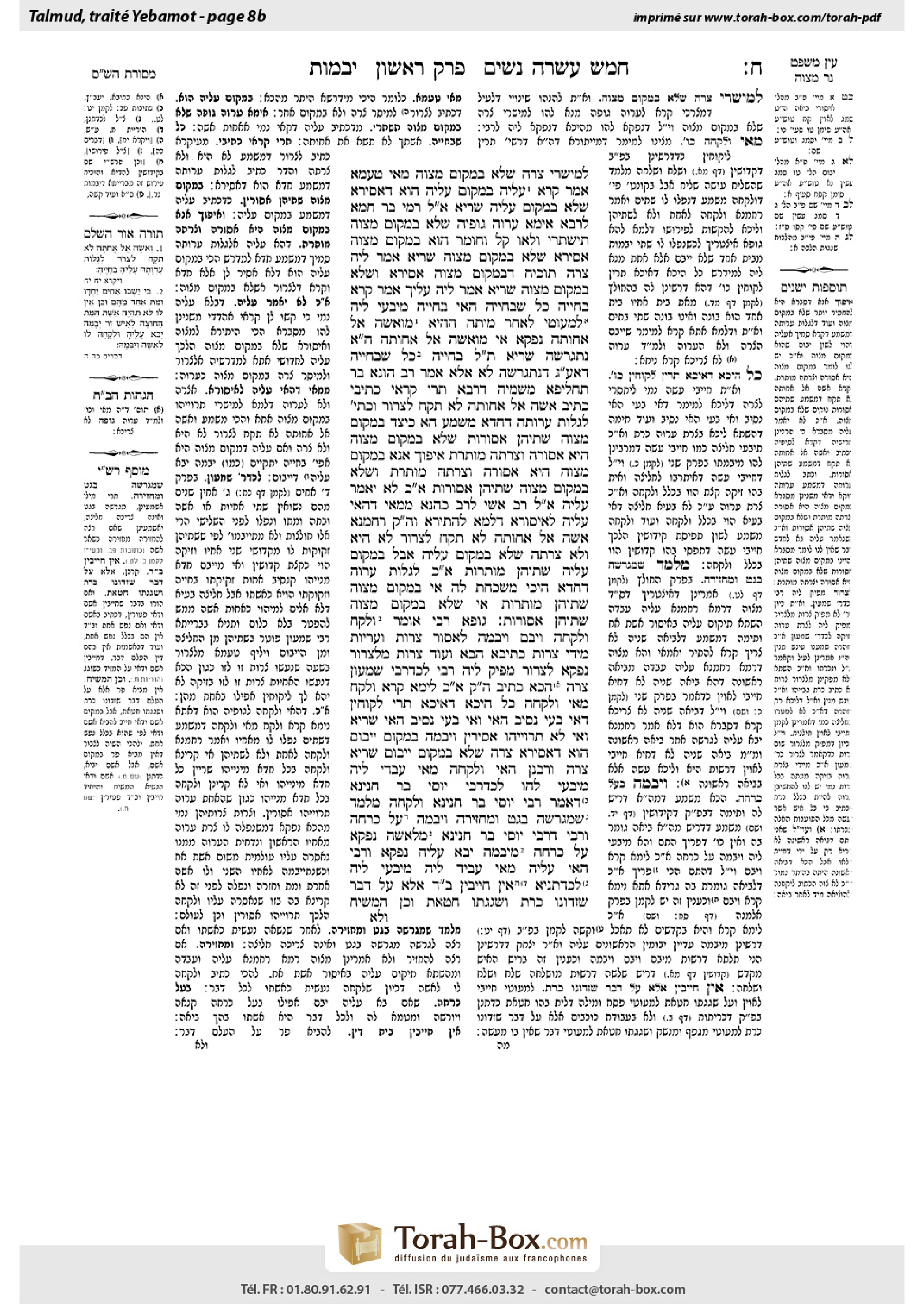
Yevamot 8b: Talmud study for Daf Yomi
Daf Yomi is the daily study of one Talmud folio. Explore 37 tractates with scans, Hebrew text, Sefaria English and AI-generated French translations where annotated.
Passage selection and English or AI-generated French translation are available where the scan has annotations. Daf Study is independent of Torah-Box and Sefaria.
Browse Yevamot · יבמות · All tractatesYevamot 8b text and translations
This page of Yevamot includes the Aramaic text, an English translation and an AI-generated French translation, alongside the scan above.
יבמות ח׳ ב · Aramaic and Hebrew text
לְמִישְׁרֵי צָרָה שֶׁלֹּא בִּמְקוֹם מִצְוָה. מַאי טַעְמָא — אָמַר קָרָא ״עָלֶיהָ״: בִּמְקוֹם ״עָלֶיהָ״ הוּא דַּאֲסִירָא, שֶׁלֹּא בִּמְקוֹם עָלֶיהָ — שַׁרְיָא.
אֲמַר לֵיהּ רָמֵי בַּר חָמָא לְרָבָא: אֵימָא עֶרְוָה גּוּפֵיהּ שֶׁלֹּא בִּמְקוֹם מִצְוָה תִּישְׁתְּרֵי! וְלָאו קַל וָחוֹמֶר הוּא? בִּמְקוֹם מִצְוָה אֲסִירָא — שֶׁלֹּא בִּמְקוֹם מִצְוָה שַׁרְיָא?!
אֲמַר לֵיהּ: צָרָה תּוֹכִיחַ, דְּבִמְקוֹם מִצְוָה אֲסִירָא וְשֶׁלֹּא בִּמְקוֹם מִצְוָה שַׁרְיָא! אֲמַר לֵיהּ: עָלֶיךָ אָמַר קְרָא ״בְּחַיֶּיהָ״ — כֹּל שֶׁבְּחַיֶּיהָ.
הַאי ״בְּחַיֶּיהָ״ מִיבְּעֵי לֵיהּ לְמַעוֹטֵי לְאַחַר מִיתָה! הָהִיא מִ״וְאִשָּׁה אֶל אֲחוֹתָהּ״ נָפְקָא.
אִי מִ״וְאִשָּׁה אֶל אֲחוֹתָהּ״, הֲוָה אָמֵינָא: נִתְגָּרְשָׁה — שַׁרְיָא, תַּלְמוּד לוֹמַר: ״בְּחַיֶּיהָ״ — כֹּל שֶׁבְּחַיֶּיהָ, דְּאַף עַל גַּב דְּנִתְגָּרְשָׁה לֹא!
אֶלָּא אָמַר רַב הוּנָא בַּר תַּחְלִיפָא מִשְּׁמֵיהּ דְּרָבָא: תְּרֵי קְרָאֵי כְּתִיבִי. כְּתִיב: ״אִשָּׁה אֶל אֲחוֹתָהּ לֹא תִקָּח לִצְרוֹר״, וּכְתִיב: ״לְגַלּוֹת עֶרְוָתָהּ״, דַּחֲדָא מַשְׁמַע. הָא כֵּיצַד? בִּמְקוֹם מִצְוָה — שְׁתֵּיהֶן אֲסוּרוֹת, שֶׁלֹּא בִּמְקוֹם מִצְוָה — הִיא אֲסוּרָה וְצָרָתָהּ מוּתֶּרֶת.
אֵיפוֹךְ אֲנָא: בִּמְקוֹם מִצְוָה — הִיא אֲסוּרָה וְצָרָתָהּ מוּתֶּרֶת, וְשֶׁלֹּא בִּמְקוֹם מִצְוָה — שְׁתֵּיהֶן אֲסוּרוֹת. אִם כֵּן, לֹא יֵאָמֵר ״עָלֶיהָ״.
אֲמַר לֵיהּ רַב אָשֵׁי לְרַב כָּהֲנָא: מִמַּאי דְּהַאי ״עָלֶיהָ״ לְאִיסּוּרָא, דִּלְמָא לְהֶתֵּירָא, וְהָכִי קָאָמַר רַחֲמָנָא: ״אִשָּׁה אֶל אֲחוֹתָהּ לֹא תִקָּח לִצְרוֹר״, לֹא הִיא וְלֹא צָרָתָהּ — שֶׁלֹּא בִּמְקוֹם ״עָלֶיהָ״, אֲבָל בִּמְקוֹם ״עָלֶיהָ״ — שְׁתֵּיהֶן מוּתָּרוֹת.
אִם כֵּן, ״לְגַלּוֹת עֶרְוָה״ דַּחֲדָא הֵיכִי מַשְׁכַּחַתְּ לַהּ? אִי בִּמְקוֹם מִצְוָה — שְׁתֵּיהֶן מוּתָּרוֹת, אִי שֶׁלֹּא בִּמְקוֹם מִצְוָה — שְׁתֵּיהֶן אֲסוּרוֹת?!
גּוּפָא. רַבִּי אוֹמֵר: ״וְלָקַח״ ״וּלְקָחָהּ״, ״וְיִבֵּם״ ״וְיִבְּמָהּ״, לֶאֱסוֹר צָרוֹת וַעֲרָיוֹת. מִידֵי ״צָרוֹת״ כְּתִיבָא הָכָא? וְעוֹד: צָרוֹת מִ״לִּצְרוֹר״ נָפְקָא!
״לִצְרוֹר״ מַפֵּיק לֵיהּ רַבִּי לְכִדְרַבִּי שִׁמְעוֹן.
צָרָה הָכָא כְּתִיב? הָכִי קָאָמַר: אִם כֵּן, לֵימָא קְרָא ״וְלָקַח״, מַאי ״וּלְקָחָהּ״ — כֹּל הֵיכָא דְּאִיכָּא תְּרֵי לִקּוּחִין, דְּאִי בָּעֵי נָסֵיב הַאי וְאִי בָּעֵי נָסֵיב הַאי — שַׁרְיָא. וְאִי לָא — תַּרְוַיְיהוּ אֲסִירִין.
״וְיִבְּמָהּ״ — בִּמְקוֹם יִיבּוּם הוּא דַּאֲסִירָא צָרָה, שֶׁלֹּא בִּמְקוֹם יִיבּוּם — שַׁרְיָא צָרָה. וְרַבָּנַן, הַאי ״וּלְקָחָהּ״ — מַאי עָבְדִי לֵיהּ?
מִיבְּעֵי לְהוּ לְכִדְרַבִּי יוֹסֵי בַּר חֲנִינָא. דְּאָמַר רַבִּי יוֹסֵי בַּר חֲנִינָא: ״וּלְקָחָהּ״ — מְלַמֵּד שֶׁמְּגָרְשָׁה בְּגֵט וּמַחְזִירָהּ. ״וְיִבְּמָהּ״ — עַל כׇּרְחָהּ.
וְרַבִּי? דְּרַבִּי יוֹסֵי בַּר חֲנִינָא — מִ״לְּאִשָּׁה״ נָפְקָא, עַל כׇּרְחָהּ — מִ״יְּבָמָה יָבֹא עָלֶיהָ״ נָפְקָא.
וְרַבִּי, הַאי ״עָלֶיהָ״ מַאי עָבֵיד לֵיהּ? מִיבְּעֵי לֵיהּ לְכִדְתַנְיָא: אֵין חַיָּיבִין בֵּית דִּין אֶלָּא עַל דָּבָר שֶׁזְּדוֹנוֹ כָּרֵת וְשִׁגְגָתוֹ חַטָּאת. וְכֵן הַמָּשִׁיחַ.
Yevamot 8b · English translation
to permit a rival wife in a place where the mitzva of levirate marriage is not applicable. What is the reason, i.e., how is this inferred? The verse states: “With her.” In other words, it is in a place where the obligation “her brother-in-law will have intercourse with her” is applicable that a rival wife is prohibited, whereas in a place where the obligation “Her brother-in-law will have intercourse with her” is not applicable, a rival wife is permitted.
Rami bar Ḥama said to Rava: If the phrase “with her” is referring only to a case where levirate marriage is applicable, one can say that a forbidden relative herself should be permitted in a place where the mitzva of levirate marriage is not applicable. According to this interpretation, the prohibitions with regard to all those with whom relations are forbidden are in effect only when levirate marriage applies. Rava answered: And is it not an a fortiori inference? If these relatives are prohibited in a place where there is a mitzva, could they be permitted in a place where there is no mitzva?
Rami bar Ḥama said to Rava: That is no proof, as the case of a rival wife herself can prove that this a fortiori inference is incorrect, as in a place where there is a mitzva she is prohibited and in a place where there is no mitzva she is permitted. Rava said to Rami bar Ḥami: With regard to your claim, the verse states: “And you shall not take a woman to her sister…in her lifetime” (Leviticus 18:18). This indicates that all cases in which it is in the lifetime of her sister she is forbidden, even when no mitzva applies.
The Gemara asks: This phrase “in her lifetime” is necessary, as indicated by the plain meaning of the phrase, to exclude the time after death, i.e., to teach that a wife’s sister is forbidden only while the wife is still alive, whereas after her death the sister is permitted. The Gemara answers: That halakha that a woman is permitted after her sister’s death is derived from “and you shall not take a woman to her sister” (Leviticus 18:18), as when one of them is dead it is no longer considered “a woman to her sister.”
The Gemara further asks: If this halakha is derived from “a woman to her sister,” I would say that even if she were divorced, her sister is permitted. Therefore, the verse states: “In her lifetime,” which indicates that the prohibition is in effect in all cases that are in her lifetime. This teaches that although she is divorced, her sister is not permitted.
§ Rather, the Gemara suggests a different interpretation. Rav Huna bar Taḥlifa said in the name of Rava: Two verses are written, i.e., two separate issues are mentioned in the same verse. It is written: “And you shall not take a woman to her sister, to be a rival [litzror],” which indicates that two rival wives are prohibited. And it is written: “To uncover her nakedness” (Leviticus 18:18), in the singular, which means one and not both of them. How is it possible to reconcile this apparent contradiction? In a place where there is a mitzva of levirate marriage, both the forbidden relation and her rival wife are prohibited. In a place where there is no mitzva of levirate marriage, the forbidden relation is prohibited but her rival wife is permitted.
The Gemara raises a difficulty: I can reverse this and suggest the opposite. In a place where there is a mitzva, the forbidden relation is prohibited and her rival wife is permitted, and in a place where there is no mitzva, both of them are prohibited. The Gemara answers: If so, let the verse not say “with her,” at all, as this superfluous phrase teaches that the prohibition with regard to a rival wife applies only when there is a mitzva of “her brother-in-law will have intercourse with her.”
Rav Ashi said to Rav Kahana: From where is it derived that this superfluous phrase “with her,” comes to prohibit, i.e., although there is an obligation that “her brother-in-law will have intercourse with her,” a wife’s sister remains prohibited? Perhaps it serves to permit, and this is what the Merciful One is saying: “You shall not take a woman to her sister, to be a rival” (Leviticus 18:18), i.e., neither her nor her rival wife. When is this the case? It is in a place where the obligation of “her brother-in-law will have intercourse with her” does not apply. However, in a place where “with her” does apply and there is an obligation of levirate marriage, both of them are permitted.
Rav Kahana replied to Rav Ashi: If the above statement is so, and “to uncover her nakedness” is referring to one woman, under what circumstances can you find this case? When is only one of them prohibited? If it is in a place where there is a mitzva, they are both permitted; if it is in a place where there is no mitzva, they are both forbidden. Therefore, the earlier line of reasoning must be accepted: A rival wife is forbidden only in a case where the mitzva of levirate marriage is in effect.
§ While clarifying the exposition of the phrase “with her,” an alternative interpretation attributed to Rabbi Yehuda HaNasi was mentioned. The Gemara discusses the matter itself. Rabbi Yehuda HaNasi says: The verse does not say have intercourse, but “have intercourse with her.” And it does not say and consummate the levirate marriage, but “and consummate the levirate marriage with her.” These phrases serve to prohibit rival wives and women with whom relations are forbidden. The Gemara asks: Are rival wives written here? In other words, what is the connection between the verse and the topic of rival wives, an issue that is not even mentioned in the verse? And furthermore: The prohibition with regard to rival wives is derived from the phrase “To be a rival wife [litzror],” not from this source.
The Gemara answers: Rabbi Yehuda HaNasi derives a different halakha from the phrase “to be a rival wife,” in accordance with that statement of Rabbi Shimon. In Rabbi Shimon’s opinion, the exemption of two sisters from levirate marriage applies not only when the yavam is married to one of the sisters, but also if two sisters who come before him for levirate marriage were previously married to two of his brothers. In that case, the levirate bond itself is sufficient for them to be considered rival wives of one another.
And with regard to the previous question: Are rival wives written here? The answer is that this is what he is saying: If so, that the verse does not come to exempt rival wives, let the verse state only: Have intercourse. What is the meaning of “have intercourse with her”? It serves to limit the case to one woman and not two, in the following manner: Anywhere that there are two possibilities of having intercourse, i.e., there is a choice between marrying one of two women in levirate marriage, in such a way that if he wants he may marry this one, and if he wants he may marry that one, then each one is permitted. And if he does not have a choice and is obligated to marry one of them, e.g., if the other is a forbidden relation to him, they are both prohibited, including the rival wife.
When the verse states: “And consummate the levirate marriage with her,” it comes to teach the following. It is in a place where levirate marriage is applicable that a rival wife is prohibited, whereas in a place where levirate marriage is not applicable, a rival wife is permitted. The Gemara asks: And with regard to the Rabbis, who do not interpret the verse in this manner, what do they do with this emphasis on “have intercourse with her”? How do they interpret it?
The Gemara responds: They need this for that which Rabbi Yosei bar Ḥanina said, as Rabbi Yosei bar Ḥanina said: “And have intercourse with her” means marriage, i.e., she is fully his wife from that moment onward. This teaches that he divorces her with a bill of divorce after levirate marriage, and she can no longer be released by ḥalitza, and he may subsequently remarry her if he so wishes. And the verse “and consummate the levirate marriage with her,” this means against her will. Although betrothal in general does not take effect without the woman’s consent, levirate marriage can be effected against her will.
The Gemara asks: And from where does Rabbi Yehuda HaNasi derive these widely accepted halakhot? The Gemara responds: That halakha cited by Rabbi Yosei bar Ḥanina, that a woman taken in levirate marriage has the status of a regular wife who may be divorced and remarried, is derived from the verse “and take her to him to be his wife” (Deuteronomy 25:5), which means that she will be his wife for all purposes, like any other wife. And the halakha that levirate marriage can be effected against her will is derived from “her brother-in-law will have intercourse with her,” which indicates that it can be achieved without her consent.
The Gemara asks: And what does Rabbi Yehuda HaNasi do with this superfluous phrase, “with her”? The Gemara responds: He needs it for that which is taught in a baraita with regard to a different matter. The Sages said: The court is obligated to bring a bull as a sin-offering for an unwittingly committed communal sin on account of an erroneous halakha they taught only for a matter whose intentional transgression incurs karet and whose unwitting violation necessitates the sacrifice of a sin-offering. And similarly, the anointed High Priest, who also brings a bull for an unwittingly committed sin, is obligated to do so only if his mistake involved a matter whose intentional transgression incurs karet and whose unwitting transgression necessitates the sacrifice of a sin-offering.
Yevamot 8b · Traduction française (IA)
pour permettre une épouse rivale dans un cas où la mitsva du lévirat ne s’applique pas. Pourquoi ? Autrement dit, comment le déduit-on ? Le verset dit : « avec elle ». Cela signifie que l’épouse rivale est interdite là où s’applique l’obligation « son beau-frère aura des relations avec elle », tandis qu’elle est permise là où cette obligation ne s’applique pas.
Rami bar Ḥama dit à Rava : Si l’expression « avec elle » ne se rapporte qu’à un cas où le lévirat s’applique, on pourrait en déduire qu’une parente interdite est elle-même permise dans un cas où la mitsva du lévirat ne s’applique pas. Selon cette interprétation, les interdictions concernant toutes les femmes avec lesquelles les relations sont interdites ne seraient en vigueur que lorsque le lévirat s’applique. Rava répond : N’est-ce pas une déduction a fortiori ? Si ces parentes sont interdites là où il y a une mitsva, pourraient-elles être permises là où il n’y en a pas ?
Rami bar Ḥama dit à Rava : Cela ne prouve rien, car le cas de l’épouse rivale elle-même montre que cette déduction a fortiori est erronée : là où il y a une mitsva, elle est interdite, et là où il n’y en a pas, elle est permise. Rava dit à Rami bar Ḥama : Pour répondre à ton argument, le verset dit : « Tu ne prendras pas une femme en plus de sa sœur […] de son vivant » (Lévitique 18:18). Cela indique qu’elle est interdite dans tous les cas tant que sa sœur est vivante, même lorsqu’aucune mitsva ne s’applique.
La Guemara demande : L’expression « de son vivant » est nécessaire, comme le montre son sens littéral, pour exclure la période qui suit la mort, c’est-à-dire pour enseigner que la sœur d’une épouse n’est interdite que tant que cette épouse est en vie, tandis qu’après sa mort, sa sœur est permise. La Guemara répond : Le fait qu’une femme soit permise après la mort de sa sœur se déduit des mots « tu ne prendras pas une femme en plus de sa sœur » (Lévitique 18:18), car si l’une d’elles est morte, il ne s’agit plus de « prendre une femme en plus de sa sœur ».
La Guemara poursuit : Si cette halakha se déduit des mots « une femme en plus de sa sœur », on pourrait dire que même si la femme a divorcé, sa sœur est permise. Le verset dit donc : « de son vivant », ce qui indique que l’interdiction s’applique dans tous les cas tant qu’elle est en vie. Cela enseigne que, même si elle a divorcé, sa sœur n’est pas permise.
§ La Guemara propose plutôt une autre interprétation. Rav Houna bar Taḥlifa dit au nom de Rava : Deux formulations sont écrites, c’est-à-dire que deux idées distinctes sont exprimées dans le même verset. Il est écrit : « Tu ne prendras pas une femme en plus de sa sœur, pour qu’elles soient rivales [litzror] », ce qui indique que deux épouses rivales sont interdites. Et il est écrit : « pour découvrir sa nudité » (Lévitique 18:18), au singulier, ce qui signifie l’une et non les deux. Comment résoudre cette contradiction apparente ? Là où il y a une mitsva de lévirat, la parente interdite et son épouse rivale sont toutes deux interdites. Là où il n’y a pas de mitsva de lévirat, la parente interdite est interdite, mais son épouse rivale est permise.
La Guemara soulève une difficulté : Je pourrais inverser les choses et proposer le contraire : là où il y a une mitsva, la parente interdite est interdite et son épouse rivale est permise ; et là où il n’y a pas de mitsva, elles sont toutes deux interdites. La Guemara répond : Si tel était le cas, le verset n’aurait pas besoin de dire « avec elle ». Cette expression superflue enseigne que l’interdiction de l’épouse rivale ne s’applique que lorsqu’il y a l’obligation « son beau-frère aura des relations avec elle ».
Rav Ashi dit à Rav Kahana : D’où déduit-on que l’expression superflue « avec elle » vient interdire, c’est-à-dire que, même lorsqu’il a l’obligation « son beau-frère aura des relations avec elle », la sœur de son épouse reste interdite ? Peut-être cette expression vient-elle au contraire permettre, et voici ce que dit le Miséricordieux : « Tu ne prendras pas une femme en plus de sa sœur, pour qu’elles soient rivales » (Lévitique 18:18), c’est-à-dire ni l’une ni son épouse rivale. Dans quel cas cela s’applique-t-il ? Là où l’obligation « son beau-frère aura des relations avec elle » ne s’applique pas. En revanche, là où « avec elle » s’applique et où il y a une obligation de lévirat, elles sont toutes deux permises.
Rav Kahana répond à Rav Ashi : Si c’est bien ainsi, et que « pour découvrir sa nudité » se rapporte à une seule femme, dans quelles circonstances peut-on trouver un cas où une seule des deux est interdite ? Là où il y a une mitsva, elles sont toutes deux permises ; là où il n’y a pas de mitsva, elles sont toutes deux interdites. Il faut donc retenir le raisonnement précédent : une épouse rivale n’est interdite que dans un cas où la mitsva de lévirat s’applique.
§ En examinant l’interprétation de l’expression « avec elle », une autre interprétation attribuée à Rabbi Yehuda HaNasi a été mentionnée. La Guemara reprend cette question. Rabbi Yehuda HaNasi dit : Le verset ne dit pas « aura des relations », mais « aura des relations avec elle ». Il ne dit pas non plus « accomplira le lévirat », mais « accomplira le lévirat avec elle ». Ces expressions servent à interdire les épouses rivales et les femmes avec lesquelles les relations sont interdites. La Guemara demande : Les épouses rivales sont-elles mentionnées ici ? Autrement dit, quel est le lien entre le verset et la question des épouses rivales, qui n’est même pas évoquée dans le verset ? De plus, l’interdiction des épouses rivales se déduit de l’expression « pour qu’elles soient rivales [litzror] », et non de cette source.
La Guemara répond : Rabbi Yehuda HaNasi déduit une autre halakha de l’expression « pour qu’elles soient rivales », conformément à l’enseignement de Rabbi Shimon. Selon Rabbi Shimon, l’exemption de deux sœurs du lévirat s’applique non seulement lorsque le yavam est marié à l’une d’elles, mais aussi lorsque deux sœurs qui se présentent à lui pour le lévirat étaient auparavant mariées à deux de ses frères. Dans ce cas, le lien léviratique lui-même suffit pour qu’elles soient considérées comme des épouses rivales l’une de l’autre.
Et pour répondre à la question précédente — les épouses rivales sont-elles mentionnées ici ? —, il faut comprendre qu’il dit ceci : si le verset ne vient pas exempter les épouses rivales, qu’il dise simplement : « aura des relations ». Que signifie alors « aura des relations avec elle » ? Cela sert à limiter le cas à une seule femme et non à deux, de la manière suivante : chaque fois qu’il a le choix entre deux femmes avec lesquelles il peut s’unir, c’est-à-dire qu’il peut épouser l’une ou l’autre par le lévirat, chacune est permise. Mais s’il n’a pas le choix et qu’il est obligé d’épouser l’une d’elles — par exemple si l’autre est une parente qui lui est interdite —, elles sont toutes deux interdites, y compris l’épouse rivale.
Lorsque le verset dit : « et accomplira le lévirat avec elle », il enseigne ceci : l’épouse rivale est interdite là où le lévirat s’applique, tandis qu’elle est permise là où le lévirat ne s’applique pas. La Guemara demande : Et les rabbins, qui n’interprètent pas le verset de cette manière, que font-ils de l’insistance sur « aura des relations avec elle » ? Comment l’interprètent-ils ?
La Guemara répond : Ils en ont besoin pour ce qu’a enseigné Rabbi Yosei bar Ḥanina. Rabbi Yosei bar Ḥanina a dit : « Aura des relations avec elle » signifie qu’il l’épouse, c’est-à-dire qu’à partir de ce moment, elle est pleinement son épouse. Cela enseigne qu’après le lévirat, il la répudie au moyen d’un acte de divorce, qu’elle ne peut plus être libérée par la ḥalitsa et qu’il peut ensuite l’épouser de nouveau s’il le souhaite. Quant aux mots « et accomplira le lévirat avec elle », ils signifient qu’il peut le faire contre sa volonté. Bien que, de manière générale, les kidouchin ne prennent pas effet sans le consentement de la femme, le lévirat peut être accompli contre sa volonté.
La Guemara demande : Et d’où Rabbi Yehuda HaNasi déduit-il ces halakhot admises par tous ? La Guemara répond : La halakha citée par Rabbi Yosei bar Ḥanina, selon laquelle une femme épousée par lévirat a le statut d’une épouse ordinaire, dont elle peut être répudiée puis qu’elle peut épouser de nouveau, se déduit du verset « il la prendra pour femme » (Deutéronome 25:5), qui signifie qu’elle sera son épouse à tous égards, comme toute autre épouse. Quant à la halakha selon laquelle le lévirat peut être accompli contre sa volonté, elle se déduit des mots « son beau-frère aura des relations avec elle », qui indiquent que cela peut se faire sans son consentement.
La Guemara demande : Et que fait Rabbi Yehuda HaNasi de l’expression superflue « avec elle » ? La Guemara répond : Il en a besoin pour l’enseignement d’une baraïta portant sur une autre question. Les Sages ont dit : Le tribunal est tenu d’apporter un taureau comme sacrifice expiatoire pour une faute collective commise par inadvertance en raison d’une halakha erronée qu’il a enseignée, uniquement pour une faute dont la transgression délibérée entraîne le karet et dont la transgression involontaire requiert un sacrifice expiatoire. De même, le grand prêtre oint, qui apporte lui aussi un taureau pour une faute commise par inadvertance, n’y est tenu que si son erreur portait sur une faute dont la transgression délibérée entraîne le karet et dont la transgression involontaire requiert un sacrifice expiatoire.
Traduction française générée par IA à partir de l’édition anglaise de Sefaria. Vérifie toujours un passage avec le texte source.
Text from Sefaria: William Davidson Edition - Vocalized Aramaic (CC BY NC); William Davidson Edition - English (CC BY NC).