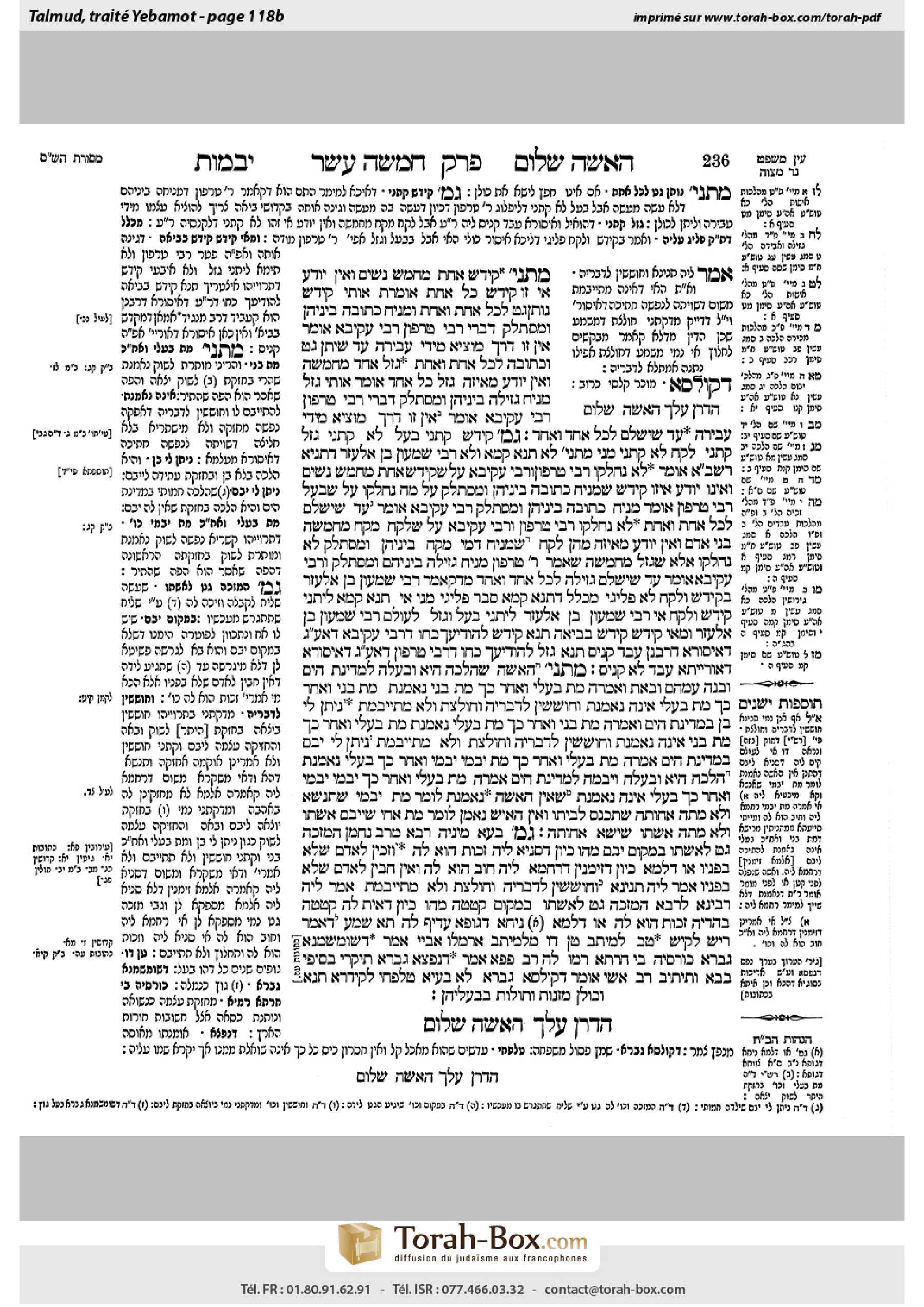
Yevamot 118b: Talmud study for Daf Yomi
Daf Yomi is the daily study of one Talmud folio. Explore 37 tractates with scans, Hebrew text, Sefaria English and AI-generated French translations where annotated.
Passage selection and English or AI-generated French translation are available where the scan has annotations. Daf Study is independent of Torah-Box and Sefaria.
Browse Yevamot · יבמות · All tractatesYevamot 118b text and translations
This page of Yevamot includes the Aramaic text, an English translation and an AI-generated French translation, alongside the scan above.
יבמות קי״ח ב · Aramaic and Hebrew text
מַתְנִי׳ קִידֵּשׁ אַחַת מֵחָמֵשׁ נָשִׁים, וְאֵין יוֹדֵעַ אֵי זוֹ קִידֵּשׁ, כׇּל אַחַת אוֹמֶרֶת: ״אוֹתִי קִידֵּשׁ״ — נוֹתֵן גֵּט לְכׇל אַחַת וְאַחַת, וּמַנִּיחַ כְּתוּבָּה בֵּינֵיהֶן, וּמִסְתַּלֵּק, דִּבְרֵי רַבִּי טַרְפוֹן.
רַבִּי עֲקִיבָא אוֹמֵר: אֵין זוֹ דֶּרֶךְ מוֹצִיא מִידֵי עֲבֵירָה, עַד שֶׁיִּתֵּן גֵּט וּכְתוּבָּה לְכׇל אַחַת וְאַחַת. גָּזַל אֶחָד מֵחֲמִשָּׁה וְאֵין יוֹדֵעַ מֵאֵיזֶה גָּזַל, כׇּל אֶחָד אוֹמֵר ״אוֹתִי גָּזַל״ — מַנִּיחַ גְּזֵילָה בֵּינֵיהֶן וּמִסְתַּלֵּק, דִּבְרֵי רַבִּי טַרְפוֹן. רַבִּי עֲקִיבָא אוֹמֵר: אֵין זוֹ דֶּרֶךְ מוֹצִיא מִידֵי עֲבֵירָה, עַד שֶׁיְּשַׁלֵּם לְכׇל אֶחָד וְאֶחָד.
גְּמָ׳ ״קִידֵּשׁ״ — קָתָנֵי, ״בָּעַל״ — לָא קָתָנֵי. ״גָּזַל״ — קָתָנֵי, ״לָקַח״ — לָא קָתָנֵי. מַנִּי מַתְנִיתִין? לָא תַּנָּא קַמָּא וְלָא רַבִּי שִׁמְעוֹן בֶּן אֶלְעָזָר!
דְּתַנְיָא, רַבִּי שִׁמְעוֹן בֶּן אֶלְעָזָר אוֹמֵר: לֹא נֶחְלְקוּ רַבִּי טַרְפוֹן וְרַבִּי עֲקִיבָא עַל שֶׁקִּידֵּשׁ אַחַת מֵחָמֵשׁ נָשִׁים וְאֵינוֹ יוֹדֵעַ אֵיזוֹ קִידֵּשׁ, שֶׁמַּנִּיחַ כְּתוּבָּה בֵּינֵיהֶן וּמִסְתַּלֵּק. עַל מָה נֶחְלְקוּ — עַל שֶׁבָּעַל. רַבִּי טַרְפוֹן אוֹמֵר: מַנִּיחַ כְּתוּבָּה בֵּינֵיהֶן וּמִסְתַּלֵּק, רַבִּי עֲקִיבָא אוֹמֵר: עַד שֶׁיְּשַׁלֵּם לְכׇל אַחַת וְאַחַת.
לֹא נֶחְלְקוּ רַבִּי טַרְפוֹן וְרַבִּי עֲקִיבָא עַל שֶׁלָּקַח מִקָּח מֵחֲמִשָּׁה בְּנֵי אָדָם וְאֵין יוֹדֵעַ מֵאֵיזֶה מֵהֶן לָקַח — שֶׁמַּנִּיחַ דְּמֵי מִקָּח בֵּינֵיהֶן וּמִסְתַּלֵּק. לֹא נֶחְלְקוּ אֶלָּא שֶׁגָּזַל מֵחֲמִשָּׁה, שֶׁאָמַר רַבִּי טַרְפוֹן: מַנִּיחַ גְּזֵילָה בֵּינֵיהֶם וּמִסְתַּלֵּק, וְרַבִּי עֲקִיבָא אוֹמֵר: עַד שֶׁיְּשַׁלֵּם גְּזֵילָה לְכׇל אֶחָד וְאֶחָד.
מִדְּקָאָמַר רַבִּי שִׁמְעוֹן בֶּן אֶלְעָזָר בְּ״קִידֵּשׁ״ וְ״לָקַח״ לָא פְּלִיגִי, מִכְּלָל דְּתַנָּא קַמָּא סָבַר פְּלִיגִי. מַנִּי?
אִי תַּנָּא קַמָּא — לִיתְנֵי ״קִידֵּשׁ״ וְ״לָקַח״. אִי רַבִּי שִׁמְעוֹן בֶּן אֶלְעָזָר — לִיתְנֵי ״בָּעַל״ וְ״גָזַל״.
לְעוֹלָם רַבִּי שִׁמְעוֹן בֶּן אֶלְעָזָר, וּמַאי ״קִידֵּשׁ״ — קִידֵּשׁ בְּבִיאָה. תְּנָא ״קִידֵּשׁ״, לְהוֹדִיעֲךָ כֹּחוֹ דְּרַבִּי עֲקִיבָא,
דְּאַף עַל גַּב דְּאִיסּוּרָא דְּרַבָּנַן עֲבַד, קָנֵיס! תְּנָא ״גָּזַל״, לְהוֹדִיעֲךָ כֹּחוֹ דְּרַבִּי טַרְפוֹן, דְּאַף עַל גַּב דְּאִיסּוּרָא דְּאוֹרָיְיתָא עֲבַד, לָא קָנֵיס.
מַתְנִי׳ הָאִשָּׁה שֶׁהָלְכָה הִיא וּבַעְלָהּ לִמְדִינַת הַיָּם וּבְנָהּ עִמָּהֶם, וּבָאת וְאָמְרָה: ״מֵת בַּעְלִי וְאַחַר כָּךְ מֵת בְּנִי״ — נֶאֱמֶנֶת. מֵת בְּנִי וְאַחַר כָּךְ מֵת בַּעְלִי״ — אֵינָהּ נֶאֱמֶנֶת. וְחוֹשְׁשִׁין לִדְבָרֶיהָ, וְחוֹלֶצֶת וְלֹא מִתְיַיבֶּמֶת.
״נִיתַּן לִי בֵּן בִּמְדִינַת הַיָּם״, וְאָמְרָה: ״מֵת בְּנִי, וְאַחַר כָּךְ מֵת בַּעְלִי״ — נֶאֱמֶנֶת. ״מֵת בַּעְלִי, וְאַחַר כָּךְ מֵת בְּנִי״ — אֵינָהּ נֶאֱמֶנֶת. וְחוֹשְׁשִׁין לִדְבָרֶיהָ, וְחוֹלֶצֶת וְלֹא מִתְיַיבֶּמֶת.
״נִיתַּן לִי יָבָם בִּמְדִינַת הַיָּם״, אָמְרָה: ״מֵת בַּעְלִי וְאַחַר כָּךְ מֵת יְבָמִי״, ״יְבָמִי וְאַחַר כָּךְ בַּעְלִי״ — נֶאֱמֶנֶת.
הָלְכָה הִיא וּבַעְלָהּ וִיבָמָהּ לִמְדִינַת הַיָּם, אָמְרָה: ״מֵת בַּעְלִי, וְאַחַר כָּךְ יְבָמִי״, ״יְבָמִי, וְאַחַר כָּךְ בַּעְלִי״ — אֵינָהּ נֶאֱמֶנֶת, שֶׁאֵין הָאִשָּׁה נֶאֱמֶנֶת לוֹמַר ״מֵת יְבָמִי״ שֶׁתִּנָּשֵׂא, וְלֹא ״מֵתָה אֲחוֹתָהּ״ שֶׁתִּכָּנֵס לְבֵיתוֹ, וְאֵין הָאִישׁ נֶאֱמָן לוֹמַר ״מֵת אָחִי״ שֶׁיְּיַבֵּם אִשְׁתּוֹ, וְלֹא ״מֵתָה אִשְׁתּוֹ״, שֶׁיִּשָּׂא אֲחוֹתָהּ.
גְּמָ׳ בְּעָא מִינֵּיהּ רָבָא מֵרַב נַחְמָן: הַמְזַכֶּה גֵּט לְאִשְׁתּוֹ בִּמְקוֹם יָבָם, מַהוּ? כֵּיוָן דְּסָנְיָא לֵיהּ — זְכוּת הוּא לָהּ, וְזָכִין לְאָדָם שֶׁלֹּא בְּפָנָיו. אוֹ דִלְמָא: כֵּיוָן דְּזִימְנִין דְּרָחֲמָא לֵיהּ, חוֹב הוּא לָהּ, וְאֵין חָבִין לָאָדָם שֶׁלֹּא בְּפָנָיו.
אֲמַר לֵיהּ, תְּנֵינָא: וְחוֹשְׁשִׁין לִדְבָרֶיהָ, וְחוֹלֶצֶת וְלֹא מִתְיַיבֶּמֶת.
אֲמַר לֵיהּ רָבִינָא לְרָבָא: הַמְזַכֶּה גֵּט לְאִשְׁתּוֹ בִּמְקוֹם קְטָטָה, מַהוּ? כֵּיוָן דְּאִית לַהּ קְטָטָה בַּהֲדֵיהּ — זְכוּת הוּא לָהּ. אוֹ דִּלְמָא, נְיָחָא דְּגוּפָא עֲדִיף לַהּ? תָּא שְׁמַע, דְּאָמַר רֵישׁ לָקִישׁ: טָב לְמֵיתַב טַן דּוּ מִלְּמֵיתַב אַרְמְלוּ.
אַבָּיֵי אָמַר: דְּשׁוּמְשְׁמָנָא גַּבְרָא, כּוּרְסְיַהּ בֵּי חָרָתָא רָמוּ לַהּ. רַב פָּפָּא אָמַר: דְּנַפָּצָא גַּבְרָא, תִּיקְרֵי בְּסִיפֵּי בָבָא וְתִיתִּיב.
רַב אָשֵׁי אוֹמֵר: דְּקוֹלְסָא גַּבְרָא, לָא בָּעֲיָא טְלָפְחֵי לְקִידְרָא. תָּנָא: וְכוּלָּן מְזַנּוֹת וְתוֹלוֹת בְּבַעְלֵיהֶן.
הֲדַרַן עֲלָךְ הָאִשָּׁה שָׁלוֹם
Yevamot 118b · English translation
MISHNA: In relation to the dispute between Rabbi Tarfon and Rabbi Akiva in the previous mishna, in which Rabbi Akiva states that one must avoid a possible transgression, the mishna cites two similar cases involving other topics. With regard to one who betrothed one of five women, and he does not know which of them he betrothed, and each one of them says: He betrothed me, if he does not want to marry any of them he gives a bill of divorce to each and every one of them so none will have the status of a woman with regard to whom there is uncertainty whether she is divorced. And he leaves the marriage contract among them and departs. The marriage contract remains in dispute between the women until they clarify which of them is entitled to the money. This is the statement of Rabbi Tarfon.
Rabbi Akiva says: This is not the way to spare someone from transgression, as perhaps the woman he actually betrothed will not receive the money to which she is entitled. There is no remedy unless he gives a bill of divorce and a marriage contract payment to each and every one. And likewise, in the case of one who stole money from one of five people and does not know from which of them he stole, and each one says: He stole from me, he leaves the stolen money among them and departs, and they will decide among themselves how to distribute the money; this is the statement of Rabbi Tarfon. Rabbi Akiva says: This is not the way to spare him from transgression; there is no remedy unless he pays each and every one of them.
GEMARA: The Gemara infers: It is taught in the mishna that he betrothed one of five women, whereas it is not taught that he had sexual intercourse with one of five women, as a different ruling applies in this case. Similarly, with regard to the second case, it is taught that he stole from one of five people, and it is not taught that he purchased an item from one of five people. If so, whose opinion is expressed in the mishna? It is not in accordance with the opinion of the first tanna and it is also not in accordance with the opinion of Rabbi Shimon ben Elazar.
The Gemara elaborates. As it is taught in a baraita that Rabbi Shimon ben Elazar says: Rabbi Tarfon and Rabbi Akiva did not dispute the case of a man who betrothed one of five women and he does not know which of them he betrothed, as everyone agrees in this case that he leaves the money of the marriage contract among them and departs. With regard to what did they disagree? With regard to the case of one who had sexual intercourse with one of them for the purpose of betrothal. Rabbi Tarfon says: He leaves the money among them and departs, while Rabbi Akiva says: He does not fulfill his obligation unless he pays each and every one of them. Since he married in an inappropriate manner, the Sages penalized him by compelling him to pay all the women.
Likewise, Rabbi Tarfon and Rabbi Akiva did not dispute the case of one who purchased an item from one of five people and he does not know from which of them he purchased it. Everyone agrees in this case that he leaves the price of the purchase among them and departs. They disagree only with regard to one who stole from five people, as Rabbi Tarfon says: He leaves the stolen money among them and departs, and Rabbi Akiva says: He does not fulfill his obligation unless he pays the stolen money to each and every one of them. In this case, as he committed a transgression, he must ensure that the stolen money is restored to its proper owner.
The Gemara states: From the fact that Rabbi Shimon ben Elazar said that Rabbi Tarfon and Rabbi Akiva do not disagree with regard to the cases of one who betrothed and one who purchased, one may learn by inference that the first tanna, with whom he disagrees, holds that they do disagree about the cases of betrothed and purchased, whereas with regard to one who had sexual intercourse and one who stole an item Rabbi Tarfon agrees with Rabbi Akiva. With this in mind, who is the author of the mishna?
The Gemara elaborates: If the mishna is in accordance with the opinion of the first tanna, let it teach the cases of betrothed and also purchased, but not that of one who stole or one who had intercourse, as the first tanna maintains that Rabbi Tarfon agrees with Rabbi Akiva in those cases. If it is in accordance with the opinion of Rabbi Shimon ben Elazar, let it teach the cases of one who had sexual relations and that of one who stole. Rabbi Shimon ben Elazar holds that Rabbi Tarfon and Rabbi Akiva disagree in the case of one who had sexual relations, not in the case of a man who betrothed one of five women. Likewise, he maintains that they disagree in the case of one who stole from five people, not one who purchased an item from five people.
The Gemara answers: Actually, the mishna is in accordance with the opinion of Rabbi Shimon ben Elazar, and what is the meaning of the term: Betrothed? It means that he betrothed one of the women by means of sexual intercourse. And the mishna taught the term betrothed to convey to you the far-reaching nature of the stringent opinion of Rabbi Akiva.
The Gemara explains: As, although this man performed an act that violated a prohibition that applies by rabbinic law, i.e., he did not have licentious sexual relations with her but rather engaged in intercourse for the purpose of betrothal, which is in violation of a rabbinic prohibition that one may not betroth a woman by sexual intercourse ab initio, even so Rabbi Akiva penalizes him. And the mishna taught the case of one who stole so as to convey to you the far-reaching nature of the lenient opinion of Rabbi Tarfon, as although he performed an act that violated a prohibition that applies by Torah law, nevertheless he does not penalize him even in this case.
MISHNA: In the case of a woman who went, she and her husband, overseas, and her son was with them, and later she came back and said: My husband died and afterward my son died, she is deemed credible. It is permitted for her to remarry, and she is exempt from levirate marriage. The reason is that she had children when she left, and therefore she retains her presumptive status of one who is exempt from levirate marriage. However, if she said: My son died and afterward my husband died, she is not deemed credible, i.e., she may not enter into levirate marriage. And yet we are concerned and give some credence to her statement, in case she was actually widowed by a childless husband, and therefore she performs ḥalitza to exempt her from the levirate bond with her yavam, and she does not enter into levirate marriage.
If she went with her childless husband and returned alone and testified: A son was born to me overseas, and she further said: My son died and afterward my husband died, she is deemed credible and may even enter into levirate marriage, as she was presumed to be childless when she left and consequently she retains that presumptive status. However, if she said: My husband died and afterward my son died, she is not deemed credible for the purpose of exempting her from levirate marriage, but the court is concerned about her statement. And therefore she must perform ḥalitza and she does not enter into levirate marriage.
If she said: A yavam was born for me overseas, i.e., when the family left the country her husband did not have a brother, and she claims that in the meantime a brother was born to her husband, and she also said: My husband died and afterward my yavam died, or: My yavam died and afterward my husband died, in either case she is deemed credible. This is because when she left she was not presumed to require levirate marriage, and the suggestion that her husband now has a brother is based solely on her testimony.
However, if she went, she and her husband and her yavam, overseas, and upon her return she said: My husband died and afterward my yavam died, or: My yavam died and afterward my husband died, she is not deemed credible, as a woman is not deemed credible if she says: My yavam died, in order that she may marry another man. And she is not deemed credible if she says that her sister died, in order that she may enter the house of her sister’s husband. And a man is not deemed credible if he says: My brother died, so that he may enter into levirate marriage with his brother’s wife, and he is not deemed credible when he says that his wife died, in order that he may marry his wife’s sister. The Sages accepted impaired testimony of this kind only when there was a concern about creating a situation of a deserted wife.
GEMARA: Rava raised a dilemma before Rav Naḥman: In the case of a man who confers possession of a bill of divorce to his wife, i.e., he appoints an agent to take the bill of divorce to his wife, when she has a potential yavam, what is the halakha if her husband dies before she is divorced? One might say that since she hates her yavam, receiving the bill of divorce is for her benefit, as this act renders her prohibited to him, and it is a principle that one may act in a person’s interest in his absence. If so, as soon as the husband gives the bill of divorce to the agent she is divorced. Or perhaps, since she sometimes loves her yavam, this bill of divorce is to her disadvantage, and one may not act against a person’s interest in his absence. Consequently, she is not divorced until the bill of divorce reaches her possession.
Rav Naḥman said to Rava that we learned an answer to this dilemma in the mishna: And we are concerned about her statement, and she must perform ḥalitza and she does not enter into levirate marriage. The mishna states that the court gives her statement some credence in either case, both when her testimony would exempt her from levirate marriage and when it would allow her to marry her yavam. This indicates that levirate marriage is considered neither in her interest nor a disadvantage for her. Rather, its classification is uncertain.
§ Ravina said to Rava: With regard to one who confers possession of a bill of divorce to his wife through an agent in a situation when there was a quarrel between them, what is the halakha? The Gemara explains both sides of the question: Since she has a quarrel with him, the bill of divorce might be considered for her benefit. Or perhaps, her physical comfort is preferable to her, as she prefers to remain married despite the quarrel between her and her husband. Come and hear a resolution, as Reish Lakish said: There is a popular idiom among women: It is better to sit as two [tan du] than to sit lonely as a widow, i.e., a woman prefers the companionship of any husband over being alone.
Abaye said a similar popular expression: One whose husband is small as an ant, she places her seat among the noblewomen, as she considers herself important merely by virtue of being married. Rav Pappa said a different maxim: One whose husband is a wool comber [naftza], a lowly occupation, she calls him to sit with her at the entrance to the house, to display herself as a married woman.
Similarly, Rav Ashi says: One whose husband sells cabbage heads [kulsa] does not require lentils for her pot. She is so happy she is married that she does not mind even if he does not provide her with food. The Gemara comments: A Sage taught: And all of these women who appear so satisfied with their marriage, they all commit adultery and attribute the children to their husbands. This is another reason why they are so keen to be married. This shows that even when there are quarrels between a couple, the wife still prefers the status of a married woman, and therefore the bill of divorce is not considered in her interest.
Yevamot 118b · Traduction française (IA)
MICHNA : À propos du désaccord entre Rabbi Tarfon et Rabbi Akiva dans la Michna précédente, où Rabbi Akiva affirme qu’il faut éviter toute transgression possible, la Michna cite deux cas semblables portant sur d’autres sujets. Dans le cas d’un homme qui a fiancé l’une de cinq femmes sans savoir laquelle, chacune d’elles affirmant : « Il m’a fiancée », s’il ne veut en épouser aucune, il remet un acte de divorce à chacune d’entre elles, afin qu’aucune ne soit considérée comme une femme dont le statut matrimonial est incertain. Puis il laisse entre elles le contrat de mariage et s’en va. Les femmes se disputent le contrat jusqu’à ce qu’elles déterminent laquelle a droit à l’argent. Telle est la position de Rabbi Tarfon.
Rabbi Akiva dit : « Ce n’est pas ainsi qu’on épargne à quelqu’un une transgression, car il se peut que la femme qu’il a effectivement fiancée ne reçoive pas l’argent auquel elle a droit. Il n’y a pas d’autre solution que de remettre à chacune d’entre elles un acte de divorce et le montant de son contrat de mariage. » De même, dans le cas d’un homme qui a volé de l’argent à l’une de cinq personnes sans savoir à laquelle, chacune affirmant : « Il m’a volé », il laisse entre elles l’argent volé et s’en va ; elles décideront entre elles comment le répartir. Telle est la position de Rabbi Tarfon. Rabbi Akiva dit : « Ce n’est pas ainsi qu’on l’épargne d’une transgression ; il n’y a pas d’autre solution que de payer chacune d’entre elles. »
GUEMARA : La Guemara déduit de la Michna qu’il y est question d’un homme qui a fiancé l’une de cinq femmes, et non d’un homme qui a eu des rapports sexuels avec l’une de cinq femmes, car une règle différente s’applique dans ce cas. De même, à propos du second cas, il est question d’un homme qui a volé l’une de cinq personnes, et non d’un homme qui a acheté un objet à l’une de cinq personnes. Dès lors, de qui la Michna exprime-t-elle l’opinion ? Elle ne suit ni l’opinion du premier tanna ni celle de Rabbi Shimon ben Elazar.
La Guemara développe : une baraïta enseigne que Rabbi Shimon ben Elazar dit : « Rabbi Tarfon et Rabbi Akiva ne sont pas en désaccord dans le cas d’un homme qui a fiancé l’une de cinq femmes sans savoir laquelle ; tous reconnaissent qu’il laisse entre elles l’argent du contrat de mariage et s’en va. Sur quoi étaient-ils en désaccord ? Sur le cas d’un homme qui a eu des rapports sexuels avec l’une d’elles afin de la fiancer. Rabbi Tarfon dit qu’il laisse l’argent entre elles et s’en va, tandis que Rabbi Akiva dit qu’il ne s’acquitte de son obligation que s’il paie chacune d’entre elles. Comme il s’est marié de manière inappropriée, les Sages l’ont sanctionné en le contraignant à payer toutes les femmes. »
De même, Rabbi Tarfon et Rabbi Akiva ne sont pas en désaccord dans le cas d’un homme qui a acheté un objet à l’une de cinq personnes sans savoir à laquelle. Tous reconnaissent qu’il laisse entre elles le prix de l’achat et s’en va. Ils ne sont en désaccord que dans le cas d’un homme qui a volé cinq personnes : Rabbi Tarfon dit qu’il laisse entre elles l’argent volé et s’en va, tandis que Rabbi Akiva dit qu’il ne s’acquitte de son obligation que s’il rend l’argent volé à chacune d’entre elles. Dans ce cas, puisqu’il a commis une transgression, il doit s’assurer que l’argent volé soit restitué à son véritable propriétaire.
La Guemara dit : Puisque Rabbi Shimon ben Elazar a déclaré que Rabbi Tarfon et Rabbi Akiva ne sont pas en désaccord dans les cas de l’homme qui a fiancé une femme et de celui qui a acheté un objet, on peut en déduire que le premier tanna, avec lequel Rabbi Shimon ben Elazar est en désaccord, estime qu’ils sont en désaccord dans les cas des fiançailles et de l’achat, tandis que, dans les cas de l’homme qui a eu des rapports sexuels et de celui qui a volé un objet, Rabbi Tarfon est d’accord avec Rabbi Akiva. Cela étant, qui est l’auteur de la Michna ?
La Guemara développe : si la Michna suit l’opinion du premier tanna, qu’elle enseigne les cas des fiançailles et de l’achat, mais non ceux du vol et des rapports sexuels, puisque le premier tanna estime que Rabbi Tarfon est d’accord avec Rabbi Akiva dans ces cas. Si elle suit l’opinion de Rabbi Shimon ben Elazar, qu’elle enseigne les cas de l’homme qui a eu des rapports sexuels et de celui qui a volé. Rabbi Shimon ben Elazar estime que Rabbi Tarfon et Rabbi Akiva sont en désaccord dans le cas de l’homme qui a eu des rapports sexuels, et non dans celui de l’homme qui a fiancé l’une de cinq femmes. De même, il estime qu’ils sont en désaccord dans le cas de l’homme qui a volé cinq personnes, et non dans celui de l’homme qui a acheté un objet à l’une de cinq personnes.
La Guemara répond : en réalité, la Michna suit l’opinion de Rabbi Shimon ben Elazar. Que signifie donc le terme « fiancé » ? Il signifie qu’il a fiancé l’une des femmes par des rapports sexuels. La Michna emploie le terme « fiancé » pour faire ressortir toute la rigueur de l’opinion de Rabbi Akiva.
La Guemara explique : bien que cet homme ait accompli un acte qui enfreignait une interdiction rabbinique — il n’a pas eu avec elle des relations sexuelles illicites, mais a eu des rapports dans l’intention de la fiancer, ce qui contrevient à l’interdiction rabbinique de fiancer une femme par des rapports sexuels a priori —, Rabbi Akiva le sanctionne malgré tout. La Michna enseigne le cas de l’homme qui a volé afin de faire ressortir toute l’étendue de l’opinion indulgente de Rabbi Tarfon : bien que cet homme ait accompli un acte qui enfreignait une interdiction de la Torah, Rabbi Tarfon ne le sanctionne pourtant pas, même dans ce cas.
MICHNA : Dans le cas d’une femme qui est partie outre-mer avec son mari, leur fils les accompagnant, puis qui est revenue et a déclaré : « Mon mari est mort, puis mon fils est mort », elle est considérée comme crédible. Elle peut se remarier et est dispensée du lévirat. En effet, elle avait un enfant lorsqu’elle est partie et conserve donc le statut présumé d’une femme dispensée du lévirat. Cependant, si elle a déclaré : « Mon fils est mort, puis mon mari est mort », elle n’est pas considérée comme crédible, c’est-à-dire qu’elle ne peut pas contracter de mariage léviratique. Néanmoins, on tient compte de sa déclaration et on lui accorde une certaine crédibilité, au cas où elle serait effectivement devenue veuve d’un mari sans enfant. Elle accomplit donc la ḥalitza afin d’être libérée du lien léviratique avec son yavam, mais ne contracte pas de mariage léviratique.
Si elle est partie avec son mari sans enfant, qu’elle est revenue seule et a témoigné : « J’ai mis au monde un fils outre-mer », puis a ajouté : « Mon fils est mort, puis mon mari est mort », elle est considérée comme crédible et peut même contracter un mariage léviratique, car elle était présumée sans enfant lorsqu’elle est partie et conserve par conséquent ce statut présumé. Cependant, si elle a déclaré : « Mon mari est mort, puis mon fils est mort », elle n’est pas considérée comme crédible pour être dispensée du lévirat, mais le tribunal tient compte de sa déclaration. Elle doit donc accomplir la ḥalitza et ne contracte pas de mariage léviratique.
Si elle a déclaré : « Un yavam m’est né outre-mer », c’est-à-dire que son mari n’avait pas de frère lorsque la famille a quitté le pays et qu’elle affirme qu’entre-temps un frère est né à son mari, et si elle a également déclaré : « Mon mari est mort, puis mon yavam est mort », ou : « Mon yavam est mort, puis mon mari est mort », elle est considérée comme crédible dans les deux cas. En effet, lorsqu’elle est partie, elle n’était pas présumée devoir contracter un mariage léviratique, et l’affirmation selon laquelle son mari a désormais un frère repose uniquement sur son témoignage.
Cependant, si elle est partie outre-mer avec son mari et son yavam, puis a déclaré à son retour : « Mon mari est mort, puis mon yavam est mort », ou : « Mon yavam est mort, puis mon mari est mort », elle n’est pas considérée comme crédible, car une femme n’est pas considérée comme crédible lorsqu’elle dit : « Mon yavam est mort », afin de pouvoir épouser un autre homme. Elle n’est pas non plus considérée comme crédible lorsqu’elle dit que sa sœur est morte, afin de pouvoir entrer dans la maison du mari de sa sœur. Un homme n’est pas considéré comme crédible lorsqu’il dit : « Mon frère est mort », afin de pouvoir contracter un mariage léviratique avec la femme de son frère ; il ne l’est pas non plus lorsqu’il dit que sa femme est morte, afin de pouvoir épouser la sœur de sa femme. Les Sages n’ont accepté un témoignage entaché de ce genre que lorsqu’il existait un risque de créer une situation d’agouna.
GUEMARA : Rava posa à Rav Naḥman la question suivante : dans le cas d’un homme qui remet à un mandataire un acte de divorce destiné à sa femme, alors qu’elle a un yavam potentiel, quelle est la halakha si son mari meurt avant qu’elle soit divorcée ? On pourrait dire que, puisqu’elle déteste son yavam, recevoir l’acte de divorce est dans son intérêt, car cet acte la rend interdite à son yavam, et qu’il est de principe qu’on peut agir dans l’intérêt d’une personne en son absence. Dans ce cas, elle est divorcée dès que son mari remet l’acte de divorce au mandataire. Ou peut-être que, puisqu’il lui arrive d’aimer son yavam, cet acte de divorce est à son désavantage et qu’on ne peut pas agir contre l’intérêt d’une personne en son absence. Par conséquent, elle n’est divorcée que lorsque l’acte de divorce lui est remis.
Rav Naḥman dit à Rava que nous trouvons une réponse à cette question dans la Michna : « On tient compte de sa déclaration ; elle doit accomplir la ḥalitza et ne contracte pas de mariage léviratique. » La Michna accorde un certain crédit à sa déclaration dans les deux cas, aussi bien lorsque son témoignage la dispenserait du lévirat que lorsqu’il lui permettrait d’épouser son yavam. Cela indique que le mariage léviratique n’est considéré pour elle ni comme un avantage ni comme un désavantage. Son statut est plutôt incertain.
§ Ravina dit à Rava : « Concernant un homme qui remet à un mandataire un acte de divorce destiné à sa femme alors qu’ils se sont disputés, quelle est la halakha ? » La Guemara expose les deux aspects de la question : puisqu’elle s’est disputée avec lui, l’acte de divorce pourrait être considéré comme un avantage pour elle. Ou peut-être préfère-t-elle le confort de la vie conjugale, car elle préfère rester mariée malgré la dispute entre elle et son mari. Écoutons une réponse : Reish Lakish a dit qu’il existe parmi les femmes un dicton populaire : « Mieux vaut être deux [tan du] que rester seule comme une veuve », c’est-à-dire qu’une femme préfère la compagnie de n’importe quel mari à la solitude.
Abaye a cité une expression populaire semblable : « Celle dont le mari est petit comme une fourmi place son siège parmi les nobles dames », car elle se considère comme importante du seul fait d’être mariée. Rav Pappa a donné un autre dicton : « Celle dont le mari est cardeur de laine [naftza], un métier modeste, l’invite à s’asseoir avec elle à l’entrée de la maison », afin de se montrer comme une femme mariée.
De même, Rav Ashi dit : « Celle dont le mari vend des têtes de chou [kulsa] n’a pas besoin de lentilles pour sa marmite. » Elle est si heureuse d’être mariée qu’elle ne se soucie même pas qu’il ne lui fournisse pas de nourriture. La Guemara commente : un Sage a enseigné que toutes ces femmes qui semblent si satisfaites de leur mariage commettent l’adultère et attribuent les enfants à leurs maris. C’est une autre raison pour laquelle elles tiennent tant à être mariées. Cela montre que, même lorsqu’un couple se dispute, l’épouse préfère toujours le statut de femme mariée ; par conséquent, l’acte de divorce n’est pas considéré comme étant dans son intérêt.
Traduction française générée par IA à partir de l’édition anglaise de Sefaria. Vérifie toujours un passage avec le texte source.
Text from Sefaria: William Davidson Edition - Vocalized Aramaic (CC BY NC); William Davidson Edition - English (CC BY NC).