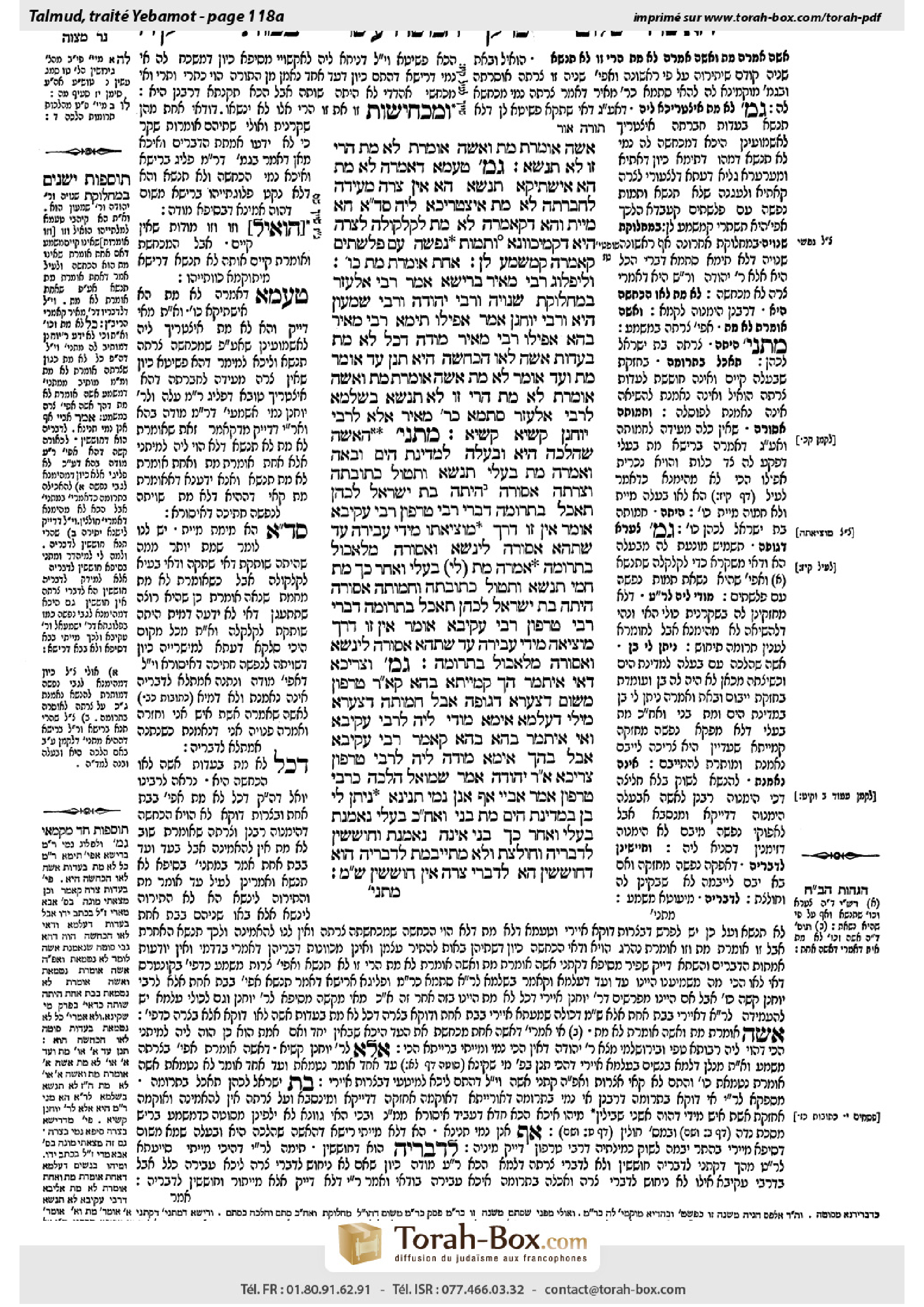
Yevamot 118a: Talmud study for Daf Yomi
Daf Yomi is the daily study of one Talmud folio. Explore 37 tractates with scans, Hebrew text, Sefaria English and AI-generated French translations where annotated.
Passage selection and English or AI-generated French translation are available where the scan has annotations. Daf Study is independent of Torah-Box and Sefaria.
Browse Yevamot · יבמות · All tractatesYevamot 118a text and translations
This page of Yevamot includes the Aramaic text, an English translation and an AI-generated French translation, alongside the scan above.
יבמות קי״ח א · Aramaic and Hebrew text
אִשָּׁה אוֹמֶרֶת: ״מֵת״, וְאִשָּׁה אוֹמֶרֶת: ״לֹא מֵת״ — הֲרֵי זוֹ לֹא תִּנָּשֵׂא.
גְּמָ׳ טַעְמָא דְּאָמְרָה ״לֹא מֵת״, הָא אִישְׁתִּיקָא — תִּנָּשֵׂא? הָא אֵין צָרָה מְעִידָה לַחֲבֶרְתָּהּ!
״לֹא מֵת״ אִיצְטְרִיכָא לֵיהּ, סָלְקָא דַּעְתָּךְ אָמֵינָא: הָא מָיֵית, וְהָא דְּקָאָמְרָה ״לֹא מֵת״ — לְקַלְקוֹלַהּ לְצָרָה הִיא דְּקָמִיכַּוְּונָא, וְ״תָמוֹת נַפְשָׁהּ עִם פְּלִשְׁתִּים״ קָאָמְרָה, קָמַשְׁמַע לַן.
אַחַת אוֹמֶרֶת מֵת כּוּ׳. וְלִיפְלוֹג רַבִּי מֵאִיר בְּרֵישָׁא! אָמַר רַבִּי אֶלְעָזָר: בְּמַחְלוֹקֶת שְׁנוּיָה, וְרַבִּי יְהוּדָה וְרַבִּי שִׁמְעוֹן הִיא. וְרַבִּי יוֹחָנָן אָמַר: אֲפִילּוּ תֵּימָא רַבִּי מֵאִיר, בְּהָא אֲפִילּוּ רַבִּי מֵאִיר מוֹדֶה דְּכֹל ״לֹא מֵת״ בְּעֵדוּת אִשָּׁה לָאו הַכְחָשָׁה הִיא.
תְּנַן: עֵד אוֹמֵר ״מֵת״, וְעֵד אוֹמֵר ״לֹא מֵת״, אִשָּׁה אוֹמֶרֶת ״מֵת״ וְאִשָּׁה אוֹמֶרֶת ״לֹא מֵת״ — הֲרֵי זוֹ לֹא תִּנָּשֵׂא. בִּשְׁלָמָא לְרַבִּי אֶלְעָזָר — סְתָמָא כְּרַבִּי מֵאִיר, אֶלָּא לְרַבִּי יוֹחָנָן קַשְׁיָא! קַשְׁיָא.
מַתְנִי׳ הָאִשָּׁה שֶׁהָלְכָה הִיא וּבַעְלָהּ לִמְדִינַת הַיָּם, וּבָאָה וְאָמְרָה ״מֵת בַּעְלִי״ — תִּנָּשֵׂא וְתִטּוֹל כְּתוּבָּתָהּ, וְצָרָתָהּ אֲסוּרָה. הָיְתָה בַּת יִשְׂרָאֵל לְכֹהֵן — תֹּאכַל בִּתְרוּמָה, דִּבְרֵי רַבִּי טַרְפוֹן.
רַבִּי עֲקִיבָא אוֹמֵר: אֵין זוֹ דֶּרֶךְ מוֹצִיאָתוֹ מִידֵי עֲבֵירָה, עַד שֶׁתְּהֵא אֲסוּרָה לִינָּשֵׂא, וַאֲסוּרָה מִלֶּאֱכוֹל בִּתְרוּמָה.
אָמְרָה: ״מֵת (לִי) בַּעְלִי, וְאַחַר כָּךְ מֵת חָמִי״ — תִּנָּשֵׂא וְתִטּוֹל כְּתוּבָּתָהּ, וַחֲמוֹתָהּ אֲסוּרָה. הָיְתָה בַּת יִשְׂרָאֵל לְכֹהֵן — תֹּאכַל בִּתְרוּמָה, דִּבְרֵי רַבִּי טַרְפוֹן. רַבִּי עֲקִיבָא אוֹמֵר: אֵין זוֹ דֶּרֶךְ מוֹצִיאָ[תָ]הּ מִידֵי עֲבֵירָה, עַד שֶׁתְּהֵא אֲסוּרָה לִינָּשֵׂא וַאֲסוּרָה מִלֶּאֱכוֹל בִּתְרוּמָה.
גְּמָ׳ וּצְרִיכָא, דְּאִי אִיתְּמַר הָךְ קַמַּיְיתָא — בְּהָא קָאָמַר רַבִּי טַרְפוֹן, מִשּׁוּם דְּצַעְרָא דְּגוּפַהּ. אֲבָל חֲמוֹת, דְּצַעְרָא מִילֵּי דְּעָלְמָא — אֵימָא מוֹדֵי לֵיהּ לְרַבִּי עֲקִיבָא.
וְאִי אִיתְּמַר בְּהָא — בְּהָא קָאָמַר רַבִּי עֲקִיבָא, אֲבָל בְּהָךְ — אֵימָא מוֹדֶה לֵיהּ לְרַבִּי טַרְפוֹן, צְרִיכָא.
אָמַר רַב יְהוּדָה אָמַר שְׁמוּאֵל: הֲלָכָה כְּרַבִּי טַרְפוֹן. אָמַר אַבָּיֵי, אַף אֲנַן נָמֵי תְּנֵינָא: ״נִיתַּן לִי בֵּן בִּמְדִינַת הַיָּם. מֵת בְּנִי, וְאַחַר כָּךְ בַּעְלִי״ — נֶאֱמֶנֶת. ״בַּעְלִי, וְאַחַר כָּךְ בְּנִי״ — אֵינָהּ נֶאֱמֶנֶת.
וְחוֹשְׁשִׁין לִדְבָרֶיהָ, וְחוֹלֶצֶת וְלֹא מִתְיַיבֶּמֶת. לִדְבָרֶיהָ הוּא דְּחוֹשְׁשִׁין, הָא לְדִבְרֵי צָרָה — אֵין חוֹשְׁשִׁין. שְׁמַע מִינַּהּ.
Yevamot 118a · English translation
or one woman says: He died, and another woman says: He did not die, this woman may not marry.
GEMARA: The mishna taught that if one rival wife says their husband died, while the second maintains that he did not die, the one who says he did not die may not remarry. The Gemara infers: The reason is that the second rival wife said explicitly: He did not die, from which it may be inferred that if she was silent and said nothing, she is permitted to marry based on the testimony of the first. However, this conclusion is problematic, as there is a principle that one rival wife may not testify on behalf of another, and if so, how can she rely on the testimony of her rival wife?
The Gemara answers that this inference is incorrect, as it was necessary for the mishna to state: He did not die, as it might enter your mind to say that this man did in fact die, and with regard to that which she says: He did not die, she intends to ruin her rival wife. And as for herself she says: Let her die with the Philistines. This is a paraphrase of the verse: “Let me die with the Philistines” (Judges 16:30), which is a shorthand expression for one’s desire to hurt his enemies even if he suffers the same fate himself. In this case it means that she is prepared to testify falsely that their husband did not die, so as to ruin her rival wife. Therefore the mishna teaches us that this is not the case, and she is not permitted to marry based on the testimony of her rival wife.
§ The mishna taught that if one wife says: He died, and one says: He was killed, Rabbi Meir says that as they contradict one another, they may not remarry. The Gemara asks: And let Rabbi Meir also disagree in the first clause, when one witness says the husband died and the other claims he did not die. Rabbi Elazar said: This is taught as a tannaitic dispute. In other words, Rabbi Meir also disagreed with the first clause, and the unattributed opinion in the mishna is that of Rabbi Yehuda and Rabbi Shimon. And Rabbi Yoḥanan said: You can even say that the first clause is in accordance with the opinion of Rabbi Meir, as in this case even Rabbi Meir concedes that any claim of: He did not die, with regard to testimony enabling a woman to remarry, is not considered contradictory.
The Gemara raises a difficulty with regard to this answer. We learned in the mishna: If one witness says: He died, and one witness says: He did not die, or if one woman says: He died, and another woman says: He did not die, she may not marry. Granted, according to the opinion of Rabbi Elazar, the unattributed statement in this mishna is in accordance with the opinion of Rabbi Meir, that when a rebuttal contradicts the original testimony, one cannot rely upon the testimony that the husband died. However, according to the opinion of Rabbi Yoḥanan, this is difficult. The Gemara answers: Yes, this is difficult.
MISHNA: In the case of a woman who went, she and her husband, overseas, and she comes and says: My husband died, she may marry, and she takes her marriage contract based on her own testimony. And it remains prohibited for her rival wife to remarry, as a woman cannot testify on behalf of her rival wife. If the rival wife was an Israelite woman married to a priest, she may continue to partake of teruma, as she is not permitted to remarry, and therefore the presumption that the husband is still alive is maintained in relation to her. This is the statement of Rabbi Tarfon.
Rabbi Akiva says: This is not the way to spare someone from transgression. According to the opinion of Rabbi Tarfon, there is a concern that she might be eating teruma unlawfully. There is no remedy for this situation unless it is prohibited for the rival wife to marry, as she cannot rely on the testimony of her rival wife, and it is also prohibited for her to partake of teruma, lest the other woman was speaking the truth. In other words, the halakha is stringent on both counts.
The mishna discusses a similar case. If a woman said: My husband died and afterward my father-in-law died, she may marry and take her marriage contract, and it is prohibited for her mother-in-law to remarry, as a woman may not testify on behalf of her mother-in-law. If the mother-in-law was the daughter of an Israelite married to a priest, she may partake of teruma; this is the statement of Rabbi Tarfon. Rabbi Akiva says: This is not the way to spare her from transgression; there is no remedy unless it is prohibited for the mother-in-law to marry and also prohibited for her to partake of teruma.
GEMARA: The mishna states the dispute between Rabbi Tarfon and Rabbi Akiva with regard to two apparently identical cases. The Gemara explains: And it is necessary to state both of these examples. As, had the mishna stated the dispute only in this first case, I would have said: It is in this case that Rabbi Tarfon said the wife is suspected of lying, because the suffering is physical, i.e., she is jealous of her rival wife, with whom she shares her husband. However, with regard to her mother-in-law, where the suffering is merely verbal and not physical, one might say that he concedes to Rabbi Akiva, i.e., that she is not considered a liar, and therefore it should be prohibited for her mother-in-law to partake in teruma.
And vice-versa: Had the mishna stated the dispute only in this second case, I would have said: It is in this case that Rabbi Akiva said that the mother-in-law must refrain from eating teruma in case the daughter-in-law is not lying, but in this other case of the rival wife, you might say that he concedes to Rabbi Tarfon that she may eat teruma, as a rival wife is certainly not telling the truth. Therefore, it is necessary for the mishna to state the dispute in both two cases.
§ Rav Yehuda said that Shmuel said: The halakha is in accordance with the opinion of Rabbi Tarfon. The testimony of a woman who is suspected of harboring ill will toward another is entirely rejected with regard to that other person, and no credence is given to her account at all. Abaye said: Likewise, we, too, learn in a mishna (118b): If a woman came and said: A son was born to me overseas, and my son died and afterward my husband died, she is deemed credible in all regards, and she enters into levirate marriage. If she said: My husband died and afterward my son died, which means she is exempt from levirate marriage, she is not deemed credible.
That mishna adds: But in any case, the court is concerned about her statement, and she must perform ḥalitza and she does not enter into levirate marriage. In other words, the court takes into consideration the possibility that she is speaking the truth, and if her son did die after her husband it is prohibited for her to enter into levirate marriage. Abaye infers from the language of the mishna on 118b: It is with regard to her own statement that the court is concerned. This indicates that the court is not concerned at all about the statement of her rival wife who testified with regard to her. The Gemara concludes: Learn from here that this is the case.
Yevamot 118a · Traduction française (IA)
ou si une femme dit : « Il est mort », et qu’une autre femme dit : « Il n’est pas mort », cette femme ne peut pas se remarier.
GUEMARA : La Michna enseigne que si une épouse rivale dit que leur mari est mort, tandis que la seconde affirme qu’il n’est pas mort, celle qui dit qu’il n’est pas mort ne peut pas se remarier. La Guemara en déduit que la raison est que la seconde épouse rivale a explicitement dit : « Il n’est pas mort ». On peut donc en inférer que si elle était restée silencieuse et n’avait rien dit, elle aurait été autorisée à se remarier sur la foi du témoignage de la première. Cette conclusion pose toutefois problème, car il existe un principe selon lequel une épouse rivale ne peut pas témoigner en faveur d’une autre. Comment pourrait-elle donc se fier au témoignage de son épouse rivale ?
La Guemara répond que cette déduction est erronée : il était nécessaire que la Michna dise : « Il n’est pas mort », car on aurait pu penser que cet homme était effectivement mort et que, lorsqu’elle dit : « Il n’est pas mort », elle entend nuire à son épouse rivale. Quant à elle-même, elle se dit : « Qu’elle périsse avec les Philistins ! » C’est une paraphrase du verset : « Que je périsse avec les Philistins ! » (Juges 16,30), expression abrégée du désir de faire du mal à ses ennemis, même si l’on subit soi-même le même sort. Dans ce cas, cela signifie qu’elle est prête à témoigner faussement que leur mari n’est pas mort, afin de nuire à son épouse rivale. La Michna nous enseigne donc que ce n’est pas le cas : elle n’est pas autorisée à se remarier sur la foi du témoignage de son épouse rivale.
§ La Michna enseigne que si une épouse dit : « Il est mort », et une autre : « Il a été tué », Rabbi Meïr dit que, puisqu’elles se contredisent, elles ne peuvent pas se remarier. La Guemara demande : Pourquoi Rabbi Meïr ne conteste-t-il pas aussi la première partie, où un témoin dit que le mari est mort et l’autre affirme qu’il n’est pas mort ? Rabbi Elazar a dit : Cela fait l’objet d’une controverse entre tannaïm. Autrement dit, Rabbi Meïr conteste également la première partie, et l’opinion anonyme de la Michna est celle de Rabbi Yehouda et de Rabbi Shimon. Rabbi Yoḥanan a dit : On peut même dire que la première partie est conforme à l’opinion de Rabbi Meïr, car en l’espèce, même Rabbi Meïr reconnaît que, dans le cadre d’un témoignage permettant à une femme de se remarier, l’affirmation « il n’est pas mort » n’est pas considérée comme une contradiction.
La Guemara soulève une difficulté à propos de cette réponse. Nous avons appris dans la Michna : Si un témoin dit : « Il est mort », et un témoin dit : « Il n’est pas mort », ou si une femme dit : « Il est mort », et une autre femme dit : « Il n’est pas mort », elle ne peut pas se remarier. Selon l’opinion de Rabbi Elazar, on comprend que la déclaration anonyme de cette Michna est conforme à l’opinion de Rabbi Meïr : lorsqu’un démenti contredit le témoignage initial, on ne peut pas se fier au témoignage selon lequel le mari est mort. Mais selon l’opinion de Rabbi Yoḥanan, cela pose problème. La Guemara répond : Oui, cela pose problème.
MICHNA : Dans le cas d’une femme qui est partie outre-mer avec son mari et qui revient en disant : « Mon mari est mort », elle peut se remarier et réclamer le paiement de sa ketouba sur la foi de son propre témoignage. Son épouse rivale, quant à elle, ne peut pas se remarier, car une femme ne peut pas témoigner en faveur de son épouse rivale. Si cette épouse rivale est une femme israélite mariée à un prêtre, elle peut continuer à consommer de la terouma, puisqu’elle n’est pas autorisée à se remarier et que la présomption selon laquelle son mari est toujours vivant est donc maintenue à son égard. Telle est l’opinion de Rabbi Tarfon.
Rabbi Akiva dit : Ce n’est pas ainsi qu’on préserve quelqu’un de la transgression. Selon l’opinion de Rabbi Tarfon, il est à craindre qu’elle consomme de la terouma illicitement. Il n’y a pas de solution à cette situation, à moins d’interdire à l’épouse rivale de se remarier, puisqu’elle ne peut pas se fier au témoignage de son épouse rivale, et de lui interdire également de consommer de la terouma, au cas où l’autre femme disait la vérité. Autrement dit, la halakha est rigoureuse sur les deux points.
La Michna évoque un cas similaire. Si une femme dit : « Mon mari est mort, puis mon beau-père est mort », elle peut se remarier et réclamer le paiement de sa ketouba, tandis qu’il est interdit à sa belle-mère de se remarier, car une femme ne peut pas témoigner en faveur de sa belle-mère. Si la belle-mère est la fille d’une femme israélite mariée à un prêtre, elle peut consommer de la terouma ; telle est l’opinion de Rabbi Tarfon. Rabbi Akiva dit : Ce n’est pas ainsi qu’on la préserve de la transgression ; il n’y a pas de solution à moins d’interdire à la belle-mère de se remarier et de lui interdire également de consommer de la terouma.
GUEMARA : La Michna expose la controverse entre Rabbi Tarfon et Rabbi Akiva à propos de deux cas apparemment identiques. La Guemara explique qu’il est nécessaire de mentionner les deux exemples. En effet, si la Michna avait exposé la controverse uniquement dans ce premier cas, j’aurais dit que c’est dans ce cas que Rabbi Tarfon a dit que l’épouse est soupçonnée de mentir, parce que sa souffrance est physique, c’est-à-dire qu’elle est jalouse de son épouse rivale, avec laquelle elle partage son mari. En revanche, à propos de sa belle-mère, où la souffrance n’est que verbale et non physique, on aurait pu dire qu’il reconnaît l’opinion de Rabbi Akiva, c’est-à-dire qu’elle n’est pas considérée comme une menteuse ; il faudrait donc interdire à sa belle-mère de consommer de la terouma.
Et inversement : si la Michna avait exposé la controverse uniquement dans ce second cas, j’aurais dit que c’est dans ce cas que Rabbi Akiva a dit que la belle-mère doit s’abstenir de consommer de la terouma au cas où sa belle-fille ne mentirait pas ; mais dans l’autre cas, celui de l’épouse rivale, on aurait pu dire qu’il reconnaît l’opinion de Rabbi Tarfon et qu’elle peut consommer de la terouma, puisqu’une épouse rivale ne dit certainement pas la vérité. Il était donc nécessaire que la Michna expose la controverse dans les deux cas.
§ Rav Yehouda a dit au nom de Shmouel : La halakha est conforme à l’opinion de Rabbi Tarfon. Le témoignage d’une femme soupçonnée d’éprouver de l’animosité envers une autre est entièrement rejeté à l’égard de cette dernière, et son récit ne reçoit aucun crédit. Abayé a dit : De même, nous l’apprenons aussi dans une Michna (118b) : Si une femme vient et dit : « Un fils m’est né outre-mer ; mon fils est mort, puis mon mari est mort », elle est considérée comme crédible à tous égards et elle entre en lévirat. Si elle dit : « Mon mari est mort, puis mon fils est mort », ce qui la dispense du lévirat, elle n’est pas considérée comme crédible.
Cette Michna ajoute : Quoi qu’il en soit, le tribunal tient compte de sa déclaration ; elle doit accomplir la ḥalitsa et n’entre pas en lévirat. Autrement dit, le tribunal prend en considération la possibilité qu’elle dise la vérité et, si son fils est mort après son mari, il lui est interdit d’entrer en lévirat. Abayé déduit du texte de la Michna en 118b que le tribunal tient compte de sa propre déclaration. Cela indique que le tribunal ne tient nullement compte de la déclaration de son épouse rivale, qui a témoigné à son sujet. La Guemara conclut : Apprends-en que c’est bien le cas.
Traduction française générée par IA à partir de l’édition anglaise de Sefaria. Vérifie toujours un passage avec le texte source.
Text from Sefaria: William Davidson Edition - Vocalized Aramaic (CC BY NC); William Davidson Edition - English (CC BY NC).