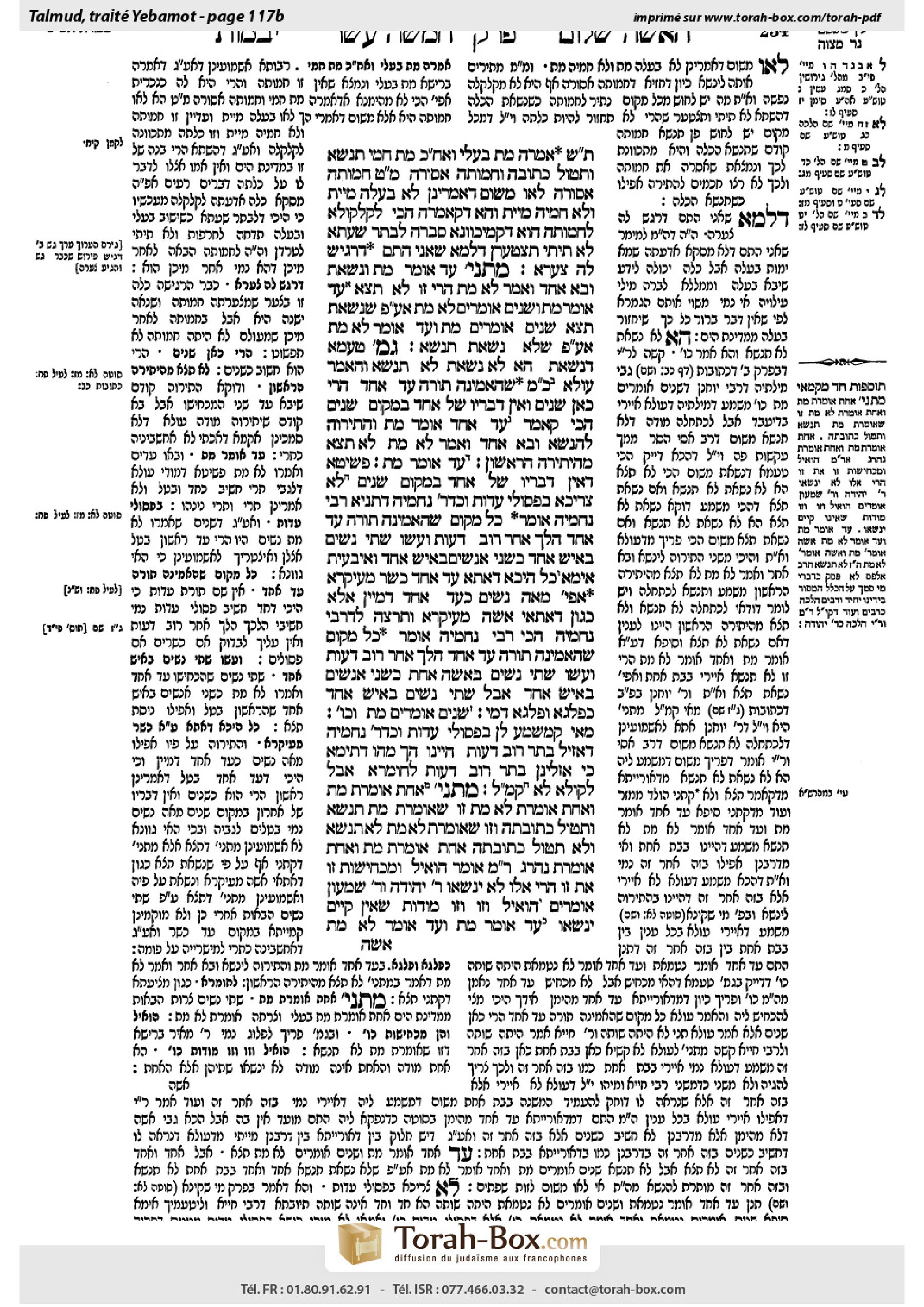
Yevamot 117b: Talmud study for Daf Yomi
Daf Yomi is the daily study of one Talmud folio. Explore 37 tractates with scans, Hebrew text, Sefaria English and AI-generated French translations where annotated.
Passage selection and English or AI-generated French translation are available where the scan has annotations. Daf Study is independent of Torah-Box and Sefaria.
Browse Yevamot · יבמות · All tractatesYevamot 117b text and translations
This page of Yevamot includes the Aramaic text, an English translation and an AI-generated French translation, alongside the scan above.
יבמות קי״ז ב · Aramaic and Hebrew text
תָּא שְׁמַע, אָמְרָה: ״מֵת בַּעְלִי וְאַחַר כָּךְ מֵת חָמִי״ — תִּנָּשֵׂא וְתִטּוֹל כְּתוּבָּה, וַחֲמוֹתָהּ אֲסוּרָה. מַאי טַעְמָא חֲמוֹתָהּ אֲסוּרָה? לָאו מִשּׁוּם דְּאָמְרִינַן לָא בַּעְלַהּ מִיית וְלָא חֲמוּהָ מִיית, וְהָא דְּקָאָמְרָה הָכִי — לְקַלְקוֹלַאּ לַחֲמוֹתָהּ הוּא דְּקָמִיכַּוְּונָא,
סָבְרָה: לְבָתַר שַׁעְתָּא לָא תֵּיתֵי (תִּצְטַעֲרַן).
דִּלְמָא שָׁאנֵי הָתָם, דִּרְגִישׁ לַהּ צַעֲרָא.
מַתְנִי׳ עֵד אוֹמֵר ״מֵת״, וְנִשֵּׂאת, וּבָא אֶחָד וְאָמַר ״לֹא מֵת״ — הֲרֵי זוֹ לֹא תֵּצֵא. עֵד אוֹמֵר ״מֵת״, וּשְׁנַיִם אוֹמְרִים ״לֹא מֵת״ — אַף עַל פִּי שֶׁנִּשֵּׂאת, תֵּצֵא. שְׁנַיִם אוֹמְרִים ״מֵת״, וְעֵד אוֹמֵר ״לֹא מֵת״ — אַף עַל פִּי שֶׁלֹּא נִשֵּׂאת, תִּנָּשֵׂא.
גְּמָ׳ טַעְמָא דְּנִשֵּׂאת, הָא לֹא נִשֵּׂאת — לֹא תִּנָּשֵׂא. וְהָאָמַר עוּלָּא: כׇּל מָקוֹם שֶׁהֶאֱמִינָה תּוֹרָה עֵד אֶחָד — הֲרֵי כָּאן שְׁנַיִם, וְאֵין דְּבָרָיו שֶׁל אֶחָד בִּמְקוֹם שְׁנַיִם.
הָכִי קָאָמַר: עֵד אֶחָד אוֹמֵר ״מֵת״, וְהִתִּירוּהָ לְהִנָּשֵׂא, וּבָא אֶחָד וְאָמַר ״לֹא מֵת״ — לֹא תֵּצֵא מֵהֶיתֵּירָהּ הָרִאשׁוֹן.
עֵד אוֹמֵר ״מֵת״ — פְּשִׁיטָא, דְּאֵין דְּבָרָיו שֶׁל אֶחָד בִּמְקוֹם שְׁנַיִם! לָא צְרִיכָא, בִּפְסוּלֵי עֵדוּת, וְכִדְרַבִּי נְחֶמְיָה.
דְּתַנְיָא, רַבִּי נְחֶמְיָה אוֹמֵר: כׇּל מָקוֹם שֶׁהֶאֱמִינָה תּוֹרָה עֵד אֶחָד — הַלֵּךְ אַחַר רוֹב דֵּעוֹת, וְעָשׂוּ שְׁתֵּי נָשִׁים בְּאִישׁ אֶחָד כִּשְׁנֵי אֲנָשִׁים בְּאִישׁ אֶחָד.
וְאִיבָּעֵית אֵימָא: כֹּל הֵיכָא דַּאֲתָא עֵד אֶחָד כָּשֵׁר מֵעִיקָּרָא — אֲפִילּוּ מֵאָה נָשִׁים כְּעֵד אֶחָד דָּמְיָין. אֶלָּא כְּגוֹן דַּאֲתַאי אִשָּׁה מֵעִיקָּרָא.
וְתָרְצַהּ לִדְרַבִּי נְחֶמְיָה הָכִי, רַבִּי נְחֶמְיָה אוֹמֵר: כׇּל מָקוֹם שֶׁהֶאֱמִינָה תּוֹרָה עֵד אֶחָד — הַלֵּךְ אַחַר רוֹב דֵּעוֹת, וְעָשׂוּ שְׁתֵּי נָשִׁים בְּאִשָּׁה אַחַת כִּשְׁנֵי אֲנָשִׁים בְּאִישׁ אֶחָד. אֲבָל שְׁתֵּי נָשִׁים בְּאִישׁ אֶחָד — כְּפַלְגָא וּפַלְגָא דָּמֵי.
שְׁנַיִם אוֹמְרִים ״מֵת״ וְכוּ׳. מַאי קָמַשְׁמַע לַן? בִּפְסוּלֵי עֵדוּת, וְכִדְרַבִּי נְחֶמְיָה, דְּאָזֵיל בָּתַר רוֹב דֵּעוֹת? הַיְינוּ הָךְ!
מַהוּ דְּתֵימָא: כִּי אָזְלִינַן בָּתַר רוֹב דֵּעוֹת — לְחוּמְרָא, אֲבָל לְקוּלָּא — לָא, קָא מַשְׁמַע לַן.
מַתְנִי׳ אַחַת אוֹמֶרֶת ״מֵת״ וְאַחַת אוֹמֶרֶת ״לֹא מֵת״. זוֹ שֶׁאוֹמֶרֶת ״מֵת״ — תִּנָּשֵׂא וְתִטּוֹל כְּתוּבָּתָהּ, וְזוֹ שֶׁאוֹמֶרֶת ״לֹא מֵת״ — לֹא תִּנָּשֵׂא וְלֹא תִּטּוֹל כְּתוּבָּתָהּ.
אַחַת אוֹמֶרֶת ״מֵת״ וְאַחַת אוֹמֶרֶת ״נֶהֱרַג״, רַבִּי מֵאִיר אוֹמֵר: הוֹאִיל וּמַכְחִישׁוֹת זוֹ אֶת זוֹ — הֲרֵי אֵלּוּ לֹא יִנָּשְׂאוּ. רַבִּי יְהוּדָה וְרַבִּי שִׁמְעוֹן אוֹמְרִים: הוֹאִיל וְזוֹ וָזוֹ מוֹדוֹת שֶׁאֵין קַיָּים — יִנָּשְׂאוּ. עֵד אוֹמֵר ״מֵת״ וְעֵד אוֹמֵר ״לֹא מֵת״,
Yevamot 117b · English translation
Come and hear a resolution to this dilemma. If she said: My husband died and afterward my father-in-law died, she may marry and take her money from the marriage contract, and her mother-in-law is prohibited to remarry; she is not deemed credible to testify for her mother-in-law, as already stated. The Gemara clarifies: What is the reason that her mother-in-law is prohibited to remarry? Is it not because we say: Perhaps her husband did not really die, and she is still her mother-in-law, and her father-in-law did not die either, and the reason that she says this statement is that she intends to ruin her mother-in-law?
The Gemara elaborates. She reasons: Later, when the husbands arrive, she will not come back and trouble me, because if the mother-in-law relies on this testimony and remarries she will no longer be able to return to her original husband, and she will be out of her daughter-in-law’s life. This shows that there is a concern that a daughter-in-law might lie in order to prevent future family relationships from coming into being. Similarly, a woman should be suspected of lying with regard to her future daughter-in-law.
The Gemara rejects this suggestion. Perhaps it is different there, as the daughter-in-law has already felt oppressed by her mother-in-law. In other words, she is suspected of lying because she had previous dealings with that woman, whereas in the case of a future mother-in-law, with whom she had no previous dealings, there is no such concern. Consequently, the dilemma cannot be resolved from this case.
MISHNA: If one witness says: The man died, and the wife married based on this testimony, and one other witness came and said: He did not die, she need not leave her new husband due to this testimony. However, if one witness comes and says: The husband died, and two witnesses say: He did not die, then even though she married based on the first witness she must leave her new husband. If two witnesses say: He died, and one witness says: He did not die, the testimony of the two witnesses is accepted, and even though she did not yet marry, she may marry.
GEMARA: The Gemara infers: The reason in the case of one witness contradicted by another witness is that she already married; however, if she did not yet marry and a second witness comes in the meantime and contradicts the statement of the first one, she may not marry. The Gemara asks: But didn’t Ulla say: Wherever you find that the Torah relies on one witness, his testimony is considered complete proof, as though there are two witnesses present here? If so, the witness who comes and testifies to the opposite is only one witness, and the statement of one witness has no standing in a place where it is contradicted by two witnesses. Why, then, may she not remarry, even ab initio?
The Gemara answers that this is what the mishna said: If one witness says: He died, and they permitted her to marry based on his testimony, and one other witness later came and said: He did not die, she does not leave her initial, permitted state, i.e., the permission she was granted to remarry is still in force, and she may marry ab initio.
§ The mishna taught that if one witness says: He died, and two come and say: He did not die, she must leave her new husband. The Gemara asks: This is obvious, as the statement of one witness has no standing in a place where it is contradicted by two witnesses. The Gemara answers: No, it is necessary in a case of people disqualified from giving testimony. In other words, the mishna is referring to two people who are generally disqualified from serving as witnesses. In the case of a missing husband, however, their testimony is accepted in contradiction of the first, qualified, witness. And this is in accordance with the opinion of Rabbi Neḥemya.
As it is taught in a baraita that Rabbi Neḥemya says: Wherever you find that the Torah relies on one witness, follow the majority of opinions, even if they are disqualified. And the Sages established the testimony of two women against one man in this case like the testimony of two men against one man, i.e., the testimony of the two witnesses negates the earlier testimony of a single witness. The mishna is teaching that even if the first witness was qualified to give testimony, his account is negated by the statements of the two disqualified witnesses who contradicted him.
And if you wish, say: Anywhere that a qualified witness came initially and testified that he died, even if one hundred women came and contradicted his account, they are considered like one witness, and cannot negate his testimony. However, here it is speaking of a case where a woman came initially and they relied on her testimony to release the wife, and afterward two other women came and contradicted her.
The Gemara explains: And you can explain the ruling in accordance with the opinion of Rabbi Neḥemya as follows: Rabbi Neḥemya says: Wherever you find that the Torah relies on one witness, e.g., in testimony concerning a woman’s missing husband, follow the majority of opinions, and they established two women against one woman like two men against one man. However, in a case involving two women against one man, the latter of whom is a qualified witness, this is like half against half, i.e., they are equal. The testimony of two women has no advantage over that of one male witness, who is considered like two witnesses in testimony concerning a missing husband.
§ The mishna taught: If two witnesses say: He died, and one witness says: He did not die, even if she did not yet marry, she may marry. The Gemara asks: What is the mishna teaching us? If you say it is referring to people disqualified from giving testimony, and this is in accordance with the opinion of Rabbi Neḥemya, who follows the majority of opinions, then this case is identical to that previous case.
The Gemara answers. This case is also necessary, lest you say that when we follow the majority of opinions, this is only when it leads to a stringency, but when this principle would lead to a leniency, to permit her to marry based on the majority of opinions, we do not follow the majority opinion. Therefore, the mishna teaches us that there is no difference in this regard, as the majority of opinions is accepted whether this leads to a lenient or a stringent outcome.
MISHNA: If two women who were married to the same man come forward, and one of them says that the husband died, and the other one says he did not die, the one who says he died may marry on the basis of her own testimony, and she takes the money of her marriage contract. And the one who said he did not die may not marry, and does not take the money of her marriage contract.
If one wife says: He died in a normal manner, and the other one says: He was killed, Rabbi Meir says: Since they contradict one another, these women may not marry. Rabbi Yehuda and Rabbi Shimon say: Since they both agree that he is not alive they may marry, despite the fact that they dispute the circumstances of his demise. If a witness says: He died, and a witness says: He did not die,
Yevamot 117b · Traduction française (IA)
Viens et entends une réponse à ce dilemme. Si elle dit : « Mon mari est mort, puis mon beau-père est mort », elle peut se remarier et percevoir la somme de sa ketouba, tandis que sa belle-mère ne peut pas se remarier ; elle n’est pas jugée crédible lorsqu’elle témoigne en faveur de sa belle-mère, comme cela a déjà été indiqué. La Guemara précise : pourquoi sa belle-mère ne peut-elle pas se remarier ? N’est-ce pas parce que nous disons : peut-être son mari n’est-il pas vraiment mort et elle est encore sa belle-mère ; son beau-père n’est pas mort non plus, et si elle tient ces propos, c’est parce qu’elle cherche à nuire à sa belle-mère ?
La Guemara développe : elle raisonne ainsi : « Plus tard, lorsque les maris reviendront, elle ne reviendra pas me causer des ennuis, car si ma belle-mère se fie à ce témoignage et se remarie, elle ne pourra plus retourner auprès de son premier mari et sortira de la vie de sa belle-fille. » Cela montre qu’on peut craindre qu’une belle-fille mente afin d’empêcher que de futures relations familiales ne se nouent. De même, une femme devrait être soupçonnée de mentir au sujet de sa future belle-fille.
La Guemara rejette cette suggestion. Peut-être le cas est-il différent, car la belle-fille a déjà subi l’oppression de sa belle-mère. Autrement dit, on la soupçonne de mentir parce qu’elle a déjà eu affaire à cette femme, tandis que, dans le cas d’une future belle-mère, avec laquelle elle n’a encore eu aucun rapport, il n’y a pas lieu de nourrir une telle crainte. Par conséquent, ce cas ne permet pas de résoudre le dilemme.
MICHNA : Si un témoin dit : « L’homme est mort », que la femme se remarie sur la foi de ce témoignage, puis qu’un autre témoin vient dire : « Il n’est pas mort », elle n’a pas à quitter son nouveau mari en raison de ce témoignage. En revanche, si un témoin vient dire : « Le mari est mort », et que deux témoins disent : « Il n’est pas mort », alors, même si elle s’est remariée sur la foi du premier témoin, elle doit quitter son nouveau mari. Si deux témoins disent : « Il est mort », et qu’un témoin dit : « Il n’est pas mort », le témoignage des deux témoins est accepté et, même si elle ne s’est pas encore remariée, elle peut le faire.
GUEMARA : La Guemara déduit que, dans le cas où un témoin est contredit par un autre, la raison pour laquelle elle n’a pas à quitter son nouveau mari est qu’elle s’est déjà remariée ; toutefois, si elle ne s’est pas encore remariée et qu’entre-temps un second témoin vient contredire le premier, elle ne peut pas se remarier. La Guemara demande : Mais Oulla n’a-t-il pas dit : partout où la Torah s’appuie sur un seul témoin, son témoignage constitue une preuve complète, comme si deux témoins étaient présents ici ? Si tel est le cas, le témoin qui vient témoigner en sens contraire n’est qu’un témoin unique, et le témoignage d’un seul témoin n’a aucune valeur lorsqu’il est contredit par deux témoins. Pourquoi, alors, ne peut-elle pas se remarier d’emblée ?
La Guemara répond que voici ce qu’enseigne la Michna : si un témoin dit : « Il est mort », qu’on l’autorise à se remarier sur la foi de son témoignage, puis qu’un autre témoin vient dire : « Il n’est pas mort », elle ne perd pas le statut qui lui avait initialement été accordé ; autrement dit, l’autorisation de se remarier reste en vigueur et elle peut se remarier d’emblée.
§ La Michna a enseigné que si un témoin dit : « Il est mort », et que deux personnes viennent dire : « Il n’est pas mort », elle doit quitter son nouveau mari. La Guemara demande : cela va de soi, puisque le témoignage d’un seul témoin n’a aucune valeur lorsqu’il est contredit par deux témoins. La Guemara répond : non, ce cas est nécessaire pour celui de personnes inaptes à témoigner. Autrement dit, la Michna parle de deux personnes généralement inaptes à servir de témoins. Toutefois, dans le cas d’un mari disparu, leur témoignage est accepté pour contredire celui du premier témoin, qui est apte à témoigner. Cela correspond à l’opinion de Rabbi Neḥemya.
Car il est enseigné dans une baraïta que Rabbi Neḥemya dit : partout où la Torah s’appuie sur un seul témoin, on suit l’avis de la majorité, même si les personnes concernées sont inaptes à témoigner. Et les Sages ont établi que, dans ce cas, le témoignage de deux femmes contre un homme équivaut à celui de deux hommes contre un homme ; autrement dit, le témoignage des deux témoins annule le témoignage antérieur d’un témoin unique. La Michna enseigne que même si le premier témoin était apte à témoigner, son témoignage est annulé par les déclarations des deux témoins inaptes qui l’ont contredit.
Ou, si tu le souhaites, dis plutôt : partout où un témoin apte est venu en premier et a témoigné qu’il était mort, même si cent femmes sont venues contredire son témoignage, elles sont considérées comme un seul témoin et ne peuvent pas l’annuler. Cependant, ici, il s’agit d’un cas où une femme est venue en premier et où l’on s’est fié à son témoignage pour autoriser l’épouse à se remarier, puis où deux autres femmes sont venues la contredire.
La Guemara explique : on peut interpréter la décision conformément à l’opinion de Rabbi Neḥemya comme suit : Rabbi Neḥemya dit que partout où la Torah s’appuie sur un seul témoin, par exemple dans le témoignage concernant le mari disparu d’une femme, on suit l’avis de la majorité ; et les Sages ont établi que deux femmes contre une femme équivalent à deux hommes contre un homme. En revanche, dans le cas de deux femmes contre un homme, si cet homme est un témoin apte, les avis sont à égalité. Le témoignage des deux femmes n’a pas plus de poids que celui d’un témoin masculin, lequel est considéré comme deux témoins dans le témoignage concernant un mari disparu.
§ La Michna a enseigné : si deux témoins disent : « Il est mort », et qu’un témoin dit : « Il n’est pas mort », même si elle ne s’est pas encore remariée, elle peut le faire. La Guemara demande : que nous enseigne la Michna ? Si elle parle de personnes inaptes à témoigner et que cela correspond à l’opinion de Rabbi Neḥemya, qui suit l’avis de la majorité, alors ce cas est identique au précédent.
La Guemara répond : ce cas aussi est nécessaire, de peur que tu ne dises que l’on ne suit l’avis de la majorité que lorsque cela entraîne une rigueur ; mais si ce principe devait entraîner une indulgence, en permettant à la femme de se remarier sur la foi de l’avis majoritaire, on ne suivrait pas cet avis. La Michna nous enseigne donc qu’il n’y a pas de différence à cet égard : l’avis majoritaire est accepté, qu’il entraîne une décision indulgente ou rigoureuse.
MICHNA : Si deux femmes qui étaient mariées au même homme se présentent, et que l’une dit que le mari est mort tandis que l’autre dit qu’il n’est pas mort, celle qui dit qu’il est mort peut se remarier sur la foi de son propre témoignage et percevoir la somme de sa ketouba. Celle qui a dit qu’il n’était pas mort ne peut pas se remarier et ne perçoit pas la somme de sa ketouba.
Si une épouse dit : « Il est mort de mort naturelle », et que l’autre dit : « Il a été tué », Rabbi Meïr dit : puisqu’elles se contredisent, ces femmes ne peuvent pas se remarier. Rabbi Yehouda et Rabbi Shimon disent : puisqu’elles reconnaissent toutes deux qu’il n’est plus en vie, elles peuvent se remarier, bien qu’elles soient en désaccord sur les circonstances de sa mort. Si un témoin dit : « Il est mort », et qu’un témoin dit : « Il n’est pas mort »,…
Traduction française générée par IA à partir de l’édition anglaise de Sefaria. Vérifie toujours un passage avec le texte source.
Text from Sefaria: William Davidson Edition - Vocalized Aramaic (CC BY NC); William Davidson Edition - English (CC BY NC).