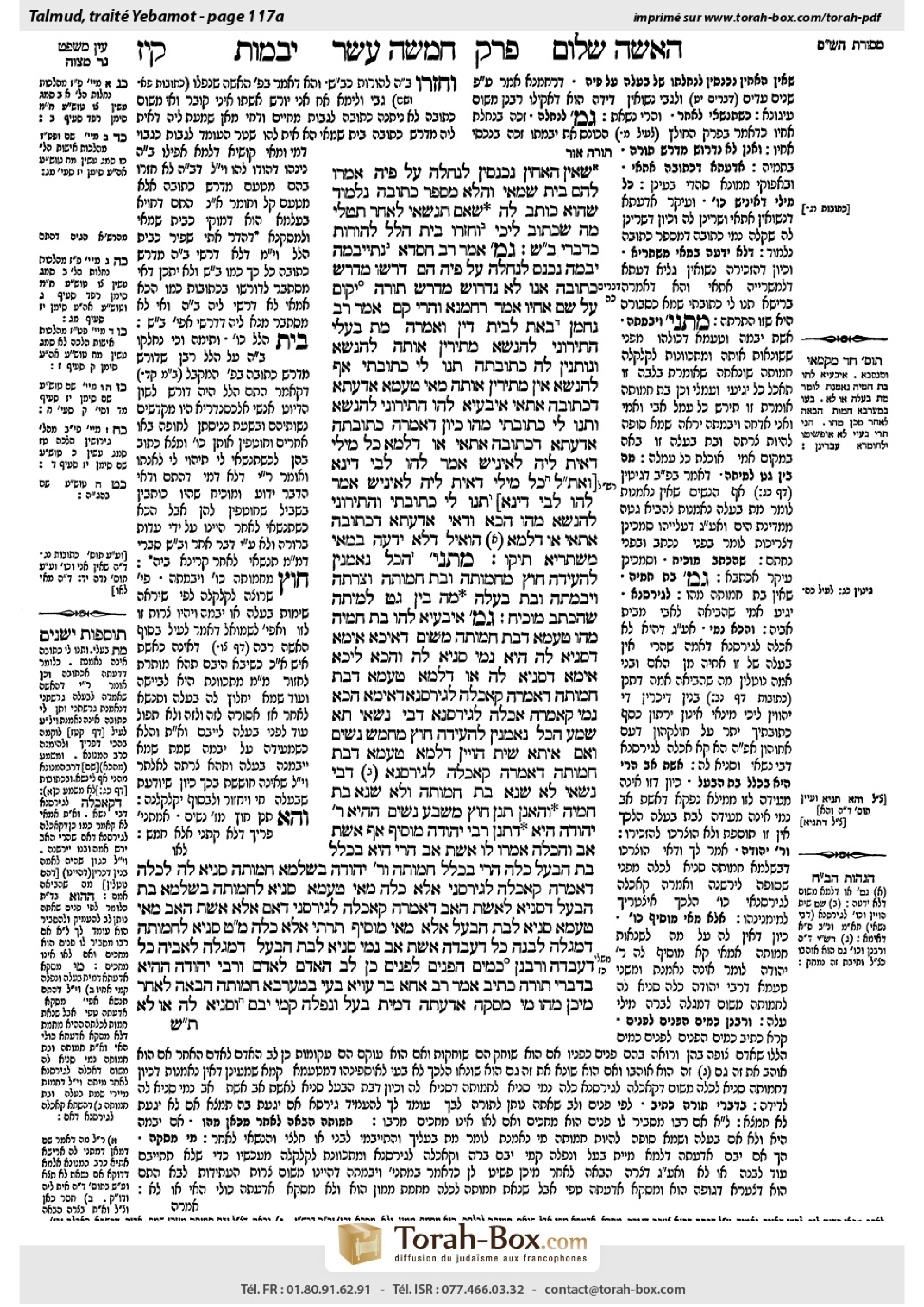
Yevamot 117a: Talmud study for Daf Yomi
Daf Yomi is the daily study of one Talmud folio. Explore 37 tractates with scans, Hebrew text, Sefaria English and AI-generated French translations where annotated.
Passage selection and English or AI-generated French translation are available where the scan has annotations. Daf Study is independent of Torah-Box and Sefaria.
Browse Yevamot · יבמות · All tractatesYevamot 117a text and translations
This page of Yevamot includes the Aramaic text, an English translation and an AI-generated French translation, alongside the scan above.
יבמות קי״ז א · Aramaic and Hebrew text
שֶׁאֵין הָאַחִין נִכְנָסִין לַנַּחֲלָה עַל פִּיהָ!
אָמְרוּ לָהֶם בֵּית שַׁמַּאי: וַהֲלֹא מִסֵּפֶר כְּתוּבָּה נִלְמוֹד, שֶׁהוּא כּוֹתֵב לָהּ: שֶׁאִם תִּנָּשְׂאִי לְאַחֵר תִּטְּלִי מַה שֶּׁכָּתוּב לִיכִי. וְחָזְרוּ בֵּית הִלֵּל לְהוֹרוֹת כְּדִבְרֵי בֵּית שַׁמַּאי.
גְּמָ׳ אָמַר רַב חִסְדָּא: נִתְיַיבְּמָה — יְבָמָהּ נִכְנָס לַנַּחֲלָה עַל פִּיהָ. הֵם דָּרְשׁוּ מִדְרַשׁ כְּתוּבָּה — אָנוּ לֹא נִדְרוֹשׁ מִדְרַשׁ תּוֹרָה?!
״יָקוּם עַל שֵׁם אָחִיו״ אָמַר רַחֲמָנָא, וַהֲרֵי קָם.
אָמַר רַב נַחְמָן: בָּאת לְבֵית דִּין וְאָמְרָה ״מֵת בַּעְלִי, הַתִּירוּנִי לְהִנָּשֵׂא״ — מַתִּירִין אוֹתָהּ לְהִנָּשֵׂא וְנוֹתְנִין לָהּ כְּתוּבָּתָהּ. ״תְּנוּ לִי כְּתוּבָּתִי״ — אַף לְהִנָּשֵׂא אֵין מַתִּירִין אוֹתָהּ. מַאי טַעְמָא — אַדַּעְתָּא דִכְתוּבָּה אֲתַאי.
אִיבַּעְיָא לְהוּ: ״הַתִּירוּנִי לְהִנָּשֵׂא וּתְנוּ לִי כְּתוּבָּתִי״, מַהוּ? כֵּיוָן דְּאָמְרָה כְּתוּבְּתַהּ — אַדַּעְתָּא דִכְתוּבָּה אֲתַאי, אוֹ דִלְמָא: כֹּל מִילֵּי דְּאִית לֵיהּ לְאִינִישׁ אָמַר לְהוּ לְבֵי דִינָא. [וְאִם תִּמְצֵי לוֹמַר כֹּל מִילֵּי דְּאִית לֵיהּ לְאִינִישׁ, אָמַר לְהוּ לְבֵי דִינָא] ״תְּנוּ לִי כְּתוּבָּתִי וְהַתִּירוּנִי לְהִנָּשֵׂא״, מַהוּ?
הָכָא וַדַּאי אַדַּעְתָּא דִכְתוּבָּה אֲתַאי, אוֹ דִּלְמָא: הוֹאִיל דְּלָא יָדְעָה בְּמַאי מִשְׁתַּרְיָא?! תֵּיקוּ.
מַתְנִי׳ הַכֹּל נֶאֱמָנִין לְהַעִידָהּ, חוּץ מֵחֲמוֹתָהּ, וּבַת חֲמוֹתָהּ, וְצָרָתָהּ, וִיבִמְתָּהּ, וּבַת בַּעֲלָהּ.
מָה בֵּין גֵּט לְמִיתָה — שֶׁהַכְּתָב מוֹכִיחַ.
גְּמָ׳ אִיבַּעְיָא לְהוּ: בַּת חָמִיהָ מַהוּ? טַעְמָא דְּבַת חֲמוֹתָהּ — מִשּׁוּם דְּאִיכָּא אִימָּא דְּסָנְיָא לַהּ, הִיא נָמֵי סָנְיָא לַהּ, וְהָכָא לֵיכָּא אִימָּא דְּסָנְיָא לַהּ.
אוֹ דִלְמָא טַעְמָא דְּבַת חֲמוֹתָהּ, דְּאָמְרָה: ״קָאָכְלָה לְגִירְסָנָא דְאִימָּא״, הָכָא נָמֵי קָאָמְרָה: ״אָכְלָה לְגִירְסָנָא דְּבֵי נָשַׁאי״.
תָּא שְׁמַע: הַכֹּל נֶאֱמָנִין לְהַעִידָהּ חוּץ מֵחָמֵשׁ נָשִׁים. וְאִם אִיתָא, שֵׁית הָוְיָין! דִּלְמָא טַעְמָא דְּבַת חֲמוֹתָהּ, דְּאָמְרָה: ״קָאָכְלָה לְגִירְסָנָא דְּבֵי נָשַׁאי״, לָא שְׁנָא בַּת חֲמוֹתָהּ וְלָא שְׁנָא בַּת חָמִיהָ.
וְהָאֲנַן תְּנַן: חוּץ מִשֶּׁבַע נָשִׁים! הָהִיא, רַבִּי יְהוּדָה הִיא. דִּתְנַן: רַבִּי יְהוּדָה מוֹסִיף אַף אֵשֶׁת אָב וְהַכַּלָּה.
אָמְרוּ לוֹ: אֵשֶׁת אָב הֲרֵי הִיא בִּכְלַל בַּת הַבַּעַל, כַּלָּה הֲרֵי בִּכְלַל חֲמוֹתָהּ.
וְרַבִּי יְהוּדָה, בִּשְׁלָמָא חֲמוֹתָהּ סָנְיָא לַהּ לְכַלָּה, דְּאָמְרָה: קָאָכְלָה לְגִירְסָנַי. אֶלָּא כַּלָּה מַאי טַעְמָא סָנְיָא לַחֲמוֹתָהּ? בִּשְׁלָמָא בַּת הַבַּעַל דְּסָנְיָא לְאֵשֶׁת הָאָב, דְּאָמְרָה: קָאָכְלָה לְגִירְסָנֵי דְאֵם. אֶלָּא אֵשֶׁת הָאָב, מַאי טַעְמָא סָנְיָא לְבַת הַבַּעַל?
אֶלָּא מַאי מוֹסִיף תַּרְתֵּי? אֶלָּא: כַּלָּה מַאי טַעְמָא סָנְיָא לַחֲמוֹתָהּ — דִּמְגַלָּה לִבְנָהּ כֹּל דְּעָבְדָה, אֵשֶׁת אָב נָמֵי סָנְיָא לְבַת הַבַּעַל — דִּמְגַלָּה לְאָבִיהָ כֹּל דְּעָבְדָה.
וְרַבָּנַן: ״כַּמַּיִם הַפָּנִים לַפָּנִים כֵּן לֵב הָאָדָם לָאָדָם״. וְרַבִּי יְהוּדָה: הָהִיא בְּדִבְרֵי תוֹרָה כְּתִיב.
אָמַר רַב אַחָא בַּר עַוְיָא, בָּעוּ בְּמַעְרְבָא: חֲמוֹתָהּ הַבָּאָה לְאַחַר מִיכֵּן מַהוּ? מִי מַסְּקָה אַדַּעְתַּהּ דְּמָיֵת בַּעַל וְנָפְלָה קַמֵּי יָבָם וְסָנְיָא לַהּ, אוֹ לָא?
Yevamot 117a · English translation
that the brothers do not come into the inheritance from the deceased brother based on her testimony. Evidently, although this testimony is accepted with regard to forbidden sexual relationships, it is not effective for monetary matters.
Beit Shammai said to them: But we can learn this halakha from the scroll of the marriage contract, as every husband writes for her that: If you marry another man, take what is written for you in this contract. This shows that her right to receive the money of her marriage contract is dependent upon her eligibility to remarry. In this case, as she is deemed credible when she says her husband died and she may marry again, she is likewise entitled to the money of the marriage contract. And Beit Hillel again retracted their opinion, and decided to teach in accordance with the opinion of Beit Shammai.
GEMARA: Rav Ḥisda said: If the woman entered into levirate marriage based upon her own testimony, her yavam comes into the inheritance of the property of his dead brother based on her testimony. He adds: If Beit Shammai taught their halakha that she is entitled to her money, by interpreting homiletically the language of a marriage contract, will we not teach by interpreting homiletically the Torah itself?
Rav Ḥisda explains: The Merciful One states in the Torah: “He shall succeed in the name of his dead brother” (Deuteronomy 25:6), which is interpreted by the Sages as referring to the right of inheritance of the brother who consummates the levirate marriage. And this man did succeed with respect to the marital relationship, as he consummated the levirate marriage based on the testimony of his yevama that her husband died. Consequently, he takes the place of his brother with respect to his inheritance as well.
§ Rav Naḥman said: A woman came to the court and said: My husband died; permit me to marry. The halakha is that after investigating the matter, they permit her to marry, and also give her her marriage contract. However, if she came and said: Give me my marriage contract, they do not even permit her to marry. What is the reason? Since she came with the money of the marriage contract in mind, she is suspected of lying, and her testimony is rejected.
However, the following dilemma was raised before the scholars. If she came and said: Permit me to marry and give me my marriage contract, what is the halakha? Since she mentioned the money from her marriage contract, this shows that she came with the marriage contract in mind. Or perhaps every matter a person has in his favor he will say to the court, even if it is not of particular importance. And if you say that the ruling in this case is in accordance with the principle: Every matter a person has in his favor he will say to the court, then in a case where she said: Give me my marriage contract and permit me to marry, what is the halakha?
The Gemara explains the sides of the dilemma: Here she certainly came with the marriage contract in mind, as she mentioned it first. Or perhaps she said it in this manner since she does not know what will set her free. In other words, she might have thought that taking the money guaranteed by her marriage contract is part of the process that enables her to remarry, but this does not prove that she is focused on the money. The Gemara states that the question shall stand unresolved.
MISHNA: All are deemed credible when they come to give testimony with regard to the death of a woman’s husband, apart from her mother-in-law, the daughter of her mother-in-law, her rival wife, the wife of her yavam, and her husband’s daughter, her stepdaughter. The reason is that these women are likely to hate her and will lie to her detriment.
The mishna explains: In the case of a divorce all people, including these women, may bring her bill of divorce and testify that it was written appropriately. What, then, is the difference between a bill of divorce and death? The mishna answers: The difference is that in the case of a bill of divorce the writing proves the accuracy of the testimony, i.e., her testimony is supported by the text of the document itself, whereas with regard to the death of her husband there is no proof apart from the statement of the woman herself.
GEMARA: A dilemma was raised before the scholars: With regard to the daughter of her father-in-law, who is not the daughter of her mother-in-law, what is the halakha? May she testify to the death of the woman’s husband, or is she also under suspicion? The Gemara explains the sides of the dilemma: The reason that the daughter of her mother-in-law is suspected of lying is because she has a mother who hates her daughter-in-law, and therefore the daughter also hates her. But here, there is no mother who hates her, as she is not the mother-in-law’s daughter, and therefore she should be deemed credible.
Or perhaps the reason that the daughter of her mother-in-law hates her is that she says: She eats the food [girsena] that my mother prepares. Here too, in the case of the daughter of her father-in-law, she also says: She eats the food of my father’s house.
The Gemara suggests: Come and hear a resolution from the following baraita: All are deemed credible when they come to testify with regard to her except for five women. And if it is so, that the daughter of her father-in-law is also disqualified, there are actually six women. The Gemara rejects this: This is no proof, as perhaps the reason that the daughter of her mother-in-law is disqualified from testifying is that she says: She eats the food of my father’s house, and if so, the halakha is no different with regard to her mother-in-law’s daughter and no different with regard to her father-in-law’s daughter. Since the two women are disqualified for the same reason the Sages did not list these as two separate cases.
The Gemara raises a contradiction from another source. But isn’t it taught in a baraita: Apart from seven women who are not trustworthy. Apparently that tanna added the daughter of her father-in-law as a separate category. The Gemara answers: That ruling is in accordance with the opinion of Rabbi Yehuda. As it was taught in a baraita: Rabbi Yehuda adds also a father’s wife, who hates her stepdaughter, and a daughter-in-law, who hates her mother-in-law.
The Rabbis said to Rabbi Yehuda: A father’s wife is included in the category of the husband’s daughter, while a daughter-in-law is included in the category of her mother-in-law. In other words, just as a mother-in-law is suspicious of her daughter-in-law, a daughter-in-law is equally suspicious of her mother-in-law, and they need not be listed separately.
And Rabbi Yehuda, who counts them separately, can answer: Granted that her mother-in-law hates the daughter-in-law, as she says: She eats the food I prepare; but a daughter-in-law, what is the reason that she hates her mother-in-law? Similarly, granted the husband’s daughter, that she hates her father’s wife, as she says: This woman eats the food that my mother prepared. However, the father’s wife, what is the reason that she hates her husband’s daughter?
The Gemara asks: Rather, what is the reason that Rabbi Yehuda adds these two? Rather, his logic is: In the case of a daughter-in-law, what is the reason that she hates her mother-in-law? Because she reveals to her son everything his wife does. And likewise a father’s wife also hates the husband’s daughter, because she reveals to her father everything she does. In each case the reason for this hatred is different from the reason for the hatred of the other woman, the mother-in-law or the husband’s daughter, and therefore they belong in a separate category.
And the Rabbis, who say that the reasons for the hatred are the same and therefore count only five disqualified women, how do they respond to this argument? They cite the verse: “As in water face answers to face, so the heart of man to man” (Proverbs 27:19). That is, if one person hates another, the feeling soon becomes mutual. Here too, there is no need for a separate reason in order that the hatred be reciprocated. The Gemara asks: And Rabbi Yehuda, why doesn’t he rely on this verse? Rabbi Yehuda would retort: That verse was written about matters of Torah. In other words, it means that the more one studies Torah, the more Torah he understands.
§ Rav Aḥa bar Avya says: They raise a dilemma in the West, i.e., Eretz Yisrael. With regard to her mother-in-law who comes afterward, what is the halakha? This refers to the mother of the husband’s brother, but not her husband’s mother, i.e., the wife’s future mother-in-law if the wife enters into levirate marriage. Can this woman testify with regard to the future wife of her son? The Gemara clarifies: Does it enter her mind that if this woman’s husband died, the widow will happen before the yavam, her son, for levirate marriage, and as the widow, when she then married her son, would eat her food she hates her already, or not?
Yevamot 117a · Traduction française (IA)
que les frères ne viennent pas à hériter du frère défunt sur la foi de son témoignage. Il apparaît donc que, bien que ce témoignage soit accepté en matière d’interdits sexuels, il n’a pas d’effet en matière pécuniaire.
Beit Chammaï leur dit : « Mais nous pouvons déduire cette halakha de l’acte de mariage, puisque tout mari lui écrit : “Si tu épouses un autre homme, prends ce qui t’est dû selon le présent acte.” » Cela montre que son droit à percevoir la somme prévue dans son acte de mariage dépend de son aptitude à se remarier. En l’occurrence, puisqu’elle est jugée digne de foi lorsqu’elle affirme que son mari est mort et qu’elle peut se remarier, elle a également droit à la somme prévue dans son acte de mariage. Beit Hillel revint alors sur son opinion et décida d’enseigner conformément à l’avis de Beit Chammaï.
GUEMARA : Rav Ḥisda dit : Si la femme a contracté un mariage léviratique sur la foi de son propre témoignage, son yavam hérite des biens de son frère défunt sur la foi de ce témoignage. Il ajoute : Si Beit Chammaï a enseigné sa halakha, selon laquelle elle a droit à la somme prévue dans son acte de mariage, en interprétant de manière homilétique les termes d’un acte de mariage, ne tirerons-nous pas une interprétation homilétique de la Torah elle-même ?
Rav Ḥisda explique : Le Miséricordieux déclare dans la Torah : « Il succédera au nom de son frère défunt » (Deutéronome 25:6), ce que les Sages interprètent comme faisant référence au droit d’héritage du frère qui consomme le mariage léviratique. Or, cet homme a bien succédé à son frère dans la relation conjugale, puisqu’il a consommé le mariage léviratique sur la foi du témoignage de sa yevama, qui affirmait que son mari était mort. Par conséquent, il prend également la place de son frère en matière d’héritage.
§ Rav Naḥman dit : Une femme se présenta au tribunal et déclara : « Mon mari est mort ; autorisez-moi à me remarier. » La halakha est qu’après avoir enquêté sur l’affaire, on l’autorise à se remarier et on lui verse également la somme prévue dans son acte de mariage. En revanche, si elle se présenta et dit : « Donnez-moi la somme prévue dans mon acte de mariage », on ne l’autorise même pas à se remarier. Pour quelle raison ? Puisqu’elle est venue en pensant à cette somme, elle est soupçonnée de mentir et son témoignage est rejeté.
Cependant, les Sages soulevèrent le dilemme suivant : si elle se présenta et dit : « Autorisez-moi à me remarier et donnez-moi la somme prévue dans mon acte de mariage », quelle est la halakha ? Puisqu’elle a mentionné cette somme, cela montre qu’elle est venue en pensant à l’acte de mariage. Ou peut-être chacun mentionne-t-il au tribunal tout ce qui joue en sa faveur, même si cela n’a pas une importance particulière. Et si tu dis que, dans ce cas, la décision suit le principe selon lequel chacun mentionne au tribunal tout ce qui joue en sa faveur, alors, dans le cas où elle a dit : « Donnez-moi la somme prévue dans mon acte de mariage et autorisez-moi à me remarier », quelle est la halakha ?
La Guemara expose les deux possibilités du dilemme : en l’occurrence, elle est certainement venue en pensant à l’acte de mariage, puisqu’elle l’a mentionné en premier. Ou peut-être l’a-t-elle formulé ainsi parce qu’elle ne sait pas ce qui lui permettra d’être libre. Autrement dit, elle a pu croire que recevoir la somme garantie par son acte de mariage faisait partie de la procédure lui permettant de se remarier, mais cela ne prouve pas que cette somme soit au centre de ses préoccupations. La Guemara conclut que la question reste sans réponse.
MICHNA : Toutes sont jugées dignes de foi lorsqu’elles viennent témoigner de la mort du mari d’une femme, à l’exception de sa belle-mère, de la fille de sa belle-mère, de sa coépouse, de la femme de son yavam et de la fille de son mari, c’est-à-dire sa belle-fille. La raison en est que ces femmes sont susceptibles de la haïr et de mentir à son détriment.
La Michna explique : en cas de divorce, toute personne, y compris ces femmes, peut lui apporter son acte de divorce et témoigner qu’il a été rédigé comme il convient. Quelle est donc la différence entre un acte de divorce et la mort ? La Michna répond : dans le cas d’un acte de divorce, l’écrit atteste l’exactitude du témoignage, c’est-à-dire que celui-ci est étayé par le texte même du document, tandis que, concernant la mort de son mari, il n’existe aucune preuve hormis la déclaration de la femme elle-même.
GUEMARA : Les Sages soulevèrent le dilemme suivant : concernant la fille de son beau-père, qui n’est pas la fille de sa belle-mère, quelle est la halakha ? Peut-elle témoigner de la mort du mari de la femme, ou est-elle elle aussi suspecte ? La Guemara expose les deux possibilités du dilemme : si la fille de sa belle-mère est suspecte de mentir, c’est parce qu’elle a une mère qui hait sa belle-fille et que, par conséquent, la fille la hait elle aussi. Mais ici, il n’y a pas de mère qui la hait, puisqu’elle n’est pas la fille de la belle-mère ; elle devrait donc être jugée digne de foi.
Ou peut-être la fille de sa belle-mère la hait-elle parce qu’elle se dit : « Elle mange la nourriture [girsena] que ma mère prépare. » Ici aussi, dans le cas de la fille de son beau-père, elle se dit également : « Elle mange la nourriture de la maison de mon père. »
La Guemara propose : « Viens et entends » une résolution tirée de la baraïta suivante : toutes sont jugées dignes de foi lorsqu’elles viennent témoigner à son sujet, à l’exception de cinq femmes. Or, si la fille de son beau-père était elle aussi disqualifiée, il y aurait en réalité six femmes. La Guemara rejette cette preuve : ce n’en est pas une, car il se peut que la fille de sa belle-mère soit disqualifiée pour témoigner parce qu’elle se dit : « Elle mange la nourriture de la maison de mon père. » Si tel est le cas, la halakha est la même pour la fille de sa belle-mère et pour celle de son beau-père. Puisque ces deux femmes sont disqualifiées pour la même raison, les Sages ne les ont pas énumérées comme deux cas distincts.
La Guemara soulève une contradiction à partir d’une autre source. N’est-il pas enseigné dans une baraïta qu’il y a sept femmes auxquelles on ne peut pas faire confiance ? Apparemment, ce tanna a ajouté la fille de son beau-père comme catégorie distincte. La Guemara répond : cette décision est conforme à l’avis de Rabbi Yehouda. En effet, il a été enseigné dans une baraïta que Rabbi Yehouda ajoute également la femme de son père, qui hait sa belle-fille, et une belle-fille, qui hait sa belle-mère.
Les Rabbins dirent à Rabbi Yehouda : la femme de son père est comprise dans la catégorie de la fille de son mari, tandis que la belle-fille est comprise dans celle de sa belle-mère. Autrement dit, de même qu’une belle-mère se méfie de sa belle-fille, une belle-fille se méfie tout autant de sa belle-mère ; il n’est donc pas nécessaire de les énumérer séparément.
Et Rabbi Yehouda, qui les dénombre séparément, peut répondre : certes, la belle-mère hait sa belle-fille, puisqu’elle se dit : « Elle mange la nourriture que je prépare » ; mais pour quelle raison une belle-fille hait-elle sa belle-mère ? De même, certes, la fille du mari hait la femme de son père, puisqu’elle se dit : « Cette femme mange la nourriture que ma mère préparait. » Mais pour quelle raison la femme du père hait-elle la fille de son mari ?
La Guemara demande : alors, pour quelle raison Rabbi Yehouda ajoute-t-il ces deux femmes ? Son raisonnement est plutôt le suivant : pour quelle raison une belle-fille hait-elle sa belle-mère ? Parce que celle-ci rapporte à son fils tout ce que fait sa femme. De même, la femme d’un père hait la fille de son mari parce que celle-ci rapporte à son père tout ce qu’elle fait. Dans chaque cas, la raison de cette haine diffère de celle qui explique la haine de l’autre femme, la belle-mère ou la fille du mari ; elles relèvent donc d’une catégorie distincte.
Et les Rabbins, qui disent que les raisons de cette haine sont les mêmes et ne dénombrent donc que cinq femmes disqualifiées, que répondent-ils à cet argument ? Ils citent le verset : « Comme le visage répond au visage dans l’eau, ainsi le cœur de l’homme répond à l’homme » (Proverbes 27:19). Autrement dit, si une personne en hait une autre, le sentiment devient bientôt réciproque. Ici aussi, il n’est pas nécessaire qu’il y ait une raison distincte pour que la haine soit réciproque. La Guemara demande : et Rabbi Yehouda, pourquoi ne s’appuie-t-il pas sur ce verset ? Rabbi Yehouda répondrait : ce verset a été écrit au sujet des questions de Torah. Autrement dit, il signifie que plus on étudie la Torah, plus on la comprend.
§ Rav Aḥa bar Avya dit : En Occident, c’est-à-dire en Terre d’Israël, on soulève le dilemme suivant : concernant la belle-mère qui vient par la suite, quelle est la halakha ? Il s’agit de la mère du frère du mari, mais non de la mère de son mari, c’est-à-dire de la future belle-mère de l’épouse si celle-ci contracte un mariage léviratique. Cette femme peut-elle témoigner au sujet de la future épouse de son fils ? La Guemara précise : lui vient-il à l’esprit que, si le mari de cette femme est mort, la veuve se retrouvera face à son yavam, son fils, pour le mariage léviratique et que, lorsque la veuve épousera ensuite son fils, elle mangera sa nourriture, de sorte qu’elle la hait déjà ? Ou bien non ?
Traduction française générée par IA à partir de l’édition anglaise de Sefaria. Vérifie toujours un passage avec le texte source.
Text from Sefaria: William Davidson Edition - Vocalized Aramaic (CC BY NC); William Davidson Edition - English (CC BY NC).