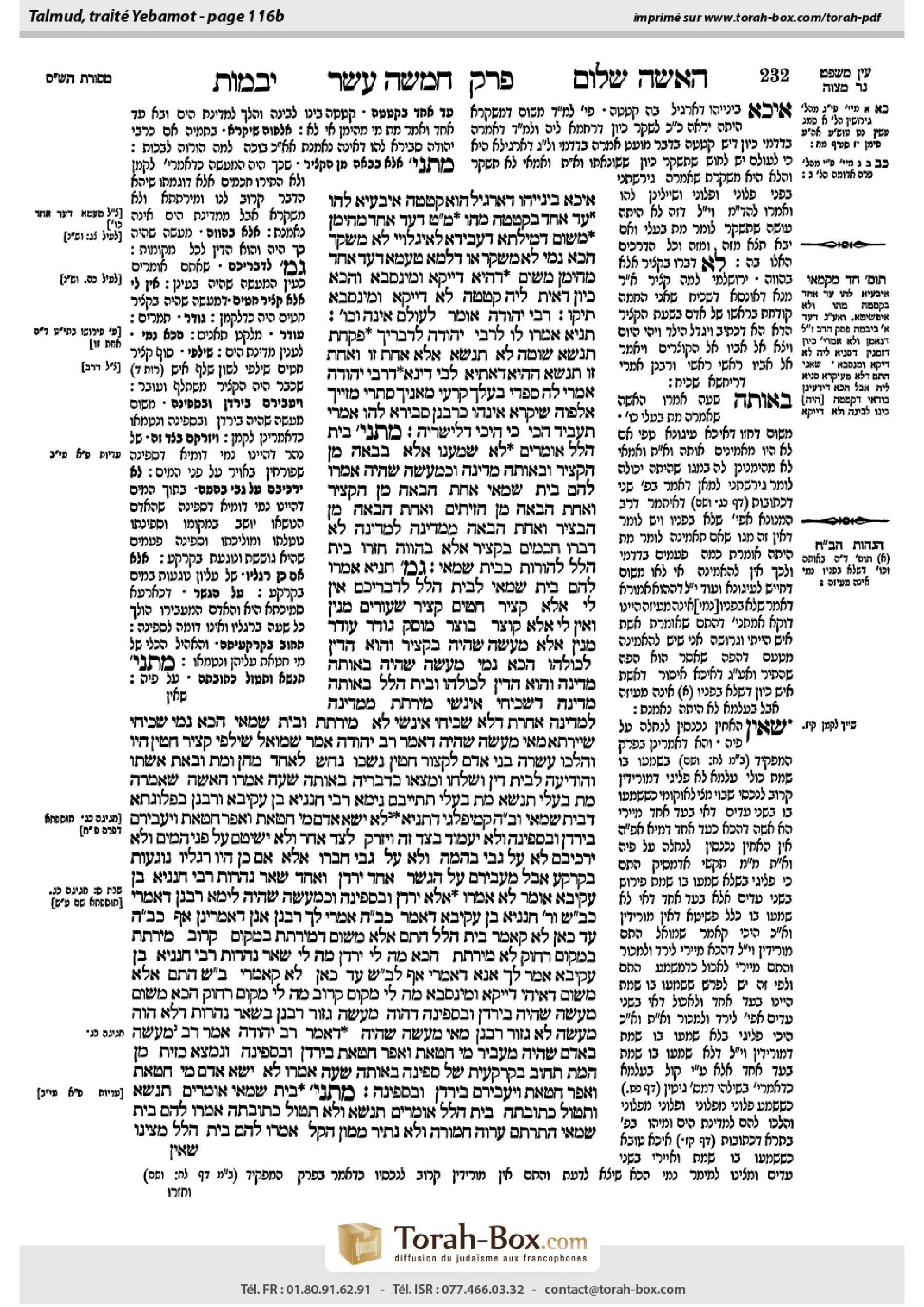
Yevamot 116b: Talmud study for Daf Yomi
Daf Yomi is the daily study of one Talmud folio. Explore 37 tractates with scans, Hebrew text, Sefaria English and AI-generated French translations where annotated.
Passage selection and English or AI-generated French translation are available where the scan has annotations. Daf Study is independent of Torah-Box and Sefaria.
Browse Yevamot · יבמות · All tractatesYevamot 116b text and translations
This page of Yevamot includes the Aramaic text, an English translation and an AI-generated French translation, alongside the scan above.
יבמות קי״ו ב · Aramaic and Hebrew text
אִיכָּא בֵּינַיְיהוּ דְּאַרְגֵּיל הוּא קְטָטָה.
אִיבַּעְיָא לְהוּ: עֵד אֶחָד בִּקְטָטָה, מַהוּ? מַאי טַעְמָא דְּעֵד אֶחָד מְהֵימַן: מִשּׁוּם דְּמִילְּתָא דַּעֲבִידָא לְאִיגַּלּוֹיֵי לָא מְשַׁקַּר — הָכָא נָמֵי לָא מְשַׁקַּר, אוֹ דִלְמָא: טַעְמָא דְּעֵד אֶחָד מְהֵימַן מִשּׁוּם דְּהִיא דָּיְיקָא וּמִינַּסְבָא, וְהָכָא, כֵּיוָן דְּאִית לֵיהּ קְטָטָה, לָא דָּיְיקָא וּמִינַּסְבָא? תֵּיקוּ.
רַבִּי יְהוּדָה אוֹמֵר לְעוֹלָם אֵינָהּ וְכוּ׳. תַּנְיָא, אָמְרוּ לוֹ לְרַבִּי יְהוּדָה: לִדְבָרֶיךָ, פִּקַּחַת — תִּנָּשֵׂא, שׁוֹטָה — לֹא תִּנָּשֵׂא?! אֶלָּא, אַחַת זוֹ וְאַחַת זוֹ תִּנָּשֵׂא.
הָהִיא דַּאֲתַאי לְבֵי דִינָא דְּרַבִּי יְהוּדָה, אָמְרִי לַהּ: סִפְדִי בַּעְלִךְ, קְרַעִי מָאנִיךְ, סִתְרִי מַזְיִיךְ. אַלְּפוּהָ שִׁיקְרָא? אִינְהוּ כְּרַבָּנַן סְבִירָא לְהוּ, אָמְרִי: תַּעֲבֵיד הָכִי כִּי הֵיכִי דְּלִישְׁרְיֻהָ.
מַתְנִי׳ בֵּית הִלֵּל אוֹמְרִים: לֹא שָׁמַעְנוּ אֶלָּא בְּבָאָה מִן הַקָּצִיר, וּבְאוֹתָהּ מְדִינָה, וּכְמַעֲשֶׂה שֶׁהָיָה.
אָמְרוּ לָהֶם בֵּית שַׁמַּאי: אַחַת הַבָּאָה מִן הַקָּצִיר, וְאַחַת הַבָּאָה מִן הַזֵּיתִים, וְאַחַת הַבָּאָה מִן הַבָּצִיר, וְאַחַת הַבָּאָה מִמְּדִינָה לִמְדִינָה. לֹא דִּבְּרוּ חֲכָמִים בַּקָּצִיר אֶלָּא בַּהוֹוֶה. חָזְרוּ בֵּית הִלֵּל לְהוֹרוֹת כְּבֵית שַׁמַּאי.
גְּמָ׳ תַּנְיָא, אָמְרוּ לָהֶם בֵּית שַׁמַּאי לְבֵית הִלֵּל: לְדִבְרֵיכֶם, אֵין לִי אֶלָּא קְצִיר חִטִּים — קְצִיר שְׂעוֹרִים, מִנַּיִן? וְאֵין לִי אֶלָּא קוֹצֵר — בּוֹצֵר, מוֹסֵק, גּוֹדֵר, עוֹדֵר, מִנַּיִן?
אֶלָּא מַעֲשֶׂה שֶׁהָיָה בַּקָּצִיר, וְהוּא הַדִּין לְכוּלְּהוּ. הָכָא נָמֵי: מַעֲשֶׂה שֶׁהָיָה בְּאוֹתָהּ מְדִינָה, וְהוּא הַדִּין לְכוּלְּהוּ.
וּבֵית הִלֵּל: בְּאוֹתָהּ מְדִינָה דִּשְׁכִיחִי אִינָשֵׁי — מִירְתַת, מִמְּדִינָה לִמְדִינָה אַחֶרֶת, דְּלָא שְׁכִיחִי אִינָשֵׁי — לָא מִירְתַת. וּבֵית שַׁמַּאי: הָכָא נָמֵי שְׁכִיחִי שַׁיָּירָתָא.
מַאי מַעֲשֶׂה שֶׁהָיָה? דְּאָמַר רַב יְהוּדָה אָמַר שְׁמוּאֵל: שִׁילְפֵי קָצִיר חִטִּין הָיוּ, וְהָלְכוּ עֲשָׂרָה בְּנֵי אָדָם לִקְצוֹר חִטִּין, נְשָׁכוֹ נָחָשׁ לְאֶחָד מֵהֶן וּמֵת, וּבָאת אִשְׁתּוֹ וְהוֹדִיעָה לְבֵית דִּין. וְשָׁלְחוּ וּמָצְאוּ כִּדְבָרֶיהָ. בְּאוֹתָהּ שָׁעָה אָמְרוּ: הָאִשָּׁה שֶׁאָמְרָה ״מֵת בַּעְלִי״ — תִּנָּשֵׂא, ״מֵת בַּעְלִי״ — תִּתְיַיבֵּם.
נֵימָא רַבִּי חֲנַנְיָא בֶּן עֲקִיבָא וְרַבָּנַן בִּפְלוּגְתָּא דְּבֵית שַׁמַּאי וּבֵית הִלֵּל קָמִיפַּלְגִי? דְּתַנְיָא: לֹא יִשָּׂא אָדָם מֵי חַטָּאת וְאֵפֶר חַטָּאת וְיַעֲבִירֵם בַּיַּרְדֵּן וּבִסְפִינָה,
וְלֹא יַעֲמוֹד בְּצַד זֶה וְיִזְרֹק לְצַד אַחֵר, וְלֹא יְשִׁיטֵם עַל פְּנֵי הַמַּיִם, וְלֹא יַרְכִּיבֵם לֹא עַל גַּבֵּי בְּהֵמָה וְלֹא עַל גַּבֵּי חֲבֵרוֹ, אֶלָּא אִם כֵּן הָיוּ רַגְלָיו נוֹגְעוֹת בַּקַּרְקַע. אֲבָל מַעֲבִירָם עַל הַגֶּשֶׁר, אֶחָד יַרְדֵּן וְאֶחָד שְׁאָר נְהָרוֹת. רַבִּי חֲנַנְיָא בֶּן עֲקִיבָא אוֹמֵר: לֹא אָמְרוּ אֶלָּא יַרְדֵּן, וּבִסְפִינָה, וּכְמַעֲשֶׂה שֶׁהָיָה.
לֵימָא רַבָּנַן דְּאָמְרִי כְּבֵית שַׁמַּאי. וְרַבִּי חֲנַנְיָא בֶּן עֲקִיבָא דְּאָמַר כְּבֵית הִלֵּל.
אָמְרִי לָךְ רַבָּנַן: אֲנַן דְּאָמְרִינַן אַף כְּבֵית הִלֵּל, עַד כָּאן לָא קָאָמַר בֵּית הִלֵּל הָתָם, אֶלָּא מִשּׁוּם דְּמִירַתְתָ[א]; בְּמָקוֹם קָרוֹב — מִירַתְתָ[א], בְּמָקוֹם רָחוֹק — לָא מִירַתְתָ[א]. הָכָא, מָה לִי יַרְדֵּן מָה לִי שְׁאָר נְהָרוֹת.
רַבִּי חֲנַנְיָא בֶּן עֲקִיבָא אָמַר לָךְ: אֲנָא דַּאֲמַרִי אַף לְבֵית שַׁמַּאי. עַד כָּאן לָא קָאָמְרִי בֵּית שַׁמַּאי הָתָם, אֶלָּא מִשּׁוּם דְּאִיהִי דָּיְיקָא וּמִינַּסְבָא, מָה לִי מָקוֹם קָרוֹב מָה לִי מָקוֹם רָחוֹק. הָכָא, מִשּׁוּם מַעֲשֶׂה שֶׁהָיָה. בַּיַּרְדֵּן וּבִסְפִינָה דַּהֲוָה מַעֲשֶׂה — גְּזוּר רַבָּנַן, בִּשְׁאָר נְהָרוֹת דְּלָא הֲוָה מַעֲשֶׂה — לָא גְּזוּר רַבָּנַן.
מַאי מַעֲשֶׂה שֶׁהָיָה? דְּאָמַר רַב יְהוּדָה אָמַר רַב: מַעֲשֶׂה בְּאָדָם שֶׁהָיָה מַעֲבִיר מֵי חַטָּאת וְאֵפֶר חַטָּאת בַּיַּרְדֵּן וּבִסְפִינָה, וְנִמְצָא כְּזַיִת מִן הַמֵּת תָּחוּב בְּקַרְקָעִית שֶׁל סְפִינָה. בְּאוֹתָהּ שָׁעָה אָמְרוּ: לֹא יִשָּׂא אָדָם מֵי חַטָּאת וְאֵפֶר חַטָּאת וְיַעֲבִירֵם בַּיַּרְדֵּן וּבִסְפִינָה.
מַתְנִי׳ בֵּית שַׁמַּאי אוֹמְרִים: תִּנָּשֵׂא, וְתִטּוֹל כְּתוּבָּתָהּ. בֵּית הִלֵּל אוֹמְרִים: תִּנָּשֵׂא, וְלֹא תִּטּוֹל כְּתוּבָּתָהּ. אָמְרוּ לָהֶם בֵּית שַׁמַּאי: הִתַּרְתֶּם עֶרְוָה חֲמוּרָה, וְלֹא נַתִּיר מָמוֹן הַקַּל?! אָמְרוּ לָהֶם בֵּית הִלֵּל: מָצִינוּ
Yevamot 116b · English translation
The practical difference between them is in a case where he initiated the quarrel. In this situation there is no concern that she might knowingly lie, as she loves him. However, due to the quarrel between them she might not be meticulous in her investigations.
§ A dilemma was raised before the Sages: If there was one witness who testified that the husband died, in a case that involved a quarrel between them, what is the halakha? The Gemara explains the different sides of this dilemma: What is the reason that one witness is deemed credible? Is it because it is a matter that is likely to be revealed, and one does not lie in a case of this kind? Here too, one witness would not lie. Or perhaps the reason that one witness is deemed credible is because she herself is exacting in her investigation before she marries again. And here, since there is a quarrel between them, she is not exacting in her investigation before she marries again, despite the testimony of the witness. The Gemara comments: The question shall stand unresolved.
§ The mishna taught that Rabbi Yehuda says that a wife is never deemed credible when she testifies that her husband died, unless she came crying and her clothing was torn, while the Rabbis say she may remarry in any case. It is taught in a baraita: The Rabbis said to Rabbi Yehuda: According to your statement, a crafty woman who knows how to deceive will come with torn clothes crying, and it will be permitted for her to marry. However, a foolish woman who does not know how to deceive will not be permitted to marry. Is this a fair outcome? Rather, both this woman and that woman may marry.
The Gemara relates: There was a certain woman who came to the court of Rabbi Yehuda. The people sitting there said to her: Lament your husband, tear your clothing, unbind your hair, so that you have the appearance of a mourner, and the court will believe you. The Gemara asks: Did they instruct her to lie? The Gemara answers: They thought, in accordance with the opinion of the Rabbis, that it is permitted for her to marry in any case. However, they were concerned that Rabbi Yehuda would rule that she may not remarry if she did not display her grief, in accordance with his opinion. Therefore, they said that she should do this, so that Rabbi Yehuda would also permit her to marry, and she would avoid any complications.
MISHNA: Beit Hillel say: We heard that one may accept the testimony of a woman concerning the death of her husband only when she comes from the grain harvest, and when she testified in the same country where he died, and in circumstances similar to the incident that occurred, in which a lenient ruling was issued, as will be explained.
Beit Shammai said to Beit Hillel: The same halakha applies to a wife who comes from the grain harvest, and one who comes from the olive harvest, and also one who comes from the grape harvest, and even one who comes from one country to another country. Although the incident in question took place during the grain harvest, the Sages spoke of the grain harvest only because it was the present occurrence, i.e., that is what happened in practice, but this is no proof that she is deemed credible only when she arrived specifically from the grain harvest. The mishna comments: Beit Hillel retracted their opinion, and decided to teach in accordance with the opinion of Beit Shammai on this issue.
GEMARA: It is taught in a baraita that Beit Shammai said to Beit Hillel: According to your statement that this halakha applies solely in circumstances similar to the incident that occurred, if so, I have derived only that it applies in the wheat harvest. From where do I derive that the same applies in the barley harvest? And I have derived only that it applies to one who reaps grain. From where do I derive that this halakha includes someone who harvests grapes, or harvests olives, or harvests dates, or harvests figs?
Rather, that incident which occurred during the grain harvest, and the same is true of all these other circumstances. Here too, concerning a woman who comes from another country, and other, similar cases, the incident that occurred took place in that country, but the same is true of all these other cases.
And Beit Hillel, how did they respond to this argument? In that same country, where people are commonly found moving from place to place, she is scared to lie, lest her account be contradicted. However, between one country and another country, where people are not commonly found moving back and forth, she is not scared, and therefore she might be lying when she says he died. And Beit Shammai reason: Here too caravans are found, and if he was alive the truth would eventually be revealed.
The Gemara asks: What was this incident that occurred? As Rav Yehuda said that Shmuel said: It was at the end [shilfei] of the wheat harvest, and ten people went to harvest wheat. A snake bit one of them and he died, and his wife came and told the court that her husband died. And they sent messengers, who discovered that it happened in accordance with her statement. At that time they said: The woman who says: My husband died, may marry on the basis of this testimony. Furthermore, if she says: My husband died without children, and he has a brother, she enters into levirate marriage. This is the case to which Beit Hillel referred.
§ The Gemara analyzes this dispute. Let us say that Rabbi Ḥananya ben Akiva and the Rabbis, who argued in this case, disagree with regard to the issue that is the subject of the dispute between Beit Shammai and Beit Hillel. As it is taught in a baraita: A person may not carry the waters of purification, i.e., the water containing the ashes of the red heifer for the ritual purification of one who became impure through contact with a corpse, and the ashes of purification, of the red heifer, and transport them on the Jordan River. And one may not transfer them across the river in a boat.
And one may not stand on one side of the river and throw the ashes to the other side, nor float them upon the water as he crosses, nor ride with them across the river, neither on the back of an animal nor on the back of another person, as this is similar to a boat that passes over the water, unless the legs of the rider were touching the ground. However, one may transport them across the water over a bridge. This prohibition applies to both the Jordan River and all other rivers. Rabbi Ḥananya ben Akiva says: They said this prohibition only with regard to the Jordan, and transporting in a boat, and in circumstances similar to the incident that occurred, when ritual impurity was found in a boat on the Jordan River.
Let us say that the Rabbis say in accordance with the opinion of Beit Shammai, that when a decree is enacted due to a specific case that occurred, this halakha applies to all similar circumstances. And Rabbi Ḥananya ben Akiva says in accordance with the opinion of Beit Hillel, that the decree applies only in the exact circumstances as the precedent case.
The Gemara rejects this suggestion. The Rabbis could say to you: We stated our ruling even in accordance with the opinion of Beit Hillel, as there is a difference between the two cases. Beit Hillel state their opinion, that she is not deemed credible when she comes from one country to another, only in that case there, because she is scared. In a nearby place she is scared to give false testimony, as her lie can easily be discovered, whereas in a distant place she is not scared. However, here, concerning the ashes of the red heifer, what difference does it make to me if it is the Jordan River, and what difference does it make to me if it is one of the many other rivers?
Meanwhile, Rabbi Ḥananya ben Akiva could have said to you: I stated my ruling even in accordance with the opinion of Beit Shammai, as Beit Shammai state their opinion only there, because she herself is exacting in her investigation before she marries again. Since this is the decisive consideration, what difference does it make to me if the place is near, and what difference does it make to me if the place is far? Here, however, the Sages issued their decree due to a specific incident that occurred. And therefore the Sages issued their decree with regard to the Jordan River and in a boat, the circumstances in which the incident occurred. Conversely, the Sages did not issue the decree with regard to other rivers, where the incident did not occur.
The Gemara explains: What is this incident that occurred, involving the ashes of the red heifer? As Rav Yehuda said that Rav said: An incident occurred involving a person who was transporting waters of purification and ashes of purification on the Jordan River, and in a boat, and an olive-bulk of a corpse was found stuck to the bottom of the boat, which rendered the waters and ashes ritually impure. At that time they said: A person may not carry waters of purification and ashes of purification and transport them on the Jordan River, and in a boat. Later Sages dispute whether this decree applies to similar cases, or only to the exact circumstances of this specific incident.
MISHNA: Beit Shammai say: A woman who testifies that her husband died may marry, and take the money guaranteed in her marriage contract. Beit Hillel say: She may marry, but she may not take her marriage contract, as qualified witnesses are required for monetary matters. Beit Shammai said to them: If you have permitted a woman potentially forbidden to him, which is a relatively stringent prohibition, based merely upon her own testimony, will we not permit a monetary matter, which is more lenient, as the money can be returned and this sin does not entail such a severe punishment? Beit Hillel said to them: This is no proof, as we find
Yevamot 116b · Traduction française (IA)
La différence pratique entre eux concerne le cas où c’est lui qui a provoqué la dispute. Dans cette situation, on ne craint pas qu’elle mente sciemment, puisqu’elle l’aime. Toutefois, en raison de leur dispute, il se peut qu’elle ne mène pas ses vérifications avec soin.
§ Une question fut posée aux Sages : s’il y a un témoin qui atteste que le mari est mort, dans un cas où il y avait une dispute entre eux, quelle est la halakha ? La Guemara expose les deux aspects de cette question : pour quelle raison un témoin est-il jugé digne de foi ? Est-ce parce qu’il s’agit d’un fait susceptible d’être découvert et que, dans un tel cas, on ne ment pas ? Ici aussi, le témoin ne mentirait pas. Ou peut-être un témoin est-il jugé digne de foi parce qu’elle-même mène ses vérifications avec soin avant de se remarier. Or, ici, puisqu’il y a une dispute entre eux, elle ne mène pas ses vérifications avec soin avant de se remarier, malgré le témoignage du témoin. La Guemara conclut : la question reste sans réponse.
§ La Michna enseigne que Rabbi Yehouda dit qu’une épouse n’est jamais jugée digne de foi lorsqu’elle témoigne que son mari est mort, à moins qu’elle ne soit venue en pleurant et avec ses vêtements déchirés, tandis que les Rabbins disent qu’elle peut se remarier dans tous les cas. Il est enseigné dans une baraïta : les Rabbins dirent à Rabbi Yehouda : selon tes propos, une femme rusée qui sait tromper viendra avec des vêtements déchirés en pleurant, et elle sera autorisée à se marier. En revanche, une femme naïve qui ne sait pas tromper ne sera pas autorisée à se marier. Est-ce là un résultat équitable ? Au contraire, cette femme comme celle-là peuvent se marier.
La Guemara rapporte : une certaine femme vint devant le tribunal de Rabbi Yehouda. Les personnes qui y siégeaient lui dirent : « Déplore la mort de ton mari, déchire tes vêtements, dénoue tes cheveux, afin d’avoir l’apparence d’une endeuillée, et le tribunal te croira. » La Guemara demande : lui ont-ils conseillé de mentir ? La Guemara répond : ils pensaient, conformément à l’avis des Rabbins, qu’elle était autorisée à se marier dans tous les cas. Toutefois, ils craignaient que Rabbi Yehouda statue qu’elle ne pouvait pas se remarier si elle ne manifestait pas son chagrin, conformément à son avis. Ils lui dirent donc d’agir ainsi, afin que Rabbi Yehouda aussi l’autorise à se marier et qu’elle évite toute difficulté.
MICHNA : Beit Hillel disent : nous avons entendu que le témoignage d’une femme concernant la mort de son mari n’est recevable que lorsqu’elle revient de la moisson du blé, qu’elle a témoigné dans le pays même où il est mort, et dans des circonstances semblables à celles de l’événement qui s’est produit et à la suite duquel une décision indulgente fut rendue, comme cela sera expliqué.
Beit Shammaï dirent à Beit Hillel : la même halakha s’applique à une épouse qui revient de la moisson du blé, à celle qui revient de la récolte des olives, ainsi qu’à celle qui revient des vendanges, et même à celle qui vient d’un pays dans un autre pays. Bien que l’événement en question ait eu lieu pendant la moisson du blé, les Sages ont parlé de la moisson du blé uniquement parce que c’est ce qui s’était produit, c’est-à-dire que telle était la situation concrète ; cela ne prouve pas qu’elle ne soit jugée digne de foi que si elle est revenue précisément de la moisson du blé. La Michna commente : Beit Hillel revinrent sur leur avis et décidèrent d’enseigner conformément à l’avis de Beit Shammaï sur ce point.
GUEMARA : Il est enseigné dans une baraïta que Beit Shammaï dirent à Beit Hillel : selon vos propos, cette halakha ne s’applique que dans des circonstances semblables à celles de l’événement qui s’est produit. Si tel est le cas, je n’ai déduit qu’elle s’applique à la moisson du blé. D’où déduis-je qu’il en va de même pour la moisson de l’orge ? Et je n’ai déduit qu’elle s’applique à celui qui moissonne des céréales. D’où déduis-je que cette halakha inclut aussi celui qui récolte le raisin, les olives, les dattes ou les figues ?
Au contraire, l’événement qui s’est produit pendant la moisson du blé s’applique aussi à toutes ces autres circonstances. De même, concernant une femme qui vient d’un autre pays et les cas analogues, l’événement qui s’est produit eut lieu dans ce pays, mais la même règle s’applique à tous ces autres cas.
Et comment Beit Hillel répondaient-ils à cet argument ? Dans ce même pays, où les gens se déplacent couramment d’un endroit à un autre, elle a peur de mentir, de crainte que son récit ne soit démenti. En revanche, d’un pays à un autre, où les gens ne font pas couramment des allers-retours, elle n’a pas peur, et elle pourrait donc mentir en disant qu’il est mort. Et Beit Shammaï raisonnent ainsi : ici aussi, des caravanes passent, et si le mari était vivant, la vérité finirait par être découverte.
La Guemara demande : quel fut cet événement ? Car Rav Yehouda dit au nom de Shmouel : cela se passa à la fin [shilfei] de la moisson du blé ; dix hommes partirent moissonner du blé. Un serpent mordit l’un d’eux et il mourut, puis sa femme vint annoncer au tribunal que son mari était mort. On envoya des messagers, qui découvrirent que les faits s’étaient déroulés comme elle l’avait dit. À cette époque, on déclara : une femme qui dit « Mon mari est mort » peut se remarier sur la foi de ce témoignage. De plus, si elle dit : « Mon mari est mort sans enfant », et qu’il a un frère, elle entre en lévirat. C’est à ce cas que Beit Hillel faisait référence.
§ La Guemara analyse cette controverse. Dirons-nous que Rabbi Ḥananya ben Akiva et les Rabbins, qui ont débattu de ce cas, sont en désaccord sur la question qui fait l’objet de la controverse entre Beit Shammaï et Beit Hillel ? Car il est enseigné dans une baraïta : on ne peut pas transporter les eaux de purification, c’est-à-dire l’eau contenant les cendres de la vache rousse, qui sert à purifier rituellement celui qui est devenu impur au contact d’un cadavre, ni les cendres de purification de la vache rousse, en les faisant passer sur le Jourdain. On ne peut pas non plus les faire traverser le fleuve dans une barque.
On ne peut pas non plus se tenir sur une rive et jeter les cendres sur l’autre rive, ni les faire flotter sur l’eau en traversant, ni traverser le fleuve avec elles en chevauchant, que ce soit sur le dos d’un animal ou sur le dos d’une autre personne, car cela ressemble à une barque qui passe sur l’eau, à moins que les pieds du cavalier ne touchent le sol. Toutefois, on peut les transporter à travers l’eau en passant sur un pont. Cette interdiction s’applique au Jourdain comme à tous les autres fleuves. Rabbi Ḥananya ben Akiva dit : cette interdiction ne fut édictée que pour le Jourdain, le transport en barque et des circonstances semblables à celles de l’événement qui s’est produit, lorsqu’une impureté rituelle fut découverte dans une barque sur le Jourdain.
Dirons-nous que les Rabbins sont d’accord avec l’avis de Beit Shammaï, selon lequel, lorsqu’un décret est édicté à la suite d’un cas particulier, cette halakha s’applique à toutes les situations analogues ? Et que Rabbi Ḥananya ben Akiva est d’accord avec l’avis de Beit Hillel, selon lequel le décret ne s’applique qu’aux circonstances exactes du cas qui sert de précédent ?
La Guemara rejette cette proposition. Les Rabbins pourraient te dire : nous avons énoncé notre décision même conformément à l’avis de Beit Hillel, car les deux cas diffèrent. Beit Hillel expriment leur avis — selon lequel elle n’est pas jugée digne de foi lorsqu’elle vient d’un pays dans un autre — uniquement dans ce cas-là, parce qu’elle a peur. Dans un lieu proche, elle craint de fournir un faux témoignage, car son mensonge peut facilement être découvert, tandis que dans un lieu éloigné, elle n’a pas peur. Mais ici, concernant les cendres de la vache rousse, quelle différence cela fait-il pour moi que ce soit le Jourdain ou l’un des nombreux autres fleuves ?
De son côté, Rabbi Ḥananya ben Akiva aurait pu te dire : j’ai énoncé ma décision même conformément à l’avis de Beit Shammaï, car Beit Shammaï n’expriment leur avis que dans ce cas-là, parce qu’elle-même mène ses vérifications avec soin avant de se remarier. Puisque c’est le facteur déterminant, quelle différence cela fait-il pour moi que le lieu soit proche ou éloigné ? Ici, en revanche, les Sages ont édicté leur décret à la suite d’un événement particulier. Les Sages l’ont donc édicté concernant le Jourdain et une barque, les circonstances dans lesquelles l’événement s’est produit. À l’inverse, les Sages n’ont pas édicté ce décret pour les autres fleuves, où cet événement ne s’est pas produit.
La Guemara explique : quel fut cet événement concernant les cendres de la vache rousse ? Car Rav Yehouda dit au nom de Rav : un événement se produisit : un homme transportait des eaux de purification et des cendres de purification sur le Jourdain, dans une barque, et une quantité d’olive de cadavre fut trouvée collée au fond de la barque, ce qui rendit rituellement impures les eaux et les cendres. À cette époque, on déclara : on ne peut pas transporter des eaux de purification ni des cendres de purification sur le Jourdain, dans une barque. Les Sages des générations suivantes discutent pour savoir si ce décret s’applique aux cas analogues ou uniquement aux circonstances exactes de cet événement particulier.
MICHNA : Beit Shammaï disent : une femme qui témoigne que son mari est mort peut se marier et recevoir l’argent garanti par son contrat de mariage. Beit Hillel disent : elle peut se marier, mais elle ne peut pas recevoir la somme prévue par son contrat de mariage, car les affaires monétaires exigent des témoins qualifiés. Beit Shammaï leur dirent : si vous avez autorisé une femme potentiellement interdite à son mari, ce qui constitue une interdiction relativement stricte, sur la seule base de son propre témoignage, ne permettrons-nous pas une affaire monétaire, qui est moins grave, puisque l’argent peut être restitué et que cette faute n’entraîne pas une sanction aussi sévère ? Beit Hillel leur dirent : cela ne prouve rien, car nous constatons
Traduction française générée par IA à partir de l’édition anglaise de Sefaria. Vérifie toujours un passage avec le texte source.
Text from Sefaria: William Davidson Edition - Vocalized Aramaic (CC BY NC); William Davidson Edition - English (CC BY NC).