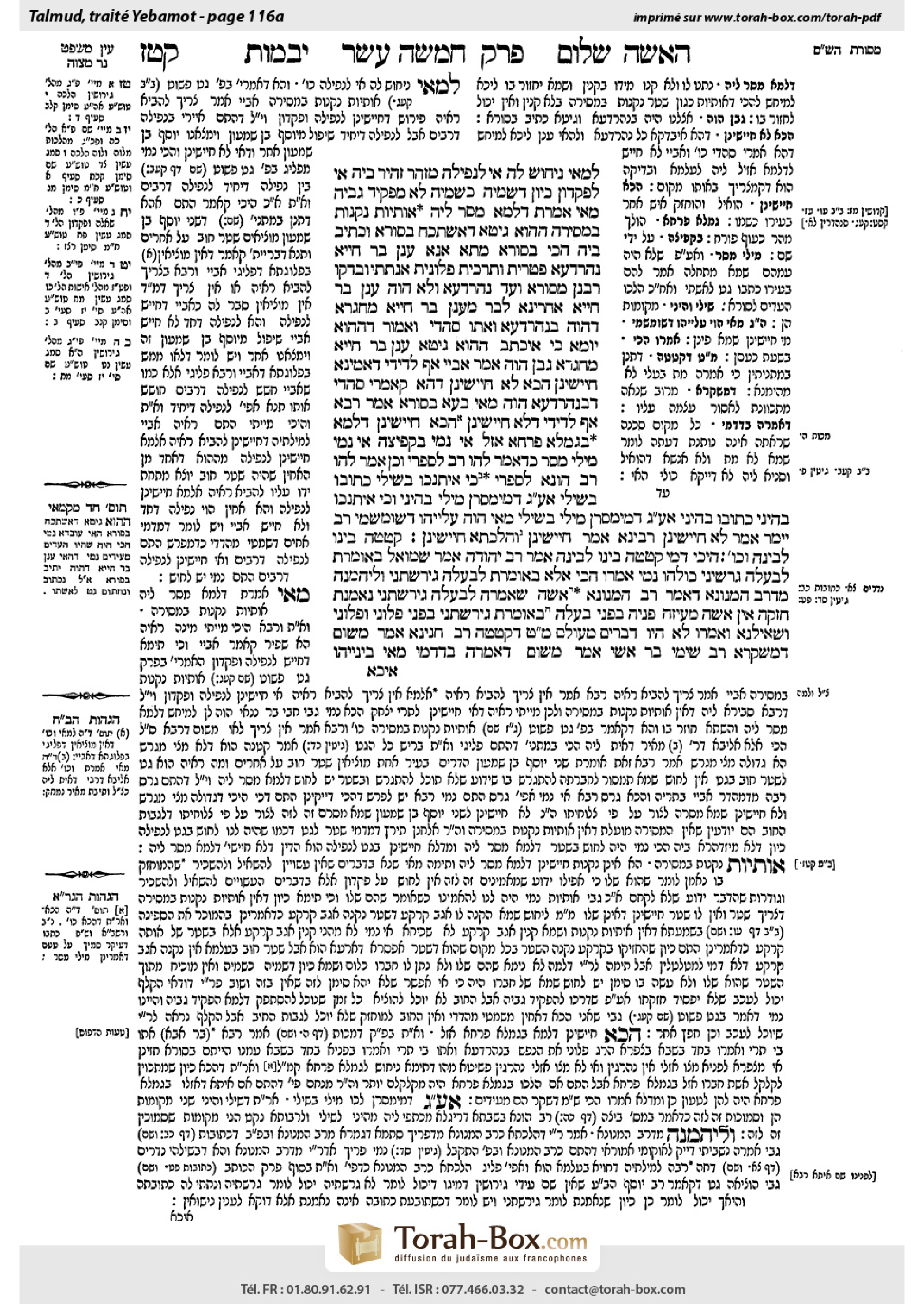
Yevamot 116a: Talmud study for Daf Yomi
Daf Yomi is the daily study of one Talmud folio. Explore 37 tractates with scans, Hebrew text, Sefaria English and AI-generated French translations where annotated.
Passage selection and English or AI-generated French translation are available where the scan has annotations. Daf Study is independent of Torah-Box and Sefaria.
Browse Yevamot · יבמות · All tractatesYevamot 116a text and translations
This page of Yevamot includes the Aramaic text, an English translation and an AI-generated French translation, alongside the scan above.
יבמות קי״ו א · Aramaic and Hebrew text
לְמַאי נֵיחוּשׁ לַהּ? אִי לִנְפִילָה — מִזְהָר זְהִיר בֵּיהּ. אִי לְפִקָּדוֹן — כֵּיוָן דִּשְׁמֵיהּ כִּשְׁמֵיהּ לָא מַפְקֵיד גַּבֵּיהּ.
מַאי אָמְרַתְּ, דִּלְמָא מְסַר לֵיהּ? אוֹתִיּוֹת נִקְנוֹת בִּמְסִירָה.
הָהוּא גִּיטָּא דְּאִשְׁתְּכַח בְּסוּרָא וּכְתִיב בֵּיהּ הָכִי: בְּסוּרָא מָתָא אֲנָא עָנָן בַּר חִיָּיא נְהַרְדָּעָא פְּטַרִית וְתָרֵכִית פְּלוֹנִית אִנְתְּתִי. וּבְדַקוּ רַבָּנַן מִסּוּרָא וְעַד נְהַרְדְּעָא, וְלָא הֲוָה עָנָן בַּר חִיָּיא אַחֲרִינָא לְבַר מֵעָנָן בַּר חִיָּיא מְחַגְּרָא דַּהֲוָה בִּנְהַרְדְּעָא. וַאֲתוֹ סָהֲדִי וֶאֱמוֹר דְּהָהוּא יוֹמָא כִּי אִיכְּתַב הָהוּא גִּיטָּא, עָנָן בַּר חִיָּיא מְחַגְּרָא גַּבַּן הֲוָה.
אָמַר אַבָּיֵי: אַף לְדִידִי דְּאָמֵינָא חָיְישִׁינַן — הָכָא לָא חָיְישִׁינַן, דְּהָא קָאָמְרִי סָהֲדִי דְּבִנְהַרְדְּעָא הֲוָה, מַאי בְּעָא בְּסוּרָא.
אָמַר רָבָא: אַף לְדִידִי דְּלָא חָיְישִׁינַן — הָכָא חָיְישִׁינַן, דִּלְמָא בְּגַמְלָא פָּרְחָא אֲזַל. אִי נָמֵי בִּקְפִיצָה. אִי נָמֵי מִילֵּי מְסַר.
כְּדַאֲמַר לְהוּ רַב לְסָפְרֵי, וְכֵן אֲמַר לְהוּ רַב הוּנָא לְסָפְרֵי: כִּי אִיתַנְכוּ בְּשִׁילֵי כְּתוּבוּ בְּשִׁילֵי, אַף עַל גַּב דְּמִימַּסְרָן מִילֵּי בְּהִינֵי. וְכִי אִיתַנְכוּ בְּהִינֵי כְּתוּבוּ בְּהִינֵי, אַף עַל גַּב דְּמִימַּסְרָן מִילֵּי בְּשִׁילֵי.
מַאי הֲוָה עֲלַיְיהוּ דְּשׁוּמְשְׁמֵי? רַב יֵימַר אָמַר: לָא חָיְישִׁינַן. רָבִינָא אָמַר: חָיְישִׁינַן. וְהִלְכְתָא: חָיְישִׁינַן.
קְטָטָה בֵּינוֹ לְבֵינָהּ וְכוּ׳. הֵיכִי דָּמֵי קְטָטָה בֵּינוֹ לְבֵינָהּ, אָמַר רַב יְהוּדָה אָמַר שְׁמוּאֵל: בְּאוֹמֶרֶת לְבַעְלָהּ ״גָּרְשֵׁינִי״. כּוּלְּהוּ נָמֵי אָמְרוּ הָכִי! אֶלָּא בְּאוֹמֶרֶת לְבַעְלָהּ ״גֵּירַשְׁתַּנִי״.
וְלִיהֵמְנַהּ מִדְּרַב הַמְנוּנָא. דְּאָמַר רַב הַמְנוּנָא: אִשָּׁה שֶׁאָמְרָה לְבַעְלָהּ ״גֵּירַשְׁתַּנִי״ — נֶאֱמֶנֶת. חֲזָקָה אֵין אִשָּׁה מְעִיזָּה פָּנֶיהָ בִּפְנֵי בַּעְלָהּ!
בְּאוֹמֶרֶת ״גֵּירַשְׁתַּנִי בִּפְנֵי פְּלוֹנִי וּפְלוֹנִי״, וְשַׁאֵילְנָא וְאָמְרוּ: ״לֹא הָיוּ דְבָרִים מֵעוֹלָם״.
מַאי טַעְמָא דִּקְטָטָה? רַב חֲנִינָא אָמַר: מִשּׁוּם דִּמְשַׁקְּרָא. רַב שִׁימִי בַּר אָשֵׁי אָמַר: מִשּׁוּם דְּאָמְרָה בִּדְדָמֵי. מַאי בֵּינַיְיהוּ?
Yevamot 116a · English translation
With regard to what should we be concerned in the case of the promissory note? If we are concerned about the possibility of falling, i.e., that the promissory note might have dropped from this person’s hand and the other one found it, the former is certainly careful with it so as not to lose it, as he knows there is someone else in the city with the same name. If we are concerned about the possibility that it was given as a deposit for safekeeping, i.e., that the actual owner might have given it to the one in possession of it, since his name is the same as the name of the bailee, the owner would not deposit his contract with him without some insurance.
If you say that perhaps the actual owner passed, i.e., transferred the promissory note to this person whose name is the same as his own, i.e., he gave or sold it to him so he may collect it for himself, in that case the one in possession is entitled to collect the money, as letters of credit are acquired through passing. There is no need for an additional act of acquisition here, which means that the promissory note belongs to the one in possession of it, despite the fact that it was not originally written for him. Consequently, no proof can be brought from this case with regard to whether or not one should be concerned about two people with identical names.
The Gemara relates: There was a certain bill of divorce that was found in the city of Sura and the following was written in it: In the city of Sura, I, Anan bar Ḥiyya of Neharde’a, excused and sent away and divorced my wife, so-and-so. And the Sages examined the area from Sura to Neharde’a, throughout almost all of Babylonia, and there was no other Anan bar Ḥiyya than the one they knew, apart from an Anan bar Ḥiyya of Ḥagra who was in Neharde’a. And yet witnesses came and said that on that day, when that bill of divorce was written: Anan bar Ḥiyya of Ḥagra was with us in Neharde’a, not in Sura.
Abaye said: Even according to my opinion, by which I say that generally we are concerned about the possibility of someone else with the same name, here we are not concerned. The reason is that the witnesses say the other Anan bar Ḥiyya was in Neharde’a; what, then, is he doing in Sura? Consequently, there is no concern that the bill of divorce was written by the Anan bar Ḥiyya of Ḥagra.
Rava said: Even according to my opinion, in which I say that we are not concerned in general, here, when it is established that there definitely is another man by the same name, we are concerned. As for the apparently contradictory testimony, perhaps he went by a flying camel, an extremely fast means of transportation, and was able to travel from Neharde’a to Sura in one day. Alternatively, he might have arrived by a miraculous shortcut. Alternatively, he might have given verbal instructions beforehand for them to write the bill of divorce in a place where he was not physically located.
This last answer is as Rav said to the court scribes, and likewise Rav Huna said to the scribes: When you are in a place called Shili, write that the contract was written in Shili, even when the instructions are given to you in a different place called Hini. And likewise, when you are in Hini, write that it was written in Hini, even when the instructions are given to you in Shili.
The Gemara returns to the original question: What was the conclusion that was reached about this case involving sesame plants? Do they belong to the one who deposited them, or is the claim of the bailee accepted, that he returned them and placed other sesame plants in the same barrel? Rav Yeimar said: We are not concerned that they are different plants, and Ravina said: We are concerned. The Gemara concludes: And the halakha is that we are concerned about the possibility that the bailee replaced them with others, and we do not rely on the distinguishing marks provided by the claimant in this case.
§ The mishna taught: If there was a quarrel between him and her, her testimony that her husband died is not accepted. The Gemara asks: What are the circumstances of a quarrel between him and her? Rav Yehuda said that Shmuel said: This is a case where people heard her say to her husband: Divorce me. The Gemara asks: Is this proof? All women likewise say this when they are angry; this does not prove that there was an unresolved quarrel left between them. Rather, a quarrel is when she says to her husband: You divorced me, i.e., she claims that she was actually divorced.
The Gemara asks: If she said to her husband that he divorced her, let us believe her claim, in accordance with the statement of Rav Hamnuna. As Rav Hamnuna said: A woman who said to her husband: You divorced me, is deemed credible. Why? There is a presumption that a woman would not dare to lie in the presence of her husband about a matter which he knows to be untrue. If so, why isn’t her claim that she was divorced accepted? This would mean that there is no need for any testimony concerning his death, as the ties between them have already been severed.
The Gemara answers: In fact, a couple is considered to be quarreling when she says: You divorced me in the presence of two witnesses, so-and-so and so-and-so; and the court asked those men and they said: This matter never happened. In this case it is obvious that there was a terrible quarrel between them, but her claim that she was divorced is not accepted. Consequently, her later claim that her husband is dead is not accepted.
§ The Gemara analyzes the ruling of the mishna itself. What is the reason that in the case of a quarrel between them the court does not accept her testimony? Rav Ḥanina said: Because she lies, i.e., due to their quarrel she is likely to testify falsely that her husband died. Rav Shimi bar Ashi said: Because she says what she imagines to be the case. When there is peace between them, she examines the matter thoroughly to discover whether he actually died, but if there is a quarrel between them she is not so exacting, as she is pleased to be rid of him. The Gemara asks: What is the difference between these two explanations?
Yevamot 116a · Traduction française (IA)
De quoi faut-il se préoccuper dans le cas du billet de dette ? Si l’on craint qu’il soit tombé — c’est-à-dire que le billet ait pu tomber des mains de cette personne et que l’autre l’ait trouvé —, le premier en prend certainement soin afin de ne pas le perdre, sachant qu’il y a dans la ville une autre personne portant le même nom. Si l’on craint qu’il ait été remis en dépôt, c’est-à-dire que son véritable propriétaire l’ait confié à celui qui le détient, puisque celui-ci porte le même nom que le dépositaire, le propriétaire ne lui aurait pas confié son contrat sans prendre de garantie.
Si tu dis que le véritable propriétaire a peut-être transmis le billet de dette à cette personne qui porte le même nom que lui — c’est-à-dire qu’il le lui a donné ou vendu afin qu’elle le recouvre pour elle-même —, alors celui qui le détient a le droit de recouvrer la somme, car les créances s’acquièrent par transmission. Aucun acte d’acquisition supplémentaire n’est nécessaire en l’occurrence : le billet de dette appartient donc à celui qui le détient, bien qu’il n’ait pas été rédigé à l’origine à son nom. Par conséquent, ce cas ne permet pas de déterminer s’il faut ou non craindre que deux personnes portent le même nom.
La Guemara rapporte : Un acte de divorce fut trouvé dans la ville de Soura, où il était écrit : « Dans la ville de Soura, moi, Anan bar Ḥiyya de Neharde’a, j’ai libéré, renvoyé et divorcé mon épouse, telle et telle. » Les Sages examinèrent la région de Soura à Neharde’a, dans presque toute la Babylonie, et ne trouvèrent aucun autre Anan bar Ḥiyya que celui qu’ils connaissaient, à l’exception d’un Anan bar Ḥiyya de Ḥagra, qui se trouvait à Neharde’a. Pourtant, des témoins vinrent attester que ce jour-là, au moment où cet acte de divorce avait été rédigé, Anan bar Ḥiyya de Ḥagra était avec eux à Neharde’a, et non à Soura.
Abayé dit : Même selon mon opinion, qui est que, généralement, nous craignons qu’une autre personne porte le même nom, dans ce cas-ci, nous ne le craignons pas. En effet, les témoins disent que l’autre Anan bar Ḥiyya se trouvait à Neharde’a ; que ferait-il donc à Soura ? Par conséquent, il n’y a pas lieu de craindre que l’acte de divorce ait été rédigé par Anan bar Ḥiyya de Ḥagra.
Rava dit : Même selon mon opinion, qui est que nous ne le craignons généralement pas, dans ce cas, puisqu’il est établi qu’il existe bel et bien un autre homme portant le même nom, nous le craignons. Quant au témoignage apparemment contradictoire, peut-être est-il venu sur un chameau volant, moyen de transport extrêmement rapide, et a-t-il pu parcourir en un jour la distance entre Neharde’a et Soura. Autre possibilité : il est peut-être arrivé par un raccourci miraculeux. Autre possibilité encore : il a peut-être donné au préalable des instructions verbales pour que l’acte de divorce soit rédigé dans un lieu où il ne se trouvait pas physiquement.
Cette dernière réponse correspond à ce que Rav disait aux scribes du tribunal, et Rav Houna disait de même aux scribes : Lorsque vous êtes dans un lieu appelé Shili, écrivez que le contrat a été rédigé à Shili, même si les instructions vous sont données dans un autre lieu appelé Hini. De même, lorsque vous êtes à Hini, écrivez qu’il a été rédigé à Hini, même si les instructions vous sont données à Shili.
La Guemara revient à la question initiale : quelle conclusion a-t-on tirée au sujet de cette affaire concernant les plants de sésame ? Appartiennent-ils à celui qui les avait déposés, ou accepte-t-on l’affirmation du dépositaire, selon laquelle il les a rendus et a placé d’autres plants de sésame dans le même tonneau ? Rav Yeimar dit : Nous ne craignons pas qu’il s’agisse de plants différents ; Ravina dit : Nous le craignons. La Guemara conclut : la halakha est que nous craignons que le dépositaire les ait remplacés par d’autres, et nous ne nous fions pas, en l’occurrence, aux signes distinctifs fournis par le demandeur.
§ La Michna enseignait : S’il y avait une dispute entre lui et elle, son témoignage selon lequel son mari est mort n’est pas accepté. La Guemara demande : En quoi consiste une dispute entre eux ? Rav Yehouda dit au nom de Shmuel : Il s’agit d’un cas où des gens l’ont entendue dire à son mari : « Divorce-moi. » La Guemara demande : Est-ce une preuve ? Toutes les femmes disent également cela lorsqu’elles sont en colère ; cela ne prouve pas qu’une dispute non résolue persistait entre eux. Une dispute désigne plutôt le cas où elle dit à son mari : « Tu m’as divorcée », c’est-à-dire qu’elle affirme avoir effectivement été divorcée.
La Guemara demande : Si elle a dit à son mari qu’il l’avait divorcée, pourquoi ne pas ajouter foi à sa déclaration, conformément à l’enseignement de Rav Hamnouna ? Car Rav Hamnouna a dit : Une femme qui dit à son mari : « Tu m’as divorcée » est jugée digne de foi. Pourquoi ? Il existe une présomption selon laquelle une femme n’oserait pas mentir en présence de son mari au sujet d’une chose qu’il sait être fausse. Dès lors, pourquoi n’accepte-t-on pas sa déclaration selon laquelle elle a été divorcée ? Cela signifierait qu’aucun témoignage concernant la mort de son mari ne serait nécessaire, puisque les liens entre eux ont déjà été rompus.
La Guemara répond : En réalité, on considère qu’un couple est en dispute lorsqu’elle dit : « Tu m’as divorcée en présence de deux témoins, untel et untel » ; le tribunal interroge ces hommes, qui répondent : « Cela ne s’est jamais produit. » Dans ce cas, il est évident qu’une terrible dispute les opposait, mais sa déclaration selon laquelle elle a été divorcée n’est pas acceptée. Par conséquent, sa déclaration ultérieure selon laquelle son mari est mort n’est pas non plus acceptée.
§ La Guemara examine la décision même de la Michna. Pourquoi le tribunal n’accepte-t-il pas son témoignage lorsqu’ils sont en dispute ? Rav Ḥanina dit : Parce qu’elle ment, c’est-à-dire qu’en raison de leur dispute, elle est susceptible de témoigner faussement que son mari est mort. Rav Shimi bar Ashi dit : Parce qu’elle dit ce qu’elle s’imagine être vrai. Lorsque la paix règne entre eux, elle vérifie soigneusement s’il est réellement mort ; mais s’ils sont en dispute, elle ne se montre pas aussi scrupuleuse, car elle se réjouit d’être débarrassée de lui. La Guemara demande : Quelle est la différence entre ces deux explications ?
Traduction française générée par IA à partir de l’édition anglaise de Sefaria. Vérifie toujours un passage avec le texte source.
Text from Sefaria: William Davidson Edition - Vocalized Aramaic (CC BY NC); William Davidson Edition - English (CC BY NC).