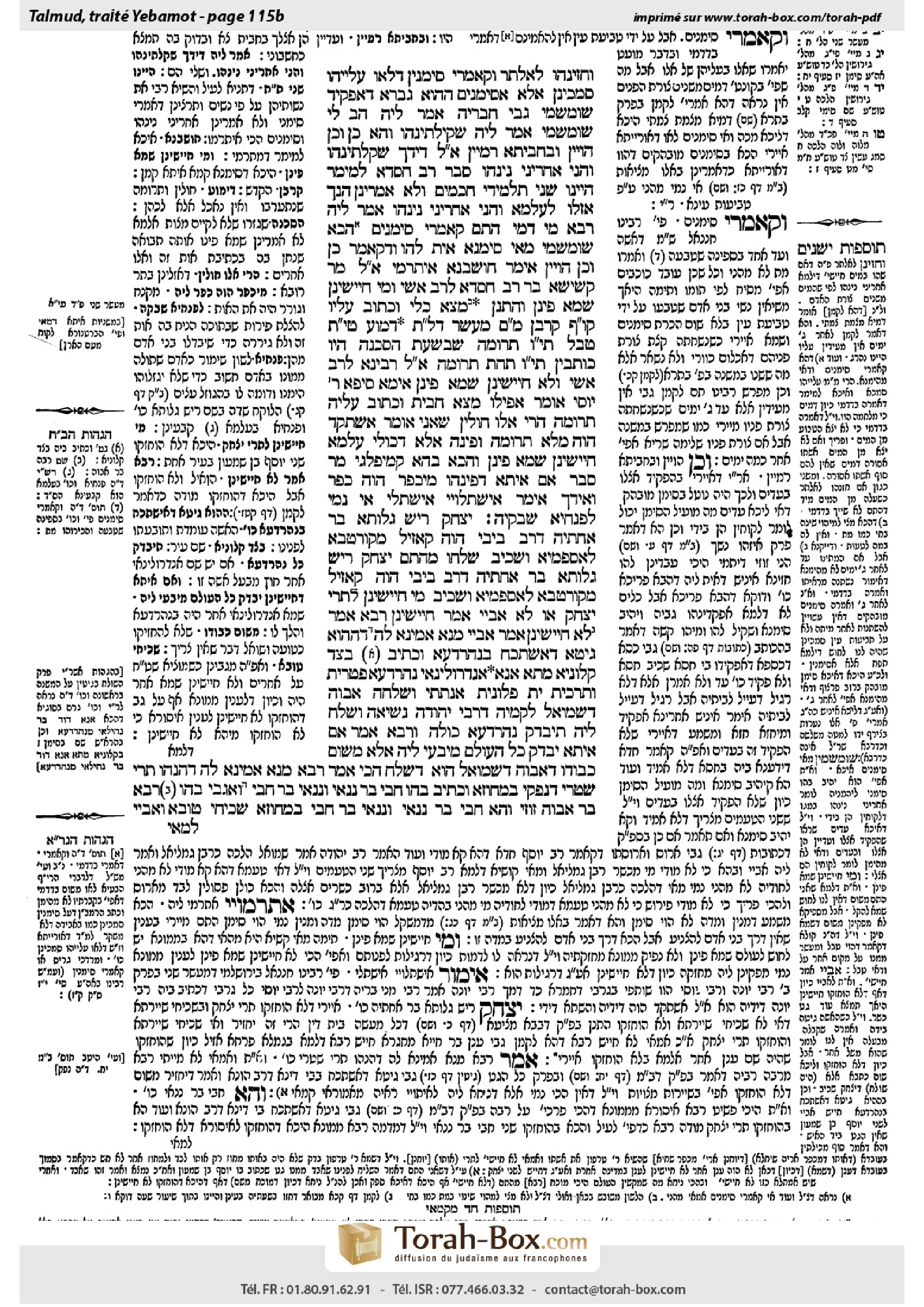
Yevamot 115b: Talmud study for Daf Yomi
Daf Yomi is the daily study of one Talmud folio. Explore 37 tractates with scans, Hebrew text, Sefaria English and AI-generated French translations where annotated.
Passage selection and English or AI-generated French translation are available where the scan has annotations. Daf Study is independent of Torah-Box and Sefaria.
Browse Yevamot · יבמות · All tractatesYevamot 115b text and translations
This page of Yevamot includes the Aramaic text, an English translation and an AI-generated French translation, alongside the scan above.
יבמות קי״ה ב · Aramaic and Hebrew text
וַחֲזֵינְהוּ לְאַלְתַּר, וְקָאָמְרִי סִימָנִין. דְּלָאו עֲלַיְיהוּ סָמְכִינַן, אֶלָּא אַסִּימָנִים.
הָהוּא גַּבְרָא דְּאַפְקֵיד שׁוּמְשְׁמֵי גַּבֵּי חַבְרֵיהּ, אֲמַר לֵיהּ: הַב לִי שׁוּמְשְׁמַי. אֲמַר לֵיהּ: שְׁקַילְתִּינְהוּ: וְהָא כֵּן וְכֵן הָוַיִין, וּבְחָבִיתָא רַמְיִין. אֲמַר לֵיהּ: דִּידָךְ שְׁקַלְתִּינְהוּ, וְהָנֵי — אַחֲרִינֵי נִינְהוּ.
סְבַר רַב חִסְדָּא לְמֵימַר: הַיְינוּ שְׁנֵי תַּלְמִידֵי חֲכָמִים, וְלָא אָמְרִינַן: הָנָךְ אֲזַלוּ לְעָלְמָא, וְהָנֵי אַחֲרִינֵי נִינְהוּ.
אֲמַר לֵיהּ רָבָא: מִי דָּמֵי? הָתָם, קָאָמְרִי סִימָנִים. הָכָא, שׁוּמְשְׁמֵי מַאי סִימָנָא אִית לְהוּ? וּדְקָאָמַר ״כֵּן וְכֵן הָוַיִין״ — אֵימַר חוּשְׁבָּנָא אִיתְרְמִי.
אֲמַר לֵיהּ מָר קַשִּׁישָׁא בַּר רַב חִסְדָּא לְרַב אָשֵׁי: וּמִי חָיְישִׁינַן שֶׁמָּא פִּינָּן? וְהָתְנַן: מָצָא כְלִי וְכָתוּב עָלָיו קוֹף — קׇרְבָּן, מֵם — מַעֲשֵׂר, דָּלֶת — דִּמּוּעַ, טֵית — טֶבֶל, תָּיו — תְּרוּמָה. שֶׁבִּשְׁעַת הַסַּכָּנָה הָיוּ כּוֹתְבִין תָּיו תַּחַת תְּרוּמָה!
אֲמַר לֵיהּ רָבִינָא לְרַב אָשֵׁי: וְלָא חָיְישִׁינַן שֶׁמָּא פִּינָּן? אֵימָא סֵיפָא, רַבִּי יוֹסֵי אוֹמֵר: אֲפִילּוּ מָצָא חָבִית וְכָתוּב עָלֶיהָ תְּרוּמָה — הֲרֵי אֵלּוּ חוּלִּין, שֶׁאֲנִי אוֹמֵר: אֶשְׁתָּקַד הֲוָה מָלֵא תְּרוּמָה, וּפִינָּהּ!
אֶלָּא: דְּכוּלֵּי עָלְמָא חָיְישִׁינַן שֶׁמָּא פִּינָּן, וְהָכָא בְּהָא קָמִיפַּלְגִי. מָר סָבַר: אִם אִיתָא דְּפִינָּהוּ — מִיכְפָּר הֲוָה כָּפַר. וְאִידַּךְ: אֵימַר אִישְׁתְּלוֹיֵי אִישְׁתְּלִי. אִי נָמֵי, לְפַנְחַיָּא שַׁבְקֵיהּ.
יִצְחָק רֵישׁ גָּלוּתָא, בַּר אֲחָתֵיהּ דְּרַב בִּיבִי, הֲוָה קָאָזֵיל מִקּוּרְטָבָא לְאַסְפַּמְיָא, וּשְׁכֵיב. שְׁלַחוּ מֵהָתָם: יִצְחָק רֵישׁ גָּלוּתָא, בַּר אֲחָתֵיהּ דְּרַב בִּיבִי, הֲוָה קָאָזֵיל מִקּוּרְטָבָא לְאַסְפַּמְיָא, וּשְׁכֵיב. מִי חָיְישִׁינַן לִתְרֵי יִצְחָק, אוֹ לָא? אַבָּיֵי אָמַר: חָיְישִׁינַן. רָבָא אָמַר: לָא חָיְישִׁינַן.
אָמַר אַבָּיֵי: מְנָא אָמֵינָא לַהּ, דְּהָהוּא גִּיטָּא דְּאִשְׁתְּכַח בִּנְהַרְדְּעָא וּכְתִיב: בְּצַד קְלוֹנְיָא מָתָא אֲנָא אַנְדְּרוֹלִינַאי נְהַרְדָּעָא פְּטַרִית וְתָרֵכִית יָת פְּלוֹנִית אִנְתְּתִי. וְשַׁלְחַהּ אֲבוּהּ דִּשְׁמוּאֵל לְקַמֵּיהּ דְּרַבִּי יְהוּדָה נְשִׂיאָה. וּשְׁלַח לֵיהּ: תִּיבָּדֵק נְהַרְדְּעָא כּוּלָּהּ.
וְרָבָא אָמַר: אִם אִיתָא — ״יִבָּדֵק כׇּל הָעוֹלָם״ מִיבְּעֵי לֵיהּ?! אֶלָּא מִשּׁוּם כְּבוֹדוֹ דַּאֲבוּהּ דִּשְׁמוּאֵל הוּא דִּשְׁלַח הָכִי.
אָמַר רָבָא: מְנָא אָמֵינָא לַהּ — דְּהָנְהוּ תְּרֵי שְׁטָרֵי דְּנָפְקִי בְּמָחוֹזָא וּכְתִיב בְּהוּ: חָבֵי בַּר נַנַּאי וְנַנַּאי בַּר חָבֵי, וְאַגְבִּי בְּהוּ רָבָא בַּר אֲבוּהּ זוּזֵי. וְהָא חָבֵי בַּר נַנַּאי וְנַנַּאי בַּר חָבֵי בְּמָחוֹזָא שְׁכִיחִי טוּבָא. וְאַבָּיֵי?
Yevamot 115b · English translation
and we saw them immediately when they came out of the water, and the women stated distinguishing marks that identified these people. As, in this case we do not rely upon the women, but upon the distinguishing marks.
§ The Gemara relates: There was a certain man who deposited sesame plants with his friend. Sometime later he said to him: Give me the sesame plants. The friend said to him: You already took them. The owner replied: But they were of such-and-such an amount, and placed in a barrel; go and check that barrel and you will see that I am right. The bailee said to him: You took your sesame plants, and these in the barrel at my house are other ones.
The case came before the Sages for a ruling. Rav Ḥisda thought to say: This situation is the same as the situation involving the two Torah scholars who drowned, when they used distinguishing marks to identify them. And we do not say in that case: Those men went elsewhere in the world, and these men who floated up are different people. Here too one may rely upon the distinguishing marks of the sesame plants given by the owner, and there is no reason to think that these sesame plants are different ones.
Rava said to Rav Ḥisda: Is it comparable? There they said distinguishing marks that identified the victims. Here, in the case of sesame plants, what distinguishing marks might they have, by which they could be identified? And as for that which he said: They were of such-and-such an amount, one can say it happened by chance that this second time it was the same amount, and there is no proof that these are the same sesame plants.
With regard to the same issue, Mar Kashisha, son of Rav Ḥisda, said to Rav Ashi: And are we concerned that perhaps the one guarding the plants moved them from their place? But didn’t we learn in a mishna (Ma’aser Sheni 4:11): If one found a vessel on which the letter kuf was written, all objects inside the vessel are designated for a korban, an offering; if the letter mem was written on it, it is ma’aser, tithes; if it was the letter dalet, it is dimua, a mixture of teruma and non-sacred produce; if tet, it signifies tevel, untithed produce; and finally, if it is a tav, it indicates teruma. As during a time of danger, i.e., religious persecution against Jews, they would write, for example, tav instead of teruma. In this case, no concern is expressed that someone might have moved the teruma from that vessel to somewhere else.
In response to this claim, Ravina said to Rav Ashi: And aren’t we concerned that perhaps someone moved the teruma from their place? Say the latter clause of that same mishna Rabbi Yosei says: Even if one found a barrel on which the full word teruma was written, these contents are non-sacred. As I say: Last year it was full of teruma, and someone removed the contents and replaced them with non-sacred produce. This proves that the possibility that someone moved the original contents is taken into consideration.
Rather, say as follows: Everyone agrees that we are concerned that perhaps someone moved the contents of a container from their place, and here, with regard to the marked vessels, they disagree about this issue: The Sage who claims that one may rely on the inscription holds that if it is so, that he moved the teruma, he would have erased the inscription. And the other Sage, Rabbi Yosei, responds that one can say he forgot to do so. Alternatively, he left the label to preserve [panaḥya] the contents, so that people would mistakenly think that it contained teruma and would refrain from taking the produce.
§ The Gemara relates a story that deals with the permission of a woman to remarry. Yitzḥak the Exilarch, son of the sister of Rav Beivai, was walking from Cortva to Spain and died along the way. They sent this message from Spain: Yitzḥak the Exilarch, son of the sister of Rav Beivai, was walking from Cortva to Spain and died. The Gemara asks: Are we concerned about the possibility of two men named Yitzḥak or not? Perhaps there is someone else with the same name, and therefore the mention of his name is not a sufficiently distinguishing mark. Abaye said: We are concerned about this possibility. Rava said: We are not concerned.
Abaye said: From where do I say my reasoning that there might be another man with the same name? As a certain bill of divorce was found in the city of Neharde’a, and this passage was written on it: On the colonial [kelonya] side of the city, I, Androlinai of Neharde’a, excused, sent away, and divorced my wife so-and-so. Androlinai’s wife requested permission to remarry based on this bill of divorce, but they did not know if he was the man who gave the divorce or if it was given by another man of the same name. And the father of Shmuel sent this question before Rabbi Yehuda Nesia in Eretz Yisrael. And Rabbi Yehuda Nesia sent a message to him: All of Neharde’a must be examined, to see whether there is another man by that name. This shows that one must be concerned that there might be two people with the same name.
And Rava said: This story provides no proof. If it is so, that there were grounds to suspect that someone else of the same name wrote the bill of divorce, Rabbi Yehuda Nesia should have said: The entire world must be examined, in case there is someone else with the same name somewhere. Since he did not say this, evidently there was no legitimate reason for this suspicion at all. Why, then, did Rabbi Yehuda Nesia send instructions to examine all of Neharde’a? Rather, Rava added, it was due to respect for the father of Shmuel that he sent this message. He did not want to write explicitly that Shmuel’s father had inquired unnecessarily, and therefore he wrote his reply in a manner which indicated his partial agreement with the concern.
Rava said: From where do I say my reasoning that we are not concerned about two people with identical names? As there were two promissory notes produced in Meḥoza, and these names of the creditors were written on them: Ḥavai bar Nanai and Nanai bar Ḥavai, and Rava bar Avuh collected dinars for them with these promissory notes, without concerning himself with the possibility that they might be referring to other people. And the names Ḥavai bar Nanai and Nanai bar Ḥavai are very common in Meḥoza, i.e., there are certainly other people with these names, and yet he was not worried about this matter. The Gemara asks: And Abaye, how does he answer this proof?
Yevamot 115b · Traduction française (IA)
Et nous les avons vus immédiatement à leur sortie de l’eau, et les femmes ont indiqué des signes distinctifs permettant de les identifier. En effet, dans ce cas, nous ne nous fions pas aux femmes, mais aux signes distinctifs.
§ La Guemara rapporte : Un homme avait confié des plants de sésame à son ami. Quelque temps plus tard, il lui dit : « Rends-moi les plants de sésame. » Son ami lui répondit : « Tu les as déjà pris. » Le propriétaire répliqua : « Mais ils étaient en telle quantité et se trouvaient dans un tonneau ; va vérifier ce tonneau et tu verras que j’ai raison. » Le dépositaire lui dit : « Tu as pris tes plants de sésame ; ceux qui se trouvent dans le tonneau chez moi sont d’autres plants. »
L’affaire fut soumise aux Sages pour qu’ils statuent. Rav Ḥisda pensa dire : Cette situation est comparable à celle des deux érudits de la Torah qui se sont noyés, lorsqu’on les identifia au moyen de signes distinctifs. Dans leur cas, nous ne disons pas : « Ces hommes sont partis ailleurs dans le monde, et ceux qui ont flotté à la surface sont d’autres personnes. » Ici aussi, on peut se fier aux signes distinctifs des plants de sésame indiqués par le propriétaire, et il n’y a aucune raison de penser qu’il s’agit d’autres plants.
Rava dit à Rav Ḥisda : Est-ce comparable ? Là-bas, ils ont indiqué des signes distinctifs permettant d’identifier les victimes. Ici, dans le cas des plants de sésame, quels signes distinctifs pourraient-ils avoir pour qu’on puisse les identifier ? Quant à ce qu’il a dit, à savoir qu’ils étaient en telle quantité, on peut dire que, par hasard, la quantité était la même cette fois-ci ; cela ne prouve pas qu’il s’agit des mêmes plants de sésame.
À propos de la même question, Mar Kashisha, fils de Rav Ḥisda, dit à Rav Ashi : Craignons-nous que celui qui gardait les plants les ait déplacés ? Pourtant, n’avons-nous pas appris dans une Michna (Ma’aser Sheni 4:11) : Si quelqu’un trouve un récipient sur lequel est inscrite la lettre qof, tous les objets qu’il contient sont destinés à un korban, une offrande ; si la lettre mem y est inscrite, il s’agit de ma’aser, de dîmes ; si c’est la lettre dalet, il s’agit de dimua, un mélange de terouma et de produits profanes ; si c’est la lettre tet, elle désigne du tevel, des produits non prélevés ; enfin, si c’est un tav, cela indique de la terouma. En effet, en période de danger, c’est-à-dire de persécution religieuse des Juifs, on écrivait, par exemple, tav au lieu de terouma. Dans ce cas, on ne craint pas que quelqu’un ait déplacé la terouma de ce récipient vers un autre endroit.
En réponse à cette affirmation, Ravina dit à Rav Ashi : Ne craignons-nous pas que quelqu’un ait déplacé la terouma de l’endroit où elle se trouvait ? Lis la dernière clause de cette même Michna. Rabbi Yosei dit : Même si quelqu’un trouve un tonneau sur lequel le mot complet terouma est inscrit, son contenu est constitué de produits profanes. Car je dis : l’année dernière, il était rempli de terouma, et quelqu’un en a retiré le contenu et l’a remplacé par des produits profanes. Cela prouve qu’on tient compte de la possibilité que quelqu’un ait déplacé le contenu initial.
Dis plutôt ainsi : tous conviennent que l’on craint que quelqu’un ait déplacé le contenu d’un récipient, et, ici, à propos des récipients marqués, les Sages sont en désaccord sur ce point : le Sage qui soutient qu’on peut se fier à l’inscription considère que, si quelqu’un avait déplacé la terouma, il aurait effacé l’inscription. L’autre Sage, Rabbi Yosei, répond qu’on peut dire qu’il a oublié de le faire. Autrement, il a laissé l’étiquette pour préserver [panaḥya] le contenu, afin que les gens pensent à tort qu’il contient de la terouma et s’abstiennent de prendre les produits.
§ La Guemara rapporte une histoire concernant l’autorisation donnée à une femme de se remarier. Yitzḥak l’Exilarque, fils de la sœur de Rav Beivai, voyageait de Cortva vers l’Espagne et mourut en chemin. D’Espagne, on envoya ce message : « Yitzḥak l’Exilarque, fils de la sœur de Rav Beivai, voyageait de Cortva vers l’Espagne et mourut. » La Guemara demande : Craignons-nous qu’il y ait deux hommes nommés Yitzḥak, ou non ? Il se peut qu’un autre homme porte le même nom et que, par conséquent, la mention de son nom ne constitue pas un signe distinctif suffisant. Abaye dit : Nous tenons compte de cette possibilité. Rava dit : Nous n’en tenons pas compte.
Abaye dit : D’où est-ce que je tire mon raisonnement, selon lequel il pourrait y avoir un autre homme portant le même nom ? On avait trouvé dans la ville de Neharde’a un acte de divorce sur lequel était écrit le passage suivant : « Du côté de la colonie [kelonya] de la ville, moi, Androlinai de Neharde’a, ai libéré, renvoyé et divorcé ma femme Untelle. » La femme d’Androlinai demanda l’autorisation de se remarier en s’appuyant sur cet acte de divorce, mais on ne savait pas si l’homme qui avait prononcé le divorce était bien lui ou si l’acte avait été établi par un autre homme portant le même nom. Le père de Shmuel soumit cette question à Rabbi Yehuda Nesia, en Eretz Israël. Rabbi Yehuda Nesia lui envoya ce message : « Il faut examiner toute la ville de Neharde’a pour vérifier s’il y a un autre homme portant ce nom. » Cela montre qu’il faut craindre que deux personnes portent le même nom.
Rava dit : Cette histoire ne constitue pas une preuve. S’il y avait eu des raisons de soupçonner qu’un autre homme portant le même nom avait rédigé l’acte de divorce, Rabbi Yehuda Nesia aurait dû dire : « Il faut examiner le monde entier, au cas où quelqu’un d’autre portant le même nom se trouverait quelque part. » Puisqu’il ne l’a pas dit, il est évident qu’il n’y avait en réalité aucun motif valable de nourrir ce soupçon. Pourquoi, alors, Rabbi Yehuda Nesia a-t-il ordonné d’examiner toute la ville de Neharde’a ? Rava ajouta : C’est par égard pour le père de Shmuel qu’il a envoyé ce message. Il ne voulait pas écrire explicitement que le père de Shmuel avait posé une question inutile ; il a donc formulé sa réponse de manière à montrer qu’il tenait partiellement compte de cette inquiétude.
Rava dit : D’où est-ce que je tire mon raisonnement, selon lequel nous ne craignons pas que deux personnes portent des noms identiques ? Deux reconnaissances de dette avaient été présentées à Meḥoza, sur lesquelles figuraient les noms suivants des créanciers : Ḥavai bar Nanai et Nanai bar Ḥavai. Rava leur a fait recouvrer des dinars au moyen de ces reconnaissances de dette, sans se préoccuper de la possibilité qu’elles désignent d’autres personnes. Or les noms Ḥavai bar Nanai et Nanai bar Ḥavai sont très répandus à Meḥoza, c’est-à-dire qu’il y a certainement d’autres personnes portant ces noms ; pourtant, il ne s’en est pas inquiété. La Guemara demande : Et Abaye, comment répond-il à cette preuve ?
Traduction française générée par IA à partir de l’édition anglaise de Sefaria. Vérifie toujours un passage avec le texte source.
Text from Sefaria: William Davidson Edition - Vocalized Aramaic (CC BY NC); William Davidson Edition - English (CC BY NC).