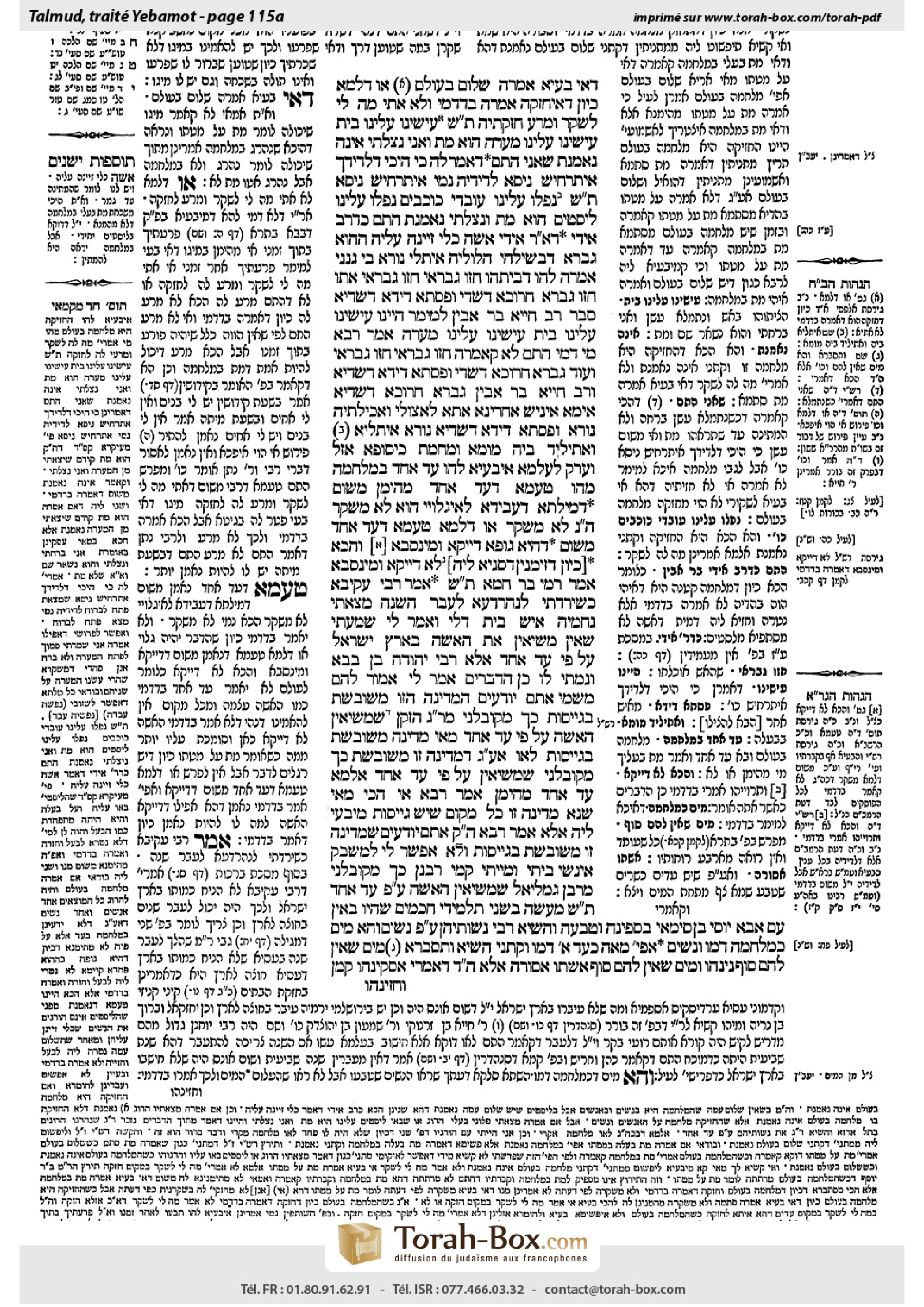
Yevamot 115a: Talmud study for Daf Yomi
Daf Yomi is the daily study of one Talmud folio. Explore 37 tractates with scans, Hebrew text, Sefaria English and AI-generated French translations where annotated.
Passage selection and English or AI-generated French translation are available where the scan has annotations. Daf Study is independent of Torah-Box and Sefaria.
Browse Yevamot · יבמות · All tractatesYevamot 115a text and translations
This page of Yevamot includes the Aramaic text, an English translation and an AI-generated French translation, alongside the scan above.
יבמות קי״ה א · Aramaic and Hebrew text
דְּאִי בָּעֲיָא אָמְרָה: ״שָׁלוֹם בָּעוֹלָם״. אוֹ דִלְמָא: כֵּיוָן דְּאִיחַזְקָה — אָמְרָה בִּדְדָמֵי, וְלָא אָתֵי ״מָה לִי לְשַׁקֵּר״ וּמַרַע חֶזְקָתֵיהּ.
תָּא שְׁמַע: ״עִישְּׁינוּ עָלֵינוּ בַּיִת״, ״עִישְּׁינוּ עָלֵינוּ מְעָרָה״, ״הוּא מֵת, וַאֲנִי נִצַּלְתִּי״ — אֵינָהּ נֶאֱמֶנֶת. שָׁאנֵי הָתָם, דְּאָמַר לָהּ: כִּי הֵיכִי דִּלְדִידָךְ אִיתְרְחִישׁ נִיסָּא, לְדִידֵיהּ נָמֵי אִיתְרְחִישׁ נִיסָּא.
תָּא שְׁמַע: ״נָפְלוּ עָלֵינוּ גּוֹיִם״, ״נָפְלוּ עָלֵינוּ לִיסְטִים״, ״הוּא מֵת, וְנִצַּלְתִּי״ — נֶאֱמֶנֶת. הָתָם, כִּדְרַב אִידִי. דְּאָמַר רַב אִידִי: אִשָּׁה כְּלֵי זַיְינָהּ עָלֶיהָ.
הָהוּא גַּבְרָא דִּבְשִׁילְהֵי הִלּוּלֵיהּ אִיתְּלַי נוּרָא בֵּי (גנני) [גְּנָנֵיהּ]. אֲמַרָה לְהוּ דְּבֵיתְהוּ: ״חֲזוֹ גַּבְרַאי! חֲזוֹ גַּבְרַאי!״ אֲתוֹ, חֲזוֹ גַּבְרָא חָרוֹכָא דִּשְׁדֵי, וּפִסְּתָא דִּידָא דְּשַׁדְיָא.
סָבַר רַב חִיָּיא בַּר אָבִין לְמֵימַר: הַיְינוּ ״עִישְּׁינוּ עָלֵינוּ בַּיִת, עִישְּׁינוּ עָלֵינוּ מְעָרָה״. אָמַר רָבָא: מִי דָּמֵי? הָתָם לָא קָאָמְרָה ״חֲזוֹ גַּבְרַאי, חֲזוֹ גַּבְרַאי״. וְעוֹד, גַּבְרָא חָרוֹכָא דִּשְׁדֵי, וּפִסְּתָא דִּידָא דְּשַׁדְיָא.
וְרַב חִיָּיא בַּר אָבִין — גַּבְרָא חָרוֹכָא דִּשְׁדֵי, אֵימָא אִינִישׁ אַחֲרִינָא אֲתָא לְאַצּוֹלֵי, וַאֲכַילְתֵּיהּ נוּרָא. וּפִסְּתָא דִידָא דְּשַׁדְיָא — נוּרָא אִיתְּלַיא וְאִתְיְלִיד בֵּיהּ מוּמָא, וּמֵחֲמַת כִּיסּוּפָא אֲזַל וַעֲרַק לְעָלְמָא.
אִיבַּעְיָא לְהוּ: עֵד אֶחָד בַּמִּלְחָמָה מַהוּ? טַעְמָא דְּעֵד אֶחָד מְהֵימַן — מִשּׁוּם דְּמִילְּתָא דַּעֲבִידָא לְאִיגַּלּוֹיֵי הוּא לָא מְשַׁקַּר, הָכָא נָמֵי לָא מְשַׁקַּר. אוֹ דִלְמָא: טַעְמָא דְּעֵד אֶחָד מִשּׁוּם דְּהִיא גּוּפָא דָּיְיקָא וּמִינַּסְבָא, וְהָכָא [כֵּיוָן דְּזִימְנִין דְּסָנְיָא לֵיהּ], לָא דָּיְיקָא וּמִינַּסְבָא.
אָמַר רָמֵי בַּר חָמָא: תָּא שְׁמַע, אָמַר רַבִּי עֲקִיבָא: כְּשֶׁיָּרַדְתִּי לִנְהַרְדְּעָא לְעַבֵּר הַשָּׁנָה, מְצָאַנִי נְחֶמְיָה אִישׁ בֵּית דְּלִי, וְאָמַר לִי: שָׁמַעְתִּי שֶׁאֵין מַשִּׂיאִין אֶת הָאִשָּׁה בְּאֶרֶץ יִשְׂרָאֵל עַל פִּי עֵד אֶחָד, אֶלָּא רַבִּי יְהוּדָה בֶּן בָּבָא. וְנַמְתִּי לוֹ: כֵּן הַדְּבָרִים. אָמַר לִי, אֱמוֹר לָהֶם מִשְּׁמִי: אַתֶּם יוֹדְעִים הַמְּדִינָה הַזּוֹ מְשׁוּבֶּשֶׁת בִּגְיָיסוֹת? כָּךְ מְקוּבְּלַנִי מֵרַבָּן גַּמְלִיאֵל הַזָּקֵן, שֶׁמַּשִּׂיאִין הָאִשָּׁה עַל פִּי עֵד אֶחָד.
מַאי מְדִינָה מְשׁוּבֶּשֶׁת בִּגְיָיסוֹת? לָאו, אַף עַל גַּב דִּמְדִינָה זוֹ מְשׁוּבֶּשֶׁת, כָּךְ מְקוּבְּלַנִי שֶׁמַּשִּׂיאִין עַל פִּי עֵד אֶחָד. אַלְמָא עֵד אֶחָד מְהֵימַן.
אָמַר רָבָא: אִי הָכִי, מַאי שְׁנָא ״מְדִינָה זוֹ״? ״כׇּל מָקוֹם שֶׁיֵּשׁ גְּיָיסוֹת״ מִיבְּעֵי לֵיהּ! אֶלָּא אָמַר רָבָא, הָכִי קָאָמַר: אַתֶּם יוֹדְעִים שֶׁמְּדִינָה זוֹ מְשׁוּבֶּשֶׁת בִּגְיָיסוֹת, וְלָא אֶפְשָׁר לִי לְמִשְׁבַּק אִינָשֵׁי בֵיתִי וּמֵייתֵי קַמֵּי רַבָּנַן. כָּךְ מְקוּבְּלַנִי מֵרַבָּן גַּמְלִיאֵל שֶׁמַּשִּׂיאִין הָאִשָּׁה עַל פִּי עֵד אֶחָד.
תָּא שְׁמַע: מַעֲשֶׂה בִּשְׁנֵי תַּלְמִידֵי חֲכָמִים שֶׁהָיוּ בָּאִין עִם אַבָּא יוֹסֵי בֶּן סִימַאי בִּסְפִינָה, וְטָבְעָה, וְהִשִּׂיא רַבִּי נְשׁוֹתֵיהֶן עַל פִּי נָשִׁים. וְהָא מַיִם כְּמִלְחָמָה דָּמוּ. וְנָשִׁים, אֲפִילּוּ מֵאָה — כְּעֵד אֶחָד דָּמוּ, וְקָתָנֵי: הִשִּׂיא!
וְתִסְבְּרָא? מַיִם שֶׁאֵין לָהֶם סוֹף נִינְהוּ, וּמַיִם שֶׁאֵין לָהֶם סוֹף — אִשְׁתּוֹ אֲסוּרָה. אֶלָּא הֵיכִי דָּמֵי, דְּאָמְרִי: אַסְּקִינְהוּ קַמַּן
Yevamot 115a · English translation
Because if she wanted to lie she would have said: There was peace in the world, and the court would have accepted her testimony. Or perhaps it can be argued: Since she has maintained that there was a war and this claim of hers has already been accepted, with regard to her report concerning her husband, she will say what she imagines to be the case, and the argument of: Why would I lie, does not come and undermine the established presumption that there was a war.
The Gemara cites a baraita in an attempt to resolve this dilemma. Come and hear: It was taught that if a woman comes and says: They set our house on fire and the house became filled with smoke, or: They set our cave on fire to smoke us out, and she adds: My husband died and I was saved, she is not deemed credible. In this case, she herself related the entire story, and even so her version of events is not accepted. The Gemara answers that this is no proof. There, in the case of the fire, it is different, as one says to her: Just as a miracle occurred for you and you were saved, likewise a miracle might have occurred for your husband and he too survived.
Come and hear a proof from another baraita. If a woman comes and says: A group of gentiles attacked us, or: A group of bandits attacked us, and she adds: My husband died and I was saved, she is deemed credible. This indicates that her testimony is accepted due to the argument of: Why should she lie? The Gemara rejects this proof. There, in that baraita, her testimony is accepted because it stands to reason that she is speaking the truth, in accordance with the opinion of Rav Idi. As Rav Idi said: With regard to a woman, her weapons are upon her. In other words, a woman is generally not killed by thieves, because the very fact of her being a woman protects her. They would most likely rape her and not kill her. Consequently, it is reasonable to assume that she is speaking the truth.
§ The Gemara relates: There was a certain man who got married. At the end of his wedding a fire broke out in the bridal chamber, where the bride and groom were standing, during the ceremony. His wife screamed and said to them: Look at my husband, look at my husband! They went and saw an unrecognizable burnt man fallen down, and a palm of a hand lying there.
Rav Ḥiyya bar Avin thought to say: This is the same as the case of: They set our house on fire and the house became filled with smoke, or: They set our cave on fire to smoke us out, i.e., we cannot rely on her claim that her husband died. Rava said: Is this case comparable to those? There she did not say: Look at my husband, look at my husband. And furthermore, there is another difference: Here, there is a burnt man who has fallen down and a palm that is lying there. In other words, her statement is substantiated by facts.
And why didn’t Rav Ḥiyya bar Avin accept her testimony? In his opinion, a burnt man who has fallen down is not conclusive proof, as one might still say: Perhaps another person came to the rescue and the fire burned him. And as for the palm lying there, perhaps the fire burned him and caused a deformity through which he lost his hand, and due to his embarrassment he went and ran away to somewhere else in the world, but he is still alive. Consequently, Rav Ḥiyya bar Avin did not want to rely upon the testimony of the wife.
§ A dilemma was raised before them: In the case of one witness who testifies to the death of someone during a war, what is the halakha? The Gemara explains the sides of the dilemma: The reason that one witness is deemed credible when he provides testimony concerning the death of a husband is because the husband being alive is a matter that is likely to be revealed, and one would not lie in a case of this kind. Here, too, one witness would not lie. Or perhaps the reason that one witness is trusted is because his account is supported by the fact that she herself is exacting in her investigation before she marries again. And here, since sometimes she hates him, and war is a situation that requires especially careful investigation and it is tempting for her to rely on the witness, she is not exacting in her investigation before she marries again, and therefore the testimony of one witness is not accepted.
Rami bar Ḥama said: Come and hear a resolution to this dilemma. Rabbi Akiva said: When I descended to Neharde’a in Babylonia to intercalate the year, I found there the Sage Neḥemya of Beit D’li, and he said to me: I heard that the Sages do not allow a woman to marry in Eretz Yisrael based on the testimony of one witness, apart from Rabbi Yehuda ben Bava, as the other Sages are reluctant to rely on his opinion. And I said [namti] to him: This is so. He said to me: Say to them in my name: Do you know that this country is riddled with troops? This is the tradition that I received from Rabban Gamliel the Elder, that the Sages do allow a woman to marry based on one witness.
The Gemara analyzes this baraita in relation to the issue at hand. What is the significance of his comment that this country is riddled with troops? Isn’t he saying: Even though this country is riddled with troops, this is the tradition that I received, that the Sages do allow a woman to marry based on one witness, notwithstanding the war. Apparently, one witness is deemed credible in the case of a missing husband during a time of war.
Rava said: If this is how you interpret the matter, in what way is this country different from any other? In other words, why did Neḥemya of Beit D’li mention a particular place? He should have said: Any place where there are troops. Rather, Rava said: This is what he said: You know that this country is riddled with troops, and I cannot leave the members of my household and come before the Sages, due to the danger. Therefore, I cannot testify in person that this is the tradition that I received from Rabban Gamliel the Elder, that the Sages allow a woman to marry based on one witness. According to this interpretation, his statement has no bearing on the matter at hand.
The Gemara continues. Come and hear a baraita that relates an incident involving two Torah scholars who were coming with Abba Yosei ben Simai by boat, and that boat sank. And Rabbi Yehuda HaNasi allowed their wives to marry based on the testimony given by women that these men were dead. But consider: Water, i.e., the sea, is like war with respect to this halakha, as there is room in both cases for conjecture and error. And women, even one hundred of them, are considered as one witness with regard to their testimony about a husband’s death. And yet the baraita taught: He allowed them to marry, which indicates that one may rely on one witness even during a war.
The Gemara rejects this proof. And how can you understand it that way? Apparently, the women testified only that the boat sank, and this is a case of an endless body of water, as the boat sank at sea in a spot from which it is impossible to see the shore. And the halakha is that if a man was on a boat that sank in an endless body of water his wife is prohibited to marry, as there is no proof that he actually drowned and didn’t emerge from the water on a different shore. Rather, one must say: What are the circumstances? That those women said: Those drowned men were brought up before us
Yevamot 115a · Traduction française (IA)
Car, si elle avait voulu mentir, elle aurait dit : « Il y avait la paix dans le monde », et le tribunal aurait accepté son témoignage. Ou peut-être peut-on soutenir que, puisqu’elle a affirmé qu’il y avait une guerre et que cette affirmation a déjà été acceptée, elle dira, à propos de son mari, ce qu’elle imagine être le cas ; l’argument « Pourquoi mentirait-elle ? » ne vient donc pas ébranler la présomption établie qu’il y avait une guerre.
La Guemara cite une baraïta pour tenter de résoudre cette question. Viens et entends : il a été enseigné que si une femme vient et dit : « Ils ont incendié notre maison et celle-ci s’est remplie de fumée », ou : « Ils ont incendié notre grotte pour nous en enfumer », puis ajoute : « Mon mari est mort et j’ai été sauvée », elle n’est pas jugée crédible. Dans ce cas, elle a elle-même raconté toute l’histoire et, malgré cela, sa version des faits n’est pas acceptée. La Guemara répond que cela ne constitue pas une preuve. Dans le cas de l’incendie, la situation est différente, car on peut lui dire : de même qu’un miracle s’est produit pour toi et que tu as été sauvée, un miracle a pu se produire aussi pour ton mari, qui a lui aussi survécu.
Viens et entends une preuve tirée d’une autre baraïta. Si une femme vient et dit : « Un groupe de non-Juifs nous a attaqués », ou : « Un groupe de bandits nous a attaqués », puis ajoute : « Mon mari est mort et j’ai été sauvée », elle est jugée crédible. Cela indique que son témoignage est accepté en vertu de l’argument : « Pourquoi mentirait-elle ? » La Guemara rejette cette preuve. Dans cette baraïta, son témoignage est accepté parce qu’il est raisonnable de penser qu’elle dit la vérité, conformément à l’avis de Rav Idi. Car Rav Idi a dit : « Pour une femme, ses armes sont sur elle. » Autrement dit, une femme n’est généralement pas tuée par des voleurs, car le fait même qu’elle soit une femme la protège. Ils la violeraient vraisemblablement au lieu de la tuer. Il est donc raisonnable de supposer qu’elle dit la vérité.
§ La Guemara rapporte : un homme se maria. À la fin de son mariage, un incendie se déclara dans la chambre nuptiale, où se tenaient la mariée et le marié pendant la cérémonie. Sa femme cria et leur dit : « Regardez mon mari, regardez mon mari ! » Ils allèrent voir et trouvèrent un homme brûlé, méconnaissable, étendu là, ainsi qu’une paume de main.
Rav Ḥiyya bar Avin pensa que ce cas était identique à celui où ils avaient incendié notre maison et qu’elle s’était remplie de fumée, ou celui où ils avaient incendié notre grotte pour nous en enfumer ; autrement dit, on ne pouvait pas se fier à son affirmation selon laquelle son mari était mort. Rava dit : « Ce cas est-il comparable à ceux-là ? Là-bas, elle n’a pas dit : “Regardez mon mari, regardez mon mari !” » De plus, il y a ici une autre différence : un homme brûlé est étendu là, ainsi qu’une paume de main. Autrement dit, des faits corroborent sa déclaration.
Et pourquoi Rav Ḥiyya bar Avin n’a-t-il pas accepté son témoignage ? Selon lui, la présence d’un homme brûlé étendu là ne constitue pas une preuve concluante, car on pourrait encore dire : peut-être une autre personne est-elle venue porter secours, et c’est elle que le feu a brûlée. Quant à la paume qui se trouve là, peut-être le feu l’a-t-il brûlée et lui a-t-il causé une difformité qui lui a fait perdre la main ; par honte, il serait alors parti ailleurs dans le monde, tout en restant vivant. Par conséquent, Rav Ḥiyya bar Avin ne voulut pas se fier au témoignage de l’épouse.
§ Une question fut soulevée devant eux : quelle est la halakha lorsqu’un témoin unique atteste la mort de quelqu’un pendant une guerre ? La Guemara expose les deux possibilités : si un témoin unique est jugé crédible lorsqu’il témoigne de la mort d’un mari, c’est parce que le fait que le mari soit encore vivant est susceptible d’être découvert, et que l’on ne mentirait pas dans un cas de ce genre. Ici aussi, un témoin unique ne mentirait pas. Ou peut-être la raison pour laquelle on fait confiance à un témoin unique est-elle que son récit est corroboré par le fait que la femme mène elle-même une enquête minutieuse avant de se remarier. Or ici, puisqu’il lui arrive de le haïr et que la guerre est une situation qui exige une enquête particulièrement rigoureuse, tandis qu’elle est tentée de se fier au témoin, elle ne mène pas une enquête minutieuse avant de se remarier ; le témoignage d’un témoin unique n’est donc pas accepté.
Rami bar Ḥama dit : viens et entends une réponse à cette question. Rabbi Akiva dit : « Lorsque je descendis à Neharde’a, en Babylonie, pour intercaler l’année, j’y trouvai le Sage Neḥemya de Beit D’li, qui me dit : “J’ai appris que les Sages n’autorisent pas une femme à se marier en terre d’Israël sur la foi du témoignage d’un seul témoin, à l’exception de Rabbi Yehuda ben Bava, car les autres Sages hésitent à se fier à son avis.” Je lui dis [namti] : “C’est exact.” Il me dit : “Dis-leur en mon nom : savez-vous que ce pays est infesté de troupes ?” Voici la tradition que j’ai reçue de Rabban Gamliel l’Ancien : les Sages autorisent une femme à se marier sur la foi d’un seul témoin. »
La Guemara analyse cette baraïta au sujet de la question débattue. Quelle est l’importance de sa remarque selon laquelle ce pays est infesté de troupes ? Ne dit-il pas : « Même si ce pays est infesté de troupes, voici la tradition que j’ai reçue : les Sages autorisent une femme à se marier sur la foi d’un seul témoin, malgré la guerre » ? Apparemment, un témoin unique est jugé crédible lorsqu’un mari est porté disparu en temps de guerre.
Rava dit : « Si tu interprètes la chose ainsi, en quoi ce pays diffère-t-il de tout autre ? » Autrement dit, pourquoi Neḥemya de Beit D’li a-t-il mentionné un lieu particulier ? Il aurait dû dire : « Partout où il y a des troupes. » Rava dit plutôt : « Voici ce qu’il voulait dire : “Vous savez que ce pays est infesté de troupes, et je ne peux pas laisser les membres de ma maisonnée pour me présenter devant les Sages, à cause du danger. Je ne peux donc pas témoigner en personne que la tradition que j’ai reçue de Rabban Gamliel l’Ancien est que les Sages autorisent une femme à se marier sur la foi d’un seul témoin.” » Selon cette interprétation, sa déclaration n’a aucun rapport avec la question débattue.
La Guemara poursuit. Viens et entends une baraïta qui rapporte un épisode concernant deux érudits de la Torah qui voyageaient avec Abba Yosei ben Simai sur un bateau, lequel sombra. Rabbi Yehuda HaNasi autorisa leurs femmes à se remarier sur la foi du témoignage de femmes affirmant que ces hommes étaient morts. Mais réfléchis : l’eau, c’est-à-dire la mer, est assimilée à la guerre pour cette halakha, car dans les deux cas, il y a place à conjecture et à erreur. De plus, les femmes, même au nombre de cent, sont considérées comme un seul témoin lorsqu’elles témoignent de la mort d’un mari. Pourtant, la baraïta enseigne qu’il les autorisa à se remarier, ce qui indique qu’on peut se fier à un témoin unique même en temps de guerre.
La Guemara rejette cette preuve. Comment peux-tu comprendre la chose ainsi ? Apparemment, les femmes ont seulement témoigné que le bateau avait sombré, et il s’agit d’une étendue d’eau sans limites, car le bateau a sombré en mer, à un endroit d’où il est impossible de voir la rive. Or la halakha est que si un homme se trouvait sur un bateau qui a sombré dans une étendue d’eau sans limites, sa femme n’est pas autorisée à se remarier, car rien ne prouve qu’il s’est effectivement noyé et qu’il n’est pas sorti de l’eau sur une autre rive. Il faut plutôt dire : dans quelles circonstances ? Ces femmes ont déclaré : « Ces hommes qui s’étaient noyés ont été remontés devant nous ».
Traduction française générée par IA à partir de l’édition anglaise de Sefaria. Vérifie toujours un passage avec le texte source.
Text from Sefaria: William Davidson Edition - Vocalized Aramaic (CC BY NC); William Davidson Edition - English (CC BY NC).