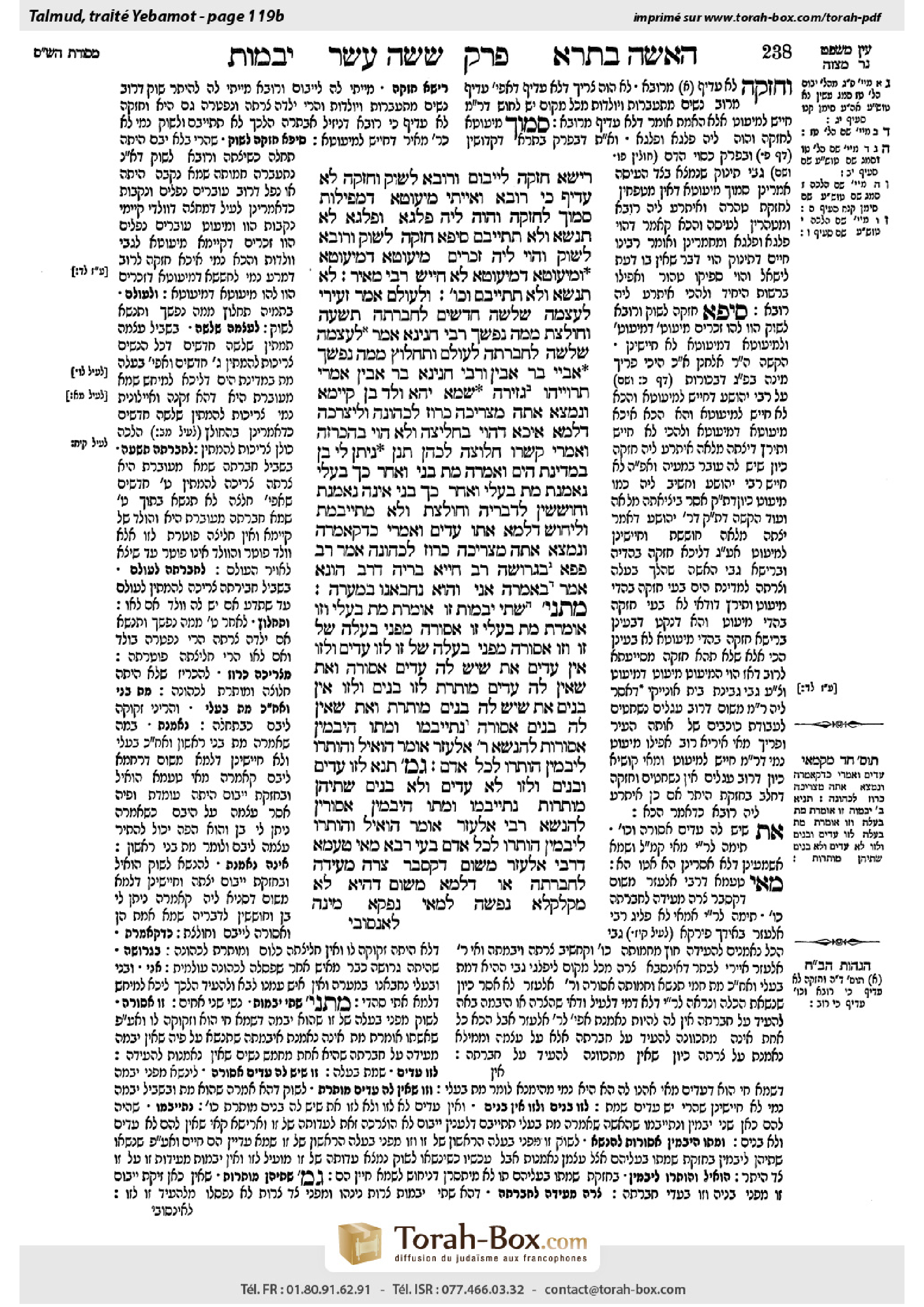
Yevamot 119b: Talmud study for Daf Yomi
Daf Yomi is the daily study of one Talmud folio. Explore 37 tractates with scans, Hebrew text, Sefaria English and AI-generated French translations where annotated.
Passage selection and English or AI-generated French translation are available where the scan has annotations. Daf Study is independent of Torah-Box and Sefaria.
Browse Yevamot · יבמות · All tractatesYevamot 119b text and translations
This page of Yevamot includes the Aramaic text, an English translation and an AI-generated French translation, alongside the scan above.
יבמות קי״ט ב · Aramaic and Hebrew text
רֵישָׁא, חֲזָקָה לְיִיבּוּם, וְרוּבָּא לַשּׁוּק. וַחֲזָקָה לָא עֲדִיף כִּי רוּבָּא. וְאַיְיתִי מִיעוּטָא דְּמַפִּילוֹת סְמוֹךְ לַחֲזָקָה, וְהָוֵה לֵיהּ פַּלְגָא וּפַלְגָא — לֹא תִּנָּשֵׂא וְלֹא תִּתְיַיבֵּם.
סֵיפָא, חֲזָקָה לַשּׁוּק, וְרוּבָּא לַשּׁוּק. וְהָוֵי לֵיהּ זְכָרִים מִיעוּטָא דְמִיעוּטָא, וּמִיעוּטָא דְמִיעוּטָא — לָא חָיֵישׁ רַבִּי מֵאִיר.
לֹא תִּנָּשֵׂא וְלֹא תִּתְיַיבֵּם וְכוּ׳. וּלְעוֹלָם!
אָמַר זְעֵירִי: לְעַצְמָהּ — שְׁלֹשָׁה חֳדָשִׁים, לַחֲבֶרְתָּהּ — תִּשְׁעָה, וְחוֹלֶצֶת מִמָּה נַפְשָׁךְ.
רַבִּי חֲנִינָא אָמַר: לְעַצְמָהּ — שְׁלֹשָׁה, לַחֲבֶרְתָּהּ — לְעוֹלָם. וְתַחְלוֹץ מִמָּה נַפְשָׁךְ!
אַבָּיֵי בַּר אָבִין וְרַבִּי חֲנִינָא בַּר אָבִין אָמְרִי תַּרְוַיְיהוּ: גְּזֵירָה שֶׁמָּא יְהֵא וָלָד בֶּן קַיָּימָא, וְנִמְצָא אַתָּה מַצְרִיכָהּ כָּרוֹז לַכְּהוּנָּה.
וְלַיצְרְכַהּ? דִּלְמָא אִיכָּא דְּהָוֵי בַּחֲלִיצָה וְלָא הָוֵי בְּהַכְרָזָה, וְאָמְרִי: קָשָׁרוּ חֲלוּצָה לְכֹהֵן.
תְּנַן: ״נִיתַּן לִי בֵּן בִּמְדִינַת הַיָּם״, וְאָמְרָה: ״מֵת בְּנִי וְאַחַר כָּךְ בַּעְלִי״ — נֶאֱמֶנֶת. ״מֵת בַּעְלִי וְאַחַר כָּךְ בְּנִי״ — אֵינָהּ נֶאֱמֶנֶת, וְחוֹשְׁשִׁין לִדְבָרֶיהָ, וְחוֹלֶצֶת וְלֹא מִתְיַיבֶּמֶת.
וְלֵיחוּשׁ דִּלְמָא אָתוּ עֵדִים וְאָמְרִי כִּדְקָאָמְרָה, וְנִמְצָא אַתָּה מַצְרִיכָהּ כָּרוֹז לַכְּהוּנָּה! אָמַר רַב פָּפָּא: בִּגְרוּשָׁה. רַב חִיָּיא בְּרֵיהּ דְּרַב הוּנָא אָמַר, בְּאָמְרָה: ״אֲנִי וָהוּא נֶחְבֵּאנוּ בִּמְעָרָה״.
מַתְנִי׳ שְׁתֵּי יְבָמוֹת, זוֹ אוֹמֶרֶת: ״מֵת בַּעְלִי״, וְזוֹ אוֹמֶרֶת: ״מֵת בַּעְלִי״. זוֹ אֲסוּרָה מִפְּנֵי בַּעְלָהּ שֶׁל זוֹ, וְזוֹ אֲסוּרָה מִפְּנֵי בַּעְלָהּ שֶׁל זוֹ.
לָזוֹ עֵדִים, וְלָזוֹ אֵין עֵדִים. אֶת שֶׁיֵּשׁ לָהּ עֵדִים — אֲסוּרָה, וְאֶת שֶׁאֵין לָהּ עֵדִים — מוּתֶּרֶת. לָזוֹ בָּנִים, וְלָזוֹ אֵין בָּנִים. אֶת שֶׁיֵּשׁ לָהּ בָּנִים — מוּתֶּרֶת, וְאֶת שֶׁאֵין לָהּ בָּנִים — אֲסוּרָה.
נִתְיַיבְּמוּ, וּמֵתוּ הַיְּבָמִין — אֲסוּרוֹת לְהִנָּשֵׂא. רַבִּי אֶלְעָזָר אוֹמֵר: הוֹאִיל וְהוּתְּרוּ לַיְּבָמִין — הוּתְּרוּ לְכׇל אָדָם.
גְּמָ׳ תָּנָא: לָזוֹ עֵדִים וּבָנִים, וְלָזוֹ לֹא עֵדִים וְלֹא בָּנִים — שְׁתֵּיהֶן מוּתָּרוֹת.
נִתְיַיבְּמוּ וּמֵתוּ הַיְּבָמִין — אֲסוּרִין לְהִנָּשֵׂא. רַבִּי אֶלְעָזָר אוֹמֵר: הוֹאִיל וְהוּתְּרוּ לַיְּבָמִין — הוּתְּרוּ לְכׇל אָדָם.
בָּעֵי רָבָא: מַאי טַעְמָא דְּרַבִּי אֶלְעָזָר? מִשּׁוּם דְּקָסָבַר צָרָה מְעִידָה לַחֲבֶרְתָּהּ, אוֹ דִלְמָא מִשּׁוּם דְּהִיא לָא מְקַלְקְלָא נַפְשַׁהּ.
לְמַאי נָפְקָא מִינַּהּ?
Yevamot 119b · English translation
In the first clause of the mishna, the legal presumption is that this widow is obligated to enter into levirate marriage, but in a majority of cases she will actually be permitted to marry a man from the general public, because it is statistically probable that her rival wife had a child. A legal presumption is not as significant as a majority, meaning that the majority carries more weight than the presumption, and she should be permitted to marry immediately. But bring the minority who miscarry into consideration, and join this to the legal presumption, and it becomes similar to an even balance of half and half. Those who miscarry detract from the strength of the majority, causing it to be equal in legal significance to the legal presumption. Therefore, the ruling is that she shall not marry any man who is not her yavam and she shall not enter into levirate marriage either.
However, in the latter clause, the legal presumption is that the widow is permitted to marry a man from the general public, since her late husband had no brothers initially. And in a majority of cases her mother-in-law will not have had another son, and therefore the widow will actually be permitted to marry a man from the general public. Consequently, the possibility that her husband has a brother, necessitating levirate marriage, is not taken into account because it is a minority of a minority, i.e., it is a minority and it contradicts the legal presumption, and even Rabbi Meir is not concerned about a minority of a minority.
§ It was taught in the mishna that in the case of a woman whose husband and rival wife went overseas and then her husband died, she shall not marry and shall not enter into levirate marriage until she knows whether her rival wife is pregnant. The Gemara asks: But must she wait indefinitely? She should be permitted to perform ḥalitza on account of the uncertainty and then marry another man.
Ze’eiri said: In order for herself [le’atzma] to be permitted to marry, she must wait three months after performing ḥalitza, since every woman must wait three months after her husband’s death before she marries again. Additionally, due to the concern for the possibility that her fellow wife may be pregnant, she must wait nine months, after which time that wife would have given birth had she been pregnant, and then she performs ḥalitza whichever way you look at it. If her rival wife gave birth in the meantime, she is permitted to marry anyone she wishes, and the ḥalitza is superfluous; if her rival wife did not give birth, necessitating levirate marriage, she is exempted by the ḥalitza. However, she may not perform ḥalitza earlier because ḥalitza performed while any wife of the deceased husband is pregnant is ineffective.
Rabbi Ḥanina said: For those concerns relating to herself she must wait three months, as explained, but for concerns related to her fellow wife’s possible pregnancy she must wait indefinitely, until it is verified whether or not that wife gave birth. The Gemara challenges Rabbi Ḥanina’s opinion: But let her perform ḥalitza whichever way you look at it, since, whatever happened, after nine months she may certainly perform ḥalitza.
Abaye bar Avin and Rabbi Ḥanina bar Avin both say in explanation of Rabbi Ḥanina’s opinion: It is a rabbinic decree lest there be viable offspring of that other wife. If so, her ḥalitza is superfluous, since she was exempt from both levirate marriage and ḥalitza; and then it transpires that you necessitate an announcement on her behalf stating that she is permitted to the priesthood, as a woman who has undergone ḥalitza is forbidden to a priest, but in this case it has become clear retroactively that she did not undergo ḥalitza.
The Gemara asks: And so let an announcement be necessary for her if a viable offspring is found. The Gemara answers: Perhaps there will be people who were present at the ḥalitza ceremony but were not present at the announcement that she is permitted to marry a priest, and if this woman marries a priest they will mistakenly say: They are permitting a ḥalutza to marry a priest.
The Gemara deliberates further about this: We learned in a mishna (Yevamot 118b): If a woman says: A son was born to me in a country overseas, and she also said: My son died, and then my husband died, she is deemed credible. However, if she said: My husband died and then my son died, she is not deemed credible about the sequence of events, but even so one must be concerned about her statement that her husband died childless. Consequently, she must perform ḥalitza, but she may not enter into levirate marriage.
The Gemara says: Just as there is concern about an announcement for the priesthood, let us be concerned that perhaps witnesses will eventually come and testify that the sequence of events was as she said, rendering her ḥalitza superfluous. And then it transpires that you necessitate an announcement on her behalf stating that she is permitted to the priesthood, and nevertheless the mishna instructs her to perform ḥalitza. Rav Pappa said: There it is referring only to a divorced woman, who was divorced from a previous husband, so that she is already prohibited from marrying a priest in any case. Rav Ḥiyya, son of Rav Huna, said: It is referring to a case where she said: He and I were hiding alone with our son in a cave. Consequently, there is no concern that witnesses will come and testify about the sequence of the events.
MISHNA: If there are two sisters-in-law married to two childless brothers who testify about their marital status, and this one says: My husband died, and that one says: My husband died, although each one of them is deemed credible with regard to her own status as a widow, this one is prohibited from marrying due to the possibility that the husband of that other sister may be alive, obligating her in levirate marriage, and that one is prohibited from marrying due to the husband of this sister, according to the same rationale. Although each is accorded credibility as to her own husband’s death, the halakha is that sisters-in-law are among the five types of women not accorded credibility with regard to each other’s permissibility to marry because of possible conflicts of interest.
If this one has witnesses to her husband’s death, and that one does not have witnesses, then the one who has witnesses is prohibited from marrying, as there are no witnesses to the death of her yavam to exempt her from levirate marriage; but the one who has no witnesses is permitted to marry based on her own testimony that her husband died combined with the witnesses’ testimony exempting her from levirate marriage. If this one has children and that one has no children, then the one with children is permitted to marry, as she herself is deemed credible with regard to her husband’s death, and her children exempt her from levirate marriage. But the one without children is prohibited from marrying, as the death of her yavam has not been corroborated independently of her sister-in-law’s testimony.
If there were two additional yevamin with whom these two widows entered into levirate marriage, and then the yevamin died childless, the women are prohibited from marrying, since the concern about an additional living yavam still remains. Rabbi Elazar says: Since these women were permitted to marry the living brothers-in-law, as the testimony of each was deemed credible with regard to her own status, they are permitted, from then on, to marry any man because their statements, taken together, indicate that neither one is obligated to enter into levirate marriage.
GEMARA: It was taught in a baraita: If this one has witnesses that her husband died and also has children, and the other has neither witnesses nor children, they are both permitted to marry. This is because the woman who has children is exempt from levirate marriage, and the woman who has no children may rely upon the witnesses’ testimony that her yavam died.
It was taught in the mishna: If they both entered into levirate marriage and then the yevamin they married died, they are prohibited from marrying. Rabbi Elazar says: Since they were permitted to marry the yevamin, they are permitted to any man.
Rava raised a dilemma: What is Rabbi Elazar’s reasoning? Is it because he holds in general that one rival wife may testify for another rival wife about her husband’s death, and he similarly holds that all of the five types of women who are presumed to have a conflict of interest with each other may testify for one another nonetheless? Or perhaps it is because she would not cause herself injury. Although she would be suspected of lying and saying that her husband died in order to harm her rival wife, if she herself enters into levirate marriage it can be assumed that she was telling the truth, because if she does so while her husband is actually alive, she would be committing incest with her brother-in-law. Consequently, her rival wife is also permitted to marry on the basis of her testimony.
The Gemara asks: What is the practical difference between the two reasons?
Yevamot 119b · Traduction française (IA)
Dans la première partie de la Michna, la présomption juridique est que cette veuve est tenue d’entrer en lévirat. Toutefois, dans la majorité des cas, elle sera en réalité autorisée à épouser un homme quelconque, car il est statistiquement probable que sa coépouse ait eu un enfant. Une présomption juridique n’a pas autant de poids qu’une majorité ; autrement dit, la majorité l’emporte sur la présomption, et elle devrait donc être autorisée à se marier immédiatement. Mais si l’on tient compte de la minorité des femmes qui font une fausse couche et qu’on l’ajoute à la présomption juridique, on obtient un équilibre comparable à une répartition moitié-moitié. Les fausses couches affaiblissent la majorité, de sorte que son poids juridique devient égal à celui de la présomption. La décision est donc qu’elle ne doit épouser aucun homme autre que son yavam, mais qu’elle ne doit pas non plus entrer en lévirat.
En revanche, dans la dernière partie, la présomption juridique est que la veuve est autorisée à épouser un homme quelconque, puisque son défunt mari n’avait initialement aucun frère. Dans la majorité des cas, sa belle-mère n’aura pas eu d’autre fils, et la veuve sera donc effectivement autorisée à épouser un homme quelconque. Par conséquent, la possibilité que son mari ait un frère, ce qui rendrait nécessaire le lévirat, n’est pas prise en compte, car il s’agit d’une minorité au sein d’une minorité : c’est une éventualité minoritaire qui contredit la présomption juridique, et même Rabbi Meïr ne tient pas compte d’une minorité au sein d’une minorité.
§ La Michna enseignait que, dans le cas d’une femme dont le mari et la coépouse sont partis outre-mer, puis dont le mari est mort, elle ne doit ni se marier ni entrer en lévirat avant de savoir si sa coépouse est enceinte. La Guemara demande : Mais doit-elle attendre indéfiniment ? Elle devrait être autorisée à accomplir la ḥalitsa en raison de l’incertitude, puis à épouser un autre homme.
Ze’eiri a dit : Pour pouvoir se marier [le’atzma], elle doit attendre trois mois après avoir accompli la ḥalitsa, puisque toute femme doit attendre trois mois après la mort de son mari avant de se remarier. En outre, par crainte que sa coépouse ne soit enceinte, elle doit attendre neuf mois, délai au terme duquel cette femme aurait accouché si elle avait été enceinte ; ensuite, elle accomplit la ḥalitsa dans tous les cas. Si sa coépouse a accouché entre-temps, elle est autorisée à épouser qui elle veut, et la ḥalitsa est superflue ; si sa coépouse n’a pas accouché, ce qui rend le lévirat nécessaire, elle en est dispensée par la ḥalitsa. Elle ne peut toutefois pas accomplir la ḥalitsa plus tôt, car une ḥalitsa accomplie alors que l’une des épouses du défunt est enceinte est sans effet.
Rabbi Ḥanina a dit : Pour ce qui la concerne elle-même, elle doit attendre trois mois, comme cela a été expliqué ; mais, pour ce qui est de l’éventuelle grossesse de sa coépouse, elle doit attendre indéfiniment, jusqu’à ce qu’on vérifie si cette dernière a accouché ou non. La Guemara objecte à l’avis de Rabbi Ḥanina : Mais qu’elle accomplisse la ḥalitsa dans tous les cas, puisque, quoi qu’il soit arrivé, elle pourra certainement accomplir la ḥalitsa au bout de neuf mois.
Abaye bar Avin et Rabbi Ḥanina bar Avin expliquent tous deux l’avis de Rabbi Ḥanina ainsi : Il s’agit d’un décret rabbinique, de crainte que l’autre femme n’ait eu un enfant viable. Dans ce cas, sa ḥalitsa serait superflue, puisqu’elle était dispensée à la fois du lévirat et de la ḥalitsa ; il faudrait alors publier en sa faveur une annonce déclarant qu’elle est autorisée à épouser un prêtre. En effet, une femme qui a accompli la ḥalitsa ne peut pas épouser un prêtre, alors qu’ici il apparaît rétrospectivement qu’elle n’a pas accompli la ḥalitsa.
La Guemara demande : Qu’on exige donc une annonce en sa faveur si l’on découvre qu’il y a eu un enfant viable. La Guemara répond : Peut-être certaines personnes auront-elles assisté à la cérémonie de ḥalitsa, mais pas à l’annonce déclarant qu’elle est autorisée à épouser un prêtre ; si cette femme épouse un prêtre, elles diront par erreur : « Ils autorisent une ḥaloutsa à épouser un prêtre. »
La Guemara examine plus avant cette question : Nous avons appris dans une Michna (Yevamot 118b) : Si une femme dit : « Un fils m’est né dans un pays d’outre-mer », puis dit aussi : « Mon fils est mort », et que son mari meurt ensuite, elle est considérée comme digne de foi. Toutefois, si elle dit : « Mon mari est mort, puis mon fils est mort », on ne la croit pas quant à l’ordre des événements ; malgré cela, il faut tenir compte de sa déclaration selon laquelle son mari est mort sans enfant. Par conséquent, elle doit accomplir la ḥalitsa, mais ne peut pas entrer en lévirat.
La Guemara dit : De même qu’on craint qu’il faille publier une annonce concernant son autorisation à épouser un prêtre, tenons aussi compte de la possibilité que des témoins se présentent un jour et attestent que les événements se sont déroulés dans l’ordre qu’elle a indiqué, ce qui rendrait sa ḥalitsa superflue. Il faudrait alors publier en sa faveur une annonce déclarant qu’elle est autorisée à épouser un prêtre ; pourtant, la Michna lui prescrit d’accomplir la ḥalitsa. Rav Pappa a dit : Là, il s’agit uniquement d’une femme divorcée, qui a été répudiée par un précédent mari ; elle est donc déjà interdite à un prêtre de toute façon. Rav Ḥiyya, fils de Rav Houna, a dit : Il s’agit d’un cas où elle a dit : « Lui et moi nous cachions seuls avec notre fils dans une grotte. » Par conséquent, on ne craint pas que des témoins se présentent et attestent de l’ordre des événements.
MICHNA : S’il y a deux belles-sœurs, chacune mariée à l’un de deux frères sans enfant, qui témoignent de leur situation matrimoniale, et que l’une dit : « Mon mari est mort », tandis que l’autre dit : « Mon mari est mort », bien que chacune soit considérée comme digne de foi au sujet de son propre statut de veuve, chacune d’elles ne peut pas se marier : l’une, parce que le mari de l’autre belle-sœur pourrait être encore vivant, ce qui l’obligerait au lévirat, et l’autre, pour la même raison, à cause du mari de la première. Bien que chacune soit crue au sujet de la mort de son propre mari, la halakha est que les belles-sœurs font partie des cinq catégories de femmes auxquelles on ne reconnaît pas de crédibilité lorsqu’il s’agit d’établir que l’autre est autorisée à se marier, en raison de possibles conflits d’intérêts.
Si l’une a des témoins attestant la mort de son mari et que l’autre n’en a pas, celle qui a des témoins ne peut pas se marier, car la mort de son yavam n’est pas attestée par des témoins et elle n’est donc pas dispensée du lévirat ; mais celle qui n’a pas de témoins est autorisée à se marier, sur la base de son propre témoignage selon lequel son mari est mort, auquel s’ajoute le témoignage des témoins qui la dispense du lévirat. Si l’une a des enfants et que l’autre n’en a pas, celle qui a des enfants est autorisée à se marier, car elle-même est considérée comme digne de foi au sujet de la mort de son mari, et ses enfants la dispensent du lévirat. Mais celle qui n’a pas d’enfants ne peut pas se marier, car la mort de son yavam n’a pas été corroborée indépendamment du témoignage de sa belle-sœur.
Si deux autres yevamim ont épousé en lévirat ces deux veuves, puis sont morts sans enfant, les femmes ne peuvent pas se marier, car la possibilité qu’un autre yavam soit encore vivant demeure. Rabbi Elazar dit : Puisque ces femmes ont été autorisées à épouser les beaux-frères vivants, le témoignage de chacune ayant été jugé crédible quant à sa propre situation, elles sont dès lors autorisées à épouser n’importe quel homme, car leurs déclarations, considérées ensemble, indiquent qu’aucune des deux n’est tenue d’entrer en lévirat.
GUEMARA : Il a été enseigné dans une baraïta : Si l’une a des témoins attestant que son mari est mort et a aussi des enfants, tandis que l’autre n’a ni témoins ni enfants, toutes deux sont autorisées à se marier. En effet, la femme qui a des enfants est dispensée du lévirat, et celle qui n’a pas d’enfants peut s’appuyer sur le témoignage des témoins attestant que son yavam est mort.
La Michna enseignait que si elles sont toutes deux entrées en lévirat, puis que les yevamim qu’elles ont épousés sont morts, elles ne peuvent pas se marier. Rabbi Elazar dit : Puisqu’elles ont été autorisées à épouser les yevamim, elles sont autorisées à épouser n’importe quel homme.
Rava souleva une difficulté : Quel est le raisonnement de Rabbi Elazar ? Est-ce parce qu’il considère, de manière générale, qu’une coépouse peut témoigner pour une autre coépouse au sujet de la mort de son mari, et qu’il estime de même que les cinq catégories de femmes présumées avoir un conflit d’intérêts entre elles peuvent néanmoins témoigner les unes pour les autres ? Ou bien est-ce parce qu’elle ne se causerait pas de tort à elle-même ? Bien qu’on puisse la soupçonner de mentir et de déclarer que son mari est mort afin de nuire à sa coépouse, si elle-même entre en lévirat, on peut supposer qu’elle a dit la vérité, car si elle le faisait alors que son mari est en réalité vivant, elle commettrait un inceste avec son beau-frère. Par conséquent, sa coépouse est elle aussi autorisée à se marier sur la base de son témoignage.
La Guemara demande : Quelle différence pratique y a-t-il entre ces deux raisons ?
Traduction française générée par IA à partir de l’édition anglaise de Sefaria. Vérifie toujours un passage avec le texte source.
Text from Sefaria: William Davidson Edition - Vocalized Aramaic (CC BY NC); William Davidson Edition - English (CC BY NC).