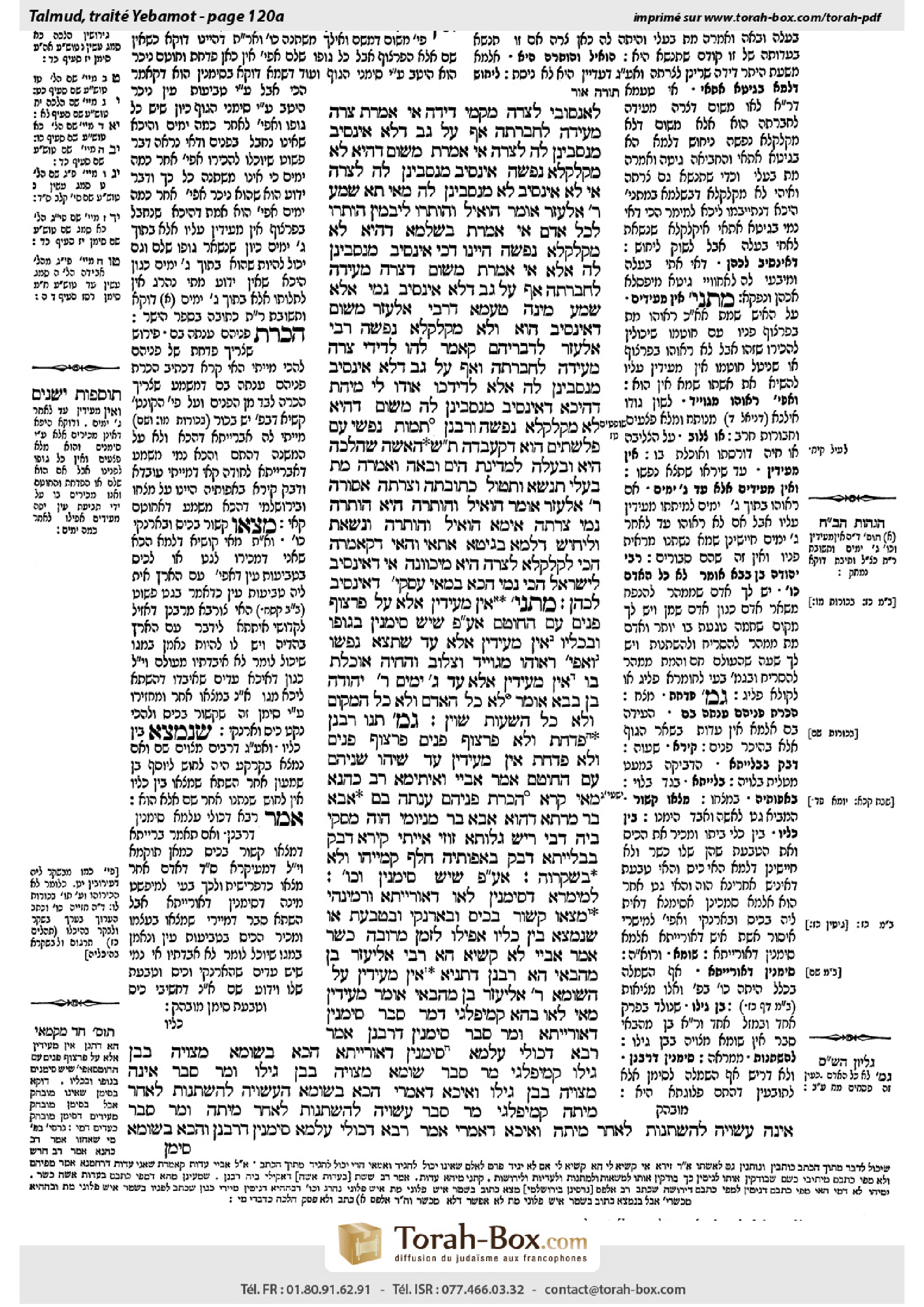
Yevamot 120a: Talmud study for Daf Yomi
Daf Yomi is the daily study of one Talmud folio. Explore 37 tractates with scans, Hebrew text, Sefaria English and AI-generated French translations where annotated.
Passage selection and English or AI-generated French translation are available where the scan has annotations. Daf Study is independent of Torah-Box and Sefaria.
Browse Yevamot · יבמות · All tractatesYevamot 120a text and translations
This page of Yevamot includes the Aramaic text, an English translation and an AI-generated French translation, alongside the scan above.
יבמות ק״כ א · Aramaic and Hebrew text
לְאַנְסוֹבֵי לְצָרָה מִקַּמֵּי דִּידַהּ: אִי אָמְרַתְּ צָרָה מְעִידָה לַחֲבֶרְתָּהּ, אַף עַל גַּב דְּלָא אִינְּסִיב — מַנְסְבִינַן לַהּ לְצָרָה. אִי אָמְרַתְּ מִשּׁוּם דְּהִיא לָא מְקַלְקְלָא נַפְשַׁהּ, אִינְּסִיב — מַנְסְבִינַן לַהּ לְצָרָה, אִי לָא אִינְּסִיב — לָא מַנְסְבִינַן לַהּ.
מַאי? תָּא שְׁמַע, רַבִּי אֶלְעָזָר אוֹמֵר: הוֹאִיל וְהוּתְּרוּ לַיְּבָמִין — הוּתְּרוּ לְכׇל אָדָם. אִי אָמְרַתְּ בִּשְׁלָמָא דְּהִיא לָא מְקַלְקְלָא נַפְשַׁהּ — הַיְינוּ דְּכִי אִינְּסִיב, מַנְסְבִינַן לַהּ,
אֶלָּא אִי אָמְרַתְּ מִשּׁוּם דְּצָרָה מְעִידָה לַחֲבֶרְתָּהּ — אַף עַל גַּב דְּלָא אִינְּסִיב נָמֵי! אֶלָּא שְׁמַע מִינַּהּ טַעְמָא דְּרַבִּי אֶלְעָזָר מִשּׁוּם דְּאִינְּסִיב הוּא, וְלָא מְקַלְקְלָא נַפְשַׁהּ.
רַבִּי אֶלְעָזָר לְדִבְרֵיהֶם קָאָמַר לְהוּ: לְדִידִי, צָרָה מְעִידָה לַחֲבֶרְתָּהּ, וְאַף עַל גַּב דְּלָא אִינְּסִיב — מַנְסְבִינַן לַהּ. אֶלָּא לְדִידְכוּ, אוֹדוֹ לִי מִיהַת דְּהֵיכָא דְּאִינְּסִיב — מַנְסְבִינַן לַהּ, מִשּׁוּם דְּהִיא לָא מְקַלְקְלָא נַפְשַׁהּ. וְרַבָּנַן, ״תָּמוֹת נַפְשִׁי עִם פְּלִשְׁתִּים״ הוּא דְּקָעָבְדָה.
תָּא שְׁמַע: הָאִשָּׁה שֶׁהָלְכָה הִיא וּבַעְלָהּ לִמְדִינַת הַיָּם, וּבָאָה וְאָמְרָה: ״מֵת בַּעְלִי״ — תִּנָּשֵׂא וְתִטּוֹל כְּתוּבָּתָהּ, וְצָרָתָהּ אֲסוּרָה. רַבִּי אֶלְעָזָר אוֹמֵר: הוֹאִיל וְהוּתְּרָה הִיא — הוּתְּרָה נָמֵי צָרָתָהּ. אֵימָא: הוֹאִיל וְהוּתְּרָה וְנִשֵּׂאת.
וְלֵיחוּשׁ דִּלְמָא בְּגִיטָּא אֲתַאי, וְהַאי דְּקָאָמְרָה הָכִי — לְקַלְקוֹלַהּ לְצָרָה הִיא מִיכַּוְּונָה!
אִי דְּאִינְּסִיב לְיִשְׂרָאֵל — הָכִי נָמֵי. הָכָא בְּמַאי עָסְקִינַן, דְּאִינְּסִיב לְכֹהֵן.
מַתְנִי׳ אֵין מְעִידִין אֶלָּא עַל פַּרְצוּף פָּנִים עִם הַחוֹטֶם. אַף עַל פִּי שֶׁיֵּשׁ סִימָנִין בְּגוּפוֹ וּבְכֵלָיו — אֵין מְעִידִין אֶלָּא עַד שֶׁתֵּצֵא נַפְשׁוֹ. וַאֲפִילּוּ רָאוּהוּ מְגוּיָּיד וְצָלוּב וְהַחַיָּה אוֹכֶלֶת בּוֹ — אֵין מְעִידִין אֶלָּא עַד שְׁלֹשָׁה יָמִים.
רַבִּי יְהוּדָה בֶּן בָּבָא אוֹמֵר: לֹא כׇּל הָאָדָם וְלֹא כׇּל הַמָּקוֹם וְלֹא כׇּל הַשָּׁעוֹת שָׁוִין.
גְּמָ׳ תָּנוּ רַבָּנַן: פַּדַּחַת וְלֹא פַּרְצוּף פָּנִים, פַּרְצוּף פָּנִים וְלֹא פַּדַּחַת — אֵין מְעִידִין, עַד שֶׁיְּהוּ שְׁנֵיהֶם עִם הַחוֹטֶם. אָמַר אַבָּיֵי, וְאִיתֵּימָא רַב כָּהֲנָא: מַאי קְרָא — ״הַכָּרַת פְּנֵיהֶם עָנְתָה בָּם״.
אַבָּא בַּר מָרְתָא דְּהוּא אַבָּא בַּר מִנְיוֹמֵי הֲוָה מַסְּקִי בֵּיהּ דְּבֵי רֵישָׁא גָּלוּתָא זוּזֵי. אַיְיתִי קִירָא, דַּבֵּק בִּבְלִייתָא, דַּבֵּק בְּאַפּוּתֵיהּ. חֲלַף קַמַּיְיהוּ וְלָא בַּשְׁקְרוּהּ.
אַף עַל פִּי שֶׁיֵּשׁ סִימָנִין וְכוּ׳. לְמֵימְרָא דְּסִימָנִין לָאו דְּאוֹרָיְיתָא.
וּרְמִינְהִי: מְצָאוֹ קָשׁוּר בְּכִיס וּבְאַרְנָקִי וּבְטַבַּעַת, אוֹ שֶׁנִּמְצָא בֵּין כֵּלָיו, אֲפִילּוּ לִזְמַן מְרוּבֶּה — כָּשֵׁר.
אָמַר אַבָּיֵי, לָא קַשְׁיָא: הָא רַבִּי אֱלִיעֶזֶר בֶּן מַהֲבַאי, הָא רַבָּנַן. דְּתַנְיָא: אֵין מְעִידִין עַל הַשּׁוּמָא. רַבִּי אֱלִיעֶזֶר בֶּן מַהֲבַאי אוֹמֵר: מְעִידִין. מַאי לָאו בְּהָא קָמִיפַּלְגִי, דְּמָר סָבַר סִימָנִין דְּאוֹרָיְיתָא, וּמָר סָבַר סִימָנִין דְּרַבָּנַן?
אָמַר רָבָא: דְּכוּלֵּי עָלְמָא סִימָנִין דְּאוֹרָיְיתָא. הָכָא, בְּשׁוּמָא מְצוּיָה בְּבֶן גִּילוֹ קָמִיפַּלְגִי. מָר סָבַר: שׁוּמָא מְצוּיָה בְּבֶן גִּילוֹ, וּמָר סָבַר: אֵינָהּ מְצוּיָה בְּבֶן גִּילוֹ.
וְאִיכָּא דְּאָמְרִי: הָכָא בְּשׁוּמָא הָעֲשׂוּיָה לְהִשְׁתַּנּוֹת לְאַחַר מִיתָה קָמִיפַּלְגִי. מָר סָבַר: עֲשׂוּיָה לְהִשְׁתַּנּוֹת לְאַחַר מִיתָה. וּמָר סָבַר: אֵינָהּ עֲשׂוּיָה לְהִשְׁתַּנּוֹת לְאַחַר מִיתָה.
וְאִיכָּא דְּאָמְרִי, אָמַר רָבָא: דְּכוּלֵּי עָלְמָא סִימָנִין דְּרַבָּנַן. וְהָכָא, בְּשׁוּמָא
Yevamot 120a · English translation
The Gemara responds that Rabbi Elazar’s reasoning could make a practical difference with regard to allowing the rival wife to marry before the woman herself, i.e., the woman who testified that her husband died, remarries. If you say that according to Rabbi Elazar, one rival wife may testify for another, then although the woman who testified that her husband died has not married, we allow her rival wife to marry. Since the woman’s report is deemed credible with regard to herself, it is also deemed credible with regard to her rival wife. However, if you say that Rabbi Elazar’s reasoning is due to the presumption that she would not cause herself injury, then if she has actually married we may allow her rival wife to marry, but if she has not married, we may not allow her rival wife to marry, in case she lied in order to cause harm to her rival wife.
What is the basis of Rabbi Elazar’s ruling? The Gemara suggests: Come and hear a resolution based upon the wording of the baraita itself: Rabbi Elazar says: Since they were permitted to marry the brothers-in-law, they are now permitted to marry any man. Granted, if you say that his reason is because she would not cause herself injury, this is the reason that if she has actually married, as in this case, where each woman entered into levirate marriage, we may allow her rival wife to marry.
But if you say the reason is because one rival wife may testify for another, then although she herself has not married, it should still be permitted for her rival wife to marry, and it would be unnecessary for Rabbi Elazar to state his opinion in a case where the women had already entered into levirate marriage. Rather, conclude from this that Rabbi Elazar’s reason is because she has already married, and she would not cause herself injury by marrying if her original husband had not died.
The Gemara rejects that and suggests that Rabbi Elazar stated his opinion to the Rabbis in accordance with their own statement, as follows: According to my own opinion, one rival wife may testify for another, and although she, herself, has not married, nevertheless we may allow her rival wife to marry. But even according to your own opinion, admit, in any event, that where she has actually married we may allow her rival wife to marry because she would not cause injury to herself. But the Rabbis, rejecting this, say that she acts upon the premise: “Let me die with the Philistines” (Judges 16:30), i.e., a woman may even harm herself by remarrying while her original husband is still alive, in order to harm her rival wife by causing her to remarry as well.
The Gemara suggests another solution. Come and hear the following baraita: In the case of a woman who went with her husband to a country overseas, and who later came and said: My husband died, she is permitted to marry and collect the widow’s compensation from her marriage contract, but her rival wife is prohibited from doing so. Rabbi Elazar says: Since she is permitted to marry, her rival wife is also permitted. This indicates that Rabbi Elazar holds that the rival wife is permitted to marry because the wife who testified that her husband has died is permitted to do so, even if the latter has not actually remarried yet. The Gemara rejects this proof: Say that Rabbi Elazar means: Since she was permitted and has married.
The Gemara asks: If Rabbi Elazar’s reason is that she would not cause herself injury, how can her rival wife be permitted to marry? Let us be concerned that perhaps she, i.e., the woman who claimed that the husband was dead, came with a bill of divorce and is therefore permitted to remarry though the husband is alive. And the fact that she says this, i.e., that her husband is dead, is intended only to injure her rival wife, who will remarry, thinking that the husband is dead, and will suffer the severe consequences of adultery.
The Gemara then validates this concern. If she actually married an Israelite, which is permitted for a divorced woman, then indeed one must consider the possibility that she is actually divorced and not widowed, and the rival wife is not permitted to marry. However, here we are dealing with a case where she married a priest, who is prohibited from marrying a divorced woman, and therefore she must actually be a widow, as she would not damage herself by entering into a forbidden marriage.
MISHNA: One may testify that a man died only if he can testify about seeing the countenance [partzuf ] of the face with the nose, as this allows one to identify the individual with certainty. Although there are distinguishing marks [simanim] on his body and his personal belongings, which appear to indicate his identity, one may not rely on these as identification. Furthermore, one may not testify that a person died until his soul actually departs. And even if one saw him cut open and severely wounded, or crucified, or with a wild animal eating parts of him, he may not testify that he died. Additionally, one may testify to someone’s death only when the body was witnessed up to three days following death and not after that, since the appearance may change due to decomposition.
Rabbi Yehuda ben Bava says: One cannot establish general guidelines for this matter because not every person, nor every place, nor every hour is identical. Decomposition is not uniform. It occurs at different rates in different situations.
GEMARA: The Sages taught in a baraita: If the witnesses saw his forehead but not the countenance of the face, or if they saw the countenance of the face but not his forehead, they may not testify that it is he, until they see both of them with the nose. Abaye said, and some say it was Rav Kahana who said: What is the verse from which it is derived that one may testify that a man died only if one sees his face? The verse is: “The show of their face does witness against them” (Isaiah 3:9), which indicates that one clearly recognizes another only upon seeing his face.
The Gemara relates that Abba bar Marta, who is also known as Abba bar Minyumi, had been loaned money by members of the Exilarch’s house. Since he did not want to be seen by these violent people, he brought wax [kira], stuck it to a strip of worn-out fabric, and stuck all of that to his forehead in order to alter his appearance. He passed before them and they did not recognize him [beshakru]. This shows how much a person’s face changes when the appearance of his forehead is altered.
§ We learned in the mishna that, although there are distinguishing marks on a dead person’s body and clothing, one may not rely on these as identification. The Gemara asks: Is this to say that distinguishing marks are not recognized as valid identification by Torah law, and while a rabbinic ordinance allows one to rely upon them to remedy certain situations, for testimony about a person’s death, the Sages require the stringencies of Torah law?
But the Gemara raises a contradiction, based upon the following baraita: If an agent charged with delivering a bill of divorce to a woman lost it, and then he found it tied to a purse, or a money bag [arnekei], or a ring, or if it was found among his personal belongings, even after a long time, it is valid, i.e., one may rely upon the distinguishing marks on these objects to positively identify the document, and the agent may then deliver it to the woman. This indicates that distinguishing marks are sufficient to identify an object even by Torah law.
Abaye said: This is not difficult. That baraita is in accordance with the opinion of Rabbi Eliezer ben Mahavai, while this mishna is in accordance with the opinion of the Rabbis; as it is taught in a baraita: One may not testify about a person’s identity based upon the position of a mole on his body. Rabbi Eliezer ben Mahavai says: One may testify based on a mole. What, is it not about this issue that they disagree: One Sage, Rabbi Eliezer ben Mahavai, holds that distinguishing marks are recognized as valid identification by Torah law, and one Sage, the anonymous first tanna, representing the majority of the Rabbis, holds that distinguishing marks are recognized as a means of identification only by rabbinic law and are therefore insufficient to permit a Torah prohibition?
Rava said: It is possible that everyone agrees that distinguishing marks are recognized as valid identification by Torah law, and here they are disagreeing about whether such a mole is commonly found on his peer, i.e., anyone very similar to him, which would undermine its usefulness as a means of identification. One Sage, the anonymous first tanna, holds that such a mole is commonly found on his peer and therefore is not sufficient for identification. And one Sage, Rabbi Eliezer ben Mahavai, holds that it is not commonly found on his peer and is therefore an unambiguous distinguishing mark sufficient for identification.
And there are those who say otherwise: Here they are disagreeing about whether a mole is likely to change in appearance and size after death. One Sage, the anonymous first tanna, holds that it is likely to change after death. It is insufficient for identification because it may have looked different when the person was alive. And one Sage, Rabbi Eliezer ben Mahavai, holds that it is not likely to change after death and is reliable for identification. This marks the end of one version of the discussion about this issue.
And there are those who say that Rava said: Everyone agrees that distinguishing marks are relied upon by rabbinic law. However, this is referring to ordinary distinguishing marks. Marks that are exceptionally unusual may be relied upon even according to Torah law. And here, in the dispute between the Rabbis and Rabbi Eliezer ben Mahavai, it is about whether a mole
Yevamot 120a · Traduction française (IA)
La Guemara répond que le raisonnement de Rabbi Elazar pourrait avoir une conséquence pratique : permettre à la coépouse de se remarier avant que la femme elle-même — c’est-à-dire celle qui a témoigné que son mari était mort — ne se remarie. Si l’on dit que, selon Rabbi Elazar, une coépouse peut témoigner pour une autre, alors, même si la femme qui a témoigné de la mort de son mari ne s’est pas remariée, on autorise sa coépouse à se remarier. Puisque le témoignage de la femme est tenu pour crédible à son propre égard, il l’est aussi à l’égard de sa coépouse. En revanche, si l’on dit que le raisonnement de Rabbi Elazar repose sur la présomption qu’elle ne se causerait pas de tort, alors, si elle s’est effectivement remariée, on peut autoriser sa coépouse à se remarier ; mais si elle ne s’est pas remariée, on ne peut pas autoriser sa coépouse à se remarier, de crainte qu’elle ait menti pour lui nuire.
Sur quoi repose la décision de Rabbi Elazar ? La Guemara propose de résoudre la question à partir de la formulation même de la baraïta : Rabbi Elazar dit : « Puisqu’elles ont été autorisées à épouser leurs beaux-frères, elles sont désormais autorisées à épouser n’importe quel homme. » Il est compréhensible que, si l’on dit que son motif est qu’elle ne se causerait pas de tort, cela explique pourquoi, si elle s’est effectivement remariée — comme dans ce cas, où chacune des femmes est entrée dans un mariage léviratique —, on peut autoriser sa coépouse à se remarier.
Mais si l’on dit que son motif est qu’une coépouse peut témoigner pour une autre, alors, même si elle-même ne s’est pas remariée, sa coépouse devrait tout de même être autorisée à se remarier ; il n’aurait donc pas été nécessaire que Rabbi Elazar exprime son avis dans un cas où les femmes étaient déjà entrées dans un mariage léviratique. Il faut plutôt en conclure que le motif de Rabbi Elazar est qu’elle s’est déjà remariée et qu’elle ne se causerait pas de tort en se remariant si son premier mari n’était pas mort.
La Guemara rejette cette conclusion et propose que Rabbi Elazar ait exposé son avis aux Rabbins en se fondant sur leur propre position, comme suit : « Selon mon avis, une coépouse peut témoigner pour une autre ; même si elle-même ne s’est pas remariée, sa coépouse peut néanmoins être autorisée à se remarier. Mais même selon votre avis, reconnaissez au moins que, si elle s’est effectivement remariée, on peut autoriser sa coépouse à se remarier, car elle ne se causerait pas de tort. » Les Rabbins rejettent cet argument : elle agit selon le principe « Que je meure avec les Philistins » (Juges 16:30), c’est-à-dire qu’une femme peut même se nuire en se remariant alors que son premier mari est encore vivant, afin de nuire à sa coépouse en la poussant elle aussi à se remarier.
La Guemara propose une autre réponse. Écoute la baraïta suivante : dans le cas d’une femme partie avec son mari dans un pays d’outre-mer, puis revenue en déclarant : « Mon mari est mort », elle est autorisée à se remarier et à percevoir la somme due à la veuve en vertu de son contrat de mariage, mais sa coépouse ne l’est pas. Rabbi Elazar dit : « Puisqu’elle est autorisée à se remarier, sa coépouse l’est aussi. » Cela indique que, selon Rabbi Elazar, la coépouse est autorisée à se remarier parce que l’épouse qui a témoigné de la mort de son mari est autorisée à le faire, même si elle-même ne s’est pas encore remariée. La Guemara rejette cette preuve : dis plutôt que Rabbi Elazar veut dire : « Puisqu’elle a été autorisée à se remarier et qu’elle s’est remariée. »
La Guemara demande : Si le motif de Rabbi Elazar est qu’elle ne se causerait pas de tort, comment sa coépouse peut-elle être autorisée à se remarier ? Ne faut-il pas craindre qu’elle — c’est-à-dire la femme qui a prétendu que son mari était mort — soit revenue avec un acte de divorce et soit donc autorisée à se remarier alors que son mari est vivant ? Si elle affirme que son mari est mort, elle pourrait ne le faire que pour nuire à sa coépouse : celle-ci se remarierait en pensant que son mari est mort et subirait les graves conséquences de l’adultère.
La Guemara confirme que cette crainte est fondée. Si elle a effectivement épousé un Israélite — ce qui est permis à une femme divorcée —, il faut en effet envisager la possibilité qu’elle soit divorcée et non veuve, et sa coépouse n’est pas autorisée à se remarier. Mais ici, il s’agit d’un cas où elle a épousé un prêtre, à qui il est interdit d’épouser une femme divorcée ; elle doit donc nécessairement être veuve, car elle ne se serait pas nui en contractant un mariage interdit.
MICHNA : On ne peut témoigner de la mort d’un homme que si l’on a vu les traits [partzuf] de son visage, avec son nez, car cela permet de l’identifier avec certitude. Même s’il existe des signes distinctifs [simanim] sur son corps et sur ses effets personnels, qui semblent indiquer son identité, on ne peut pas s’appuyer sur eux pour l’identifier. En outre, on ne peut témoigner qu’une personne est morte qu’après que son âme l’a effectivement quittée. Même si on l’a vue éventrée et grièvement blessée, crucifiée ou partiellement dévorée par un animal sauvage, on ne peut pas témoigner qu’elle est morte. De plus, on ne peut témoigner de la mort d’une personne que si l’on a vu le corps dans les trois jours qui ont suivi sa mort, et non au-delà, car son apparence peut changer avec la décomposition.
Rabbi Yehuda ben Bava dit : « On ne peut établir de règles générales en la matière, car toutes les personnes, tous les lieux et tous les moments ne sont pas identiques. » La décomposition n’est pas uniforme : elle se produit à des rythmes différents selon les situations.
GUEMARA : Les Sages ont enseigné dans une baraïta : si les témoins ont vu son front, mais pas les traits de son visage, ou s’ils ont vu les traits de son visage, mais pas son front, ils ne peuvent témoigner qu’il s’agit bien de lui avant d’avoir vu les deux, ainsi que son nez. Abaye a dit — et certains disent que c’est Rav Kahana qui l’a dit : Quel verset enseigne qu’on ne peut témoigner de la mort d’un homme que si l’on a vu son visage ? Le verset dit : « L’expression de leur visage témoigne contre eux » (Isaïe 3:9), ce qui indique qu’on ne reconnaît clairement quelqu’un qu’en voyant son visage.
La Guemara raconte qu’Abba bar Marta, également connu sous le nom d’Abba bar Minyumi, avait emprunté de l’argent à des membres de la maison de l’Exilarque. Comme il ne voulait pas être vu par ces hommes violents, il prit de la cire [kira], la colla à une bande de tissu usagé, puis fixa le tout sur son front afin de modifier son apparence. Il passa devant eux, et ils ne le reconnurent pas [beshakru]. Cela montre à quel point l’apparence d’une personne change lorsque celle de son front est modifiée.
§ Nous avons appris dans la Michna que, même s’il existe des signes distinctifs sur le corps et les vêtements d’un mort, on ne peut pas s’appuyer sur eux pour l’identifier. La Guemara demande : Faut-il en déduire que les signes distinctifs ne sont pas reconnus comme un moyen d’identification valable selon la Torah, et que, bien qu’une ordonnance rabbinique permette de s’y fier pour remédier à certaines situations, lorsqu’il s’agit de témoigner de la mort d’une personne, les Sages exigent que l’on applique les rigueurs de la Torah ?
La Guemara soulève toutefois une contradiction à partir de la baraïta suivante : si un agent chargé de remettre un acte de divorce à une femme l’a perdu, puis l’a retrouvé attaché à une bourse, à un sac d’argent [arnekei], à une bague, ou parmi ses effets personnels, même après un long délai, l’acte est valide ; autrement dit, on peut se fier aux signes distinctifs de ces objets pour identifier formellement le document, et l’agent peut alors le remettre à la femme. Cela indique que les signes distinctifs suffisent à identifier un objet même selon la Torah.
Abaye dit : Ce n’est pas difficile. Cette baraïta suit l’opinion de Rabbi Eliezer ben Mahavai, tandis que cette Michna suit celle des Rabbins, comme on l’enseigne dans une baraïta : on ne peut pas témoigner de l’identité d’une personne en se fondant sur l’emplacement d’un grain de beauté sur son corps. Rabbi Eliezer ben Mahavai dit : « On peut témoigner en se fondant sur un grain de beauté. » Ne sont-ils pas en désaccord sur cette question : un Sage, Rabbi Eliezer ben Mahavai, estime que les signes distinctifs sont reconnus comme un moyen d’identification valable selon la Torah, tandis qu’un autre Sage, le premier tanna anonyme, qui représente la majorité des Rabbins, estime qu’ils ne sont reconnus comme moyen d’identification que par décision rabbinique et ne suffisent donc pas à autoriser ce qu’interdit la Torah ?
Rava dit : Il est possible que tous soient d’accord pour reconnaître que les signes distinctifs constituent un moyen d’identification valable selon la Torah, et que leur désaccord porte ici sur le fait de savoir si un grain de beauté de ce type se trouve couramment chez un semblable, c’est-à-dire chez quelqu’un qui lui ressemble beaucoup, ce qui en diminuerait la valeur comme moyen d’identification. Un Sage, le premier tanna anonyme, estime qu’un tel grain de beauté se trouve couramment chez un semblable et ne suffit donc pas à l’identifier. L’autre Sage, Rabbi Eliezer ben Mahavai, estime qu’il ne se trouve pas couramment chez un semblable et constitue donc un signe distinctif sans équivoque, suffisant pour l’identification.
Certains disent une autre version : leur désaccord porte ici sur le fait de savoir si l’apparence et la taille d’un grain de beauté sont susceptibles de changer après la mort. Un Sage, le premier tanna anonyme, estime qu’elles sont susceptibles de changer après la mort. Le grain de beauté ne suffit donc pas à identifier la personne, car il pouvait avoir une apparence différente de son vivant. L’autre Sage, Rabbi Eliezer ben Mahavai, estime qu’il n’est pas susceptible de changer après la mort et qu’il constitue un moyen fiable d’identification. C’est la fin d’une version de la discussion sur cette question.
Certains disent que Rava a formulé une autre opinion : tous sont d’accord pour dire qu’on se fie aux signes distinctifs en vertu du droit rabbinique. Toutefois, cela concerne les signes distinctifs ordinaires. Les signes exceptionnellement inhabituels peuvent être tenus pour fiables même selon la Torah. Et ici, dans le désaccord entre les Rabbins et Rabbi Eliezer ben Mahavai, la question porte sur le fait de savoir si un grain de beauté
Traduction française générée par IA à partir de l’édition anglaise de Sefaria. Vérifie toujours un passage avec le texte source.
Text from Sefaria: William Davidson Edition - Vocalized Aramaic (CC BY NC); William Davidson Edition - English (CC BY NC).