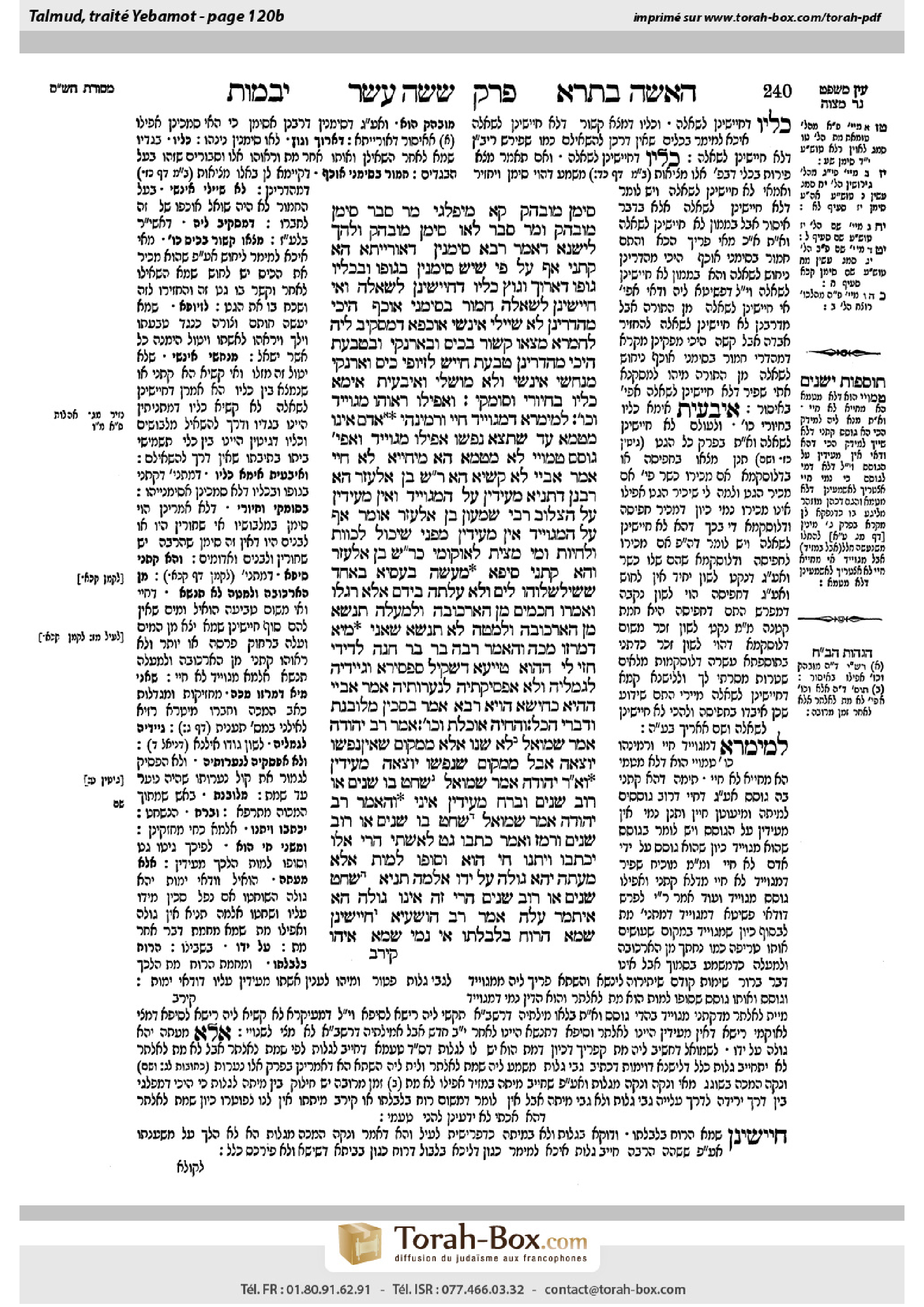
Yevamot 120b: Talmud study for Daf Yomi
Daf Yomi is the daily study of one Talmud folio. Explore 37 tractates with scans, Hebrew text, Sefaria English and AI-generated French translations where annotated.
Passage selection and English or AI-generated French translation are available where the scan has annotations. Daf Study is independent of Torah-Box and Sefaria.
Browse Yevamot · יבמות · All tractatesYevamot 120b text and translations
This page of Yevamot includes the Aramaic text, an English translation and an AI-generated French translation, alongside the scan above.
יבמות ק״כ ב · Aramaic and Hebrew text
סִימָן מוּבְהָק קָא מִיפַּלְגִי. מָר סָבַר סִימָן מוּבְהָק, וּמָר סָבַר לָאו סִימָן מוּבְהָק.
וּלְהַךְ לִישָּׁנָא דְּאָמַר רָבָא סִימָנִין דְּאוֹרָיְיתָא, הָא קָתָנֵי: אַף עַל פִּי שֶׁיֵּשׁ סִימָנִין בְּגוּפוֹ וּבְכֵלָיו!
גּוּפוֹ — דְּאָרוֹךְ וְגוּץ. כֵּלָיו — דְּחָיְישִׁינַן לִשְׁאֵלָה. וְאִי חָיְישִׁינַן לִשְׁאֵלָה, חֲמוֹר בְּסִימָנֵי אוּכָּף הֵיכִי מַהְדְּרִינַן?
לָא שָׁיְילִי אִינָשֵׁי אוּכָּפָא, דִּמְסַקֵּיב לֵיהּ לַחֲמָרָא. מְצָאוֹ קָשׁוּר בְּכִיס וּבְאַרְנָקִי וּבְטַבַּעַת, הֵיכִי מַהְדְּרִינַן?
טַבַּעַת — חָיְישִׁי לְזַיּוֹפֵי. כִּיס וְאַרְנָקִי — מְנַחֲשִׁי אִינָשֵׁי וְלָא מוֹשְׁלִי. וְאִיבָּעֵית אֵימָא: כֵּלָיו, בְּחִיוָּרֵי וְסוּמָּקֵי.
וַאֲפִילּוּ רָאוּהוּ מְגוּיָּיד וְכוּ׳. לְמֵימְרָא דִּמְגוּיָּיד חָיֵי? וּרְמִינְהִי: אָדָם אֵינוֹ מְטַמֵּא עַד שֶׁתֵּצֵא נַפְשׁוֹ, אֲפִילּוּ מְגוּיָּיד, וַאֲפִילּוּ גּוֹסֵס. טַמּוֹיֵי לָא מְטַמֵּא, הָא מִיחְיָיא — לָא חָיֵי!
אָמַר אַבָּיֵי, לָא קַשְׁיָא: הָא רַבִּי שִׁמְעוֹן בֶּן אֶלְעָזָר, הָא רַבָּנַן, דְּתַנְיָא: מְעִידִין עַל הַמְגוּיָּיד, וְאֵין מְעִידִין עַל הַצָּלוּב. רַבִּי שִׁמְעוֹן בֶּן אֶלְעָזָר אוֹמֵר: אַף עַל הַמְגוּיָּיד אֵין מְעִידִין, מִפְּנֵי שֶׁיָּכוֹל לִכָּווֹת וְלִחְיוֹת.
וּמִי מָצֵית לְאוֹקוֹמֵי כְּרַבִּי שִׁמְעוֹן בֶּן אֶלְעָזָר? וְהָא קָתָנֵי סֵיפָא: מַעֲשֶׂה בְּעַסְיָא בְּאֶחָד שֶׁשִּׁילְשְׁלוּהוּ לַיָּם, וְלֹא עָלְתָה בְּיָדָם אֶלָּא רַגְלוֹ, וְאָמְרוּ חֲכָמִים: מִן הָאַרְכּוּבָּה וּלְמַעְלָה — תִּנָּשֵׂא, מִן הָאַרְכּוּבָּה וּלְמַטָּה — לֹא תִּנָּשֵׂא.
שָׁאנֵי מַיָּא דְּמַרְזוּ מַכָּה.
וְהָאָמַר רַבָּה בַּר בַּר חָנָה: לְדִידִי חֲזֵי לִי הַהוּא טַיָּיעָא דְּשָׁקֵיל סַפְסִירָא וְגַיְּידֵיהּ לְגַמְלֵיהּ, וְלָא אַפְסֵיקְתַּיהּ לְנַעֲרוּתֵיהּ! אָמַר אַבָּיֵי: הָהִיא כְּחִישָׁא הַוְיָא.
רָבָא אָמַר: בְּסַכִּין מְלוּבֶּנֶת, וְדִבְרֵי הַכֹּל.
וְהַחַיָּה אוֹכֶלֶת וְכוּ׳. אָמַר רַב יְהוּדָה אָמַר שְׁמוּאֵל: לֹא שָׁנוּ אֶלָּא מִמָּקוֹם שֶׁאֵין נַפְשׁוֹ יוֹצְאָה, אֲבָל מִמָּקוֹם שֶׁנַּפְשׁוֹ יוֹצְאָה — מְעִידִין.
וְאָמַר רַב יְהוּדָה אָמַר שְׁמוּאֵל: שָׁחַט בּוֹ שְׁנַיִם, אוֹ רוֹב שְׁנַיִם, וּבָרַח — מְעִידִין.
אִינִי? וְהָאָמַר רַב יְהוּדָה אָמַר שְׁמוּאֵל: שָׁחַט בּוֹ שְׁנַיִם אוֹ רוֹב שְׁנַיִם, וְרָמַז וְאָמַר: ״כִּתְבוּ גֵּט לְאִשְׁתִּי״ — הֲרֵי אֵלּוּ יִכְתְּבוּ וְיִתְּנוּ. חַי הוּא, וְסוֹפוֹ לָמוּת.
אֶלָּא מֵעַתָּה, יְהֵא גּוֹלֶה עַל יָדוֹ. אַלְּמָה תַּנְיָא: שָׁחַט שְׁנַיִם אוֹ רוֹב שְׁנַיִם — הֲרֵי זֶה אֵינוֹ גּוֹלֶה! הָא אִיתְּמַר עֲלַהּ, אָמַר רַב הוֹשַׁעְיָא: חָיְישִׁינַן שֶׁמָּא הָרוּחַ בִּלְבְּלַתּוּ. אִי נָמֵי, שֶׁמָּא אִיהוּ
Yevamot 120b · English translation
is an unambiguous distinguishing mark that they disagree. One Sage, Rabbi Eliezer ben Mahavai, holds that a mole is an unambiguous distinguishing mark and may be relied upon by Torah law. Consequently, if a man’s corpse was identified in this manner, his wife may remarry. And one Sage, the anonymous first tanna, holds that a mole is not an unambiguous distinguishing mark.
The Gemara asks: According to the first version, that Rava said that distinguishing marks are recognized as valid identification by Torah law, there is a question: Isn’t it taught in the mishna: Although there are distinguishing marks on his body and his personal belongings, one may not rely on these as identification, implying that distinguishing marks are not valid identification by Torah law?
The Gemara answers: The mishna’s intent is that ordinary distinguishing marks on one’s body, which constitute only weak evidence to a person’s identity, e.g., that he was tall or short, are not valid identification. Additionally, one cannot rely upon distinguishing marks on his personal belongings, as we are concerned about borrowing, i.e., perhaps the deceased had borrowed the clothes he was wearing from someone else. The Gemara asks: But if we are concerned about borrowing, then, with regard to returning lost property, how can we return a donkey based solely upon distinguishing marks on the saddle? Why don’t we consider the possibility that the saddle was borrowed?
The Gemara answers: People do not normally borrow a saddle because it bruises the donkey, as the saddle must fit exactly to the donkey’s measurements. The Gemara raises further objections based upon the baraita cited earlier: If he found the lost bill of divorce tied to a purse, or a money bag, or a ring, he may rely upon the distinguishing marks on those items and deliver the bill of divorce to the woman. But how can we return it and not be concerned that these belongings may have been lent to someone else whose bill of divorce is tied to them?
The Gemara answers: The case of the ring is referring to a signet ring, which one does not lend, because he is concerned about forgery, i.e., that the borrower might use it to forge his consent on documents without his knowledge. With regard to a purse or a money bag, people consider it a bad omen to lend them out and do not lend them to others. And if you wish, say that the reason not to permit a woman to remarry and not to accept that her husband is dead based upon the distinguishing marks found on his personal belongings is that the distinguishing marks referred to are only general ones, e.g., he wore white or red clothing, but they are not unambiguous distinguishing marks.
§ We learned in the mishna: And even if one saw him cut open [meguyyad] and severely wounded, one may not testify that he died. The Gemara asks: Is this to say that a person who is cut open is fit to live for much time afterward? The Gemara raises a contradiction from what was taught in a mishna (Oholot 1:6): A dead person renders other people and objects impure only when his soul actually departs, even if he is cut open and severely wounded, and even if he is clearly dying. From this we may deduce that he does not yet render others ritually impure, as he still has some life in him, but he is not fit to live for much time afterward.
Abaye said: The contradiction raised is not difficult: This mishna here is in accordance with the opinion of Rabbi Shimon ben Elazar, while that mishna from tractate Oholot is in accordance with the opinion of the Rabbis, as it is taught in a baraita: One may testify about the death of a person who is cut open, but one may not testify about a crucified person. Rabbi Shimon ben Elazar says: Even concerning a person who is cut open, one may not testify that he is dead because his wound can be scorched, and this cauterization of the wound may stop the flow of blood and allow him to survive.
The Gemara challenges this: But can you establish the mishna to be in accordance with the opinion of Rabbi Shimon ben Elazar? Isn’t it taught in the latter clause (121a): An incident occurred in Asya in which they lowered a certain man into the sea on a rope, and when they pulled the rope back to land only his leg came up in their hands. They were not certain whether he was alive or dead. The Sages said: If his leg was cut from the knee and above, his wife may marry, as he would not survive such a wound; if his leg was cut only from the knee and below, she may not marry. This indicates that someone cut open in the first manner is assumed to be dead. If this follows Rabbi Shimon ben Elazar’s opinion, why doesn’t it say that there is a concern that he might be alive even if the leg was cut from the knee and above?
The Gemara answers: Water is different, as it aggravates the wound. Since he was in the water, it can be assumed that such a wound will certainly lead to death.
The Gemara asks: But didn’t Rabba bar bar Ḥanna say: I myself saw an Arab who took his sword [safseira] and cut open his camel, and the camel died so quickly that it could not even cease its braying before it died? This indicates that a living being that is cut open has no chance of surviving. Abaye said: That camel was emaciated and weak, causing it to die immediately, but a normal camel would not have died so quickly.
Rava said a different resolution to the apparent contradiction between the mishna here and the mishna in tractate Oholot: The mishna here is referring to a case where the man was cut open with a white-hot knife, and everyone agrees that one may not testify to the death of a person wounded in such a manner, as the wound would close due to the heat.
§ It was taught in the mishna: Or even if one saw that a wild animal was eating parts of him, one may not testify that he died. Rav Yehuda said that Shmuel said: They taught this only where the animal was eating from a place on his body that does not cause his soul to depart, i.e., does not inevitably lead to death, such as his hand or foot. But if the animal was eating from a place on his body that does cause his soul to depart, one may testify to his death.
And Rav Yehuda said that Shmuel said: If someone cut a man’s two passageways, the trachea and the esophagus, or most of the way through the two passageways, and the maimed person fled, one may testify to his death.
The Gemara challenges that conclusion: Is that so? But didn’t Rav Yehuda say that Shmuel said: If someone cut a man’s two passageways, or most of the way through the two passageways, and the maimed person gestured and thereby communicated: Write a bill of divorce for my wife, then these onlookers should write it and deliver it to her. Since only a living person may give a bill of divorce, this indicates that the maimed man is considered alive. The Gemara answers: He is still alive at the moment, but he will eventually die from the wound. Consequently, he may appoint an agent to deliver a bill of divorce to his wife, but after a while one may testify that he is dead.
The Gemara asks: If that is so, that such a wound is definitely fatal, one who unintentionally wounds another in this manner should be exiled on his account, in accordance with the halakha of one who unintentionally kills another. Why is it taught in a baraita: If one unintentionally cut the two passageways of another person, or most of the thickness of the two, he is not exiled? The Gemara answers: But it was stated with regard to that baraita that Rav Hoshaya said: We are concerned that perhaps the wind aggravated his condition and actually caused his death, in which case the perpetrator is not culpable for the death and should not be exiled. Alternatively, perhaps he, the maimed person,
Yevamot 120b · Traduction française (IA)
est un signe distinctif sans équivoque qui explique leur désaccord. Un Sage, Rabbi Eliezer ben Mahavai, estime qu’un grain de beauté est un signe distinctif sans équivoque et que l’on peut s’y fier selon la Torah. Par conséquent, si le corps d’un homme a été identifié de cette manière, sa femme peut se remarier. L’autre Sage, le premier tanna anonyme, estime qu’un grain de beauté n’est pas un signe distinctif sans équivoque.
La Guemara demande : Selon la première version, où Rava a dit que les signes distinctifs sont reconnus comme un moyen d’identification valable selon la Torah, une difficulté se pose : n’est-il pas enseigné dans la Michna : « Même s’il y a des signes distinctifs sur son corps et sur ses effets personnels, on ne peut pas s’y fier pour l’identifier » ? Cela implique que les signes distinctifs ne constituent pas un moyen d’identification valable selon la Torah.
La Guemara répond : La Michna veut dire que les signes distinctifs ordinaires sur le corps, qui ne fournissent qu’un indice faible quant à l’identité d’une personne — par exemple, le fait qu’elle était grande ou petite —, ne constituent pas un moyen d’identification valable. De plus, on ne peut pas se fier aux signes distinctifs de ses effets personnels, car on craint qu’ils aient été empruntés, c’est-à-dire que le défunt ait peut-être emprunté à quelqu’un d’autre les vêtements qu’il portait. La Guemara demande : Mais si l’on craint les emprunts, alors, lorsqu’il s’agit de restituer un objet perdu, comment peut-on rendre un âne en se fondant uniquement sur les signes distinctifs de sa selle ? Pourquoi ne pas envisager que la selle ait été empruntée ?
La Guemara répond : En général, les gens n’empruntent pas de selle, car elle blesse l’âne si elle n’est pas parfaitement adaptée à ses mensurations. La Guemara soulève d’autres objections à partir de la baraïta citée précédemment : Si quelqu’un trouve l’acte de divorce perdu, attaché à une bourse, à un sac d’argent ou à une bague, il peut se fier aux signes distinctifs de ces objets et remettre l’acte de divorce à la femme. Mais comment peut-on le restituer sans craindre que ces effets personnels aient été prêtés à quelqu’un d’autre, auquel serait attaché son propre acte de divorce ?
La Guemara répond : Dans le cas de la bague, il s’agit d’une chevalière, que l’on ne prête pas, car on craint la falsification : l’emprunteur pourrait s’en servir pour apposer à l’insu du propriétaire une fausse approbation sur des documents. Quant à une bourse ou à un sac d’argent, les gens considèrent que les prêter porte malheur et ne les prêtent donc pas à autrui. Et si tu le souhaites, dis plutôt que la raison pour laquelle on ne permet pas à une femme de se remarier et que l’on n’admet pas que son mari soit mort sur la foi des signes distinctifs relevés sur ses effets personnels est que les signes distinctifs en question ne sont que des indications générales — par exemple, qu’il portait des vêtements blancs ou rouges — et non des signes distinctifs sans équivoque.
§ Nous avons appris dans la Michna : « Et même si l’on a vu qu’il était éventré [meguyyad] et grièvement blessé, on ne peut pas témoigner qu’il est mort. » La Guemara demande : Cela signifie-t-il qu’une personne éventrée peut rester longtemps en vie après cela ? La Guemara soulève une contradiction à partir de ce qui est enseigné dans une Michna (Oholot 1:6) : Un mort ne rend les personnes et les objets impurs que lorsque son âme le quitte effectivement, même s’il est éventré et grièvement blessé, et même s’il est manifestement à l’agonie. On peut en déduire qu’il ne rend pas encore les autres rituellement impurs, car il lui reste un souffle de vie ; pourtant, il ne peut pas rester longtemps en vie.
Abayé dit : La contradiction soulevée n’est pas difficile à résoudre : cette Michna-ci suit l’opinion de Rabbi Shimon ben Elazar, tandis que la Michna du traité Oholot suit celle des Rabbins, comme il est enseigné dans une baraïta : On peut témoigner de la mort d’une personne éventrée, mais on ne peut pas témoigner de la mort d’une personne crucifiée. Rabbi Shimon ben Elazar dit : Même au sujet d’une personne éventrée, on ne peut pas témoigner qu’elle est morte, car sa plaie peut être cautérisée ; cette cautérisation peut arrêter l’écoulement du sang et lui permettre de survivre.
La Guemara objecte : Mais peut-on établir que la Michna suit l’opinion de Rabbi Shimon ben Elazar ? N’est-il pas enseigné dans la dernière partie de la Michna (121a) : Un événement s’est produit à Asya : on avait descendu un homme dans la mer au bout d’une corde et, lorsqu’on a ramené la corde à terre, seule sa jambe est remontée entre leurs mains. Ils ne savaient pas s’il était vivant ou mort. Les Sages ont dit : Si sa jambe avait été coupée au-dessus du genou, sa femme peut se remarier, car il ne pourrait pas survivre à une telle blessure ; si sa jambe avait été coupée seulement au-dessous du genou, elle ne peut pas se remarier. Cela indique qu’une personne éventrée de la première manière est présumée morte. Si ce passage suit l’opinion de Rabbi Shimon ben Elazar, pourquoi ne dit-on pas qu’il est à craindre qu’elle soit encore en vie, même si sa jambe a été coupée au-dessus du genou ?
La Guemara répond : L’eau constitue un cas différent, car elle aggrave la blessure. Puisqu’il était dans l’eau, on peut supposer qu’une telle blessure entraînera certainement la mort.
La Guemara demande : Mais Rabba bar bar Ḥanna n’a-t-il pas dit : « J’ai moi-même vu un Arabe prendre son épée [safseira] et éventrer son chameau ; celui-ci mourut si rapidement qu’il n’eut même pas le temps d’interrompre ses braiments avant de mourir » ? Cela indique qu’un être vivant éventré n’a aucune chance de survivre. Abayé dit : Ce chameau était émacié et faible, ce qui causa sa mort immédiate ; mais un chameau ordinaire ne serait pas mort aussi vite.
Rava propose une autre résolution de la contradiction apparente entre la Michna ici et celle du traité Oholot : la Michna ici traite d’un cas où l’homme a été éventré avec un couteau chauffé à blanc, et tous conviennent qu’on ne peut pas témoigner de la mort d’une personne blessée de cette manière, car la chaleur refermerait la plaie.
§ Il a été enseigné dans la Michna : « Ou même si l’on a vu qu’un animal sauvage dévorait des parties de son corps, on ne peut pas témoigner qu’il est mort. » Rav Yehouda a dit au nom de Shmuel : Cela n’a été enseigné que lorsque l’animal dévorait une partie du corps dont la blessure n’entraîne pas nécessairement la mort, comme la main ou le pied. Mais si l’animal dévorait une partie du corps dont la blessure entraîne la mort, on peut témoigner qu’il est mort.
Et Rav Yehouda a dit au nom de Shmuel : Si quelqu’un a tranché les deux conduits d’un homme — la trachée et l’œsophage — ou en a tranché la majeure partie, et que le blessé s’est enfui, on peut témoigner de sa mort.
La Guemara conteste cette conclusion : Est-ce bien ainsi ? Mais Rav Yehouda n’a-t-il pas dit au nom de Shmuel : Si quelqu’un a tranché les deux conduits d’un homme, ou en a tranché la majeure partie, et que le blessé a fait un signe pour communiquer : « Écrivez un acte de divorce pour ma femme », les personnes présentes doivent l’écrire et le lui remettre. Puisqu’une personne ne peut donner un acte de divorce que si elle est vivante, cela indique que l’homme blessé est considéré comme vivant. La Guemara répond : Il est encore vivant à cet instant, mais il finira par mourir de sa blessure. Il peut donc désigner un mandataire pour remettre un acte de divorce à sa femme, mais, quelque temps après, on peut témoigner de sa mort.
La Guemara demande : S’il en est ainsi, et si une telle blessure est certainement mortelle, celui qui blesse involontairement quelqu’un de cette manière devrait être exilé pour cela, conformément à la halakha applicable à celui qui tue involontairement autrui. Pourquoi est-il enseigné dans une baraïta : Si quelqu’un a involontairement tranché les deux conduits d’une autre personne, ou en a tranché la majeure partie, il n’est pas exilé ? La Guemara répond : Or, Rav Hoshaya a dit à propos de cette baraïta : Nous craignons que le vent ait aggravé son état et ait effectivement causé sa mort, auquel cas l’auteur de la blessure n’est pas responsable de cette mort et ne doit pas être exilé. Autre possibilité : peut-être que lui, le blessé,
Traduction française générée par IA à partir de l’édition anglaise de Sefaria. Vérifie toujours un passage avec le texte source.
Text from Sefaria: William Davidson Edition - Vocalized Aramaic (CC BY NC); William Davidson Edition - English (CC BY NC).