Yevamot 121a: Talmud study for Daf Yomi
Daf Yomi is the daily study of one Talmud folio. Explore 37 tractates with scans, Hebrew text, Sefaria English and AI-generated French translations where annotated.
Passage selection and English or AI-generated French translation are available where the scan has annotations. Daf Study is independent of Torah-Box and Sefaria.
Browse Yevamot · יבמות · All tractatesYevamot 121a text and translations
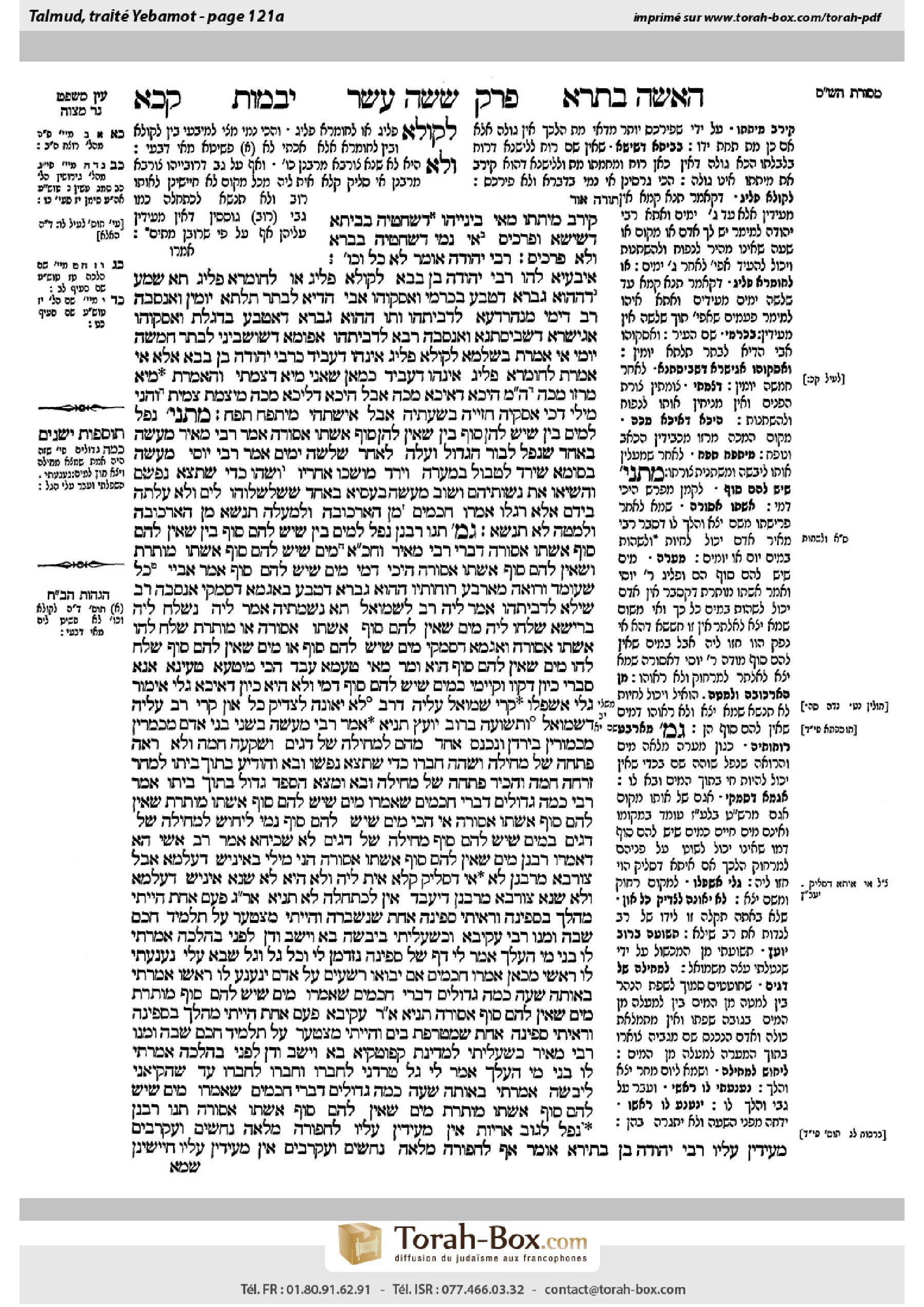
This page of Yevamot includes the Aramaic text, an English translation and an AI-generated French translation, alongside the scan above.
יבמות קכ״א א · Aramaic and Hebrew text
קֵירַב מִיתָתוֹ. מַאי בֵּינַיְיהוּ?
דְּשַׁחְטֵיהּ בְּבֵיתָא דְשֵׁישָׁא וּפַרְכֵּיס. אִי נָמֵי: דְּשַׁחְטֵיהּ בְּבָרָא וְלָא פַּרְכֵּיס.
רַבִּי יְהוּדָה אוֹמֵר: לֹא כָּל וְכוּ׳. אִיבַּעְיָא לְהוּ: רַבִּי יְהוּדָה בֶּן בָּבָא לְקוּלָּא פְּלִיג, אוֹ לְחוּמְרָא פְּלִיג.
תָּא שְׁמַע: דְּהָהוּא גַּבְרָא דְּטָבַע בְּכַרְמֵי, וְאַסְּקוּהוּ אַבֵּי הֲדָיָא לְבָתַר תְּלָתָא יוֹמִין, וְאַנְסְבַהּ רַב דִּימִי מִנְּהַרְדְּעָא לִדְבֵיתְהוּ. וְתוּ: הָהוּא גַּבְרָא דִּאטְבַע בְּדִגְלַת, וְאַסְּקוּהוּ אַגִּישְׁרָא דְּשַׁבִּיסְתָּנָא, וְאַנְסְבַהּ רָבָא לִדְבֵיתְהוּ אַפּוּמָּא דְשׁוֹשְׁבִינֵי לְבָתַר חַמְשָׁה יוֹמֵי.
אִי אָמְרַתְּ בִּשְׁלָמָא לְקוּלָּא פְּלִיג, אִינְהוּ דַּעֲבוּד כְּרַבִּי יְהוּדָה בֶּן בָּבָא. אֶלָּא אִי אָמְרַתְּ לְחוּמְרָא פְּלִיג, אִינְהוּ דַּעֲבוּד כְּמַאן? שָׁאנֵי מַיָּא, דְּצָמְתִי.
וְהָאָמְרַתְּ מַיָּא מַרְזוּ מַכָּה! הָנֵי מִילֵּי הֵיכָא דְּאִיכָּא מַכָּה, אֲבָל הֵיכָא דְּלֵיכָּא מַכָּה — מִיצְמָת צָמֵית. וְהָנֵי מִילֵּי דְּכִי אַסְּקֵיהּ חַזְיֵיהּ בְּשַׁעְתֵּיהּ. אֲבָל אִישְׁתַּהִי, מִיתְפָּח תָּפַח.
מַתְנִי׳ נָפַל לְמַיִם, בֵּין שֶׁיֵּשׁ לָהֶן סוֹף, בֵּין שֶׁאֵין לָהֶן סוֹף — אִשְׁתּוֹ אֲסוּרָה. אָמַר רַבִּי מֵאִיר: מַעֲשֶׂה בְּאֶחָד שֶׁנָּפַל לְבוֹר הַגָּדוֹל, וְעָלָה לְאַחַר שְׁלֹשָׁה יָמִים.
אָמַר רַבִּי יוֹסֵי: מַעֲשֶׂה בְּסוֹמֵא שֶׁיָּרַד לִטְבּוֹל בִּמְעָרָה, וְיָרַד מוֹשְׁכוֹ אַחֲרָיו, וְשָׁהוּ כְּדֵי שֶׁתֵּצֵא נַפְשָׁם — וְהִשִּׂיאוּ אֶת נְשׁוֹתֵיהֶם. וְשׁוּב מַעֲשֶׂה בְּעַסְיָא, בְּאֶחָד שֶׁשִּׁלְשְׁלוּהוּ לַיָּם, וְלֹא עָלְתָה בְּיָדָם אֶלָּא רַגְלוֹ, אָמְרוּ חֲכָמִים: מִן הָאַרְכּוּבָּה וּלְמַעְלָה — תִּנָּשֵׂא. מִן הָאַרְכּוּבָּה וּלְמַטָּה — לֹא תִּנָּשֵׂא.
גְּמָ׳ תָּנוּ רַבָּנַן: נָפַל לַמַּיִם, בֵּין שֶׁיֵּשׁ לָהֶם סוֹף, בֵּין שֶׁאֵין לָהֶם סוֹף — אִשְׁתּוֹ אֲסוּרָה, דִּבְרֵי רַבִּי מֵאִיר. וַחֲכָמִים אוֹמְרִים: מַיִם שֶׁיֵּשׁ לָהֶם סוֹף — אִשְׁתּוֹ מוּתֶּרֶת, וְשֶׁאֵין לָהֶם סוֹף — אִשְׁתּוֹ אֲסוּרָה.
הֵיכִי דָּמֵי מַיִם שֶׁיֵּשׁ לָהֶם סוֹף? אָמַר אַבָּיֵי: כֹּל שֶׁעוֹמֵד וְרוֹאֶה מֵאַרְבַּע רוּחוֹתָיו.
הָהוּא גַּבְרָא דִּטְבַע בְּאַגְמָא דְסַמְקֵי, אַנְסְבַהּ רַב שֵׁילָא לִדְבֵיתְהוּ. אֲמַר לֵיהּ רַב לִשְׁמוּאֵל, תָּא נְשַׁמְּתֵיהּ. אֲמַר לֵיהּ: נִשְׁלַח לֵיהּ בְּרֵישָׁא.
שְׁלַחוּ לֵיהּ: מַיִם שֶׁאֵין לָהֶם סוֹף, אִשְׁתּוֹ אֲסוּרָה אוֹ מוּתֶּרֶת? שְׁלַח לְהוּ: אִשְׁתּוֹ אֲסוּרָה. וְאַגְמָא דְסַמְקֵי — מַיִם שֶׁיֵּשׁ לָהֶם סוֹף, אוֹ מַיִם שֶׁאֵין לָהֶם סוֹף? שְׁלַח לְהוּ: מַיִם שֶׁאֵין לָהֶם סוֹף הוּא. וּמָר, מַאי טַעְמָא עֲבַד הָכִי?
מִיטְעָא טְעֵינָא, אֲנָא סְבַרִי כֵּיוָן דִּקְווּ וְקָיְימִי — כְּמַיִם שֶׁיֵּשׁ לָהֶם סוֹף דָּמֵי, וְלָא הִיא: כֵּיוָן דְּאִיכָּא גַּלֵּי — אֵימוֹר גַּלֵּי אַשְׁפְּלוּ[הּ].
קָרֵי שְׁמוּאֵל עֲלֵיהּ דְּרַב: ״לֹא יְאוּנֶּה לַצַּדִּיק כׇּל אָוֶן״. קָרֵי רַב עֲלֵיהּ דִּשְׁמוּאֵל: ״וּתְשׁוּעָה בְּרוֹב יוֹעֵץ״.
תַּנְיָא, אָמַר רַבִּי: מַעֲשֶׂה בִּשְׁנֵי בְּנֵי אָדָם מְכַמְּרִין מִכְמוֹרִין בַּיַּרְדֵּן, וְנִכְנַס אֶחָד מֵהֶם לִמְחִילָּה שֶׁל דָּגִים, וְשָׁקְעָה חַמָּה וְלֹא רָאָה פִּתְחָהּ שֶׁל מְחִילָּה, וְשָׁהָה חֲבֵרוֹ כְּדֵי שֶׁתֵּצֵא נַפְשׁוֹ, וּבָא וְהוֹדִיעַ בְּתוֹךְ בֵּיתוֹ. לְמָחָר, זָרְחָה חַמָּה וְהִכִּיר פִּתְחָהּ שֶׁל מְחִילָּה, וּבָא וּמָצָא הֶסְפֵּד גָּדוֹל בְּתוֹךְ בֵּיתוֹ. אָמַר רַבִּי: כַּמָּה גְּדוֹלִים דִּבְרֵי חֲכָמִים, שֶׁאָמְרוּ: מַיִם שֶׁיֵּשׁ לָהֶם סוֹף — אִשְׁתּוֹ מוּתֶּרֶת, שֶׁאֵין לָהֶם סוֹף — אִשְׁתּוֹ אֲסוּרָה.
אִי הָכִי, מַיִם שֶׁיֵּשׁ לָהֶם סוֹף נָמֵי, לֵיחוּשׁ לִמְחִילָּה שֶׁל דָּגִים! בְּמַיִם שֶׁיֵּשׁ לָהֶם סוֹף מְחִילָּה שֶׁל דָּגִים לָא שְׁכִיחָא.
אָמַר רַב אָשֵׁי: הָא דַּאֲמַרוּ רַבָּנַן מַיִם שֶׁאֵין לָהֶם סוֹף אִשְׁתּוֹ אֲסוּרָה — הָנֵי מִילֵּי בְּאִינִישׁ דְּעָלְמָא, אֲבָל צוּרְבָּא מֵרַבָּנַן — לָא. אִי דִּסְלֵיק — קָלָא אִית לֵיהּ. וְלָא הִיא: לָא שְׁנָא אִינִישׁ דְּעָלְמָא, וְלָא שְׁנָא צוּרְבָּא מֵרַבָּנַן, דִּיעֲבַד — אִין, לְכַתְּחִלָּה — לָא.
תַּנְיָא, אָמַר רַבָּן גַּמְלִיאֵל: פַּעַם אַחַת הָיִיתִי מְהַלֵּךְ בִּסְפִינָה, וְרָאִיתִי סְפִינָה אַחַת שֶׁנִּשְׁבְּרָה. וְהָיִיתִי מִצְטַעֵר עַל תַּלְמִיד חָכָם שֶׁבָּהּ, וּמַנּוּ — רַבִּי עֲקִיבָא. וּכְשֶׁעָלִיתִי בַּיַּבָּשָׁה, בָּא וְיָשַׁב וְדָן לְפָנַי בַּהֲלָכָה. אָמַרְתִּי לוֹ: בְּנִי, מִי הֶעֶלְךָ? אָמַר לִי: דַּף שֶׁל סְפִינָה נִזְדַּמֵּן לִי, וְכׇל גַּל וְגַל שֶׁבָּא עָלַי — נִעְנַעְתִּי לוֹ רֹאשִׁי.
מִכָּאן אָמְרוּ חֲכָמִים: אִם יָבוֹאוּ רְשָׁעִים עַל אָדָם — יְנַעְנֵעַ לוֹ רֹאשׁוֹ. אָמַרְתִּי בְּאוֹתָהּ שָׁעָה: כַּמָּה גְּדוֹלִים דִּבְרֵי חֲכָמִים, שֶׁאָמְרוּ: מַיִם שֶׁיֵּשׁ לָהֶם סוֹף — מוּתֶּרֶת, מַיִם שֶׁאֵין לָהֶם סוֹף — אֲסוּרָה.
תַּנְיָא, אָמַר רַבִּי עֲקִיבָא: פַּעַם אַחַת הָיִיתִי מְהַלֵּךְ בִּסְפִינָה, וְרָאִיתִי סְפִינָה אַחַת שֶׁמִּטָּרֶפֶת בַּיָּם, וְהָיִיתִי מִצְטַעֵר עַל תַּלְמִיד חָכָם שֶׁבָּהּ, וּמַנּוּ — רַבִּי מֵאִיר. כְּשֶׁעָלִיתִי לִמְדִינַת קַפּוֹטְקְיָא, בָּא וְיָשַׁב וְדָן לְפָנַי בַּהֲלָכָה. אָמַרְתִּי לוֹ: בְּנִי, מִי הֶעֶלְךָ? אָמַר לִי: גַּל טְרָדַנִי לַחֲבֵרוֹ, וַחֲבֵרוֹ לַחֲבֵרוֹ, עַד שֶׁהֱקִיאַנִי לַיַּבָּשָׁה. אָמַרְתִּי בְּאוֹתָהּ שָׁעָה: כַּמָּה גְּדוֹלִים דִּבְרֵי חֲכָמִים, שֶׁאָמְרוּ: מַיִם שֶׁיֵּשׁ לָהֶם סוֹף — אִשְׁתּוֹ מוּתֶּרֶת, מַיִם שֶׁאֵין לָהֶם סוֹף — אִשְׁתּוֹ אֲסוּרָה.
תָּנוּ רַבָּנַן: נָפַל לְגוֹב אֲרָיוֹת — אֵין מְעִידִין עָלָיו. לַחֲפוּרָה מְלֵאָה נְחָשִׁים וְעַקְרַבִּים — מְעִידִין עָלָיו. רַבִּי יְהוּדָה בֶּן בְּתֵירָא אוֹמֵר: אַף לַחֲפוּרָה מְלֵאָה נְחָשִׁים וְעַקְרַבִּים אֵין מְעִידִין עָלָיו, חָיְישִׁינַן
Yevamot 121a · English translation
hastened his own death. For instance, if the maimed man convulsed intensely, injuring himself, the perpetrator is not culpable for the death and should not be exiled. The Gemara asks: What is the practical difference between these two considerations, that the wind or the victim himself hastened his death?
The Gemara explains: There is a practical difference between them in a case where one cut someone in a house of marble that was closed on every side, in which there was no wind, and the victim convulsed. Alternatively, there is a difference in a case where one cut the victim outside, where there is wind, and the victim did not convulse at all.
§ It was taught in the mishna that one may testify to someone’s death only when he saw the corpse within three days of the individual’s death. However, Rabbi Yehuda ben Bava says: Not every person, nor every place, nor every hour is identical. A dilemma was raised before the Sages: Did Rabbi Yehuda ben Bava disagree with the Rabbis with the intent to rule more leniently and hold that sometimes one may testify to the identity of one who died even if he did not see the body within three days of his death? Or, did he disagree with the intent to rule more stringently and hold that sometimes one may not testify even if he saw the body within three days of the individual’s death?
Come and hear a solution: A certain man drowned in a place called Carmi, and they drew him out of the water near Bei Hedya after three days, and Rav Dimi from Neharde’a allowed his wife to marry. And furthermore, a certain man drowned in the Tigris River, and they drew him out of the river onto the Bridge of Shabistana, and Rava allowed his wife to marry based upon his friends’ testimony, although the body was seen only five days after death.
Granted, if you say Rabbi Yehuda ben Bava disagreed with the intent to rule more leniently, these Sages who acted here, allowing these women to marry, acted in accordance with the opinion of Rabbi Yehuda ben Bava. But if you say he disagreed with the intent to rule more stringently, in accordance with whose opinion did these Sages act? The Gemara answers: Water is different, since it contracts the body, preventing it from bloating and changing shape.
The Gemara wonders about this: But didn’t you say (120b) that water aggravates a wound by causing additional swelling? The Gemara answers: This applies when there is a wound, but when there is no wound, the water contracts the body and thereby prevents the shape of the face from changing. The Gemara comments: And this applies only in a case where they drew him out of the water and viewed him at that time. But if the viewing was delayed for some time after the body was drawn from the water, it certainly will have become very bloated, making it impossible to positively identify.
MISHNA: If a man fell into the water and did not come out, whether the body of water has a visible end or does not have a visible end, his wife is prohibited from remarrying. There is no absolute proof that the man died, as it is possible that he emerged from the water some distance away. Rabbi Meir said: An incident occurred involving a certain person who fell into the Great Cistern and emerged only after three days. This is evidence that sometimes one may survive a fall into water, even when everyone assumes he is dead.
Rabbi Yosei said: An incident occurred involving a blind man who descended to immerse for ritual purity in a cave, and his guide descended after him, and they disappeared there, and they remained there long enough for their souls to have departed, and the Sages permitted their wives to marry because they had disappeared into the water and not emerged. And there was another incident in Asya in which they lowered a certain man into the sea on a rope, and when they pulled the rope back to land only his leg came up in their hands, and they were not certain whether he was alive or dead. The Sages said: If his leg was cut from the knee and above, his wife may marry, as he did not survive such a wound; if his leg was cut only from the knee and below, she may not marry.
GEMARA: The Sages taught: If a man fell into the water, whether the body of water has a visible end or does not have a visible end, his wife is prohibited from marrying; this is the statement of Rabbi Meir. And the Rabbis say: If he fell into a body of water with a visible end, his wife is permitted to marry, but if he fell into a body of water with no end, his wife is prohibited from marrying.
The Gemara asks: What are the circumstances defining a body of water with a visible end? Abaye said: Any body of water where one stands in one place and can see the shore in all four directions is considered water with a visible end, since anyone emerging from the water would be seen. However, if the body of water is so large that it is impossible to see its shore on all sides, the individual may have emerged at a place where he could not be seen by others standing at the place where he fell in.
There was a certain man who drowned in the lake in a place called Samkei. Rav Sheila allowed his wife to marry based on the testimony of witnesses who saw that he entered the water and did not emerge. Rav said to Shmuel: Come, let us excommunicate him for having issued this ruling. Shmuel said to him: Let us first send him a message and clarify whether he had a sufficient reason to issue this ruling.
They sent him the following question: When a man disappears in an endless body of water, is his wife a forbidden or a permitted woman, i.e., may she remarry? He sent back to them: His wife is forbidden. They asked him further: Is the lake of Samkei a body of water with a visible end or an endless body of water? He sent a response to them: It is an endless body of water, since one cannot see the water’s edge on every side. They then asked him: If so, what is the reason that the Master, i.e., Rav Sheila, acted this way, allowing the wife to remarry?
He answered them: I erred in my reasoning. I thought: Since the waters are gathered and stagnant and not flowing like a river, they are considered as a body of water with a visible end. But that is not so. Since there are waves in this body of water, say that the waves carried him away from our sight, allowing him to emerge without being seen.
In light of this response, Shmuel recited this verse about Rav: “No mischief shall befall the righteous” (Proverbs 12:21). Since the righteous Rav waited and did not excommunicate Rav Sheila, he was prevented from causing him injustice. Rav Sheila had been mistaken and had not intentionally violated the decree of the Sages prohibiting a woman from remarrying on the basis of her husband having disappeared into an endless body of water. Rav recited this verse about Shmuel: “But salvation lies in much counsel” (Proverbs 11:14), since it was Shmuel’s advice that caused Rav to wait.
It is taught in a baraita that Rabbi Yehuda HaNasi said: An incident occurred involving two people who were fishing with nets on the Jordan River, and one of them entered a cave containing a pond of fish next to the shore. Meanwhile, the sun set and the one who had entered the cave could not see the cave’s opening and did not exit, so his friend thought he had drowned. His friend waited long enough for his soul to have departed and came and notified the man’s household that he had drowned. The following day the sun rose, and the man in the cave recognized the opening of the cave and exited through it. And he came and found profuse eulogizing in his house. Rabbi Yehuda HaNasi said about this: How great are the words of the Sages, who said: If a man fell into a body of water with a visible end, his wife is permitted to marry, but in a case of water with no end, his wife is prohibited from marrying.
The Gemara asks: If so, even in the case of a body of water with a visible end, let us also be concerned about a cave containing a pond of fish. Even if the individual did not emerge for a long period of time, it is possible that he entered a cave and is still alive. The Gemara answers: A cave containing a pond of fish is not common in a body of water with a visible end.
Rav Ashi said: That which the Sages said, that if a man fell into an endless body of water, his wife is prohibited from remarrying, applies only to an ordinary person who is not well known and could slip away secretly and live in anonymity, hiding the fact that he survived. But it does not apply to a Torah scholar, because if he would emerge from the water, publicity would be generated and the news of his survival would spread. The Gemara rejects this: That is not so. It is no different for an ordinary man and it is no different for a Torah scholar. After the fact, i.e., if she remarried, yes, she may remain with her new husband, but she may not remarry ab initio.
§ It is taught in a baraita: Rabban Gamliel said: Once I was traveling on a boat, and from a distance I saw a boat that shattered and sank. And I was grieved over the apparent death of the Torah scholar who was on board. And who was it? Rabbi Akiva. But when I disembarked onto dry land, he came, and sat, and deliberated before me about halakha. I said to him: My son, who brought you up from the water? He said to me: A plank from the boat came to me, and I bent my head before each and every wave that came toward me. The waves did not wash me off of the board, and I reached the shore.
From here the Sages stated: If wicked people come upon a person, he should bend his head before them. That is, he should temporarily restrain himself and not fight them, and he will therefore be saved. After this parenthetical statement, the Gemara returns to Rabban Gamliel’s story. I said at that moment: How great are the words of the Sages, who said: If a man fell into a body of water with a visible end, his wife is permitted to remarry. But in a case of an endless body of water, his wife is prohibited from remarrying.
It is taught in a baraita: Rabbi Akiva said: Once I was traveling on a boat, and I saw a certain boat sinking at sea, and I was grieved over the apparent death of the Torah scholar who was on board. And who was it? Rabbi Meir. But when I disembarked at the province of Cappadocia, he came, and sat, and deliberated before me about halakha. I said to him: My son, who brought you up from the water? He said to me: One wave carried me to another, and that other wave to another, until I reached the shore, and a wave cast me up onto dry land. I said at that moment: How great are the words of the Sages, who said: If a man fell into a body of water with a visible end, his wife is permitted to remarry. But in a case of an endless body of water, his wife is prohibited from remarrying.
§ The Sages taught: If an individual fell into a lion’s den, one may not testify about him that he died, since the lions might not have killed him. If he fell into a pit filled with snakes and scorpions, one may testify about his death, since it is certain that they killed him. Rabbi Yehuda ben Beteira says: Even if he fell into a pit filled with snakes and scorpions, one may not testify about him that he died, because we are concerned
Yevamot 121a · Traduction française (IA)
a précipité sa propre mort. Par exemple, si le blessé s’est violemment débattu et s’est ainsi blessé, l’auteur des faits n’est pas responsable de sa mort et ne doit pas être envoyé en exil. La Guemara demande : Quelle différence pratique y a-t-il entre ces deux possibilités, à savoir que le vent ou la victime elle-même ait précipité sa mort ?
La Guemara explique : Il y a une différence pratique dans le cas où quelqu’un a blessé une personne dans une maison de marbre fermée de tous côtés, où il n’y avait pas de vent, et où la victime s’est débattue. Autre possibilité : quelqu’un a blessé la victime à l’extérieur, où il y avait du vent, et celle-ci ne s’est pas débattue du tout.
§ Il a été enseigné dans la Michna qu’on ne peut témoigner de la mort d’une personne que si l’on a vu son corps dans les trois jours suivant son décès. Cependant, Rabbi Yehuda ben Bava dit : Les personnes, les lieux et les moments ne sont pas tous identiques. Les Sages ont soulevé une question : Rabbi Yehuda ben Bava était-il en désaccord avec les Rabbins pour adopter une position plus indulgente, estimant que, dans certains cas, on peut témoigner de l’identité d’un défunt même si l’on n’a pas vu son corps dans les trois jours suivant sa mort ? Ou bien était-il en désaccord pour adopter une position plus stricte, estimant que, dans certains cas, on ne peut pas témoigner même si l’on a vu le corps dans les trois jours suivant le décès ?
Venez entendre une réponse : Un homme se noya en un lieu appelé Carmi. On le repêcha près de Bei Hedya trois jours plus tard, et Rav Dimi de Nehardea autorisa sa femme à se remarier. De plus, un homme se noya dans le Tigre, et on le repêcha et le ramena sur la terre ferme, au pont de Shabistana. Rava autorisa sa femme à se remarier sur la foi du témoignage de ses amis, bien que le corps n’ait été vu que cinq jours après sa mort.
Il est compréhensible que, si l’on dit que Rabbi Yehuda ben Bava était en désaccord pour adopter une position plus indulgente, ces Sages, qui ont autorisé ces femmes à se remarier, aient suivi son opinion. Mais si l’on dit qu’il était en désaccord pour adopter une position plus stricte, au nom de quelle opinion ces Sages ont-ils agi ? La Guemara répond : Le cas de l’eau est différent, car elle contracte le corps, l’empêchant de gonfler et de changer de forme.
La Guemara s’interroge : Mais n’as-tu pas dit (120b) que l’eau aggrave une blessure en provoquant un gonflement supplémentaire ? La Guemara répond : Cela vaut lorsqu’il y a une blessure, mais en l’absence de blessure, l’eau contracte le corps et empêche ainsi le visage de changer de forme. La Guemara précise : Cela ne s’applique que si on l’a sorti de l’eau et examiné à ce moment-là. Mais si l’examen a eu lieu quelque temps après qu’on a sorti le corps de l’eau, celui-ci aura certainement beaucoup gonflé, rendant toute identification certaine impossible.
MICHNA : Si un homme est tombé dans l’eau et n’en est pas ressorti, que l’étendue d’eau ait une limite visible ou non, sa femme n’a pas le droit de se remarier. Rien ne prouve de façon absolue que l’homme est mort, car il est possible qu’il soit ressorti de l’eau à une certaine distance. Rabbi Meïr a dit : Un événement s’est produit : un homme est tombé dans la Grande Citerne et n’en est ressorti qu’au bout de trois jours. Cela prouve qu’on peut parfois survivre à une chute dans l’eau, même lorsque tous pensent que l’on est mort.
Rabbi Yosei a dit : Un événement s’est produit : un aveugle est descendu dans une grotte pour s’immerger en vue de la purification rituelle, et son guide est descendu après lui. Ils y disparurent et y restèrent assez longtemps pour que leurs âmes aient quitté leur corps. Les Sages autorisèrent leurs femmes à se remarier, car ils avaient disparu dans l’eau et n’en étaient pas ressortis. Un autre événement eut lieu à Asya : on descendit un homme dans la mer à l’aide d’une corde et, lorsqu’on ramena la corde à terre, seule sa jambe se trouvait entre leurs mains. Ils ne savaient pas s’il était vivant ou mort. Les Sages dirent : Si sa jambe a été sectionnée au niveau du genou ou plus haut, sa femme peut se remarier, car il n’a pas survécu à une telle blessure ; si elle a été sectionnée seulement au-dessous du genou, elle ne peut pas se remarier.
GUEMARA : Les Sages ont enseigné : Si un homme est tombé dans l’eau, que l’étendue d’eau ait une limite visible ou non, sa femme n’a pas le droit de se remarier ; telle est l’opinion de Rabbi Meïr. Les Rabbins disent : S’il est tombé dans une étendue d’eau dont la limite est visible, sa femme peut se remarier ; mais s’il est tombé dans une étendue d’eau sans limite visible, elle n’a pas le droit de se remarier.
La Guemara demande : Quelles sont les caractéristiques d’une étendue d’eau dont la limite est visible ? Abaye a dit : Toute étendue d’eau depuis laquelle on peut, en se tenant en un point, voir la rive dans les quatre directions est considérée comme ayant une limite visible, puisque quiconque ressortirait de l’eau serait aperçu. En revanche, si l’étendue d’eau est si vaste qu’il est impossible d’en voir la rive de tous côtés, l’homme a pu ressortir en un lieu où les personnes se tenant à l’endroit où il est tombé ne pouvaient pas le voir.
Un homme se noya dans le lac, en un lieu appelé Samkei. Rav Sheila autorisa sa femme à se remarier, sur la foi du témoignage de témoins qui l’avaient vu entrer dans l’eau et ne pas en ressortir. Rav dit à Shmuel : Viens, excommunions-le pour avoir rendu cette décision. Shmuel lui dit : Envoyons-lui d’abord un message et vérifions s’il avait une raison suffisante de rendre cette décision.
On lui envoya la question suivante : Lorsqu’un homme disparaît dans une étendue d’eau sans limite visible, sa femme est-elle interdite ou autorisée à se remarier ? Il leur répondit : Sa femme est interdite. Ils lui demandèrent ensuite : Le lac de Samkei est-il une étendue d’eau dont la limite est visible ou une étendue d’eau sans limite visible ? Il leur répondit : C’est une étendue d’eau sans limite visible, car on ne peut pas en voir les rives de tous côtés. Ils lui demandèrent alors : Dans ce cas, pour quelle raison le Maître, c’est-à-dire Rav Sheila, a-t-il agi ainsi en autorisant la femme à se remarier ?
Il leur répondit : Mon raisonnement était erroné. J’ai pensé que, puisque les eaux sont rassemblées et stagnantes, et qu’elles ne s’écoulent pas comme celles d’un fleuve, cette étendue d’eau devait être considérée comme ayant une limite visible. Mais il n’en est pas ainsi. Puisqu’il y a des vagues dans cette étendue d’eau, il se peut qu’elles l’aient emporté hors de notre champ de vision, lui permettant de ressortir sans être vu.
À la lumière de cette réponse, Shmuel récita à propos de Rav le verset suivant : « Aucun malheur n’arrivera au juste » (Proverbes 12, 21). Parce que Rav, qui était juste, avait attendu et n’avait pas excommunié Rav Sheila, il fut empêché de lui causer une injustice. Rav Sheila s’était trompé et n’avait pas délibérément enfreint le décret des Sages interdisant à une femme de se remarier parce que son mari avait disparu dans une étendue d’eau sans limite visible. Rav récita à propos de Shmuel le verset suivant : « Mais le salut se trouve dans l’abondance des conseils » (Proverbes 11, 14), car c’est le conseil de Shmuel qui avait incité Rav à attendre.
Il est enseigné dans une baraïta que Rabbi Yehuda HaNassi a dit : Un événement s’est produit : deux hommes pêchaient au filet dans le Jourdain, et l’un d’eux entra dans une grotte contenant un bassin de poissons, près de la rive. Entre-temps, le soleil se coucha et l’homme qui était entré dans la grotte ne parvint pas à en repérer l’ouverture et n’en sortit pas. Son compagnon pensa donc qu’il s’était noyé. Il attendit assez longtemps pour que son âme ait quitté son corps, puis alla annoncer à la famille de l’homme qu’il s’était noyé. Le lendemain, le soleil se leva et l’homme, dans la grotte, repéra l’ouverture et en sortit. Il rentra chez lui et y trouva des lamentations funèbres abondantes. Rabbi Yehuda HaNassi dit à ce propos : Combien grandes sont les paroles des Sages, qui ont dit : Si un homme est tombé dans une étendue d’eau dont la limite est visible, sa femme peut se remarier ; mais dans le cas d’une étendue d’eau sans limite visible, elle n’a pas le droit de se remarier.
La Guemara demande : Dans ce cas, même pour une étendue d’eau dont la limite est visible, ne devrait-on pas également craindre la présence d’une grotte contenant un bassin de poissons ? Même si l’homme n’est pas ressorti pendant longtemps, il est possible qu’il soit entré dans une grotte et qu’il soit toujours en vie. La Guemara répond : Il est rare qu’une grotte contenant un bassin de poissons se trouve dans une étendue d’eau dont la limite est visible.
Rav Ashi a dit : Ce que les Sages ont enseigné, à savoir que si un homme est tombé dans une étendue d’eau sans limite visible, sa femme n’a pas le droit de se remarier, ne s’applique qu’à un homme ordinaire, peu connu, qui pourrait disparaître secrètement et vivre dans l’anonymat, en cachant qu’il a survécu. Mais cela ne s’applique pas à un sage en Torah, car s’il ressortait de l’eau, cela ferait du bruit et la nouvelle de sa survie se répandrait. La Guemara rejette cette affirmation : Il n’en est pas ainsi. Il n’y a pas de différence entre un homme ordinaire et un sage en Torah. Après coup, c’est-à-dire si elle s’est remariée, elle peut rester avec son nouveau mari ; mais elle ne peut pas se remarier d’emblée.
§ Il est enseigné dans une baraïta : Rabban Gamliel a dit : Un jour, je voyageais en bateau et j’aperçus au loin un bateau qui se brisait et coulait. Je fus affligé par la mort apparente du sage en Torah qui se trouvait à bord. Et de qui s’agissait-il ? De Rabbi Akiva. Mais lorsque je débarquai sur la terre ferme, il vint, s’assit et discuta de halakha devant moi. Je lui dis : Mon fils, qui t’a tiré de l’eau ? Il me répondit : Une planche du bateau est venue jusqu’à moi, et j’ai baissé la tête devant chacune des vagues qui venaient vers moi. Les vagues ne m’ont pas emporté de la planche, et j’ai atteint le rivage.
C’est de là que les Sages ont dit : Si des méchants s’en prennent à quelqu’un, qu’il baisse la tête devant eux. Autrement dit, qu’il se retienne temporairement et ne les combatte pas ; il sera ainsi sauvé. Après cette remarque incidente, la Guemara revient au récit de Rabban Gamliel. Je dis alors : Combien grandes sont les paroles des Sages, qui ont dit : Si un homme est tombé dans une étendue d’eau dont la limite est visible, sa femme peut se remarier ; mais dans le cas d’une étendue d’eau sans limite visible, elle n’a pas le droit de se remarier.
Il est enseigné dans une baraïta : Rabbi Akiva a dit : Un jour, je voyageais en bateau et je vis un bateau qui coulait en mer. Je fus affligé par la mort apparente du sage en Torah qui se trouvait à bord. Et de qui s’agissait-il ? De Rabbi Meïr. Mais lorsque je débarquai dans la province de Cappadoce, il vint, s’assit et discuta de halakha devant moi. Je lui dis : Mon fils, qui t’a tiré de l’eau ? Il me répondit : Une vague m’a porté jusqu’à une autre, puis celle-ci jusqu’à une autre, jusqu’à ce que j’atteigne le rivage ; une vague m’a alors rejeté sur la terre ferme. Je dis alors : Combien grandes sont les paroles des Sages, qui ont dit : Si un homme est tombé dans une étendue d’eau dont la limite est visible, sa femme peut se remarier ; mais dans le cas d’une étendue d’eau sans limite visible, elle n’a pas le droit de se remarier.
§ Les Sages ont enseigné : Si un homme est tombé dans une fosse aux lions, on ne peut pas témoigner de sa mort, car les lions ne l’ont peut-être pas tué. S’il est tombé dans une fosse remplie de serpents et de scorpions, on peut témoigner de sa mort, car il est certain qu’ils l’ont tué. Rabbi Yehuda ben Beteira dit : Même s’il est tombé dans une fosse remplie de serpents et de scorpions, on ne peut pas témoigner de sa mort, car nous craignons
Traduction française générée par IA à partir de l’édition anglaise de Sefaria. Vérifie toujours un passage avec le texte source.
Text from Sefaria: William Davidson Edition - Vocalized Aramaic (CC BY NC); William Davidson Edition - English (CC BY NC).