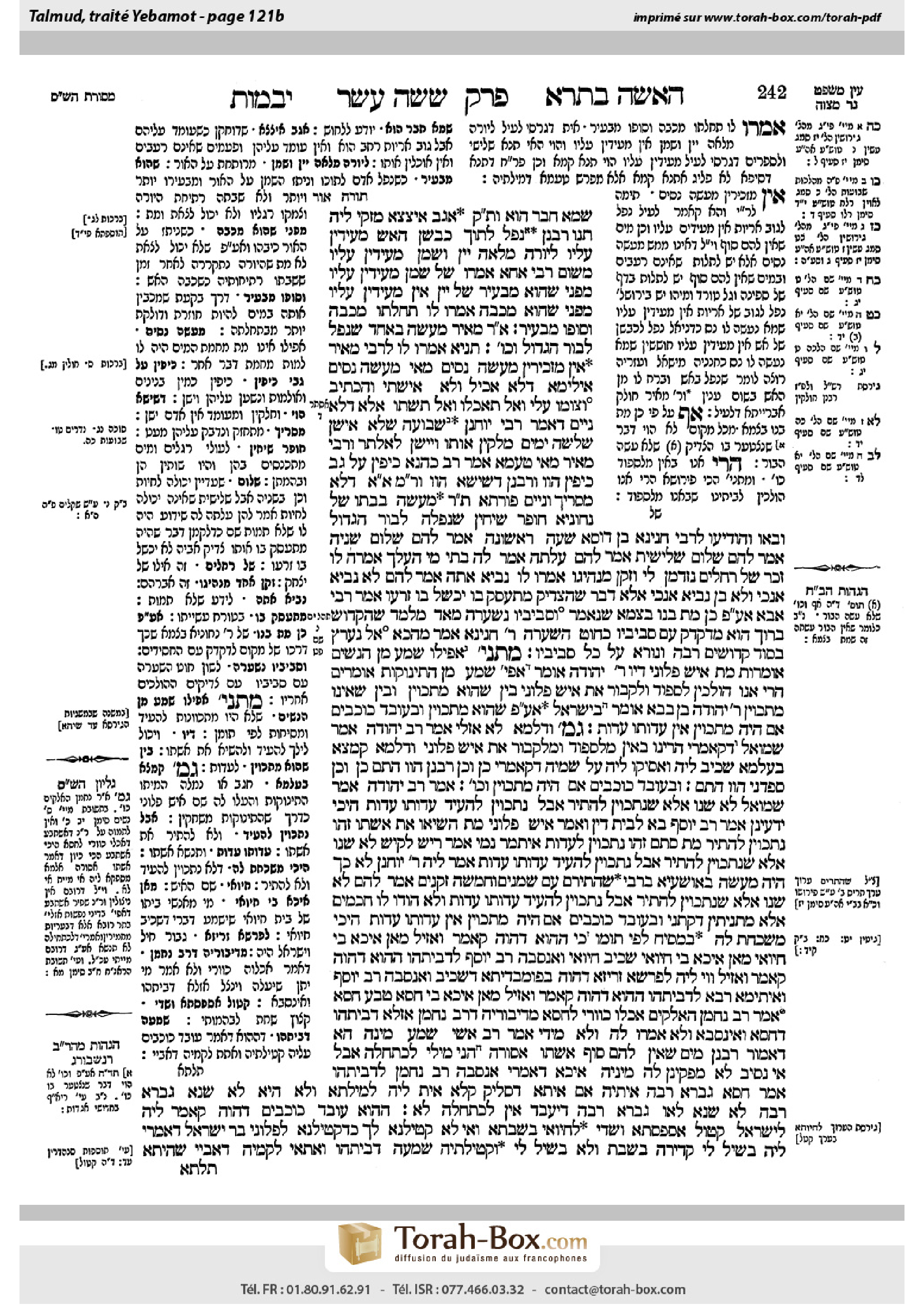
Yevamot 121b: Talmud study for Daf Yomi
Daf Yomi is the daily study of one Talmud folio. Explore 37 tractates with scans, Hebrew text, Sefaria English and AI-generated French translations where annotated.
Passage selection and English or AI-generated French translation are available where the scan has annotations. Daf Study is independent of Torah-Box and Sefaria.
Browse Yevamot · יבמות · All tractatesYevamot 121b text and translations
This page of Yevamot includes the Aramaic text, an English translation and an AI-generated French translation, alongside the scan above.
יבמות קכ״א ב · Aramaic and Hebrew text
שֶׁמָּא חַבָּר הוּא. וְתַנָּא קַמָּא, אַגַּב אִיצְצָא מַזְּקִי לֵיהּ.
תָּנוּ רַבָּנַן: נָפַל לְתוֹךְ כִּבְשַׁן הָאֵשׁ — מְעִידִין עָלָיו. לְיוֹרָה מְלֵאָה יַיִן וָשֶׁמֶן — מְעִידִין עָלָיו. מִשּׁוּם רַבִּי אַחָא אָמְרוּ: שֶׁל שֶׁמֶן — מְעִידִין עָלָיו, מִפְּנֵי שֶׁהוּא מַבְעִיר. שֶׁל יַיִן — אֵין מְעִידִין עָלָיו, מִפְּנֵי שֶׁהוּא מְכַבֶּה. אָמְרוּ לוֹ: תְּחִלָּתוֹ מְכַבֶּה וְסוֹפוֹ מַבְעִיר.
אָמַר רַבִּי מֵאִיר: מַעֲשֶׂה בְּאֶחָד שֶׁנָּפַל לַבּוֹר הַגָּדוֹל וְכוּ׳. תַּנְיָא, אָמְרוּ לוֹ לְרַבִּי מֵאִיר: אֵין מַזְכִּירִין מַעֲשֵׂה נִסִּים. מַאי מַעֲשֵׂה נִסִּים? אִילֵּימָא דְּלָא אֲכַל וְלָא אִישְׁתִּי — וְהָכְתִיב: ״וְצוּמוּ עָלַי וְאַל תֹּאכְלוּ וְאַל תִּשְׁתּוּ״.
אֶלָּא דְּלָא נָיֵים. דְּאָמַר רַבִּי יוֹחָנָן: שְׁבוּעָה שֶׁלֹּא אִישַׁן שְׁלֹשָׁה יָמִים — מַלְקִין אוֹתוֹ, וְיִישַׁן לְאַלְתַּר.
וְרַבִּי מֵאִיר מַאי טַעְמָא? אָמַר רַב כָּהֲנָא: כִּיפִּין עַל גַּב כִּיפִּין הֲווֹ. וְרַבָּנַן — דְּשֵׁישָׁא הֲווֹ. וְרַבִּי מֵאִיר: אִי אֶפְשָׁר דְּלָא מְסָרֵיךְ וְנָיֵים פּוּרְתָּא.
תָּנוּ רַבָּנַן: מַעֲשֶׂה בְּבִתּוֹ שֶׁל נְחוּנְיָא חוֹפֵר שִׁיחִין שֶׁנָּפְלָה לְבוֹר הַגָּדוֹל, וּבָאוּ וְהוֹדִיעוּ לְרַבִּי חֲנִינָא בֶּן דּוֹסָא. שָׁעָה רִאשׁוֹנָה, אָמַר לָהֶם: שָׁלוֹם. שְׁנִיָּה, אָמַר לָהֶם: שָׁלוֹם. שְׁלִישִׁית, אָמַר לָהֶם: עָלְתָה.
אָמַר לָהּ: בִּתִּי, מִי הֶעֱלֵךְ? אָמְרָה לוֹ: זָכָר שֶׁל רְחֵלִים נִזְדַּמֵּן לִי, וְזָקֵן מַנְהִיגוֹ. אָמְרוּ לוֹ: נָבִיא אַתָּה? אָמַר לָהֶם: ״לֹא נָבִיא אָנֹכִי וְלֹא בֶּן נָבִיא אָנֹכִי״, אֶלָּא: דָּבָר שֶׁהַצַּדִּיק מִתְעַסֵּק בּוֹ — יִכָּשֵׁל בּוֹ זַרְעוֹ?
אָמַר רַבִּי אַבָּא: אַף עַל פִּי כֵן מֵת בְּנוֹ בַּצָּמָא, שֶׁנֶּאֱמַר: ״וּסְבִיבָיו נִשְׂעֲרָה מְאֹד״, מְלַמֵּד שֶׁהַקָּדוֹשׁ בָּרוּךְ הוּא מְדַקְדֵּק עִם סְבִיבָיו כְּחוּט הַשַּׂעֲרָה. רַבִּי חֲנִינָא אָמַר, מֵהָכָא: ״אֵל נַעֲרָץ בְּסוֹד קְדוֹשִׁים רַבָּה וְנוֹרָא עַל כׇּל סְבִיבָיו״.
מַתְנִי׳ אֲפִילּוּ שָׁמַע מִן הַנָּשִׁים אוֹמְרוֹת ״מֵת אִישׁ פְּלוֹנִי״ — דַּיּוֹ. רַבִּי יְהוּדָה אוֹמֵר: אֲפִילּוּ שָׁמַע מִן הַתִּינוֹקוֹת אוֹמְרִים ״הֲרֵי אָנוּ הוֹלְכִין לִסְפּוֹד וְלִקְבּוֹר אֶת אִישׁ פְּלוֹנִי״. בֵּין שֶׁהוּא מִתְכַּוֵּין, וּבֵין שֶׁאֵינוֹ מִתְכַּוֵּין.
רַבִּי יְהוּדָה בֶּן בָּבָא אוֹמֵר: בְּיִשְׂרָאֵל, אַף עַל פִּי שֶׁהוּא מִתְכַּוֵּין, וּבְגוֹי אִם הָיָה מִתְכַּוֵּין — אֵין עֵדוּתוֹ עֵדוּת.
גְּמָ׳ וְדִלְמָא לָא אָזְלִי? אָמַר רַב יְהוּדָה אָמַר שְׁמוּאֵל, דְּקָאָמְרִי: ״הָרֵינוּ בָּאִין מִלִּסְפּוֹד וּמִלִּקְבּוֹר אֶת אִישׁ פְּלוֹנִי״.
וְדִלְמָא קַמְצָא בְּעָלְמָא שְׁכֵיב לֵיהּ וְאַסִּיקוּ לֵיהּ עַל שְׁמֵיהּ! דְּקָאָמְרִי: כֵּן וְכֵן רַבָּנַן הֲווֹ הָתָם. כֵּן וְכֵן סַפְדָנֵי הֲווֹ הָתָם.
וּבְגוֹי, אִם הָיָה מִתְכַּוֵּין וְכוּ׳. אָמַר רַב יְהוּדָה אָמַר שְׁמוּאֵל: לֹא שָׁנוּ אֶלָּא שֶׁנִּתְכַּוֵּין לְהַתִּיר, אֲבָל נִתְכַּוֵּין לְהָעִיד — עֵדוּתוֹ עֵדוּת. הֵיכִי יָדְעִינַן? אָמַר רַב יוֹסֵף: בָּא לְבֵית דִּין וְאָמַר: ״אִישׁ פְּלוֹנִי מֵת, הַשִּׂיאוּ אֶת אִשְׁתּוֹ״ — זֶהוּ נִתְכַּוֵּין לְהַתִּיר. ״מֵת״ סְתָם — זֶהוּ נִתְכַּוֵּין לְעֵדוּת.
אִיתְּמַר נָמֵי, אָמַר רֵישׁ לָקִישׁ: לֹא שָׁנוּ אֶלָּא שֶׁנִּתְכַּוֵּין לְהַתִּיר, אֲבָל נִתְכַּוֵּין לְהָעִיד — עֵדוּתוֹ עֵדוּת. אֲמַר לֵיהּ רַבִּי יוֹחָנָן: לֹא כָּךְ הָיָה מַעֲשֶׂה בְּאוֹשַׁעְיָא בְּרַבִּי, שֶׁהִתִּירָם עִם שְׁמֹנִים וַחֲמִשָּׁה זְקֵנִים. אָמַר לָהֶם: לֹא שָׁנוּ אֶלָּא שֶׁנִּתְכַּוֵּין לְהַתִּיר, אֲבָל נִתְכַּוֵּין לְהָעִיד — עֵדוּתוֹ עֵדוּת. וְלֹא הוֹדוּ לוֹ חֲכָמִים.
אֶלָּא מַתְנִיתִין דְּקָתָנֵי: וּבְגוֹי, אִם הָיָה מִתְכַּוֵּין — אֵין עֵדוּתוֹ עֵדוּת, הֵיכִי מַשְׁכַּחַתְּ לַהּ? בְּמֵסִיחַ לְפִי תּוּמּוֹ. כִּי הָהוּא דַּהֲוָה קָאָמַר וְאָזֵיל: ״מַאן אִיכָּא בֵּי חִיוַּאי, מַאן אִיכָּא בֵּי חִיוַּאי, שְׁכֵיב חִיוַּאי״, וְאַנְסְבַהּ רַב יוֹסֵף לִדְבֵיתְהוּ. הָהוּא דַּהֲוָה קָאָמַר וְאָזֵיל: ״וַוי לֵיהּ לְפָרָשָׁא זְרִיזָא דַּהֲוָה בְּפוּמְבְּדִיתָא דִּשְׁכֵיב״, וְאַנְסְבַהּ רַב יוֹסֵף, וְאִיתֵּימָא רָבָא, לִדְבֵיתְהוּ.
הָהוּא דַּהֲוָה קָאָמַר וְאָזֵיל: ״מַאן אִיכָּא בֵּי חָסָא, טְבַע חָסָא״. אָמַר רַב נַחְמָן: הָאֱלֹקִים! אֲכַלוּ כְּווֹרֵי לְחָסָא מִדִּיבּוּרֵיהּ דְּרַב נַחְמָן. אֲזַלָא דְּבֵיתְהוּ דְחָסָא וְאִינַּסְבָא, וְלָא אֲמַרוּ לָהּ וְלָא מִידֵּי. אָמַר רַב אָשֵׁי: שְׁמַע מִינַּהּ, הָא דַּאֲמוּר רַבָּנַן מַיִם שֶׁאֵין לָהֶם סוֹף אִשְׁתּוֹ אֲסוּרָה, הָנֵי מִילֵּי לְכַתְּחִלָּה, אֲבָל אִי נָסֵיב — לָא מַפְּקִינַן לַהּ מִינֵּיהּ.
אִיכָּא דְּאָמְרִי, אַנְסְבַהּ רַב נַחְמָן לִדְבֵיתְהוּ, אֲמַר: חָסָא גַּבְרָא רַבָּה אִיתֵיהּ, אִם אִיתָא דִּסְלֵיק — קָלָא אִית לֵיהּ לְמִילְּתָא. וְלָא הִיא: לָא שְׁנָא גַּבְרָא רַבָּה, לָא שְׁנָא לָאו גַּבְרָא רַבָּה — דִּיעֲבַד אִין, לְכַתְּחִלָּה לָא.
הָהוּא גּוֹי דַּהֲוָה קָאָמַר לֵיהּ לְיִשְׂרָאֵל: קְטוֹל אַסְפַּסְתָּא וּשְׁדִי לְחֵיוָ[תַ]אי בְּשַׁבְּתָא, וְאִי לָא — קָטֵילְנָא לָךְ כְּדִקְטֵילְנָא לִפְלוֹנִי בַּר יִשְׂרָאֵל, דַּאֲמַרִי לֵיהּ: בַּשֵּׁיל לִי קְדֵירָה בְּשַׁבָּת, וְלָא בַּשֵּׁיל לִי, וּקְטֵילְתֵּיהּ. שְׁמַעָה דְּבֵיתְהוּ, וַאֲתַאי לְקַמֵּיהּ דְּאַבָּיֵי. (שְׁהֵיתָא)
Yevamot 121b · English translation
that perhaps he is a charmer [ḥabbar] of snakes and scorpions who knows magic or some stratagem to keep them from harming him. And the first tanna holds that we need not be concerned about this possibility, as, due to the pressure of his body falling on top of them, they will harm him, even if he could control them under other circumstances.
The Sages taught: If one fell into a blazing furnace, one may testify about him that he has died. If he fell into a boiling cauldron filled with wine or oil, one may also testify about him that he has died. In the name of Rabbi Aḥa, they said: If he fell into a cauldron of oil, one may testify about him that he has died, because this ignites the fire even more. Through the force of his fall, oil will splash into the fire and increase the heat of the cauldron. However, if he fell into a cauldron of wine, one may not testify about him that he has died, because when wine splashes into the fire it extinguishes the fire. They said to him: At first it partially extinguishes the fire but eventually it ignites it even more, and therefore it can be assumed that he has died.
§ The mishna stated that Rabbi Meir said: An incident occurred involving a certain individual who fell into the Great Cistern and emerged after three days. It is taught in a baraita: They said to Rabbi Meir: One does not mention miraculous acts to teach general halakha. The Gemara asks: What about that story defines it as an example of miraculous acts? If we say the fact that he did not eat or drink for three days and still survived is miraculous, but isn’t it written: “Fast for me, and neither eat nor drink three days, night or day” (Esther 4:16), demonstrating that one may survive this experience naturally?
The Gemara answers: Rather, the miraculous element is that he did not sleep during those three days, as Rabbi Yoḥanan said: If one says: I hereby take on an oath that I will not sleep for three days, the court flogs him for taking an oath in vain, and he may sleep immediately because it is impossible to remain awake for three consecutive days.
The Gemara asks: And according to Rabbi Meir, what is the reason this was not a miraculous incident? The Gemara answers that Rav Kahana said: There were several levels of arches built on top of other arches within the Great Cistern, and he supported himself on the arches and slept. And the Rabbis said that they were made of marble and it was impossible to hold onto them and sleep. And Rabbi Meir assumed that it is inconceivable that he didn’t grasp some part of an arch for a short time and sleep a little, and therefore this incident does not qualify as a miracle.
The Sages taught: An incident occurred involving the daughter of Neḥunya the well digger, who fell into the Great Cistern, and they came and notified Rabbi Ḥanina ben Dosa and asked that he pray for her. After the first hour, he said to them: She is at peace and unharmed. After the second hour, he said to them: She is at peace. After the third hour he said to them: She has ascended from the cistern.
When she came to Rabbi Ḥanina ben Dosa, he said to her: My daughter, who pulled you up from the cistern? She said to him: A male sheep, i.e., a ram, happened by and sensed me in that cistern, and there was an old man leading him who pulled me out. They said to Rabbi Ḥanina ben Dosa: Are you a prophet with knowledge of what is happening far away? He said to them, using a figure of speech from the Bible: “I am not a prophet, nor the son of a prophet am I” (Amos 7:14). Rather, I reasoned as follows: Could it be that concerning the endeavor that the righteous Neḥunya is engaged in, i.e., digging for the benefit of the public, his offspring would stumble upon its fruits and thereby be killed? I therefore knew that God would certainly save her.
Rabbi Abba said: Even so, the son of Neḥunya the well digger died of thirst, and the merit of his father, who attended to the water supply, did not protect him, as is stated: “And around Him it storms [nisara] mightily” (Psalms 50:3), which teaches that the Holy One, Blessed be He, is exacting with His surroundings, i.e., the righteous who are close to Him, up to a hairsbreadth [sa’ara], so that even slight deviations can elicit severe punishment. Rabbi Ḥanina said: This idea is derived from here: “A God dreaded in the great council of the holy ones, and feared by all that are about Him” (Psalms 89:8). This indicates that God is most feared by those that are nearest to Him, i.e., the righteous, because He is more exacting of them.
MISHNA: Even if one heard from the women, who were saying: So-and-so died, this is sufficient in order to testify to his death. Rabbi Yehuda says: Even if one heard from the children, who were saying: We are going to eulogize and bury so-and-so, that is also sufficient. Furthermore, one may rely upon someone mentioning that a man died, regardless of whether the speaker intends to testify and thereby allow the man’s wife to remarry or whether he does not intend to offer formal testimony.
Rabbi Yehuda ben Bava says: With regard to a Jew who offers this information, it may be relied upon even if he intends for his statement to be considered formal testimony. However, with regard to a gentile, if he intended to testify, his testimony is not considered valid testimony. His statement is relied upon only when he does not intend to state it as formal testimony.
GEMARA: With regard to relying on what children said, that they are going to eulogize and bury so-and-so, the Gemara asks: Perhaps they will not go; perhaps they only assumed that the individual would die, but in the end he didn’t. The Gemara answers: Rav Yehuda said that Shmuel said: It is referring to a situation where the children say: We are coming from eulogizing and burying so-and-so.
The Gemara asks: Since they are children, perhaps it was merely a grasshopper with which they played that died, and they brought it out as if to its funeral, calling it by the name of the individual suspected to be dead, and their statement should not be considered valid proof of his death. The Gemara answers: It is referring to a situation where the children say: Such and such rabbis were there; such and such eulogizers were there, so that it is clear that they were referring to an event that truly occurred.
§ It was taught in the mishna: With regard to a gentile, if he intended to testify, his testimony is not considered valid testimony. Rav Yehuda said that Shmuel said: They taught this only in a case where he intended to permit the woman to remarry through his testimony, but if he merely intended to testify about the man’s death, his testimony is considered testimony. The Gemara asks: How do we know the intention of the gentile? Rav Yosef said: If he came to the court and said: So-and-so died, allow his wife to marry, this is an instance of intending to permit her to remarry. If he said simply: He died, this is an instance of merely intending to testify.
This was also stated by other amora’im. Reish Lakish said: They taught this only when one intended to permit the woman to remarry, but if he merely intended to testify about the man’s death, his testimony is considered valid testimony. Rabbi Yoḥanan said to him: Didn’t such an incident occur involving Rabbi Oshaya the Distinguished, who permitted women to marry based upon the testimony of gentiles while he was with eighty-five Elders? He said to the Elders: They taught that one may not rely upon a gentile’s testimony only when he intended to permit the woman to remarry, but if he merely intended to testify about the man’s death, his testimony is considered valid testimony. But the Rabbis did not concur with him on this, and they maintained that one may not rely upon the testimony of a gentile at all.
The Gemara asks: But, if that is so, what about that which is taught in the mishna: With regard to a gentile, if he intended to testify, his testimony is not considered valid testimony, which implies that if the gentile does not intend to testify, his statement may be relied upon? How can you find a case where one would rely on his statement? The Gemara answers: One may rely on a gentile’s statement when he speaks offhandedly, without any intention to testify. Like that gentile who was going around saying: Who is from the house of Ḥivvai; who is from the house of Ḥivvai? Ḥivvai has died. And based upon this report, Rav Yosef allowed Ḥivvai’s wife to marry. There was also a certain gentile who was going around saying: Alas for the brave horseman who was in Pumbedita, for he is dead. And Rav Yosef, and some say Rava, allowed his wife to marry.
§ There was also a certain gentile who was going around saying: Who is from the house of Ḥasa? Ḥasa has drowned. Rav Naḥman said: By God! The fish have eaten Ḥasa. The Gemara relates: Due to Rav Naḥman’s statement, although he did not issue a court ruling permitting it, Ḥasa’s wife went and married, and no one said anything to her to protest this action. Rav Ashi said: Learn the following from this incident: That which the Sages said, that if a man fell into an endless body of water, his wife is prohibited from remarrying, this applies only ab initio, but if someone married her, we do not take her away from him.
There are those who say that Rav Naḥman actually issued a ruling and allowed his wife to marry. He said: Ḥasa is a great man; if it was so that he emerged from the water the incident would have generated publicity. Since nothing was heard from Ḥasa in a long while, it can be assumed that he died. The Gemara comments: That is not so. It is not different if he is a great man and it is not different if he is not a great man. If a woman remarried based on testimony that her husband drowned in an endless body of water, after the fact, yes, she may remain married, but she may not remarry ab initio.
The Gemara relates that a certain gentile said to a Jew: Harvest the fodder and give it to my animals on Shabbat, and if not, I will kill you like I killed so-and-so the Jew, for I said to him: Cook me a pot of food on Shabbat, and he didn’t cook it for me, so I killed him. The wife of the missing Jew heard the gentile say that he killed her husband, and she came before Abaye to ask if she was permitted to remarry. He deferred the ruling in her case
Yevamot 121b · Traduction française (IA)
peut-être est-il un charmeur [ḥabbar] de serpents et de scorpions, qui connaît la magie ou quelque stratagème pour les empêcher de lui faire du mal. Le premier tanna estime qu’il n’y a pas lieu de craindre cette éventualité, car, sous la pression de son corps qui tombe sur eux, ils lui feront du mal, même s’il pouvait les maîtriser dans d’autres circonstances.
Les Sages ont enseigné : Si quelqu’un tombe dans une fournaise ardente, on peut témoigner qu’il est mort. S’il tombe dans un chaudron bouillant rempli de vin ou d’huile, on peut également témoigner qu’il est mort. Au nom de Rabbi Aḥa, ils ont dit : S’il tombe dans un chaudron d’huile, on peut témoigner qu’il est mort, car l’huile attise encore davantage le feu. Sous la force de sa chute, l’huile éclaboussera le feu et augmentera la chaleur du chaudron. En revanche, s’il tombe dans un chaudron de vin, on ne peut pas témoigner qu’il est mort, car, lorsque le vin éclabousse le feu, il l’éteint. Ils lui dirent : Au début, le vin éteint partiellement le feu, mais il finit par l’attiser encore davantage ; on peut donc supposer que l’homme est mort.
§ La Michna rapporte que Rabbi Meïr a dit : Un incident est arrivé à un homme qui tomba dans la Grande Citerne et en ressortit après trois jours. Une baraïta enseigne : On dit à Rabbi Meïr : On ne cite pas des actes miraculeux pour enseigner une halakha générale. La Guemara demande : Qu’est-ce qui, dans cette histoire, en fait un exemple d’acte miraculeux ? Si l’on dit que c’est le fait qu’il n’ait ni mangé ni bu pendant trois jours et qu’il ait pourtant survécu, n’est-il pas écrit : « Jeûnez pour moi, ne mangez ni ne buvez pendant trois jours, nuit et jour » (Esther 4:16), ce qui montre qu’on peut survivre naturellement à cette épreuve ?
La Guemara répond : L’élément miraculeux est plutôt qu’il n’a pas dormi pendant ces trois jours, car Rabbi Yoḥanan a dit : Si quelqu’un déclare : « Je fais le serment de ne pas dormir pendant trois jours », le tribunal le fouette pour avoir prêté un serment en vain, et il peut dormir immédiatement, car il est impossible de rester éveillé trois jours de suite.
La Guemara demande : Et selon Rabbi Meïr, pourquoi ne s’agissait-il pas d’un événement miraculeux ? La Guemara répond que Rav Kahana a dit : Dans la Grande Citerne, plusieurs niveaux d’arches étaient construits les uns au-dessus des autres ; l’homme s’appuyait sur les arches et dormait. Les Sages ont dit que celles-ci étaient en marbre et qu’il était impossible de s’y agripper et d’y dormir. Rabbi Meïr supposait qu’il était inconcevable que l’homme n’ait pas saisi une partie d’une arche pendant un bref instant et dormi un peu ; cet incident ne pouvait donc pas être considéré comme un miracle.
Les Sages ont enseigné : Un incident est arrivé à la fille de Neḥunya, le creuseur de puits, qui tomba dans la Grande Citerne. On vint en informer Rabbi Ḥanina ben Dosa et on lui demanda de prier pour elle. Au bout de la première heure, il leur dit : Elle est saine et sauve. Au bout de la deuxième heure, il leur dit : Elle est saine et sauve. Au bout de la troisième heure, il leur dit : Elle est remontée de la citerne.
Lorsqu’elle se présenta devant Rabbi Ḥanina ben Dosa, il lui demanda : Ma fille, qui t’a tirée de la citerne ? Elle lui répondit : Un bélier est passé par là et m’a sentie dans cette citerne ; un vieil homme le conduisait et m’a tirée de là. On dit à Rabbi Ḥanina ben Dosa : Es-tu un prophète, qui sait ce qui se passe au loin ? Il leur répondit en reprenant une expression biblique : « Je ne suis pas prophète, ni fils de prophète » (Amos 7:14). J’ai plutôt raisonné ainsi : Se pourrait-il que, dans le cadre de l’entreprise à laquelle s’adonne le juste Neḥunya, c’est-à-dire creuser des puits pour le bien du public, sa descendance trébuche sur les fruits de cette entreprise et en meure ? J’ai donc su que Dieu la sauverait certainement.
Rabbi Abba a dit : Malgré cela, le fils de Neḥunya, le creuseur de puits, est mort de soif, et le mérite de son père, qui s’occupait de l’approvisionnement en eau, ne l’a pas protégé, comme il est dit : « Autour de Lui, la tempête [nisara] fait rage » (Psaumes 50:3). Cela enseigne que le Saint, béni soit-Il, se montre rigoureux envers ceux qui L’entourent, c’est-à-dire les justes qui Lui sont proches, jusqu’à l’épaisseur d’un cheveu [sa’ara], de sorte que même de légers écarts peuvent entraîner une sévère punition. Rabbi Ḥanina a dit : Cette idée se déduit d’ici : « Dieu redoutable dans le conseil des saints, et craint par tous ceux qui L’entourent » (Psaumes 89:8). Cela indique que Dieu est particulièrement craint par ceux qui sont les plus proches de Lui, c’est-à-dire les justes, car Il se montre plus rigoureux envers eux.
MICHNA : Même si quelqu’un a entendu des femmes dire : « Untel est mort », cela suffit pour témoigner de sa mort. Rabbi Yehouda dit : Même si quelqu’un a entendu des enfants dire : « Nous allons faire l’éloge funèbre et enterrer untel », cela suffit également. En outre, on peut se fier à quelqu’un qui mentionne la mort d’un homme, que celui qui parle ait ou non l’intention de témoigner et ainsi de permettre à la femme de cet homme de se remarier.
Rabbi Yehouda ben Bava dit : Quand un Juif fournit cette information, on peut s’y fier même s’il a l’intention que sa déclaration soit considérée comme un témoignage formel. En revanche, quand il s’agit d’un non-Juif, s’il a l’intention de témoigner, sa déclaration n’est pas considérée comme un témoignage valable. On ne se fie à sa déclaration que s’il n’a pas l’intention de la présenter comme un témoignage formel.
GUEMARA : À propos du fait de se fier aux propos des enfants qui disent qu’ils vont faire l’éloge funèbre et enterrer untel, la Guemara demande : Peut-être n’iront-ils pas ; peut-être ont-ils seulement supposé que l’homme allait mourir, mais qu’il n’est finalement pas mort. La Guemara répond : Rav Yehouda a dit au nom de Shmuel : Cela concerne une situation où les enfants disent : « Nous revenons d’avoir fait l’éloge funèbre et enterré untel. »
La Guemara demande : Puisqu’il s’agit d’enfants, peut-être n’était-ce qu’une sauterelle avec laquelle ils jouaient qui était morte et qu’ils avaient emportée comme pour ses funérailles, en lui donnant le nom de l’homme dont on soupçonne la mort ; leur déclaration ne devrait donc pas être considérée comme une preuve valable de sa mort. La Guemara répond : Cela concerne une situation où les enfants disent : « Tel et tel rabbins étaient là ; tels et tels orateurs funèbres étaient là », de sorte qu’il est clair qu’ils font référence à un événement qui a réellement eu lieu.
§ La Michna enseigne : Quand il s’agit d’un non-Juif, s’il a l’intention de témoigner, sa déclaration n’est pas considérée comme un témoignage valable. Rav Yehouda a dit au nom de Shmuel : Cela a été enseigné uniquement dans le cas où il avait l’intention de permettre à la femme de se remarier par son témoignage ; mais s’il avait simplement l’intention de témoigner de la mort de l’homme, sa déclaration est considérée comme un témoignage valable. La Guemara demande : Comment connaître l’intention du non-Juif ? Rav Yossef a dit : S’il est venu au tribunal et a dit : « Untel est mort ; permettez à sa femme de se remarier », il s’agit d’un cas où il entendait permettre à la femme de se remarier. S’il a simplement dit : « Il est mort », il s’agit d’un cas où il avait seulement l’intention de témoigner.
D’autres amoraïm ont également rapporté cet enseignement. Reish Lakish a dit : Cela a été enseigné uniquement lorsque quelqu’un avait l’intention de permettre à la femme de se remarier ; mais s’il avait simplement l’intention de témoigner de la mort de l’homme, sa déclaration est considérée comme un témoignage valable. Rabbi Yoḥanan lui dit : Un tel incident ne s’est-il pas produit avec Rabbi Oshaya le Distingué, qui a autorisé des femmes à se remarier sur la foi de témoignages de non-Juifs, alors qu’il se trouvait avec quatre-vingt-cinq Anciens ? Il dit aux Anciens : On a enseigné qu’on ne peut se fier au témoignage d’un non-Juif que lorsqu’il avait l’intention de permettre à la femme de se remarier ; mais s’il avait simplement l’intention de témoigner de la mort de l’homme, sa déclaration est considérée comme un témoignage valable. Cependant, les Sages ne furent pas d’accord avec lui sur ce point et estimaient qu’on ne peut en aucun cas se fier au témoignage d’un non-Juif.
La Guemara demande : Mais, dans ce cas, qu’en est-il de ce qu’enseigne la Michna : Quand il s’agit d’un non-Juif, s’il a l’intention de témoigner, sa déclaration n’est pas considérée comme un témoignage valable ? Cela implique que si le non-Juif n’a pas l’intention de témoigner, on peut se fier à sa déclaration. Dans quel cas pourrait-on se fier à sa déclaration ? La Guemara répond : On peut se fier à la déclaration d’un non-Juif lorsqu’il parle en passant, sans aucune intention de témoigner. C’est le cas de ce non-Juif qui allait de-ci de-là en disant : « Qui est de la maison de Ḥivvai ? Qui est de la maison de Ḥivvai ? Ḥivvai est mort. » Sur la foi de cette annonce, Rav Yossef autorisa la femme de Ḥivvai à se remarier. Il y eut aussi un certain non-Juif qui allait de-ci de-là en disant : « Malheur au vaillant cavalier qui était à Poumbedita, car il est mort. » Rav Yossef — et certains disent Rava — autorisa sa femme à se remarier.
§ Il y eut aussi un certain non-Juif qui allait de-ci de-là en disant : « Qui est de la maison de Ḥasa ? Ḥasa s’est noyé. » Rav Naḥman dit : « Par Dieu ! Les poissons ont mangé Ḥasa. » La Guemara raconte : À la suite des paroles de Rav Naḥman, bien qu’il n’ait pas rendu de décision judiciaire l’autorisant, la femme de Ḥasa alla se remarier, et personne ne protesta. Rav Ashi dit : Il faut tirer de cet incident l’enseignement suivant : Ce que les Sages ont dit — qu’une femme n’a pas le droit de se remarier si son mari tombe dans une étendue d’eau sans fond — ne s’applique qu’a priori ; mais si quelqu’un l’a épousée, nous ne la séparons pas de lui.
Certains disent que Rav Naḥman a effectivement rendu une décision et autorisé la femme de Ḥasa à se remarier. Il a dit : Ḥasa est un homme important ; s’il était sorti de l’eau, l’événement aurait fait grand bruit. Puisqu’on n’a rien entendu de Ḥasa depuis longtemps, on peut supposer qu’il est mort. La Guemara fait remarquer : Ce n’est pas ainsi. Qu’il s’agisse d’un homme important ou non, cela ne change rien. Si une femme s’est remariée sur la foi d’un témoignage selon lequel son mari s’est noyé dans une étendue d’eau sans fond, a posteriori, elle peut rester mariée ; mais elle ne peut pas se remarier a priori.
La Guemara raconte qu’un certain non-Juif dit à un Juif : « Coupe le fourrage et donne-le à mes animaux pendant Chabbat ; sinon, je te tuerai comme j’ai tué untel, le Juif. Je lui ai dit : “Fais-moi cuire une marmite de nourriture pendant Chabbat”, mais il ne l’a pas fait ; alors je l’ai tué. » La femme du Juif disparu entendit le non-Juif dire qu’il avait tué son mari et se présenta devant Abaye pour lui demander si elle avait le droit de se remarier. Abaye ajourna sa décision dans son cas.
Traduction française générée par IA à partir de l’édition anglaise de Sefaria. Vérifie toujours un passage avec le texte source.
Text from Sefaria: William Davidson Edition - Vocalized Aramaic (CC BY NC); William Davidson Edition - English (CC BY NC).