Yevamot 122a: Talmud study for Daf Yomi
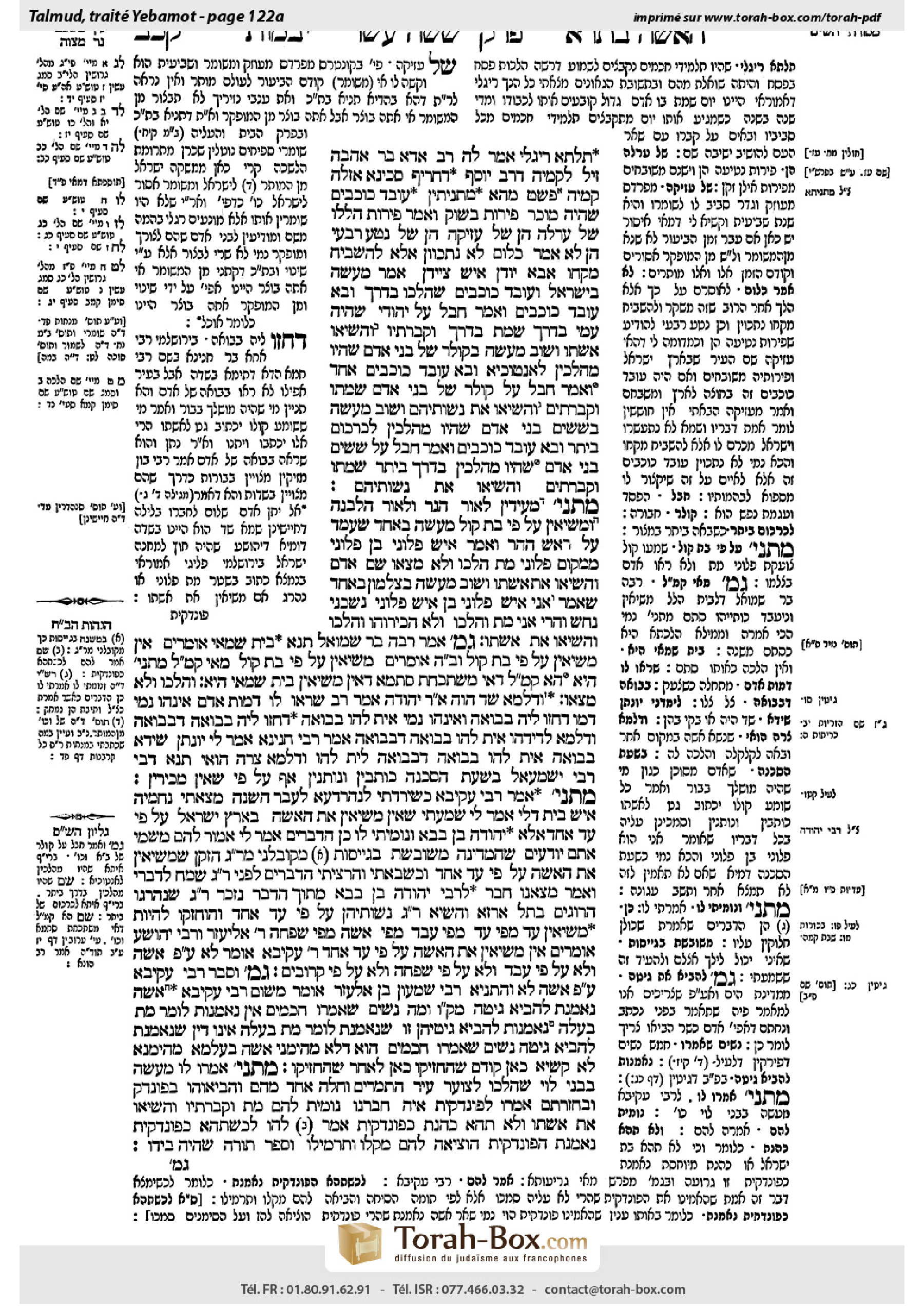
Daf Yomi is the daily study of one Talmud folio. Explore 37 tractates with scans, Hebrew text, Sefaria English and AI-generated French translations where annotated.
Passage selection and English or AI-generated French translation are available where the scan has annotations. Daf Study is independent of Torah-Box and Sefaria.
Browse Yevamot · יבמות · All tractatesYevamot 122a text and translations
This page of Yevamot includes the Aramaic text, an English translation and an AI-generated French translation, alongside the scan above.
יבמות קכ״ב א · Aramaic and Hebrew text
תְּלָתָא רִיגְלֵי. אֲמַר לַהּ רַב אַדָּא בַּר אַהֲבָה: זִיל לְקַמֵּיהּ דְּרַב יוֹסֵף, דְּחָרִיף סַכִּינֵאּ.
אֲזַלָה קַמֵּיהּ. פְּשַׁט מֵהָא מַתְנִיתִין: גּוֹי שֶׁהָיָה מוֹכֵר פֵּירוֹת בַּשּׁוּק, וְאָמַר: ״פֵּירוֹת הַלָּלוּ שֶׁל עׇרְלָה הֵן״ ״שֶׁל עֲזֵיקָה הֵן״, ״שֶׁל נֶטַע רְבָעִי הֵן״ — לֹא אָמַר כְּלוּם, לֹא נִתְכַּוֵּון אֶלָּא לְהַשְׁבִּיחַ מִקָּחוֹ.
אַבָּא יוּדָן אִישׁ צַיְידָן אָמַר: מַעֲשֶׂה בְּיִשְׂרָאֵל וְגוֹי שֶׁהָלְכוּ בַּדֶּרֶךְ, וּבָא גּוֹי וְאָמַר: ״חֲבָל עַל יְהוּדִי שֶׁהָיָה עִמִּי בַּדֶּרֶךְ שֶׁמֵּת בַּדֶּרֶךְ, וּקְבַרְתִּיו״, וְהִשִּׂיאוּ אִשְׁתּוֹ.
וְשׁוּב מַעֲשֶׂה בְּקוֹלָר שֶׁל בְּנֵי אָדָם, שֶׁהָיוּ מְהַלְּכִין לְאַנְטוֹכְיָא, וּבָא גּוֹי אֶחָד וְאָמַר: ״חֲבָל עַל קוֹלָר שֶׁל בְּנֵי אָדָם שֶׁמֵּתוּ, וּקְבַרְתִּים״, וְהִשִּׂיאוּ אֶת נְשׁוֹתֵיהֶם. וְשׁוּב מַעֲשֶׂה בְּשִׁשִּׁים בְּנֵי אָדָם שֶׁהָיוּ מְהַלְּכִין לְכַרְכּוֹם בֵּיתֵּר, וּבָא גּוֹי וְאָמַר: ״חֲבָל עַל שִׁשִּׁים בְּנֵי אָדָם שֶׁהָיוּ מְהַלְּכִין בְּדֶרֶךְ בֵּיתֵּר שֶׁמֵּתוּ, וּקְבַרְתִּים״ וְהִשִּׂיאוּ אֶת נְשׁוֹתֵיהֶם.
מַתְנִי׳ מְעִידִין לְאוֹר הַנֵּר וּלְאוֹר הַלְּבָנָה, וּמַשִּׂיאִין עַל פִּי בַּת קוֹל. מַעֲשֶׂה בְּאֶחָד שֶׁעָמַד עַל רֹאשׁ הָהָר וְאָמַר: ״אִישׁ פְּלוֹנִי בֶּן פְּלוֹנִי מִמָּקוֹם פְּלוֹנִי מֵת״. הָלְכוּ וְלֹא מָצְאוּ שָׁם אָדָם, וְהִשִּׂיאוּ אֶת אִשְׁתּוֹ.
וְשׁוּב מַעֲשֶׂה בְּצַלְמוֹן, בְּאֶחָד שֶׁאָמַר: ״אֲנִי אִישׁ פְּלוֹנִי בֶּן אִישׁ פְּלוֹנִי, נְשָׁכַנִי נָחָשׁ וַהֲרֵי אֲנִי מֵת״. וְהָלְכוּ וְלֹא הִכִּירוּהוּ, וְהָלְכוּ וְהִשִּׂיאוּ אֶת אִשְׁתּוֹ.
גְּמָ׳ אָמַר רַבָּה בַּר שְׁמוּאֵל: תָּנָא, בֵּית שַׁמַּאי אוֹמְרִים: אֵין מַשִּׂיאִין עַל פִּי בַּת קוֹל. וּבֵית הִלֵּל אוֹמְרִים: מַשִּׂיאִין עַל פִּי בַּת קוֹל. מַאי קָא מַשְׁמַע לַן, מַתְנִיתִין הִיא! הָא קָא מַשְׁמַע לַן דְּאִי מַשְׁכַּחַתְּ סְתָמָא דְּאֵין מַשִּׂיאִין — בֵּית שַׁמַּאי הִיא.
וְהָלְכוּ וְלֹא מָצְאוּ. וְדִלְמָא שֵׁד הֲוָה? אָמַר רַב יְהוּדָה אָמַר רַב: שֶׁרָאוּ לוֹ דְּמוּת אָדָם. אִינְהוּ נָמֵי דָּמוּ! דַּחֲזוֹ לֵיהּ בָּבוּאָה.
וְאִינְהוּ נָמֵי אִית לְהוּ בָּבוּאָה! דַּחֲזוֹ לֵיהּ בָּבוּאָה דְבָבוּאָה. וְדִלְמָא לְדִידְהוּ אִית לְהוּ בָּבוּאָה דְבָבוּאָה. אָמַר רַבִּי חֲנִינָא, אָמַר לִי יוֹנָתָן שֵׁידָא: בָּבוּאָה — אִית לְהוּ, בָּבוּאָה דְבָבוּאָה — לֵית לְהוּ.
וְדִלְמָא צָרָה הֲוַאי? תָּנָא דְּבֵי רַבִּי יִשְׁמָעֵאל: בִּשְׁעַת הַסַּכָּנָה כּוֹתְבִין וְנוֹתְנִין, אַף עַל פִּי שֶׁאֵין מַכִּירִין.
מַתְנִי׳ אָמַר רַבִּי עֲקִיבָא: כְּשֶׁיָּרַדְתִּי לִנְהַרְדְּעָא לְעַבֵּר הַשָּׁנָה, מְצָאַנִי נְחֶמְיָה אִישׁ בֵּית דְּלִי, אָמַר לִי: שָׁמַעְתִּי שֶׁאֵין מַשִּׂיאִין אֶת הָאִשָּׁה בְּאֶרֶץ יִשְׂרָאֵל עַל פִּי עֵד אֶחָד אֶלָּא יְהוּדָה בֶּן בָּבָא. וְנוּמֵּיתִי לוֹ: כֵּן הַדְּבָרִים. אָמַר לִי, אֱמוֹר לָהֶם מִשְּׁמִי: אַתֶּם יוֹדְעִים שֶׁהַמְּדִינָה מְשׁוּבֶּשֶׁת בִּגְיָיסוֹת, מְקוּבְּלַנִי מֵרַבָּן גַּמְלִיאֵל הַזָּקֵן שֶׁמַּשִּׂיאִין אֶת הָאִשָּׁה עַל פִּי עֵד אֶחָד.
וּכְשֶׁבָּאתִי וְהִרְצֵיתִי הַדְּבָרִים לִפְנֵי רַבָּן גַּמְלִיאֵל, שָׂמַח לִדְבָרַי, וְאָמַר: מָצָאנוּ חָבֵר לְרַבִּי יְהוּדָה בֶּן בָּבָא.
מִתּוֹךְ הַדָּבָר, נִזְכַּר רַבָּן גַּמְלִיאֵל שֶׁנֶּהֶרְגוּ הֲרוּגִים בְּתֵל אַרְזָא, וְהִשִּׂיא רַבָּן גַּמְלִיאֵל נְשׁוֹתֵיהֶן עַל פִּי עֵד אֶחָד. וְהוּחְזְקוּ לִהְיוֹת מַשִּׂיאִין עֵד מִפִּי עֵד, מִפִּי עֶבֶד, מִפִּי אִשָּׁה, מִפִּי שִׁפְחָה. רַבִּי אֱלִיעֶזֶר וְרַבִּי יְהוֹשֻׁעַ אוֹמְרִים: אֵין מַשִּׂיאִין אֶת הָאִשָּׁה עַל פִּי עֵד אֶחָד. רַבִּי עֲקִיבָא אוֹמֵר: לֹא עַל פִּי אִשָּׁה, וְלֹא עַל פִּי עֶבֶד, וְלֹא עַל פִּי שִׁפְחָה, וְלֹא עַל פִּי קְרוֹבִים.
גְּמָ׳ וְסָבַר רַבִּי עֲקִיבָא עַל פִּי אִשָּׁה לָא? וְהָתַנְיָא, רַבִּי שִׁמְעוֹן בֶּן אֶלְעָזָר אוֹמֵר מִשּׁוּם רַבִּי עֲקִיבָא: אִשָּׁה נֶאֱמֶנֶת לְהָבִיא גִּיטָּהּ מִקַּל וָחוֹמֶר; וּמָה נָשִׁים שֶׁאָמְרוּ חֲכָמִים אֵין נֶאֱמָנוֹת לוֹמַר ״מֵת בַּעְלָהּ״ — נֶאֱמָנוֹת לְהָבִיא גִּיטֵּיהֶן, זוֹ שֶׁנֶּאֱמֶנֶת לוֹמַר ״מֵת בַּעְלָהּ״ — אֵינוֹ דִּין שֶׁנֶּאֱמֶנֶת לְהָבִיא גִּיטָּהּ.
נָשִׁים שֶׁאָמְרוּ חֲכָמִים הוּא דְּלָא מְהֵימְנִי, אִשָּׁה בְּעָלְמָא — מְהֵימְנָא. לָא קַשְׁיָא: כָּאן קוֹדֶם שֶׁהֶחֱזִיקוּ, כָּאן לְאַחַר שֶׁהֶחֱזִיקוּ.
מַתְנִי׳ אָמְרוּ לוֹ: מַעֲשֶׂה בִּבְנֵי לֵוִי שֶׁהָלְכוּ לְצוֹעַר עִיר הַתְּמָרִים, וְחָלָה אֶחָד מֵהֶם, וֶהֱבִיאוּהוּ בְּפוּנְדָּק. וּבַחֲזָרָתָם אָמְרוּ לַפּוּנְדָּקִית: ״אַיֵּה חֲבֵרֵנוּ?״ נוּמֵּית לָהֶם: ״מֵת, וּקְבַרְתִּיו״, וְהִשִּׂיאוּ אֶת אִשְׁתּוֹ. וְלֹא תְּהֵא כֹּהֶנֶת כְּפוּנְדָּקִית?
אֲמַר לְהוּ: לִכְשֶׁתְּהֵא כְּפוּנְדָּקִית — נֶאֱמֶנֶת. הַפּוּנְדָּקִית הוֹצִיאָה לָהֶם מַקְלוֹ וְתַרְמִילוֹ וְסֵפֶר תּוֹרָה שֶׁהָיָה בְּיָדוֹ.
Yevamot 122a · English translation
for three pilgrim Festivals, on which the Sages gather together to study, but he could not resolve this uncertainty on any of those occasions. Rav Adda bar Ahava said to her: Go before Rav Yosef, whose knife is sharp, i.e., he has keen insight into halakhic matters, and ask him to decide your case.
She went before him and he resolved the case based on this baraita: With regard to a gentile who was selling fruit at the market and said: These fruits are from the first three years of the tree’s growth [orla]; or they are from Azeka, i.e., land tilled on the Sabbatical Year, the produce of which it is prohibited to eat; or they are fourth-year produce, which it is prohibited to eat outside of Jerusalem, he has said nothing of consequence. His statement is not deemed credible, since it is possible that he intended only to enhance the reputation of his goods, as he thought that his produce would fetch a higher price if he described it in that fashion. Rav Yosef derived from this baraita that in the case of the missing Jew, the gentile’s statement could not be relied upon, as he may have stated it only to promote his own agenda.
Abba Yudan of Sidon said: An incident occurred involving a Jew and a gentile who traveled on the road, and later the gentile came and said: Alas for the Jew who was with me on the road, for he died, and I buried him. And the Sages relied upon this statement and allowed his wife to marry.
And there was another incident involving a group of people who had been taken prisoner, each of whom was shackled with a collar [kolar] around his neck, and they were walking to Antokhya. And some time later a certain gentile came and said: Alas for the group of collared people, for they died, and I buried them. And the Sages allowed their wives to marry. And there was yet another incident involving sixty people who were walking to the siege [karkom] of Beitar, and later a gentile came and said: Alas for those sixty people who were walking on the road to Beitar, for they died, and I buried them. And the Sages allowed their wives to marry.
MISHNA: Witnesses may testify that an individual died even if they saw his corpse only by candlelight or by moonlight. And the court may allow a woman to marry based on the statement of a disembodied voice proclaiming that her husband died. There was an incident with regard to a certain individual who stood at the top of a mountain and said: So-and-so, son of so-and-so, from such and such a place died. They went and found no person there, but even so they relied upon the statement and allowed the wife of the individual declared dead to marry.
And there was another incident in Tzalmon, a city in the Galilee, where a particular man said: I am so-and-so, son of so-and-so. A snake bit me and I am dying. And they went and found his corpse but could not recognize him, yet they went ahead and allowed his wife to marry based on what he said in his dying moments.
GEMARA: Rabba bar Shmuel said: It was taught in a baraita that Beit Shammai say: The judges of a court may not allow a woman to marry based on the statement of a disembodied voice; they require actual testimony. And Beit Hillel say: The judges may allow a woman to marry based on the statement of a disembodied voice. The Gemara asks: What is Rabba bar Shmuel teaching us here? This is simply our mishna, since the decisive ruling follows Beit Hillel’s opinion. The Gemara answers that he teaches us this: That if an anonymous mishna or baraita is found that states that the judges may not allow a woman to marry under such circumstances, it is simply the opinion of Beit Shammai, and is not the accepted ruling.
With regard to the incident where they heard a disembodied voice but went and found no person there, which is mentioned in the mishna, the Gemara asks: Perhaps it was a demon. Rav Yehuda said that Rav said: They saw that he had the form of a person, so they knew it was not a demon. The Gemara asks: They, i.e., demons, also appear similar to people. The Gemara answers: They saw that he had a shadow.
The Gemara asks: But they also have a shadow. The Gemara answers: It was a case where they saw that he had a shadow of a shadow. The Gemara asks: But perhaps they also have a shadow of a shadow? Rabbi Ḥanina said: Yonatan the demon expert said to me: They have a shadow, but they do not have a shadow of a shadow.
The Gemara asks: And perhaps it was a rival wife, or some other enemy of that man’s wife, who cried out that her husband was dead and then fled, in order to trick her into disgracing herself by remarrying while her husband was still alive? The Gemara answers: The school of Rabbi Yishmael taught: During a period of danger, one may write and give a bill of divorce to a woman, although the witnesses do not know the husband, because we do not raise many suspicions at such a time. This case was similar to a period of danger in that they did not find witnesses that her husband died, and therefore the court did not require further clarification.
MISHNA: Rabbi Akiva said: When I descended to Neharde’a, in Babylonia, to intercalate the year, I found the Sage Neḥemya of Beit D’li. He said to me: I heard that the Sages in Eretz Yisrael do not allow a woman to remarry based on the testimony of a single witness, except for Yehuda ben Bava. And I told him: That is so. He said to me: Tell the Sages in my name: You know that the country is confounded by army troops, and I cannot come myself. I declare that I received this tradition from Rabban Gamliel the Elder, that the court may allow a woman to remarry based on the testimony of a single witness.
Rabbi Akiva continues: And when I came and presented the matter before Rabban Gamliel of Yavne, the grandson of Rabban Gamliel the Elder, he rejoiced at my words and said: We have found a companion who agrees with Rabbi Yehuda ben Bava, and since his lenient opinion is no longer the opinion of a lone Sage, it may now be relied upon.
As a result of this event, Rabban Gamliel remembered that people were murdered in Tel Arza, and Rabban Gamliel then allowed their wives to remarry based on only one witness. And from then onward they established as protocol to allow a woman to remarry based on hearsay testimony, a slave’s testimony, a woman’s testimony, or a maidservant’s testimony. Rabbi Eliezer and Rabbi Yehoshua say: The court may not allow a woman to remarry based on only one witness. Rabbi Akiva says: The court may not allow a woman to marry based on the testimony of a woman, nor based on the testimony of a slave, nor based on the testimony of a maidservant, nor based on the testimony of close relatives.
GEMARA: The Gemara asks: Does Rabbi Akiva hold that the court may not allow a woman to remarry based on another woman’s testimony? But isn’t it taught in a baraita: Rabbi Shimon ben Elazar says in the name of Rabbi Akiva: A woman is trusted to bring her own bill of divorce and affirm in court that it was written and signed properly, and that trust is based on the following a fortiori inference: If women, e.g., a rival wife, whom the Sages said are not deemed credible to say that another woman’s husband died, are nevertheless trusted to bring their bills of divorce, then is it not logical that this woman herself, who is deemed credible to say that her husband died, should be trusted to bring her own bill of divorce?
This statement indicates that according to Rabbi Akiva, it is specifically the women who the Sages mentioned who are not deemed credible. In general, a woman is deemed credible, and another woman is permitted to remarry on the basis of her testimony. The Gemara answers: This is not difficult. Here, where Rabbi Akiva disqualified the testimony of a woman, it was before they established the protocol that a woman may be permitted to remarry on the basis of another woman’s testimony. There, where he allowed it, it was after they established that protocol.
MISHNA: They said to Rabbi Akiva: Do we not rely upon a woman’s testimony? After all, an incident occurred involving Levites who traveled to Tzoar, the city of date palms. And one of them became ill, and they brought him to an inn [pundak] to rest, while they continued on their travels. Upon their return to the inn they said to the innkeeper, who was a woman: Where is our friend? She told them: He died, and I buried him. And based on her testimony they allowed his wife to remarry. And shouldn’t a priestess, or any Jewish woman who testifies that a man died, be deemed as credible as an innkeeper?
Rabbi Akiva said to them: When a woman will be as convincing as the innkeeper, then she shall also be deemed credible. The innkeeper brought them his staff, and his bag, and the Torah scroll that was in his possession, thereby providing supporting evidence to reinforce her claim.
Yevamot 122a · Traduction française (IA)
pendant les trois fêtes de pèlerinage, où les Sages se réunissaient pour étudier, mais il ne parvint à résoudre cette incertitude à aucune de ces occasions. Rav Adda bar Ahava lui dit : « Va trouver Rav Yossef, dont le couteau est aiguisé », c’est-à-dire qu’il est très perspicace en matière de halakha, « et demande-lui de trancher ton cas. »
Elle se présenta devant lui, et il trancha le cas en s’appuyant sur cette baraïta : À propos d’un non-Juif qui vendait des fruits au marché et disait : « Ces fruits proviennent des trois premières années de croissance de l’arbre [orla] », ou : « Ils proviennent d’Azeka », c’est-à-dire d’une terre travaillée pendant l’année sabbatique, dont les produits sont interdits à la consommation, ou encore : « Ce sont des produits de la quatrième année », qu’il est interdit de consommer hors de Jérusalem, sa déclaration n’a aucune valeur probante. Elle n’est pas considérée comme crédible, car il est possible qu’il ait seulement voulu rehausser la réputation de sa marchandise, pensant que ses produits se vendraient plus cher s’il les décrivait ainsi. Rav Yossef déduisit de cette baraïta que, dans le cas du Juif disparu, on ne pouvait pas se fier aux paroles du non-Juif, car il avait pu les prononcer uniquement pour servir ses propres intérêts.
Abba Yudan de Sidon dit : Un événement s’est produit : un Juif et un non-Juif voyageaient ensemble sur la route. Plus tard, le non-Juif vint et dit : « Hélas pour le Juif qui était avec moi sur la route ! Il est mort et je l’ai enterré. » Les Sages s’appuyèrent sur cette déclaration et autorisèrent sa femme à se remarier.
Un autre événement s’est produit, impliquant un groupe de personnes qui avaient été faites prisonnières, chacune entravée par un collier [kolar] autour du cou, et qui se rendaient à Antokhya. Quelque temps plus tard, un certain non-Juif vint et dit : « Hélas pour ce groupe de prisonniers entravés ! Ils sont morts et je les ai enterrés. » Les Sages autorisèrent leurs femmes à se remarier. Un autre événement encore s’est produit, impliquant soixante personnes qui se rendaient au siège [karkom] de Beitar. Plus tard, un non-Juif vint et dit : « Hélas pour ces soixante personnes qui se rendaient à Beitar ! Elles sont mortes et je les ai enterrées. » Les Sages autorisèrent leurs femmes à se remarier.
Michna : Des témoins peuvent attester qu’un homme est mort même s’ils n’ont vu son cadavre qu’à la lueur d’une chandelle ou au clair de lune. Le tribunal peut également autoriser une femme à se remarier sur la foi d’une voix désincarnée annonçant que son mari est mort. Un événement s’est produit : un homme se tenait au sommet d’une montagne et dit : « Untel, fils d’Untel, de tel endroit, est mort. » On se rendit sur place et l’on n’y trouva personne ; néanmoins, on se fia à cette déclaration et l’on autorisa la femme de l’homme déclaré mort à se remarier.
Un autre événement s’est produit à Tzalmon, une ville de Galilée : un homme dit : « Je suis Untel, fils d’Untel. Un serpent m’a mordu et je suis en train de mourir. » On se rendit sur place et l’on trouva son cadavre, mais on ne put l’identifier. Pourtant, on autorisa sa femme à se remarier sur la foi de ses paroles prononcées à l’agonie.
Guemara : Rabba bar Shmuel dit : Il a été enseigné dans une baraïta que Beit Shammaï disent : Les juges du tribunal ne peuvent pas autoriser une femme à se remarier sur la foi d’une voix désincarnée ; ils exigent un témoignage direct. Beit Hillel disent : Les juges peuvent autoriser une femme à se remarier sur la foi d’une voix désincarnée. La Guemara demande : Que nous enseigne Rabba bar Shmuel ? Ce n’est que ce qui figure dans notre Michna, puisque la décision suit l’opinion de Beit Hillel. La Guemara répond qu’il nous enseigne ceci : si l’on trouve une Michna ou une baraïta anonyme stipulant que les juges ne peuvent pas autoriser une femme à se remarier dans de telles circonstances, il s’agit simplement de l’opinion de Beit Shammaï, et non de la décision retenue.
À propos de l’épisode mentionné dans la Michna, où l’on entendit une voix désincarnée mais où l’on ne trouva personne sur place, la Guemara demande : Peut-être s’agissait-il d’un démon. Rav Yehouda dit au nom de Rav : On vit qu’il avait l’apparence d’un homme, et l’on sut donc qu’il ne s’agissait pas d’un démon. La Guemara demande : Mais les démons aussi prennent une apparence humaine. La Guemara répond : On vit qu’il avait une ombre.
La Guemara demande : Mais eux aussi ont une ombre. La Guemara répond : On vit qu’il avait une ombre double. La Guemara demande : Mais peut-être ont-ils aussi une ombre double ? Rabbi Ḥanina dit : Yonatan, l’expert en démons, m’a dit : Ils ont une ombre, mais pas d’ombre double.
La Guemara demande : Et peut-être s’agissait-il d’une épouse rivale, ou d’une autre ennemie de la femme de cet homme, qui cria que son mari était mort, puis s’enfuit afin de la tromper et de la pousser à se déshonorer en se remariant alors que son mari était encore vivant ? La Guemara répond : L’école de Rabbi Yishmaël a enseigné : En période de danger, on peut rédiger et remettre un acte de divorce à une femme, même si les témoins ne connaissent pas le mari, car en pareille période, on ne multiplie pas les soupçons. Ce cas était semblable à une période de danger, puisqu’on n’avait pas trouvé de témoins attestant la mort de son mari ; le tribunal n’exigea donc pas d’éclaircissements supplémentaires.
Michna : Rabbi Akiva dit : Lorsque je descendis à Neharde’a, en Babylonie, pour intercaler l’année, je rencontrai le sage Neḥemya de Beit D’li. Il me dit : « J’ai entendu dire que les Sages d’Eretz Israël n’autorisent pas une femme à se remarier sur le témoignage d’un seul témoin, à l’exception de Yehuda ben Bava. » Je lui répondis : « C’est exact. » Il me dit : « Dis aux Sages en mon nom : Vous savez que le pays est bouleversé par les troupes armées et que je ne peux pas venir moi-même. Je déclare avoir reçu cette tradition de Rabban Gamliel l’Ancien : le tribunal peut autoriser une femme à se remarier sur le témoignage d’un seul témoin. »
Rabbi Akiva poursuit : Lorsque je revins et présentai la question à Rabban Gamliel de Yavné, le petit-fils de Rabban Gamliel l’Ancien, il se réjouit de mes paroles et dit : « Nous avons trouvé un compagnon qui partage l’opinion de Rabbi Yehuda ben Bava ; puisque son avis indulgent n’est plus celui d’un sage isolé, on peut désormais s’y fier. »
À la suite de cet événement, Rabban Gamliel se souvint que des gens avaient été assassinés à Tel Arza, puis autorisa leurs femmes à se remarier sur le témoignage d’un seul témoin. À partir de ce moment, on établit comme règle qu’une femme pouvait être autorisée à se remarier sur la foi d’un témoignage indirect, du témoignage d’un esclave, d’une femme ou d’une servante. Rabbi Eliezer et Rabbi Yehoshua disent : Le tribunal ne peut pas autoriser une femme à se remarier sur le témoignage d’un seul témoin. Rabbi Akiva dit : Le tribunal ne peut pas autoriser une femme à se remarier sur le témoignage d’une femme, d’un esclave, d’une servante ou de proches parents.
Guemara : La Guemara demande : Rabbi Akiva pense-t-il que le tribunal ne peut pas autoriser une femme à se remarier sur le témoignage d’une autre femme ? Pourtant, n’est-il pas enseigné dans une baraïta : Rabbi Shimon ben Elazar dit au nom de Rabbi Akiva : Une femme est considérée comme crédible lorsqu’elle apporte son propre acte de divorce et affirme devant le tribunal qu’il a été rédigé et signé comme il se doit. Cette confiance repose sur le raisonnement a fortiori suivant : si les femmes — par exemple une épouse rivale — dont les Sages ont dit qu’elles ne sont pas considérées comme crédibles lorsqu’elles affirment que le mari d’une autre femme est mort, sont néanmoins considérées comme crédibles pour apporter leurs actes de divorce, n’est-il pas logique que cette femme elle-même, qui est considérée comme crédible lorsqu’elle affirme que son mari est mort, soit considérée comme crédible pour apporter son propre acte de divorce ?
Cette déclaration indique que, selon Rabbi Akiva, seules les femmes mentionnées par les Sages ne sont pas considérées comme crédibles. En règle générale, une femme est considérée comme crédible, et une autre femme peut se remarier sur la foi de son témoignage. La Guemara répond : Il n’y a pas de difficulté. Ici, lorsque Rabbi Akiva a écarté le témoignage d’une femme, c’était avant qu’on établisse la règle selon laquelle une femme pouvait être autorisée à se remarier sur le témoignage d’une autre femme. Là, lorsqu’il l’a autorisé, c’était après l’établissement de cette règle.
Michna : On dit à Rabbi Akiva : Ne nous fions-nous pas au témoignage d’une femme ? En effet, un événement s’est produit impliquant des lévites qui se rendaient à Tzoar, la ville des palmiers-dattiers. L’un d’eux tomba malade, et on l’amena dans une auberge [pundak] pour qu’il se repose, tandis que les autres poursuivaient leur route. À leur retour à l’auberge, ils demandèrent à l’aubergiste, qui était une femme : « Où est notre compagnon ? » Elle leur répondit : « Il est mort et je l’ai enterré. » Sur la foi de son témoignage, on autorisa sa femme à se remarier. Une femme de prêtre, ou toute autre femme juive qui témoigne de la mort d’un homme, ne devrait-elle pas être considérée comme aussi crédible qu’une aubergiste ?
Rabbi Akiva leur dit : « Lorsqu’une femme sera aussi convaincante que l’aubergiste, elle sera elle aussi considérée comme crédible. » L’aubergiste leur apporta le bâton de l’homme, son sac et le rouleau de Torah qui était en sa possession, fournissant ainsi des éléments à l’appui de sa déclaration.
Traduction française générée par IA à partir de l’édition anglaise de Sefaria. Vérifie toujours un passage avec le texte source.
Text from Sefaria: William Davidson Edition - Vocalized Aramaic (CC BY NC); William Davidson Edition - English (CC BY NC).