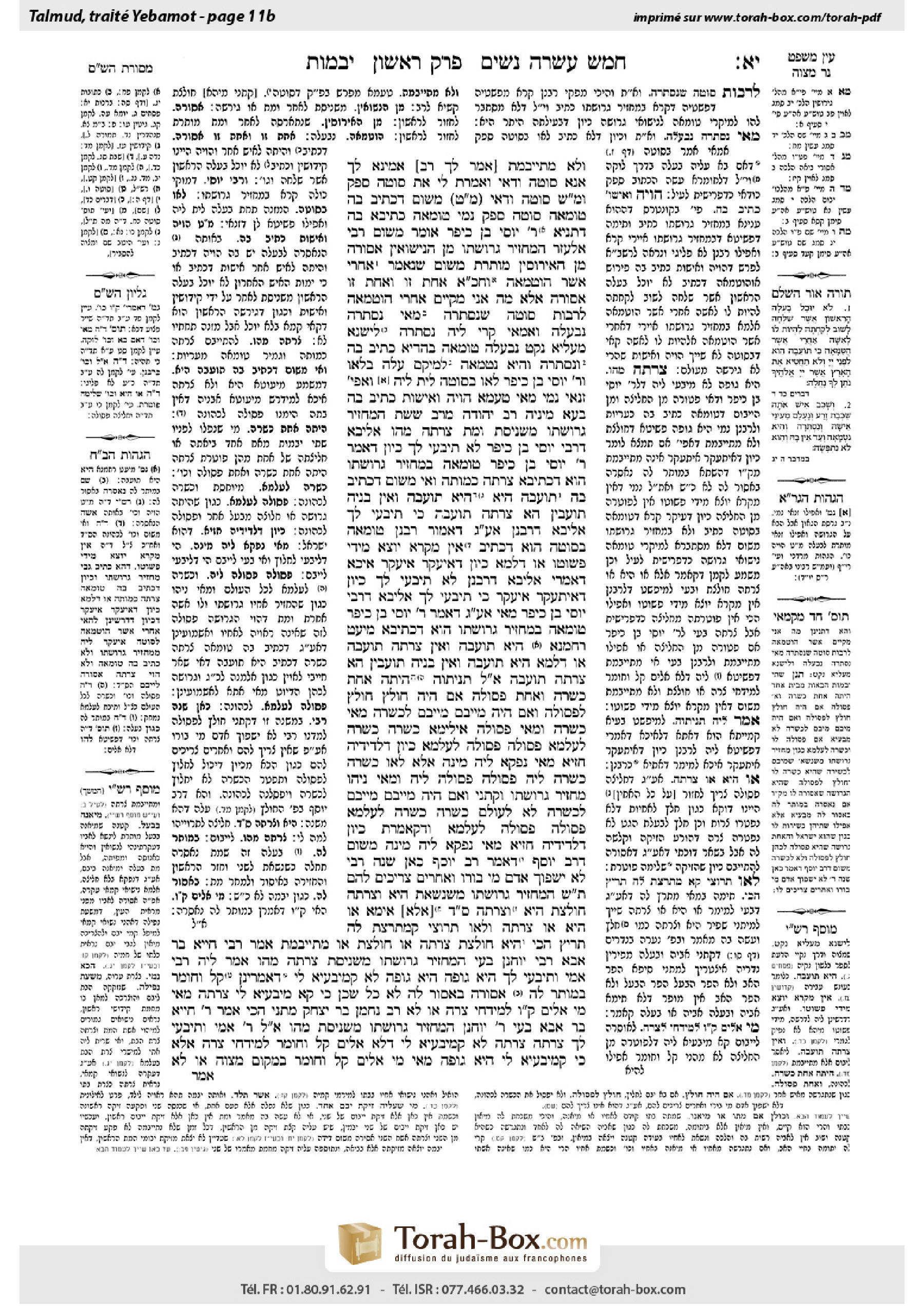
Yevamot 11b: Talmud study for Daf Yomi
Daf Yomi is the daily study of one Talmud folio. Explore 37 tractates with scans, Hebrew text, Sefaria English and AI-generated French translations where annotated.
Passage selection and English or AI-generated French translation are available where the scan has annotations. Daf Study is independent of Torah-Box and Sefaria.
Browse Yevamot · יבמות · All tractatesYevamot 11b text and translations
This page of Yevamot includes the Aramaic text, an English translation and an AI-generated French translation, alongside the scan above.
יבמות י״א ב · Aramaic and Hebrew text
וְלֹא מִתְיַיבֶּמֶת. [אָמַר לְךָ רַב:] אָמֵינָא לָךְ אֲנָא סוֹטָה וַדַּאי, וְאָמְרַתְּ לִי אַתְּ סוֹטָה סָפֵק! וּמַאי שְׁנָא סוֹטָה וַדַּאי (מַאי טַעְמָא) — מִשּׁוּם דִּכְתִיב בָּהּ טוּמְאָה,
סוֹטָה סָפֵק נָמֵי טוּמְאָה כְּתִיבָא בַּהּ! דְּתַנְיָא: רַבִּי יוֹסֵי בֶּן כִּיפָּר אוֹמֵר מִשּׁוּם רַבִּי אֶלְעָזָר: הַמַּחְזִיר גְּרוּשָׁתוֹ מִן הַנִּישּׂוּאִין — אֲסוּרָה, מִן הָאֵירוּסִין — מוּתֶּרֶת, מִשּׁוּם שֶׁנֶּאֱמַר: ״אַחֲרֵי אֲשֶׁר הֻטַּמָּאָה״.
וַחֲכָמִים אוֹמְרִים: אַחַת זוֹ וְאַחַת זוֹ — אֲסוּרָה, אֶלָּא מָה אֲנִי מְקַיֵּים ״אַחֲרֵי [אֲשֶׁר] הֻטַּמָּאָה״ — לְרַבּוֹת סוֹטָה שֶׁנִּסְתְּרָה.
וּמַאי ״נִסְתְּרָה״ — נִבְעֲלָה. וְאַמַּאי קָרֵי לֵיהּ נִסְתְּרָה — לִישָּׁנָא מְעַלְּיָא נָקֵט. נִבְעֲלָה, טוּמְאָה בְּהֶדְיָא כְּתִיב בַּהּ, ״וְנִסְתְּרָה וְהִיא נִטְמָאָה״?
לְמֵיקַם עֲלַהּ בְּלָאו. וְרַבִּי יוֹסֵי בֶּן כִּיפָּר — לָאו בְּסוֹטָה לֵית לֵיהּ, וַאֲפִילּוּ זַנַּאי נָמֵי.
מַאי טַעְמָא — הֲוָיָה וְאִישׁוּת כְּתִיב בַּהּ.
בְּעָא מִינֵּיהּ רַב יְהוּדָה מֵרַב שֵׁשֶׁת: הַמַּחְזִיר גְּרוּשָׁתוֹ מִשֶּׁנִּיסֵּת, וּמֵת, צָרָתָהּ מַהוּ? אַלִּיבָּא דְּרַבִּי יוֹסֵי בֶּן כִּיפָּר לָא תִּיבְּעֵי לָךְ, כֵּיוָן דְּאָמַר רַבִּי יוֹסֵי בֶּן כִּיפָּר טוּמְאָה בְּמַחֲזִיר גְּרוּשָׁתוֹ הוּא דִּכְתִיבָא — צָרָתָהּ כְּמוֹתָהּ.
וְאִי מִשּׁוּם דִּכְתִיב בָּהּ ״תּוֹעֵבָה הִיא״, הִיא תּוֹעֵבָה וְאֵין בָּנֶיהָ תּוֹעֲבִין — הָא צָרָתָהּ תּוֹעֵבָה.
כִּי תִּיבְּעֵי לָךְ אַלִּיבָּא דְּרַבָּנַן: אַף עַל גַּב דַּאֲמוּר רַבָּנַן טוּמְאָה בְּסוֹטָה הוּא דִּכְתִיב — אֵין מִקְרָא יוֹצֵא מִידֵי פְּשׁוּטוֹ,
אוֹ דִלְמָא כֵּיוָן דְּאִיעֲקַר — אִיעֲקַר. אִיכָּא דְּאָמְרִי: אַלִּיבָּא דְּרַבָּנַן לָא תִּיבְּעֵי לָךְ, כֵּיוָן דְּאִיתְעֲקַר — אִיעֲקַר.
כִּי תִּיבְּעֵי לָךְ — אַלִּיבָּא דְּרַבִּי יוֹסֵי בֶּן כִּיפָּר, מַאי? אַף עַל גַּב דְּאָמַר רַבִּי יוֹסֵי בֶּן כִּיפָּר טוּמְאָה בְּמַחֲזִיר גְּרוּשָׁתוֹ הוּא דִּכְתִיבָא — מִיעֵט רַחֲמָנָא הִיא תּוֹעֵבָה וְאֵין צָרָתָהּ תּוֹעֵבָה, אוֹ דִלְמָא: הִיא תּוֹעֵבָה וְאֵין בָּנֶיהָ תּוֹעֲבִין, הָא צָרָתָהּ — תּוֹעֵבָה?
אֲמַר לֵיהּ, תְּנֵיתוּהָ: הָיְתָה אַחַת כְּשֵׁרָה וְאַחַת פְּסוּלָה, אִם הָיָה חוֹלֵץ — חוֹלֵץ לַפְּסוּלָה, וְאִם הָיָה מְיַיבֵּם — מְיַיבֵּם לַכְּשֵׁרָה.
מַאי ״כְּשֵׁרָה״ וּמַאי ״פְּסוּלָה״? אִילֵּימָא ״כְּשֵׁרָה״ — כְּשֵׁרָה לְעָלְמָא, ״פְּסוּלָה״ — פְּסוּלָה לְעָלְמָא. כֵּיוָן דִּלְדִידֵיהּ חַזְיָא — מַאי נָפְקָא לֵיהּ מִינַּהּ?
אֶלָּא לָאו: ״כְּשֵׁרָה״ — כְּשֵׁרָה לֵיהּ, ״פְּסוּלָה״ — פְּסוּלָה לֵיהּ, וּמַאי נִיהוּ — מַחֲזִיר גְּרוּשָׁתוֹ, וְקָתָנֵי: וְאִם הָיָה מְיַיבֵּם — מְיַיבֵּם לַכְּשֵׁרָה!
לָא, לְעוֹלָם ״כְּשֵׁרָה״ — כְּשֵׁרָה לְעָלְמָא, ״פְּסוּלָה״ — פְּסוּלָה לְעָלְמָא. וּדְקָאָמְרַתְּ: כֵּיוָן דִּלְדִידֵיהּ חַזְיָא, מַאי נָפְקָא לֵיהּ מִינַּהּ — מִשּׁוּם דְּרַב יוֹסֵף.
דְּאָמַר רַב יוֹסֵף: כָּאן שָׁנָה רַבִּי: לֹא יִשְׁפּוֹךְ אָדָם מֵי בוֹרוֹ, וַאֲחֵרִים צְרִיכִים לָהֶם.
תָּא שְׁמַע: הַמַּחְזִיר גְּרוּשָׁתוֹ מִשֶּׁנִּשֵּׂאת — הִיא וְצָרָתָהּ חוֹלֶצֶת. הִיא וְצָרָתָהּ סָלְקָא דַּעְתָּךְ? [אֶלָּא] אֵימָא: אוֹ הִיא, אוֹ צָרָתָהּ.
וְלָאו תָּרוֹצֵי קָמְתָרְצַתְּ לַהּ?! תָּרֵיץ הָכִי: הִיא — חוֹלֶצֶת, צָרָתָהּ — אוֹ חוֹלֶצֶת אוֹ מִתְיַיבֶּמֶת.
אָמַר רַבִּי חִיָּיא בַּר אַבָּא, רַבִּי יוֹחָנָן בָּעֵי: הַמַּחְזִיר גְּרוּשָׁתוֹ מִשֶּׁנִּיסֵּת, צָרָתָהּ מַהוּ? אֲמַר לֵיהּ רַבִּי אַמֵּי: וְתִיבְּעֵי לָךְ הִיא גּוּפַהּ? הִיא גּוּפַהּ לָא קָמִיבַּעְיָא לִי,
דְּאָמְרִינַן קַל וָחוֹמֶר: בַּמּוּתָּר לָהּ — אֲסוּרָה, בָּאָסוּר לָהּ — לֹא כׇּל שֶׁכֵּן?! כִּי קָא מִיבַּעְיָא לִי: צָרָתָהּ, מַאי? מִי אַלִּים קַל וָחוֹמֶר לְמִידְחֵי צָרָה, אוֹ לָא?
רַב נַחְמָן בַּר יִצְחָק מַתְנֵי הָכִי: אָמַר רַבִּי חִיָּיא בַּר אַבָּא, בָּעֵי רַבִּי יוֹחָנָן: הַמַּחְזִיר גְּרוּשָׁתוֹ מִשֶּׁנִּיסֵּת, מַהוּ? אֲמַר לֵיהּ רַבִּי אַמֵּי: וְתִיבְּעֵי לָךְ צָרָתָהּ? צָרָתָהּ לָא קָמִיבַּעְיָא לִי, דְּלָא אַלִּים קַל וָחוֹמֶר לְמִידְחֵי צָרָה. אֶלָּא כִּי קָמִיבַּעְיָא לִי, הִיא גּוּפַהּ מַאי: מִי אַלִּים קַל וָחוֹמֶר בִּמְקוֹם מִצְוָה, אוֹ לָא?
Yevamot 11b · English translation
and may not enter into levirate marriage. This indicates that the levirate bond does apply to a sota, which contradicts Rav’s statement. The Gemara retorts that Rav could have said to you: I spoke to you about a sota whose infidelity was definite, and you speak to me of an uncertain sota. There is no proof that this wife who secluded herself with another man was actually unfaithful, and due to the uncertainty she must still undergo ḥalitza. The Gemara raises a difficulty: And what is different about a definite sota? Is it different because the term defilement is written with regard to her?
But with regard to an uncertain sota, who was alone with a specific man enough time to engage in relations, defilement is written as well. As it is taught in a baraita: Rabbi Yosei ben Keifar said in the name of Rabbi Elazar: With regard to one who remarries his divorcée after she had been married to another man, an act prohibited by Torah law, if he remarried her following actual marriage to another, she is forbidden to her first husband. However, if he remarried her following mere betrothal to another man, she is permitted, because it is stated: “Her former husband, who sent her away, may not take her again to be his wife, after she was defiled” (Deuteronomy 24:4), and a woman who was merely betrothed was never defiled, as no sexual relations had taken place.
And the Rabbis say: Both this one and that one, i.e., whether she had been fully married or merely betrothed to another, she is forbidden to her first husband. Rather, how do I establish the phrase: “After she was defiled”? This verse does not refer at all to the case of a woman who married another man lawfully, as she is not called “defiled.” Rather, it comes to include a sota who secluded herself with another man, as she is forbidden to her husband due to the concern that she might have committed adultery. This baraita shows that a sota is termed “defiled,” despite the fact that hers is an uncertain case.
The Gemara rejects this argument: And what does: Secluded herself, mean in this context? It means that she had actually engaged in relations. And why does the baraita call this: Secluded herself, instead of the more straightforward: Engaged in sexual relations? The baraita employed a euphemistic expression, but it actually means that she engaged in intercourse. The Gemara asks: If this is referring to a woman who had engaged in relations, the term defilement is already explicitly written with regard to her, in the chapter that deals with a sota. Why is it necessary to derive that she is defiled from a different source, as in the context of a sota herself the verse states: “She being defiled secretly” (Numbers 5:13)?
The Gemara explains that “may not take her again to be his wife after she was defiled” does not teach that she is called “defiled,” but rather that the halakha establishes upon her a prohibition. In other words, if the husband engages in relations with his wife after she had had intercourse with another, he transgresses a prohibition. And the Gemara comments that Rabbi Yosei ben Keifar does not hold the opinion that there is a prohibition in the case of a sota, as he maintains that a husband who has relations with his sota wife does not transgress any prohibition at all, and the same is true even if she definitely fornicated with another man.
What is the rationale of Rabbi Yosei ben Keifar? In his opinion, “after she was defiled” does not refer to a sota but to a woman who had been legally divorced from her first husband and subsequently married another man. This is indicated by the fact that both becoming, i.e., betrothal, and matrimony are written in this context: “Becomes another man’s wife” (Deuteronomy 24:2) and: “Or if the latter husband die, who took her to be his wife” (Deuteronomy 24:3). Here it is clear that the reference is to halakhically valid marriage, whereas a sota had never been another man’s wife, as she cannot marry another man while she is still married.
§ The Gemara discusses a similar case. Rav Yehuda raised a dilemma before Rav Sheshet: In the case of one who remarries his divorcée after she had married another, and then he dies childless, what is the halakha with regard to the levirate marriage of her rival wife? According to the opinion of Rabbi Yosei ben Keifar, do not raise the dilemma, since Rabbi Yosei ben Keifar said that it is with regard to one who remarries his divorcée that defilement is written, and therefore the status of her rival wife is the same as hers.
And if one would claim that the dilemma does in fact arise because it is written: “That is an abomination” (Deuteronomy 24:4), and the emphasis on “that” serves to limit the range of the prohibition and teaches that this halakha applies only to her and not her rival wife, still, the accepted interpretation of this verse is as follows: She is an abomination, but her children are not abominations. In other words, if he transgressed the prohibition and remarried this woman, their children are not disqualified from marrying priests. If so, the term “that” does not come to exclude her rival wife from this halakha, and therefore her rival wife is an abomination for the purposes of levirate marriage, just like the wife herself, and she too is exempt.
Rather, let the dilemma be raised according to the opinion of the Rabbis. Although the Rabbis said that it is with regard to a sota that defilement is written, perhaps here they apply the principle that a verse does not depart from its literal meaning. In other words, notwithstanding the fact that the Rabbis derive from here a halakhic ruling concerning a sota, the straightforward meaning of the verse should not be entirely disregarded. Accordingly, as the context here is remarriage to one’s divorced wife, this verse would teach that hers is a case of defilement.
Or perhaps once a verse is uprooted from its context, it is entirely uprooted and no longer teaches anything about the subject matter of the chapter in which it is written. This would mean that the sole significance of this particular verse is in reference to a sota. There are those who say the opposite: According to the opinion of the Rabbis, do not raise the dilemma, as once a verse is uprooted from its context, it is entirely uprooted. Consequently, there is no defilement when a man remarries his divorcée, neither with regard to her nor concerning her rival wife.
Rather, let the dilemma be raised according to the opinion of Rabbi Yosei ben Keifar. What is the dilemma? Although Rabbi Yosei ben Keifar said that it is with regard to one who remarries his divorcée that defilement is written, one can ask: Does the Merciful One limit this halakha by the phrase “that is an abomination,” which indicates: And her rival wife is not an abomination? Or perhaps this verse teaches that she is an abomination but her children are not abominations, which indicates that her rival wife is an abomination.
Rav Sheshet said to him: You learned it in a baraita that deals with a case of two yevamot who came before a yavam for levirate marriage. In a situation where one of the women was fit and the other disqualified, if he would like to perform ḥalitza he performs ḥalitza with the disqualified woman, and if he would like to enter into levirate marriage he enters into levirate marriage with the fit woman.
Rav Sheshet analyzes this baraita: What is the meaning of fit, and what is the meaning of disqualified? If we say that fit means fit for all men, and disqualified means disqualified in general, e.g., a woman who had already been divorced is disqualified from marrying any priest, despite the fact that she is fit to marry this particular man himself, then since for him she is suitable, what difference does it make for him whether she is disqualified from or fit for marriage to others?
Rather, is it not the case that fit means fit for him, and disqualified means disqualified for him? And what is that case in which a woman is fit or disqualified only with regard to him but not any other man? This is evidently referring to the case of one who remarries his divorcée. The deceased brother had remarried his divorced wife after she had married another man, and therefore she is disqualified from entering into levirate marriage with that particular man but she is permitted to other men. And it is taught there that if he would like to enter into levirate marriage, he may enter into levirate marriage even with the fit woman. This indicates that the rival wife of a remarried divorcée is fit for levirate marriage.
The Gemara rejects this argument: No; actually, fit means fit to all men, and disqualified means disqualified in general, e.g., a woman who had already been divorced is disqualified from marrying any priest. And that which you said: Since for him she is suitable what difference does it make for him, this is significant because of the statement of Rav Yosef.
As Rav Yosef said: Here Rabbi Yehuda HaNasi taught a valuable moral lesson, that a person should not pour the water from his well when others are in need of it. That is, one should not cause loss in any situation, even when this relates to his own personal life, if he might thereby cause a future loss to others. The same reasoning applies here: If he intends to perform ḥalitza it does not matter to him which of the women he chooses, but if he does so with the one who is fit to others, he thereby disqualifies her from marrying a priest, as the legal status of a woman who underwent ḥalitza is like that of a divorcée. It is therefore preferable to perform ḥalitza with the one who in any case was disqualified from marrying a priest.
The Gemara suggests: Come and hear a different baraita: With regard to one who remarries his divorcée after she had married another, she and her rival wife perform ḥalitza. The Gemara first analyzes the wording of the baraita: Can it enter your mind that both she and her rival wife must perform ḥalitza? After all, only one wife of a deceased brother undergoes ḥalitza, not two. Rather, say: Either she or her rival wife. This indicates that both women are unfit for levirate marriage.
The Gemara rejects this claim: And did you not already resolve a difficulty in the baraita by adjusting its language and not interpreting it as it is? If so, you cannot cite a proof from here, as you can adjust it differently and answer as follows: She performs ḥalitza, while her rival wife either performs ḥalitza or enters into levirate marriage. If so, this baraita provides no conclusive proof that might resolve Rav Yehuda’s dilemma.
§ On the same issue, Rabbi Ḥiyya bar Abba said that Rabbi Yoḥanan raised a dilemma: With regard to one who remarries his divorcée after she had been married to another, what is the halakha concerning the levirate marriage of her rival wife? Rabbi Ami said to him: And you can raise the dilemma with regard to this woman herself. Why not ask if she requires levirate marriage when her husband dies? Rabbi Ḥiyya bar Abba replied: The halakha of the divorcée herself is not a dilemma for me, as she is certainly forbidden.
Rabbi Ḥiyya bar Abba elaborates: As in this case we state an a fortiori inference: If she is now forbidden to one who was previously permitted to her, i.e., her first husband, with regard to one who was forbidden to her, the yavam, is it not all the more so the case that she remains forbidden to him? Where I raise the dilemma it is with regard to her rival wife. What is the halakha in this case? Is the aforementioned a fortiori inference strong enough to invalidate her rival wife or not? The divorcée herself is certainly exempt from levirate marriage, but the question is whether the a fortiori inference applies to the rival wife as well.
Rav Naḥman bar Yitzḥak would teach a different version of this discussion, as follows: Rabbi Ḥiyya bar Abba said that Rabbi Yoḥanan raised a dilemma: With regard to one who remarries his divorcée after she had been married to another, what is the halakha concerning her levirate marriage? Rabbi Ami said to him: And you can raise the dilemma with regard to her rival wife as well. Rabbi Ḥiyya bar Abba replied: The halakha of her rival wife is not a dilemma for me, as the a fortiori inference is not strong enough to invalidate a rival wife. Rather, where I raise the dilemma it is with regard to the divorcée herself. What is the halakha? Is the a fortiori inference strong enough that it can be accepted even in place of a mitzva to enter into levirate marriage, or not?
Yevamot 11b · Traduction française (IA)
et ne peut pas contracter de mariage léviratique. Cela indique que le lien léviratique s’applique bien à une sota, ce qui contredit la déclaration de Rav. La Guemara rétorque que Rav aurait pu vous répondre : « Je vous ai parlé d’une sota dont l’infidélité était certaine, et vous me parlez d’une sota dont le cas est incertain. » Rien ne prouve que cette femme, qui s’est isolée avec un autre homme, lui ait réellement été infidèle ; en raison de ce doute, elle doit encore subir la ḥalitsa. La Guemara soulève une difficulté : En quoi une sota dont l’infidélité est certaine diffère-t-elle ? Est-ce parce que le terme « souillure » est écrit à son sujet ?
Mais au sujet d’une sota dont le cas est incertain, qui est restée seule avec un homme précis assez longtemps pour avoir des relations avec lui, le terme « souillure » est également écrit. Car il est enseigné dans une baraïta : Rabbi Yosei ben Keifar a dit au nom de Rabbi Elazar : Celui qui reprend son ex-femme après qu’elle a été mariée à un autre homme — acte interdit par la Torah —, si elle a ensuite été véritablement mariée à un autre, elle est interdite à son premier mari. En revanche, s’il l’a reprise après de simples fiançailles avec un autre homme, elle lui est permise, car il est dit : « Son ancien mari, qui l’a renvoyée, ne pourra pas la reprendre pour qu’elle redevienne sa femme, après qu’elle a été souillée » (Deutéronome 24, 4). Or, une femme qui a seulement été fiancée n’a jamais été souillée, puisqu’elle n’a pas eu de relations sexuelles.
Et les Rabbins disent : dans les deux cas, qu’elle ait été pleinement mariée ou seulement fiancée à un autre, elle est interdite à son premier mari. Alors, comment comprendre l’expression « après qu’elle a été souillée » ? Ce verset ne parle pas du tout du cas d’une femme qui a légalement épousé un autre homme, car elle n’est pas appelée « souillée ». Il vient plutôt inclure une sota qui s’est isolée avec un autre homme, car elle est interdite à son mari en raison du soupçon qu’elle ait commis l’adultère. Cette baraïta montre qu’une sota est qualifiée de « souillée », bien que son cas soit incertain.
La Guemara rejette cet argument : Que signifie ici « s’est isolée » ? Cela signifie qu’elle a effectivement eu des relations. Et pourquoi la baraïta dit-elle « s’est isolée » au lieu de l’expression plus directe « a eu des relations sexuelles » ? La baraïta emploie une expression euphémique, mais elle signifie en réalité qu’elle a eu des relations sexuelles. La Guemara demande : S’il s’agit d’une femme qui a eu des relations, le terme « souillure » est déjà explicitement écrit à son sujet, dans le passage consacré à la sota. Pourquoi est-il nécessaire de déduire d’une autre source qu’elle est souillée, alors que le verset dit, dans le contexte de la sota elle-même : « Elle s’étant souillée secrètement » (Nombres 5, 13) ?
La Guemara explique que l’expression « ne pourra pas la reprendre pour qu’elle redevienne sa femme, après qu’elle a été souillée » n’enseigne pas qu’elle est qualifiée de « souillée », mais établit plutôt une interdiction à son égard. Autrement dit, si le mari a des relations avec sa femme après qu’elle a eu des rapports avec un autre, il transgresse une interdiction. La Guemara fait remarquer que Rabbi Yosei ben Keifar ne soutient pas qu’il existe une interdiction dans le cas d’une sota, car, selon lui, un mari qui a des relations avec sa femme sota ne transgresse absolument aucune interdiction. Il en va de même même si elle a certainement commis l’adultère avec un autre homme.
Quel est le raisonnement de Rabbi Yosei ben Keifar ? Selon lui, l’expression « après qu’elle a été souillée » ne désigne pas une sota, mais une femme qui a été légalement divorcée de son premier mari, puis a épousé un autre homme. Cela ressort du fait que les étapes des fiançailles et du mariage sont toutes deux mentionnées dans ce passage : « Devient la femme d’un autre homme » (Deutéronome 24, 2), et « ou si le dernier mari, qui l’a prise pour femme, meurt » (Deutéronome 24, 3). Il est clair ici qu’il s’agit d’un mariage conforme à la halakha, tandis qu’une sota n’a jamais été la femme d’un autre homme, puisqu’elle ne peut pas épouser un autre homme tant qu’elle est encore mariée.
§ La Guemara examine un cas similaire. Rav Yehuda posa une question à Rav Sheshet : Dans le cas d’un homme qui reprend son ex-femme après qu’elle a épousé un autre homme, puis meurt sans enfant, quelle est la halakha concernant le mariage léviratique de sa coépouse ? Selon l’opinion de Rabbi Yosei ben Keifar, la question ne se pose pas, puisque Rabbi Yosei ben Keifar a dit que le terme « souillure » est écrit au sujet de celui qui reprend son ex-femme ; le statut de sa coépouse est donc le même que le sien.
Et si l’on prétend que la question se pose bel et bien, car il est écrit : « C’est une abomination » (Deutéronome 24, 4), et que l’accent mis sur « c’est » restreint la portée de l’interdiction et enseigne que cette halakha ne s’applique qu’à elle, et non à sa coépouse, l’interprétation reçue de ce verset est néanmoins la suivante : elle est une abomination, mais ses enfants ne sont pas des abominations. Autrement dit, si l’homme a transgressé l’interdiction et a repris cette femme, leurs enfants ne sont pas disqualifiés pour épouser des prêtres. Le terme « c’est » ne vient donc pas exclure sa coépouse de cette halakha ; par conséquent, du point de vue du mariage léviratique, sa coépouse est une abomination tout comme la femme elle-même, et elle aussi en est dispensée.
La question se pose plutôt selon l’opinion des Rabbins. Bien que les Rabbins disent que le terme « souillure » est écrit au sujet d’une sota, peut-être appliquent-ils ici le principe selon lequel un verset ne s’écarte pas de son sens littéral. Autrement dit, même si les Rabbins déduisent de ce passage une règle de halakha concernant une sota, il ne faut pas pour autant écarter entièrement le sens littéral du verset. Puisque le contexte est ici celui d’un remariage avec son ex-femme, le verset enseignerait donc qu’il s’agit d’un cas de souillure.
Ou peut-être qu’une fois qu’un verset est détaché de son contexte, il l’est entièrement et n’enseigne plus rien sur le sujet du chapitre où il est écrit. Cela signifierait que ce verset précis ne concerne que la sota. Certains disent le contraire : selon l’opinion des Rabbins, la question ne se pose pas, car une fois qu’un verset est détaché de son contexte, il l’est entièrement. Par conséquent, le remariage d’un homme avec son ex-femme n’entraîne aucune souillure, ni pour elle ni pour sa coépouse.
La question se pose plutôt selon l’opinion de Rabbi Yosei ben Keifar. Quelle est la question ? Bien que Rabbi Yosei ben Keifar ait dit que le terme « souillure » est écrit au sujet de celui qui reprend son ex-femme, on peut demander : Le Miséricordieux limite-t-il cette halakha par l’expression « c’est une abomination », qui indique que sa coépouse n’est pas une abomination ? Ou peut-être ce verset enseigne-t-il qu’elle est une abomination, mais que ses enfants ne sont pas des abominations, ce qui indique que sa coépouse est une abomination.
Rav Sheshet lui dit : Tu l’as appris dans une baraïta portant sur le cas de deux yevamot qui se présentent devant un yavam pour le mariage léviratique. Si l’une des femmes est apte et l’autre disqualifiée, s’il souhaite accomplir la ḥalitsa, il l’accomplit avec la femme disqualifiée ; s’il souhaite contracter le mariage léviratique, il le contracte avec la femme apte.
Rav Sheshet analyse cette baraïta : Que signifient « apte » et « disqualifiée » ? Si l’on dit qu’« apte » signifie apte à épouser tous les hommes, et que « disqualifiée » signifie disqualifiée de façon générale — par exemple, une femme déjà divorcée, qui ne peut épouser aucun prêtre, bien qu’elle puisse épouser cet homme en particulier —, alors, puisqu’elle lui convient, quelle différence cela fait-il pour lui qu’elle soit disqualifiée ou apte à épouser d’autres hommes ?
Ne faut-il pas plutôt comprendre qu’« apte » signifie apte pour lui, et « disqualifiée », disqualifiée pour lui ? Et dans quel cas une femme est-elle apte ou disqualifiée uniquement à l’égard de cet homme, mais pas des autres ? Il s’agit manifestement du cas d’un homme qui reprend son ex-femme. Le frère défunt avait repris son ex-femme après qu’elle eut épousé un autre homme ; elle est donc disqualifiée pour contracter le mariage léviratique avec cet homme en particulier, mais elle est permise aux autres hommes. Or, il est enseigné là-bas que, s’il souhaite contracter le mariage léviratique, il peut le contracter même avec la femme apte. Cela indique que la coépouse d’une femme reprise par son premier mari est apte au mariage léviratique.
La Guemara rejette cet argument : Non ; en réalité, « apte » signifie apte à épouser tous les hommes, et « disqualifiée » signifie disqualifiée de façon générale, par exemple une femme déjà divorcée, qui ne peut épouser aucun prêtre. Quant à ce que tu as dit — puisqu’elle lui convient, quelle différence cela fait-il pour lui ? —, cela a de l’importance en raison de la déclaration de Rav Yosef.
Car Rav Yosef a dit : Ici, Rabbi Yehuda HaNasi a enseigné une précieuse leçon de morale : une personne ne doit pas vider l’eau de son puits alors que d’autres en ont besoin. Autrement dit, il ne faut causer aucune perte, même dans sa vie personnelle, si l’on risque ainsi d’occasionner une perte à autrui à l’avenir. Le même raisonnement s’applique ici : s’il a l’intention d’accomplir la ḥalitsa, peu lui importe laquelle des femmes il choisit ; mais s’il l’accomplit avec celle qui est apte à épouser d’autres hommes, il la disqualifie ainsi pour épouser un prêtre, car le statut juridique d’une femme ayant subi la ḥalitsa est semblable à celui d’une divorcée. Il est donc préférable d’accomplir la ḥalitsa avec celle qui, de toute façon, était déjà disqualifiée pour épouser un prêtre.
La Guemara propose : Viens entendre une autre baraïta : Celui qui reprend son ex-femme après qu’elle a épousé un autre homme : elle et sa coépouse accomplissent la ḥalitsa. La Guemara examine d’abord le libellé de la baraïta : Peut-on vraiment penser qu’elles doivent toutes deux accomplir la ḥalitsa ? Après tout, une seule épouse du frère défunt subit la ḥalitsa, et non deux. Il faut plutôt dire : soit elle, soit sa coépouse. Cela indique que les deux femmes sont inaptes au mariage léviratique.
La Guemara rejette cette affirmation : N’as-tu pas déjà résolu une difficulté concernant la baraïta en en ajustant le texte au lieu de l’interpréter tel quel ? Tu ne peux donc pas en tirer une preuve, car tu peux l’ajuster autrement et répondre ainsi : elle accomplit la ḥalitsa, tandis que sa coépouse accomplit soit la ḥalitsa, soit le mariage léviratique. Cette baraïta n’apporte donc aucune preuve décisive susceptible de résoudre la question de Rav Yehuda.
§ Sur la même question, Rabbi Ḥiyya bar Abba a dit que Rabbi Yoḥanan a soulevé une question : Dans le cas d’un homme qui reprend son ex-femme après qu’elle a été mariée à un autre, quelle est la halakha concernant le mariage léviratique de sa coépouse ? Rabbi Ami lui dit : Tu peux aussi soulever la question au sujet de cette femme elle-même. Pourquoi ne pas demander si elle doit contracter le mariage léviratique à la mort de son mari ? Rabbi Ḥiyya bar Abba répondit : Je ne m’interroge pas sur la halakha concernant l’ex-femme elle-même, car elle est certainement interdite.
Rabbi Ḥiyya bar Abba développe : Dans ce cas, nous formulons un raisonnement a fortiori : si elle est désormais interdite à un homme qui lui était auparavant permis, c’est-à-dire son premier mari, à plus forte raison reste-t-elle interdite à un homme qui lui était interdit, le yavam. Ma question porte sur sa coépouse. Quelle est la halakha dans ce cas ? Le raisonnement a fortiori mentionné suffit-il à disqualifier sa coépouse ou non ? L’ex-femme elle-même est certainement dispensée du mariage léviratique, mais la question est de savoir si le raisonnement a fortiori s’applique également à sa coépouse.
Rav Naḥman bar Yitzḥak enseignait une autre version de cette discussion, comme suit : Rabbi Ḥiyya bar Abba a dit que Rabbi Yoḥanan a soulevé une question : Dans le cas d’un homme qui reprend son ex-femme après qu’elle a été mariée à un autre, quelle est la halakha concernant son mariage léviratique ? Rabbi Ami lui dit : Tu peux aussi soulever la question au sujet de sa coépouse. Rabbi Ḥiyya bar Abba répondit : Je ne m’interroge pas sur la halakha concernant sa coépouse, car le raisonnement a fortiori ne suffit pas à disqualifier une coépouse. Ma question porte plutôt sur l’ex-femme elle-même. Quelle est la halakha ? Le raisonnement a fortiori est-il assez fort pour être retenu même face à une mitsva de contracter le mariage léviratique, ou non ?
Traduction française générée par IA à partir de l’édition anglaise de Sefaria. Vérifie toujours un passage avec le texte source.
Text from Sefaria: William Davidson Edition - Vocalized Aramaic (CC BY NC); William Davidson Edition - English (CC BY NC).