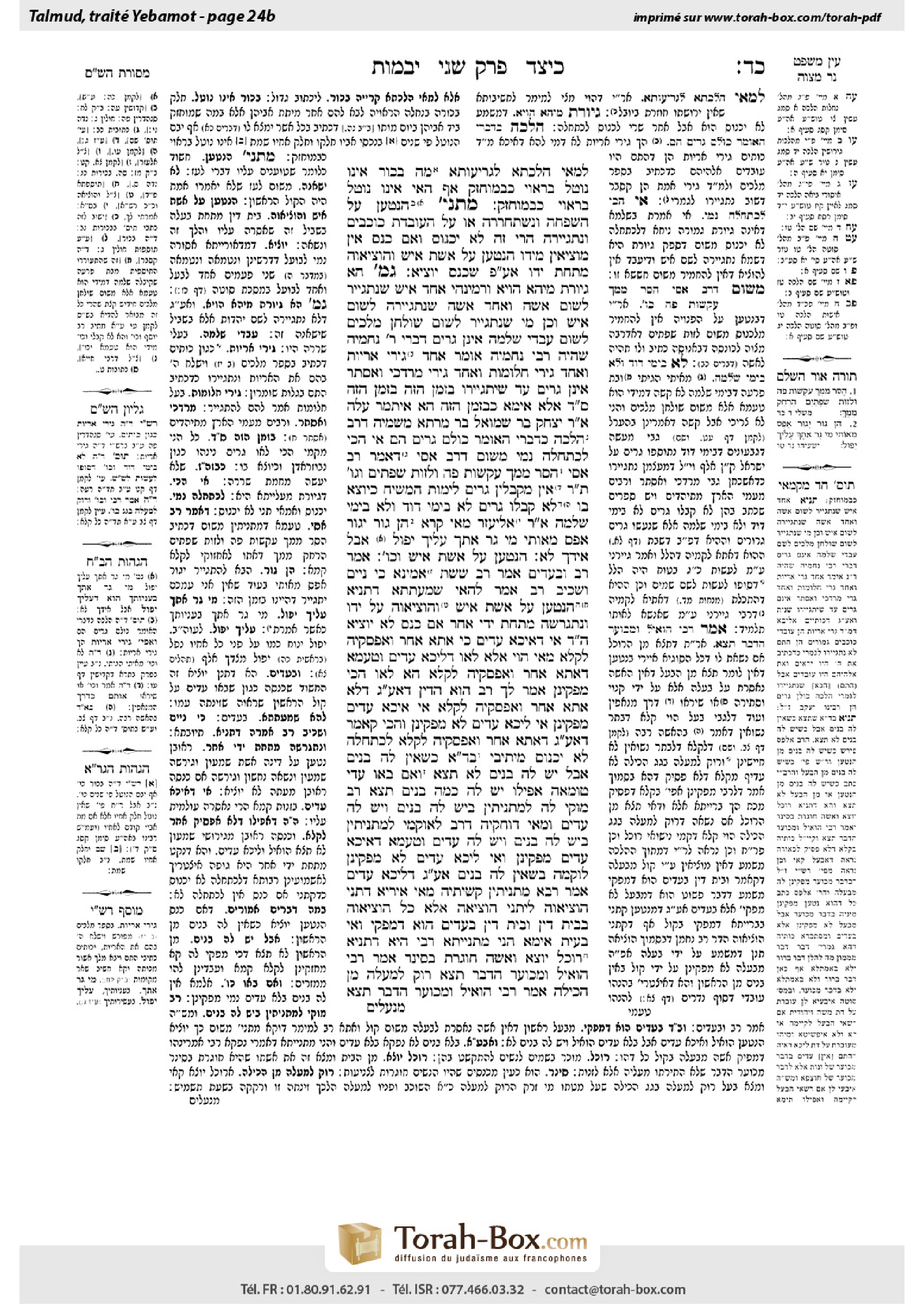
Yevamot 24b: Talmud study for Daf Yomi
Daf Yomi is the daily study of one Talmud folio. Explore 37 tractates with scans, Hebrew text, Sefaria English and AI-generated French translations where annotated.
Passage selection and English or AI-generated French translation are available where the scan has annotations. Daf Study is independent of Torah-Box and Sefaria.
Browse Yevamot · יבמות · All tractatesYevamot 24b text and translations
This page of Yevamot includes the Aramaic text, an English translation and an AI-generated French translation, alongside the scan above.
יבמות כ״ד ב · Aramaic and Hebrew text
לְמַאי הִלְכְתָא? לִגְרִיעוּתָא: מָה בְּכוֹר אֵינוֹ נוֹטֵל בָּרָאוּי כִּבְמוּחְזָק — אַף הַאי אֵינוֹ נוֹטֵל בָּרָאוּי כִּבְמוּחְזָק.
מַתְנִי׳ הַנִּטְעָן עַל הַשִּׁפְחָה וְנִשְׁתַּחְרְרָה, אוֹ עַל הַגּוֹיָה וְנִתְגַּיְּירָה — הֲרֵי זֶה לֹא יִכְנוֹס. וְאִם כָּנַס — אֵין מוֹצִיאִין מִיָּדוֹ. הַנִּטְעָן עַל אֵשֶׁת אִישׁ וְהוֹצִיאוּהָ מִתַּחַת יָדוֹ, אַף עַל פִּי שֶׁכָּנַס — יוֹצִיא.
גְּמָ׳ הָא גִּיּוֹרֶת מִיהָא הָוְיָא. וּרְמִינְהִי: אֶחָד אִישׁ שֶׁנִּתְגַּיֵּיר לְשׁוּם אִשָּׁה, וְאֶחָד אִשָּׁה שֶׁנִּתְגַּיְּירָה לְשׁוּם אִישׁ, וְכֵן מִי שֶׁנִּתְגַּיֵּיר לְשׁוּם שׁוּלְחַן מְלָכִים, לְשׁוּם עַבְדֵי שְׁלֹמֹה — אֵינָן גֵּרִים, דִּבְרֵי רַבִּי נְחֶמְיָה.
שֶׁהָיָה רַבִּי נְחֶמְיָה אוֹמֵר: אֶחָד גֵּירֵי אֲרָיוֹת, וְאֶחָד גֵּירֵי חֲלוֹמוֹת, וְאֶחָד גֵּירֵי מׇרְדֳּכַי וְאֶסְתֵּר — אֵינָן גֵּרִים עַד שֶׁיִּתְגַּיְּירוּ בַּזְּמַן הַזֶּה.
בַּזְּמַן הַזֶּה סָלְקָא דַּעְתָּךְ?! אֶלָּא אֵימָא: כְּבַזְּמַן הַזֶּה.
הָא אִיתְּמַר עֲלַהּ, אָמַר רַב יִצְחָק בַּר שְׁמוּאֵל בַּר מָרְתָא מִשְּׁמֵיהּ דְּרַב: הֲלָכָה כְּדִבְרֵי הָאוֹמֵר כּוּלָּם גֵּרִים הֵם.
אִי הָכִי, לְכַתְּחִלָּה נָמֵי! מִשּׁוּם דְּרַב אַסִּי. דְּאָמַר רַב אַסִּי: ״הָסֵר מִמְּךָ עִקְּשׁוּת פֶּה וּלְזוּת שְׂפָתַיִם וְגוֹ׳״.
תָּנוּ רַבָּנַן: אֵין מְקַבְּלִין גֵּרִים לִימוֹת הַמָּשִׁיחַ. כַּיּוֹצֵא בּוֹ, לֹא קִבְּלוּ גֵּרִים לֹא בִּימֵי דָוִד וְלֹא בִּימֵי שְׁלֹמֹה. אָמַר רַבִּי אֱלִיעֶזֶר, מַאי קְרָא: ״הֵן גּוֹר יָגוּר אֶפֶס מֵאוֹתִי מִי גָר אִתָּךְ עָלַיִךְ יִפּוֹל״, אֲבָל אִידַּךְ לָא.
הַנִּטְעָן עַל אֵשֶׁת אִישׁ וְכוּ׳. אָמַר רַב: וּבְעֵדִים.
אָמַר רַב שֵׁשֶׁת: אָמֵינָא, כִּי נָיֵים וְשָׁכֵיב רַב אָמַר לְהַאי שְׁמַעְתָּתָא. דְּתַנְיָא: הַנִּטְעָן עַל אֵשֶׁת אִישׁ וְהוֹצִיאוּהָ עַל יָדוֹ, וְנִתְגָּרְשָׁה מִתַּחַת יְדֵי אַחֵר, אִם כָּנַס — לֹא יוֹצִיא.
הֵיכִי דָּמֵי: אִי דְּאִיכָּא עֵדִים, כִּי אֲתָא אַחֵר וְאַפְסְקֵיהּ לְקָלָא מַאי הָוֵי? אֶלָּא לָאו דְּלֵיכָּא עֵדִים, וְטַעְמָא דַּאֲתָא אַחֵר וְאַפְסְקֵיהּ לְקָלָא, הָא לָאו הָכִי, מַפְּקִינַן!
אָמַר לְךָ רַב: הוּא הַדִּין דְּאַף עַל גַּב דְּלָא אֲתָא אַחֵר וְאַפְסְקֵיהּ לְקָלָא, אִי אִיכָּא עֵדִים — מַפְּקִינַן, אִי לֵיכָּא עֵדִים — לָא מַפְּקִינַן, וְהָכִי קָאָמַר: דְּאַף עַל גַּב דַּאֲתָא אַחֵר וְאַפְסְקֵיהּ לְקָלָא, לְכַתְּחִלָּה לֹא יִכְנוֹס.
מֵיתִיבִי: בַּמֶּה דְּבָרִים אֲמוּרִים — כְּשֶׁאֵין לָהּ בָּנִים, אֲבָל יֵשׁ לָהּ בָּנִים — לֹא תֵּצֵא. וְאִם בָּאוּ עֵדֵי טוּמְאָה, אֲפִילּוּ יֵשׁ לָהּ כַּמָּה בָּנִים — תֵּצֵא.
רַב מוֹקֵי לַהּ לְמַתְנִיתִין בְּיֵשׁ לָהּ בָּנִים וְיֵשׁ לָהּ עֵדִים. וּמַאי דּוּחְקֵיהּ דְּרַב לְאוֹקֹמֵי לְמַתְנִיתִין בְּיֵשׁ לָהּ בָּנִים וְיֵשׁ לָהּ עֵדִים, וְטַעְמָא דְּאִיכָּא עֵדִים מַפְּקִינַן, וְאִי לֵיכָּא עֵדִים לָא מַפְּקִינַן? לוֹקְמַהּ בְּשֶׁאֵין לָהּ בָּנִים, אַף עַל גַּב דְּלֵיכָּא עֵדִים!
אָמַר רָבָא: מַתְנִיתִין קְשִׁיתֵיהּ. מַאי אִירְיָא דְּתָנֵי ״הוֹצִיאוּהָ״? לִיתְנֵי ״הוֹצִיאָהּ״! אֶלָּא: כֹּל ״הוֹצִיאוּהָ״ — בְּבֵית דִּין, וּבֵית דִּין בְּעֵדִים הוּא דְּמַפְּקִי.
וְאִי בָּעֵית אֵימָא: הָנֵי מַתְנְיָיתָא — רַבִּי הִיא. דְּתַנְיָא: רוֹכֵל יוֹצֵא, וְאִשָּׁה חוֹגֶרֶת בְּסִינָר, אָמַר רַבִּי: הוֹאִיל וּמְכוֹעָר הַדָּבָר — תֵּצֵא. רוֹק לְמַעְלָה מִן הַכִּילָה, אָמַר רַבִּי: הוֹאִיל וּמְכוֹעָר הַדָּבָר — תֵּצֵא.
Yevamot 24b · English translation
With regard to what halakha was that word written in the Torah? This is in order to limit the inheritance. Just as a firstborn does not take in inheritance property due as he does property possessed, but instead receives a double inheritance only from that property already in actual possession of their father, so too, this one who enters levirate marriage, whether firstborn or younger, does not take in inheritance property due as he does property possessed.
MISHNA: One suspected by others of engaging in sexual relations with a Canaanite maidservant and she was later set free, or one suspected of relations with a gentile woman and she subsequently converted, may not marry that woman, since this will strengthen the suspicions against him. But if he did marry her, they, the judges of the court, do not remove her from him, i.e., they do not require him to divorce her. With regard to one who is suspected of illicit relations with a married woman and they, the judges of the court, removed her from her husband, i.e., required them to divorce due to this, even if the man suspected of the illicit relations subsequently married her, he must divorce her.
GEMARA: The mishna teaches that one who is suspected of relations with a gentile woman who later converted may never marry her. This implies that she is, however, a convert, although it appears that she converted only in order that he might marry her. The Gemara raises a contradiction from a baraita: Both a man who converted for the sake of a woman and a woman who converted for the sake of a man, and similarly, one who converted for the sake of the king’s table, so that he could serve in a prestigious capacity, or for the sake of Solomon’s servants, who were also considered prestigious, in all of these cases they are not converts; this is the statement of Rabbi Neḥemya.
As Rabbi Neḥemya would say: With regard to converts by lions, i.e., forced converts such as the Samaritans [Kutim] described in II Kings (17:24–25); and converts who convert based on their dreams; and converts of the time of Mordecai and Esther described in the verse, “And many from among the peoples of the land became Jews; for the fear of the Jews was fallen upon them” (Esther 8:17); all of these are not converts until they are converted at this present time.
The Gemara clarifies the meaning of the words: Could it enter your mind to say only at this present time? Since he mentioned the converts of Mordecai and Esther, who were deceased before Rabbi Neḥemya made this statement, he therefore cannot possibly mean this phrase literally. Rather, say: Like at this present time, when the Jewish people are in exile and there is no material benefit to conversion.
Returning to the question above: How could a woman who converted for the sake of a man be considered a true convert? The Gemara answers: But wasn’t it stated with regard to that baraita that Rav Yitzḥak bar Shmuel bar Marta said in the name of Rav: The halakha is in accordance with the statement of the one who says that they are all converts.
The Gemara asks: If so, why is one suspected of relations with such a woman not permitted to enter into marriage with her ab initio as well? The Gemara answers: The reason for the prohibition is due to the following statement of Rav Asi. As Rav Asi said with regard to such cases: “Put away from yourself a twisted mouth, and perverse lips put far from you” (Proverbs 4:24). If they were to marry, they would give substance to the prior suspicions.
The Sages taught: Converts are not accepted in the days of the Messiah. Similarly, they did not accept converts in the days of King David or in the days of King Solomon. Rabbi Eliezer said: What is the verse that hints at this halakha? “Behold, they may gather together [gor yagur], but without Me; whosoever shall gather together [gar] with you shall fall on yours” (Isaiah 54:15). The word gor implies that only a convert [ger] who becomes part of the Jewish people when the Jews are living in exile, at a time when God is not clearly revealed, i.e., “without Me,” are considered part of the Jewish people. But another who wishes to convert in a time when God is clearly revealed shall not be accepted.
§ The mishna states that one who was suspected of relations with a married woman may not marry her even after she divorces her husband. Even if they marry without permission, they must divorce. Rav said: This is only in a case when there were witnesses to her infidelity, and because of their testimony the court required her first husband divorce her. However, if her first husband divorced her due to suspicion and rumors but without witnesses, her second husband would not be obligated to divorce her.
Rav Sheshet said: I say that when Rav was dozing or sleeping he said that halakha, and it is mistaken. As it is taught in a baraita: With regard to one who was suspected of adultery with a married woman and as a result the court requires her husband to divorce her, and later she married someone else and was then divorced by this other, if the one who had been suspected of illicit relations with her then married her, he need not divorce her.
The Gemara clarifies this: What are the circumstances of this case? If it is referring to a case where there are witnesses to their adultery, when another came and put an end to the rumor of her misconduct by marrying her, what of it? If there were witnesses, the adulterers may never marry each other. Rather, is it not referring to a case where there were no witnesses to the adultery, and the reason she does not have to be divorced from her third husband, with whom she committed adultery while married to her first husband, is specifically because another came and, by marrying her, put an end to the rumor? This implies that were it not so, i.e., had she not married someone else before marrying the man suspected of committing adultery with her, the court would have removed her from him and required them to divorce, even without witnesses to their adultery. This contradicts Rav’s statement above that they must divorce only if there were witnesses to the infidelity.
The Gemara responds: Rav could have said to you that the same is true even if another did not come and put an end to the rumor by marrying her. The same principle applies: If there were witnesses to the adultery the court removes her and requires them to divorce, but if there were no witnesses, the court does not remove her. And this is what the baraita is saying: The novelty in this baraita is that even though another came and put an end to the rumor by marrying her, nevertheless, the suspected adulterer may not marry her ab initio due to the original suspicions.
The Gemara raises an objection from a different baraita that qualifies the previous one: In what case is this statement, that the court removes her from the suspected adulterer, said? It is when she has no children from her first husband. But if she has children from him, she is not required to be divorced from the suspected adulterer. On the contrary, if they were required to divorce, it could strengthen the original rumor and others might suspect that her children are mamzerim. However, if witnesses to her impurity, i.e., her adultery, came and testified that she had relations with this man while she was married, then even if she has several children from the first husband, she is required to be divorced. This implies that a woman without children from her first husband must separate from a man suspected of illicit relations with her on strength of suspicion alone.
The Gemara answers and explains that Rav establishes the mishna as referring only to a case where she has children by her first husband and there are witnesses to her adultery. In such a situation, she and the adulterer must divorce, but without witnesses they are not required to divorce. The Gemara asks: What forced Rav to establish the mishna as referring to a case where she has children and there are witnesses and explain that the reason that the court removes her from the suspected adulterer is because there were witnesses, but that if there were no witnesses they do not remove her? Why does he not establish the mishna as referring to a case where there were no children and that they must divorce even if there were no witnesses?
Rava said: The language of the mishna was difficult for him; due to that he deemed it necessary to interpret it as he did. Why does the tanna specifically teach: They remove her from him [hotziuha]? Let it teach: He divorces her [hotziah] in the singular. Rather, every time the plural form: They remove her, is used, it is referring to the judges of the court. And a court removes a woman from her suspected adulterer only if there were witnesses, and not due to suspicion alone.
If you wish, say a different answer for Rav’s explanation: Those baraitot that require the wife and the suspected adulterer to divorce even without witnesses to the adultery are taught in accordance with the opinion of Rabbi Yehuda HaNasi. As it is taught in a baraita: With regard to a case where a husband saw a peddler leaving the house, and when he entered he found his wife retying her smock [sinar], i.e., putting her clothes back on, Rabbi Yehuda HaNasi said: Since this is a distasteful matter because it looks as though she committed adultery with the peddler, she must be divorced by her husband. Alternatively, if the husband entered after the peddler had left and found saliva above the netting of the bed, implying that someone had lain on the bed and spit upward, although no actual act was witnessed, Rabbi Yehuda HaNasi said: Since this is a distasteful matter, she must be divorced.
Yevamot 24b · Traduction française (IA)
À quelle halakha ce mot a-t-il été écrit dans la Torah ? Il vise à limiter l’héritage. De même qu’un premier-né ne reçoit pas en héritage un bien qui est dû comme il reçoit un bien déjà possédé, mais ne reçoit un double héritage que sur les biens effectivement en possession de son père, de même celui qui contracte un mariage léviratique, qu’il soit premier-né ou cadet, ne reçoit pas en héritage un bien qui est dû comme il reçoit un bien déjà possédé.
MICHNA : Un homme soupçonné par autrui d’avoir eu des relations avec une servante cananéenne, qui a ensuite été affranchie, ou d’avoir eu des relations avec une non-Juive, qui s’est ensuite convertie, ne peut pas épouser cette femme, car cela confirmerait les soupçons qui pèsent sur lui. Mais s’il l’a épousée, les juges du tribunal ne la lui retirent pas, c’est-à-dire qu’ils ne lui imposent pas de divorcer. Quant à celui qui est soupçonné d’avoir eu des relations interdites avec une femme mariée et dont les juges du tribunal ont séparé la femme de son mari, c’est-à-dire leur ont imposé de divorcer à la suite de cela, même si l’homme soupçonné d’avoir eu ces relations l’épouse ensuite, il doit divorcer d’elle.
GUEMARA : La Michna enseigne que celui qui est soupçonné d’avoir eu des relations avec une non-Juive qui s’est ensuite convertie ne peut jamais l’épouser. Cela implique toutefois qu’elle est convertie, bien qu’il semble qu’elle se soit convertie uniquement pour pouvoir l’épouser. La Guemara soulève une contradiction à partir d’une baraïta : un homme qui se convertit pour une femme et une femme qui se convertit pour un homme, de même que celui qui se convertit pour servir à la table du roi, afin d’occuper une fonction prestigieuse, ou pour servir les serviteurs de Salomon, eux aussi considérés comme prestigieux, ne sont, dans tous ces cas, pas des convertis. Telle est la déclaration de Rabbi Neḥemya.
Car Rabbi Neḥemya disait : les convertis par les lions, c’est-à-dire les convertis de force tels que les Samaritains [Kutim] décrits dans II Rois (17:24–25) ; les convertis qui se convertissent à la suite de leurs rêves ; et les convertis de l’époque de Mardochée et d’Esther, décrits dans le verset : « Et beaucoup de gens parmi les peuples du pays se firent Juifs, car la crainte des Juifs était tombée sur eux » (Esther 8:17) : aucun d’eux n’est considéré comme converti, à moins de se convertir à l’époque actuelle.
La Guemara précise le sens de ces mots : Peut-on penser qu’ils ne sont convertis qu’à l’époque actuelle ? Puisqu’il a mentionné les convertis de Mardochée et d’Esther, qui étaient morts avant que Rabbi Neḥemya ne fasse cette déclaration, il ne peut évidemment pas vouloir dire cette expression au sens littéral. Il faut plutôt dire : comme à l’époque actuelle, où le peuple juif est en exil et où la conversion n’apporte aucun avantage matériel.
Revenant à la question posée plus haut : comment une femme qui s’est convertie pour un homme peut-elle être considérée comme une véritable convertie ? La Guemara répond : Mais n’a-t-il pas été dit au sujet de cette baraïta que Rav Yitzḥak bar Shmuel bar Marta a déclaré au nom de Rav : la halakha est conforme à l’opinion de celui qui dit qu’ils sont tous des convertis.
La Guemara demande : Dans ce cas, pourquoi celui qui est soupçonné d’avoir eu des relations avec une telle femme n’est-il pas autorisé à l’épouser d’emblée ? La Guemara répond : l’interdiction tient à la déclaration suivante de Rav Asi. En effet, Rav Asi a dit à propos de tels cas : « Éloigne de toi une bouche tortueuse et tiens loin de toi des lèvres perverses » (Proverbes 4:24). S’ils se mariaient, ils donneraient du crédit aux soupçons antérieurs.
Les Sages ont enseigné : On n’accepte pas de convertis à l’époque du Messie. De même, on n’a pas accepté de convertis à l’époque du roi David ni à celle du roi Salomon. Rabbi Eliezer a dit : Quel verset fait allusion à cette halakha ? « Voici, ils se rassembleront [gor yagur], mais non par Moi ; quiconque se rassemblera [gar] contre toi tombera à cause de toi » (Isaïe 54:15). Le mot gor implique que seul un converti [ger] qui rejoint le peuple juif lorsque les Juifs vivent en exil, à une époque où Dieu ne se révèle pas clairement, c’est-à-dire « non par Moi », est considéré comme faisant partie du peuple juif. Mais celui qui souhaite se convertir à une époque où Dieu se révèle clairement ne sera pas accepté.
§ La Michna dit que celui qui était soupçonné d’avoir eu des relations avec une femme mariée ne peut pas l’épouser, même après qu’elle a divorcé de son mari. Même s’ils se marient sans autorisation, ils doivent divorcer. Rav a dit : cela ne s’applique que dans le cas où des témoins ont attesté son infidélité et où, à la suite de leur témoignage, le tribunal a imposé à son premier mari de divorcer d’elle. En revanche, si son premier mari a divorcé d’elle à cause de soupçons et de rumeurs, mais sans témoins, son second mari ne serait pas tenu de divorcer d’elle.
Rav Sheshet a dit : je dis que Rav a énoncé cette halakha alors qu’il somnolait ou dormait, et qu’elle est erronée. Car il est enseigné dans une baraïta : si un homme est soupçonné d’adultère avec une femme mariée et que, par conséquent, le tribunal impose à son mari de divorcer d’elle, puis qu’elle épouse quelqu’un d’autre et que ce dernier divorce ensuite d’elle, si l’homme qui avait été soupçonné d’avoir eu des relations interdites avec elle l’épouse alors, il n’a pas besoin de divorcer d’elle.
La Guemara précise : quelles sont les circonstances de ce cas ? S’il s’agit d’un cas où il y a des témoins de leur adultère, qu’importe si un autre est venu mettre fin à la rumeur de son inconduite en l’épousant ? S’il y avait des témoins, les adultères ne peuvent jamais se marier l’un avec l’autre. Il faut plutôt comprendre qu’il s’agit d’un cas où il n’y avait pas de témoins de l’adultère, et que si elle n’a pas à divorcer de son troisième mari, avec qui elle a commis l’adultère alors qu’elle était mariée à son premier mari, c’est précisément parce qu’un autre est venu mettre fin à la rumeur en l’épousant. Cela implique que, sans cela, c’est-à-dire si elle n’avait pas épousé quelqu’un d’autre avant d’épouser l’homme soupçonné d’avoir commis l’adultère avec elle, le tribunal l’aurait séparée de lui et leur aurait imposé de divorcer, même sans témoins de leur adultère. Cela contredit la déclaration de Rav ci-dessus, selon laquelle ils ne doivent divorcer que s’il y avait des témoins de l’infidélité.
La Guemara répond : Rav aurait pu te dire que la même règle s’applique même si un autre n’était pas venu mettre fin à la rumeur en l’épousant. Le même principe s’applique : s’il y avait des témoins de l’adultère, le tribunal les sépare et leur impose de divorcer, mais s’il n’y avait pas de témoins, le tribunal ne les sépare pas. Et voici ce que dit la baraïta : la nouveauté de cette baraïta est que, même si un autre est venu mettre fin à la rumeur en l’épousant, l’homme soupçonné d’adultère ne peut néanmoins pas l’épouser d’emblée, en raison des soupçons initiaux.
La Guemara soulève une objection à partir d’une autre baraïta, qui précise la précédente : dans quel cas a-t-on dit que le tribunal la sépare de l’homme soupçonné ? C’est lorsqu’elle n’a pas d’enfants de son premier mari. Mais si elle a des enfants de lui, elle n’est pas tenue de divorcer de l’homme soupçonné. Au contraire, si on leur imposait de divorcer, cela pourrait renforcer la rumeur initiale et d’autres pourraient soupçonner ses enfants d’être des mamzerim. Toutefois, si des témoins de son impureté, c’est-à-dire de son adultère, se présentent et attestent qu’elle a eu des relations avec cet homme alors qu’elle était mariée, même si elle a plusieurs enfants de son premier mari, elle doit divorcer. Cela implique qu’une femme sans enfants de son premier mari doit se séparer d’un homme soupçonné d’avoir eu des relations interdites avec elle sur la seule base de soupçons.
La Guemara répond et explique que Rav établit que la Michna ne parle que d’un cas où elle a des enfants de son premier mari et où des témoins attestent son adultère. Dans une telle situation, elle et l’adultère doivent divorcer, mais en l’absence de témoins, ils ne sont pas tenus de divorcer. La Guemara demande : qu’est-ce qui a obligé Rav à établir que la Michna parle d’un cas où elle a des enfants et où il y a des témoins, et à expliquer que le tribunal la sépare de l’homme soupçonné parce qu’il y avait des témoins, mais que, s’il n’y avait pas de témoins, il ne les sépare pas ? Pourquoi ne pas établir que la Michna parle d’un cas où il n’y avait pas d’enfants et où ils doivent divorcer même en l’absence de témoins ?
Rava a dit : la formulation de la Michna lui posait problème ; c’est pourquoi il a jugé nécessaire de l’interpréter comme il l’a fait. Pourquoi le tanna enseigne-t-il précisément : « Ils la lui retirent » [hotziuha] ? Qu’il enseigne : « Il divorce d’elle » [hotziah], au singulier. Il faut plutôt comprendre que chaque fois que la forme plurielle « ils la lui retirent » est employée, elle désigne les juges du tribunal. Or un tribunal ne sépare une femme de l’homme soupçonné d’adultère que s’il y avait des témoins, et non sur la seule base de soupçons.
Si tu veux, donne une autre réponse pour expliquer l’avis de Rav : ces baraïtot qui imposent à l’épouse et à l’homme soupçonné d’adultère de divorcer même en l’absence de témoins de l’adultère suivent l’opinion de Rabbi Yehuda HaNasi. En effet, il est enseigné dans une baraïta : dans le cas où un mari a vu un marchand ambulant sortir de la maison et où, en entrant, il a trouvé sa femme en train de renouer sa tunique [sinar], c’est-à-dire de remettre ses vêtements, Rabbi Yehuda HaNasi a dit : puisqu’il s’agit d’une situation répugnante, car elle donne l’impression qu’elle a commis l’adultère avec le marchand ambulant, son mari doit divorcer d’elle. Autre cas : si le mari est entré après le départ du marchand ambulant et a trouvé de la salive au-dessus du treillis du lit, ce qui laisse entendre que quelqu’un s’était allongé sur le lit et avait craché vers le haut, bien qu’aucun acte n’ait été vu, Rabbi Yehuda HaNasi a dit : puisqu’il s’agit d’une situation répugnante, elle doit divorcer.
Traduction française générée par IA à partir de l’édition anglaise de Sefaria. Vérifie toujours un passage avec le texte source.
Text from Sefaria: William Davidson Edition - Vocalized Aramaic (CC BY NC); William Davidson Edition - English (CC BY NC).