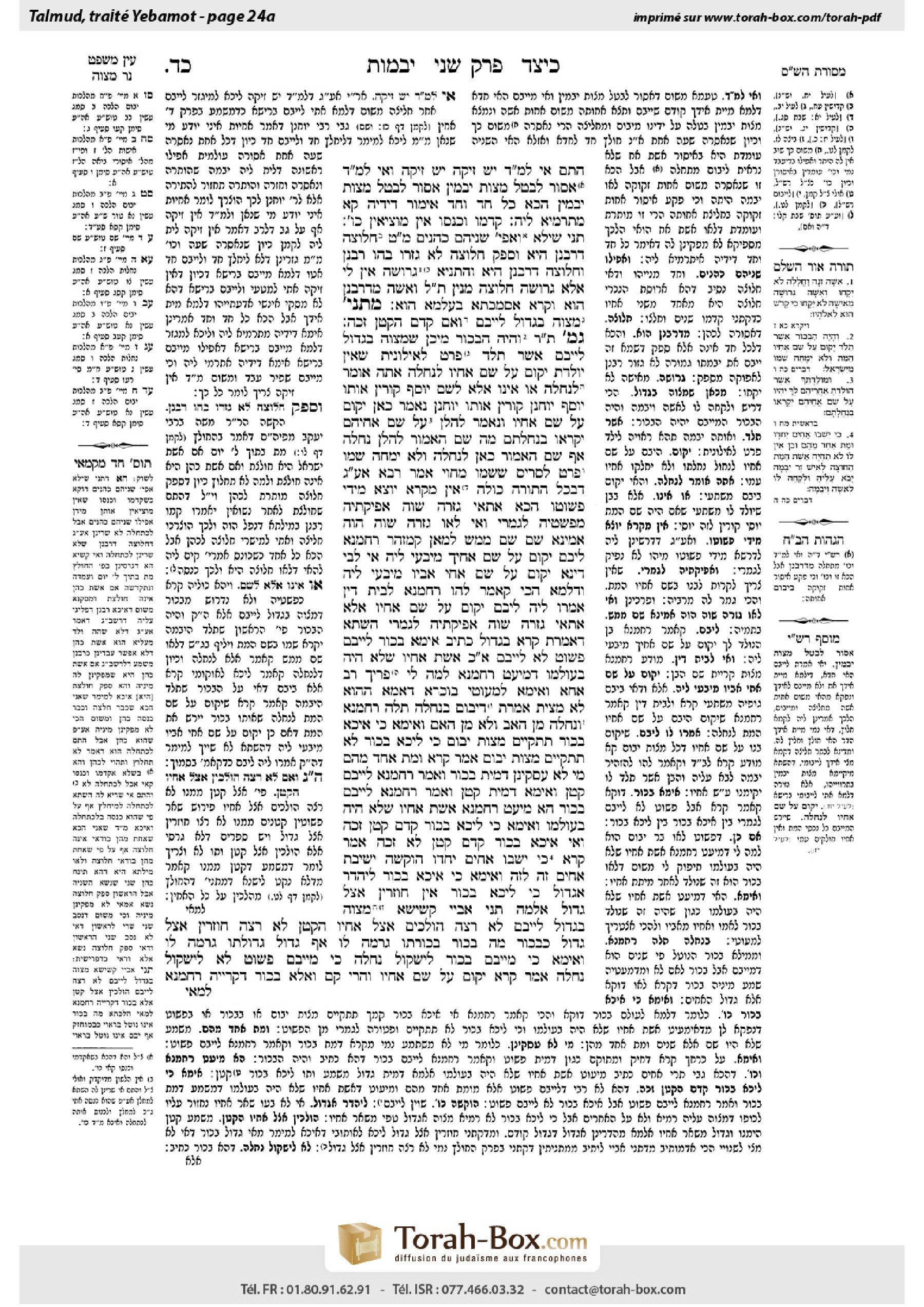
Yevamot 24a: Talmud study for Daf Yomi
Daf Yomi is the daily study of one Talmud folio. Explore 37 tractates with scans, Hebrew text, Sefaria English and AI-generated French translations where annotated.
Passage selection and English or AI-generated French translation are available where the scan has annotations. Daf Study is independent of Torah-Box and Sefaria.
Browse Yevamot · יבמות · All tractatesYevamot 24a text and translations
This page of Yevamot includes the Aramaic text, an English translation and an AI-generated French translation, alongside the scan above.
יבמות כ״ד א · Aramaic and Hebrew text
הָתָם, אִי לְמַאן דְּאָמַר יֵשׁ זִיקָה — יֵשׁ זִיקָה, וְאִי לְמַאן דְּאָמַר אָסוּר לְבַטֵּל מִצְוַת יְבָמִין — אָסוּר לְבַטֵּל מִצְוַת יְבָמִין. הָכָא — כׇּל חַד וְחַד אֵימוֹר דִּידֵיהּ קָא מִתְרַמְיָא לֵיהּ.
קָדְמוּ וְכָנְסוּ אֵין מוֹצִיאִין כּוּ׳. תָּנֵי שֵׁילָא: וַאֲפִילּוּ שְׁנֵיהֶם כֹּהֲנִים. מַאי טַעְמָא — חֲלוּצָה דְּרַבָּנַן הִיא, וְסָפֵק חֲלוּצָה לָא גְּזַרוּ בְּהוּ רַבָּנַן.
וַחֲלוּצָה דְּרַבָּנַן הִיא? וְהָתַנְיָא: ״גְּרוּשָׁה״, אֵין לִי אֶלָּא גְּרוּשָׁה, חֲלוּצָה מִנַּיִן? תַּלְמוּד לוֹמַר: ״וְאִשָּׁה״! מִדְּרַבָּנַן הוּא, וּקְרָא אַסְמַכְתָּא בְּעָלְמָא הוּא.
מַתְנִי׳ מִצְוָה בַּגָּדוֹל לְיַיבֵּם, וְאִם קָדַם הַקָּטָן — זָכָה.
גְּמָ׳ תָּנוּ רַבָּנַן: ״וְהָיָה הַבְּכוֹר״ — מִיכָּן שֶׁמִּצְוָה בַּגָּדוֹל לְיַיבֵּם. ״אֲשֶׁר תֵּלֵד״ — פְּרָט לְאַיְלוֹנִית, שֶׁאֵין יוֹלֶדֶת. ״יָקוּם עַל שֵׁם אָחִיו״ — לְנַחֲלָה.
אַתָּה אוֹמֵר לְנַחֲלָה, אוֹ אֵינוֹ אֶלָּא לְשֵׁם: יוֹסֵף — קוֹרִין אוֹתוֹ יוֹסֵף, יוֹחָנָן — קוֹרִין אוֹתוֹ יוֹחָנָן. נֶאֱמַר כָּאן ״יָקוּם עַל שֵׁם אָחִיו״, וְנֶאֱמַר לְהַלָּן: ״עַל שֵׁם אֲחֵיהֶם יִקָּרְאוּ בְּנַחֲלָתָם״, מָה שֵׁם הָאָמוּר לְהַלָּן — נַחֲלָה, אַף שֵׁם הָאָמוּר כָּאן — לְנַחֲלָה.
״וְלֹא יִמָּחֶה שְׁמוֹ״ — פְּרָט לְסָרִיס שֶׁשְּׁמוֹ מָחוּי.
אָמַר רָבָא: אַף עַל גַּב דִּבְכׇל הַתּוֹרָה כּוּלָּהּ אֵין מִקְרָא יוֹצֵא מִידֵי פְשׁוּטוֹ — הָכָא אֲתַאי גְּזֵרָה שָׁוָה אַפֵּיקְתֵּיהּ מִפְּשָׁטֵיהּ לִגְמָרֵי.
וְאִי לָאו גְּזֵרָה שָׁוָה, הֲוָה אָמֵינָא ״שֵׁם״ — שֵׁם מַמָּשׁ? לְמַאן קָמַזְהַר רַחֲמָנָא? לְיָבָם — ״יָקוּם עַל שֵׁם אָחִיךָ״ מִיבְּעֵי לֵיהּ! אִי לְבֵי דִינָא — ״יָקוּם עַל שֵׁם אֲחִי אָבִיו״ מִיבְּעֵי לֵיהּ!
וְדִלְמָא הָכִי קָאָמַר לְהוּ רַחֲמָנָא לְבֵית דִּין: אֱמַרוּ לֵיהּ לְיָבָם ״יָקוּם עַל שֵׁם אָחִיו״. אֶלָּא אֲתַאי גְּזֵרָה שָׁוָה אַפֵּיקְתֵּיהּ לִגְמָרֵי.
הַשְׁתָּא דְּאָמְרַתְּ קְרָא בְּגָדוֹל כְּתִיב, אֵימָא: בְּכוֹר — לְיַיבֵּם, פָּשׁוּט — לָא לְיַיבֵּם!
אִם כֵּן, אֵשֶׁת אָחִיו שֶׁלֹּא הָיָה בְּעוֹלָמוֹ דְּמִיעֵט רַחֲמָנָא — לְמָה לִי?
פָּרֵיךְ רַב אַחָא: וְאֵימָא לְמַעוֹטֵי בּוּכְרָא דְאִמָּא! הָהוּא לָא מָצֵית אָמְרַתְּ — דְּיִבּוּם בְּנַחֲלָה תְּלָה רַחֲמָנָא, וְנַחֲלָה מִן הָאָב וְלֹא מִן הָאֵם.
וְאֵימָא: כִּי אִיכָּא בְּכוֹר תִּתְקַיֵּים מִצְוַת יִבּוּם, כִּי לֵיכָּא בְּכוֹר לֹא תִּתְקַיֵּים מִצְוַת יִבּוּם! אָמַר קְרָא: ״וּמֵת אַחַד מֵהֶם״, מִי לָא עָסְקִינַן דְּמִית בְּכוֹר, וְאָמַר רַחֲמָנָא: לְיַיבֵּם קָטָן.
וְאֵימָא דְּמִית קָטָן, וְאָמַר רַחֲמָנָא לְיַיבֵּם בְּכוֹר? הָא מִיעֵט רַחֲמָנָא אֵשֶׁת אָחִיו שֶׁלֹּא הָיָה בְּעוֹלָמוֹ.
וְאֵימָא: כִּי לֵיכָּא בְּכוֹר, קְדַם קָטָן — זְכָה. וְאִי אִיכָּא בְּכוֹר, קְדַם קָטָן — לָא זְכָה! אָמַר קְרָא: ״כִּי יֵשְׁבוּ אַחִים יַחְדָּו״ — הוּקְּשָׁה יְשִׁיבַת אַחִים זֶה לָזֶה.
וְאֵימָא: כִּי אִיכָּא בְּכוֹר — לֶיהְדַּר אַגָּדוֹל. כִּי לֵיכָּא בְּכוֹר — אֵין חוֹזְרִין אֵצֶל גָּדוֹל! אַלְּמָה תָּנֵי אַבָּיֵי קַשִּׁישָׁא: מִצְוָה בַּגָּדוֹל לְיַיבֵּם, לֹא רָצָה — הוֹלְכִים אֵצֶל אָחִיו הַקָּטָן, לֹא רָצָה — חוֹזְרִין אֵצֶל גָּדוֹל!
כִּבְכוֹר: מָה בְּכוֹר — בְּכוֹרָתוֹ גָּרְמָה לוֹ, אַף גָּדוֹל — גְּדוּלָּתוֹ גָּרְמָה לוֹ.
וְאֵימָא: כִּי מְיַיבֵּם בְּכוֹר — לִישְׁקוֹל נַחֲלָה, כִּי מְיַיבֵּם פָּשׁוּט — לָא לִישְׁקוֹל נַחֲלָה. אָמַר קְרָא: ״יָקוּם עַל שֵׁם אָחִיו״, וַהֲרֵי קָם.
וְאֶלָּא ״בְּכוֹר״ דְּקַרְיֵיהּ רַחֲמָנָא,
Yevamot 24a · English translation
There, in that mishna, if it is according to the one who said that the levirate bond is substantial, then there is a bond in that case, as two sisters were certainly married to the brothers and require levirate marriage. And if it is according to the one who said that it is prohibited to nullify the levirate mitzva through marrying the sister of the yevama, then the explanation of that mishna is that it is prohibited to nullify the levirate mitzva and for this reason they must perform ḥalitza and may not enter into levirate marriage. However, here, in this mishna, there is uncertainty concerning the betrothal such that with regard to each one of the brothers, one could say that possibly he encountered his own yevama. Perhaps each brother took his own brother’s wife in levirate marriage, and for this reason the Sages did not issue a decree.
§ The mishna states that if they married their wives before consulting the court, the court does not remove them from the marriage. Sheila teaches a baraita that clarifies the mishna: And this is the case even if both of the brothers were priests. A woman who performed ḥalitza is normally forbidden to a priest, yet in this case, although the brother of the other man performed ḥalitza, they are not required to divorce. What is the reason for this halakha? It is as follows: A ḥalutza is forbidden to a priest by rabbinic law because her status is similar to that of a divorcée, who is forbidden to a priest by Torah law. And in a case of uncertainty as to whether she is a ḥalutza, since it may not have been her yavam who performed the ceremony, the Sages did not issue a decree.
The Gemara asks: And is the prohibition against a ḥalutza marrying a priest really by rabbinic law? But isn’t it taught in a baraita: “They shall not take a woman that is a harlot, or profaned; neither shall they take a woman divorced from her husband; for he is holy unto his God” (Leviticus 21:7). I have derived only a divorcée; from where do I derive that a priest may not marry a ḥalutza? The verse states: “Neither shall they take a woman.” The repetition of the word “woman” extends the halakha to include a ḥalutza. The Gemara answers: This prohibition is by rabbinic law, and the verse is a mere support.
MISHNA: It is a mitzva for the eldest to consummate the levirate marriage, i.e., the eldest takes precedence over the other brothers, though they too are obligated. But if the younger brother consummated the levirate marriage first, he acquires the yevama as his wife.
GEMARA: The Sages taught the following interpretation of the verse: “And it shall be that the firstborn that she bears shall be established in the name of his dead brother and his name will not be blotted out of Israel” (Deuteronomy 25:6). From here the Sages derive that the mitzva to consummate the levirate marriage is upon the eldest. The next phrase: “That she bears,” is interpreted to exclude levirate marriage in the case of a widow who is an aylonit, who cannot bear children. From the next phrase: “Shall be established in the name of his dead brother,” it is derived that the same brother who performs the mitzva of levirate marriage is established in his brother’s name with regard to inheritance, i.e., he inherits his brother’s property.
The baraita continues and asks: Do you say that he succeeds in the name of his brother for inheritance, or perhaps it is only to inherit his name? If, e.g., the deceased brother was named Yosef, they must call the son born from levirate marriage Yosef, or if his name was Yoḥanan, then they must call him Yoḥanan. The baraita answers: It is stated here: “He shall succeed in the name of his brother,” and it is stated there: “They shall be called after the name of their brothers in their inheritance” (Genesis 48:6). Just as the word “name” stated there in Genesis is referring explicitly to inheritance, so too, the word “name” stated here in Leviticus means with regard to inheritance.
The baraita continues to expound the next phrase of the verse: “And his name will not be blotted out of Israel” (Deuteronomy 25:6). This excludes the case where the deceased was a eunuch, as his name is already blotted out, since it is impossible for him to have children.
Rava said: Even though in the entire Torah a verse does not depart from its literal meaning, and even if the Sages offer a homiletical interpretation of the verses, the literal meaning remains intact, here the verbal analogy teaching that the word “name” is referring to inheritance comes to remove the verse from its literal meaning altogether.
The Gemara asks: Were it not for the verbal analogy, would I have said that the meaning of the word “name” is the actual name? The verse would be incomprehensible according to the literal reading. Whom is the Merciful One instructing in this verse? To whom does the possessive pronoun in the phrase “his brother” apply? If He is speaking to the yavam, He should have stated: Shall succeed in the name of your dead brother. And if the verse is instructing the court about the halakha in general, it should have said: Shall succeed in the name of his father’s brother.
The Gemara rejects this question: And perhaps this is what the Merciful One is saying to the court: Say to the yavam that the child born to him shall be established in the name of his brother. Were it not for the verbal analogy, the verse could have been understood according to its literal meaning. Rather, the verbal analogy comes to remove it from its literal meaning altogether.
The Gemara challenges the baraita: Now that you say that the verse: “And it shall be that the firstborn that she bears” is written in reference to the eldest brother, say that the firstborn brother consummates the levirate marriage but that an ordinary brother, i.e., not the firstborn, may not consummate the levirate marriage, and that if the firstborn son is unable to enter into levirate marriage or is no longer alive, no one else may perform the mitzva.
The Gemara answers: If so that the mitzva of levirate marriage applies only to the firstborn, then in the case of a wife of a brother with whom he did not coexist, which the Merciful One excluded by the verse: “If brothers dwell together,” why do I need such an exclusion? If only the firstborn is obligated to perform levirate marriage, then there is no need to separately exclude the case of a wife of one’s brother with whom one did not coexist, because by definition one in that position cannot be the firstborn.
Rav Aḥa refutes the Gemara’s answer: But say that the verse comes to exclude the case of a brother with whom one did not coexist when one is nevertheless the firstborn of the mother, e.g., if the father had two wives. The Gemara rejects this: You cannot say that, as the Merciful One made levirate marriage dependent upon inheritance, and inheritance comes from the father and not from the mother.
The Gemara again challenges the baraita: Then say that when there is a firstborn the mitzva of levirate marriage can be fulfilled by any of the brothers, but that when there is no firstborn, e.g., if he had already died, the mitzva of levirate marriage may not be fulfilled by any of the younger brothers. The Gemara answers: The verse states: “And one of them dies” (Deuteronomy 25:5), without specifying which brother dies. Are we not dealing even with the case where the firstborn died, and yet the Merciful One states that the younger brother should consummate the levirate marriage?
The Gemara refutes this answer: Say that the case in the Torah is referring to when the younger brother died, and only then the Merciful One states that the firstborn must consummate the levirate marriage. The Gemara answers: Didn’t the Merciful One explicitly exclude the wife of a brother with whom he did not coexist, which can apply only to a brother who was not the firstborn?
The Gemara challenges the halakha: Say that when there is no firstborn brother, if a younger brother went ahead and consummated the levirate marriage, then he acquires his yevama as a wife. But if there is a firstborn, and the younger brother went ahead and performed levirate marriage first, then he does not acquire his yevama as a wife, because the Torah specifies that the firstborn brother must perform the mitzva. The Gemara rejects this: The verse states: “If brothers dwell together” (Deuteronomy 25:5), implying that the brothers’ dwellings were equated one with the other, and all the brothers are equally obligated in this mitzva.
The Gemara challenges the halakha again: Then say: When there is a firstborn, let the mitzva return to the eldest brother if the other brothers refuse to perform levirate marriage. But when there is no firstborn, the court does not return to the eldest, as the mitzva primarily applies specifically to the firstborn, and if there is no firstborn, none of the brothers take precedence. Why did Abaye the Elder teach: It is a mitzva for the eldest of the brothers to consummate the levirate marriage? If the eldest did not wish to do so, then the court goes to his younger brother. If he also did not wish to do so, the court returns again to the eldest. This implies that the eldest, even if he is not the firstborn, has a greater mitzva than the younger brothers.
The Gemara answers: Since it is derived that the eldest brother takes precedence from the verse about the firstborn, then just as with regard to the firstborn, his status as firstborn causes him to take precedence, so too, with regard to the eldest, his status as eldest causes him to take precedence.
The Gemara challenges the halakha again: Then say that if the firstborn consummates the levirate marriage he receives his deceased brother’s inheritance, but if an ordinary brother consummates the levirate marriage he does not receive the inheritance. The Gemara answers that the verse states: “The firstborn that she bears shall be established in the name of his dead brother” (Deuteronomy 25:6), and if the younger brother performs levirate marriage he has established his brother’s name and thereby earns the inheritance.
The Gemara asks: But if there is no difference between the firstborn and the eldest, why does the Merciful One call the brother who enters levirate marriage the firstborn?
Yevamot 24a · Traduction française (IA)
Là, dans cette Michna, si elle suit l’opinion selon laquelle le lien léviratique est substantiel, il existe alors un lien dans ce cas, car deux sœurs ont certainement été mariées aux frères et requièrent un mariage léviratique. Et si elle suit l’opinion selon laquelle il est interdit d’annuler la mitsva du lévirat en épousant la sœur de la yevama, l’explication de cette Michna est qu’il est interdit d’annuler la mitsva du lévirat ; c’est pourquoi elles doivent accomplir la ḥalitsa et ne peuvent pas contracter de mariage léviratique. Ici, en revanche, dans cette Michna, il existe une incertitude quant aux fiançailles, de sorte que, pour chacun des frères, on peut dire qu’il a peut-être rencontré sa propre yevama. Peut-être chacun des frères a-t-il épousé en mariage léviratique la femme de son propre frère ; c’est pourquoi les Sages n’ont pas édicté de décret.
§ La Michna enseigne que, s’ils ont épousé leurs femmes avant de consulter le tribunal, celui-ci ne les oblige pas à mettre fin à leur mariage. Sheila enseigne une baraïta qui précise la Michna : cela vaut même si les deux frères étaient prêtres. Une femme qui a accompli la ḥalitsa est normalement interdite à un prêtre ; pourtant, dans ce cas, bien que le frère de l’autre homme ait accompli la ḥalitsa, ils ne sont pas tenus de divorcer. Quelle est la raison de cette halakha ? La voici : une ḥaloutsa est interdite à un prêtre par décret rabbinique, parce que son statut est comparable à celui d’une divorcée, interdite à un prêtre par la Torah. Et, en cas d’incertitude quant au fait qu’elle soit une ḥaloutsa, puisqu’il se peut que ce ne soit pas son yavam qui ait accompli la cérémonie, les Sages n’ont pas édicté de décret.
La Guemara demande : L’interdiction faite à une ḥaloutsa d’épouser un prêtre relève-t-elle vraiment du droit rabbinique ? N’est-il pas enseigné dans une baraïta : « Ils ne prendront pas une femme prostituée ou profanée, et ils ne prendront pas une femme répudiée par son mari, car il est saint pour son Dieu » (Lévitique 21,7) ? Je n’ai déduit de là que l’interdiction concernant une divorcée ; d’où déduit-on qu’un prêtre ne peut pas épouser une ḥaloutsa ? Le verset dit : « Ils ne prendront pas une femme. » La répétition du mot « femme » étend la halakha à une ḥaloutsa. La Guemara répond : Cette interdiction relève du droit rabbinique, et le verset n’en est qu’un appui.
MICHNA : C’est une mitsva que l’aîné contracte le mariage léviratique, c’est-à-dire qu’il a priorité sur les autres frères, bien qu’eux aussi y soient tenus. Mais si le frère cadet contracte le mariage léviratique le premier, il prend la yevama pour épouse.
GUEMARA : Les Sages ont enseigné l’interprétation suivante du verset : « Le premier-né qu’elle enfantera sera établi au nom de son frère défunt, et son nom ne sera pas effacé d’Israël » (Deutéronome 25,6). Les Sages en déduisent que la mitsva de contracter le mariage léviratique incombe à l’aîné. L’expression suivante, « qu’elle enfantera », est interprétée comme excluant le mariage léviratique dans le cas d’une veuve aïlonit, qui ne peut pas avoir d’enfants. De l’expression suivante, « sera établi au nom de son frère défunt », on déduit que le frère qui accomplit la mitsva du mariage léviratique est celui qui est établi au nom de son frère en matière d’héritage, c’est-à-dire qu’il hérite des biens de son frère.
La baraïta poursuit en posant la question suivante : Comprends-tu qu’il lui succède en matière d’héritage au nom de son frère, ou peut-être s’agit-il seulement de reprendre le nom de celui-ci ? Par exemple, si le frère défunt s’appelait Yosef, il faudrait appeler Yosef le fils né du mariage léviratique ; s’il s’appelait Yoḥanan, il faudrait appeler ce fils Yoḥanan. La baraïta répond : Il est dit ici : « Il lui succédera au nom de son frère », et il est dit là : « Ils seront appelés du nom de leurs frères dans leur héritage » (Genèse 48,6). De même que le mot « nom » employé là, dans la Genèse, se rapporte explicitement à l’héritage, de même le mot « nom » employé ici, dans le Deutéronome, se rapporte à l’héritage.
La baraïta poursuit l’interprétation de l’expression suivante du verset : « Et son nom ne sera pas effacé d’Israël » (Deutéronome 25,6). Cela exclut le cas où le défunt était un eunuque, puisque son nom est déjà effacé, car il lui est impossible d’avoir des enfants.
Rava a dit : Bien que, dans toute la Torah, un verset ne s’écarte pas de son sens littéral, même lorsque les Sages en proposent une interprétation homilétique, le sens littéral demeure intact. Ici, cependant, l’analogie verbale qui enseigne que le mot « nom » se rapporte à l’héritage vient écarter entièrement le verset de son sens littéral.
La Guemara demande : Sans l’analogie verbale, aurais-je compris que le mot « nom » désigne le nom propre ? Le verset serait incompréhensible selon sa lecture littérale. À qui le Miséricordieux donne-t-il une instruction dans ce verset ? À qui se rapporte le pronom possessif dans l’expression « son frère » ? S’il s’adresse au yavam, il aurait dû dire : « Il succédera au nom de ton frère défunt. » Et si le verset enseigne au tribunal la halakha de manière générale, il aurait dû dire : « Il succédera au nom du frère de son père. »
La Guemara rejette cette question : Peut-être est-ce ainsi que le Miséricordieux s’adresse au tribunal : « Dites au yavam que l’enfant qui lui naîtra sera établi au nom de son frère. » Sans l’analogie verbale, le verset aurait pu être compris selon son sens littéral. C’est donc l’analogie verbale qui vient l’écarter entièrement de son sens littéral.
La Guemara conteste la baraïta : Dès lors que tu dis que le verset « Le premier-né qu’elle enfantera » se rapporte au frère aîné, dis donc que le frère premier-né contracte le mariage léviratique, mais qu’un frère qui n’est pas le premier-né ne peut pas le contracter, et que si le frère premier-né ne peut pas contracter de mariage léviratique ou n’est plus en vie, personne d’autre ne peut accomplir la mitsva.
La Guemara répond : Si la mitsva du mariage léviratique ne s’appliquait qu’au premier-né, alors, dans le cas de la femme d’un frère avec lequel on n’a pas vécu, cas que le Miséricordieux a exclu par le verset « Si des frères demeurent ensemble », pourquoi aurait-on besoin d’une telle exclusion ? Si seul le premier-né est tenu de contracter un mariage léviratique, il n’est pas nécessaire d’exclure séparément le cas de la femme d’un frère avec lequel on n’a pas vécu, car, par définition, celui qui se trouve dans cette situation ne peut pas être le premier-né.
Rav Aḥa réfute la réponse de la Guemara : Mais dis plutôt que le verset vient exclure le cas d’un frère avec lequel on n’a pas vécu, alors qu’il est néanmoins le premier-né de sa mère, par exemple si le père avait deux femmes. La Guemara rejette cette possibilité : On ne peut pas dire cela, car le Miséricordieux a fait dépendre le mariage léviratique de l’héritage, et l’héritage se transmet par le père, non par la mère.
La Guemara conteste de nouveau la baraïta : Dis donc que, lorsqu’il y a un premier-né, n’importe lequel des frères peut accomplir la mitsva du mariage léviratique, mais qu’en l’absence de premier-né, par exemple s’il était déjà mort, aucun des frères cadets ne peut accomplir cette mitsva. La Guemara répond : Le verset dit : « L’un d’eux meurt » (Deutéronome 25,5), sans préciser de quel frère il s’agit. Ne sommes-nous pas également dans le cas où le premier-né est mort, alors que le Miséricordieux dit que le frère cadet doit contracter le mariage léviratique ?
La Guemara réfute cette réponse : Dis que le cas décrit dans la Torah concerne la mort du frère cadet, et que c’est seulement alors que le Miséricordieux dit que le premier-né doit contracter le mariage léviratique. La Guemara répond : Le Miséricordieux n’a-t-il pas explicitement exclu la femme d’un frère avec lequel on n’a pas vécu, ce qui ne peut concerner qu’un frère qui n’était pas le premier-né ?
La Guemara conteste la halakha : Dis que, lorsqu’il n’y a pas de frère premier-né, si un frère cadet prend les devants et contracte le mariage léviratique, il prend alors sa yevama pour épouse. Mais s’il y a un premier-né et que le frère cadet prend les devants en contractant le mariage léviratique, il ne prend pas sa yevama pour épouse, parce que la Torah précise que c’est au frère premier-né d’accomplir la mitsva. La Guemara rejette cette proposition : Le verset dit : « Si des frères demeurent ensemble » (Deutéronome 25,5), ce qui implique que les frères sont mis sur un pied d’égalité quant à leur résidence et que tous sont également tenus d’accomplir cette mitsva.
La Guemara conteste encore la halakha : Dis donc que, lorsqu’il y a un premier-né, la mitsva revient à l’aîné des frères si les autres frères refusent de contracter le mariage léviratique. Mais lorsqu’il n’y a pas de premier-né, le tribunal ne revient pas à l’aîné, puisque la mitsva incombe avant tout au premier-né et que, s’il n’y a pas de premier-né, aucun des frères n’a priorité. Pourquoi Abaye l’Ancien a-t-il enseigné : « C’est une mitsva que l’aîné des frères contracte le mariage léviratique. Si l’aîné ne le souhaite pas, le tribunal s’adresse à son frère cadet. Si celui-ci ne le souhaite pas non plus, le tribunal revient à l’aîné » ? Cela implique que l’aîné, même s’il n’est pas le premier-né, a une obligation plus grande d’accomplir la mitsva que ses frères cadets.
La Guemara répond : Puisqu’on déduit du verset sur le premier-né que le frère aîné a priorité, de même que, pour le premier-né, c’est son statut de premier-né qui lui donne la priorité, de même, pour l’aîné, c’est son statut d’aîné qui lui donne la priorité.
La Guemara conteste encore la halakha : Dis donc que si le premier-né contracte le mariage léviratique, il reçoit l’héritage de son frère défunt, mais que si un frère qui n’est pas le premier-né contracte le mariage léviratique, il ne reçoit pas l’héritage. La Guemara répond que le verset dit : « Le premier-né qu’elle enfantera sera établi au nom de son frère défunt » (Deutéronome 25,6) ; si le frère cadet contracte le mariage léviratique, il a établi le nom de son frère et acquiert ainsi l’héritage.
La Guemara demande : Mais s’il n’y a pas de différence entre le premier-né et l’aîné, pourquoi le Miséricordieux appelle-t-il « premier-né » le frère qui contracte le mariage léviratique ?
Traduction française générée par IA à partir de l’édition anglaise de Sefaria. Vérifie toujours un passage avec le texte source.
Text from Sefaria: William Davidson Edition - Vocalized Aramaic (CC BY NC); William Davidson Edition - English (CC BY NC).