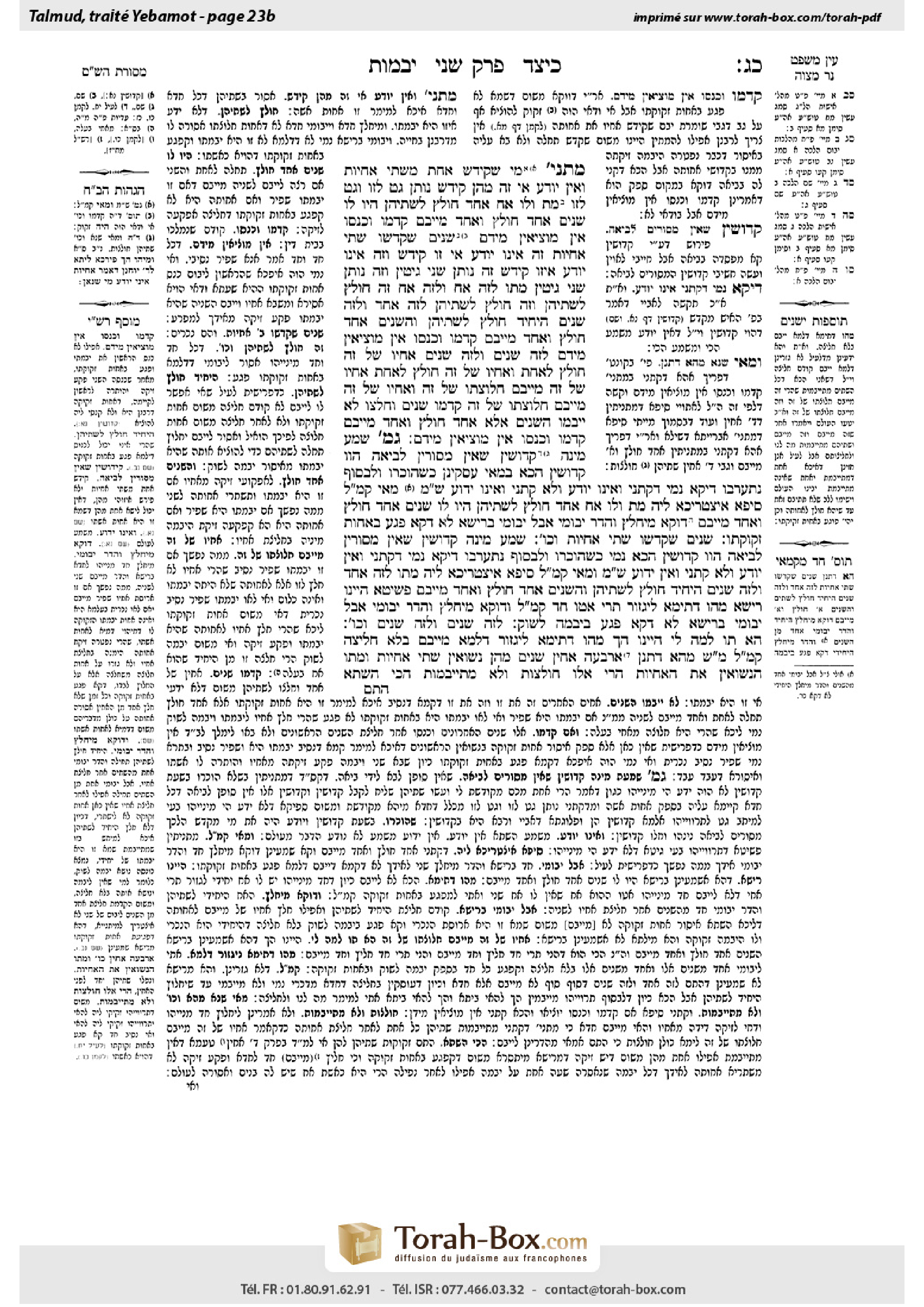
Yevamot 23b: Talmud study for Daf Yomi
Daf Yomi is the daily study of one Talmud folio. Explore 37 tractates with scans, Hebrew text, Sefaria English and AI-generated French translations where annotated.
Passage selection and English or AI-generated French translation are available where the scan has annotations. Daf Study is independent of Torah-Box and Sefaria.
Browse Yevamot · יבמות · All tractatesYevamot 23b text and translations
This page of Yevamot includes the Aramaic text, an English translation and an AI-generated French translation, alongside the scan above.
יבמות כ״ג ב · Aramaic and Hebrew text
מַתְנִי׳ מִי שֶׁקִּידֵּשׁ אַחַת מִשְׁתֵּי אֲחָיוֹת, וְאֵין יוֹדֵעַ אֵי זֹה מֵהֶן קִידֵּשׁ — נוֹתֵן גֵּט לָזוֹ וְגֵט לָזוֹ. מֵת וְלוֹ אָח אֶחָד — חוֹלֵץ לִשְׁתֵּיהֶן.
הָיוּ לוֹ שְׁנַיִם — אֶחָד חוֹלֵץ וְאֶחָד מְיַיבֵּם. קָדְמוּ וְכָנְסוּ — אֵין מוֹצִיאִין מִיָּדָם.
שְׁנַיִם שֶׁקִּדְּשׁוּ שְׁתֵּי אֲחָיוֹת, זֶה אֵינוֹ יוֹדֵעַ אֵי זוֹ קִידֵּשׁ, וְזֶה אֵינוֹ יוֹדֵעַ אֵיזוֹ קִידֵּשׁ — זֶה נוֹתֵן שְׁנֵי גִיטִּין, וְזֶה נוֹתֵן שְׁנֵי גִיטִּין. מֵתוּ, לָזֶה אָח וְלָזֶה אָח — זֶה חוֹלֵץ לִשְׁתֵּיהֶן, וְזֶה חוֹלֵץ לִשְׁתֵּיהֶן.
לָזֶה אֶחָד וְלָזֶה שְׁנַיִם — הַיָּחִיד חוֹלֵץ לִשְׁתֵּיהֶן, וְהַשְּׁנַיִם — אֶחָד חוֹלֵץ, וְאֶחָד מְיַיבֵּם. קָדְמוּ וְכָנְסוּ, אֵין מוֹצִיאִין מִיָּדָם. לָזֶה שְׁנַיִם וְלָזֶה שְׁנַיִם — אָחִיו שֶׁל זֶה חוֹלֵץ לְאַחַת, וְאָחִיו שֶׁל זֶה חוֹלֵץ לְאַחַת. אָחִיו שֶׁל זֶה מְיַיבֵּם חֲלוּצָתוֹ שֶׁל זֶה, וְאָחִיו שֶׁל זֶה מְיַיבֵּם חֲלוּצָתוֹ שֶׁל זֶה.
קָדְמוּ שְׁנַיִם וְחָלְצוּ — לֹא יְיַבְּמוּ הַשְּׁנַיִם, אֶלָּא אֶחָד חוֹלֵץ וְאֶחָד מְיַיבֵּם. קָדְמוּ וְכָנְסוּ — אֵין מוֹצִיאִין מִיָּדָם.
גְּמָ׳ שְׁמַע מִינַּהּ: קִדּוּשִׁין שֶׁאֵין מְסוּרִין לְבִיאָה — הָווּ קִדּוּשִׁין!
הָכָא בְּמַאי עָסְקִינַן — כְּשֶׁהוּכְּרוּ וּלְבַסּוֹף נִתְעָרְבוּ. דַּיְקָא נָמֵי, דְּקָתָנֵי: ״וְאֵינוֹ יוֹדֵעַ״, וְלָא קָתָנֵי: ״וְאֵינוֹ יָדוּעַ״. שְׁמַע מִינַּהּ.
מַאי קָא מַשְׁמַע לַן? סֵיפָא אִיצְטְרִיכָא לֵיהּ: מֵת וְלוֹ אָח אֶחָד — חוֹלֵץ לִשְׁתֵּיהֶן, הָיוּ לוֹ שְׁנַיִם — אֶחָד חוֹלֵץ וְאֶחָד מְיַיבֵּם. דַּוְקָא מִיחְלָץ וַהֲדַר יַבּוֹמֵי, אֲבָל יַבּוֹמֵי בְּרֵישָׁא — לָא, דְּקָא פָּגַע בַּאֲחוֹת זְקוּקָתוֹ.
שְׁנַיִם שֶׁקִּדְּשׁוּ שְׁתֵּי אֲחָיוֹת וְכוּ׳. שְׁמַע מִינַּהּ: קִדּוּשִׁין שֶׁאֵין מְסוּרִין לְבִיאָה — הָווּ קִדּוּשִׁין! הָכָא נָמֵי, כְּשֶׁהוּכְּרוּ וּלְבַסּוֹף נִתְעָרְבוּ. דַּיְקָא נָמֵי, דְּקָתָנֵי: ״וְאֵין יוֹדֵעַ״, וְלָא קָתָנֵי ״וְאֵין יָדוּעַ״. שְׁמַע מִינַּהּ.
וּמַאי קָא מַשְׁמַע לַן? סֵיפָא אִיצְטְרִיכָא לֵיהּ: מֵתוּ, לָזֶה אֶחָד וְלָזֶה שְׁנַיִם — הַיָּחִיד חוֹלֵץ לִשְׁתֵּיהֶן, וְהַשְּׁנַיִם — אֶחָד חוֹלֵץ וְאֶחָד מְיַיבֵּם.
פְּשִׁיטָא, הַיְינוּ רֵישָׁא! מַהוּ דְּתֵימָא: לִיגְזוֹר תְּרֵי אַטּוּ חַד, קָא מַשְׁמַע לַן.
וְדַוְקָא מִיחְלָץ וַהֲדַר יַבּוֹמֵי, אֲבָל יַבּוֹמֵי בְּרֵישָׁא — לָא, דְּקָא פָּגַע בִּיבָמָה לַשּׁוּק.
לָזֶה שְׁנַיִם וְלָזֶה שְׁנַיִם וְכוּ׳. הָא תּוּ לְמָה לִי? הַיְינוּ הָךְ! מַהוּ דְּתֵימָא: לִיגְזוֹר דִּלְמָא מְיַיבֵּם בְּלֹא חֲלִיצָה, קָא מַשְׁמַע לַן.
מַאי שְׁנָא מֵהָא דִּתְנַן: אַרְבָּעָה אַחִין, שְׁנַיִם מֵהֶן נְשׂוּאִין שְׁתֵּי אֲחָיוֹת, וּמֵתוּ הַנְּשׂוּאִין אֶת הָאֲחָיוֹת — הֲרֵי אֵלּוּ חוֹלְצוֹת וְלֹא מִתְיַיבְּמוֹת?
הָכִי הַשְׁתָּא?!
Yevamot 23b · English translation
MISHNA: In the case of one who betrothed one of two sisters and does not know which of them he betrothed, so that both are forbidden to him, he gives a bill of divorce to this one and a bill of divorce to that one due to the uncertainty. If the man who had betrothed one of these women died before he could give a bill of divorce, and he had one brother, that brother performs ḥalitza with both of them, but he may not take either in levirate marriage. This is because he does not know which woman is his yevama and which is forbidden to him as the sister of a woman with whom he has a levirate bond.
If the man who betrothed one of these women had two brothers, one of them performs ḥalitza with one of the sisters, but he may not enter into levirate marriage with her due to the possibility that she is the sister of a woman with whom he has a levirate bond. And one takes the other in levirate marriage if he so desires. If the two brothers married the two sisters before consulting the court, the court does not remove them from their marriage and they are permitted to remain married. The couple who performed levirate marriage second was even permitted to do so, since there was no longer any doubt about the levirate bond.
Furthermore, in the case of two unrelated men who betrothed two sisters: If this one does not know which sister he betrothed and that one does not know which sister he betrothed, this one gives two bills of divorce, one to each of the women, and that one gives two bills of divorce. If the two men died before they divorced, and this one had a brother and that one had a brother, then this brother performs ḥalitza with both of them, and that brother performs ḥalitza with both of them.
If this one had one brother and that one had two brothers, the single brother performs ḥalitza with both of them, and of the two brothers, one performs ḥalitza and one performs levirate marriage if he so desires. If they married the sisters before consulting the court, the court does not remove them from the marriage and they are not told to divorce them. If this one had two brothers and that one had two brothers, the brother of this one performs ḥalitza with one sister, and the brother of that one performs ḥalitza with one sister. The brother of this one who performed ḥalitza may take the woman who performed ḥalitza [ḥalutza] of that other’s brother in levirate marriage, and the brother of that second one who performed ḥalitza may take the ḥalutza of that other’s brother in levirate marriage.
If the two brothers performed ḥalitza with both wives before consulting the court, the two brothers of the second man may not takeeither sister in levirate marriage lest one marry the sister of a woman with whom he had a levirate bond. Rather, one performs ḥalitza and one performs levirate marriage if he so desires. If they married their wives before consulting the court, the court does not remove them from the marriage.
GEMARA: Learn from here in the mishna that betrothals that cannot ultimately lead to consummation are nevertheless betrothals. There is a dispute between Abaye and Rava in tractate Kiddushin with regard to a case of a betrothal that, due to some halakhic complication, can never be consummated. The cases in this mishna may not be consummated, since each of the two sisters is forbidden due to the uncertainty as to whether she is the woman he betrothed or the sister of the woman he betrothed. Therefore, both are forbidden to him. Nevertheless, the mishna instructs that he must give a bill of divorce to both of them. This implies that such betrothals are valid, in contrast to Rava’s opinion that betrothals that cannot ultimately be consummated are not betrothals at all.
The Gemara rejects this: With what are we dealing here? We are dealing with a case when at first both sisters were recognized and at the moment of betrothal he knew whom he betrothed; it was a betrothal destined for consummation. But later the two sisters were mixed up so that he was no longer certain which he betrothed. If so, there was not any flaw in the betrothal itself initially. The language of the mishna is also precise, as it teaches: And he does not know which of them he betrothed, but it does not teach: It is unknown completely. This implies that the matter was known at some time. The Gemara adds: Conclude from here that this is the case.
The Gemara asks: If so, what is the mishna teaching us in the segment of the mishna referring to the giving of two bills of divorce? That is obvious. The Gemara answers: It was necessary to teach the last clause of the mishna, as there it teaches: If he died and he had one brother, that brother performs ḥalitza with both of them; if he had two brothers, one performs ḥalitza and the other one enters into levirate marriage if he so desires. Specifically, one brother must perform ḥalitza first, and only subsequently the other brother may perform levirate marriage. But one brother may not enter levirate marriage first, before the other brother has performed ḥalitza, as he would thereby encounter the sister of a woman with whom he has a levirate bond.
The mishna says: In the case of two unrelated men who betrothed two sisters: If this one does not know which sister he betrothed and that one does not know which sister he betrothed, this one gives two bills of divorce, one to each of the women, and that one gives two bills of divorce. The Gemara asks: Learn from here that betrothals that cannot ultimately lead to consummation are valid betrothals. The Gemara rejects this: Here too, this is referring to a case where they were recognized and later mixed up. The language is also precise, as it teaches: And he does not know, meaning that he does not know now whom he betrothed, and it does not teach: It is unknown. The Gemara summarizes: Indeed, conclude this from here that this is the case.
The Gemara asks: If so, what does it come to teach us in relating that both of them must give bills of divorce? The Gemara explains: It was necessary to teach the last clause, where it says: If they died and this one had one brother and this one had two, the single brother performs ḥalitza with both of them. And of the two, one performs ḥalitza and one enters levirate marriage if he so desires.
The Gemara asks: That is obvious, as this is identical to the halakha taught in the first clause of the mishna. Why should this case be different from the previous case of two brothers? The Gemara answers: It is necessary to teach this lest you say the Sages should issue a decree in the case of two brothers due to the case of one brother. In a case of one brother he may only perform ḥalitza but may not enter into levirate marriage. Without this mishna one may have thought the same should be true for two brothers. This comes to teach us that they did not issue such a decree, and in this case one of them is allowed to enter into levirate marriage.
And this is specifically if the brother of one man first performs ḥalitza and subsequently the brother of the other man consummates the levirate marriage, but if he consummated the levirate marriage first, then no, that is prohibited. And why is that? He might be encountering the prohibition of a yevama to a member of the public. Possibly the woman he married was not his yevama but someone else’s yevama, and until the other man’s brother performs ḥalitza with her she is still forbidden to other men.
The mishna taught: If this one had two brothers and that one had two brothers, the brother of this who performed ḥalitza may take the ḥalutza of that other’s brother in levirate marriage, and the brother of that second one who performed ḥalitza may take the ḥalutza of that other’s brother in levirate marriage. The Gemara asks: Why do I need this as well? This clause is identical to that previous halakha. The Gemara answers: It is necessary lest you say: Let the Sages issue a decree lest he consummate the levirate marriage without the other first performing ḥalitza at all. This comes to teach us that such a decree is not issued. Rather, one of each pair of brothers can enter a levirate marriage.
The Gemara asks: In what way is this case different from that which we learned in a mishna (26a): If there were four brothers, and two of them were married to two sisters, and those married to the sisters died, then those two sisters perform ḥalitza but may not enter into levirate marriage with the remaining brothers, since each woman is the sister of a woman with a levirate bond to each of the brothers. Why not say here as well that each is the sister of a woman with a levirate bond?
The Gemara rejects this: How can these cases be compared?
Yevamot 23b · Traduction française (IA)
MICHNA : Si un homme a fiancé l’une de deux sœurs sans savoir laquelle, de sorte que toutes deux lui sont interdites, il remet un acte de divorce à chacune, en raison du doute. Si l’homme qui avait fiancé l’une de ces femmes meurt avant d’avoir pu remettre un acte de divorce et qu’il avait un frère, ce frère accomplit la ḥalitsa avec chacune d’elles, mais ne peut épouser aucune d’elles par lévirat. En effet, il ne sait pas laquelle est sa yevama et laquelle lui est interdite en tant que sœur d’une femme avec laquelle il a un lien de lévirat.
Si l’homme qui avait fiancé l’une de ces femmes avait deux frères, l’un d’eux accomplit la ḥalitsa avec l’une des sœurs, mais ne peut pas l’épouser par lévirat, car il est possible qu’elle soit la sœur d’une femme avec laquelle il a un lien de lévirat. L’autre frère peut, s’il le souhaite, épouser l’autre sœur par lévirat. Si les deux frères épousent les deux sœurs avant de consulter le tribunal, celui-ci ne les sépare pas et les autorise à rester mariés. Même le couple qui a contracté le mariage léviratique en second était autorisé à le faire, puisqu’il n’y avait alors plus de doute concernant le lien de lévirat.
En outre, si deux hommes sans lien de parenté ont fiancé deux sœurs, et que chacun ignore laquelle des sœurs il a fiancée, le premier remet deux actes de divorce, un à chacune des femmes, et le second en remet lui aussi deux. Si les deux hommes meurent avant d’avoir divorcé, et que le premier avait un frère et le second un frère, le frère du premier accomplit la ḥalitsa avec chacune des deux femmes, et le frère du second accomplit la ḥalitsa avec chacune des deux femmes.
Si le premier avait un frère et le second deux frères, le frère unique accomplit la ḥalitsa avec chacune des deux femmes ; parmi les deux frères de l’autre homme, l’un accomplit la ḥalitsa et l’autre peut, s’il le souhaite, contracter un mariage léviratique. S’ils épousent les sœurs avant de consulter le tribunal, celui-ci ne les sépare pas et ne leur ordonne pas de divorcer. Si le premier avait deux frères et le second deux frères, un frère du premier accomplit la ḥalitsa avec une sœur, et un frère du second accomplit la ḥalitsa avec une sœur. Le frère du premier qui a accompli la ḥalitsa peut épouser par lévirat la femme ayant reçu la ḥalitsa [ḥalutza] du frère du second ; et le frère du second qui a accompli la ḥalitsa peut épouser par lévirat la femme ayant reçu la ḥalitsa du frère du premier.
Si les deux frères accomplissent la ḥalitsa avec les deux femmes avant de consulter le tribunal, les deux frères du second homme ne peuvent épouser aucune des deux sœurs par lévirat, de peur que l’un d’eux n’épouse la sœur d’une femme avec laquelle il a un lien de lévirat. Au contraire, l’un accomplit la ḥalitsa et l’autre peut, s’il le souhaite, contracter un mariage léviratique. S’ils épousent leurs femmes avant de consulter le tribunal, celui-ci ne les sépare pas.
GUEMARA : Déduisons de la Michna que des fiançailles qui ne peuvent finalement pas être consommées restent néanmoins des fiançailles. Dans le traité Kiddouchin, Abaye et Rava sont en désaccord au sujet d’un cas de fiançailles qui, en raison d’une complication halakhique, ne peuvent jamais être consommées. Les fiançailles décrites dans cette Michna ne peuvent pas être consommées, puisque chacune des deux sœurs est interdite à l’homme, faute de savoir si elle est la femme qu’il a fiancée ou la sœur de celle-ci. Toutes deux lui sont donc interdites. Pourtant, la Michna prescrit qu’il doit remettre un acte de divorce à chacune d’elles. Cela implique que de telles fiançailles sont valides, contrairement à l’avis de Rava, selon lequel des fiançailles qui ne peuvent finalement pas être consommées ne sont pas des fiançailles du tout.
La Guemara rejette cette déduction : de quel cas s’agit-il ici ? D’un cas où, au départ, les deux sœurs étaient identifiées et où, au moment des fiançailles, l’homme savait laquelle il fiançait ; ces fiançailles étaient destinées à être consommées. Mais, par la suite, les deux sœurs ont été confondues, si bien qu’il ne savait plus laquelle il avait fiancée. Ainsi, les fiançailles elles-mêmes ne comportaient initialement aucun défaut. La formulation de la Michna est également précise, puisqu’elle enseigne : « Et il ne sait pas laquelle d’entre elles il a fiancée », mais non : « La chose est totalement inconnue ». Cela implique que la chose était connue à un moment donné. La Guemara ajoute : conclus de là que tel est bien le cas.
La Guemara demande : Si tel est le cas, que nous enseigne le passage de la Michna concernant la remise de deux actes de divorce ? C’est évident. La Guemara répond : Il était nécessaire d’enseigner la dernière clause de la Michna, qui dit : « S’il meurt et qu’il a un frère, ce frère accomplit la ḥalitsa avec chacune d’elles ; s’il a deux frères, l’un accomplit la ḥalitsa et l’autre peut, s’il le souhaite, contracter un mariage léviratique. » Plus précisément, un frère doit d’abord accomplir la ḥalitsa ; ce n’est qu’ensuite que l’autre frère peut contracter un mariage léviratique. Un frère ne peut pas contracter le mariage léviratique en premier, avant que l’autre frère ait accompli la ḥalitsa, car il risquerait ainsi de prendre la sœur d’une femme avec laquelle il a un lien de lévirat.
La Michna dit : « Si deux hommes sans lien de parenté ont fiancé deux sœurs, et que chacun ignore laquelle des sœurs il a fiancée, le premier remet deux actes de divorce, un à chacune des femmes, et le second en remet lui aussi deux. » La Guemara demande : Déduisons de là que des fiançailles qui ne peuvent finalement pas être consommées sont valides. La Guemara rejette cette déduction : ici aussi, il s’agit d’un cas où les sœurs étaient identifiées, puis ont été confondues. La formulation est également précise, puisqu’elle enseigne : « Et il ne sait pas », c’est-à-dire qu’il ne sait pas maintenant laquelle il a fiancée, et non : « La chose est inconnue ». La Guemara conclut : En effet, conclus de là que tel est bien le cas.
La Guemara demande : Si tel est le cas, que vient nous enseigner le fait que chacun des deux hommes doit remettre des actes de divorce ? La Guemara explique : Il était nécessaire d’enseigner la dernière clause, qui dit : « S’ils meurent, et que le premier a un frère tandis que le second en a deux, le frère unique accomplit la ḥalitsa avec chacune d’elles ; parmi les deux autres frères, l’un accomplit la ḥalitsa et l’autre peut, s’il le souhaite, contracter un mariage léviratique. »
La Guemara demande : C’est évident, puisque cela est identique à la halakha enseignée dans la première clause de la Michna. En quoi ce cas diffère-t-il du cas précédent, celui de deux frères ? La Guemara répond : Il était nécessaire de l’enseigner, de peur que tu ne dises que les Sages devraient, dans le cas de deux frères, décréter la même chose que dans celui d’un frère unique. Dans le cas d’un frère unique, celui-ci ne peut qu’accomplir la ḥalitsa, mais pas contracter de mariage léviratique. Sans cette Michna, on aurait pu penser qu’il en va de même pour deux frères. La Michna vient nous enseigner qu’ils n’ont pas pris un tel décret et que, dans ce cas, l’un des frères est autorisé à contracter un mariage léviratique.
Cela vaut précisément si le frère d’un homme accomplit d’abord la ḥalitsa, puis que le frère de l’autre homme consomme le mariage léviratique. En revanche, s’il consomme le mariage léviratique en premier, c’est interdit. Pourquoi ? Il risquerait de transgresser l’interdiction faite à une yevama d’épouser un homme qui n’est pas son beau-frère. Il se peut que la femme qu’il a épousée ne soit pas sa yevama, mais celle d’un autre ; tant que le frère de l’autre homme n’a pas accompli la ḥalitsa avec elle, elle reste interdite aux autres hommes.
La Michna a enseigné : « Si le premier avait deux frères et le second deux frères, le frère du premier qui a accompli la ḥalitsa peut épouser par lévirat la femme ayant reçu la ḥalitsa du frère du second ; et le frère du second qui a accompli la ḥalitsa peut épouser par lévirat la femme ayant reçu la ḥalitsa du frère du premier. » La Guemara demande : Pourquoi cela aussi est-il nécessaire ? Cette clause est identique à la halakha précédente. La Guemara répond : Il était nécessaire de l’enseigner, de peur que tu ne dises : Que les Sages décrètent par crainte qu’un homme ne consomme le mariage léviratique sans que l’autre ait d’abord accompli la ḥalitsa. Cela vient nous enseigner qu’un tel décret n’est pas pris. Au contraire, un frère de chaque paire peut contracter un mariage léviratique.
La Guemara demande : En quoi ce cas diffère-t-il de celui que nous avons appris dans une Michna (26a) : s’il y avait quatre frères, dont deux étaient mariés à deux sœurs, et que les deux hommes mariés aux sœurs mouraient, ces deux sœurs accomplissent la ḥalitsa, mais ne peuvent pas contracter de mariage léviratique avec les frères restants, puisque chacune est la sœur d’une femme avec laquelle chacun des frères a un lien de lévirat. Pourquoi ne pas dire ici aussi que chacune est la sœur d’une femme avec laquelle il a un lien de lévirat ?
La Guemara rejette cette comparaison : comment comparer ces cas ?
Traduction française générée par IA à partir de l’édition anglaise de Sefaria. Vérifie toujours un passage avec le texte source.
Text from Sefaria: William Davidson Edition - Vocalized Aramaic (CC BY NC); William Davidson Edition - English (CC BY NC).