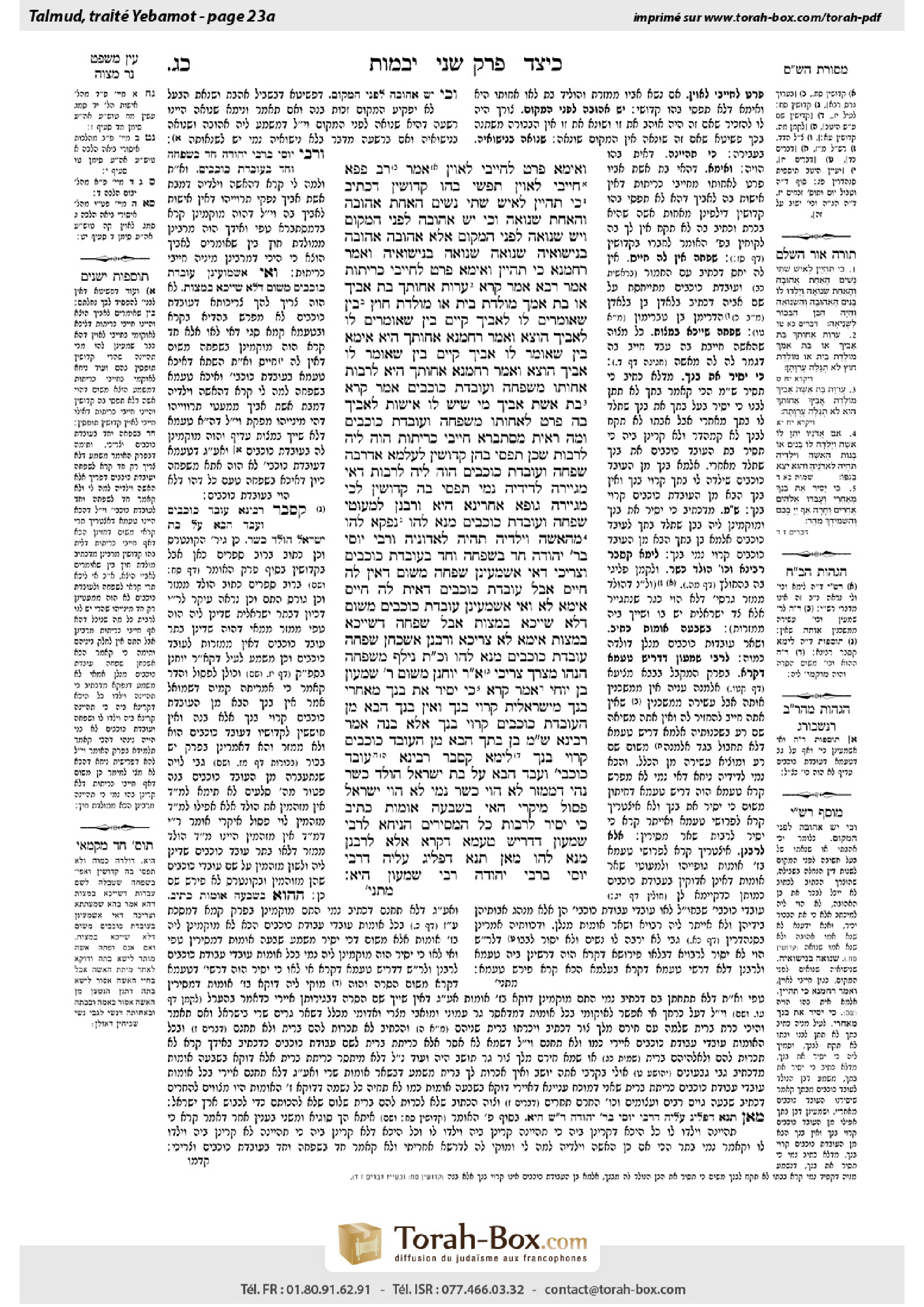
Yevamot 23a: Talmud study for Daf Yomi
Daf Yomi is the daily study of one Talmud folio. Explore 37 tractates with scans, Hebrew text, Sefaria English and AI-generated French translations where annotated.
Passage selection and English or AI-generated French translation are available where the scan has annotations. Daf Study is independent of Torah-Box and Sefaria.
Browse Yevamot · יבמות · All tractatesYevamot 23a text and translations
This page of Yevamot includes the Aramaic text, an English translation and an AI-generated French translation, alongside the scan above.
יבמות כ״ג א · Aramaic and Hebrew text
וְאֵימָא: פְּרָט לְחַיָּיבֵי לָאוִין! אָמַר רַב פָּפָּא: חַיָּיבֵי לָאוִין תָּפְשִׂי בְּהוּ קִדּוּשִׁין,
דִּכְתִיב: ״כִּי תִהְיֶיןָ לְאִישׁ שְׁתֵּי נָשִׁים הָאַחַת אֲהוּבָה וְהָאַחַת שְׂנוּאָה״, וְכִי יֵשׁ אֲהוּבָה לִפְנֵי הַמָּקוֹם וְיֵשׁ שְׂנוּאָה לִפְנֵי הַמָּקוֹם? אֶלָּא: ״אֲהוּבָה״ — אֲהוּבָה בְּנִישּׂוּאֶיהָ, ״שְׂנוּאָה״ — שְׂנוּאָה בְּנִישּׂוּאֶיהָ, וְאָמַר רַחֲמָנָא: ״כִּי תִּהְיֶיןָ״.
וְאֵימָא: פְּרָט לְחַיָּיבֵי כָּרֵיתוֹת! אָמַר רָבָא, אָמַר קְרָא: ״עֶרְוַת אֲחוֹתְךָ בַת אָבִיךָ אוֹ בַת אִמֶּךָ מוֹלֶדֶת בַּיִת אוֹ מוֹלֶדֶת חוּץ״, בֵּין שֶׁאוֹמְרִים לוֹ לְאָבִיךָ קַיֵּים, בֵּין שֶׁאוֹמְרִים לוֹ לְאָבִיךָ הוֹצֵא, וְאָמַר רַחֲמָנָא: ״אֲחוֹתְךָ הִיא״.
אֵימָא: בֵּין שֶׁאוֹמֵר לוֹ אָבִיךָ קַיֵּים, בֵּין שֶׁאוֹמֵר לוֹ אָבִיךָ הוֹצֵא, וְאָמַר רַחֲמָנָא: ״אֲחוֹתְךָ הִיא״, לְרַבּוֹת אֲחוֹתוֹ מִשִּׁפְחָה וְגוֹיָה! אָמַר קְרָא: ״בַּת אֵשֶׁת אָבִיךָ״ — מִי שֶׁיֵּשׁ לוֹ אִישׁוּת לְאָבִיךָ בָּהּ, פְּרָט לַאֲחוֹתוֹ מִשִּׁפְחָה וְגוֹיָה.
וּמָה רָאִיתָ? מִסְתַּבְּרָא חַיָּיבֵי כָּרֵיתוֹת הֲוָה לֵיהּ לְרַבּוֹת, שֶׁכֵּן תָּפְסִי בָּהֶן קִדּוּשִׁין לְעָלְמָא.
אַדְּרַבָּה: שִׁפְחָה וְגוֹיָה הֲוָה לֵיהּ לְרַבּוֹת, דְּאִי מִגַּיְּירָה לְדִידֵיהּ נָמֵי, תָּפְסִי בַּהּ קִדּוּשִׁין! לְכִי מִגַּיְּירָה — גּוּפָא אַחֲרִינָא הִיא.
וְרַבָּנַן, לְמַעוֹטֵי שִׁפְחָה וְגוֹיָה מְנָא לְהוּ? נָפְקָא לְהוּ מֵ״הָאִשָּׁה וִילָדֶיהָ תִּהְיֶה לַאדוֹנֶיהָ״.
וְרַבִּי יוֹסֵי בְּרַבִּי יְהוּדָה? חַד בְּשִׁפְחָה, וְחַד בְּגוֹיָה. וּצְרִיכִי, דְּאִי אַשְׁמְעִינַן שִׁפְחָה: מִשּׁוּם דְּאֵין לָהּ חַיִיס, אֲבָל גּוֹיָה דְּאִית לַהּ חַיִיס — אֵימָא לָא.
וְאִי אַשְׁמְעִינַן גּוֹיָה — מִשּׁוּם דְּלָא שָׁיְיכָא בְּמִצְוֹת. אֲבָל שִׁפְחָה, דְּשָׁיְיכָא בְּמִצְוֹת — אֵימָא לָא, צְרִיכָא.
וְרַבָּנַן, אַשְׁכְּחַן שִׁפְחָה, גּוֹיָה מְנָא לְהוּ? וְכִי תֵּימָא: נֵילַף מִשִּׁפְחָה — הָנְהוּ מִצְרָךְ צְרִיכִי!
אָמַר רַבִּי יוֹחָנָן מִשּׁוּם רַבִּי שִׁמְעוֹן בֶּן יוֹחַי, אָמַר קְרָא: ״כִּי יָסִיר אֶת בִּנְךָ מֵאַחֲרַי״, בִּנְךָ מִיִּשְׂרְאֵלִית קָרוּי בִּנְךָ, וְאֵין בִּנְךָ הַבָּא מִן הַגּוֹיָה קָרוּי בִּנְךָ, אֶלָּא בְּנָהּ.
אָמַר רָבִינָא, שְׁמַע מִינַּהּ: בֶּן בִּתְּךָ הַבָּא מִן הַגּוֹי קָרוּי בִּנְךָ. לֵימָא קָסָבַר רָבִינָא גּוֹי וְעֶבֶד הַבָּא עַל בַּת יִשְׂרָאֵל הַוָּלָד כָּשֵׁר? נְהִי דְּמַמְזֵר לָא הָוֵי — כָּשֵׁר נָמֵי לָא הָוֵי, יִשְׂרָאֵל פָּסוּל מִיקְּרֵי.
הַאי בְּשִׁבְעָה גּוֹיִם כְּתִיב? ״כִּי יָסִיר״ — לְרַבּוֹת כׇּל הַמְּסִירִים.
הָנִיחָא לְרַבִּי שִׁמְעוֹן, דְּדָרֵישׁ טַעְמָא דִּקְרָא, אֶלָּא לְרַבָּנַן מְנָא לְהוּ? מַאן תַּנָּא דִּפְלִיג עֲלֵיהּ דְּרַבִּי יוֹסֵי בְּרַבִּי יְהוּדָה — רַבִּי שִׁמְעוֹן הִיא.
Yevamot 23a · English translation
The Gemara raises a challenge: And say that the verse: “The daughter of your father’s wife” comes to exclude women who were forbidden, as they are liable for violating prohibitions but were nevertheless married to his father, such as a mamzeret. If so, his sister from such a union would not be considered his sister. Rav Pappa said: Betrothal comes into effect with women who are forbidden, and one would be liable for violating prohibitions despite the fact that union with them is forbidden, and so she is called the wife of your father.
This is derived from the verse in which it is written: “If a man has two wives, the one beloved, and the other hated” (Deuteronomy 21:15). Is there one who is loved by the Omnipresent and one who is hated by the Omnipresent? Rather, “beloved” means her marriage is beloved, as it was permitted for her to be married, in accordance with halakha, and “hated” means her marriage is hated because it was not permitted for her to be married, according to halakha. And the Merciful One states: “If a man has two wives,” meaning that both are considered to be married.
The Gemara asks: Say that this verse comes to exclude a union between one’s father and a woman that is forbidden to him as they are liable to receive karet, and that since betrothal does not come into effect with her there is no marriage bond. Perhaps a sister born of such a woman would not be prohibited as the daughter of one’s father’s wife. Rava said that the verse states: “The nakedness of your sister, the daughter of your father, or the daughter of your mother, whether born at home or born outside” (Leviticus 18:9). This includes all daughters, whether from a woman for whom the Sages tell your father: Maintain her within your home, or whether the Sages tell your father she is a woman who is forbidden to him and therefore: Send her out of your home. And the Merciful One states that nevertheless: “She is your sister.” Even the daughter of a woman who was forbidden to your father such that both parties are liable to receive karet is called your sister.
The Gemara asks: Say that whether the Sages say to your father: Maintain her, or whether they say to your father: Send her out, and the Merciful One states that “she is your sister,” this comes to include the additional cases of his sister from a Canaanite maidservant or a gentile woman. The Gemara rejects this: The verse states: “The daughter of your father’s wife,” and this means whoever can enter a marriage bond with your father. This excludes his sister from a Canaanite maidservant or gentile woman, with whom no marital bond is possible.
The Gemara asks: Since the verse rendering his sister forbidden both includes and excludes cases, what did you see as a reason to include a daughter from a woman who is forbidden and both parties are liable to receive karet, and to exclude the daughter of a Canaanite maidservant or gentile woman? The Gemara answers: It stands to reason that those relationships that are forbidden because they render both parties liable to receive karet should be included, since in general betrothal can come into effect with them. This is because although this woman is forbidden to his father, she is nevertheless permitted to other men.
The Gemara rejects this: On the contrary, it should include a Canaanite maidservant or a gentile woman, as, if she converts, betrothal can come into effect with the father himself. The Gemara answers: When she converts, she is considered like a different body, i.e., a new person, but when she was a gentile there was no possibility of marital relations with her. Therefore, the verse excludes her.
The Gemara asks: And with regard to the Rabbis, who infer a different matter from the verse “your father’s wife’s nakedness,” from where do they derive the halakha to exclude one’s sister from a Canaanite maidservant or gentile woman? The Gemara answers: They derive it from that which was said with regard to a Canaanite maidservant who was married to a Hebrew slave: “The wife and her children shall be her master’s” (Exodus 21:4). From here they learn that the lineage of the maidservant’s children is connected only to their mother and not at all connected to their Jewish father.
The Gemara asks: And why does Rabbi Yosei, son of Rabbi Yehuda, not learn this from here? The Gemara responds: One verse was necessary to teach the case of a Canaanite maidservant, and one verse was necessary to teach the case of a gentile woman. And both verses are necessary, as, if the Torah taught us only about a Canaanite maidservant, one could say she is excluded only because she does not have a pedigree, since the Torah ascribes no family relationships to maidservants, but with regard to a gentile woman who does have a pedigree, say no. It was therefore necessary to say that one’s daughter by a gentile woman does not have the legal status of a daughter.
Conversely, if it would teach us only the case of a gentile woman, one might say that this is because she does not have any connection with the mitzvot and therefore her children are in no way Jewish. But since a Canaanite maidservant has a connection with the mitzvot, as she is obligated to observe the prohibitions in the same way as a Jewish woman, say no, i.e., her children should be considered children of their Jewish father. Therefore, this additional proof is necessary.
The Gemara asks: And according to the opinion of the Rabbis, we found a source that the children of a Canaanite maidservant are not considered the children of their Jewish father, but from where do we derive that children born to a Jewish father by a gentile woman are not considered his children? And if you say: Let us derive it from the case of the Canaanite maidservant, it has already been shown that these are both necessary, and one cannot be derived from the other.
The Gemara answers: Rabbi Yoḥanan said in the name of Rabbi Shimon ben Yoḥai: The verse states: “Neither shall you make marriages with them: Your daughter you shall not give unto his son, nor his daughter shall you take unto your son, for he will turn away your son from following Me” (Deuteronomy 7:3–4). This teaches that your son born from a Jewish woman is called your son, but your son born from a gentile woman is not called your son, but her son. The verse teaches that since the son of a gentile woman is her son alone, he is not considered related at all to his Jewish father.
Ravina said: Conclude from here that the son of your daughter by a gentile father is nevertheless called your son, i.e., grandson. The Gemara asks: Shall we say that Ravina holds that if a gentile or slave engaged in intercourse with a Jewish woman, the offspring is of unflawed lineage? The Gemara answers: There is no conclusive proof from here, because granted, she is not a mamzer, but nevertheless she is still not of unflawed lineage; rather, she is called a Jew who is unfit to marry into the priesthood.
The Gemara asks with regard to Rabbi Shimon’s reasoning: Was this verse not written in relation to the seven nations who inhabited the land of Canaan when Joshua entered Eretz Yisrael but not with regard to other nations? The Gemara responds that the words “He will turn away” comes to include all those who would turn one’s grandson away from God, i.e., any gentile.
The Gemara asks: This works out well for Rabbi Shimon, who interprets the rationale behind the mitzva in the verse and draws halakhic conclusions based on that interpretation. Although the verse is stated with regard to the seven nations, the reason for the verse applies to all other gentile nations. However, according to the opinion of the Rabbis, who do not draw inferences from the rationale of the verse to apply this ruling to all other nations, from where do they derive this halakha? The Gemara answers: Who is the tanna who disagrees with Rabbi Yosei, son of Rabbi Yehuda? It is Rabbi Shimon, who applies the rationale of the verse to all other nations.
Yevamot 23a · Traduction française (IA)
La Guemara soulève une objection : disons que le verset « la fille de la femme de ton père » vient exclure les femmes interdites, avec lesquelles on est néanmoins passible d’une peine pour avoir transgressé une interdiction, mais que son père a tout de même épousées, comme une mamzeret. Dans ce cas, sa sœur issue d’une telle union ne serait pas considérée comme sa sœur. Rav Pappa dit : les kidouchin prennent effet avec les femmes interdites, et l’on est passible d’une peine pour avoir transgressé une interdiction, bien que l’union avec elles soit interdite ; elle est donc appelée « la femme de ton père ».
Cela se déduit du verset où il est écrit : « Si un homme a deux femmes, l’une aimée et l’autre haïe » (Deutéronome 21,15). En existe-t-il une qui soit aimée par le Saint, béni soit-Il, et une autre qui soit haïe par le Saint, béni soit-Il ? Mais « aimée » signifie que son mariage est aimé, car elle pouvait se marier conformément à la halakha ; et « haïe » signifie que son mariage est haï, car elle ne pouvait pas se marier selon la halakha. Et le Miséricordieux dit : « Si un homme a deux femmes », ce qui signifie qu’elles sont toutes deux considérées comme mariées.
La Guemara demande : disons que ce verset vient exclure une union entre son père et une femme avec laquelle les rapports lui sont interdits et le rendent passible de karet, et que, puisque les kidouchin ne prennent pas effet avec elle, aucun lien matrimonial n’existe. Peut-être qu’une sœur née d’une telle femme ne serait pas interdite en tant que fille de la femme de son père. Rava dit que le verset énonce : « La nudité de ta sœur, fille de ton père ou fille de ta mère, née dans la maison ou née au-dehors » (Lévitique 18,9). Cela inclut toutes les filles, qu’elles soient issues d’une femme au sujet de laquelle les Sages disent à ton père : « Garde-la dans ta maison », ou d’une femme au sujet de laquelle les Sages disent à ton père qu’elle lui est interdite et qu’il doit donc : « La renvoyer de ta maison ». Et le Miséricordieux affirme néanmoins : « Elle est ta sœur. » Même la fille d’une femme interdite à ton père, de sorte que les deux parties sont passibles de karet, est appelée ta sœur.
La Guemara demande : que les Sages disent à ton père : « Garde-la », ou qu’ils lui disent : « Renvoie-la », et que le Miséricordieux affirme qu’« elle est ta sœur », cela vient peut-être inclure les cas supplémentaires de sa sœur issue d’une servante cananéenne ou d’une femme non juive. La Guemara rejette cette hypothèse : le verset dit « la fille de la femme de ton père », ce qui désigne toute femme qui peut contracter un lien matrimonial avec ton père. Cela exclut sa sœur issue d’une servante cananéenne ou d’une femme non juive, avec lesquelles aucun lien matrimonial n’est possible.
La Guemara demande : puisque le verset qui interdit sa sœur inclut certains cas et en exclut d’autres, pourquoi choisir d’inclure une fille issue d’une femme interdite, avec laquelle les deux parties sont passibles de karet, et d’exclure la fille d’une servante cananéenne ou d’une femme non juive ? La Guemara répond : il est logique d’inclure les relations interdites qui rendent les deux parties passibles de karet, puisque, en général, les kidouchin peuvent prendre effet dans ces cas. En effet, bien que cette femme soit interdite à son père, elle est néanmoins permise aux autres hommes.
La Guemara rejette cette explication : au contraire, il faudrait inclure une servante cananéenne ou une femme non juive, car, si elle se convertit, les kidouchin peuvent prendre effet avec le père lui-même. La Guemara répond : lorsqu’elle se convertit, elle est considérée comme une autre personne, c’est-à-dire comme une nouvelle personne ; mais, lorsqu’elle était non juive, aucune relation conjugale avec elle n’était possible. C’est pourquoi le verset l’exclut.
La Guemara demande : et les Rabbins, qui déduisent une autre règle du verset « la nudité de la femme de ton père », d’où déduisent-ils la halakha qui exclut la sœur issue d’une servante cananéenne ou d’une femme non juive ? La Guemara répond : ils la déduisent de ce qui est dit au sujet d’une servante cananéenne mariée à un esclave hébreu : « La femme et ses enfants appartiendront à son maître » (Exode 21,4). Ils apprennent de là que la filiation des enfants de la servante est liée uniquement à leur mère et nullement à leur père juif.
La Guemara demande : et pourquoi Rabbi Yossei, fils de Rabbi Yehouda, ne déduit-il pas cela de ce verset ? La Guemara répond : un verset était nécessaire pour enseigner le cas d’une servante cananéenne, et un autre était nécessaire pour enseigner le cas d’une femme non juive. Les deux versets sont nécessaires, car si la Torah nous avait enseigné uniquement le cas d’une servante cananéenne, on aurait pu dire qu’elle est exclue seulement parce qu’elle n’a pas de généalogie, la Torah n’attribuant aucun lien familial aux servantes ; mais, s’agissant d’une femme non juive, qui a une généalogie, on aurait pu dire le contraire. Il était donc nécessaire d’enseigner que la fille d’un homme et d’une femme non juive n’a pas le statut de sa fille.
À l’inverse, si la Torah nous avait enseigné uniquement le cas d’une femme non juive, on aurait pu dire que c’est parce qu’elle n’a aucun lien avec les mitsvot et que ses enfants ne sont donc en aucune manière juifs. Mais, puisqu’une servante cananéenne a un lien avec les mitsvot, car elle est tenue d’observer les interdits comme une femme juive, on aurait pu dire le contraire, c’est-à-dire que ses enfants devraient être considérés comme les enfants de leur père juif. Une preuve supplémentaire est donc nécessaire.
La Guemara demande : selon l’opinion des Rabbins, nous avons trouvé une source établissant que les enfants d’une servante cananéenne ne sont pas considérés comme les enfants de leur père juif ; mais d’où déduisons-nous que les enfants qu’un père juif a eus avec une femme non juive ne sont pas considérés comme ses enfants ? Et si l’on dit : déduisons-le du cas de la servante cananéenne, il a déjà été démontré que ces deux cas sont nécessaires et que l’on ne peut pas déduire l’un de l’autre.
La Guemara répond : Rabbi Yoḥanan dit au nom de Rabbi Shimon ben Yoḥai : le verset énonce : « Tu ne contracteras pas de mariage avec eux : tu ne donneras pas ta fille à leur fils et tu ne prendras pas leur fille pour ton fils, car il détournera ton fils de Me suivre » (Deutéronome 7,3-4). Cela enseigne que ton fils né d’une femme juive est appelé ton fils, mais que ton fils né d’une femme non juive n’est pas appelé ton fils : il est son fils à elle. Le verset enseigne que, puisque le fils d’une femme non juive est son fils à elle seule, il n’est aucunement considéré comme apparenté à son père juif.
Ravina dit : déduis de là que le fils de ta fille née d’un père non juif est néanmoins appelé ton fils, c’est-à-dire ton petit-fils. La Guemara demande : devons-nous en conclure que Ravina estime que, lorsqu’un non-Juif ou un esclave a des rapports avec une femme juive, l’enfant a une filiation sans défaut ? La Guemara répond : il n’y a pas là de preuve concluante. Certes, elle n’est pas une mamzer ; néanmoins, sa filiation n’est pas sans défaut : elle est plutôt appelée une Juive inapte à épouser un membre de la prêtrise.
La Guemara interroge le raisonnement de Rabbi Shimon : ce verset n’a-t-il pas été écrit au sujet des sept peuples qui habitaient le pays de Canaan lorsque Josué entra en Eretz Yisrael, et non au sujet des autres peuples ? La Guemara répond que les mots « il détournera » viennent inclure tous ceux qui détourneraient ton petit-fils de Dieu, c’est-à-dire n’importe quel non-Juif.
La Guemara demande : cela convient bien selon Rabbi Shimon, qui interprète la raison de la mitsva énoncée dans le verset et tire des conclusions halakhiques de cette interprétation. Bien que le verset porte sur les sept peuples, sa raison s’applique à tous les autres peuples non juifs. Mais, selon l’opinion des Rabbins, qui ne tirent pas de conclusions de la raison du verset pour appliquer cette règle à tous les autres peuples, d’où déduisent-ils cette halakha ? La Guemara répond : qui est le tanna en désaccord avec Rabbi Yossei, fils de Rabbi Yehouda ? C’est Rabbi Shimon, qui applique la raison du verset à tous les autres peuples.
Traduction française générée par IA à partir de l’édition anglaise de Sefaria. Vérifie toujours un passage avec le texte source.
Text from Sefaria: William Davidson Edition - Vocalized Aramaic (CC BY NC); William Davidson Edition - English (CC BY NC).