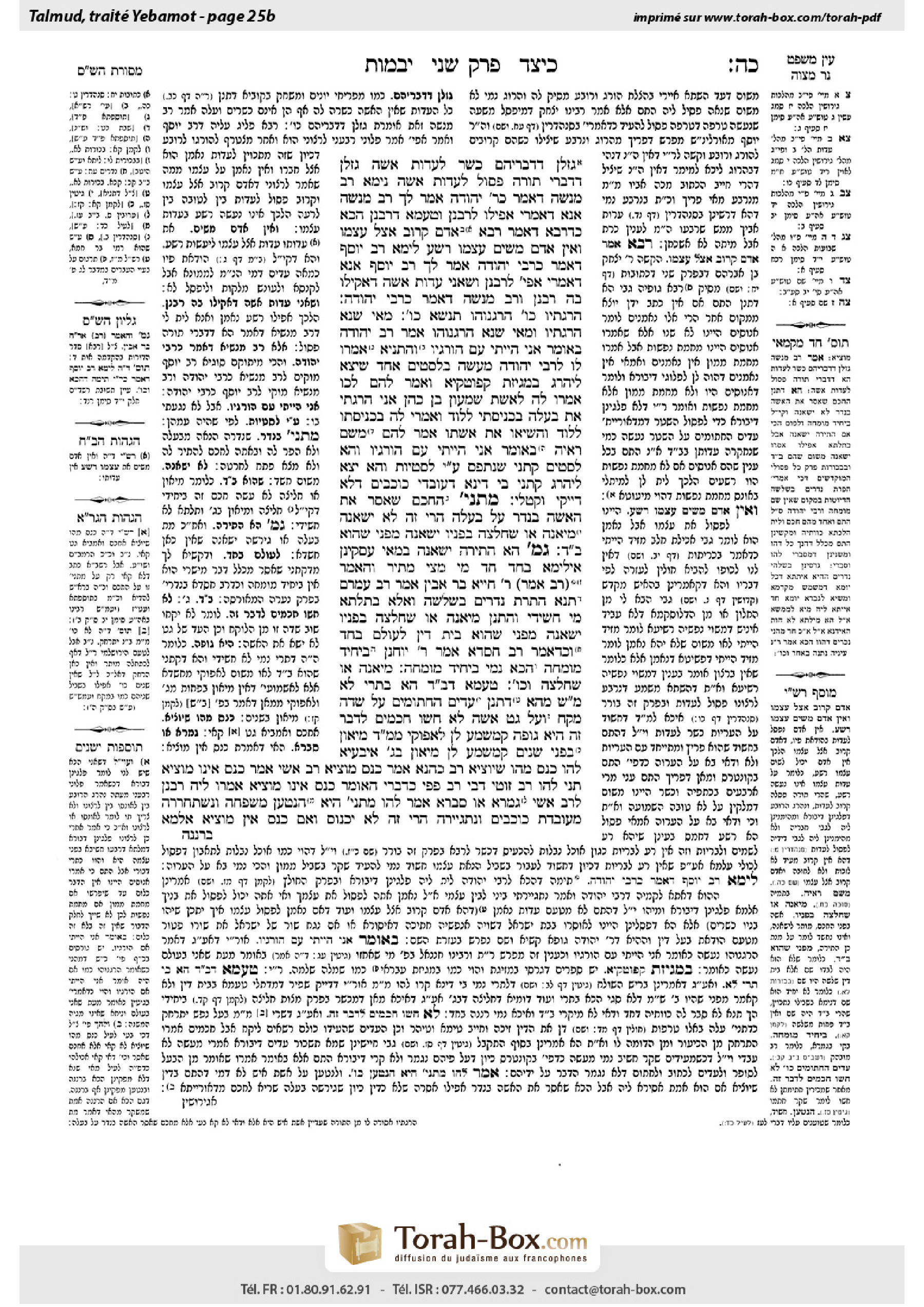
Yevamot 25b: Talmud study for Daf Yomi
Daf Yomi is the daily study of one Talmud folio. Explore 37 tractates with scans, Hebrew text, Sefaria English and AI-generated French translations where annotated.
Passage selection and English or AI-generated French translation are available where the scan has annotations. Daf Study is independent of Torah-Box and Sefaria.
Browse Yevamot · יבמות · All tractatesYevamot 25b text and translations
This page of Yevamot includes the Aramaic text, an English translation and an AI-generated French translation, alongside the scan above.
יבמות כ״ה ב · Aramaic and Hebrew text
גַּזְלָן דְּדִבְרֵיהֶם — כָּשֵׁר לְעֵדוּת אִשָּׁה, גַּזְלָן דְּדִבְרֵי תוֹרָה — פָּסוּל לְעֵדוּת אִשָּׁה. נֵימָא רַב מְנַשֶּׁה דְּאָמַר כְּרַבִּי יְהוּדָה!
אָמַר לְךָ רַב מְנַשֶּׁה: אֲנָא דַּאֲמַרִי אֲפִילּוּ לְרַבָּנַן — וְטַעְמָא דְּרַבָּנַן הָכָא כִּדְרָבָא, דְּאָמַר רָבָא: אָדָם קָרוֹב אֵצֶל עַצְמוֹ, וְאֵין אָדָם מֵשִׂים עַצְמוֹ רָשָׁע.
לֵימָא רַב יוֹסֵף דְּאָמַר כְּרַבִּי יְהוּדָה? אָמַר לְךָ רַב יוֹסֵף: אֲנָא דַּאֲמַרִי אֲפִילּוּ לְרַבָּנַן, וְשָׁאנֵי עֵדוּת אִשָּׁה, דַּאֲקִילּוּ בַּהּ רַבָּנַן. וְרַב מְנַשֶּׁה דְּאָמַר כְּרַבִּי יְהוּדָה.
הֲרַגְתִּיו כּוּ׳ הֲרַגְנוּהוּ תִּנָּשֵׂא כּוּ׳. מַאי שְׁנָא ״הֲרַגְתִּיו״ וּמַאי שְׁנָא ״הֲרַגְנוּהוּ״? אָמַר רַב יְהוּדָה, בְּאוֹמֵר: אֲנִי הָיִיתִי עִם הוֹרְגָיו.
וְהָתַנְיָא: אָמְרוּ לוֹ לְרַבִּי יְהוּדָה, מַעֲשֶׂה בְּלִסְטִים אֶחָד שֶׁיָּצָא לֵיהָרֵג בִּמְגִיזַת קַפּוֹטְקְיָא, וְאָמַר לָהֶם: ״לְכוּ אִמְרוּ לָהּ לְאֵשֶׁת שִׁמְעוֹן בֶּן כֹּהֵן: ׳אֲנִי הָרַגְתִּי אֶת בַּעְלָהּ בִּכְנִיסָתִי לְלוֹד׳״, וְאָמְרִי לַהּ: ׳בִּכְנִיסָתוֹ לְלוֹד׳, וְהִשִּׂיאוּ אֶת אִשְׁתּוֹ! אָמַר לָהֶם: מִשָּׁם רְאָיָה?! בְּאוֹמֵר: ״אֲנִי הָיִיתִי עִם הוֹרְגָיו״.
וְהָא ״לִסְטִים״ קָתָנֵי! שֶׁנִּתְפַּס עַל יְדֵי לִסְטִיּוּת. וְהָא ״יָצָא״ לֵיהָרֵג קָתָנֵי! בֵּי דִינָא דְּגוֹיִם, דְּלָא דָּיְיקִי וְקָטְלִי.
מַתְנִי׳ הֶחָכָם שֶׁאָסַר אֶת הָאִשָּׁה בְּנֶדֶר עַל בַּעְלָהּ — הֲרֵי זֶה לֹא יִשָּׂאֶנָּה. מֵיאֲנָה, אוֹ שֶׁחָלְצָה בְּפָנָיו — יִשָּׂאֶנָּה, מִפְּנֵי שֶׁהוּא בֵּית דִּין.
גְּמָ׳ הָא הִתִּירָה — יִשָּׂאֶנָּה. בְּמַאי עָסְקִינַן? אִילֵימָא בְּחַד — חַד מִי מָצֵי מַתִּיר? וְהָאָמַר (רַב אָמַר) רַבִּי חִיָּיא בַּר אָבִין אָמַר רַב עַמְרָם, תָּנָא: הַתָּרַת נְדָרִים בִּשְׁלֹשָׁה!
וְאֶלָּא, בִּתְלָתָא. מִי חֲשִׁידִי? וְהָתְנַן: מֵיאֲנָה אוֹ שֶׁחָלְצָה בְּפָנָיו — יִשָּׂאֶנָּה, מִפְּנֵי שֶׁהוּא בֵּית דִּין.
לְעוֹלָם בְּחַד, וְכִדְאָמַר רַב חִסְדָּא אָמַר רַבִּי יוֹחָנָן: בְּיָחִיד מוּמְחֶה, הָכָא נָמֵי: בְּיָחִיד מוּמְחֶה.
מֵיאֲנָה אוֹ שֶׁחָלְצָה וְכוּ׳. טַעְמָא דְּבֵית דִּין, הָא בִּתְרֵי — לָא,
מַאי שְׁנָא מֵהָא דִּתְנַן: עֵדִים הַחֲתוּמִים עַל שְׂדֵה מִקָּח, וְעַל גֵּט אִשָּׁה לֹא חָשׁוּ חֲכָמִים לְדָבָר זֶה? הִיא גּוּפַהּ קָמַשְׁמַע לַן, לְאַפּוֹקֵי מִמַּאן דְּאָמַר מֵיאוּן בִּפְנֵי שְׁנַיִם, קָמַשְׁמַע לַן מֵיאוּן בִּשְׁלֹשָׁה.
אִיבַּעְיָא לְהוּ: כָּנַס, מַהוּ שֶׁיּוֹצִיא? רַב כָּהֲנָא אָמַר: כָּנַס — מוֹצִיא. רַב אָשֵׁי אָמַר: כָּנַס — אֵינוֹ מוֹצִיא. תָּנֵי לְהוּ רַב זוּטֵי דְּבֵי רַב פַּפֵּי כְּדִבְרֵי הָאוֹמֵר כָּנַס אֵינוֹ מוֹצִיא.
אֲמַרוּ לֵיהּ רַבָּנַן לְרַב אָשֵׁי: גְּמָרָא, אוֹ סְבָרָא? אֲמַר לְהוּ, מַתְנִיתִין הִיא: הַנִּטְעָן מִשִּׁפְחָה וְנִשְׁתַּחְרְרָה, מִגּוֹיָה וְנִתְגַּיְּירָה — הֲרֵי זֶה לֹא יִכְנוֹס, וְאִם כָּנַס — אֵין מוֹצִיא. אַלְמָא
Yevamot 25b · English translation
Although one who is considered a robber according to the words of the Sages is unfit for other forms of testimony, he is fit as a witness for testimony that a woman’s husband died. A robber according to Torah law is unfit as a witness even for testimony that a woman’s husband has died. Should we say that what Rav Menashe said is in accordance with the opinion of Rabbi Yehuda? Rabbi Yehuda said in the mishna that one who is considered absolutely wicked because he admitted that he is a murderer is unfit for testifying to the death of a husband, but one who was merely present among a gang of murderers is not.
The Gemara rejects this: Rav Menashe could have said to you: I am speaking even according to the opinion of the Rabbis. Although the Rabbis did not allow one who was wicked by Torah law to testify for a woman, a witness who admitted: I killed him, is nevertheless believed. And the rationale of the Rabbis here is in accordance with the opinion of Rava, as Rava disputed Rav Yosef’s opinion and said: Even if one said that he was willingly sodomized by this man, he is not believed concerning his own actions, because a person is his own relative. Consequently, he may not testify about himself, just as the testimony of any relative is disqualified. And furthermore, a person does not make himself wicked. His testimony with regard to his own actions is inadmissible because he is his own relative, but his testimony is accepted both to put a sodomizer to death or to render it permitted for a woman to remarry by saying that he killed her husband.
The Gemara asks: Shall we say according to this explanation that the opinion that Rav Yosef spoke is in accordance with the opinion of Rabbi Yehuda? The Gemara rejects this: Rav Yosef could have said to you: I am speaking even according to the opinion of the Rabbis, as in my opinion, testimony enabling a woman to remarry is different in that the Rabbis ruled more leniently and they even accept testimony from a completely wicked individual. However, Rav Menashe, who renders unfit one who is wicked by Torah law from testimony enabling a woman to remarry, spoke in accordance with the opinion of Rabbi Yehuda, who differentiates even in such testimony between one who is considered wicked according to Torah law and one who is considered wicked by rabbinic law.
In the mishna it is taught that the court accepts testimony from one who said: I killed him, or: We killed him, while Rabbi Yehuda differentiates between one who said: I killed him, whose testimony is not accepted, and one who said: We killed him, whose testimony is accepted and the woman may be married to others. The Gemara asks: What is different between: I killed him, and: We killed him? Isn’t he a murderer by his own admission as well when he testifies: We killed him? Rav Yehuda said: Do not understand that by saying: We killed him, he included himself among the murderers. Rather, it is referring to a case where he said: I was with his murderers, but he was not an active participant to the murder.
And it is taught in a baraita that this is the basis for Rabbi Yehuda’s distinction: They told Rabbi Yehuda: There was an incident involving an armed bandit [listim] who was taken out to be executed in the passage [megizat] of Cappadocia, and he said to those present: Go and tell the wife of Shimon the Priest that I killed her husband as I entered Lod. And some say that he said: As he entered Lod. And they married off his wife on the basis of this testimony. This implies that the court accepts testimony from the murderer himself. Rabbi Yehuda said to them: You derive proof from there? The case was that he said: I was with his murderers, but not that he himself murdered the woman’s husband.
The Gemara challenges: How could Rabbi Yehuda understand the incident in such a way? But it is taught in the baraita that the witness himself was an armed bandit. The Gemara answers: He was captured for a charge of armed banditry. The Gemara asks: But it is taught that he was taken out to be executed, implying that he was found guilty of murder. The Gemara answers: That was a gentile court, and they execute without being precise. One who is among a gang of bandits is executed by a gentile court regardless of whether or not he himself was a murderer. This baraita therefore provides evidence that Rabbi Yehuda admits the testimony of such a witness only if he says: I was with his murderers.
MISHNA: A Sage who refused to release a woman from a vow that rendered the wife forbidden to her husband by that vow, resulting in her being divorced from her husband, may not marry her, so as to avoid suspicion that he rendered her forbidden to her husband in order to marry her himself. However, a judge before whom a woman performed refusal when she was a minor, declaring that she did not desire the husband chosen for her by her family, or before whom she performed ḥalitza, may marry her because he was only one member of the court, thereby alleviating suspicion.
GEMARA: The mishna taught that a Sage who rendered a woman forbidden to her husband may not then marry her. The Gemara deduces from here: This implies that if he rendered her permitted to her husband and she was later widowed or divorced, then he may marry her. The Gemara clarifies this: With what are we dealing? If we say that he was a single judge and not part of a court, can a single judge dissolve vows? But didn’t Rav say that Rabbi Ḥiyya bar Avin said that Rav Amram said: It is taught in a baraita: Dissolution of vows requires a court of three judges?
Rather, could it be a case of three judges rather than one? In such a case, would they be suspect of distorting judgment? But didn’t we learn in the mishna: If she performed refusal or performed ḥalitza before him, he may marry her because he functioned as a member of a court of three? This teaches that there is no suspicion of a judge in a court of three.
The Gemara answers: Actually, you should explain that this case is that of a single judge, and it is as Rav Ḥisda said that Rabbi Yoḥanan said: Vows may be dissolved even by a single expert, and a three-member court is not always necessary. Here too, it is referring to a single expert refusing to nullify her vow.
It is taught in the mishna that if a woman performed refusal or performed ḥalitza before a judge, he may still marry her, as he was part of a court. The Gemara deduces from here: The reason is specifically that he functioned on the court as one of three judges. The Gemara deduces: Then, if there were only two judges, he would not be permitted to marry her.
If so, in what way is this case different from that which we learned in a baraita: If witnesses signed on the document of sale of a field or on a woman’s bill of divorce, the Sages were not concerned about this matter if one of the witnesses subsequently purchased the field or married the divorcée. Since there are two witnesses, there is no suspicion that they collaborated for the benefit of one of them. The Gemara answers: If there were two judges there would also be no concern; however, this mishna itself comes to teach us that a refusal must be performed before a full court, to exclude the opinion of the one who said that refusal may be performed before two. This teaches us that refusal must be performed before three judges.
§ A dilemma was raised before the Sages with regard to one who was prohibited from marrying a certain woman: If he nevertheless married her despite the prohibition, what is the halakha with regard to whether he must divorce her? Rav Kahana said: If he married her, he must divorce her. Rav Ashi said: If he married her, he need not divorce her. Rav Zuti from the school of Rav Pappi taught the Sages a baraita in accordance with the statement of the one who said that if he married her, he need not divorce her.
The Rabbis said to Rav Ashi: With regard to the halakha that you said, that if he married her he need not divorce her, was it based upon tradition or is it your own conclusion? He said to them: It is the mishna. I reached this conclusion from the wording of the mishna, which taught that one suspected by others of engaging in sexual relations with a Canaanite maidservant and she was subsequently set free, or with a gentile woman and she subsequently converted may not marry that woman. But if he did marry her, they, the judges of the court, do not remove her from him. Apparently,
Yevamot 25b · Traduction française (IA)
Bien qu’un individu considéré comme un voleur selon les paroles des Sages soit inapte à fournir d’autres types de témoignage, il est apte à témoigner de la mort du mari d’une femme. Un voleur au regard de la Torah est inapte à témoigner même de la mort du mari d’une femme. Faut-il en conclure que ce que Rav Menashe a dit correspond à l’opinion de Rabbi Yehuda ? Dans la Michna, Rabbi Yehuda a dit que celui qui est considéré comme absolument mauvais parce qu’il a reconnu être un meurtrier est inapte à témoigner de la mort d’un mari, mais que celui qui se trouvait simplement parmi une bande de meurtriers ne l’est pas.
La Guemara rejette cette interprétation : Rav Menashe aurait pu te répondre qu’il parle même selon l’opinion des Rabbins. Bien que les Rabbins n’aient pas autorisé une personne qui était mauvaise au regard de la Torah à témoigner en faveur d’une femme, un témoin qui a reconnu : « Je l’ai tué » est néanmoins cru. La position des Rabbins ici correspond à l’opinion de Rava, qui a contesté celle de Rav Yosef et a dit : même si quelqu’un disait qu’il a été sodomisé de son plein gré par cet homme, on ne le croit pas au sujet de ses propres actes, car une personne est son propre parent. Par conséquent, elle ne peut témoigner à son propre sujet, tout comme le témoignage de tout parent est irrecevable. De plus, une personne ne peut pas se déclarer elle-même mauvaise. Son témoignage concernant ses propres actes est irrecevable parce qu’elle est son propre parent, mais son témoignage est accepté aussi bien pour faire exécuter un sodomiseur que pour permettre à une femme de se remarier en affirmant qu’elle a tué son mari.
La Guemara demande : Selon cette explication, faut-il en conclure que l’opinion exprimée par Rav Yosef correspond à celle de Rabbi Yehuda ? La Guemara rejette cette interprétation : Rav Yosef aurait pu te répondre qu’il parle même selon l’opinion des Rabbins, car, à son avis, les témoignages permettant à une femme de se remarier constituent un cas particulier : les Rabbins y ont statué avec plus de souplesse et acceptent même le témoignage d’un individu totalement mauvais. En revanche, Rav Menashe, qui déclare inapte à fournir un témoignage permettant à une femme de se remarier celui qui est mauvais au regard de la Torah, s’est exprimé selon l’opinion de Rabbi Yehuda, qui opère une distinction, même pour ce type de témoignage, entre celui qui est considéré comme mauvais au regard de la Torah et celui qui l’est selon la loi rabbinique.
La Michna enseigne que le tribunal accepte le témoignage de celui qui a dit : « Je l’ai tué », ou : « Nous l’avons tué », tandis que Rabbi Yehuda établit une distinction entre celui qui a dit : « Je l’ai tué », dont le témoignage n’est pas accepté, et celui qui a dit : « Nous l’avons tué », dont le témoignage est accepté et qui permet à la femme d’épouser un autre homme. La Guemara demande : Quelle différence y a-t-il entre « Je l’ai tué » et « Nous l’avons tué » ? N’est-il pas meurtrier de son propre aveu également lorsqu’il témoigne : « Nous l’avons tué » ? Rav Yehuda a dit : Ne comprends pas que, par « Nous l’avons tué », il s’inclut parmi les meurtriers. Il s’agit plutôt du cas où il a dit : « J’étais avec ses meurtriers », sans avoir participé activement au meurtre.
Et une baraïta enseigne que telle est la base de la distinction établie par Rabbi Yehuda : On lui dit : « Il y a eu le cas d’un brigand armé [listim] qu’on conduisait à l’exécution dans le passage [megizat] de Cappadoce. Il dit aux personnes présentes : “Allez dire à la femme de Shimon le Prêtre que j’ai tué son mari alors qu’il entrait à Lod.” Certains disent qu’il a dit : “Alors qu’il entrait à Lod.” » On remaria sa femme sur la base de ce témoignage. Rabbi Yehuda leur dit : « Vous tirez une preuve de là ? » Il s’agissait du cas où il avait dit : « J’étais avec ses meurtriers », et non qu’il avait lui-même tué le mari de la femme.
La Guemara objecte : Comment Rabbi Yehuda pouvait-il comprendre l’incident de cette façon ? La baraïta enseigne pourtant que le témoin lui-même était un brigand armé. La Guemara répond : Il avait été arrêté pour brigandage armé. La Guemara demande : La baraïta enseigne pourtant qu’on l’avait conduit à l’exécution, ce qui implique qu’il avait été reconnu coupable de meurtre. La Guemara répond : C’était un tribunal non juif, où l’on exécute sans examiner les faits avec précision. Un membre d’une bande de brigands est exécuté par un tribunal non juif, qu’il ait lui-même été meurtrier ou non. Cette baraïta prouve donc que Rabbi Yehuda n’accepte le témoignage d’un tel témoin que s’il dit : « J’étais avec ses meurtriers. »
MICHNA : Un Sage qui a refusé de délier une femme d’un vœu qui la rendait interdite à son mari, et qui a ainsi entraîné leur divorce, ne peut pas l’épouser, afin d’éviter tout soupçon qu’il l’ait rendue interdite à son mari pour l’épouser lui-même. En revanche, un juge devant lequel une femme a accompli le mi’oun alors qu’elle était mineure, déclarant qu’elle ne voulait pas de l’époux choisi pour elle par sa famille, ou devant lequel elle a accompli la ḥalitsa, peut l’épouser, car il n’était qu’un membre du tribunal, ce qui écarte tout soupçon.
GUEMARA : La Michna enseigne qu’un Sage qui a rendu une femme interdite à son mari ne peut ensuite l’épouser. La Guemara en déduit : cela implique que s’il l’a rendue permise à son mari, puis qu’elle est devenue veuve ou a divorcé, il peut l’épouser. La Guemara précise : De quel cas s’agit-il ? Si l’on dit qu’il était un juge unique et ne faisait pas partie d’un tribunal, un juge unique peut-il délier des vœux ? Rav n’a-t-il pas dit que Rabbi Ḥiyya bar Avin a dit que Rav Amram a dit qu’une baraïta enseigne que la dissolution des vœux requiert un tribunal de trois juges ?
S’agirait-il plutôt d’un tribunal de trois juges et non d’un juge unique ? Dans ce cas, pourrait-on soupçonner les juges de fausser le jugement ? N’avons-nous pas appris dans la Michna : si elle a accompli le mi’oun ou la ḥalitsa devant lui, il peut l’épouser parce qu’il a siégé comme membre d’un tribunal de trois juges ? Cela enseigne qu’un juge siégeant dans un tribunal de trois n’est pas suspect.
La Guemara répond : En réalité, il faut expliquer qu’il s’agit du cas d’un juge unique, conformément à ce que Rav Ḥisda a dit au nom de Rabbi Yoḥanan : les vœux peuvent être déliés même par un expert unique, et un tribunal de trois n’est pas toujours nécessaire. Ici aussi, il s’agit d’un expert unique qui a refusé de délier son vœu.
La Michna enseigne que si une femme a accompli le mi’oun ou la ḥalitsa devant un juge, celui-ci peut néanmoins l’épouser, puisqu’il faisait partie d’un tribunal. La Guemara en déduit que la raison est précisément qu’il siégeait au tribunal comme l’un des trois juges. Elle en déduit donc que, s’il n’y avait eu que deux juges, il n’aurait pas été autorisé à l’épouser.
Si tel est le cas, en quoi cette situation diffère-t-elle de celle que nous avons apprise dans une baraïta : lorsque des témoins ont signé l’acte de vente d’un champ ou l’acte de divorce d’une femme, les Sages ne se sont pas inquiétés si, par la suite, l’un des témoins a acheté le champ ou épousé la divorcée ? Puisqu’il y a deux témoins, on ne soupçonne pas qu’ils se soient entendus pour favoriser l’un d’eux. La Guemara répond : S’il y avait eu deux juges, il n’y aurait pas non plus eu lieu de s’inquiéter. Toutefois, cette Michna vient précisément nous enseigner que le mi’oun doit être accompli devant un tribunal complet, excluant ainsi l’opinion de celui qui a dit que le mi’oun peut être accompli devant deux juges. Elle nous enseigne que le mi’oun doit être accompli devant trois juges.
§ Les Sages ont soulevé un dilemme au sujet de celui qui avait interdiction d’épouser une certaine femme : s’il l’a néanmoins épousée malgré l’interdiction, quelle est la halakha quant à savoir s’il doit divorcer d’elle ? Rav Kahana a dit : s’il l’a épousée, il doit divorcer d’elle. Rav Ashi a dit : s’il l’a épousée, il n’est pas tenu de divorcer d’elle. Rav Zuti, de l’école de Rav Pappi, a enseigné aux Sages une baraïta conforme à l’avis de celui qui dit que, s’il l’a épousée, il n’est pas tenu de divorcer d’elle.
Les Rabbins dirent à Rav Ashi : « Concernant la halakha que tu as énoncée, selon laquelle s’il l’a épousée, il n’est pas tenu de divorcer d’elle, te fondes-tu sur une tradition ou sur ta propre déduction ? » Il leur répondit : « C’est la Michna. » Il était parvenu à cette conclusion à partir de la formulation de la Michna, qui enseignait que celui que d’autres soupçonnent d’avoir eu des relations sexuelles avec une servante cananéenne, puis libérée, ou avec une femme non juive, puis convertie, ne peut épouser cette femme. Mais s’il l’a épousée, les juges du tribunal ne la lui retirent pas. Apparemment,
Traduction française générée par IA à partir de l’édition anglaise de Sefaria. Vérifie toujours un passage avec le texte source.
Text from Sefaria: William Davidson Edition - Vocalized Aramaic (CC BY NC); William Davidson Edition - English (CC BY NC).