Yevamot 33a: Talmud study for Daf Yomi
Daf Yomi is the daily study of one Talmud folio. Explore 37 tractates with scans, Hebrew text, Sefaria English and AI-generated French translations where annotated.
Passage selection and English or AI-generated French translation are available where the scan has annotations. Daf Study is independent of Torah-Box and Sefaria.
Browse Yevamot · יבמות · All tractatesYevamot 33a text and translations
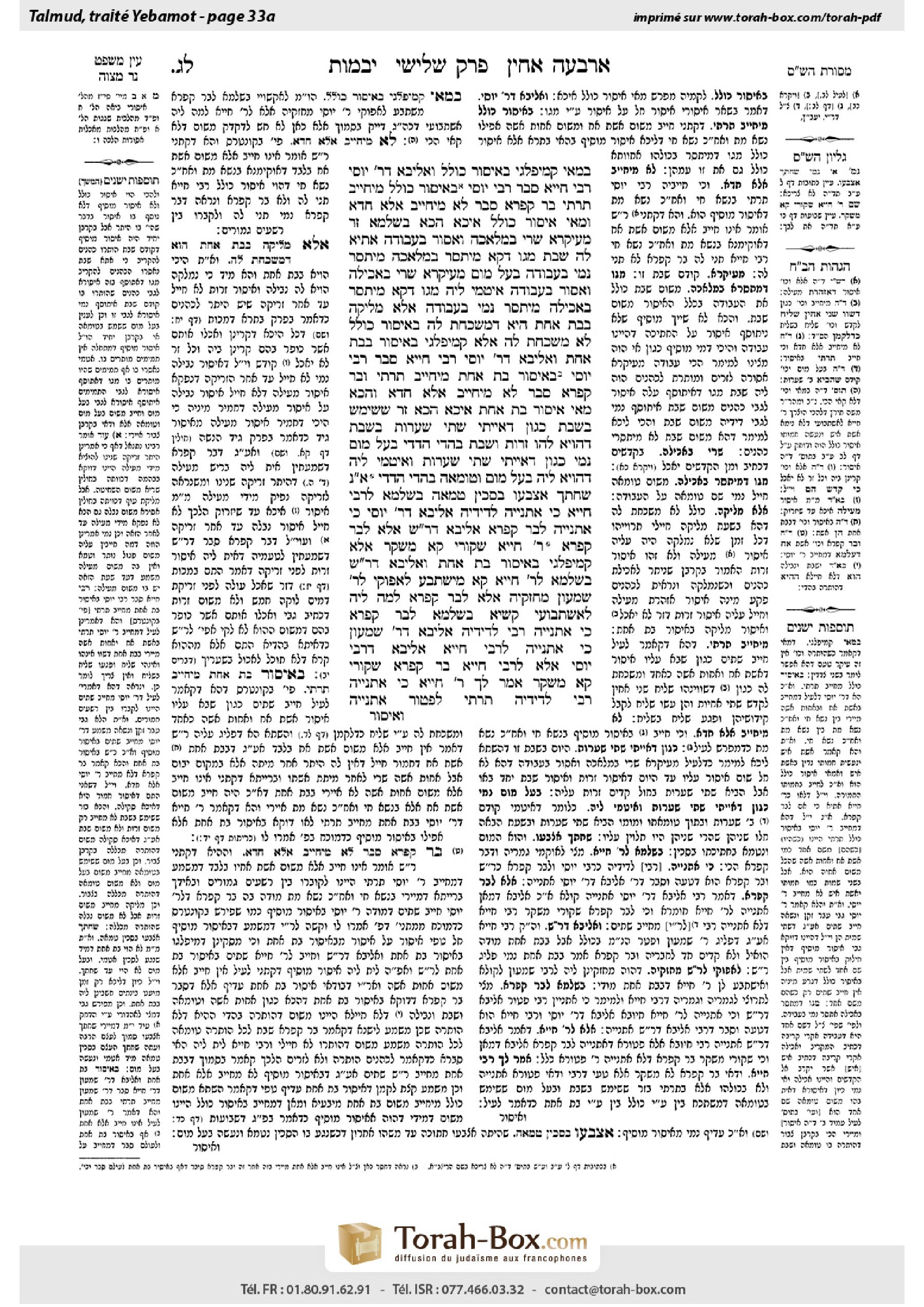
This page of Yevamot includes the Aramaic text, an English translation and an AI-generated French translation, alongside the scan above.
יבמות ל״ג א · Aramaic and Hebrew text
בְּמַאי קָמִיפַּלְגִי — בְּאִיסּוּר כּוֹלֵל, וְאַלִּיבָּא דְּרַבִּי יוֹסֵי. רַבִּי חִיָּיא סָבַר: רַבִּי יוֹסֵי בְּאִיסּוּר כּוֹלֵל מִיחַיַּיב תַּרְתֵּי, בַּר קַפָּרָא סָבַר: לָא מִיחַיַּיב אֶלָּא חֲדָא.
וּמַאי אִיסּוּר כּוֹלֵל אִיכָּא הָכָא? בִּשְׁלָמָא זָר: מֵעִיקָּרָא שְׁרֵי בִּמְלָאכָה וְאָסוּר בַּעֲבוֹדָה. אָתְיָא לַהּ שַׁבָּת, מִגּוֹ דְּקָא מִיתְּסַר בִּמְלָאכָה — מִיתְּסַר נָמֵי בַּעֲבוֹדָה.
בַּעַל מוּם: מֵעִיקָּרָא שְׁרֵי בַּאֲכִילָה, וְאָסוּר בַּעֲבוֹדָה. אִיטַּמִּי לֵיהּ, מִגּוֹ דְּקָא מִיתְּסַר בַּאֲכִילָה — מִיתְּסַר נָמֵי בַּעֲבוֹדָה. אֶלָּא מְלִיקָה — בְּבַת אַחַת הִיא דְּמַשְׁכַּחַתְּ לַהּ, בְּאִיסּוּר כּוֹלֵל לָא מַשְׁכַּחַתְּ לַהּ.
אֶלָּא, קָמִיפַּלְגִי בְּאִיסּוּר בְּבַת אַחַת, וְאַלִּיבָּא דְּרַבִּי יוֹסֵי. רַבִּי חִיָּיא סָבַר: רַבִּי יוֹסֵי בְּאִיסּוּר בַּת אַחַת מִיחַיַּיב תַּרְתֵּי, וּבַר קַפָּרָא סָבַר: לָא מִיחַיַּיב אֶלָּא חֲדָא.
וְהָכָא, מַאי אִיסּוּר בַּת אַחַת אִיכָּא הָכָא? זָר שֶׁשִּׁימֵּשׁ בְּשַׁבָּת — כְּגוֹן דְּאַיְיתִי שְׁתֵּי שְׂעָרוֹת בְּשַׁבָּת, דְּהָוְיָא לְהוּ זָרוּת וְשַׁבָּת בַּהֲדֵי הֲדָדֵי.
בַּעַל מוּם נָמֵי — כְּגוֹן דְּאַיְיתִי שְׁתֵּי שְׂעָרוֹת וְאִיטַּמִּי לֵיהּ, דְּהָוְיָא לֵיהּ בַּעַל מוּם וְטוּמְאָה בַּהֲדֵי הֲדָדֵי. אִי נָמֵי, שֶׁחָתַךְ אֶצְבָּעוֹ בְּסַכִּין טְמֵאָה.
בִּשְׁלָמָא לְרַבִּי חִיָּיא, כִּי אַתְנְיֵיהּ לְדִידֵיהּ — אַלִּיבָּא דְּרַבִּי יוֹסֵי, כִּי אַתְנְיֵיהּ לְבַר קַפָּרָא — אַלִּיבָּא דְּרַבִּי שִׁמְעוֹן. אֶלָּא לְבַר קַפָּרָא, רַבִּי חִיָּיא שַׁקּוֹרֵי קָא מְשַׁקֵּר?
אֶלָּא: קָמִיפַּלְגִי בְּאִיסּוּר בַּת אַחַת, וְאַלִּיבָּא דְּרַבִּי שִׁמְעוֹן: בִּשְׁלָמָא לְרַבִּי חִיָּיא, קָא מִישְׁתְּבַע לְאַפּוֹקֵי לְרַבִּי שִׁמְעוֹן מֵחֶזְקֵיהּ. אֶלָּא לְבַר קַפָּרָא — לְמָה לֵיהּ לְאִשְׁתְּבוֹעֵי? קַשְׁיָא.
בִּשְׁלָמָא לְבַר קַפָּרָא, כִּי אַתְנְיֵיהּ רַבִּי לְדִידֵיהּ — אַלִּיבָּא דְּרַבִּי שִׁמְעוֹן, כִּי אַתְנְיֵיהּ לְרַבִּי חִיָּיא — אַלִּיבָּא דְּרַבִּי יוֹסֵי. אֶלָּא לְרַבִּי חִיָּיא בַּר קַפָּרָא, שַׁקּוֹרֵי קָא מְשַׁקֵּר?
אָמַר לָךְ רַבִּי חִיָּיא: כִּי אַתְנְיֵיהּ רַבִּי לְדִידֵיהּ, תַּרְתֵּי לִפְטוּר אַתְנְיֵיהּ,
Yevamot 33a · English translation
The Gemara asks: With regard to what principle do they disagree? The Gemara suggests that they disagree with regard to the issue of a more inclusive prohibition, and this dispute pertains to the status of a more inclusive prohibition specifically according to the opinion of Rabbi Yosei. Rabbi Ḥiyya holds that Rabbi Yosei is of the opinion that in the case of a more inclusive prohibition, one is liable on two counts. Bar Kappara holds that Rabbi Yosei is of the opinion that one is liable only on one count.
The Gemara asks: And what more inclusive prohibition is there here in these cases? Granted, in the case of a non-priest who served in the Temple on Shabbat, initially he was permitted to perform labor every day and was prohibited from engaging in the Temple service. When Shabbat came, since he is now prohibited from engaging in prohibited labor in all contexts due to Shabbat, he is also prohibited from engaging in labors related to the Temple service due to Shabbat. Indeed, the additional prohibition of Shabbat was added to the previously existing prohibition against performing service in the Temple. This is a more inclusive prohibition since it also includes prohibited labor outside of the Temple.
The same is true with regard to a blemished priest who served in the Temple while ritually impure: Initially, prior to his becoming ritually impure, he was allowed to eat from the consecrated animals but was prohibited from performing the Temple service, like all blemished priests. When he was rendered ritually impure, since he is now prohibited from eating of the consecrated items, he is also prohibited from performing the Temple service due to that same ritual impurity. There is, then, a more inclusive prohibition here. However, with regard to the case of a bird that was killed by pinching, you find that the prohibition against the eating of consecrated items by a non-priest and the prohibition against eating an unslaughtered animal carcass take effect simultaneously. You do not, however, find a more inclusive prohibition here as there was no original prohibition that took effect beforehand. Instead, this is a case of two prohibitions that take effect simultaneously.
Rather, the previous explanation is rejected and the Gemara suggests instead that they disagree with regard to an additional prohibition that takes effect simultaneously, and this dispute pertains to the status of these prohibitions specifically according to the opinion of Rabbi Yosei. Rabbi Ḥiyya holds that Rabbi Yosei is of the opinion that one is liable on two counts in cases of prohibitions that take effect simultaneously. And bar Kappara holds that Rabbi Yosei is of the opinion that one is liable only on a single count.
The Gemara challenges this explanation: But here, in the first two instances, what case of simultaneous prohibitions is there here? In the two previous cases the prohibitions took effect one after the other, and not simultaneously. The Gemara answers that these cases can also be interpreted as occurring simultaneously as follows: With regard to the non-priest who served on Shabbat, this would be in a case where a minor grew two pubic hairs, signaling adulthood on Shabbat. Before that point he was considered a minor and therefore not liable for his actions. Therefore, this is a case where the prohibition against serving as a non-priest and the prohibition against violating Shabbat took effect together.
With regard to the case of one who was blemished, this can be explained as well: This is referring to a case where a minor grew two pubic hairs and was immediately rendered ritually impure. This is a case where the prohibition with regard to a blemished priest and the prohibition with regard to ritual impurity took effect together. Alternatively, it could be a case where he cut off his finger with a ritually impure knife. Here, the cut and removal of his finger rendered him simultaneously blemished and ritually impure.
Following this clarification of the dispute, the matter is now considered from a different angle: Granted, according to the opinion of Rabbi Ḥiyya, the dispute between his version of Rabbi Yehuda HaNasi’s ruling and that of bar Kappara can be explained as follows: When Rabbi Yehuda HaNasi taught Rabbi Ḥiyya, he taught him according to the opinion of Rabbi Yosei, and Rabbi Yosei holds that there are cases where two prohibitions can both take effect. And when Rabbi Yehuda HaNasi taught bar Kappara, he did so according to the opinion of Rabbi Shimon who holds that a new prohibition can never take effect where another prohibition already exists. Therefore, Rabbi Ḥiyya could understand why bar Kappara insisted on his opinion. Rabbi Ḥiyya thought that bar Kappara was in fact relating an accurate statement of Rabbi Yehuda HaNasi, as Rabbi Yehuda HaNasi was relating to the opinion of Rabbi Shimon. Rabbi Ḥiyya assumed that bar Kappara did not understand that Rabbi Yehuda HaNasi’s statement was not in accordance with Rabbi Yosei’s opinion. According to bar Kappara, however, was Rabbi Ḥiyya then telling a falsehood? How would bar Kappara relate to Rabbi Ḥiyya’s oath? Did he think that Rabbi Ḥiyya would swear that he heard words from Rabbi Yehuda HaNasi that were never said?
Rather, this must be explained differently: Rabbi Ḥiyya and bar Kappara disagree with regard to cases where two prohibitions take effect simultaneously, and this dispute pertains to the status of these prohibition specifically according to the opinion of Rabbi Shimon. It could be suggested that when the two prohibitions take effect simultaneously, Rabbi Shimon would concede that they both take effect. However, this explanation raises a difficulty as well: Granted, according to Rabbi Ḥiyya it is clear why he was swearing. He did so in order to exclude the understanding of Rabbi Shimon’s opinion that was based on his presumed opinion. As it was known that Rabbi Shimon holds that a new prohibition cannot take effect where another prohibition exists; this is the default understanding of his opinion. Therefore, it was incumbent upon Rabbi Ḥiyya to take an oath in order to emphasize that despite Rabbi Shimon’s general opinion, in cases where the prohibitions take effect simultaneously, he would concede that both prohibitions can take effect. However, according to bar Kappara, why was it necessary to swear? It would have sufficed for him simply to make his statement, as it concurs with the default understanding of Rabbi Shimon’s opinion. The Gemara comments: Indeed, this is difficult.
One can raise a difficulty with this explanation from a different angle as well: Granted, according to bar Kappara, when Rabbi Yehuda HaNasi taught him, he taught him according to the opinion of Rabbi Shimon, who holds that two prohibitions cannot take effect even in cases when they occur simultaneously, and when he taught the ruling to Rabbi Ḥiyya it was according to the opinion of Rabbi Yosei. Accordingly, Rabbi Ḥiyya did in fact swear that he heard that one is liable only on one count, but he wrongly understood that this was Rabbi Shimon’s opinion. However, according to Rabbi Ḥiyya, who holds that Rabbi Shimon concedes that in cases where the prohibitions take effect simultaneously one is liable for both, was bar Kappara lying? His statement would accord neither with Rabbi Shimon nor with Rabbi Yosei.
The Gemara answers: Rabbi Ḥiyya could have said to you that this is what transpired: When Rabbi Yehuda HaNasi taught him, bar Kappara, he taught him two cases involving exemptions, i.e., the cases of a non-priest who served in the Temple on Shabbat and that of the blemished priest who served while ritually impure. Both of these are cases of more inclusive prohibitions, and he was informing bar Kappara that Rabbi Shimon holds them liable on only one count, because Rabbi Shimon holds that a prohibition takes effect where another prohibition already exists only if the prohibitions take effect simultaneously, but not in cases of more inclusive prohibitions.
Yevamot 33a · Traduction française (IA)
La Guemara demande : Sur quel principe porte leur désaccord ? Elle suggère qu’ils sont en désaccord au sujet d’une interdiction plus englobante, et que cette controverse concerne le statut d’une telle interdiction précisément selon l’opinion de Rabbi Yossé. Rabbi Ḥiyya considère que, selon Rabbi Yossé, dans le cas d’une interdiction plus englobante, on est passible de deux sanctions. Bar Kappara considère que, selon Rabbi Yossé, on n’est passible que d’une seule sanction.
La Guemara demande : Et quelle interdiction plus englobante trouve-t-on ici dans ces cas ? Certes, dans le cas d’un non-prêtre qui a accompli le service au Temple pendant Chabbat, avant cela, il était autorisé à effectuer des travaux chaque jour, mais interdit d’accomplir le service au Temple. Lorsque Chabbat est arrivé, puisqu’il lui est désormais interdit d’effectuer des travaux interdits en toute circonstance en raison de Chabbat, il lui est également interdit d’effectuer des travaux liés au service du Temple en raison de Chabbat. Ainsi, l’interdiction supplémentaire de Chabbat s’est ajoutée à l’interdiction préexistante d’accomplir le service au Temple. Il s’agit d’une interdiction plus englobante, car elle inclut également les travaux interdits en dehors du Temple.
Il en va de même pour un prêtre atteint d’un défaut physique qui a accompli le service au Temple alors qu’il était impur rituellement : avant de devenir impur rituellement, il était autorisé à manger des animaux consacrés, mais interdit d’accomplir le service au Temple, comme tous les prêtres atteints d’un défaut physique. Lorsqu’il est devenu impur rituellement, puisqu’il lui est désormais interdit de manger des aliments consacrés, il lui est également interdit d’accomplir le service au Temple en raison de cette même impureté rituelle. Il y a donc ici une interdiction plus englobante. En revanche, dans le cas d’un oiseau dont le cou a été tranché par pincement, l’interdiction faite à un non-prêtre de manger des aliments consacrés et celle de manger la carcasse d’un animal qui n’a pas été abattu rituellement prennent effet simultanément. Mais on ne trouve pas ici d’interdiction plus englobante, puisqu’aucune interdiction initiale n’avait pris effet auparavant. Il s’agit plutôt de deux interdictions qui prennent effet simultanément.
La Guemara rejette donc l’explication précédente et suggère plutôt qu’ils sont en désaccord au sujet d’une interdiction supplémentaire qui prend effet simultanément, et que cette controverse concerne le statut de ces interdictions précisément selon l’opinion de Rabbi Yossé. Rabbi Ḥiyya considère que, selon Rabbi Yossé, on est passible de deux sanctions lorsque des interdictions prennent effet simultanément. Bar Kappara considère, quant à lui, que, selon Rabbi Yossé, on n’est passible que d’une seule sanction.
La Guemara conteste cette explication : Mais ici, dans les deux premiers cas, où trouve-t-on une situation d’interdictions simultanées ? Dans ces deux cas, les interdictions ont pris effet l’une après l’autre et non simultanément. La Guemara répond que ces cas peuvent eux aussi être interprétés comme s’étant produits simultanément, de la manière suivante : dans le cas du non-prêtre qui a accompli le service pendant Chabbat, il s’agirait d’un mineur chez qui deux poils pubiens ont poussé pendant Chabbat, signe qu’il est devenu majeur. Avant cela, il était considéré comme mineur et n’était donc pas responsable de ses actes. Il s’agit ainsi d’un cas où l’interdiction d’accomplir le service en tant que non-prêtre et l’interdiction de transgresser Chabbat ont pris effet simultanément.
Le cas de celui qui était atteint d’un défaut physique peut également s’expliquer ainsi : il s’agit d’un mineur chez qui deux poils pubiens ont poussé et qui est devenu impur rituellement aussitôt après. L’interdiction applicable à un prêtre atteint d’un défaut physique et celle liée à l’impureté rituelle ont alors pris effet simultanément. Autre possibilité : il aurait pu se couper le doigt avec un couteau impur rituellement. La coupure et l’amputation de son doigt l’auraient alors rendu simultanément atteint d’un défaut physique et impur rituellement.
À la suite de cette clarification du désaccord, la question est maintenant examinée sous un autre angle : certes, selon l’opinion de Rabbi Ḥiyya, le désaccord entre sa version de la décision de Rabbi Yehouda HaNassi et celle de Bar Kappara peut s’expliquer ainsi : lorsque Rabbi Yehouda HaNassi enseigna à Rabbi Ḥiyya, il le fit selon l’opinion de Rabbi Yossé, qui considère qu’il existe des cas où deux interdictions peuvent toutes deux prendre effet. Et lorsque Rabbi Yehouda HaNassi enseigna à Bar Kappara, il le fit selon l’opinion de Rabbi Chimon, qui considère qu’une nouvelle interdiction ne peut jamais prendre effet lorsqu’une autre interdiction existe déjà. Rabbi Ḥiyya pouvait donc comprendre pourquoi Bar Kappara maintenait son opinion. Rabbi Ḥiyya pensait que Bar Kappara rapportait en réalité fidèlement une déclaration de Rabbi Yehouda HaNassi, puisque celui-ci exposait l’opinion de Rabbi Chimon. Rabbi Ḥiyya supposait que Bar Kappara n’avait pas compris que la déclaration de Rabbi Yehouda HaNassi ne correspondait pas à l’opinion de Rabbi Yossé. Mais, selon Bar Kappara, Rabbi Ḥiyya aurait-il alors menti ? Comment Bar Kappara interprétait-il le serment de Rabbi Ḥiyya ? Pensait-il que Rabbi Ḥiyya jurerait avoir entendu de Rabbi Yehouda HaNassi des paroles qui n’avaient jamais été prononcées ?
Il faut plutôt l’expliquer autrement : Rabbi Ḥiyya et Bar Kappara sont en désaccord au sujet des cas où deux interdictions prennent effet simultanément, et leur controverse concerne le statut de ces interdictions précisément selon l’opinion de Rabbi Chimon. On pourrait suggérer que, lorsque les deux interdictions prennent effet simultanément, Rabbi Chimon admet qu’elles prennent toutes deux effet. Mais cette explication soulève également une difficulté : certes, selon Rabbi Ḥiyya, on comprend clairement pourquoi il a prêté serment. Il l’a fait pour écarter l’interprétation de l’opinion de Rabbi Chimon fondée sur l’opinion qu’on lui attribuait. En effet, on savait que Rabbi Chimon considère qu’une nouvelle interdiction ne peut prendre effet lorsqu’une autre interdiction existe déjà ; telle est l’interprétation par défaut de son opinion. Rabbi Ḥiyya devait donc prêter serment afin de souligner que, malgré l’opinion générale de Rabbi Chimon, dans les cas où les interdictions prennent effet simultanément, il admettrait qu’elles peuvent toutes deux prendre effet. Mais, selon Bar Kappara, pourquoi était-il nécessaire de prêter serment ? Il lui aurait suffi de faire sa déclaration, puisqu’elle concorde avec l’interprétation par défaut de l’opinion de Rabbi Chimon. La Guemara commente : En effet, c’est une difficulté.
On peut également soulever une difficulté contre cette explication sous un autre angle : certes, selon Bar Kappara, lorsque Rabbi Yehouda HaNassi lui enseigna, il le fit selon l’opinion de Rabbi Chimon, qui considère que deux interdictions ne peuvent pas prendre effet, même lorsqu’elles surviennent simultanément ; et lorsqu’il enseigna la décision à Rabbi Ḥiyya, il le fit selon l’opinion de Rabbi Yossé. Ainsi, Rabbi Ḥiyya a effectivement juré qu’il avait entendu qu’on n’est passible que d’une seule sanction, mais il a compris à tort qu’il s’agissait de l’opinion de Rabbi Chimon. Mais, selon Rabbi Ḥiyya, qui considère que Rabbi Chimon admet que, lorsque les interdictions prennent effet simultanément, on est passible des deux, Bar Kappara mentait-il ? Sa déclaration ne correspondrait ni à l’opinion de Rabbi Chimon ni à celle de Rabbi Yossé.
La Guemara répond : Rabbi Ḥiyya aurait pu vous dire que voici ce qui s’est passé : lorsque Rabbi Yehouda HaNassi enseigna à Bar Kappara, il lui enseigna deux cas d’exemption, à savoir celui du non-prêtre qui a accompli le service au Temple pendant Chabbat et celui du prêtre atteint d’un défaut physique qui a accompli le service alors qu’il était impur rituellement. Ces deux cas relèvent d’interdictions plus englobantes, et Rabbi Yehouda HaNassi informait Bar Kappara que, selon Rabbi Chimon, on n’est passible que d’une seule sanction dans ces cas, car Rabbi Chimon considère qu’une interdiction ne prend effet alors qu’une autre existe déjà que si les interdictions prennent effet simultanément, mais pas dans les cas d’interdictions plus englobantes.
Traduction française générée par IA à partir de l’édition anglaise de Sefaria. Vérifie toujours un passage avec le texte source.
Text from Sefaria: William Davidson Edition - Vocalized Aramaic (CC BY NC); William Davidson Edition - English (CC BY NC).