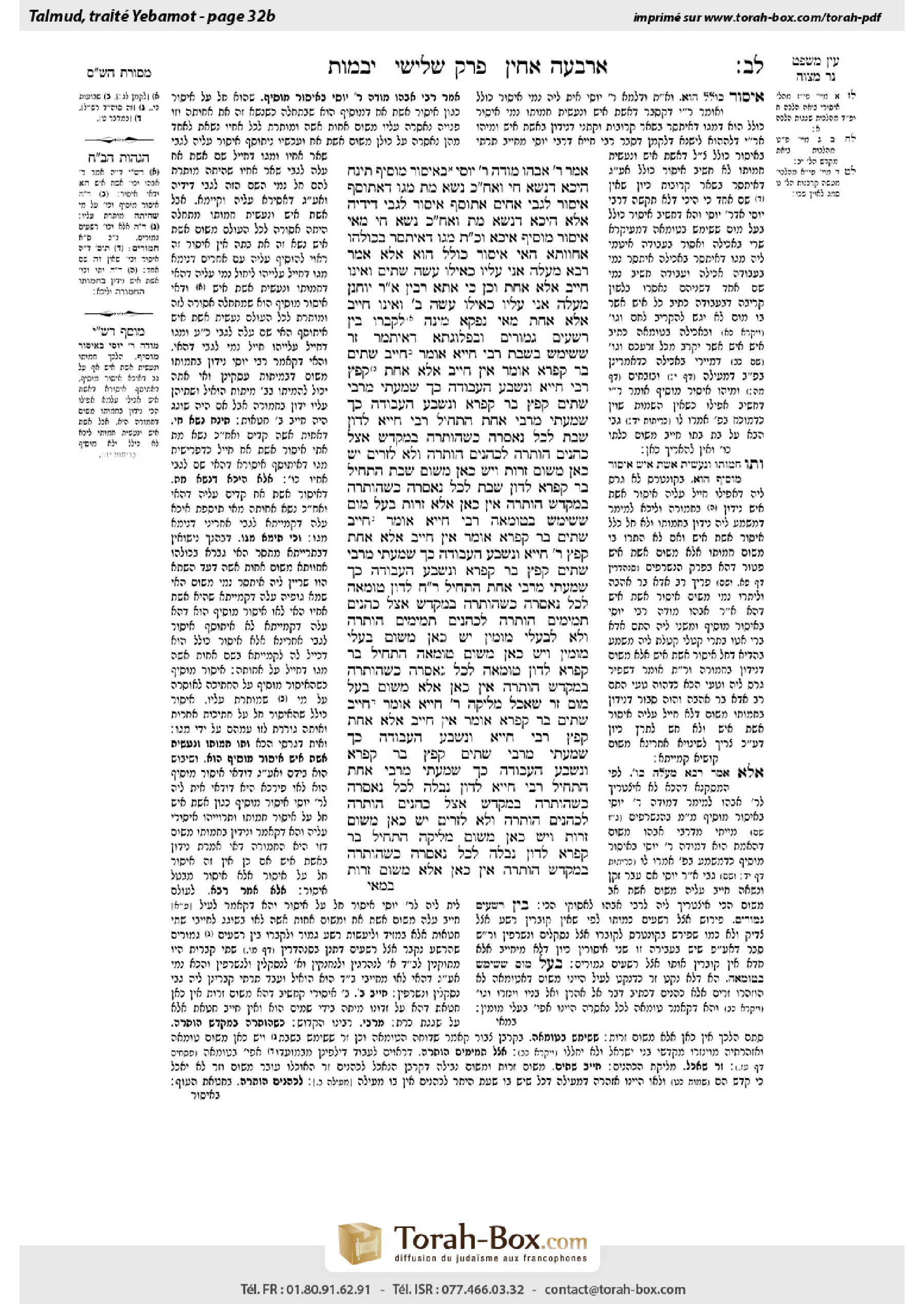
Yevamot 32b: Talmud study for Daf Yomi
Daf Yomi is the daily study of one Talmud folio. Explore 37 tractates with scans, Hebrew text, Sefaria English and AI-generated French translations where annotated.
Passage selection and English or AI-generated French translation are available where the scan has annotations. Daf Study is independent of Torah-Box and Sefaria.
Browse Yevamot · יבמות · All tractatesYevamot 32b text and translations
This page of Yevamot includes the Aramaic text, an English translation and an AI-generated French translation, alongside the scan above.
יבמות ל״ב ב · Aramaic and Hebrew text
אָמַר רַבִּי אֲבָהוּ: מוֹדֶה רַבִּי יוֹסֵי בְּאִיסּוּר מוֹסִיף.
תִּינַח הֵיכָא דְּנָשָׂא חַי וְאַחַר כָּךְ נָשָׂא מֵת — מִגּוֹ דְּאִתּוֹסַף אִיסּוּר לְגַבֵּי אַחִים, אִתּוֹסַף אִיסּוּר לְגַבֵּי דִידֵיהּ.
אֶלָּא הֵיכָא דְּנָשָׂא מֵת וְאַחַר כָּךְ נָשָׂא חַי, מַאי אִיסּוּר מוֹסִיף אִיכָּא?
וְכִי תֵּימָא מִגּוֹ דְּאִיתְּסַר בְּכוּלְּהוּ אַחְווֹתָא — הַאי אִיסּוּר כּוֹלֵל הוּא.
אֶלָּא אָמַר רָבָא: מַעֲלֶה אֲנִי עָלָיו כְּאִילּוּ עָשָׂה שְׁתַּיִם, וְאֵינוֹ חַיָּיב אֶלָּא אַחַת. וְכֵן כִּי אֲתָא רָבִין, אָמַר רַבִּי יוֹחָנָן: מַעֲלֶה אֲנִי עָלָיו כְּאִילּוּ עָשָׂה שְׁתַּיִם, וְאֵינוֹ חַיָּיב אֶלָּא אַחַת. מַאי נָפְקָא מִינַּהּ? לְקׇבְרוֹ בֵּין רְשָׁעִים גְּמוּרִים.
וּבִפְלוּגְתָּא. דְּאִיתְּמַר: זָר שֶׁשִּׁימֵּשׁ בְּשַׁבָּת, רַבִּי חִיָּיא אוֹמֵר: חַיָּיב שְׁתַּיִם. בַּר קַפָּרָא אוֹמֵר: אֵין חַיָּיב אֶלָּא אַחַת. קָפַץ רַבִּי חִיָּיא וְנִשְׁבַּע: הָעֲבוֹדָה! כָּךְ שָׁמַעְתִּי מֵרַבִּי: שְׁתַּיִם. קָפַץ בַּר קַפָּרָא וְנִשְׁבַּע: הָעֲבוֹדָה! כָּךְ שָׁמַעְתִּי מֵרַבִּי: אַחַת.
הִתְחִיל רַבִּי חִיָּיא לָדוּן: שַׁבָּת לַכֹּל נֶאֶסְרָה, כְּשֶׁהוּתְּרָה בַּמִּקְדָּשׁ — אֵצֶל כֹּהֲנִים הוּתְּרָה. לְכֹהֲנִים הוּתְּרָה, וְלֹא לְזָרִים. יֵשׁ כָּאן מִשּׁוּם זָרוּת, וְיֵשׁ כָּאן מִשּׁוּם שַׁבָּת. הִתְחִיל בַּר קַפָּרָא לָדוּן: שַׁבָּת לַכֹּל נֶאֶסְרָה, כְּשֶׁהוּתְּרָה בַּמִּקְדָּשׁ — הוּתְּרָה. אֵין כָּאן אֶלָּא זָרוּת.
בַּעַל מוּם שֶׁשִּׁימֵּשׁ בְּטוּמְאָה. רַבִּי חִיָּיא אוֹמֵר: חַיָּיב שְׁתַּיִם. בַּר קַפָּרָא אוֹמֵר: אֵין חַיָּיב אֶלָּא אַחַת. קָפַץ רַבִּי חִיָּיא וְנִשְׁבַּע: הָעֲבוֹדָה! כָּךְ שָׁמַעְתִּי מֵרַבִּי: שְׁתַּיִם. קָפַץ בַּר קַפָּרָא וְנִשְׁבַּע: הָעֲבוֹדָה! כָּךְ שָׁמַעְתִּי מֵרַבִּי: אַחַת.
הִתְחִיל רַבִּי חִיָּיא לָדוּן: טוּמְאָה לַכֹּל נֶאֶסְרָה, כְּשֶׁהוּתְּרָה בַּמִּקְדָּשׁ — אֵצֶל כֹּהֲנִים תְּמִימִים הוּתְּרָה. לְכֹהֲנִים תְּמִימִים הוּתְּרָה, וְלֹא לְבַעֲלֵי מוּמִין. יֵשׁ כָּאן מִשּׁוּם בַּעֲלֵי מוּמִין, וְיֵשׁ כָּאן מִשּׁוּם טוּמְאָה. הִתְחִיל בַּר קַפָּרָא לָדוּן: טוּמְאָה לַכֹּל נֶאֶסְרָה, כְּשֶׁהוּתְּרָה בַּמִּקְדָּשׁ — הוּתְּרָה, אֵין כָּאן אֶלָּא מִשּׁוּם בַּעַל מוּם.
זָר שֶׁאָכַל מְלִיקָה, רַבִּי חִיָּיא אוֹמֵר: חַיָּיב שְׁתַּיִם. בַּר קַפָּרָא אוֹמֵר: אֵין חַיָּיב אֶלָּא אַחַת. קָפַץ רַבִּי חִיָּיא וְנִשְׁבַּע: הָעֲבוֹדָה! כָּךְ שָׁמַעְתִּי מֵרַבִּי: שְׁתַּיִם. קָפַץ בַּר קַפָּרָא וְנִשְׁבַּע: הָעֲבוֹדָה! כָּךְ שָׁמַעְתִּי מֵרַבִּי: אַחַת.
הִתְחִיל רַבִּי חִיָּיא לָדוּן: נְבֵלָה לַכֹּל נֶאֶסְרָה. כְּשֶׁהוּתְּרָה בַּמִּקְדָּשׁ — אֵצֶל כֹּהֲנִים הוּתְּרָה. לְכֹהֲנִים הוּתְּרָה, וְלֹא לְזָרִים. יֵשׁ כָּאן מִשּׁוּם זָרוּת, וְיֵשׁ כָּאן מִשּׁוּם מְלִיקָה. הִתְחִיל בַּר קַפָּרָא לָדוּן: נְבֵלָה לַכֹּל נֶאֶסְרָה, כְּשֶׁהוּתְּרָה בַּמִּקְדָּשׁ — הוּתְּרָה, אֵין כָּאן אֶלָּא מִשּׁוּם זָרוּת.
Yevamot 32b · English translation
Rabbi Abbahu said: Rabbi Yosei concedes that a prohibition takes effect where another prohibition already exists when it is an expanded prohibition. An expanded prohibition is a prohibition that has a greater scope than the original prohibition, either because it applies with greater severity or because it applies to additional individuals. Rabbi Yosei holds that if the second prohibition incorporates additional individuals into the list of those for whom the original item is prohibited, then it takes effect in addition to the previous prohibition that had a more limited range.
The Gemara asks: This works out well in cases where the living brother married his wife first, and her sister became forbidden to him as a wife’s sister, and then afterward the brother who was subsequently deceased married his wife’s sister. In that case it is possible to say: Since a prohibition was added for all the brothers, a prohibition was added for the living brother as well, and he is liable due to both prohibitions, as this prohibition is more wide-ranging than the previous one. In other words, at first this sister was permitted to the other brothers, and when the second brother married her she was rendered a brother’s wife and so she was additionally forbidden to the other brothers.
However, where the deceased brother married first and afterward the living brother married her sister, in what way is there a prohibition that adds? No additional individuals were incorporated into the prohibition as a result of the marriage of the living brother with the sister, since the prohibition here proscribing a wife’s sister applies to him alone.
And if you would say: Since he himself now married a sister he became prohibited to all of the other sisters, as opposed to the prior state of affairs where only his brother was married to one of the sisters and all of the other sisters were permitted to him, and therefore an additional prohibition now applies to him, this is difficult. In this case the new prohibition is not considered an expanded prohibition, but rather it is considered a more inclusive prohibition. It is more inclusive and more comprehensive in that it adds additional aspects to the prohibition for the same individual. This is not called an expanded prohibition, as it does not add prohibitions to additional individuals.
Rather, Rava said that when Rabbi Yosei stated in the baraita that the man is liable due to both prohibitions, for a brother’s wife and for a wife’s sister, he meant to say: I ascribe to him liability as though he transgressed twice, since indeed he violated two prohibitions, yet he is liable to receive punishment in human courts on only one count. And likewise, when Ravin came from Eretz Yisrael to Babylonia, he said that Rabbi Yoḥanan said: I ascribe to him liability as though he transgressed twice, yet he is liable to receive punishment on only one count. The Gemara asks: What difference does it make if we consider it as though he transgressed twice? The Gemara answers: It affects the decision whether or not to bury him among the completely wicked. Just as a righteous individual is not buried among the wicked, so too, a wicked individual is not buried among those more wicked than himself. He who violated this prohibition is considered as though he committed two transgressions and not one, and so he would be buried accordingly.
§ The Gemara comments that the issue of a prohibition taking effect where another prohibition already exists is taught in the dispute found in a baraita, where it was stated: With regard to a non-priest who served in some capacity in one of the Temple services, such as the burning of a burnt-offering on the altar on Shabbat, Rabbi Ḥiyya says: He is liable to receive punishment on two counts, both because he was a non-priest serving in the Temple and because he desecrated Shabbat. Bar Kappara says: He is liable on only one count. Rabbi Ḥiyya jumped up and swore: I swear by the Temple service that this I heard from Rabbi Yehuda HaNasi: He is liable on two counts. Bar Kappara jumped up and swore: I swear by the Temple service that this I heard from Rabbi Yehuda HaNasi: He is liable on one count.
Since the matter could not be decided by tradition, Rabbi Ḥiyya began to deliberate and analyze the question logically. Prohibited labor on Shabbat was prohibited to all. When prohibited labor was permitted in the Temple for the purposes of the Temple service, it was permitted only for priests. This indicates that it was permitted for priests and not for non-priests. Therefore, when a non-priest serves in the Temple on Shabbat, there is a transgression here due to his serving as a non-priest and there is a transgression here due to his desecrating Shabbat. Bar Kappara began to deliberate in a different manner: Shabbat was prohibited to all. When it was permitted it was permitted in the Temple, so that if it was permitted for one to serve in the Temple, it was permitted for him to serve on Shabbat. Therefore, there is a transgression here only for his serving as a non-priest, since if this man were a priest his service would have been permitted. Therefore, he is not liable to receive punishment for desecrating Shabbat.
They disagreed over a similar issue as well, the case of a priest with a blemish who served in the Temple by sacrificing a public offering, which overrides ritual impurity, while he was ritually impure. Rabbi Ḥiyya says: He is liable on two counts, both for serving with a blemish and for being ritually impure. Bar Kappara says: He is liable on only one count, for serving with a blemish. Rabbi Ḥiyya jumped up and swore: I swear by the Temple service that this I heard from Rabbi Yehuda HaNasi: He is liable on two counts. Bar Kappara jumped up and swore: I swear by the Temple service that this I heard from Rabbi Yehuda HaNasi: He is liable on one count.
Rabbi Ḥiyya began to deliberate. Ritual impurity was prohibited to all, as it was prohibited for all individuals who are ritually impure to enter into the Temple. When it was permitted in the Temple in circumstances where the entire public was impure, it was permitted for unblemished priests. Therefore, it was permitted only for unblemished priests and not for priests with blemishes. Consequently, if that priest with a blemish served while impure, there is a transgression here due to his status as a blemished priest and there is a transgression here due to ritual impurity. Bar Kappara began to deliberate in a different manner: Ritual impurity was prohibited to all. When it was permitted in the Temple, it was permitted for all. Therefore, the only problem was that this priest was blemished, and so there is a transgression here only due to his status as a blemished priest.
They disagreed over a similar issue as well. This dispute is with regard to a non-priest who ate a bird sin-offering that was killed by pinching the back of its neck. It is permitted for priests to consume such an offering, but it is prohibited to consume any other bird killed in such a manner, since it was not ritually slaughtered. Rabbi Ḥiyya says: He is liable to receive punishment on two counts, both for being a non-priest who ate a priestly offering and for eating something that was not properly slaughtered. Bar Kappara says: He is liable on only one count. Rabbi Ḥiyya jumped up and swore: I swear by the Temple service that this I heard from Rabbi Yehuda HaNasi: He is liable on two counts. Bar Kappara jumped up and swore: I swear by the Temple service that this I heard from Rabbi Yehuda HaNasi: He is liable on one count.
Rabbi Ḥiyya began to deliberate. An unslaughtered animal carcass was prohibited to all. When it was permitted in the Temple, it was permitted to priests alone. Since it was permitted to priests and not to non-priests, there is a transgression here due to his status as a non-priest who ate of the sin-offering and there is a transgression here due to eating an animal killed by pinching. Bar Kappara began to deliberate: An unslaughtered animal carcass was prohibited to all. When it was permitted in the Temple, it was permitted to all. Therefore there is a transgression here only for being a non-priest, since if he were a priest there would be no prohibition at all.
Yevamot 32b · Traduction française (IA)
Rabbi Abbahou dit : Rabbi Yossé admet qu’une interdiction prend effet alors qu’une autre interdiction existe déjà lorsqu’il s’agit d’une interdiction élargie. Une interdiction élargie est une interdiction dont la portée dépasse celle de l’interdiction initiale, soit parce qu’elle s’applique avec une plus grande sévérité, soit parce qu’elle concerne davantage de personnes. Selon Rabbi Yossé, si la seconde interdiction ajoute des personnes à celles auxquelles l’objet concerné est interdit, elle prend effet en plus de l’interdiction précédente, dont la portée était plus limitée.
La Guemara demande : Cela convient dans les cas où le frère vivant a épousé sa femme en premier, et où la sœur de celle-ci lui est alors devenue interdite en tant que sœur de sa femme ; puis, par la suite, le frère qui est mort ensuite a épousé la sœur de sa femme. Dans ce cas, on peut dire : puisqu’une interdiction s’est ajoutée pour tous les frères, une interdiction s’est également ajoutée pour le frère vivant, qui est passible au titre des deux interdictions, car celle-ci a une portée plus large que la précédente. Autrement dit, au départ, cette sœur était permise aux autres frères ; lorsque le second frère l’a épousée, elle est devenue l’épouse d’un frère et a donc été interdite en plus aux autres frères.
Cependant, lorsque le frère décédé a épousé sa femme en premier, puis que le frère vivant a épousé la sœur de celle-ci, en quoi y a-t-il une interdiction qui s’ajoute ? Le mariage du frère vivant avec cette sœur n’a ajouté personne aux personnes visées par l’interdiction, puisque l’interdiction de la sœur de sa femme ne s’applique ici qu’à lui seul.
Et si tu dis : puisqu’il a lui-même épousé une sœur, il est désormais interdit à toutes les autres sœurs, contrairement à la situation antérieure, où seul son frère était marié à l’une des sœurs et où toutes les autres lui étaient permises, de sorte qu’une interdiction supplémentaire s’applique maintenant à lui, cela pose difficulté. Dans ce cas, la nouvelle interdiction n’est pas considérée comme une interdiction élargie, mais comme une interdiction plus inclusive. Elle est plus inclusive et plus générale en ce qu’elle ajoute des aspects à l’interdiction visant la même personne. Cela ne s’appelle pas une interdiction élargie, car elle n’ajoute pas d’interdiction visant d’autres personnes.
Rava dit plutôt que, lorsque Rabbi Yossé a déclaré dans la baraïta que l’homme est passible au titre des deux interdictions, celle de l’épouse de son frère et celle de la sœur de sa femme, il voulait dire : je le considère comme ayant transgressé deux fois, puisqu’il a effectivement enfreint deux interdictions ; toutefois, il n’est passible d’une peine devant les tribunaux humains que pour une seule infraction. De même, lorsque Ravin vint d’Eretz Israël en Babylonie, il rapporta que Rabbi Yoḥanan avait dit : je le considère comme ayant transgressé deux fois, mais il n’est passible d’une peine que pour une seule infraction. La Guemara demande : Quelle différence cela fait-il de le considérer comme ayant transgressé deux fois ? La Guemara répond : Cela influe sur la décision de savoir s’il faut ou non l’enterrer parmi les méchants absolus. De même qu’un juste n’est pas enterré parmi les méchants, un méchant n’est pas enterré parmi ceux qui sont plus méchants que lui. Celui qui a enfreint cette interdiction est considéré comme ayant commis deux transgressions et non une seule, et il sera donc enterré en conséquence.
§ La Guemara fait remarquer que la question de savoir si une interdiction prend effet alors qu’une autre existe déjà est enseignée dans la controverse rapportée par une baraïta. Il y est dit : au sujet d’un non-prêtre qui a accompli une fonction parmi les services du Temple, par exemple en brûlant un holocauste sur l’autel pendant Chabbat, Rabbi Ḥiyya dit : il est passible d’une peine pour deux infractions, à la fois parce qu’il a officié dans le Temple sans être prêtre et parce qu’il a profané Chabbat. Bar Kappara dit : il n’est passible d’une peine que pour une seule infraction. Rabbi Ḥiyya bondit et jura : Par le service du Temple, j’ai entendu ceci de Rabbi Yehouda HaNassi : il est passible d’une peine pour deux infractions. Bar Kappara bondit et jura : Par le service du Temple, j’ai entendu ceci de Rabbi Yehouda HaNassi : il n’est passible d’une peine que pour une seule infraction.
Comme la tradition ne permettait pas de trancher la question, Rabbi Ḥiyya se mit à l’examiner et à l’analyser logiquement. Le travail interdit le Chabbat était interdit à tous. Lorsque le travail interdit fut permis dans le Temple pour les besoins du service du Temple, il ne fut permis qu’aux prêtres. Cela indique qu’il était permis aux prêtres, mais non aux non-prêtres. Par conséquent, lorsqu’un non-prêtre officie dans le Temple le Chabbat, il y a une transgression liée au fait qu’il officie sans être prêtre et une transgression liée à la profanation du Chabbat. Bar Kappara se mit à raisonner autrement : le Chabbat était interdit à tous. Lorsqu’il fut permis, ce fut dans le Temple ; ainsi, si l’on avait la permission d’officier dans le Temple, on avait la permission d’officier le Chabbat. Il n’y a donc ici qu’une transgression, celle d’officier sans être prêtre, car si cet homme avait été prêtre, son service aurait été permis. Il n’est donc pas passible d’une peine pour avoir profané le Chabbat.
Ils étaient également en désaccord sur une question similaire : le cas d’un prêtre atteint d’un défaut qui a officié dans le Temple en offrant un sacrifice public qui repousse l’impureté rituelle, alors qu’il était lui-même impur. Rabbi Ḥiyya dit : il est passible d’une peine pour deux infractions, à la fois pour avoir officié avec un défaut et pour avoir été impur. Bar Kappara dit : il n’est passible d’une peine que pour une seule infraction, pour avoir officié avec un défaut. Rabbi Ḥiyya bondit et jura : Par le service du Temple, j’ai entendu ceci de Rabbi Yehouda HaNassi : il est passible d’une peine pour deux infractions. Bar Kappara bondit et jura : Par le service du Temple, j’ai entendu ceci de Rabbi Yehouda HaNassi : il n’est passible d’une peine que pour une seule infraction.
Rabbi Ḥiyya se mit à raisonner. L’impureté rituelle était interdite à tous, puisque toute personne impure avait interdiction d’entrer dans le Temple. Lorsqu’elle fut permise dans le Temple, dans les circonstances où tout le peuple était impur, elle le fut aux prêtres sans défaut. Elle fut donc permise uniquement aux prêtres sans défaut, et non aux prêtres atteints d’un défaut. Par conséquent, si ce prêtre atteint d’un défaut a officié alors qu’il était impur, il y a une transgression liée à son statut de prêtre atteint d’un défaut et une transgression liée à l’impureté rituelle. Bar Kappara se mit à raisonner autrement : l’impureté rituelle était interdite à tous. Lorsqu’elle fut permise dans le Temple, elle le fut à tous. Le seul problème était donc que ce prêtre était atteint d’un défaut, et il n’y a par conséquent ici qu’une transgression liée à son statut de prêtre atteint d’un défaut.
Ils étaient également en désaccord sur une question similaire. Cette controverse porte sur un non-prêtre qui a mangé un sacrifice expiatoire d’oiseau mis à mort par pincement de la nuque. Les prêtres sont autorisés à consommer une telle offrande, mais il est interdit de consommer tout autre oiseau tué de cette manière, puisqu’il n’a pas été abattu rituellement. Rabbi Ḥiyya dit : il est passible d’une peine pour deux infractions, à la fois parce qu’il est un non-prêtre qui a mangé une offrande réservée aux prêtres et parce qu’il a mangé quelque chose qui n’a pas été abattu comme il convient. Bar Kappara dit : il n’est passible d’une peine que pour une seule infraction. Rabbi Ḥiyya bondit et jura : Par le service du Temple, j’ai entendu ceci de Rabbi Yehouda HaNassi : il est passible d’une peine pour deux infractions. Bar Kappara bondit et jura : Par le service du Temple, j’ai entendu ceci de Rabbi Yehouda HaNassi : il n’est passible d’une peine que pour une seule infraction.
Rabbi Ḥiyya se mit à raisonner. La carcasse d’un animal qui n’a pas été abattu rituellement était interdite à tous. Lorsqu’elle fut permise dans le Temple, elle ne le fut qu’aux prêtres. Puisqu’elle était permise aux prêtres, mais non aux non-prêtres, il y a une transgression liée au fait qu’il est un non-prêtre ayant mangé du sacrifice expiatoire et une transgression liée au fait d’avoir mangé un animal mis à mort par pincement. Bar Kappara se mit à raisonner : la carcasse d’un animal qui n’a pas été abattu rituellement était interdite à tous. Lorsqu’elle fut permise dans le Temple, elle le fut à tous. Il n’y a donc ici qu’une transgression, celle d’être un non-prêtre, car s’il avait été prêtre, il n’y aurait eu aucune interdiction.
Traduction française générée par IA à partir de l’édition anglaise de Sefaria. Vérifie toujours un passage avec le texte source.
Text from Sefaria: William Davidson Edition - Vocalized Aramaic (CC BY NC); William Davidson Edition - English (CC BY NC).