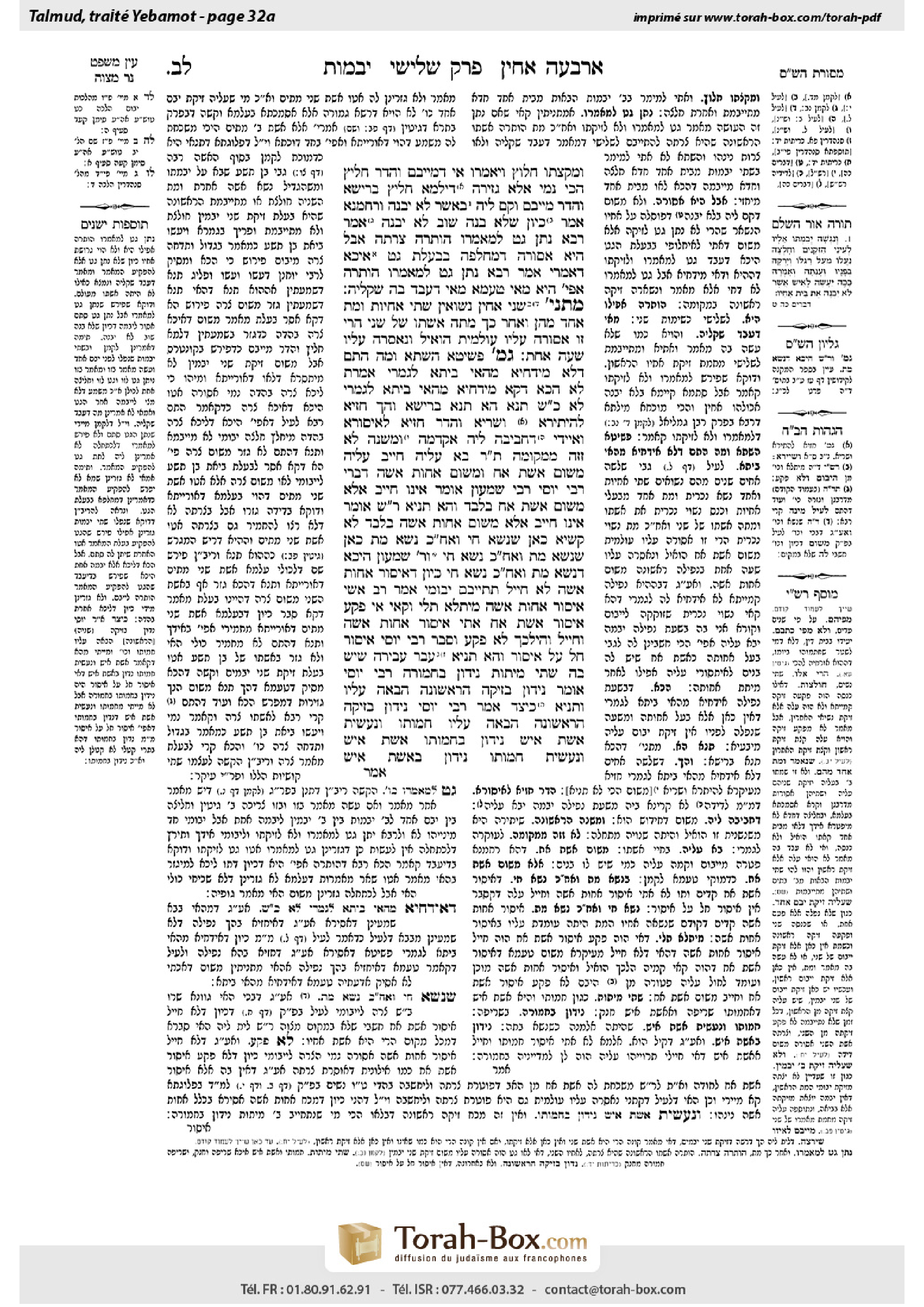
Yevamot 32a: Talmud study for Daf Yomi
Daf Yomi is the daily study of one Talmud folio. Explore 37 tractates with scans, Hebrew text, Sefaria English and AI-generated French translations where annotated.
Passage selection and English or AI-generated French translation are available where the scan has annotations. Daf Study is independent of Torah-Box and Sefaria.
Browse Yevamot · יבמות · All tractatesYevamot 32a text and translations
This page of Yevamot includes the Aramaic text, an English translation and an AI-generated French translation, alongside the scan above.
יבמות ל״ב א · Aramaic and Hebrew text
וּמִקְצָתוֹ חָלוּץ.
וְיֹאמְרוּ! אִי דִּמְיַיבֵּם וַהֲדַר חָלֵיץ — הָכִי נָמֵי.
אֶלָּא גְּזֵירָה דִּילְמָא חָלֵיץ בְּרֵישָׁא וַהֲדַר מְיַיבֵּם, וְקָם לֵיהּ בַּ״אֲשֶׁר לֹא יִבְנֶה״, וְרַחֲמָנָא אָמַר: כֵּיוָן שֶׁלֹּא בָּנָה — שׁוּב לֹא יִבְנֶה.
אָמַר רָבָא: נָתַן גֵּט לְמַאֲמָרוֹ — הוּתְּרָה צָרָתָהּ. אֲבָל הִיא אֲסוּרָה, דְּמִחַלְּפָה בְּבַעֲלַת גֵּט.
אִיכָּא דְּאָמְרִי, אָמַר רָבָא: נָתַן גֵּט לְמַאֲמָרוֹ — הוּתְּרָה אֲפִילּוּ הִיא. מַאי טַעְמָא? מַאי דַּעֲבַד בַּהּ — שַׁקְלֵיהּ.
מַתְנִי׳ שְׁנֵי אַחִין נְשׂוּאִין שְׁתֵּי אֲחָיוֹת, וּמֵת אֶחָד מֵהֶן, וְאַחַר כָּךְ מֵתָה אִשְׁתּוֹ שֶׁל שֵׁנִי — הֲרֵי זוֹ אֲסוּרָה עָלָיו עוֹלָמִית, הוֹאִיל וְנֶאֶסְרָה עָלָיו שָׁעָה אַחַת.
גְּמָ׳ פְּשִׁיטָא! הַשְׁתָּא, וּמָה הָתָם דְּלָא מִידַּחְיָא מֵהַאי בֵּיתָא לִגְמָרֵי — אָמְרַתְּ לָא, הָכָא דְּקָא מִידַּחְיָא מֵהַאי בֵּיתָא לִגְמָרֵי — לָא כׇּל שֶׁכֵּן! תַּנָּא — הָא תְּנָא בְּרֵישָׁא, וְהָךְ חַזְיַאּ לְהֶיתֵּירָא וְשַׁרְיַאּ, וַהֲדַר חַזְיַאּ לְאִיסּוּרָא. וְאַיְּידֵי דְּחַבִּיבָה לֵיהּ אַקְדְּמַהּ, וּמִשְׁנָה לֹא זָזָה מִמְּקוֹמָהּ.
תָּנוּ רַבָּנַן: בָּא עָלֶיהָ — חַיָּיב עָלֶיהָ מִשּׁוּם אֵשֶׁת אָח, וּמִשּׁוּם אֲחוֹת אִשָּׁה, דִּבְרֵי רַבִּי יוֹסֵי. רַבִּי שִׁמְעוֹן אוֹמֵר: אֵינוֹ חַיָּיב אֶלָּא מִשּׁוּם אֵשֶׁת אָח בִּלְבַד. וְהָא תַּנְיָא, רַבִּי שִׁמְעוֹן אוֹמֵר: אֵינוֹ חַיָּיב אֶלָּא מִשּׁוּם אֲחוֹת אִשָּׁה בִּלְבָד!
לָא קַשְׁיָא: כָּאן שֶׁנָּשָׂא חַי, וְאַחַר כָּךְ נָשָׂא מֵת. כָּאן שֶׁנָּשָׂא מֵת, וְאַחַר כָּךְ נָשָׂא חַי.
וְרַבִּי שִׁמְעוֹן, הֵיכָא דְּנָשָׂא מֵת וְאַחַר כָּךְ נָשָׂא חַי, כֵּיוָן דְּאִיסּוּר אֲחוֹת אִשָּׁה לָא חָיֵיל — תִּתְיַיבֵּם יַבּוֹמֵי!
אָמַר רַב אָשֵׁי: אִיסּוּר אֲחוֹת אִשָּׁה מִיתְלָא תְּלֵי וְקָאֵי, אִי פָּקַע אִיסּוּר אֵשֶׁת אָח — אָתֵי אִיסּוּר אֲחוֹת אִשָּׁה וְחָיֵיל, וְהִילְכָּךְ לָא פָּקַע.
וְסָבַר רַבִּי יוֹסֵי אִיסּוּר חָל עַל אִיסּוּר? וְהָא תַּנְיָא: עָבַר עֲבֵירָה שֶׁיֵּשׁ בָּהּ שְׁתֵּי מִיתוֹת — נִידּוֹן בַּחֲמוּרָה. רַבִּי יוֹסֵי אוֹמֵר: נִידּוֹן בַּזִּיקָּה הָרִאשׁוֹנָה הַבָּאָה עָלָיו.
וְתַנְיָא: כֵּיצַד אָמַר רַבִּי יוֹסֵי נִידּוֹן בַּזִּיקָּה הָרִאשׁוֹנָה הַבָּאָה עָלָיו? חֲמוֹתוֹ וְנַעֲשֵׂית אֵשֶׁת אִישׁ — נִידּוֹן בַּחֲמוֹתוֹ. אֵשֶׁת אִישׁ וְנַעֲשֵׂית חֲמוֹתוֹ — נִידּוֹן בְּאֵשֶׁת אִישׁ.
Yevamot 32a · English translation
and part of it must be released by ḥalitza. That is, if two women were married to a single man, one of these women must enter into levirate marriage and the other must perform ḥalitza.
The Gemara wonders: So let them say it. Why would it be problematic if people thought that? Even were they to act upon this mistaken assumption it would cause no harm, as there is no transgression involved in performing ḥalitza. The Gemara answers: If he were to consummate the levirate marriage with one and then later proceed to perform ḥalitza with the other, then indeed there would be no reason for concern.
Rather, the requirement to perform ḥalitza with both women is a rabbinic decree that was instituted lest he first perform ḥalitza with one of his brother’s wives and subsequently consummate the levirate marriage with the other. Under such circumstances, he would in fact be violating a prohibition. Once he performs ḥalitza with the first woman he is subject to the prohibition indicated by the verse “So shall it be done to the man who does not build his brother’s house” (Deuteronomy 25:9). In this verse the Merciful One states that once he did not build his brother’s house but rather opted to perform ḥalitza with one of his brother’s wives, he may not proceed to build it by consummating the levirate marriage with a different wife.
Rava said: If the brother who performed levirate betrothal in the case described in the mishna subsequently gave a bill of divorce to that wife in order to nullify his levirate betrothal before he died, her rival wife is rendered permitted to the third brother. The third brother is allowed to consummate the levirate marriage with the wife of the second brother because this wife is no longer considered to be the rival wife of a woman with a double levirate relationship. The bill of divorce serves to nullify the act of levirate betrothal completely. However, the woman with whom the brother performed levirate betrothal and then received the bill of divorce is forbidden to the third brother. Why is this? She might be confused with a woman who receives a bill of divorce. In general cases where levirate betrothal was not performed, if a man gives a yevama a bill of divorce, he is no longer allowed to consummate the levirate marriage with her. If it were permitted to consummate the levirate marriage in this case, people might mistakenly do so in other cases of divorce as well.
There are those who say an alternative formulation of Rava’s statement. Rava said: If the second brother gave a bill of divorce to the wife of the first deceased brother in order to nullify his levirate betrothal to her, then even she herself is permitted to enter into levirate marriage with the third brother. What is the reason for this? That which he performed with her, he removed. The levirate betrothal was completely nullified by the bill of divorce, and it is as though he had done nothing at all. Therefore, as far as the third brother is concerned, she remains with her original, single levirate bond, as though her status had never been changed by the second brother.
MISHNA: In the case where two brothers were married to two sisters, and one of the brothers died, the widow at this point would be exempt from levirate marriage as the sister of his wife. And afterward the wife of the second brother died. Although the yevama is no longer the sister of his wife, this woman is nevertheless forbidden to him forever, since she had already been forbidden to him at one time.
GEMARA: The Gemara asks: Isn’t this obvious? Now, just as there, in the earlier mishnayot, where there was a third brother and so the woman was not disassociated from this household completely, as the levirate obligation existed between her and the third brother to whom she was permitted, you said that she may not enter into levirate marriage because she was forbidden at one time, here, in the case of only two brothers, where she is disassociated from this household completely, is it not all the more so clear that it should be prohibited for her to enter into levirate marriage? The Gemara answers: The tanna taught this mishna at first, at which time he saw it fitting to rule that those other cases are permitted, and therefore he permitted them. And then he subsequently saw it fitting to rule that they are forbidden. And since that case was novel, it was beloved to him, he taught it earlier. But despite the fact that this mishna was no longer necessary, the mishna does not move from its place.
§ The Sages taught: If he engaged in sexual intercourse with this woman who was forbidden to him, he is liable to receive punishment for violating the prohibition against marrying a brother’s wife, because she was never rendered permitted by the levirate mitzva, and he is liable to receive punishment for violating the prohibition against marrying a wife’s sister; this is the statement of Rabbi Yosei. Rabbi Shimon says: He is liable to receive punishment only for violating the prohibition proscribing a brother’s wife. Rabbi Shimon holds that one prohibition does not take effect where another prohibition is already in place, and since she was already forbidden as his brother’s wife, the additional prohibition cannot take effect. The Gemara asks: But isn’t it taught in a baraita, Rabbi Shimon says: He is liable only due to the prohibition against marrying a wife’s sister?
The Gemara answers: This is not difficult. Here, in the second baraita, it is referring to a case where the living brother married his wife first and afterward the brother who is now deceased married her sister. In that case, the first prohibition to take effect on the yevama was that of a wife’s sister, and only later, when she was married to his now-deceased brother, did the additional prohibition proscribing a brother’s wife take effect. There, in the first baraita, it is referring to a case where the brother who is now deceased married his wife first, whereby she became forbidden to the brother as a brother’s wife, and afterward the living brother married her sister, rendering her forbidden as his wife’s sister as well.
The Gemara asks: And according to the opinion of Rabbi Shimon, in a case where the deceased brother married one of the sisters first, in which case she was forbidden to his brother as a brother’s wife, and afterward the living brother married her sister, the only prohibition in place is that of a brother’s wife. Therefore, since the prohibition with regard to a wife’s sister never took effect, then after her husband died she should now enter into levirate marriage. As the prohibition proscribing a brother’s wife is canceled in the face of the levirate mitzva, she should indeed enter into levirate marriage.
Rav Ashi said: The prohibition with regard to a wife’s sister remains suspended. If the prohibition proscribing a brother’s wife is terminated, the prohibition proscribing a wife’s sister comes and takes effect. Therefore, it is clear that the prohibition proscribing a wife’s sister is not completely terminated. Accordingly, when a man dies and the prohibition proscribing a brother’s wife is overridden by the levirate mitzva, the prohibition proscribing a wife’s sister takes effect and she is forbidden to him due to that. The moment the first prohibition ceases to exist, the second immediately takes effect.
The baraita indicates that Rabbi Yosei holds that if the brother consummated the levirate marriage with this woman he violated two prohibitions. The Gemara asks: And does Rabbi Yosei hold that a prohibition takes effect where another prohibition already exists? But isn’t it taught in a baraita: One who committed a transgression deserving of two death penalties is sentenced to the harsher of the two deaths? One would be guilty of such a transgression if he engaged in intercourse with a forbidden relative who was also a married woman, as he would incur one death penalty due to her being a forbidden relative and one death penalty due to her being a married woman. Rabbi Yosei says: He is sentenced according to the first relationship that applied to him with regard to this woman.
And it is taught in a baraita: In what case did Rabbi Yosei say that he is sentenced according to the first relationship that applied to him? If this woman was his mother-in-law who was widowed or divorced, and therefore forbidden to him only due to her status as his mother-in-law, and later she married and became forbidden as a married woman and he engaged in sexual relations with her, then he is sentenced for violating the prohibition proscribing his mother-in-law, since this was the first prohibition to apply. Alternatively, if she was a married woman and then he married her daughter so that she then became his mother-in-law, and then had sexual relations with her, he is sentenced for violating the prohibition proscribing a married woman.
Yevamot 32a · Traduction française (IA)
et une partie d'entre elles doit être libérée par la ḥalitza. C'est-à-dire que si deux femmes étaient mariées à un seul homme, l'une de ces femmes doit entrer dans le mariage lévirat et l'autre doit accomplir la ḥalitza.
La Guemara s'étonne : Qu'ils le disent donc. Pourquoi serait-il problématique que les gens le pensent ? Même s'ils agissaient sur la base de cette supposition erronée, cela ne causerait aucun préjudice, car il n'y a aucune transgression à accomplir la ḥalitza. La Guemara répond : S'il consommait le mariage lévirat avec l'une d'elles et qu'il procédait ensuite à la ḥalitza avec l'autre, il n'y aurait effectivement aucune raison de s'inquiéter.
Au contraire, l'obligation d'accomplir la ḥalitza avec les deux femmes est un décret rabbinique institué de peur qu'il n'accomplisse d'abord la ḥalitza avec l'une des épouses de son frère et qu'il ne consomme ensuite le mariage lévirat avec l'autre. Dans de telles circonstances, il violerait en effet une interdiction. Dès qu'il a accompli la ḥalitza avec la première femme, il est soumis à l'interdiction indiquée par le verset : « C'est ainsi qu'on agira envers l'homme qui ne bâtit pas la maison de son frère » (Deutéronome 25:9). Dans ce verset, le Tout-Puissant déclare que s'il n'a pas bâti la maison de son frère, mais a plutôt opté pour la ḥalitza avec l'une des épouses de son frère, il ne peut pas procéder à sa construction en consommant le mariage lévirat avec une autre épouse.
Rava a dit : Si le frère qui a accompli les fiançailles lévirates dans le cas décrit dans la Michna a ensuite donné un acte de divorce à cette épouse afin d'annuler ses fiançailles lévirates avant de mourir, son épouse rivale est rendue permise au troisième frère. Le troisième frère est autorisé à consommer le mariage lévirat avec l'épouse du deuxième frère, car cette épouse n'est plus considérée comme l'épouse rivale d'une femme ayant une double relation lévirate. L'acte de divorce sert à annuler complètement l'acte de fiançailles lévirates. Cependant, la femme avec laquelle le frère a accompli les fiançailles lévirates et qui a ensuite reçu l'acte de divorce est interdite au troisième frère. Pourquoi ? Elle pourrait être confondue avec une femme qui reçoit un acte de divorce. Dans les cas généraux où les fiançailles lévirates n'ont pas été accomplies, si un homme donne un acte de divorce à une yevama, il n'est plus autorisé à consommer le mariage lévirat avec elle. S'il était permis de consommer le mariage lévirat dans ce cas, les gens pourraient le faire par erreur dans d'autres cas de divorce également.
Certains disent qu'il existe une formulation alternative de la déclaration de Rava. Rava a dit : Si le deuxième frère a donné un acte de divorce à l'épouse du premier frère défunt afin d'annuler ses fiançailles lévirates avec elle, alors même elle-même est permise pour entrer dans le mariage lévirat avec le troisième frère. Quelle est la raison de cela ? Ce qu'il a accompli avec elle, il l'a retiré. Les fiançailles lévirates ont été complètement annulées par l'acte de divorce, et c'est comme s'il n'avait rien fait du tout. Par conséquent, en ce qui concerne le troisième frère, elle conserve son lien lévirat original et unique, comme si son statut n'avait jamais été modifié par le deuxième frère.
MICHNA : Dans le cas où deux frères étaient mariés à deux sœurs, et que l'un des frères est mort, la veuve est à ce moment exemptée du mariage lévirat en tant que sœur de son épouse. Et ensuite, l'épouse du deuxième frère est morte. Bien que la yevama ne soit plus la sœur de son épouse, cette femme lui est néanmoins interdite à jamais, car elle lui avait déjà été interdite à un moment donné.
GUEMARA : La Guemara demande : N'est-ce pas évident ? Maintenant, tout comme là, dans les Michnot précédentes, où il y avait un troisième frère et où la femme n'était donc pas totalement détachée de cette famille, car l'obligation lévirate existait entre elle et le troisième frère avec lequel elle était permise, vous avez dit qu'elle ne peut pas entrer dans le mariage lévirat parce qu'elle avait été interdite à un moment donné ; ici, dans le cas de seulement deux frères, où elle est totalement détachée de cette famille, n'est-il pas d'autant plus clair qu'il devrait lui être interdit d'entrer dans le mariage lévirat ? La Guemara répond : Le tanna a enseigné cette Michna au début, à un moment où il a jugé opportun de statuer que ces autres cas sont permis, et il les a donc permis. Et ensuite, il a jugé opportun de statuer qu'ils sont interdits. Et comme ce cas était nouveau, il lui était cher, il l'a enseigné plus tôt. Mais malgré le fait que cette Michna ne soit plus nécessaire, la Michna ne se déplace pas de sa place.
§ Les Sages ont enseigné : Si un homme a eu des rapports sexuels avec cette femme qui lui était interdite, il est passible de châtiment pour avoir violé l'interdiction de se marier avec l'épouse d'un frère, car elle n'a jamais été rendue permise par la mitsva du lévirat, et il est passible de châtiment pour avoir violé l'interdiction de se marier avec la sœur d'une épouse ; c'est l'opinion de Rabbi Yosei. Rabbi Shimon dit : Il n'est passible de châtiment que pour avoir violé l'interdiction concernant l'épouse d'un frère. Rabbi Shimon soutient qu'une interdiction ne prend pas effet là où une autre interdiction est déjà en place, et comme elle était déjà interdite en tant qu'épouse de son frère, l'interdiction supplémentaire ne peut pas prendre effet. La Guemara demande : Mais n'est-il pas enseigné dans une baraïta : Rabbi Shimon dit : Il n'est passible que de l'interdiction de se marier avec la sœur d'une épouse ?
La Guemara répond : Ce n'est pas difficile. Ici, dans la deuxième baraïta, il s'agit d'un cas où le frère vivant a d'abord épousé son épouse, et ensuite le frère qui est maintenant décédé a épousé sa sœur. Dans ce cas, la première interdiction à prendre effet sur la yevama était celle de la sœur d'une épouse, et ce n'est que plus tard, lorsqu'elle était mariée à son frère maintenant décédé, que l'interdiction supplémentaire concernant l'épouse d'un frère a pris effet. Là, dans la première baraïta, il s'agit d'un cas où le frère qui est maintenant décédé a d'abord épousé son épouse, de sorte qu'elle est devenue interdite au frère en tant qu'épouse d'un frère, et ensuite le frère vivant a épousé sa sœur, la rendant interdite en tant que sœur de son épouse également.
La Guemara demande : Et selon l'opinion de Rabbi Chimon, dans un cas où le frère défunt a d'abord épousé l'une des sœurs, de sorte qu'elle était interdite à son frère en tant qu'épouse d'un frère, et que par la suite le frère vivant a épousé sa sœur, la seule interdiction en vigueur est celle de l'épouse d'un frère. Par conséquent, puisque l'interdiction concernant la sœur d'une épouse n'a jamais pris effet, après la mort de son mari, elle devrait maintenant entrer dans le mariage de levirat. Comme l'interdiction de l'épouse d'un frère est annulée face à la mitsva de levirat, elle devrait effectivement entrer dans le mariage de levirat.
Rav Ashi a dit : L'interdiction concernant la sœur d'une épouse reste suspendue. Si l'interdiction de l'épouse d'un frère est levée, l'interdiction de la sœur d'une épouse intervient et prend effet. Par conséquent, il est clair que l'interdiction de la sœur d'une épouse n'est pas complètement levée. En conséquence, lorsqu'un homme meurt et que l'interdiction de l'épouse d'un frère est outrepassée par la mitsva de levirat, l'interdiction de la sœur d'une épouse prend effet et elle lui est interdite en raison de celle-ci. Dès l'instant où la première interdiction cesse d'exister, la seconde prend immédiatement effet.
La baraïta indique que Rabbi Yosei est d'avis que si le frère a consommé le mariage de levirat avec cette femme, il a violé deux interdictions. La Guemara demande : Rabbi Yosei est-il d'avis qu'une interdiction prend effet là où une autre interdiction existe déjà ? Mais n'est-il pas enseigné dans une baraïta : Celui qui a commis une transgression méritant deux peines de mort est condamné à la plus sévère des deux ? On serait coupable d'une telle transgression s'il avait eu des rapports avec une parente interdite qui était également une femme mariée, car il encourrait une peine de mort en raison de son statut de parente interdite et une peine de mort en raison de son statut de femme mariée. Rabbi Yosei dit : Il est condamné selon la première relation qui s'appliquait à lui concernant cette femme.
Et il est enseigné dans une baraïta : Dans quel cas Rabbi Yosei a-t-il dit qu'il est condamné selon la première relation qui s'appliquait à lui ? Si cette femme était sa belle-mère qui était devenue veuve ou divorcée, et donc interdite à lui uniquement en raison de son statut de belle-mère, et qu'ensuite elle s'est mariée et est devenue interdite en tant que femme mariée, et qu'il a eu des relations sexuelles avec elle, alors il est condamné pour avoir violé l'interdiction concernant sa belle-mère, car c'était la première interdiction à s'appliquer. Ou bien, si elle était une femme mariée et qu'ensuite il a épousé sa fille de sorte qu'elle est devenue sa belle-mère, et qu'il a ensuite eu des relations sexuelles avec elle, il est condamné pour avoir violé l'interdiction concernant une femme mariée.
Traduction française générée par IA à partir de l’édition anglaise de Sefaria. Vérifie toujours un passage avec le texte source.
Text from Sefaria: William Davidson Edition - Vocalized Aramaic (CC BY NC); William Davidson Edition - English (CC BY NC).