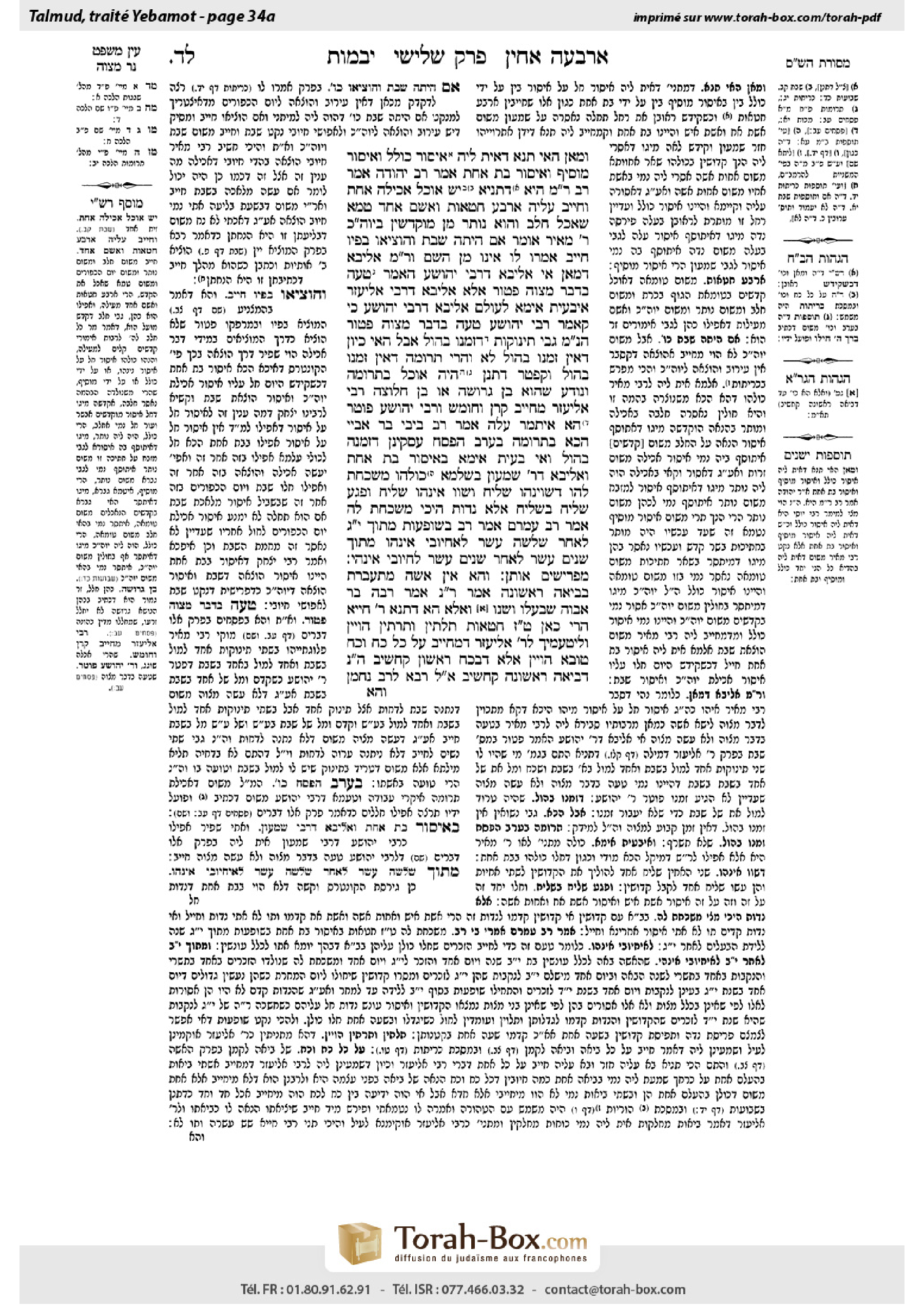
Yevamot 34a: Talmud study for Daf Yomi
Daf Yomi is the daily study of one Talmud folio. Explore 37 tractates with scans, Hebrew text, Sefaria English and AI-generated French translations where annotated.
Passage selection and English or AI-generated French translation are available where the scan has annotations. Daf Study is independent of Torah-Box and Sefaria.
Browse Yevamot · יבמות · All tractatesYevamot 34a text and translations
This page of Yevamot includes the Aramaic text, an English translation and an AI-generated French translation, alongside the scan above.
יבמות ל״ד א · Aramaic and Hebrew text
וּמַאן הַאי תַּנָּא דְּאִית לֵיהּ אִיסּוּר כּוֹלֵל וְאִיסּוּר מוֹסִיף וְאִיסּוּר בַּת אַחַת?
אָמַר רַב יְהוּדָה אָמַר רַב: רַבִּי מֵאִיר הִיא. דְּתַנְיָא: יֵשׁ אוֹכֵל אֲכִילָה אַחַת וְחַיָּיב עָלֶיהָ אַרְבַּע חַטָּאוֹת וְאָשָׁם אֶחָד.
טָמֵא שֶׁאָכַל חֵלֶב, וְהוּא נוֹתָר מִן מוּקְדָּשִׁין, בְּיוֹם הַכִּפּוּרִים.
רַבִּי מֵאִיר אוֹמֵר: אִם הָיְתָה שַׁבָּת וְהוֹצִיאוֹ בְּפִיו — חַיָּיב. אָמְרוּ לוֹ: אֵינוֹ מִן הַשֵּׁם.
וְרַבִּי מֵאִיר אַלִּיבָּא דְּמַאן? אִי אַלִּיבָּא דְּרַבִּי יְהוֹשֻׁעַ, הָאָמַר: טָעָה בִּדְבַר מִצְוָה — פָּטוּר. אֶלָּא אַלִּיבָּא דְּרַבִּי אֱלִיעֶזֶר.
אִיבָּעֵית אֵימָא: לְעוֹלָם אַלִּיבָּא דְּרַבִּי יְהוֹשֻׁעַ, כִּי קָאָמַר רַבִּי יְהוֹשֻׁעַ טָעָה בִּדְבַר מִצְוָה פָּטוּר, הָנֵי מִילֵּי גַּבֵּי תִּינוֹקוֹת — דִּזְמַנּוֹ בָּהוּל, אֲבָל הַאי, כֵּיוָן דְּאֵין זְמַנּוֹ בָּהוּל — לָא.
וַהֲרֵי תְּרוּמָה, דְּאֵין זְמַנּוֹ בָּהוּל, וְקָפָטַר! דִּתְנַן: הָיָה אוֹכֵל בִּתְרוּמָה, וְנוֹדַע שֶׁהוּא בֶּן גְּרוּשָׁה אוֹ בֶּן חֲלוּצָה, רַבִּי אֱלִיעֶזֶר מְחַיֵּיב קֶרֶן וָחוֹמֶשׁ, וְרַבִּי יְהוֹשֻׁעַ פּוֹטֵר.
הָא אִיתְּמַר עֲלַהּ, אָמַר רַב בִּיבִי בַּר אַבָּיֵי: הָכָא בִּתְרוּמָה בְּעֶרֶב הַפֶּסַח עָסְקִינַן — דִּזְמַנָּהּ בָּהוּל.
וְאִי בָּעֵית אֵימָא: בְּאִיסּוּר בַּת אַחַת, וְאַלִּיבָּא דְּרַבִּי שִׁמְעוֹן.
בִּשְׁלָמָא כּוּלְּהוּ מַשְׁכַּחַתְּ לְהוּ: דְּשַׁוִּינְהוּ שָׁלִיחַ, וְשַׁוּוֹ אִינְהוּ שָׁלִיחַ, וּפְגַע שָׁלִיחַ בְּשָׁלִיחַ. אֶלָּא נִדּוּת הֵיכִי מַשְׁכַּחַתְּ לַהּ?
אָמַר רַב עַמְרָם אָמַר רַב: בְּשׁוֹפְעוֹת מִתּוֹךְ שְׁלֹשָׁה עָשָׂר לְאַחַר שְׁלֹשָׁה עָשָׂר — לְאִחַיּוֹבֵי אִינְהוּ, מִתּוֹךְ שְׁנֵים עָשָׂר לְאַחַר שְׁנֵים עָשָׂר — לְחַיּוֹבֵי אִינְהִי.
מַפְרִישִׁים אוֹתָן. וְהָא אֵין אִשָּׁה מִתְעַבֶּרֶת בְּבִיאָה רִאשׁוֹנָה! אָמַר רַב נַחְמָן אָמַר רַבָּה בַּר אֲבוּהּ: שֶׁבָּעֲלוּ וְשָׁנוּ. וְאֶלָּא הָא דְּתָנֵי רַבִּי חִיָּיא: הֲרֵי כָּאן שֵׁשׁ עֶשְׂרֵה חַטָּאוֹת, תְּלָתִין וְתַרְתֵּין הָוְיָין!
וְלִיטַעְמָיךְ — לְרַבִּי אֱלִיעֶזֶר, דִּמְחַיֵּיב עַל כׇּל כֹּחַ וָכֹחַ — טוּבָא הָוְיָין. אֶלָּא דִּבְכֹחַ רִאשׁוֹן קָחָשֵׁיב, הָכִי נָמֵי, דְּבִיאָה רִאשׁוֹנָה קָחָשֵׁיב.
אֲמַר לֵיהּ רָבָא לְרַב נַחְמָן:
Yevamot 34a · English translation
The Gemara asks: According to Rabbi Ḥiyya, who teaches that this case incurs sixteen sin-offerings, who is this tanna who holds that a prohibition takes effect where another prohibition already exists for a more inclusive prohibition, an expanded prohibition, and a simultaneous prohibition? If these men are brothers, the moment that one betrothed a woman, that woman was immediately rendered forbidden to the second brother both as a married woman and as his brother’s wife. When the second brother betrothed her sister, this added the prohibition pertaining to his wife’s sister. This is a more inclusive prohibition because, as a result of this betrothal, the second brother is prohibited from engaging in sexual intercourse not only with his wife’s sister, who is his brother’s wife, but also with all of her other sisters. When this woman becomes a menstruating woman, she is forbidden to her husband as well, which is an expanded prohibition. Consequently, the mishna includes examples of all three types of prohibitions and asserts that they all take effect in this case. Therefore, the Gemara wonders which tanna holds that in each of these cases the prohibition takes effect even where another prohibition exists.
Rav Yehuda said that Rav said: This is the opinion of Rabbi Meir, as it is taught in a baraita: There is one who performs a single act of eating an olive-bulk of food, and he is liable to bring four sin-offerings and one guilt-offering.
How so? This halakha applies to one who is ritually impure who ate forbidden fat that was notar from a consecrated offering, i.e., it remained after the time when it was permitted to eat it, and this occurred on Yom Kippur. One who did this is liable to bring one sin offering for eating consecrated food while impure, one for eating forbidden fat, one for eating notar, and one for eating on Yom Kippur. He is also liable to bring a guilt-offering for misuse of consecrated items. In this case, it was prohibited to eat the fat from the moment the animal was born. When the animal was consecrated, the prohibition against deriving benefit from it took effect on the entire animal, rendering this an expanded prohibition. When the priest became ritually impure and thereby prohibited from partaking of all sanctified foods, a more inclusive prohibition took effect. The moment the fat was rendered notar, it became prohibited to offer it on the altar as well, so that that is another instance of an expanded prohibition. Lastly, on Yom Kippur, an additional, more inclusive prohibition took effect because on Yom Kippur it is prohibited to eat all food, even that which is not consecrated.
Rabbi Meir says: There is one more sin-offering for which he may be liable. If it was Shabbat and he carried this olive-bulk of food from one domain to another in his mouth, he is liable for carrying out on Shabbat. The Rabbis said to Rabbi Meir: Liability for the sin-offering that you added is not incurred from violation of the same type of prohibition. He is liable for carrying out the food, not for eating it. In this example, the prohibitions of Shabbat and Yom Kippur take effect at the same moment, and therefore this last case would be an instance of simultaneous prohibitions, and Rabbi Meir holds that they take effect as well. Therefore, this baraita demonstrates that Rabbi Meir holds that prohibitions take effect where other prohibitions already exist in all of these instances: More inclusive prohibitions, expanded prohibitions, and simultaneous prohibitions.
The Gemara continues to clarify the opinion of Rabbi Meir: And in accordance with whose opinion is the statement of Rabbi Meir? If you say that it is in accordance with the opinion of Rabbi Yehoshua, this is difficult. Didn’t Rabbi Yehoshua say that one who erred with regard to a mitzva is exempt from bringing a sin-offering, i.e., one who unwittingly performed a transgression while intending to perform a mitzva is exempt from punishment? In the case in the mishna as well, the men intended to perform the mitzva of marriage but unwittingly violated a transgression because the wives were switched. Therefore, according to the opinion of Rabbi Yehoshua, they should be exempt from a sin-offering. Rather, this must be in accordance with the opinion of Rabbi Eliezer, who holds that even if one mistakenly transgressed while attempting to perform a mitzva, he is still obligated to bring a sin-offering.
If you wish, resolve this differently and say: Actually, this can be explained even according to the opinion of Rabbi Yehoshua. When Rabbi Yehoshua says that one who erred with regard to a mitzva is exempt, this applies only to the case of babies who were mixed up in such a way that on Shabbat the mohel mistakenly circumcised a baby whose time had not yet come for circumcision. Since the mohel did not fulfill the mitzva of circumcision, he should be liable for performing prohibited labor on Shabbat. However, Rabbi Yehoshua exempts him from a sin-offering since he is pressed for time. Because circumcision must be performed only on the day specified, he was rushed and anxious to perform the circumcision, and due to this sense of urgency he erred and thought that the proper time was on Shabbat. In this case in the mishna, however, where the mistake involved marriage, since the brothers were not pressed for time Rabbi Yehoshua does not deem the brothers exempt.
The Gemara objects: And yet in the case of eating teruma, where one is not pressed for time and nevertheless Rabbi Yehoshua exempts him if the act involved a mitzva, as we learned in a mishna (Pesaḥim 72b): If a priest was partaking of teruma and it became known that he was the son of a divorced woman or the son of a ḥalutza and thereby disqualified from the priesthood and prohibited from eating teruma, Rabbi Eliezer deems him liable to pay the value of the principal and an additional fifth, like any non-priest who unwittingly ate teruma. However, Rabbi Yehoshua exempts him because at the time of consumption he intended to perform a mitzva, for he thought that he was a priest eating of the teruma.
The Gemara responds: But wasn’t it stated with regard to that mishna: Rav Beivai bar Abaye said: Here we are dealing with leavened teruma that was being eaten by the priest on the eve of Passover, for he is pressed for time. In this case, he would rush to eat it so that it would not have to be burned.
The Gemara offers a different attribution of the mishna: And if you wish, say a different explanation: The mishna is not according to the opinion of Rabbi Meir, who deems one liable in cases of more inclusive prohibitions and expanded prohibitions. Rather, the mishna is referring only to cases of simultaneous prohibitions, and in accordance with the opinion of Rabbi Shimon.
The Gemara asks: Granted, with regard to all of the prohibitions in the mishna, you can find that they take effect simultaneously in the case where the men appointed a single agent to betroth the women for them, and the women appointed an agent to accept the betrothals for them, and one agent encounters the other agent. In this scenario, all the men become betrothed to all the women the moment that the agents meet, and the prohibitions all take effect simultaneously. However, with regard to the prohibition pertaining to menstruating women, how can you find the case where both women become menstruating women at the exact time of betrothal?
Rav Amram said that Rav said: This is referring to a situation where the women continuously discharge menstrual blood from within the thirteenth year of the brothers until after they reached the age of thirteen, in order to deem the men liable for the prohibition pertaining to a menstruating woman. At the moment that the boys reached maturity and the betrothals went into effect, the sisters were forbidden as menstruating women. And the women were continuously discharging blood from within the twelfth year of the women until after the age of twelve, in order to deem the women liable for engaging in relations as a menstruating woman. Therefore, if this took place in such a way that on the exact day when the men reached maturity, i.e., their thirteenth birthday, the women reached maturity, i.e., their twelfth birthday, and at that moment they were menstruating, then all of the prohibitions would take effect simultaneously and they would be liable on all counts, according to Rabbi Shimon as well.
§ The mishna taught that we separate these women from their husbands for three months, as perhaps they became pregnant. The Gemara asks: But isn’t it known that a virgin woman does not become pregnant from her first sexual act? Rav Naḥman said that Rabba bar Avuh said: This is referring to a situation where they engaged in intercourse and then repeated the act, so that it is possible that the women were impregnated during the second act of intercourse. The Gemara asks: But if this is so, how can one explain that which Rabbi Ḥiyya teaches: Here, then, are sixteen sin-offerings? If there were indeed two acts of intercourse, then there should be thirty-two sin-offerings, since each prohibition was violated twice.
The Gemara answers: And according to your reasoning, that Rabbi Ḥiyya’s enumeration of sin-offerings applies to all acts of intercourse, then according to the opinion of Rabbi Eliezer, who deems one liable to bring a sin-offering for each and every thrusting movement during a single act of intercourse, there would be many prohibitions that were violated. This would greatly multiply the number of sin-offerings required. Rather, it must be that Rabbi Ḥiyya, with regard to Rabbi Eliezer’s opinion, is enumerating only the first thrusting movement in the intercourse. And so too, with regard to the Rabbis’ opinion, he is enumerating only the first act of intercourse. If there were two acts of intercourse, however, the number of sin-offerings would be doubled.
Rava said to Rav Naḥman:
Yevamot 34a · Traduction française (IA)
La Guemara demande : Selon Rabbi Ḥiyya, qui enseigne que ce cas entraîne seize sacrifices expiatoires, quel est ce tanna qui considère qu’une interdiction prend effet alors qu’une autre existe déjà, dans le cas d’une interdiction plus englobante, d’une interdiction élargie et d’interdictions simultanées ? Si ces hommes sont frères, dès que l’un d’eux a fiancé une femme, celle-ci est immédiatement devenue interdite au second frère à la fois en tant que femme mariée et en tant qu’épouse de son frère. Lorsque le second frère a fiancé sa sœur, cela a ajouté l’interdiction relative à la sœur de son épouse. Il s’agit d’une interdiction plus englobante car, à la suite de ces fiançailles, le second frère ne peut avoir de relations sexuelles non seulement avec la sœur de son épouse, qui est l’épouse de son frère, mais aussi avec toutes les autres sœurs de celle-ci. Lorsque cette femme devient menstruée, elle devient également interdite à son mari ; il s’agit là d’une interdiction élargie. Par conséquent, la Michna donne des exemples des trois types d’interdictions et affirme qu’elles prennent toutes effet dans ce cas. La Guemara se demande donc quel tanna considère que, dans chacun de ces cas, une interdiction prend effet alors qu’une autre existe déjà.
Rav Yehouda a dit au nom de Rav : C’est l’opinion de Rabbi Meïr, comme on l’enseigne dans une baraïta : Il y a un homme qui, en un seul acte, mange un kazaït de nourriture et qui est tenu d’apporter quatre sacrifices expiatoires et un sacrifice de culpabilité.
Comment cela ? Cette halakha s’applique à celui qui, en état d’impureté rituelle, a mangé du suif interdit qui était du notar provenant d’une offrande consacrée, c’est-à-dire qui était resté après le délai pendant lequel il était permis de le manger, et cela s’est produit à Yom Kippour. Celui qui a agi ainsi est tenu d’apporter un sacrifice expiatoire pour avoir mangé un aliment consacré en état d’impureté, un pour avoir mangé du suif interdit, un pour avoir mangé du notar et un pour avoir mangé à Yom Kippour. Il est également tenu d’apporter un sacrifice de culpabilité pour avoir fait un usage illicite d’objets consacrés. Dans ce cas, il était interdit de manger le suif dès la naissance de l’animal. Lorsque l’animal a été consacré, l’interdiction d’en tirer profit a pris effet sur l’animal tout entier : il s’agissait donc d’une interdiction élargie. Lorsque le prêtre est devenu rituellement impur et s’est ainsi vu interdire de consommer tous les aliments consacrés, une interdiction plus englobante a pris effet. Au moment où le suif est devenu du notar, il est également devenu interdit de le présenter sur l’autel : il s’agit donc d’un autre cas d’interdiction élargie. Enfin, à Yom Kippour, une interdiction supplémentaire et plus englobante a pris effet, car il est interdit de manger tout aliment à Yom Kippour, même s’il n’est pas consacré.
Rabbi Meïr dit : Il peut être tenu d’apporter un sacrifice expiatoire supplémentaire. Si c’était Chabbat et qu’il a transporté ce kazaït de nourriture d’un domaine à un autre dans sa bouche, il est passible d’un sacrifice expiatoire pour l’avoir transporté à Chabbat. Les Sages dirent à Rabbi Meïr : Le sacrifice expiatoire que tu as ajouté n’est pas dû à la transgression d’une interdiction du même type. Il est passible pour avoir transporté la nourriture, et non pour l’avoir mangée. Dans cet exemple, les interdictions de Chabbat et de Yom Kippour prennent effet au même moment ; ce dernier cas serait donc un exemple d’interdictions simultanées, et Rabbi Meïr considère qu’elles prennent elles aussi effet. Cette baraïta démontre donc que Rabbi Meïr considère que des interdictions prennent effet alors que d’autres existent déjà dans tous ces cas : les interdictions plus englobantes, les interdictions élargies et les interdictions simultanées.
La Guemara poursuit en précisant l’opinion de Rabbi Meïr : Selon l’opinion de qui Rabbi Meïr parle-t-il ? Si tu dis que c’est selon l’opinion de Rabbi Yehoshoua, cela pose une difficulté. Rabbi Yehoshoua n’a-t-il pas dit que celui qui se trompe au sujet d’une mitsva est dispensé d’apporter un sacrifice expiatoire, c’est-à-dire que celui qui transgresse involontairement une interdiction alors qu’il avait l’intention d’accomplir une mitsva est dispensé de sanction ? Dans le cas de la Michna également, les hommes avaient l’intention d’accomplir la mitsva du mariage, mais ils ont involontairement transgressé une interdiction parce que les épouses avaient été échangées. Par conséquent, selon Rabbi Yehoshoua, ils devraient être dispensés d’apporter un sacrifice expiatoire. Il faut plutôt dire que c’est selon l’opinion de Rabbi Eliezer, qui considère que même si quelqu’un a transgressé par erreur en cherchant à accomplir une mitsva, il reste tenu d’apporter un sacrifice expiatoire.
Si tu le souhaites, résous la difficulté autrement et dis : En réalité, cela peut s’expliquer même selon l’opinion de Rabbi Yehoshoua. Lorsque Rabbi Yehoshoua dit que celui qui se trompe au sujet d’une mitsva est dispensé, cela ne s’applique qu’au cas de bébés qui ont été mélangés, de telle sorte qu’à Chabbat le mohel a circoncis par erreur un bébé dont le moment de la circoncision n’était pas encore venu. Puisque le mohel n’a pas accompli la mitsva de la circoncision, il aurait dû être passible d’un sacrifice expiatoire pour avoir effectué un travail interdit à Chabbat. Cependant, Rabbi Yehoshoua le dispense d’apporter un sacrifice expiatoire parce qu’il est pressé par le temps. La circoncision ne devant être pratiquée qu’au jour fixé, il était pressé et anxieux de l’accomplir et, en raison de cette urgence, il s’est trompé en pensant que le moment convenable était Chabbat. En revanche, dans le cas de la Michna, où l’erreur concernait un mariage, les frères n’étant pas pressés par le temps, Rabbi Yehoshoua ne les considère pas comme dispensés.
La Guemara objecte : Pourtant, dans le cas de la consommation de terouma, où l’on n’est pas pressé par le temps, Rabbi Yehoshoua le dispense néanmoins lorsque l’acte impliquait une mitsva, comme nous l’avons appris dans une Michna (Pessaḥim 72b) : Si un prêtre consommait de la terouma et qu’il a été établi qu’il était le fils d’une femme divorcée ou le fils d’une ḥaloutsa, et qu’il était donc disqualifié de la prêtrise et interdit de consommer de la terouma, Rabbi Eliezer le considère comme tenu de rembourser la valeur du principal et un cinquième supplémentaire, comme tout non-prêtre qui aurait consommé involontairement de la terouma. Rabbi Yehoshoua, toutefois, le dispense, car au moment de la consommation, il avait l’intention d’accomplir une mitsva : il pensait être un prêtre consommant de la terouma.
La Guemara répond : Mais n’a-t-il pas été dit à propos de cette Michna que Rav Beivai bar Abaye a dit : Ici, nous parlons de terouma levée que le prêtre consommait la veille de Pessaḥ, car il était pressé par le temps. Dans ce cas, il se dépêchait de la manger afin qu’elle n’ait pas à être brûlée.
La Guemara propose une autre attribution de la Michna : Et si tu le souhaites, donne une autre explication : la Michna ne suit pas l’opinion de Rabbi Meïr, qui considère qu’on est passible dans les cas d’interdictions plus englobantes et d’interdictions élargies. La Michna ne traite que de cas d’interdictions simultanées et suit l’opinion de Rabbi Shimon.
La Guemara demande : Certes, pour toutes les interdictions de la Michna, on peut trouver un cas où elles prennent effet simultanément : les hommes ont désigné un seul mandataire pour fiancer les femmes en leur nom, les femmes ont désigné un mandataire pour accepter les fiançailles en leur nom, et un mandataire rencontre l’autre. Dans ce scénario, tous les hommes se trouvent fiancés à toutes les femmes au moment où les mandataires se rencontrent, et toutes les interdictions prennent effet simultanément. Mais, pour l’interdiction relative aux femmes menstruées, comment peut-on trouver un cas où les deux femmes deviennent menstruées exactement au moment des fiançailles ?
Rav Amram a dit au nom de Rav : Il s’agit d’une situation où les femmes ont continuellement perdu du sang menstruel depuis leur treizième année jusqu’après l’âge de treize ans, afin que les hommes soient passibles de l’interdiction relative à une femme menstruée. Au moment où les garçons ont atteint la majorité et où les fiançailles ont pris effet, les sœurs étaient interdites en tant que femmes menstruées. Et les femmes perdaient continuellement du sang depuis leur douzième année jusqu’après l’âge de douze ans, afin que les femmes soient passibles pour avoir eu des relations alors qu’elles étaient menstruées. Par conséquent, si les événements se sont produits de telle sorte que, le jour précis où les hommes ont atteint la majorité, c’est-à-dire le jour de leur treizième anniversaire, les femmes ont atteint la majorité, c’est-à-dire le jour de leur douzième anniversaire, et qu’elles étaient alors menstruées, toutes les interdictions auraient pris effet simultanément et ils seraient passibles à tous les titres, selon Rabbi Shimon également.
§ La Michna a enseigné que nous séparons ces femmes de leurs maris pendant trois mois, car elles sont peut-être tombées enceintes. La Guemara demande : Mais ne sait-on pas qu’une femme vierge ne tombe pas enceinte lors de son premier rapport sexuel ? Rav Naḥman a dit au nom de Rabba bar Avouha : Il s’agit d’une situation où ils ont eu un rapport sexuel, puis ont recommencé, de sorte qu’il est possible que les femmes aient été fécondées lors du second rapport. La Guemara demande : Mais si tel est le cas, comment expliquer ce qu’enseigne Rabbi Ḥiyya : « Il y a donc ici seize sacrifices expiatoires » ? S’il y a effectivement eu deux rapports, il devrait y avoir trente-deux sacrifices expiatoires, puisque chaque interdiction a été transgressée deux fois.
La Guemara répond : Selon ton raisonnement, si le décompte des sacrifices expiatoires de Rabbi Ḥiyya s’appliquait à tous les rapports sexuels, alors, selon l’opinion de Rabbi Eliezer, qui considère qu’on est tenu d’apporter un sacrifice expiatoire pour chaque mouvement de poussée au cours d’un seul rapport, un grand nombre d’interdictions auraient été transgressées. Cela augmenterait considérablement le nombre de sacrifices expiatoires requis. Il faut plutôt dire que Rabbi Ḥiyya, en ce qui concerne l’opinion de Rabbi Eliezer, ne compte que le premier mouvement de poussée au cours du rapport. De même, en ce qui concerne l’opinion des Sages, il ne compte que le premier rapport. Toutefois, s’il y avait eu deux rapports, le nombre de sacrifices expiatoires serait doublé.
Rava dit à Rav Naḥman :
Traduction française générée par IA à partir de l’édition anglaise de Sefaria. Vérifie toujours un passage avec le texte source.
Text from Sefaria: William Davidson Edition - Vocalized Aramaic (CC BY NC); William Davidson Edition - English (CC BY NC).