Yevamot 34b: Talmud study for Daf Yomi
Daf Yomi is the daily study of one Talmud folio. Explore 37 tractates with scans, Hebrew text, Sefaria English and AI-generated French translations where annotated.
Passage selection and English or AI-generated French translation are available where the scan has annotations. Daf Study is independent of Torah-Box and Sefaria.
Browse Yevamot · יבמות · All tractatesYevamot 34b text and translations
This page of Yevamot includes the Aramaic text, an English translation and an AI-generated French translation, alongside the scan above.
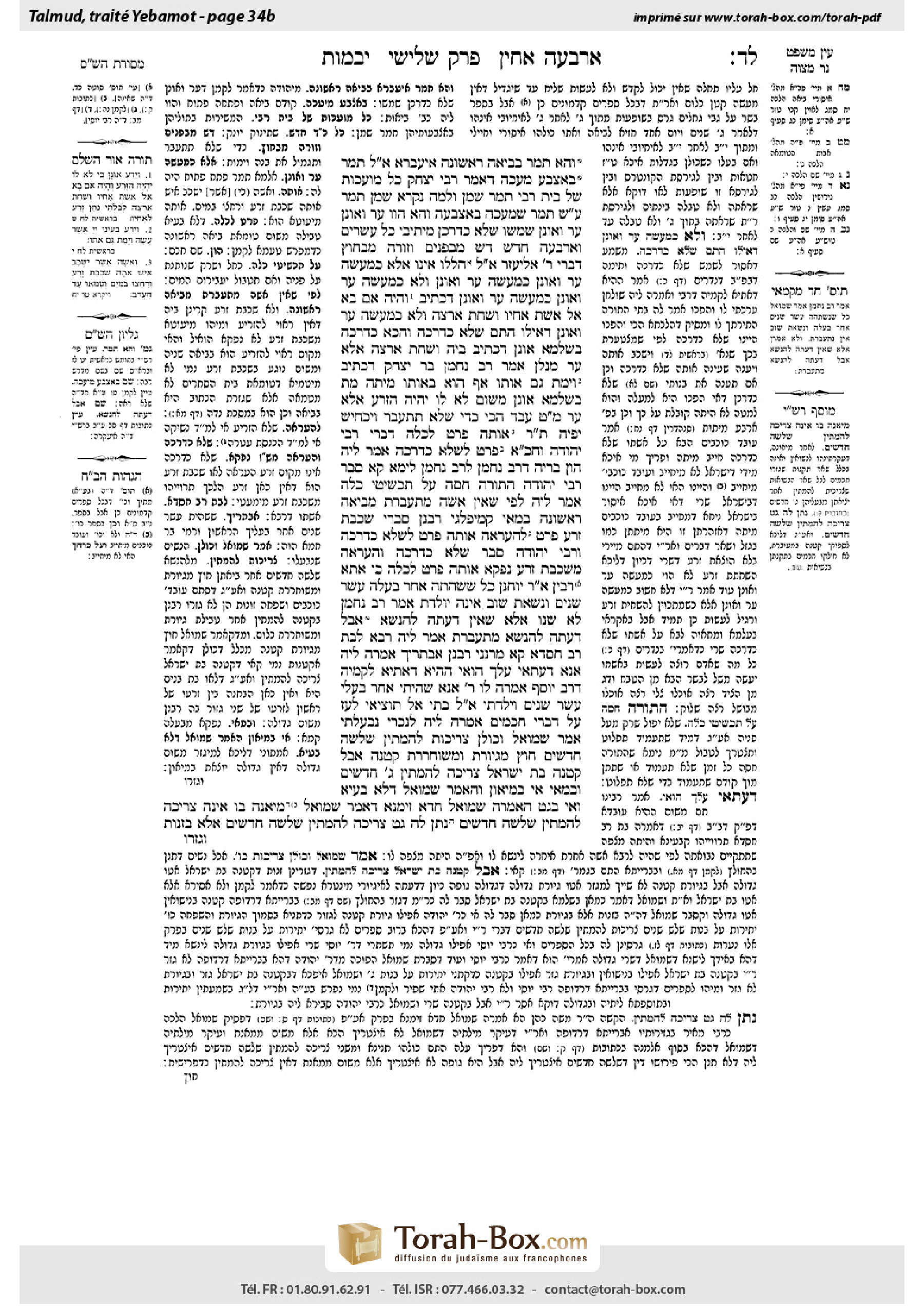
יבמות ל״ד ב · Aramaic and Hebrew text
וְהָא תָּמָר בְּבִיאָה רִאשׁוֹנָה אִיעַבַּרָא! אֲמַר לֵיהּ: תָּמָר בְּאֶצְבַּע מִעֲכָה. דְּאָמַר רַבִּי יִצְחָק: כׇּל מוֹעֹכוֹת שֶׁל בֵּית רַבִּי — תָּמָר שְׁמָן, וְלָמָּה נִקְרָא שְׁמָן תָּמָר — עַל שֵׁם תָּמָר שֶׁמִּעֲכָה בְּאֶצְבָּעָהּ. וְהָא הֲווֹ עֵר וְאוֹנָן! עֵר וְאוֹנָן שִׁמְּשׁוּ שֶׁלֹּא כְּדַרְכָּן.
מֵיתִיבִי: כׇּל עֶשְׂרִים וְאַרְבָּעָה חֹדֶשׁ דָּשׁ מִבִּפְנִים וְזוֹרֶה מִבַּחוּץ, דִּבְרֵי רַבִּי אֱלִיעֶזֶר. אָמְרוּ לוֹ: הַלָּלוּ אֵינוֹ אֶלָּא כְּמַעֲשֵׂה עֵר וְאוֹנָן!
כְּמַעֲשֵׂה עֵר וְאוֹנָן, וְלֹא כְּמַעֲשֵׂה עֵר וְאוֹנָן. כְּמַעֲשֵׂה עֵר וְאוֹנָן, דִּכְתִיב: ״וְהָיָה אִם בָּא אֶל אֵשֶׁת אָחִיו וְשִׁחֵת אַרְצָה״. וְלֹא כְּמַעֲשֵׂה עֵר וְאוֹנָן, דְּאִילּוּ הָתָם שֶׁלֹּא כְּדַרְכָּהּ, וְהָכָא כְּדַרְכָּהּ.
בִּשְׁלָמָא אוֹנָן, דִּכְתִיב בֵּיהּ ״וְשִׁחֵת אַרְצָה״, אֶלָּא עֵר מְנָלַן? אָמַר רַב נַחְמָן בַּר יִצְחָק: דִּכְתִיב ״וַיָּמֶת גַּם אוֹתוֹ״, אַף הוּא בְּאוֹתָהּ מִיתָה מֵת. בִּשְׁלָמָא אוֹנָן, מִשּׁוּם ״לֹּא לוֹ יִהְיֶה הַזָּרַע״, אֶלָּא עֵר מַאי טַעְמָא עֲבַד הָכִי? כְּדֵי שֶׁלֹּא תִּתְעַבֵּר וְיַכְחִישׁ יָפְיָהּ.
תָּנוּ רַבָּנַן: ״אוֹתָהּ״, פְּרָט לְכַלָּה, דִּבְרֵי רַבִּי יְהוּדָה. וַחֲכָמִים אוֹמְרִים: פְּרָט לְשֶׁלֹּא כְּדַרְכָּהּ. אֲמַר לֵיהּ הוּן בְּרֵיהּ דְּרַב נַחְמָן לְרַב נַחְמָן: לֵימָא קָא סָבַר רַבִּי יְהוּדָה הַתּוֹרָה חָסָה עַל תַּכְשִׁיטֵי כַלָּה? אֲמַר לֵיהּ: לְפִי שֶׁאֵין אִשָּׁה מִתְעַבֶּרֶת מִבִּיאָה רִאשׁוֹנָה.
בְּמַאי קָמִיפַּלְגִי — רַבָּנַן סָבְרִי: ״שִׁכְבַת זָרַע״, פְּרָט לְהַעֲרָאָה. ״אוֹתָהּ״, פְּרָט לְשֶׁלֹּא כְּדַרְכָּהּ. וְרַבִּי יְהוּדָה סָבַר: שֶׁלֹּא כְּדַרְכָּהּ וְהַעֲרָאָה מִ״שִּׁכְבַת זָרַע״ נָפְקָא. ״אוֹתָהּ״ — פְּרָט לְכַלָּה.
כִּי אֲתָא רָבִין אָמַר רַבִּי יוֹחָנָן: כׇּל שֶׁשָּׁהֲתָה אַחַר בַּעֲלָהּ עֶשֶׂר שָׁנִים וְנִשֵּׂאת — שׁוּב אֵינָהּ יוֹלֶדֶת. אָמַר רַב נַחְמָן: לֹא שָׁנוּ אֶלָּא שֶׁאֵין דַּעְתָּהּ לְהִנָּשֵׂא, אֲבָל דַּעְתָּהּ לְהִנָּשֵׂא — מִתְעַבֶּרֶת. אֲמַר לֵיהּ רָבָא לְבַת רַב חִסְדָּא: קָא מְרַנְּנִי רַבָּנַן אַבָּתְרִיךָ! אֲמַרָה לֵיהּ: אֲנָא דַּעְתַּאי עֲלָךְ הֲוַאי.
הָהִיא דַּאֲתַאי לְקַמֵּיהּ דְּרַב יוֹסֵף, אָמְרָה לוֹ: רַבִּי, (אֲנָא) [אֲנִי] שָׁהִיתִי אַחַר בַּעְלִי עֶשֶׂר שָׁנִים וְיָלַדְתִּי! אֲמַר לַהּ: בִּתִּי, אַל תּוֹצִיאִי לַעַז עַל דִּבְרֵי חֲכָמִים! אֲמַרָה לֵיהּ: לְגוֹי נִבְעַלְתִּי.
אָמַר שְׁמוּאֵל: וְכוּלָּן — צְרִיכוֹת לְהַמְתִּין שְׁלֹשָׁה חֳדָשִׁים, חוּץ מִגִּיּוֹרֶת וּמְשׁוּחְרֶרֶת קְטַנָּה. אֲבָל קְטַנָּה בַּת יִשְׂרָאֵל צְרִיכָה לְהַמְתִּין שְׁלֹשָׁה חֳדָשִׁים.
וּבְמַאי? אִי בְּמֵיאוּן, וְהָאָמַר שְׁמוּאֵל דְּלָא בָּעֲיָא, וְאִי בְּגֵט — הָאַמְרַהּ שְׁמוּאֵל חֲדָא זִימְנָא? דְּאָמַר שְׁמוּאֵל: מֵיאֲנָה בּוֹ — אֵינָהּ צְרִיכָה לְהַמְתִּין שְׁלֹשָׁה חֳדָשִׁים, נָתַן לָהּ גֵּט — צְרִיכָה לְהַמְתִּין שְׁלֹשָׁה חֳדָשִׁים! אֶלָּא בִּזְנוּת,
Yevamot 34b · English translation
But didn’t Tamar become pregnant from the first act of intercourse, despite the fact that she was a virgin at the time of her sexual act with Judah? Rav Naḥman said: Tamar broke her hymen with her finger prior to intercourse, and it is due to this that she became pregnant from the first act of intercourse, as Rabbi Yitzḥak said: All of those women from the household of Rabbi Yehuda HaNasi who break their hymens are named Tamar by nickname. And why are they named Tamar? They are called this on account of Tamar, who broke her hymen with her finger. The Gemara wonders about the proof from Tamar itself: But weren’t there Er and Onan, her previous husbands, who presumably engaged in sexual intercourse with her? The Gemara responds: Er and Onan engaged in sexual intercourse in an atypical manner, i.e., anal intercourse, and therefore she was still a virgin.
The Gemara raises an objection from a baraita: After a woman gives birth, her husband penetrates inside and spills his semen outside for the entire twenty-four months during which the baby is breastfeeding, so that his wife not become pregnant, as that would terminate her milk production and the child might die. This is the statement of Rabbi Eliezer. They said to him: These acts are nothing other than acts similar to those of Er and Onan, which are prohibited. Regardless, it can be deduced from here that Er and Onan engaged in normative sexual intercourse with Tamar, only they did not fully complete the sexual act.
The Gemara answers: The Tosefta actually means that what they did was similar to the act of Er and Onan in some ways, but not similar to the act of Er and Onan in other ways. The Gemara elaborates: It was similar to the act of Er and Onan in that there was a spilling of semen, as it is written: “And it came to pass when he had intercourse with his brother’s wife, that he spilled it on the ground” (Genesis 38:9). Yet it was not similar to the act of Er and Onan, as there Er and Onan engaged in sexual intercourse in an atypical manner, i.e., anal intercourse, while here the Tosefta is referring to sexual intercourse in a typical manner.
The Gemara continues to clarify what took place: Granted, Onan engaged in unnatural sexual intercourse with her, as it is written with regard to his act: “That he spilled it on the ground” (Genesis 38:9). However, from where do we derive that Er engaged in unnatural sexual intercourse with her? Rav Naḥman bar Yitzḥak said: As it is written with regard to Onan: “And He slew him also” (Genesis 38:10). This indicates that he, too, died the same death for performing the same transgression as his brother. The Gemara asks: Granted, Onan engaged in anal intercourse because he did not want Tamar to give birth as “he knew that the seed would not be his” (Genesis 38:9). However, with regard to Er, what is the reason he acted in this way? The Gemara responds: He did so in order that she not become pregnant and become less beautiful as a result of her pregnancy.
The Sages taught: The verse states: “And the woman, with whom a man shall lie giving seed, they shall both bathe themselves in water, and be unclean until the evening” (Leviticus 15:18). The extra term “with whom” comes to exclude a bride who does not become ritually impure; this is the statement of Rabbi Yehuda. And the Rabbis say: It excludes the case of sexual intercourse performed in an atypical manner. Hon, son of Rav Naḥman, said to Rav Naḥman: Shall we say that Rabbi Yehuda holds: The Torah spared a bride’s adornments, including her make-up, and therefore exempted her from submersion in water, as that might cause them ruin? Rav Naḥman said to him: That is not the reason. Rather, it is because a woman does not become pregnant from the first act of intercourse. Therefore, that act of intercourse would not cause ritual impurity, as it is not considered intercourse that can result in the implanting of seed.
The Gemara asks: With regard to what do Rabbi Yehuda and the Rabbis disagree? The Rabbis hold that the phrase “giving seed” excludes the initial stage of intercourse, during which there is no emission of semen. And the extra phrase “with whom” excludes intercourse that is performed in an atypical way. Rabbi Yehuda, on the other hand, holds that the exclusion of both atypical sexual intercourse and the initial stage of intercourse were derived from the phrase “giving seed,” as neither of these are sexual acts that might bring about the birth of a seed, i.e., a child. The phrase “with whom” then excludes a bride.
On the topic of intercourse that cannot result in conception, the Gemara relates the following: When Ravin came from Eretz Yisrael to Babylonia, he said that Rabbi Yoḥanan said: Any woman who waits after her husband has died or divorced her for ten years without intercourse and is then married can no longer bear children. Rav Naḥman said: They taught this principle only with regard to cases where she did not intend to get married at a later time, but if she intended to get married at some point, she can become pregnant later on. Rava said to his wife, the daughter of Rav Ḥisda: The Sages are gossiping about you. From the time she was widowed from her first husband until the time that she was married to Rava, more than ten years passed, yet she bore him children. It seemed as though she had engaged in intercourse in the meantime. She said to him: My mind was on you. Indeed, it is told that already as a young girl she prophesized that she would marry Rava.
The Gemara relates: A certain woman who came before Rav Yosef said to him: My teacher, I waited after my husband’s death for ten years, and nevertheless I gave birth. He said to her: My daughter, do not cast aspersions on the statement of the Sages. She said to him in confession: I had sexual intercourse with a gentile during those ten years.
§ Shmuel said: And all of those women who had sexual intercourse, and there is therefore a concern that they might be pregnant, must wait three months before marrying so as to differentiate between a child born from the previous intercourse and a child born from this marriage, except for a female convert who is a minor and a female released slave who is a minor. Although it is possible that they had sexual intercourse, they cannot become pregnant in any case. However, a female Israelite who was a minor and had intercourse must wait three months like all other women.
The Gemara asks: And with regard to what situation is this statement referring? If it is referring to a minor who was released from her marriage by refusal, as a minor girl who was married to a man by her mother or brothers may refuse to remain married to her husband until reaching majority, but didn’t Shmuel say that she is not required to wait three months? And if it is referring to a woman who received a bill of divorce as a minor, didn’t Shmuel already state this halakha one time? Why would he repeat this ruling, as Shmuel said: A female minor who refused her husband need not wait three months before her second marriage, but if he gave her a bill of divorce, she must wait three months, so as not to make a distinction between an adult divorcée and a minor divorcée. Rather, it must be that this is referring to a female minor who was involved in licentious sexual intercourse.
Yevamot 34b · Traduction française (IA)
Mais Tamar n’est-elle pas tombée enceinte dès le premier rapport sexuel, alors qu’elle était vierge lorsqu’elle eut un rapport avec Juda ? Rav Naḥman dit : Tamar avait rompu son hymen avec son doigt avant le rapport ; c’est pourquoi elle est tombée enceinte dès le premier rapport. En effet, Rabbi Yitzḥak a dit : Toutes les femmes de la maison de Rabbi Yehuda HaNasi qui rompent leur hymen sont surnommées Tamar. Et pourquoi les appelle-t-on Tamar ? En référence à Tamar, qui avait rompu son hymen avec son doigt. La Guemara s’interroge sur le cas même de Tamar : Mais Er et Onan, ses maris précédents, n’avaient-ils pas eu de rapports sexuels avec elle ? La Guemara répond : Er et Onan avaient eu des rapports sexuels d’une manière atypique, c’est-à-dire des rapports anaux ; elle était donc encore vierge.
La Guemara soulève une objection à partir d’une baraïta : après qu’une femme a accouché, son mari la pénètre et répand sa semence à l’extérieur pendant toute la période de vingt-quatre mois durant laquelle le bébé est allaité, afin que sa femme ne tombe pas enceinte, car cela interromprait sa production de lait et l’enfant pourrait mourir. Telle est la déclaration de Rabbi Eliezer. On lui dit : Ces actes ne sont rien d’autre que des actes semblables à ceux d’Er et d’Onan, qui sont interdits. Quoi qu’il en soit, on peut en déduire qu’Er et Onan avaient eu avec Tamar des rapports sexuels normaux, mais qu’ils n’avaient pas mené l’acte à son terme.
La Guemara répond : La Tosefta veut en réalité dire que ce qu’ils faisaient ressemblait sous certains aspects à l’acte d’Er et d’Onan, mais pas sous d’autres aspects. La Guemara développe : cela ressemblait à l’acte d’Er et d’Onan en ce qu’il y avait émission de semence, comme il est écrit : « Et il arriva, lorsqu’il allait vers la femme de son frère, qu’il la répandait à terre » (Genèse 38:9). Mais cela ne ressemblait pas à l’acte d’Er et d’Onan, car ceux-ci avaient eu des rapports sexuels d’une manière atypique, c’est-à-dire des rapports anaux, tandis qu’ici la Tosefta parle de rapports sexuels d’une manière normale.
La Guemara poursuit en précisant ce qui s’est passé : il est certain qu’Onan avait eu avec elle des rapports sexuels contre nature, comme il est écrit à propos de son acte : « Il la répandait à terre » (Genèse 38:9). Mais d’où savons-nous qu’Er avait lui aussi eu avec elle des rapports sexuels contre nature ? Rav Naḥman bar Yitzḥak dit : Comme il est écrit à propos d’Onan : « Il le fit mourir, lui aussi » (Genèse 38:10). Cela indique qu’il mourut lui aussi de la même manière, pour avoir commis la même transgression que son frère. La Guemara demande : Il est certain qu’Onan avait eu des rapports anaux parce qu’il ne voulait pas que Tamar donne naissance à un enfant, car « il savait que la semence ne serait pas à lui » (Genèse 38:9). Mais concernant Er, quelle raison avait-il d’agir ainsi ? La Guemara répond : Il agissait ainsi afin qu’elle ne tombe pas enceinte et ne devienne pas moins belle à la suite de sa grossesse.
Les Sages ont enseigné : Le verset dit : « Et la femme avec laquelle un homme aura couché en répandant sa semence, ils se baigneront tous deux dans l’eau et seront impurs jusqu’au soir » (Lévitique 15:18). Le terme supplémentaire « avec laquelle » vient exclure une jeune mariée, qui ne devient pas rituellement impure ; telle est la déclaration de Rabbi Yehuda. Les Rabbins disent : il exclut le cas de rapports sexuels pratiqués d’une manière atypique. Hon, fils de Rav Naḥman, dit à Rav Naḥman : Devons-nous dire que, selon Rabbi Yehuda, la Torah a épargné à une jeune mariée ses parures, y compris son maquillage, et l’a donc exemptée de l’immersion dans l’eau, qui risquerait de les abîmer ? Rav Naḥman lui dit : Ce n’est pas la raison. C’est plutôt parce qu’une femme ne tombe pas enceinte à la suite du premier rapport sexuel. Ce rapport ne la rend donc pas rituellement impure, puisqu’il n’est pas considéré comme un rapport susceptible d’entraîner l’implantation de la semence.
La Guemara demande : Sur quoi Rabbi Yehuda et les Rabbins sont-ils en désaccord ? Les Rabbins estiment que l’expression « en répandant sa semence » exclut le début du rapport sexuel, durant lequel il n’y a pas d’émission de semence. Et l’expression supplémentaire « avec laquelle » exclut les rapports sexuels pratiqués d’une manière atypique. Rabbi Yehuda, en revanche, estime que l’exclusion des rapports sexuels atypiques et celle du début du rapport sont toutes deux déduites de l’expression « en répandant sa semence », puisque ni l’un ni l’autre ne constitue un acte sexuel susceptible d’entraîner la naissance d’une semence, c’est-à-dire d’un enfant. L’expression « avec laquelle » exclut alors une jeune mariée.
À propos des rapports sexuels qui ne peuvent entraîner de conception, la Guemara rapporte ce qui suit : Lorsque Ravin vint d’Eretz Israël en Babylonie, il dit que Rabbi Yoḥanan avait déclaré : Toute femme qui, après la mort de son mari ou son divorce, reste dix ans sans avoir de rapports sexuels, puis se marie, ne peut plus avoir d’enfants. Rav Naḥman dit : Ce principe n’a été enseigné que pour les cas où elle n’avait pas l’intention de se marier par la suite ; mais si elle avait l’intention de se marier un jour, elle peut tomber enceinte ultérieurement. Rava dit à sa femme, la fille de Rav Ḥisda : Les Sages font des commérages à ton sujet. Plus de dix ans s’étaient écoulés entre son veuvage, après la mort de son premier mari, et son mariage avec Rava, et pourtant elle lui avait donné des enfants. On aurait dit qu’elle avait eu des rapports sexuels entre-temps. Elle lui dit : Je pensais à toi. On raconte en effet que, dès son jeune âge, elle avait prédit qu’elle épouserait Rava.
La Guemara rapporte : Une certaine femme qui se présenta devant Rav Yosef lui dit : Mon maître, après la mort de mon mari, j’ai attendu dix ans et, néanmoins, j’ai accouché. Il lui dit : Ma fille, ne mets pas en doute la déclaration des Sages. Elle lui avoua : J’ai eu des rapports sexuels avec un non-Juif pendant ces dix années.
§ Shmuel a dit : Toutes les femmes qui ont eu des rapports sexuels et dont on peut donc craindre qu’elles soient enceintes doivent attendre trois mois avant de se marier, afin de distinguer un enfant né des rapports précédents d’un enfant né de ce mariage, à l’exception d’une convertie mineure et d’une esclave affranchie mineure. Bien qu’il soit possible qu’elles aient eu des rapports sexuels, elles ne peuvent en aucun cas tomber enceintes. En revanche, une Israélite mineure qui a eu des rapports sexuels doit attendre trois mois, comme toutes les autres femmes.
La Guemara demande : À quelle situation cette déclaration se rapporte-t-elle ? S’agit-il d’une mineure qui a été libérée de son mariage par refus ? Une jeune fille mineure mariée à un homme par sa mère ou ses frères peut refuser de rester mariée à son mari jusqu’à sa majorité ; mais Shmuel n’a-t-il pas dit qu’elle n’est pas tenue d’attendre trois mois ? Et s’agit-il d’une femme qui a reçu un acte de divorce alors qu’elle était mineure ? Shmuel n’a-t-il pas déjà énoncé cette halakha une fois ? Pourquoi répéter cette règle ? Shmuel a dit en effet : Une mineure qui a refusé son mari n’a pas besoin d’attendre trois mois avant son second mariage, mais si son mari lui a remis un acte de divorce, elle doit attendre trois mois, afin de ne pas faire de distinction entre une femme adulte divorcée et une mineure divorcée. Il faut plutôt dire que cela concerne une mineure qui a eu des rapports sexuels illicites.
Traduction française générée par IA à partir de l’édition anglaise de Sefaria. Vérifie toujours un passage avec le texte source.
Text from Sefaria: William Davidson Edition - Vocalized Aramaic (CC BY NC); William Davidson Edition - English (CC BY NC).