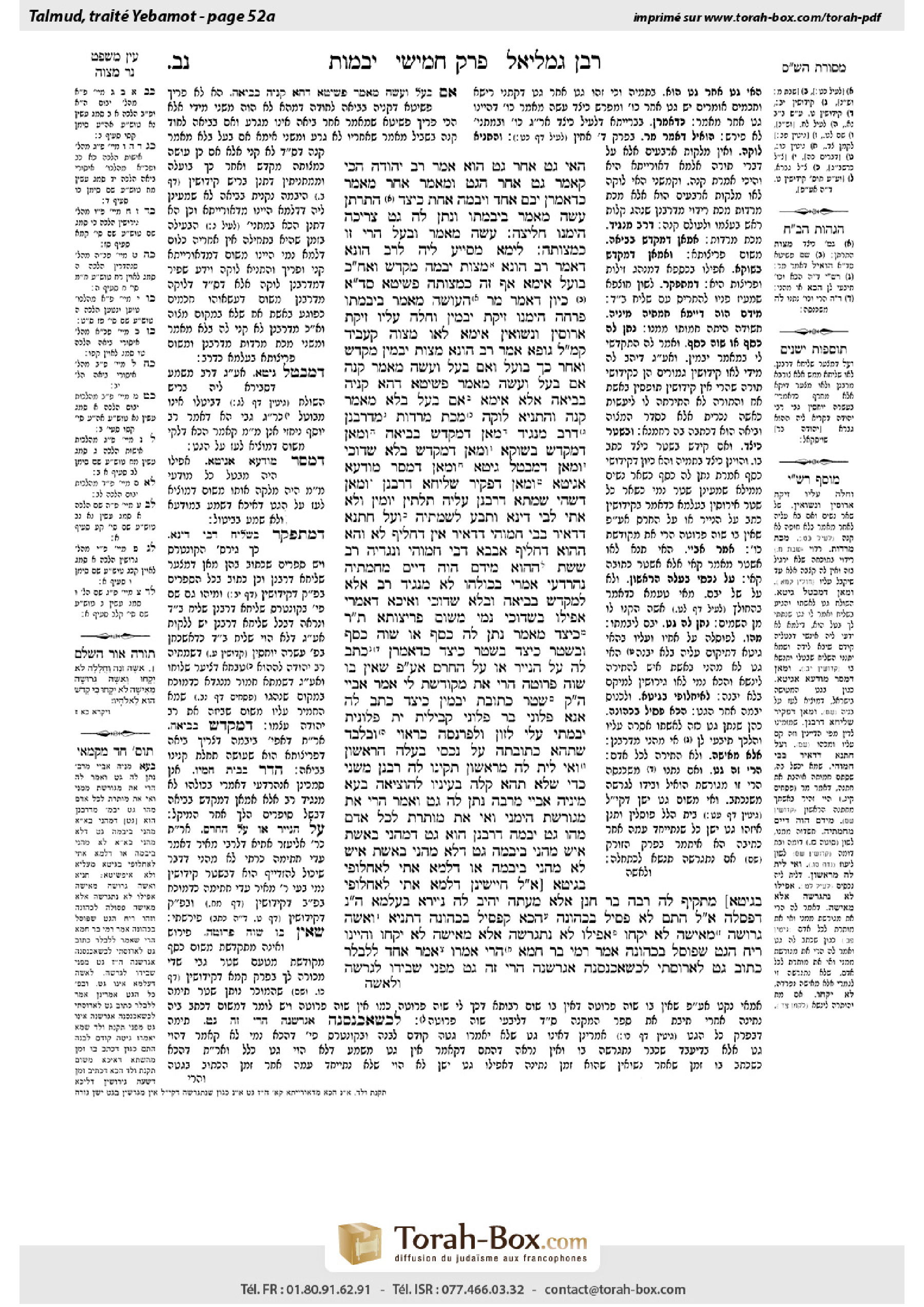
Yevamot 52a: Talmud study for Daf Yomi
Daf Yomi is the daily study of one Talmud folio. Explore 37 tractates with scans, Hebrew text, Sefaria English and AI-generated French translations where annotated.
Passage selection and English or AI-generated French translation are available where the scan has annotations. Daf Study is independent of Torah-Box and Sefaria.
Browse Yevamot · יבמות · All tractatesYevamot 52a text and translations
This page of Yevamot includes the Aramaic text, an English translation and an AI-generated French translation, alongside the scan above.
יבמות נ״ב א · Aramaic and Hebrew text
הַאי גֵּט אַחַר גֵּט הוּא? אָמַר רַב יְהוּדָה, הָכִי קָאָמַר: גֵּט אַחַר הַגֵּט, וּמַאֲמָר אַחַר מַאֲמָר — כְּדַאֲמַרַן, יָבָם אֶחָד וִיבָמָה אַחַת כֵּיצַד הַתָּרָתָן? עָשָׂה מַאֲמָר בִּיבִמְתּוֹ וְנָתַן לָהּ גֵּט — צְרִיכָה הֵימֶנּוּ חֲלִיצָה.
עָשָׂה מַאֲמָר וּבָעַל — הֲרֵי זוֹ כְּמִצְוָתָהּ. לֵימָא מְסַיַּיע לֵיהּ לְרַב הוּנָא, דְּאָמַר רַב הוּנָא: מִצְוַת יְבָמָה — מְקַדֵּשׁ וְאַחַר כָּךְ בּוֹעֵל. אֵימָא: אַף זֶה כְּמִצְוָתָהּ.
פְּשִׁיטָא! סָלְקָא דַּעְתָּךְ אָמֵינָא: כֵּיוָן דְּאָמַר מָר הָעוֹשֶׂה מַאֲמָר בִּיבִמְתּוֹ — פָּרְחָה הֵימֶנּוּ זִיקַּת יְבָמִין, וְחָלָה עָלָיו זִיקַּת אֵרוּסִין וְנִשּׂוּאִין, אֵימָא לָאו מִצְוָה קָעָבֵיד, קָא מַשְׁמַע לַן.
גּוּפָא, אָמַר רַב הוּנָא: מִצְוַת יְבָמִין — מְקַדֵּשׁ וְאַחַר כָּךְ בּוֹעֵל, וְאִם בָּעַל וְעָשָׂה מַאֲמָר — קָנָה. אִם בָּעַל וְעָשָׂה מַאֲמָר — פְּשִׁיטָא, דְּהָא קַנְיַהּ בְּבִיאָה! אֶלָּא אֵימָא: אִם בָּעַל בְּלֹא מַאֲמָר — קָנָה.
וְהָתַנְיָא לוֹקֶה! מַכַּת מַרְדּוּת מִדְּרַבָּנַן.
דְּרַב מְנַגֵּיד מַאן דִּמְקַדֵּשׁ בְּבִיאָה, וּמַאן דִּמְקַדֵּשׁ בְּשׁוּקָא, וּמַאן דִּמְקַדֵּשׁ בְּלָא שִׁדּוּכֵי.
וּמַאן דִּמְבַטֵּל גִּיטָּא, וּמַאן דְּמָסַר מוֹדָעָא אַגִּיטָּא.
[דְּמִתְפַּקַּר בִּשְׁלוּחָא] דְרַבָּנַן, וּמַאן דִּ[מְ]שַׁהֵי שַׁמְתָּא דְרַבָּנַן עֲלֵיהּ תְּלָתִין יוֹמִין, וְלָא אָתֵי לְבֵי דִינָא וְתָבַע לְשַׁמְתֵּיהּ.
וְעַל חַתְנָא דְּדָאֵיר בְּבֵי חֲמוּהִי. דְּדָאֵיר — אִין, דְּחָלֵיף — לָא? וְהָא הָהוּא דַּחֲלֵיף אַבָּבָא דְּבֵי חֲמוּהִי, וְנַגְּדֵיהּ רַב שֵׁשֶׁת! הָהוּא מֵידָם הֲוָה דַּיִים מֵחֲמָתֵיהּ.
נְהַרְדָּעֵי אָמְרִי: בְּכוּלְּהוּ לָא מְנַגֵּיד רַב, אֶלָּא לִמְקַדֵּשׁ בְּבִיאָה וּבְלָא שִׁדּוּכֵי. וְאִיכָּא דְּאָמְרִי: אֲפִילּוּ בְּשִׁדּוּכֵי נָמֵי מִשּׁוּם פְּרִיצוּתָא.
תָּנוּ רַבָּנַן: כֵּיצַד מַאֲמָר? נָתַן לָהּ כֶּסֶף אוֹ שָׁוֶה כֶּסֶף. וּבִשְׁטָר כֵּיצַד? בִּשְׁטָר כֵּיצַד?! כְּדַאֲמַרַן: כָּתַב לָהּ עַל הַנְּיָיר אוֹ עַל הַחֶרֶס, אַף עַל פִּי שֶׁאֵין בּוֹ שָׁוֶה פְּרוּטָה: ״הֲרֵי אַתְּ מְקוּדֶּשֶׁת לִי״! אָמַר אַבָּיֵי, הָכִי קָאָמַר: שְׁטַר כְּתוּבַּת יְבָמִין כֵּיצַד?
כָּתַב לַהּ: ״אֲנָא פְּלוֹנִי בַּר פְּלוֹנִי קַבֵּילִית יָת פְּלוֹנִית יְבִמְתִּי עֲלַי, לָזוּן וּלְפַרְנְסָהּ כָּרָאוּי, וּבִלְבַד שֶׁתְּהֵא כְּתוּבָּתָהּ עַל נִכְסֵי בַּעְלָהּ הָרִאשׁוֹן״. וְאִי לֵית לַהּ מֵרִאשׁוֹן — תַּקִּינוּ לַהּ רַבָּנַן מִשֵּׁנִי, כְּדֵי שֶׁלֹּא תְּהֵא קַלָּה בְּעֵינָיו לְהוֹצִיאָהּ.
בְּעָא מִינֵּיהּ אַבָּיֵי מֵרַבָּה: נָתַן לָהּ גֵּט, וְאָמַר: ״הֲרֵי אַתְּ מְגוֹרֶשֶׁת הֵימֶנִּי, וְאִי אַתְּ מוּתֶּרֶת לְכׇל אָדָם״. מַהוּ? גֵּט יְבָמָה דְּרַבָּנַן הוּא, גֵּט דְּמַהֲנֵי בְּאֵשֶׁת אִישׁ — מַהֲנֵי בִּיבָמָה, גֵּט דְּלָא מַהֲנֵי בְּאֵשֶׁת אִישׁ — לָא מַהֲנֵי בִּיבָמָה, אוֹ דִלְמָא אָתֵי לְאִחַלּוֹפֵי בְּגִיטָּא.
[אֲמַר לֵיהּ: חָיְישִׁינַן דִּלְמָא אָתֵי לְאִחַלּוֹפֵי בְּגִיטָּא.] מַתְקֵיף לַהּ רַבָּה בַּר חָנָן: אֶלָּא מֵעַתָּה, יָהֵיב לַהּ נְיָירָא בְּעָלְמָא — הָכִי נָמֵי דְּפַסְלַהּ? אֲמַר לֵיהּ: הָתָם לָא פָּסֵיל בִּכְהוּנָּה, הָכָא קָפָסֵיל בִּכְהוּנָּה,
דְּתַנְיָא: ״וְאִשָּׁה גְּרוּשָׁה מֵאִישָׁהּ לֹא יִקָּחוּ״, אֲפִילּוּ לֹא נִתְגָּרְשָׁה אֶלָּא מֵאִישָׁהּ — ״לֹא יִקָּחוּ״, וְהַיְינוּ רֵיחַ הַגֵּט שֶׁפּוֹסֵל בִּכְהוּנָּה.
אָמַר רָמֵי בַּר חָמָא: הֲרֵי אָמְרוּ, אָמַר אֶחָד לְלַבְלָר: כְּתוֹב גֵּט לַאֲרוּסָתִי, לִכְשֶׁאֶכְנְסֶנָּה אֲגָרְשֶׁנָּה — הֲרֵי זֶה גֵּט, מִפְּנֵי שֶׁבְּיָדוֹ לְגָרְשָׁהּ.
Yevamot 52a · English translation
The Gemara is puzzled: Is this case upon which the mishna elaborates the case of a bill of divorce after a bill of divorce that is mentioned first in the mishna? The mishna first is referring to a bill of divorce after a bill of divorce, but when it comes to the specifics, it mentions a bill of divorce after levirate betrothal. Rav Yehuda said: This is what the tanna is saying: With regard to a bill of divorce after a bill of divorce, and levirate betrothal after levirate betrothal, it is as we said and these cases were explained in the baraita, but with regard to one yavam and one yevama, how is their complex bond released? He then proceeds to delineate: If he performed levirate betrothal with his yevama and gave her a bill of divorce, she requires ḥalitza from him.
§ The mishna teaches: If the yavam performed levirate betrothal and engaged in intercourse, this is done in accordance with its mitzva. The Gemara suggests: Let us say that this mishna supports the statement of Rav Huna. As Rav Huna said: The mitzva of a yevama is properly performed when the yavam betroths the yevama and only afterward engages in intercourse. This statement indicates that the levirate betrothal is a necessary component of the mitzva, and the mishna seems to imply the same. The Gemara refutes this claim: This is not necessarily the case, as you can read the mishna as stating that this also is in accordance with its mitzva. If he performed levirate betrothal and then engaged in intercourse, this too is a proper manner to proceed, but we do not have to interpret the mishna as indicating that this is the only way to fulfill the mitzva.
The Gemara asks: Isn’t this obvious? If one can fulfill the mitzva without performing levirate betrothal, why would one think that levirate betrothal is detrimental? The Gemara answers: It was indeed necessary for the mishna to teach us this, for it might enter your mind to say that since the Master said above (29b): One who performs levirate betrothal with his yevama causes the levirate bond to dissipate from himself, and a standard bond of betrothal and marriage takes effect on him, you might say that he no longer performs a mitzva when he carries out levirate marriage, as the levirate bond is no longer in place. The tanna therefore teaches us that we consider the levirate betrothal and the subsequent intercourse as part of the same process, which constitutes a mitzva.
The Gemara continues: With regard to the matter itself, Rav Huna said: The mitzva of levirate marriage is properly performed when the yavam betroths the yevama and afterward engages in intercourse, and if he engaged in intercourse and later performed levirate betrothal, he has acquired the yevama. The Gemara is puzzled: If he engaged in intercourse and then performed levirate betrothal it is obvious that he has acquired her, as he has already acquired her by intercourse. The levirate betrothal does not affect the issue one way or another. Rather, say as follows: If he engaged in intercourse without prior levirate betrothal, even in that case he has acquired her.
The Gemara challenges this: But isn’t it taught in a baraita that a yavam who has intercourse without levirate betrothal is flogged? The Gemara answers: The lashes are not because he transgressed by not performing levirate betrothal, but rather they are lashes for rebelliousness given for transgressing a rabbinic law, namely for acting in an immodest manner.
The Gemara cites other instances where the Sages administered lashes for immodest behavior. As Rav would flog one who betroths a woman by intercourse, despite the fact that betrothal is effective by this method, because he acted in a promiscuous manner. And he would likewise flog one who betroths a woman in the marketplace, rather than at home, as this too is loose behavior, and he would also administer lashes to one who betroths a woman without a prior marriage agreement [shiddukhei], as this too is an act of permissiveness.
And he would further lash one who nullifies a bill of divorce he had earlier sent by declaring in the presence of witnesses that the bill of divorce is nullified. This action is effective, but by doing so he transgresses the rabbinic ordinance of the Sages that bans such an action as it might lead his wife to unlawfully wed another. And he would also flog one who delivers a declaration preemptively invalidating a bill of divorce, by informing three people before giving a bill of divorce that he is not doing so of his own free will and he wants to cancel it ahead of time. Here too he will mislead his wife, who will assume it is a valid bill of divorce.
And he would lash one who behaves irreverently toward a messenger of the Sages, even if the messenger is not a scholar, as he thereby shows disrespect to the Sages themselves. And he would administer lashes to one who remained under an excommunication of the Sages for thirty days and did not go to the court and petition for the removal of his excommunication after correcting the sin that led to the excommunication in the first place. This behavior demonstrates that he does not care about the excommunication, and is therefore deserving of lashes.
And he would also lash a son-in-law who lives in his father-in-law’s house, as this is likely to lead to temptation between the younger couple and older couple who share the same house. The Gemara asks: With regard to one who lives in his father-in-law’s house, yes, he would lash him, but with regard to one who only passed through his father-in-law’s house at regular intervals, no, he would not lash him? But an incident occurred involving a certain man who passed by the entrance to his father-in-law’s house and Rav Sheshet lashed him. The Gemara explains: There was a special set of circumstances in that case, as that man was suspected with regard to his mother-in-law, and therefore he was lashed merely for passing near her house, as he thereby gave credence to the rumors.
The Sages of Neharde’a would say: In all these cases Rav would not flog, apart from the case of one who betrothed by intercourse and without a prior marriage agreement. And there are those who say he would flog a man who betrothed by intercourse even if he did so with a prior marriage agreement, due to the immorality involved, as he must invite witnesses to observe the act.
§ The Sages taught: How is levirate betrothal performed? He gives her money or the equivalent value of money and declares: You are hereby betrothed to me. The Gemara asks: And with a document, how does he betroth her? The Gemara is puzzled by this question: With a document, how does he betroth her? It is as we have said by the halakhot of a regular document of betrothal: If he wrote to her on paper or on earthenware, even though it is not worth a peruta, the words: You are hereby betrothed to me, it is effective. As a document is not effective as a means of betrothal due to its monetary value but rather due to the words it contains, there is no requirement that it be of a minimum value. However, because the halakhot of betrothal by a document were already taught, the Gemara is puzzled as to the nature of this question. Abaye said that this is what the baraita is saying: With regard to the document of a marriage contract for levirate marriage, how is it written? Abaye understands that the question did not refer to the document of betrothal but rather to the marriage contract of a levirate marriage.
The Gemara explains that he writes to her: I, so-and-so, son of so-and-so, have accepted so-and-so, my yevama upon me, to feed and maintain her in a fitting manner, provided that her marriage contract will still be payable from the property of her first husband and not from the property of the yavam. The Gemara adds: But if the first husband does not have property, the Sages instituted for her that she should receive her marriage contract from the second husband, i.e., the yavam, for the same reason that they instituted the marriage contract in the first place: So that she will not be demeaned in his eyes such that he will easily divorce her. If he will suffer no financial penalty, he is likely to divorce over the smallest argument.
§ Abaye inquired of Rabba: If a yavam gave his yevama a bill of divorce, and said the following formula: You are hereby divorced from me but you are not permitted to any other man, what is the status of such a bill of divorce? Is the bill of divorce of a yevama a bill of divorce based on rabbinic law and therefore subject to the halakhot of a regular bill of divorce; and consequently, a bill of divorce that is effective for a married woman is also effective for a yevama, and a bill of divorce that is not effective for a married woman is not effective for a yevama? Since this type of a divorce is invalid in the case of a married woman, it is similarly ineffective in the case of a yevama. Or perhaps the Sages were concerned that perhaps people will come to confuse this bill of divorce with an unqualified bill of divorce given by a yavam and they therefore decreed that it should affect the levirate bond, preventing the yavam from marrying the yevama.
Rabba said to him: We are concerned that perhaps they will come to confuse this bill of divorce with a regular bill of divorce, and it therefore disqualifies a yevama. Rabba bar Ḥanan strongly objects to this: However, if that is so, that we are stringent with the bill of divorce of a yevama out of concern that people might confuse the two types of bills of divorce, if he gives her a mere piece of paper, which does not mention divorce, so too will it disqualify her? He said to him: There it is different, as a mere piece of paper has no effect on any other woman, for it does not disqualify her for marrying into the priesthood. If a husband gives his wife a piece of paper that contains nothing about divorce, even if he says: This is a bill of divorce, his action is of no consequence, not even to forbid her to a priest. Here, however, a bill of divorce of this kind at least disqualifies a woman from marrying into the priesthood.
As it is taught in a baraita: “They shall not take a woman that is a harlot, or profaned; and a woman divorced from her husband they shall not take, as he is holy to his God” (Leviticus 21:7). This verse lists the women whom a priest is prohibited from marrying. From this verse it can be inferred: Even if she was only divorced from her husband who said when giving her a bill of divorce: You are divorced from me, but did not permit her to other men, even such a woman they may not take in marriage. Although a bill of divorce of this kind does not permit the woman to others, it does suffice to prohibit her from marrying a priest. And this is what is referred to as the trace of a bill of divorce, which disqualifies a woman from marrying into the priesthood. Since this bill of divorce is valid to a certain extent, it also disqualifies a yevama.
Rami bar Ḥama said: They said that if one said to a scribe [lavlar]: Write a bill of divorce for my betrothed now, such that when I marry her I will divorce her with the bill of divorce, if he indeed gave her this bill of divorce after their marriage it is a valid bill of divorce. Why? Because it is already in his power to divorce her while she is betrothed to him, and therefore the bill of divorce written during their betrothal is valid.
Yevamot 52a · Traduction française (IA)
La Guemara s’interroge : Le cas que la Michna développe est-il celui d’un acte de divorce après un acte de divorce, mentionné au début de la Michna ? Au début, la Michna parle d’un acte de divorce après un acte de divorce, mais, lorsqu’elle en précise les détails, elle mentionne un acte de divorce après des fiançailles léviratiques. Rav Yehouda dit : Voici ce que dit le tanna : Pour ce qui est d’un acte de divorce après un acte de divorce et de fiançailles léviratiques après des fiançailles léviratiques, les choses se passent comme nous l’avons dit, et ces cas ont été expliqués dans la baraïta. Mais, dans le cas d’un seul yavam et d’une seule yevama, comment dénoue-t-on leur lien complexe ? Il poursuit en détaillant : S’il a contracté des fiançailles léviratiques avec sa yevama et lui a remis un acte de divorce, elle doit recevoir de lui la ḥalitsa.
§ La Michna enseigne : Si le yavam a contracté des fiançailles léviratiques, puis a eu des rapports avec elle, cela constitue un accomplissement conforme à la mitsva. La Guemara propose : Disons que cette Michna appuie l’affirmation de Rav Houna. Car Rav Houna a dit : La mitsva de la yevama est accomplie comme il convient lorsque le yavam fiance la yevama, puis a des rapports avec elle. Cette affirmation indique que les fiançailles léviratiques constituent un élément nécessaire de la mitsva, et la Michna semble suggérer la même chose. La Guemara réfute cette proposition : Ce n’est pas nécessairement le cas, car on peut comprendre la Michna comme disant que cela aussi est conforme à la mitsva. S’il a contracté des fiançailles léviratiques, puis a eu des rapports avec elle, c’est également une manière convenable de procéder, mais il n’est pas nécessaire d’interpréter la Michna comme indiquant que c’est la seule façon d’accomplir la mitsva.
La Guemara demande : N’est-ce pas évident ? Si l’on peut accomplir la mitsva sans contracter de fiançailles léviratiques, pourquoi penserait-on que celles-ci nuisent ? La Guemara répond : Il était effectivement nécessaire que la Michna nous l’enseigne, car on aurait pu penser que, puisque le Maître a dit plus haut (29b) : « Celui qui contracte des fiançailles léviratiques avec sa yevama fait disparaître de lui le lien léviratique, et un lien ordinaire de fiançailles et de mariage prend effet à son égard », on aurait pu dire qu’il n’accomplit plus de mitsva lorsqu’il réalise le mariage léviratique, puisque le lien léviratique n’est plus en vigueur. Le tanna nous enseigne donc que nous considérons les fiançailles léviratiques et les rapports qui suivent comme les étapes d’un même processus, lequel constitue une mitsva.
La Guemara poursuit : Revenons à la question elle-même. Rav Houna a dit : La mitsva du mariage léviratique est accomplie comme il convient lorsque le yavam fiance la yevama, puis a des rapports avec elle ; s’il a des rapports avec elle, puis contracte des fiançailles léviratiques, il l’a acquise. La Guemara s’interroge : S’il a eu des rapports avec elle, puis a contracté des fiançailles léviratiques, il est évident qu’il l’a acquise, puisqu’il l’a déjà acquise par les rapports. Les fiançailles léviratiques ne changent rien à la question. Il faut plutôt dire ceci : S’il a eu des rapports avec elle sans avoir d’abord contracté de fiançailles léviratiques, même dans ce cas, il l’a acquise.
La Guemara objecte : Mais n’est-il pas enseigné dans une baraïta qu’un yavam qui a des rapports avec elle sans avoir contracté de fiançailles léviratiques est flagellé ? La Guemara répond : Il ne reçoit pas ces coups pour avoir transgressé en omettant de contracter des fiançailles léviratiques ; ce sont plutôt des coups de rébellion, infligés pour avoir transgressé une règle rabbinique, à savoir pour s’être conduit de manière impudique.
La Guemara cite d’autres cas où les Sages infligeaient des coups pour une conduite impudique. Rav faisait flageller celui qui fiance une femme par des rapports, bien que les fiançailles soient valides par ce moyen, parce qu’il s’était conduit de manière licencieuse. Il faisait également flageller celui qui fiance une femme sur la place du marché plutôt qu’à la maison, car cela aussi est une conduite dissolue ; il infligeait aussi des coups à celui qui fiance une femme sans accord préalable en vue du mariage [shiddukhei], car cela aussi est un acte de permissivité.
Il faisait aussi flageller celui qui annulait un acte de divorce qu’il avait envoyé auparavant, en déclarant devant témoins que l’acte de divorce était annulé. Cette action est effective, mais, en agissant ainsi, il transgresse l’ordonnance rabbinique des Sages qui interdit un tel acte, car cela pourrait amener sa femme à épouser illicitement un autre homme. Il faisait également flageller celui qui déclarait à l’avance invalider un acte de divorce, en informant trois personnes, avant de remettre l’acte de divorce, qu’il ne le faisait pas de son plein gré et voulait l’annuler par avance. Ici aussi, il induirait sa femme en erreur, car elle supposerait que l’acte de divorce est valide.
Il faisait flageller celui qui se comportait avec irrévérence envers un émissaire des Sages, même si cet émissaire n’était pas un érudit, car il manifestait ainsi son manque de respect envers les Sages eux-mêmes. Il infligeait aussi des coups à celui qui demeurait sous le coup d’une mise au ban des Sages pendant trente jours sans se rendre au tribunal pour demander la levée de cette mise au ban, après avoir corrigé le péché qui l’avait initialement entraînée. Ce comportement montre qu’il ne se soucie pas de la mise au ban ; il mérite donc des coups.
Il faisait aussi flageller un gendre qui vivait dans la maison de son beau-père, car cela risquait de conduire à la tentation entre le jeune couple et le couple plus âgé qui partageaient la même maison. La Guemara demande : Celui qui vit dans la maison de son beau-père, oui, il le faisait flageller ; mais celui qui ne faisait que passer régulièrement devant la maison de son beau-père, non, il ne le faisait pas flageller ? Pourtant, un incident survint : un certain homme passait devant l’entrée de la maison de son beau-père, et Rav Sheshet le fit flageller. La Guemara explique : Dans ce cas, les circonstances étaient particulières, car cet homme était soupçonné au sujet de sa belle-mère. Il fut donc flagellé pour le simple fait de passer près de sa maison, car il donnait ainsi du crédit aux rumeurs.
Les Sages de Neharde’a disaient que, dans tous ces cas, Rav ne faisait pas flageller, sauf celui qui fiance une femme par des rapports et sans accord préalable en vue du mariage. Certains disent qu’il faisait flageller un homme qui fiance une femme par des rapports même s’il avait obtenu un accord préalable en vue du mariage, en raison de l’immoralité de l’acte, puisqu’il doit faire venir des témoins pour y assister.
§ Les Sages ont enseigné : Comment contracte-t-on des fiançailles léviratiques ? Il lui donne de l’argent ou l’équivalent en valeur et déclare : « Tu m’es désormais fiancée. » La Guemara demande : Et comment la fiance-t-il au moyen d’un document ? La Guemara s’étonne de cette question : Comment la fiance-t-il au moyen d’un document ? C’est comme nous l’avons enseigné au sujet des lois d’un document ordinaire de fiançailles : s’il lui écrit sur du papier ou sur un morceau de poterie, même si cela ne vaut pas une perouta, les mots « Tu m’es désormais fiancée », cela est valide. Un document n’étant un moyen de fiançailles non pas en raison de sa valeur monétaire, mais en raison des mots qu’il contient, il n’est pas nécessaire qu’il ait une valeur minimale. Toutefois, comme les lois des fiançailles au moyen d’un document ont déjà été enseignées, la Guemara s’interroge sur le sens de cette question. Abayé dit que voici ce que dit la baraïta : Comment rédige-t-on l’acte de mariage d’un mariage léviratique ? Abayé comprend que la question ne portait pas sur le document de fiançailles, mais sur l’acte de mariage d’un mariage léviratique.
La Guemara explique qu’il lui écrit : « Moi, untel, fils d’untel, ai pris untelle, ma yevama, à ma charge, afin de la nourrir et de subvenir convenablement à ses besoins », à condition que le montant de son acte de mariage reste recouvrable sur les biens de son premier mari, et non sur ceux du yavam. La Guemara ajoute : Mais si le premier mari ne possède pas de biens, les Sages ont institué qu’elle reçoive le montant de son acte de mariage de son second mari, c’est-à-dire du yavam, pour la même raison que celle pour laquelle ils ont institué l’acte de mariage dès l’origine : afin qu’elle ne soit pas dépréciée à ses yeux, au point qu’il la répudierait facilement. S’il ne subissait aucune conséquence financière, il risquerait de la répudier à la moindre dispute.
§ Abayé demanda à Rabba : Si un yavam a remis à sa yevama un acte de divorce en employant la formule suivante : « Tu es divorcée de moi, mais tu n’es pas autorisée à épouser un autre homme », quel est le statut d’un tel acte de divorce ? L’acte de divorce d’une yevama est-il un acte de divorce institué par les Sages et donc soumis aux lois d’un acte de divorce ordinaire ? Par conséquent, un acte de divorce valide pour une femme mariée est également valide pour une yevama, et un acte qui n’est pas valide pour une femme mariée ne l’est pas pour une yevama ? Puisque cette forme de divorce est invalide dans le cas d’une femme mariée, elle serait de même sans effet dans le cas d’une yevama. Ou bien les Sages ont-ils craint que les gens confondent cet acte de divorce avec un acte de divorce sans réserve remis par un yavam, et ont-ils donc décrété qu’il affecte le lien léviratique, empêchant le yavam d’épouser la yevama ?
Rabba lui dit : Nous craignons que les gens ne confondent cet acte de divorce avec un acte de divorce ordinaire ; il disqualifie donc une yevama. Rabba bar Ḥanan s’y oppose vigoureusement : Mais si tel est le cas, si nous sommes stricts au sujet de l’acte de divorce d’une yevama par crainte que les gens ne confondent les deux types d’actes de divorce, s’il lui donne un simple morceau de papier, qui ne mentionne pas le divorce, cela aussi la disqualifiera-t-il ? Il lui répondit : Là, c’est différent, car un simple morceau de papier n’a aucun effet sur une autre femme, puisqu’il ne la disqualifie pas pour épouser un prêtre. Si un mari donne à sa femme un morceau de papier qui ne mentionne pas le divorce, même s’il dit : « Ceci est un acte de divorce », son geste n’a aucune conséquence, pas même celle de lui interdire d’épouser un prêtre. Ici, cependant, un acte de divorce de ce type disqualifie au moins une femme pour épouser un prêtre.
Comme il est enseigné dans une baraïta : « Ils ne prendront pas une femme prostituée ou profanée, et ils ne prendront pas une femme répudiée par son mari, car il est saint pour son Dieu » (Lévitique 21:7). Ce verset énumère les femmes qu’un prêtre n’a pas le droit d’épouser. On peut déduire de ce verset que même si son mari l’a seulement répudiée en lui disant, lorsqu’il lui remettait un acte de divorce : « Tu es divorcée de moi », sans toutefois l’autoriser à épouser d’autres hommes, ils ne peuvent pas non plus épouser une telle femme. Bien qu’un acte de divorce de ce type n’autorise pas la femme à épouser d’autres hommes, il suffit à lui interdire d’épouser un prêtre. C’est ce qu’on appelle la trace d’un acte de divorce, qui disqualifie une femme pour épouser un prêtre. Puisque cet acte de divorce est valide dans une certaine mesure, il disqualifie également une yevama.
Rami bar Ḥama dit : Ils ont enseigné que si quelqu’un dit à un scribe [lavlar] : « Rédige maintenant un acte de divorce pour ma fiancée, afin que, lorsque je l’épouserai, je la répudie au moyen de cet acte de divorce », et qu’il le lui remet effectivement après leur mariage, l’acte de divorce est valide. Pourquoi ? Parce qu’il a déjà le pouvoir de la répudier alors qu’elle est fiancée à lui ; l’acte de divorce rédigé pendant leurs fiançailles est donc valide.
Traduction française générée par IA à partir de l’édition anglaise de Sefaria. Vérifie toujours un passage avec le texte source.
Text from Sefaria: William Davidson Edition - Vocalized Aramaic (CC BY NC); William Davidson Edition - English (CC BY NC).