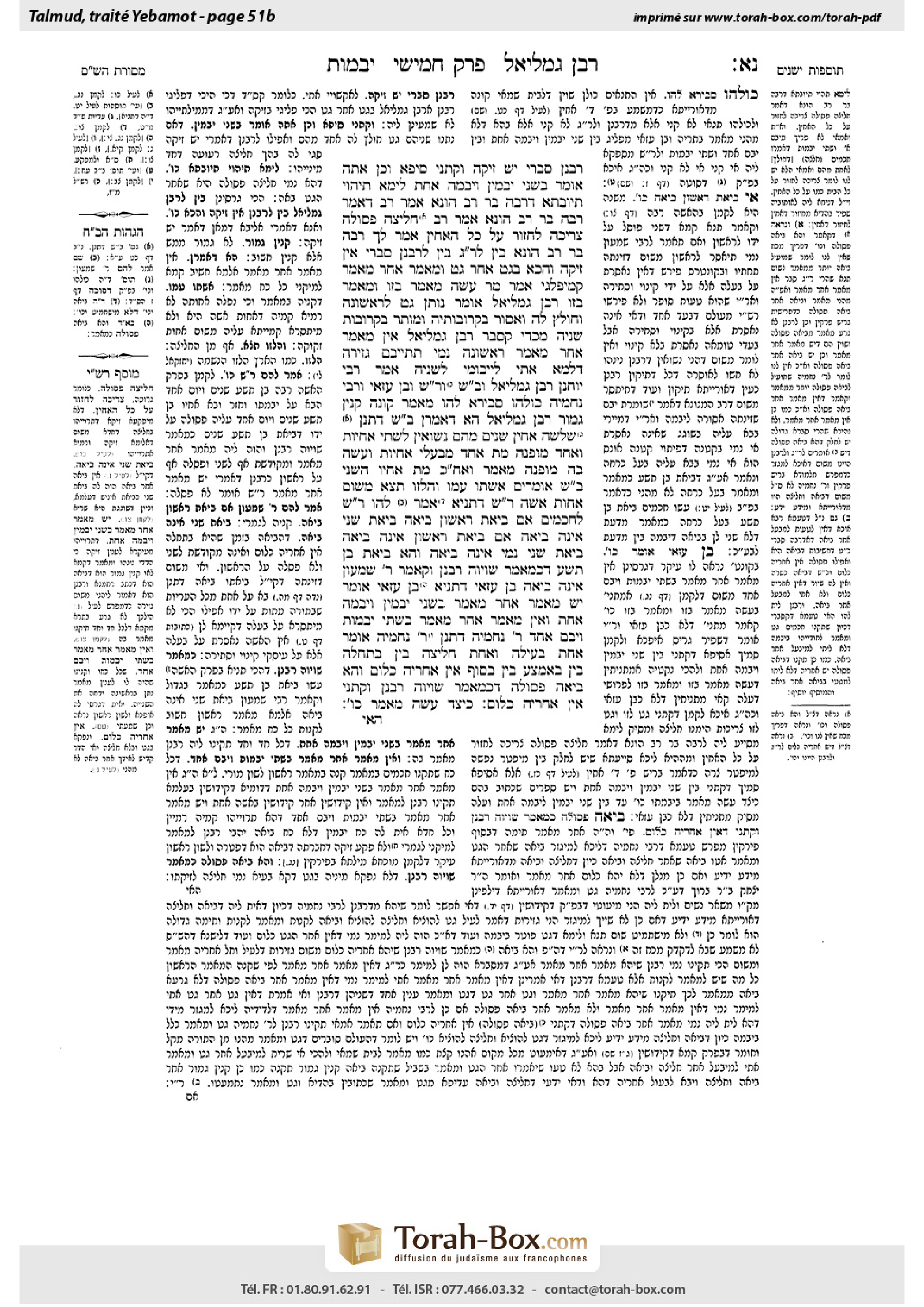
Yevamot 51b: Talmud study for Daf Yomi
Daf Yomi is the daily study of one Talmud folio. Explore 37 tractates with scans, Hebrew text, Sefaria English and AI-generated French translations where annotated.
Passage selection and English or AI-generated French translation are available where the scan has annotations. Daf Study is independent of Torah-Box and Sefaria.
Browse Yevamot · יבמות · All tractatesYevamot 51b text and translations
This page of Yevamot includes the Aramaic text, an English translation and an AI-generated French translation, alongside the scan above.
יבמות נ״א ב · Aramaic and Hebrew text
רַבָּנַן סָבְרִי יֵשׁ זִיקָּה, וְקָתָנֵי סֵיפָא: וְכֵן אַתָּה אוֹמֵר בִּשְׁנֵי יְבָמִין וִיבָמָה אַחַת. לֵימָא תֶּיהְוֵי תְּיוּבְתָּא דְּרַבָּה בַּר רַב הוּנָא אָמַר רַב. דְּאָמַר רַבָּה בַּר רַב הוּנָא אָמַר רַב: חֲלִיצָה פְּסוּלָה — צְרִיכָה לַחֲזוֹר עַל כׇּל הָאַחִין.
אָמַר לָךְ רַבָּה בַּר רַב הוּנָא: בֵּין לְרַבָּן גַּמְלִיאֵל בֵּין לְרַבָּנַן סָבְרִי אֵין זִיקָּה, וְהָכָא בְּגֵט אַחַר גֵּט וּמַאֲמָר אַחַר מַאֲמָר קָמִיפַּלְגִי.
אָמַר מָר: עָשָׂה מַאֲמָר בָּזוֹ וּמַאֲמָר בָּזוֹ, רַבָּן גַּמְלִיאֵל אוֹמֵר: נוֹתֵן גֵּט לָרִאשׁוֹנָה וְחוֹלֵץ לָהּ, וְאָסוּר בִּקְרוֹבוֹתֶיהָ, וּמוּתָּר בִּקְרוֹבוֹת שְׁנִיָּה. מִכְּדֵי קָסָבַר רַבָּן גַּמְלִיאֵל אֵין מַאֲמָר אַחַר מַאֲמָר, רִאשׁוֹנָה נָמֵי תִּתְיַיבֵּם? גְּזֵירָה דִּלְמָא אָתֵי לְיַיבּוֹמֵי לִשְׁנִיָּה.
אָמַר רַבִּי יוֹחָנָן: רַבָּן גַּמְלִיאֵל וּבֵית שַׁמַּאי וְרַבִּי שִׁמְעוֹן וּבֶן עַזַּאי וְרַבִּי נְחֶמְיָה — כּוּלְּהוּ סְבִירָא לְהוּ מַאֲמָר קוֹנֶה קִנְיָן גָּמוּר. רַבָּן גַּמְלִיאֵל — הָא דַּאֲמַרַן.
בֵּית שַׁמַּאי — דִּתְנַן: שְׁלֹשָׁה אַחִין, שְׁנַיִם מֵהֶם נְשׂוּאִין לִשְׁתֵּי אֲחָיוֹת, וְאֶחָד מוּפְנֶה, מֵת אֶחָד מִבַּעֲלֵי אֲחָיוֹת, וְעָשָׂה בָּהּ מוּפְנֶה מַאֲמָר, וְאַחַר כָּךְ מֵת אָחִיו הַשֵּׁנִי, בֵּית שַׁמַּאי אוֹמְרִים: אִשְׁתּוֹ עִמּוֹ, וְהַלֵּזוּ — תֵּצֵא מִשּׁוּם אֲחוֹת אִשָּׁה.
רַבִּי שִׁמְעוֹן — דְּתַנְיָא: אֲמַר לְהוּ רַבִּי שִׁמְעוֹן לַחֲכָמִים: אִם בִּיאַת רִאשׁוֹן בִּיאָה — בִּיאַת שֵׁנִי אֵינָהּ בִּיאָה. אִם בִּיאַת רִאשׁוֹן אֵינָהּ בִּיאָה — בִּיאַת שֵׁנִי נָמֵי אֵינָהּ בִּיאָה. וְהָא בִּיאַת בֶּן תֵּשַׁע, דִּכְמַאֲמָר שַׁוְּיוּהָ רַבָּנַן, וְקָאָמַר רַבִּי שִׁמְעוֹן אֵינָהּ בִּיאָה.
בֶּן עַזַּאי — דְּתַנְיָא, בֶּן עַזַּאי אוֹמֵר: יֵשׁ מַאֲמָר אַחַר מַאֲמָר בִּשְׁנֵי יְבָמִין וִיבָמָה אַחַת, וְאֵין מַאֲמָר אַחַר מַאֲמָר בִּשְׁתֵּי יְבָמוֹת וְיָבָם אֶחָד. רַבִּי נְחֶמְיָה — דִּתְנַן, רַבִּי נְחֶמְיָה אוֹמֵר: אַחַת בְּעִילָה, וְאַחַת חֲלִיצָה, בֵּין בַּתְּחִלָּה בֵּין בָּאֶמְצַע בֵּין בַּסּוֹף — אֵין אַחֲרֶיהָ כְּלוּם. וְהָא בִּיאָה פְּסוּלָה, דִּכְמַאֲמָר שַׁוְּיוּהָ רַבָּנַן, וְקָתָנֵי: אֵין אַחֲרֶיהָ כְּלוּם.
כֵּיצַד? עָשָׂה מַאֲמָר כּוּ׳.
Yevamot 51b · English translation
it can be inferred that the Rabbis hold that the levirate bond is substantial, as it is assumed that they disagree with Rabban Gamliel in this regard as well. And the latter clause of that baraita teaches: And you would say the same with regard to two yevamin and one yevama such that if the two yevamin gave one yevama a bill of divorce, she is exempted by the ḥalitza of one of them. If so, let us say that it is a conclusive refutation of the statement that Rabba bar Rav Huna said that Rav said. For Rabba bar Rav Huna said that Rav said: In cases of invalid ḥalitza, the yevama is required to repeat the ḥalitza with all the brothers. If the ḥalitza was invalid for some reason, all the brothers must perform ḥalitza with the yevama, as her bond with them is not canceled by an invalid ḥalitza.
The Gemara responds: Rabba bar Rav Huna could have said to you: Both Rabban Gamliel and the Rabbis hold that the levirate bond is not substantial, whereas my statement is in accordance with the opinion that the levirate bond is substantial. And here the dispute does not concern the topic of the levirate bond at all, but rather it only involves the explicitly mentioned issue: They disagree with regard to the efficacy of a bill of divorce after a bill of divorce and levirate betrothal after levirate betrothal.
The Master said above in the baraita: If he performed levirate betrothal with this one and levirate betrothal with that one, Rabban Gamliel says: He gives a bill of divorce to the first one and performs ḥalitza with her and is forbidden to her relatives, but he is permitted to the relatives of the second one. The Gemara poses a question: Since Rabban Gamliel holds that levirate betrothal is not effective after levirate betrothal, and the second levirate betrothal is of no consequence, the first woman should also be permitted to enter into levirate marriage. Why must he perform ḥalitza with her? The Gemara answers: It is prohibited due to a rabbinic decree lest he perform levirate marriage with the second woman. The Sages were concerned that in cases where the yavam performed levirate betrothal with both women, if he were permitted to consummate the levirate marriage with the first woman, he might do so with the second woman as well.
§ Rabbi Yoḥanan said: Rabban Gamliel, and Beit Shammai, and Rabbi Shimon, and ben Azzai, and Rabbi Neḥemya, they all hold that levirate betrothal acquires the yevama as a full-fledged acquisition, like a regular betrothal. The source for Rabban Gamliel’s opinion is that which we said above, that levirate betrothal is not effective after levirate betrothal. Rabbi Yoḥanan maintains that the second levirate betrothal is not effective because she was already fully acquired by the first one.
The source for the opinion of Beit Shammai is as we learned in a mishna: In the case of three brothers, two of whom were married to two sisters, and one who was single, the following occurred: The husband of one of the sisters died childless, leaving behind his wife, and the single brother performed levirate betrothal with this wife. Afterward, the second brother died, whereby the second brother’s wife, the sister of the betrothed, happened before him for levirate marriage as well. In this case, Beit Shammai say: His wife remains with him, i.e., the woman he betrothed is considered like his wife, and he is not required to divorce her. And this other leaves the yavam and is exempt from levirate marriage due to the fact that she is the sister of a wife. This indicates that Beit Shammai hold that the levirate betrothal performed with the first woman makes her fully betrothed, thereby nullifying the levirate bond with her sister.
The source for the opinion of Rabbi Shimon is based on the following case cited in a mishna (96b): In the case of a boy aged nine years and one day old who had relations with his yevama, and afterward his brother, who is also nine years and one day old, had relations with her, the second brother disqualifies her from performing levirate marriage with the first one. Rabbi Shimon says he does not disqualify her. As it is taught in a baraita that Rabbi Shimon said to the Rabbis: If the intercourse of the first brother is considered effective intercourse, the intercourse of the second brother is not considered effective intercourse such that it would disqualify her from performing levirate marriage with the first brother, as the first brother has already acquired her through his intercourse. If the intercourse of the first brother is not considered effective intercourse, the intercourse of the second brother is also not effective intercourse. And the Sages considered the intercourse of a nine-year-old boy to be like levirate betrothal, and Rabbi Shimon says that the intercourse of the second boy is not considered intercourse. This proves that in his opinion the intercourse of a nine-year-old fully acquires the yevama, and similarly, so does levirate betrothal.
This source for ben Azzai’s opinion is as it is taught in a baraita that ben Azzai says: Levirate betrothal is effective after levirate betrothal in the case of two yevamin and one yevama, but levirate betrothal is not effective after levirate betrothal in the case of two yevamot and one yavam. Because the latter case involves only one yavam, his levirate betrothal fully acquires the yevama, and therefore the levirate betrothal he performs with the second woman is of no account, as he is already betrothed to the first yevama. The source for Rabbi Neḥemya’s opinion is as we learned in a mishna that Rabbi Neḥemya says: With regard to both intercourse and ḥalitza, whether at the beginning, in the middle, or at the end, nothing is effective after it. And the Sages considered invalid intercourse to be like levirate betrothal, and Rabbi Neḥemya teaches that nothing is effective after it. This indicates that he maintains that no form of acquisition is effective after levirate betrothal, as levirate betrothal completely acquires the yevama.
§ The mishna states: How so? If he performed levirate betrothal with his yevama and gave her a bill of divorce, etc.
Yevamot 51b · Traduction française (IA)
On peut en déduire que les Rabbins considèrent que le lien de lévirat est substantiel, puisqu’on suppose qu’ils sont également en désaccord avec Rabban Gamliel sur ce point. La dernière partie de cette baraïta enseigne : « On pourrait dire la même chose au sujet de deux yevamin et d’une yevama : si les deux yevamin ont donné un acte de divorce à la yevama, la ḥalitsa accomplie par l’un d’eux la dispense. » Dans ce cas, disons que cela réfute définitivement ce que Rabba bar Rav Huna a dit au nom de Rav. En effet, Rabba bar Rav Huna a dit au nom de Rav : Dans les cas de ḥalitsa invalide, la yevama doit répéter la ḥalitsa avec tous les frères. Si la ḥalitsa est invalide pour une raison quelconque, tous les frères doivent accomplir la ḥalitsa avec la yevama, car son lien avec eux n’est pas annulé par une ḥalitsa invalide.
La Guemara répond : Rabba bar Rav Huna aurait pu te dire : Rabban Gamliel et les Rabbins considèrent tous deux que le lien de lévirat n’est pas substantiel, tandis que mon propos suit l’opinion selon laquelle le lien de lévirat est substantiel. Ici, cependant, le désaccord ne porte pas du tout sur la question du lien de lévirat, mais uniquement sur le sujet explicitement mentionné : ils sont en désaccord sur l’efficacité d’un acte de divorce après un autre acte de divorce, et d’un kiddouchin de lévirat après un autre kiddouchin de lévirat.
Le Maître a dit plus haut dans la baraïta : « S’il a accompli un kiddouchin de lévirat avec celle-ci et un kiddouchin de lévirat avec celle-là, Rabban Gamliel dit : Il donne un acte de divorce à la première, accomplit la ḥalitsa avec elle et ne peut épouser ses parentes, mais il peut épouser les parentes de la seconde. » La Guemara pose une question : Puisque, selon Rabban Gamliel, un kiddouchin de lévirat n’est pas effectif après un autre kiddouchin de lévirat, le second kiddouchin de lévirat est sans effet ; la première femme devrait donc elle aussi pouvoir contracter un mariage léviral. Pourquoi doit-il accomplir la ḥalitsa avec elle ? La Guemara répond : C’est interdit en vertu d’un décret rabbinique, de peur qu’il ne contracte un mariage léviral avec la seconde femme. Les Sages craignaient que, si le yavam avait accompli un kiddouchin de lévirat avec les deux femmes et était autorisé à consommer le mariage léviral avec la première, il ne le fasse également avec la seconde.
§ Rabbi Yoḥanan a dit : Rabban Gamliel, Beit Shammaï, Rabbi Shimon, ben Azzai et Rabbi Neḥemya considèrent tous que le kiddouchin de lévirat acquiert la yevama pleinement, comme un kiddouchin ordinaire. La source de l’opinion de Rabban Gamliel est ce que nous avons dit plus haut : un kiddouchin de lévirat n’est pas effectif après un autre kiddouchin de lévirat. Selon Rabbi Yoḥanan, le second kiddouchin de lévirat n’est pas effectif parce que la yevama avait déjà été pleinement acquise par le premier.
La source de l’opinion de Beit Shammaï se trouve dans une Michna que nous avons étudiée : Dans le cas de trois frères, dont deux étaient mariés à deux sœurs et le troisième était célibataire, voici ce qui se produisit : le mari de l’une des sœurs mourut sans enfant, laissant sa femme, et le frère célibataire accomplit un kiddouchin de lévirat avec cette femme. Ensuite, le second frère mourut ; sa femme, qui était la sœur de la femme déjà promise au célibataire par kiddouchin de lévirat, se trouva elle aussi soumise au lévirat. Dans ce cas, Beit Shammaï disent : « Sa femme reste avec lui », c’est-à-dire que la femme avec laquelle il a accompli le kiddouchin est considérée comme son épouse et qu’il n’est pas tenu de divorcer d’elle. Quant à l’autre, elle quitte le yavam et est dispensée du mariage léviral, puisqu’elle est la sœur d’une épouse. Cela indique que, selon Beit Shammaï, le kiddouchin de lévirat accompli avec la première femme la rend pleinement mariée à lui, annulant ainsi le lien de lévirat avec sa sœur.
La source de l’opinion de Rabbi Shimon repose sur le cas suivant, cité dans une Michna (96b) : un garçon âgé de neuf ans et un jour eut des relations avec sa yevama, puis son frère, lui aussi âgé de neuf ans et un jour, eut des relations avec elle. Le second frère l’empêche alors de contracter un mariage léviral avec le premier. Rabbi Shimon dit qu’il ne l’en empêche pas. Une baraïta enseigne que Rabbi Shimon dit aux Rabbins : « Si les rapports du premier frère sont considérés comme des rapports effectifs, ceux du second frère ne sont pas considérés comme des rapports effectifs au point de l’empêcher de contracter un mariage léviral avec le premier, car celui-ci l’a déjà acquise par ses rapports. Si les rapports du premier frère ne sont pas considérés comme effectifs, ceux du second ne le sont pas non plus. » Or, les Sages ont considéré les rapports d’un garçon de neuf ans comme équivalents à un kiddouchin de lévirat, et Rabbi Shimon affirme que les rapports du second garçon ne sont pas considérés comme des rapports. Cela prouve qu’à son avis, les rapports d’un garçon de neuf ans acquièrent pleinement la yevama ; il en va de même du kiddouchin de lévirat.
La source de l’opinion de ben Azzai est la baraïta qui enseigne que ben Azzai dit : « Un kiddouchin de lévirat est effectif après un autre kiddouchin de lévirat dans le cas de deux yevamin et d’une yevama, mais il ne l’est pas dans le cas de deux yevamot et d’un yavam. » Comme ce dernier cas ne comporte qu’un seul yavam, son kiddouchin de lévirat acquiert pleinement la yevama ; le kiddouchin de lévirat qu’il accomplit avec la seconde femme est donc sans effet, puisqu’il est déjà fiancé à la première yevama. La source de l’opinion de Rabbi Neḥemya est une Michna que nous avons étudiée : Rabbi Neḥemya dit qu’en ce qui concerne aussi bien les rapports que la ḥalitsa, qu’ils aient lieu au début, au milieu ou à la fin, rien n’est effectif après eux. Les Sages ont considéré les rapports invalides comme équivalents à un kiddouchin de lévirat, et Rabbi Neḥemya enseigne que rien n’est effectif après eux. Cela indique qu’il considère qu’aucune forme d’acquisition n’est effective après un kiddouchin de lévirat, car celui-ci acquiert entièrement la yevama.
§ La Michna énonce : « Comment cela ? S’il a accompli un kiddouchin de lévirat avec sa yevama et lui a donné un acte de divorce, etc. »
Traduction française générée par IA à partir de l’édition anglaise de Sefaria. Vérifie toujours un passage avec le texte source.
Text from Sefaria: William Davidson Edition - Vocalized Aramaic (CC BY NC); William Davidson Edition - English (CC BY NC).