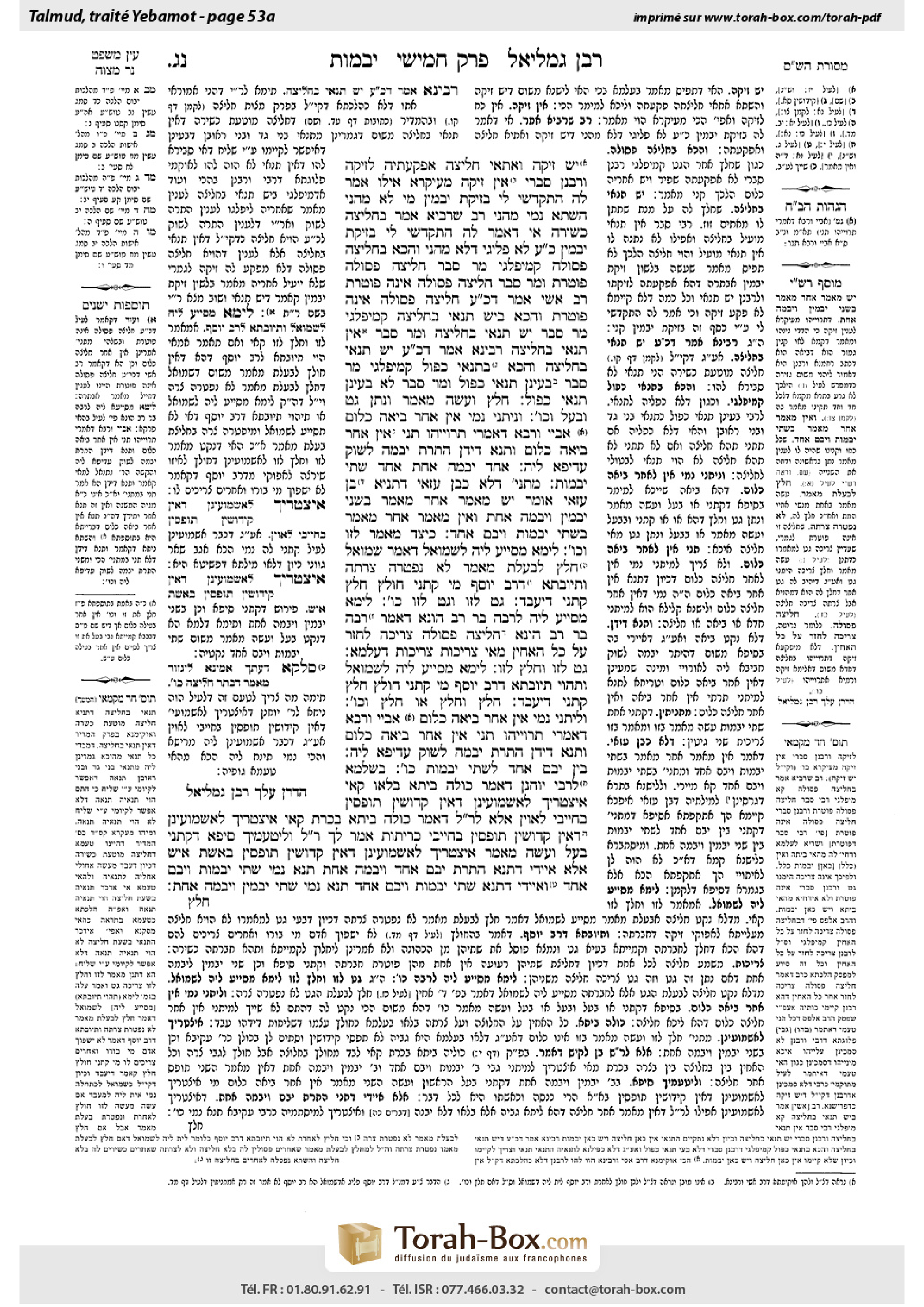
Yevamot 53a: Talmud study for Daf Yomi
Daf Yomi is the daily study of one Talmud folio. Explore 37 tractates with scans, Hebrew text, Sefaria English and AI-generated French translations where annotated.
Passage selection and English or AI-generated French translation are available where the scan has annotations. Daf Study is independent of Torah-Box and Sefaria.
Browse Yevamot · יבמות · All tractatesYevamot 53a text and translations
This page of Yevamot includes the Aramaic text, an English translation and an AI-generated French translation, alongside the scan above.
יבמות נ״ג א · Aramaic and Hebrew text
יֵשׁ זִיקָה, וַאֲתַאי חֲלִיצָה אַפְקַעְתַּיהּ לְזִיקָּה. וְרַבָּנַן סָבְרִי: אֵין זִיקָּה. מֵעִיקָּרָא אִילּוּ אָמַר לַהּ: ״הִתְקַדְּשִׁי לִי בְּזִיקַּת יְבָמִין״, מִי לָא מַהֲנֵי? הַשְׁתָּא נָמֵי מַהֲנֵי.
רַב שֵׁרֵבְיָא אָמַר: בַּחֲלִיצָה כְּשֵׁירָה, אִי דְּאָמַר לַהּ ״הִתְקַדְּשִׁי לִי בְּזִיקַּת יְבָמִין״ — כּוּלֵּי עָלְמָא לָא פְּלִיגִי דְּלָא מַהֲנֵי. וְהָכָא בַּחֲלִיצָה פְּסוּלָה קָמִיפַּלְגִי: מָר סָבַר חֲלִיצָה פְּסוּלָה פּוֹטֶרֶת, וּמָר סָבַר חֲלִיצָה פְּסוּלָה אֵינָהּ פּוֹטֶרֶת.
רַב אָשֵׁי אָמַר: דְּכוּלֵּי עָלְמָא חֲלִיצָה פְּסוּלָה אֵינָהּ פּוֹטֶרֶת, וְהָכָא בְּיֵשׁ תְּנַאי בַּחֲלִיצָה קָמִיפַּלְגִי: מָר סָבַר יֵשׁ תְּנַאי בַּחֲלִיצָה, וּמַר סָבַר אֵין תְּנַאי בַּחֲלִיצָה.
רָבִינָא אָמַר: דְּכוּלֵּי עָלְמָא יֵשׁ תְּנַאי בַּחֲלִיצָה, וְהָכָא בִּתְנַאי כָּפוּל קָמִיפַּלְגִי: מָר סָבַר בָּעֵינַן תְּנַאי כָּפוּל, וּמָר סָבַר לָא בָּעֵינַן תְּנַאי כָּפוּל.
חָלֵץ וְעָשָׂה מַאֲמָר וְנָתַן גֵּט וּבָעַל וְכוּ׳. וְנִיתְנֵי נָמֵי אֵין אַחַר בִּיאָה כְּלוּם? אַבָּיֵי וְרָבָא דְּאָמְרִי תַּרְוַיְיהוּ: תָּנֵי אֵין אַחַר בִּיאָה כְּלוּם. וְתַנָּא דִּידַן? הַתָּרַת יְבָמָה לַשּׁוּק עֲדִיפָא לֵיהּ.
אֶחָד יְבָמָה אַחַת, אֶחָד שְׁתֵּי יְבָמוֹת. מַתְנִיתִין דְּלָא כְּבֶן עַזַּאי, דְּתַנְיָא, בֶּן עַזַּאי אוֹמֵר: יֵשׁ מַאֲמָר אַחַר מַאֲמָר בִּשְׁנֵי יְבָמִין וִיבָמָה אַחַת, וְאֵין מַאֲמָר אַחַר מַאֲמָר בִּשְׁתֵּי יְבָמוֹת וְיָבָם אֶחָד.
כֵּיצַד — מַאֲמָר לָזוֹ וְכוּ׳. לֵימָא מְסַיַּיע לֵיהּ לִשְׁמוּאֵל, דְּאָמַר שְׁמוּאֵל: חָלַץ לְבַעֲלַת מַאֲמָר — לֹא נִפְטְרָה צָרָתָהּ.
וּתְיוּבְתָּא דְּרַב יוֹסֵף: מִי קָתָנֵי ״חוֹלֵץ״? ״חָלַץ״ קָתָנֵי, דִּיעֲבַד.
גֵּט לָזוֹ וְגֵט לָזוֹ כּוּ׳. לֵימָא מְסַיַּיע לֵיהּ לְרַבָּה בַּר רַב הוּנָא, דְּאָמַר רַבָּה בַּר רַב הוּנָא: חֲלִיצָה פְּסוּלָה — צְרִיכָה לְחַזֵּר עַל כׇּל הָאַחִין. מַאי צְרִיכוֹת — צְרִיכוֹת דְּעָלְמָא.
גֵּט לָזוֹ וְחָלַץ לְזוֹ. לֵימָא מְסַיַּיע לֵיהּ לִשְׁמוּאֵל, וְתִהְוֵי תְּיוּבְתָּא דְּרַב יוֹסֵף! מִי קָתָנֵי ״חוֹלֵץ״? ״חָלַץ״ קָתָנֵי, דִּיעֲבַד.
חָלַץ וְחָלַץ אוֹ חָלַץ וְכוּ׳. וְלִיתְנֵי נָמֵי אֵין אַחַר בִּיאָה כְּלוּם! אַבָּיֵי וְרָבָא דְּאָמְרִי תַּרְוַיְיהוּ: תָּנֵי אֵין אַחַר בִּיאָה כְּלוּם. וְתַנָּא דִּידַן — הַתָּרַת יְבָמָה לַשּׁוּק עֲדִיפָא לֵיהּ.
בֵּין יָבָם אֶחָד לִשְׁתֵּי יְבָמוֹת כּוּ׳. בִּשְׁלָמָא לְרַבִּי יוֹחָנָן, דְּאָמַר כּוּלֵּהּ בֵּיתָא בְּלָאו קָאֵי — אִיצְטְרִיךְ לְאַשְׁמוֹעִינַן דְּאֵין קִדּוּשִׁין תּוֹפְסִין בְּחַיָּיבֵי לָאוִין.
אֶלָּא לְרֵישׁ לָקִישׁ, דְּאָמַר כּוּלֵּהּ בֵּיתָא בְּכָרֵת קָאֵי — אִיצְטְרִיךְ לְאַשְׁמוֹעִינַן דְּאֵין קִדּוּשִׁין תּוֹפְסִין בְּחַיָּיבֵי כָּרֵיתוֹת!
אָמַר לָךְ רֵישׁ לָקִישׁ: וְלִיטַעְמָיךְ, סֵיפָא דְּקָתָנֵי בָּעַל וְעָשָׂה מַאֲמָר — אִיצְטְרִיךְ לְאַשְׁמוֹעִינַן דְּאֵין קִדּוּשִׁין תּוֹפְסִין בְּאֵשֶׁת אִישׁ?
אֶלָּא: אַיְּידֵי דִּתְנָא הַתָּרַת יָבָם אֶחָד וִיבָמָה אַחַת, תְּנָא נָמֵי שְׁתֵּי יְבָמוֹת וְיָבָם אֶחָד. וְאַיְּידֵי דִּתְנָא שְׁתֵּי יְבָמוֹת וְיָבָם אֶחָד, תְּנָא נָמֵי שְׁתֵּי יְבָמִין וִיבָמָה אַחַת.
Yevamot 53a · English translation
that the levirate bond is substantial, and this betrothal is based on the levirate bond. And in this case, the ḥalitza comes and releases the levirate bond. Therefore this type of betrothal does not acquire the ḥalutza. But the Rabbis hold that the levirate bond is not substantial, that is, the bond itself does not create a connection between the yavam and yevama, and that in general, levirate betrothal acquires a yevama as a form of betrothal unrelated to the levirate bond. And consequently, at the outset, if he had said to her: Be betrothed to me by the levirate bond, would this not be effective? Now too, after ḥalitza, even without the bond, it should likewise be effective.
Rav Sherevya suggested a different point of dispute and said: In a case when the woman performed valid ḥalitza, if he later said to her: Be betrothed to me by the levirate bond, everyone agrees that it is not effective, as there is no longer any bond. And here, they disagree with regard to one who performed invalid ḥalitza. One Sage, Rabbi Yehuda HaNasi, holds that invalid ḥalitza exempts her from the levirate bond and disqualifies her from betrothal as a yevama. And one Sage, i.e., the Rabbis, holds that invalid ḥalitza does not fully exempt her, and some element of the levirate bond remains intact and she can therefore be betrothed with the levirate bond.
Rav Ashi said: Everyone agrees that invalid ḥalitza does not exempt her and does not entirely nullify the bond. And here they disagree as to whether a condition is effective with regard to ḥalitza. When the yavam states he is performing ḥalitza on the condition that the yevama give him one hundred dinars, for example, is this condition effective and therefore the ḥalitza is nullified if the condition is not fulfilled? One Sage, i.e., the Rabbis, holds that a condition is effective with regard to ḥalitza. If the yevama fails to comply with the condition, the ḥalitza is ineffective and she can still be betrothed with the levirate bond. And one Sage, Rabbi Yehuda HaNasi, holds that a condition is not effective with regard to ḥalitza, and therefore the ḥalitza is always effective, and the subsequent levirate betrothal is ineffective.
Ravina said: Everyone agrees that a condition is effective with regard to ḥalitza, and here they disagree with regard to a compound condition. One Sage, Rabbi Yehuda HaNasi, holds that we require a compound condition. The man must explicitly stipulate that the ḥalitza should be effective if the condition is upheld, and that it should not be effective if she does not fulfill the condition. If he did not state both the positive and negative sides of the condition it does not take effect, and the ḥalitza is effective and the levirate bond is canceled. Consequently, betrothal by the levirate bond is ineffective. And one Sage, i.e., the Rabbis, holds that we do not require a compound condition. Therefore, the condition applies and cancels the ḥalitza, which leaves the levirate bond intact.
§ The mishna teaches: If the yavam performed ḥalitza and then either performed levirate betrothal, or gave a bill of divorce, or engaged in intercourse, nothing is effective after ḥalitza. The Gemara asks: And let the tanna likewise teach that nothing is effective after intercourse, for he also mentioned the case of one who engaged in intercourse and then proceeded to perform other actions such as levirate betrothal, divorce and ḥalitza. Indeed, Abaye and Rava both say that the mishna should teach: Nothing is effective after intercourse, as this clause is fit to be inserted into the mishna. The Gemara asks: And the tanna of our mishna; why did he not state this? The Gemara explains: The permission for a yevama to marry a member of the public is preferable to him. He preferred to teach cases in which the yevama is permitted to marry any man from the general public as opposed to a situation where she is married to the yavam.
The mishna teaches that all the halakhot with regard to levirate betrothal after levirate betrothal and the like apply both in cases of one yevama to one yavam, as well as in cases of two yevamot to one yavam. The Gemara comments: The mishna is not in accordance with the opinion of ben Azzai. As it is taught in a baraita: Ben Azzai says: Levirate betrothal is effective after levirate betrothal in the case of two yevamin and one yevama, but levirate betrothal is not effective after levirate betrothal in the case of two yevamot and one yavam. The tanna of the mishna, in contrast, does not differentiate between the cases.
The mishna further teaches: How so? If he performed levirate betrothal with this one and performed ḥalitza with that one, the first woman requires a bill of divorce to cancel the levirate betrothal. The Gemara suggests: Let us say that this teaching supports the opinion of Shmuel. As Shmuel said: If a yavam performed ḥalitza with the woman who received levirate betrothal, then the rival wife is not exempt as this ḥalitza is invalid. The fact that the Gemara does not state that the ḥalitza be performed with the woman who received levirate betrothal indicates that this ḥalitza is not a valid ḥalitza and would not be sufficient to exempt the rival wife.
And this would constitute a conclusive refutation of Rav Yosef’s opinion, for he holds that it is preferable to perform ḥalitza with the woman who received levirate betrothal and thereby exempt the second woman. As the first woman requires a bill of divorce and therefore is necessarily disqualified from marrying into the priesthood, it is preferable to perform ḥalitza with her as well and consequently leave the second woman eligible to marry a priest. The Gemara refutes this claim: Does the mishna teach: He should perform ḥalitza, which would imply that the yavam should do so ab initio? It teaches that he performed ḥalitza, implying that the ruling in the mishna is after the fact. Therefore, there is no indication in the mishna that the yavam should perform ḥalitza with the second woman, and it is possible that if he were to perform ḥalitza with the first woman he would thereby exempt the second one. It is simply that the particular case discussed by the mishna here concerns a man who performed levirate betrothal with this woman and ḥalitza with that one.
It is further taught in the mishna: If he gave a bill of divorce to this one and a bill of divorce to that one, they require ḥalitza from him. The Gemara suggests: Let us say that it supports the statement of Rabba bar Rav Huna. As Rabba bar Rav Huna said: In cases of invalid ḥalitza, the yevama is required to repeat the ḥalitza with all of the brothers, as that single invalid ḥalitza is insufficient. Similarly, in this case of invalid ḥalitza, it would be necessary to perform ḥalitza with all of the yevamot. The Gemara rejects this suggestion: What is the meaning of require in this context? It means that such women require in general. The plural form does not refer to all the yevamot mentioned in the mishna, but rather it means that all yevamot in similar situations require ḥalitza.
It was taught in the mishna: If he gave a bill of divorce to this one and performed ḥalitza with that one, nothing is effective after ḥalitza. The Gemara suggests: Let us say that this supports the opinion of Shmuel, as it indicates that the yavam should perform ḥalitza with the rival wife rather than the woman who received a bill of divorce. And it would likewise be a conclusive refutation of the opinion of Rav Yosef, who prefers performing ḥalitza with the disqualified woman. The Gemara again rejects this proof: Does it teach: He should perform ḥalitza, a ruling ab initio? It teaches: He performed ḥalitza, which is only after the fact, meaning he acted in that manner in this particular case.
The mishna taught that if he performed ḥalitza with one woman and then performed ḥalitza with another one, or he performed ḥalitza and then proceeded to perform levirate betrothal, nothing is effective after ḥalitza. The Gemara suggests: And let the tanna also teach: Nothing is effective after intercourse, as this is indicated in the mishna as well. The Gemara answers: Indeed, Abaye and Rava both say that it should teach: Nothing is effective after intercourse. The Gemara comments: And the tanna of our mishna did not state this because the permission for a yevama to marry a member of the public is preferable to him, and he therefore specified a case that involves ḥalitza.
§ It was taught in the mishna: Nothing is effective after ḥalitza, both in cases of one yavam to two yevamot, as well as cases of two yevamin to one yevama. The Gemara comments: Granted, according to the opinion of Rabbi Yoḥanan, who said that once a yavam has performed ḥalitza with his yevama, the entire household, the woman who performed ḥalitza as well as her rival wives, is liable due to a prohibition derived from the verse “So shall it be done to the man who does not build his brother’s house” (Deuteronomy 25:9), but the women are not liable to karet due to the prohibition with regard to a brother’s wife. In light of Rabbi Yoḥanan’s ruling, it was necessary to teach us that betrothal does not take effect on the rival wife of the woman who performed ḥalitza, despite the fact that she is only liable for violating a prohibition, in accordance with the opinion of Rabbi Akiva.
However, according to Reish Lakish, who said that the entire household, apart from the woman who received ḥalitza, is liable to receive karet, was it necessary to teach us that betrothal does not take effect on forbidden relations for which one is liable to receive karet? According to Reish Lakish, after the yavam performs ḥalitza, the mitzva of levirate marriage is canceled and the karet prohibition against marrying a brother’s wife is once again in force. As all agree that betrothal does not take effect on those liable to receive karet, it is unnecessary for the mishna to teach this ruling.
The Gemara answers: Reish Lakish could have said to you: And according to your reasoning, that the mishna would not be teaching us an apparently obvious halakha, consider the latter clause of the mishna, which teaches that if a yavam engaged in intercourse and another yavam performed levirate betrothal with the same woman, the levirate betrothal is not effective. Now was it necessary to teach us that betrothal is not effective for a married woman? Once a yavam has engaged in relations with a yevama she is his full-fledged wife, and certainly no other betrothal is effective.
Rather, it must be that not every clause in the mishna teaches a novel halakha, and the reasoning of the tanna is as follows: Since he teaches the release of the bond between one yavam and one yevama, he also teaches the case of two yevamot and one yavam, and since he teaches the case of two yevamot and one yavam, he also teaches the case of two yevamin and one yevama. The tanna therefore listed all possible cases even though we do not learn a novel halakha from each and every one.
Yevamot 53a · Traduction française (IA)
que le lien léviratique est substantiel et que ces kidouchin reposent sur ce lien. Dans ce cas, la ḥalitsa vient dénouer le lien léviratique. Par conséquent, cette forme de kidouchin ne rend pas la femme qui a reçu la ḥalitsa acquise. Mais les Sages estiment que le lien léviratique n’est pas substantiel, c’est-à-dire que le lien lui-même ne crée pas de rapport entre le yavam et la yevama, et que, de manière générale, les kidouchin léviratiques acquièrent la yevama comme une forme de kidouchin sans rapport avec le lien léviratique. Par conséquent, au départ, s’il lui avait dit : « Sois-moi consacrée par le lien léviratique », cela n’aurait-il pas été valable ? À présent aussi, après la ḥalitsa, même en l’absence de ce lien, cela devrait également être valable.
Rav Sherevya proposa une autre explication du point de désaccord et dit : dans le cas où la femme a accompli une ḥalitsa valide, si l’homme lui dit ensuite : « Sois-moi consacrée par le lien léviratique », tous conviennent que cela n’est pas valable, puisqu’il n’y a plus de lien. Ici, ils sont en désaccord au sujet de celui qui a accompli une ḥalitsa invalide. Un Sage, Rabbi Yehouda HaNassi, estime qu’une ḥalitsa invalide la libère du lien léviratique et la rend inapte à être consacrée en tant que yevama. Un autre Sage, c’est-à-dire les Sages, estime qu’une ḥalitsa invalide ne la libère pas complètement : une part du lien léviratique subsiste, et elle peut donc être consacrée par le lien léviratique.
Rav Ashi dit : tous conviennent qu’une ḥalitsa invalide ne la libère pas et n’annule pas entièrement le lien. Ils sont en désaccord sur la question de savoir si une condition est opérante en matière de ḥalitsa. Lorsque le yavam déclare qu’il accomplit la ḥalitsa à condition que la yevama lui donne cent dinars, par exemple, cette condition est-elle opérante, de sorte que la ḥalitsa est annulée si la condition n’est pas remplie ? Un Sage, c’est-à-dire les Sages, estime qu’une condition est opérante en matière de ḥalitsa. Si la yevama ne respecte pas la condition, la ḥalitsa est invalide et elle peut toujours être consacrée par le lien léviratique. L’autre Sage, Rabbi Yehouda HaNassi, estime qu’une condition n’est pas opérante en matière de ḥalitsa ; la ḥalitsa est donc toujours effective, et les kidouchin léviratiques ultérieurs sont sans effet.
Ravina dit : tous conviennent qu’une condition est opérante en matière de ḥalitsa ; ils sont ici en désaccord au sujet de la condition double. Un Sage, Rabbi Yehouda HaNassi, estime qu’une condition double est requise. L’homme doit stipuler explicitement que la ḥalitsa sera valide si la condition est respectée et qu’elle sera invalide si la femme ne remplit pas la condition. S’il n’a pas énoncé les deux termes, positif et négatif, de la condition, celle-ci ne prend pas effet ; la ḥalitsa est alors valide et le lien léviratique est annulé. Par conséquent, les kidouchin par le lien léviratique sont sans effet. L’autre Sage, c’est-à-dire les Sages, estime qu’une condition double n’est pas requise. La condition s’applique donc et annule la ḥalitsa, ce qui maintient le lien léviratique.
§ La Michna enseigne : si le yavam a accompli la ḥalitsa puis a soit procédé à des kidouchin léviratiques, soit remis un acte de divorce, soit eu des rapports, rien n’est opérant après la ḥalitsa. La Guemara demande : le tanna ne devrait-il pas également enseigner que rien n’est opérant après des rapports, puisqu’il a aussi mentionné le cas de celui qui a eu des rapports avant d’accomplir ensuite d’autres actes, tels que des kidouchin léviratiques, un divorce et une ḥalitsa ? Abayé et Rava disent effectivement tous deux que la Michna devrait enseigner : « Rien n’est opérant après des rapports », car cette clause pourrait être insérée dans la Michna. La Guemara demande : pourquoi le tanna de notre Michna ne l’a-t-il pas énoncée ? La Guemara explique : le fait que la yevama soit autorisée à épouser un homme du public est préférable à ses yeux. Il a préféré enseigner les cas où la yevama est autorisée à épouser n’importe quel homme plutôt qu’une situation où elle est mariée au yavam.
La Michna enseigne que toutes les halakhot relatives aux kidouchin léviratiques après des kidouchin léviratiques, et aux cas semblables, s’appliquent aussi bien au cas d’une yevama et d’un yavam qu’à celui de deux yevamot et d’un yavam. La Guemara fait remarquer que la Michna ne suit pas l’opinion de Ben Azaï. Car il est enseigné dans une baraïta : Ben Azaï dit que des kidouchin léviratiques sont opérants après d’autres kidouchin léviratiques dans le cas de deux yevamin et d’une yevama, mais que des kidouchin léviratiques ne sont pas opérants après d’autres kidouchin léviratiques dans le cas de deux yevamot et d’un yavam. Le tanna de la Michna, en revanche, ne fait pas de distinction entre ces cas.
La Michna enseigne encore : comment cela ? S’il a procédé à des kidouchin léviratiques avec l’une et accompli la ḥalitsa avec l’autre, la première femme doit recevoir un acte de divorce pour annuler les kidouchin léviratiques. La Guemara suggère : disons que cet enseignement vient étayer l’opinion de Shmouel. Shmouel a dit que si un yavam accomplit la ḥalitsa avec la femme qui a reçu les kidouchin léviratiques, l’épouse rivale n’est pas libérée, car cette ḥalitsa est invalide. Le fait que la Guemara ne précise pas que la ḥalitsa doit être accomplie avec la femme qui a reçu les kidouchin léviratiques indique que cette ḥalitsa n’est pas valide et ne suffirait pas à libérer l’épouse rivale.
Cela constituerait une réfutation irréfutable de l’opinion de Rav Yosef, car il estime qu’il est préférable d’accomplir la ḥalitsa avec la femme qui a reçu les kidouchin léviratiques et de libérer ainsi la seconde femme. Puisque la première femme doit recevoir un acte de divorce et est donc nécessairement disqualifiée pour épouser un membre de la prêtrise, il est préférable d’accomplir également la ḥalitsa avec elle et de laisser ainsi la seconde femme apte à épouser un prêtre. La Guemara réfute cet argument : la Michna enseigne-t-elle : « Il doit accomplir la ḥalitsa », ce qui impliquerait que le yavam devrait le faire a priori ? Elle enseigne qu’il a accompli la ḥalitsa, ce qui implique que la règle de la Michna concerne un cas a posteriori. La Michna n’indique donc pas que le yavam doit accomplir la ḥalitsa avec la seconde femme, et il est possible que, s’il accomplissait la ḥalitsa avec la première femme, il libérerait ainsi la seconde. Le cas particulier traité ici par la Michna est simplement celui d’un homme qui a procédé à des kidouchin léviratiques avec cette femme et accompli la ḥalitsa avec l’autre.
La Michna enseigne encore : s’il a remis un acte de divorce à l’une et un acte de divorce à l’autre, elles doivent recevoir de lui la ḥalitsa. La Guemara suggère : disons que cela étaye la déclaration de Rabba bar Rav Houna. Car Rabba bar Rav Houna a dit que, dans les cas de ḥalitsa invalide, la yevama doit répéter la ḥalitsa avec chacun des frères, puisqu’une seule ḥalitsa invalide ne suffit pas. De même, dans ce cas de ḥalitsa invalide, il serait nécessaire d’accomplir la ḥalitsa avec toutes les yevamot. La Guemara rejette cette suggestion : que signifie ici « doivent recevoir » ? Cela signifie que, de manière générale, de telles femmes doivent la recevoir. Le pluriel ne se rapporte pas à toutes les yevamot mentionnées dans la Michna ; il signifie plutôt que toutes les yevamot dans des situations semblables doivent recevoir la ḥalitsa.
La Michna enseigne : s’il a remis un acte de divorce à l’une et accompli la ḥalitsa avec l’autre, rien n’est opérant après la ḥalitsa. La Guemara suggère : disons que cela étaye l’opinion de Shmouel, car cela indique que le yavam devrait accomplir la ḥalitsa avec l’épouse rivale plutôt qu’avec la femme qui a reçu un acte de divorce. Cela constituerait également une réfutation irréfutable de l’opinion de Rav Yosef, qui préfère accomplir la ḥalitsa avec la femme disqualifiée. La Guemara rejette de nouveau cette preuve : la Michna enseigne-t-elle : « Il doit accomplir la ḥalitsa », comme une règle a priori ? Elle enseigne : « Il a accompli la ḥalitsa », ce qui ne vaut qu’a posteriori, c’est-à-dire qu’il a agi ainsi dans ce cas particulier.
La Michna enseigne que s’il a accompli la ḥalitsa avec une femme puis avec une autre, ou s’il a accompli la ḥalitsa puis procédé à des kidouchin léviratiques, rien n’est opérant après la ḥalitsa. La Guemara suggère : le tanna ne devrait-il pas également enseigner que rien n’est opérant après des rapports, comme cela ressort aussi de la Michna ? La Guemara répond : Abayé et Rava disent effectivement tous deux qu’elle devrait enseigner : « Rien n’est opérant après des rapports. » La Guemara fait remarquer que le tanna de notre Michna ne l’a pas énoncé parce que le fait que la yevama soit autorisée à épouser un homme du public est préférable à ses yeux ; il a donc précisé un cas impliquant la ḥalitsa.
§ La Michna enseigne : rien n’est opérant après la ḥalitsa, aussi bien dans le cas d’un yavam et de deux yevamot que dans celui de deux yevamin et d’une yevama. La Guemara fait remarquer : cela se comprend selon l’opinion de Rabbi Yoḥanan, qui a dit qu’une fois que le yavam a accompli la ḥalitsa avec sa yevama, toute la maisonnée — la femme qui a accompli la ḥalitsa ainsi que ses épouses rivales — est passible d’une interdiction dérivée du verset : « On agira ainsi envers l’homme qui ne bâtit pas la maison de son frère » (Deutéronome 25,9), mais que les femmes ne sont pas passibles de karet en raison de l’interdiction relative à l’épouse d’un frère. À la lumière de l’enseignement de Rabbi Yoḥanan, il était nécessaire de nous enseigner que les kidouchin ne prennent pas effet avec l’épouse rivale de la femme qui a accompli la ḥalitsa, bien qu’elle ne soit passible que d’une interdiction, conformément à l’opinion de Rabbi Akiva.
Cependant, selon Reish Lakish, qui a dit que toute la maisonnée, à l’exception de la femme qui a reçu la ḥalitsa, est passible de karet, était-il nécessaire de nous enseigner que les kidouchin ne prennent pas effet avec des femmes interdites dont la relation rend passible de karet ? Selon Reish Lakish, après que le yavam a accompli la ḥalitsa, la mitsva du mariage léviratique est annulée et l’interdiction, assortie de karet, d’épouser la femme d’un frère est de nouveau en vigueur. Puisque tous conviennent que les kidouchin ne prennent pas effet avec celles dont la relation rend passible de karet, il n’était pas nécessaire que la Michna enseigne cette règle.
La Guemara répond : Reish Lakish aurait pu te dire : selon ton raisonnement, la Michna n’enseignerait pas une halakha apparemment évidente ; considère donc la dernière clause de la Michna, qui enseigne que si un yavam a eu des rapports avec une femme et qu’un autre yavam a procédé à des kidouchin léviratiques avec cette même femme, ces kidouchin léviratiques sont sans effet. Était-il nécessaire de nous enseigner que les kidouchin ne prennent pas effet avec une femme mariée ? Dès qu’un yavam a eu des rapports avec une yevama, celle-ci devient pleinement son épouse ; il est donc évident qu’aucun autre kidouchin ne prend effet.
Il faut plutôt conclure que toutes les clauses de la Michna n’enseignent pas une halakha nouvelle, et que le raisonnement du tanna est le suivant : puisqu’il enseigne la dissolution du lien entre un yavam et une yevama, il enseigne aussi le cas de deux yevamot et d’un yavam ; et puisqu’il enseigne le cas de deux yevamot et d’un yavam, il enseigne également celui de deux yevamin et d’une yevama. Le tanna a donc énuméré tous les cas possibles, même si chacun d’eux n’apporte pas une halakha nouvelle.
Traduction française générée par IA à partir de l’édition anglaise de Sefaria. Vérifie toujours un passage avec le texte source.
Text from Sefaria: William Davidson Edition - Vocalized Aramaic (CC BY NC); William Davidson Edition - English (CC BY NC).