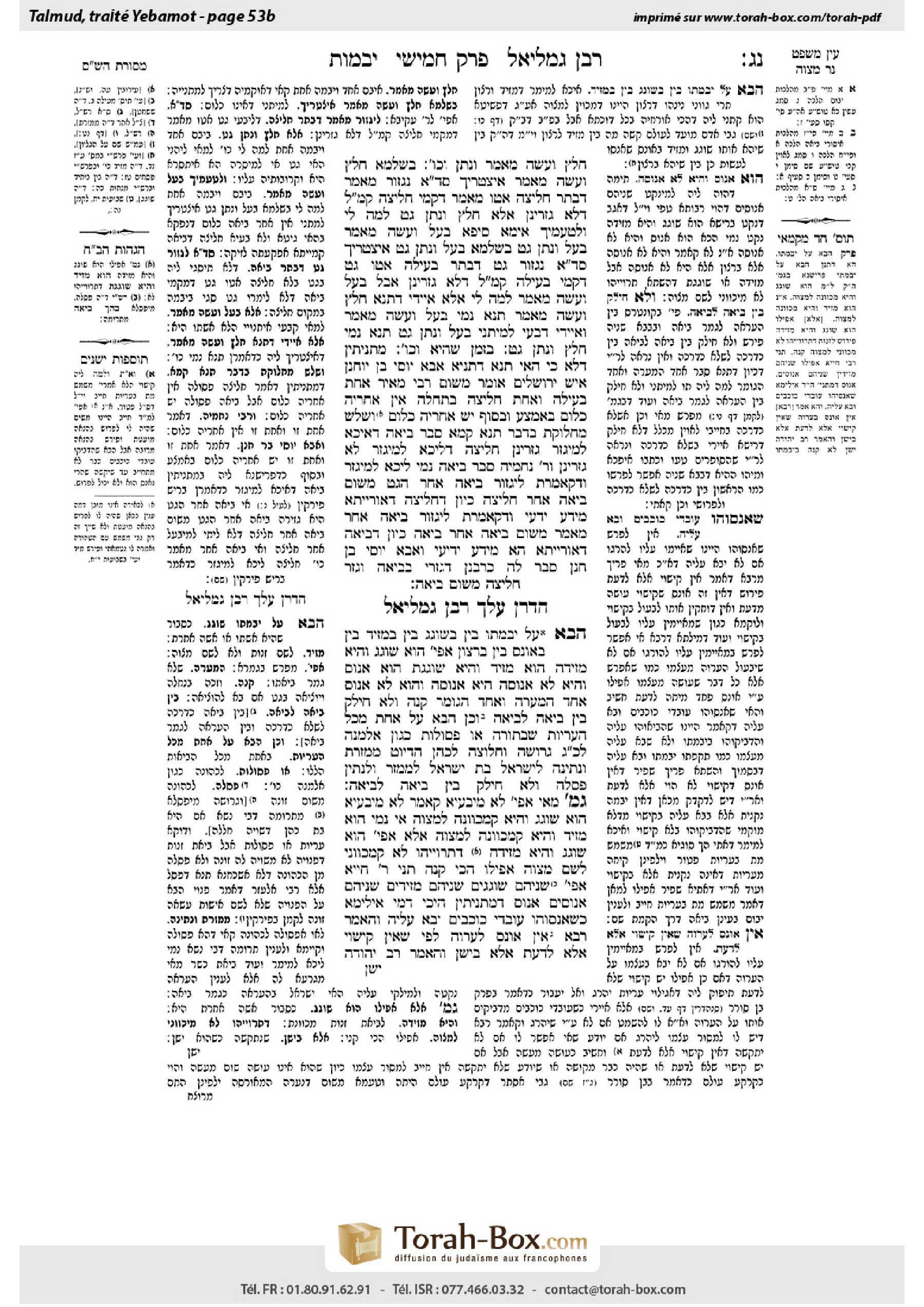
Yevamot 53b: Talmud study for Daf Yomi
Daf Yomi is the daily study of one Talmud folio. Explore 37 tractates with scans, Hebrew text, Sefaria English and AI-generated French translations where annotated.
Passage selection and English or AI-generated French translation are available where the scan has annotations. Daf Study is independent of Torah-Box and Sefaria.
Browse Yevamot · יבמות · All tractatesYevamot 53b text and translations
This page of Yevamot includes the Aramaic text, an English translation and an AI-generated French translation, alongside the scan above.
יבמות נ״ג ב · Aramaic and Hebrew text
חָלַץ וְעָשָׂה מַאֲמָר וְנָתַן וְכוּ׳. בִּשְׁלָמָא חָלַץ וְעָשָׂה מַאֲמָר, אִיצְטְרִיךְ, סָלְקָא דַּעְתָּךְ אָמֵינָא: נִגְזוֹר מַאֲמָר דְּבָתַר חֲלִיצָה אַטּוּ מַאֲמָר דְּקַמֵּי חֲלִיצָה, קָא מַשְׁמַע לַן דְּלָא גָּזְרִינַן. אֶלָּא חָלַץ וְנָתַן גֵּט לְמָה לִי?
וּלְטַעְמָיךְ, אֵימָא סֵיפָא: בָּעַל וְעָשָׂה מַאֲמָר, בָּעַל וְנָתַן גֵּט — בִּשְׁלָמָא בָּעַל וְנָתַן גֵּט אִיצְטְרִיךְ, סָלְקָא דַּעְתָּךְ אָמֵינָא: נִגְזוֹר גֵּט דְּבָתַר בְּעִילָה אַטּוּ גֵּט דְּקַמֵּי בְּעִילָה, קָא מַשְׁמַע לַן דְּלָא גָּזְרִינַן, אֲבָל בָּעַל וְעָשָׂה מַאֲמָר לְמָה לִי?
אֶלָּא: אַיְּידֵי דִּתְנָא חָלַץ וְעָשָׂה מַאֲמָר, תְּנָא נָמֵי בָּעַל וְעָשָׂה מַאֲמָר. וְאַיְּידֵי דְבָעֵי לְמִיתְנֵי בָּעַל וְנָתַן גֵּט, תְּנָא נָמֵי חָלַץ וְנָתַן גֵּט.
בִּזְמַן שֶׁהִיא וְכוּ׳. מַתְנִיתִין דְּלָא כִּי הַאי תַּנָּא, דְּתַנְיָא: אַבָּא יוֹסֵי בֶּן יוֹחָנָן אִישׁ יְרוּשָׁלַיִם אוֹמֵר מִשּׁוּם רַבִּי מֵאִיר: אַחַת בְּעִילָה וְאַחַת חֲלִיצָה, בַּתְּחִלָּה — אֵין אַחֲרֶיהָ כְּלוּם, בָּאֶמְצַע וּבַסּוֹף — יֵשׁ אַחֲרֶיהָ כְּלוּם.
וְשָׁלֹשׁ מַחְלוֹקוֹת בַּדָּבָר, תַּנָּא קַמָּא סָבַר: בִּיאָה, דְּאִיכָּא לְמִיגְזַר — גָּזְרִינַן. חֲלִיצָה, דְּלֵיכָּא לְמִיגְזַר — לָא גָּזְרִינַן.
וְרַבִּי נְחֶמְיָה סָבַר: בִּיאָה נָמֵי לֵיכָּא לְמִיגְזַר, וּדְקָאָמְרַתְּ לִיגְזוֹר בִּיאָה אַחַר הַגֵּט מִשּׁוּם בִּיאָה אַחַר חֲלִיצָה — כֵּיוָן דַּחֲלִיצָה דְּאוֹרָיְיתָא, מִידָּע יָדְעִי. וּדְקָאָמְרַתְּ לִיגְזוֹר בִּיאָה אַחַר מַאֲמָר מִשּׁוּם בִּיאָה אַחַר בִּיאָה — כֵּיוָן דְּבִיאָה דְּאוֹרָיְיתָא, הָא מִידָּע יְדִיעִי. וְאַבָּא יוֹסֵי בֶּן חָנָן סָבַר לַהּ כְּרַבָּנַן דְּגָזְרִי בְּבִיאָה, וְגָזַר חֲלִיצָה מִשּׁוּם בִּיאָה.
הֲדַרַן עֲלָךְ רַבָּן גַּמְלִיאֵל
הַבָּא עַל יְבִמְתּוֹ, בֵּין בְּשׁוֹגֵג בֵּין בְּמֵזִיד, בֵּין בְּאוֹנֶס בֵּין בְּרָצוֹן, אֲפִילּוּ הוּא שׁוֹגֵג וְהִיא מְזִידָה, הוּא מֵזִיד וְהִיא שׁוֹגֶגֶת, הוּא אָנוּס וְהִיא לֹא אֲנוּסָה, הִיא אֲנוּסָה וְהוּא לֹא אָנוּס. אֶחָד הַמְעָרֶה וְאֶחָד הַגּוֹמֵר — קָנָה. וְלֹא חִילֵּק בֵּין בִּיאָה לְבִיאָה.
וְכֵן הַבָּא עַל אַחַת מִכׇּל הָעֲרָיוֹת שֶׁבַּתּוֹרָה, אוֹ פְּסוּלוֹת, כְּגוֹן אַלְמָנָה לְכֹהֵן גָּדוֹל גְּרוּשָׁה וַחֲלוּצָה לְכֹהֵן הֶדְיוֹט, מַמְזֶרֶת וּנְתִינָה לְיִשְׂרָאֵל, בַּת יִשְׂרָאֵל לְמַמְזֵר וּלְנָתִין פְּסָלָהּ — וְלֹא חִילֵּק בֵּין בִּיאָה לְבִיאָה.
גְּמָ׳ מַאי ״אֲפִילּוּ״?
לָא מִיבַּעְיָא קָאָמַר. לָא מִיבַּעְיָא הוּא שׁוֹגֵג וְהִיא קָמִכַּוְּונָה לְמִצְוָה, אִי נָמֵי הוּא מֵזִיד וְהִיא קָמִכַּוְּונָה לְמִצְוָה, אֶלָּא אֲפִילּוּ הוּא שׁוֹגֵג וְהִיא מְזִידָה, דְּתַרְוַיְיהוּ לָא קָמִכַּוְּונִי לְשֵׁם מִצְוָה — אֲפִילּוּ הָכִי קָנָה. תָּנֵי רַבִּי חִיָּיא: אֲפִילּוּ שְׁנֵיהֶם שׁוֹגְגִים, שְׁנֵיהֶם מְזִידִים, שְׁנֵיהֶם אֲנוּסִים.
אָנוּס דְּמַתְנִיתִין הֵיכִי דָמֵי? אִילֵּימָא כְּשֶׁאֲנָסוּהוּ גּוֹיִם וּבָא עָלֶיהָ, וְהָאָמַר רָבָא: אֵין אוֹנֶס לְעֶרְוָה! לְפִי שֶׁאֵין קִישּׁוּי אֶלָּא לְדַעַת.
אֶלָּא בְּיָשֵׁן. וְהָאָמַר רַב יְהוּדָה:
Yevamot 53b · English translation
§ It was taught in the mishna: If he performed ḥalitza and then proceeded to either perform levirate betrothal, or give a bill of divorce, or engage in intercourse with a second woman, nothing is effective after ḥalitza. The Gemara asks: Granted, it was necessary to teach that in the case of one who performed ḥalitza and then performed levirate betrothal the levirate betrothal is not effective. For it might enter your mind to say that we should issue a decree with regard to levirate betrothal that takes place after ḥalitza due to levirate betrothal that takes place before ḥalitza, and rule that all levirate betrothal is effective. The mishna therefore teaches us that we do not issue a decree in this case. However, the case of one who performed ḥalitza and gave a bill of divorce, why do I need this case? What novelty is there in the teaching that a bill of divorce after ḥalitza is not effective?
The Gemara answers: And according to your reasoning, that each new case must teach something new, say the latter clause of the mishna: If he engaged in intercourse and then proceeded to perform levirate betrothal, or give a bill of divorce, or perform ḥalitza with a second woman, nothing is effective. In this case the same question can be asked: Granted, it was necessary to teach the case of one who engaged in intercourse and gave a bill of divorce. This is because it might enter your mind to say that we should issue a decree with regard to a bill of divorce that is given after intercourse, due to a bill of divorce that is given before intercourse, and decree that this bill of divorce alone is insufficient and she requires ḥalitza as well. The mishna therefore teaches us that we do not issue such a decree. But the case of a yavam who engaged in intercourse and performed levirate betrothal, why do I need to state it? Once he has engaged in intercourse with her she is his wife in all regards; what difference does levirate betrothal make?
Rather, one must say that since the tanna taught the case of one who performed ḥalitza and then performed levirate betrothal, he also taught the case of one who engaged in intercourse and then performed levirate betrothal, due to the similarity between them. And since he wished to teach the case of one who engaged in intercourse and then gave a bill of divorce, he also taught the case of one who performed ḥalitza and then gave a bill of divorce. We should therefore not infer anything from these superfluous cases, as they are merely stated for stylistic reasons.
§ The mishna taught: With regard to intercourse, when it is at the beginning nothing is effective after it, but if it was in the middle or at the end, something is effective after it. The Gemara comments: The mishna is not in accordance with the opinion of this tanna. As it is taught in a baraita: Abba Yosei ben Yoḥanan, a man of Jerusalem, says in the name of Rabbi Meir: With regard to both intercourse and ḥalitza, if one of them were performed at the beginning, nothing is effective after it, but if they were done in the middle or at the end, i.e., they were preceded by some other action, something is effective after it. According to the mishna, however, nothing is effective after ḥalitza regardless of when it was performed.
And therefore it can be concluded that there are three disputes with regard to this matter, i.e., three opinions on this issue. The first tanna holds: In the case of intercourse that is preceded by a disqualifying action, where there is a reason to issue a decree, lest one violate a prohibition by engaging in intercourse after ḥalitza or intercourse was performed, we issue a decree establishing that invalid intercourse should not be as effective as valid intercourse. With regard to ḥalitza, however, where there is no reason to issue a decree as there is no concern of a prohibition even if an action is performed after ḥalitza, we do not issue a decree.
And Rabbi Neḥemya holds that with regard to intercourse there is also no reason to issue a decree. And as for what you said in justification of your ruling, that we should issue a decree in a case of intercourse after a bill of divorce due to intercourse after ḥalitza, there is no cause for such a concern. Since ḥalitza is effective by Torah law, people know that it is fully effective and cannot be followed by anything, and they will not confuse it with laws instituted by the Sages. And as for what you said that we should issue a decree with regard to intercourse after levirate betrothal due to intercourse after intercourse, since the acquisition of intercourse is by Torah law, this matter is known by people, and they will not err in this regard. And Abba Yosei ben Ḥanan holds in accordance with the opinion of the Rabbis, who issue a decree with regard to intercourse, but he adds and issues a decree with regard to ḥalitza due to intercourse. He therefore does not differentiate between ḥalitza and intercourse at all.
MISHNA: One who had intercourse with his yevama, whether unwittingly, i.e., he thought he was having intercourse with someone else, or intentionally, i.e., he knew she was his yevama and nevertheless had intercourse with her without intent to perform levirate marriage; whether due to coercion or willingly; even if he was unwitting and her participation was intentional, his participation was intentional and she was unwitting, he was coerced and she was not coerced, or she was coerced and he was not coerced; both one who merely engages in the initial stage of intercourse and one who completes the act of intercourse has thereby acquired his yevama. And similarly, the Torah did not distinguish between an act of intercourse in an atypical manner, i.e., anal intercourse, and intercourse in a typical manner.
And so too, with regard to a man who had intercourse with any one of those with whom relations are forbidden [arayot] by the Torah or with those who are unfit for him even though they are not in the category of arayot, for example, a widow with a High Priest; a divorcée and a yevama who performed ḥalitza [ḥalutza] with a common priest; a mamzeret, i.e., a woman born from an incestuous or adulterous relationship, or a Gibeonite woman with an Israelite; the daughter of an Israelite with a mamzer or a Gibeonite; he has disqualified her from marrying into the priesthood through this act no matter how it was performed, and the Torah did not distinguish between the act of intercourse in an atypical manner, i.e., anal intercourse, and intercourse in a typical manner.
GEMARA: The Gemara asks: What is the significance of the word even in the statement that begins with: Even if he was unwitting and her participation was intentional? Since the mishna has already said that there is no halakhic difference whether the act of intercourse was performed intentionally, what is added by that statement?
The Gemara answers: The mishna is stated in the style of: Needless to say. It is needless to say that if he was unwitting and she intended to fulfill the mitzva, or alternatively, he acted intentionally without intent to fulfill the mitzva and she intended to fulfill the mitzva, he has acquired her. However, even if he was unwitting and she acted intentionally, where both of them did not intend to act for the sake of the mitzva, he nevertheless acquires her. Similarly, Rabbi Ḥiyya taught: Even if both of them acted unwittingly, intentionally, or were coerced, he acquires the yevama through the act of intercourse.
§ The Gemara asks: What are the circumstances the mishna is referring to when it mentions a man who was coerced? If we say that it is when gentiles coerced him by threatening to kill him if he did not have intercourse with her and he therefore had intercourse with her, didn’t Rava say that there is no such thing as coercion of a man to have intercourse with a woman with whom relations are forbidden, because there is no erection of the male organ without intent? Consequently, even if he acted due to the threat, his action is considered intentional.
Rather, the mishna must be referring to one who was sleeping and became erect, and his yevama drew him onto herself. However, didn’t Rav Yehuda say that
Yevamot 53b · Traduction française (IA)
§ Il est enseigné dans la Michna : Si un homme a accompli la ḥalitza, puis a procédé à une fiançailles de levirat, ou a délivré un acte de divorce, ou a eu des rapports avec une seconde femme, rien n'est effectif après la ḥalitza. La Guemara demande : Certes, il était nécessaire d'enseigner que dans le cas d'un homme qui a accompli la ḥalitza puis a procédé à une fiançailles de levirat, cette fiançailles n'est pas effective. Car il pourrait vous venir à l'esprit de dire que nous devrions édicter une mesure préventive concernant une fiançailles de levirat qui a lieu après la ḥalitza, en raison d'une fiançailles de levirat qui a lieu avant la ḥalitza, et statuer que toute fiançailles de levirat est effective. La Michna nous enseigne donc que nous n'éditons pas de mesure préventive dans ce cas. Cependant, dans le cas d'un homme qui a accompli la ḥalitza et a délivré un acte de divorce, pourquoi ai-je besoin de ce cas ? Quelle est la nouveauté dans l'enseignement qu'un acte de divorce après la ḥalitza n'est pas effectif ?
La Guemara répond : Et selon votre raisonnement, selon lequel chaque nouveau cas doit enseigner quelque chose de nouveau, citez la dernière clause de la Michna : S'il a eu des rapports puis a procédé à une fiançailles de levirat, ou a délivré un acte de divorce, ou a accompli la ḥalitza avec une seconde femme, rien n'est effectif. Dans ce cas, la même question peut être posée : Certes, il était nécessaire d'enseigner le cas d'un homme qui a eu des rapports et a délivré un acte de divorce. C'est parce qu'il pourrait vous venir à l'esprit de dire que nous devrions édicter une mesure préventive concernant un acte de divorce délivré après des rapports, en raison d'un acte de divorce délivré avant des rapports, et statuer que cet acte de divorce seul est insuffisant et qu'elle a également besoin de la ḥalitza. La Michna nous enseigne donc que nous n'éditons pas une telle mesure préventive. Mais le cas d'un yavam qui a eu des rapports et a procédé à une fiançailles de levirat, pourquoi ai-je besoin de le mentionner ? Une fois qu'il a eu des rapports avec elle, elle est sa femme à tous égards ; quelle différence la fiançailles de levirat peut-elle faire ?
Il faut plutôt dire que, puisque le tanna a enseigné le cas d'un homme qui a accompli la ḥalitza puis a contracté une fiançaille de levirat, il a également enseigné le cas d'un homme qui a eu des rapports puis a contracté une fiançaille de levirat, en raison de la similitude entre les deux. Et puisqu'il a souhaité enseigner le cas d'un homme qui a eu des rapports puis a délivré un acte de divorce, il a également enseigné le cas d'un homme qui a accompli la ḥalitza puis a délivré un acte de divorce. Nous ne devrions donc rien inférer de ces cas superflus, car ils sont simplement énoncés pour des raisons stylistiques.
§ La Michna a enseigné : Concernant les rapports, lorsqu'ils ont lieu au début, rien n'est effectif après, mais s'ils ont eu lieu au milieu ou à la fin, quelque chose est effectif après. La Guemara commente : La Michna ne suit pas l'opinion de ce tanna. Car il est enseigné dans une baraïta : Abba Yosei ben Yoḥanan, un homme de Jérusalem, dit au nom de Rabbi Meïr : Concernant à la fois les rapports et la ḥalitza, si l'un d'eux a été accompli au début, rien n'est effectif après, mais s'ils ont été faits au milieu ou à la fin, c'est-à-dire s'ils ont été précédés d'une autre action, quelque chose est effectif après. Selon la Michna, cependant, rien n'est effectif après la ḥalitza, quel que soit le moment où elle a été accomplie.
Et par conséquent, on peut conclure qu'il y a trois désaccords concernant cette question, c'est-à-dire trois opinions sur ce sujet. Le premier tanna soutient : Dans le cas de rapports précédés d'une action invalidante, où il y a une raison d'édicter une mesure préventive, de peur qu'on ne viole une interdiction en ayant des rapports après la ḥalitza ou après que des rapports ont été accomplis, nous édictons une mesure préventive établissant que des rapports invalides ne doivent pas être aussi effectifs que des rapports valides. Concernant la ḥalitza, cependant, où il n'y a pas de raison d'édicter une mesure préventive car il n'y a pas de crainte d'interdiction même si une action est accomplie après la ḥalitza, nous n'éditons pas de mesure préventive.
Et Rabbi Neḥemya soutient qu'il n'y a pas non plus de raison d'édicter une mesure préventive en ce qui concerne les rapports. Et quant à ce que vous avez dit pour justifier votre décision, à savoir que nous devrions édicter une mesure préventive dans le cas de rapports après un acte de divorce en raison de rapports après la ḥalitza, il n'y a pas de motif pour une telle préoccupation. Puisque la ḥalitza est effective par la loi de la Torah, les gens savent qu'elle est pleinement effective et qu'elle ne peut être suivie de rien, et ils ne la confondront pas avec les lois instituées par les Sages. Et quant à ce que vous avez dit que nous devrions édicter une mesure préventive concernant les rapports après une fiançailles de levirat en raison de rapports après des rapports, puisque l'acquisition par les rapports est par la loi de la Torah, cette question est connue des gens, et ils ne se tromperont pas à cet égard. Et Abba Yosei ben Ḥanan soutient conformément à l'opinion des Rabbins, qui édictent une mesure préventive concernant les rapports, mais il ajoute et édictent une mesure préventive concernant la ḥalitza en raison des rapports. Il ne fait donc aucune distinction entre la ḥalitza et les rapports.
MICHNA : Celui qui a eu des rapports avec sa yevama, qu'il l'ait fait involontairement, c'est-à-dire qu'il pensait avoir des rapports avec quelqu'un d'autre, ou volontairement, c'est-à-dire qu'il savait qu'elle était sa yevama et a néanmoins eu des rapports avec elle sans l'intention d'accomplir le mariage de levirat ; qu'il ait été contraint ou qu'il l'ait fait de son plein gré ; même s'il était involontaire et sa participation volontaire, sa participation volontaire et elle involontaire, il a été contraint et elle non, ou elle a été contrainte et lui non ; tant celui qui s'engage seulement dans la phase initiale des rapports que celui qui accomplit l'acte de rapports a par là acquis sa yevama. Et de même, la Torah n'a pas fait de distinction entre un acte de rapports d'une manière atypique, c'est-à-dire des rapports anaux, et des rapports d'une manière typique.
Il en est de même pour un homme qui a eu des rapports avec l'une de celles avec qui les relations sont interdites [arayot] par la Torah, ou avec celles qui ne sont pas aptes pour lui, même si elles n'appartiennent pas à la catégorie des arayot, par exemple une veuve avec un Cohen Gadol ; une divorcée et une yevama qui a effectué la ḥalitza [ḥalutza] avec un Cohen ordinaire ; une mamzeret, c'est-à-dire une femme née d'une relation incestueuse ou adultère, ou une femme Gibeonite avec un Israélite ; la fille d'un Israélite avec un mamzer ou un Gibeonite ; il l'a rendue inapte à épouser un prêtre par cet acte, quelle que soit la manière dont il a été accompli, et la Torah n'a pas fait de distinction entre l'acte de rapports d'une manière atypique, c'est-à-dire la sodomie, et les rapports d'une manière typique.
GUEMARA : La Guemara demande : Quelle est la signification du mot « même » dans l'énoncé qui commence par : Même s'il l'a fait sans le savoir et que sa participation était intentionnelle ? Puisque la Michna a déjà dit qu'il n'y a pas de différence halakhique que l'acte de rapports ait été accompli intentionnellement, que vient ajouter cet énoncé ?
La Guemara répond : La Michna est formulée dans le style de : « A fortiori ». Il va de soi que s'il l'a fait sans le savoir et qu'elle a eu l'intention d'accomplir la mitsva, ou alternativement, s'il a agi intentionnellement sans l'intention d'accomplir la mitsva et qu'elle a eu l'intention d'accomplir la mitsva, il l'a acquise. Cependant, même s'il l'a fait sans le savoir et qu'elle a agi intentionnellement, où aucun des deux n'avait l'intention d'agir pour le sake de la mitsva, il l'acquiert néanmoins. De même, Rabbi Ḥiyya a enseigné : Même si tous les deux ont agi sans le savoir, intentionnellement, ou sous la contrainte, il acquiert la yevama par l'acte de rapports.
§ La Guemara demande : Quelles sont les circonstances auxquelles la Michna fait référence lorsqu'elle mentionne un homme qui a été contraint ? Si nous disons qu'il s'agit du cas où des non-Juifs l'ont contraint en menaçant de le tuer s'il n'avait pas de rapports avec elle, et qu'il a donc eu des rapports avec elle, n'est-ce pas Rava qui a dit qu'il n'existe pas de contrainte d'un homme à avoir des rapports avec une femme avec qui les relations sont interdites, car il n'y a pas d'érection de l'organe masculin sans intention ? Par conséquent, même s'il a agi sous la menace, son action est considérée comme intentionnelle.
Plutôt, la Michna doit faire référence à un homme qui dormait et a eu une érection, et sa yevama l'a attiré sur elle. Cependant, n'est-ce pas Rav Yehuda qui a dit que
Traduction française générée par IA à partir de l’édition anglaise de Sefaria. Vérifie toujours un passage avec le texte source.
Text from Sefaria: William Davidson Edition - Vocalized Aramaic (CC BY NC); William Davidson Edition - English (CC BY NC).