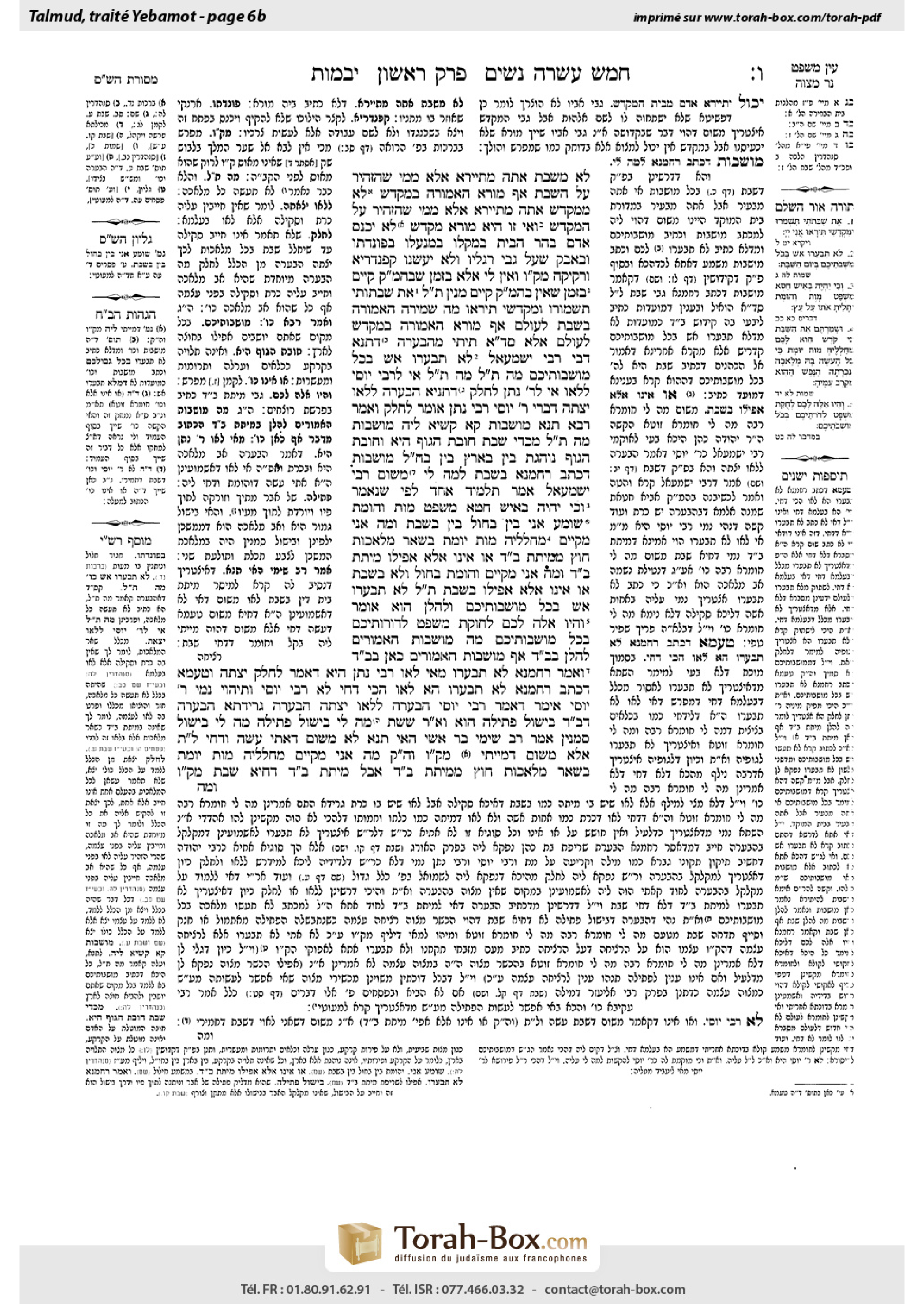
Yevamot 6b: Talmud study for Daf Yomi
Daf Yomi is the daily study of one Talmud folio. Explore 37 tractates with scans, Hebrew text, Sefaria English and AI-generated French translations where annotated.
Passage selection and English or AI-generated French translation are available where the scan has annotations. Daf Study is independent of Torah-Box and Sefaria.
Browse Yevamot · יבמות · All tractatesYevamot 6b text and translations
This page of Yevamot includes the Aramaic text, an English translation and an AI-generated French translation, alongside the scan above.
יבמות ו׳ ב · Aramaic and Hebrew text
לֹא מִשַּׁבָּת אַתָּה מִתְיָירֵא, אֶלָּא מִמִּי שֶׁהִזְהִיר עַל הַשַּׁבָּת, אַף מוֹרָא הָאֲמוּרָה בַּמִּקְדָּשׁ — לֹא מִמִּקְדָּשׁ אַתָּה מִתְיָירֵא, אֶלָּא מִמִּי שֶׁהִזְהִיר עַל הַמִּקְדָּשׁ.
וְאֵי זוֹ הִיא מוֹרָא מִקְדָּשׁ? לֹא יִכָּנֵס אָדָם בְּהַר הַבַּיִת בְּמַקְלוֹ, בְּמִנְעָלוֹ, בְּפוּנְדָּתוֹ, וּבְאָבָק שֶׁעַל גַּבֵּי רַגְלָיו, וְלֹא יַעֲשֶׂנּוּ קַפַּנְדַּרְיָא. וּרְקִיקָה מִקַּל וָחוֹמֶר.
וְאֵין לִי אֶלָּא בִּזְמַן שֶׁבֵּית הַמִּקְדָּשׁ קַיָּים, בִּזְמַן שֶׁאֵין בֵּית הַמִּקְדָּשׁ קַיָּים — מִנַּיִן? תַּלְמוּד לוֹמַר: ״אֶת שַׁבְּתוֹתַי תִּשְׁמוֹרוּ וּמִקְדָּשִׁי תִּירָאוּ״. מָה שְׁמִירָה הָאֲמוּרָה בְּשַׁבָּת — לְעוֹלָם, אַף מוֹרָא הָאֲמוּרָה בַּמִּקְדָּשׁ — לְעוֹלָם.
אֶלָּא, סָלְקָא דַּעְתָּךְ אָמֵינָא: תֵּיתֵי מֵהַבְעָרָה. דְּתָנָא דְּבֵי רַבִּי יִשְׁמָעֵאל: ״לֹא תְבַעֲרוּ אֵשׁ בְּכֹל מוֹשְׁבוֹתֵיכֶם״, מָה תַּלְמוּד לוֹמַר?
מָה תַּלְמוּד לוֹמַר?! אִי לְרַבִּי יוֹסֵי — לְלָאו. אִי לְרַבִּי נָתָן — לְחַלֵּק.
דְּתַנְיָא: הַבְעָרָה לְלָאו יָצָתָה, דִּבְרֵי רַבִּי יוֹסֵי. רַבִּי נָתָן אוֹמֵר: לְחַלֵּק.
וְאָמַר רָבָא: תַּנָּא ״מוֹשָׁבוֹת״ קָא קַשְׁיָא לֵיהּ: ״מוֹשָׁבוֹת״ מָה תַּלְמוּד לוֹמַר?
מִכְּדֵי שַׁבָּת חוֹבַת הַגּוּף הִיא, וְחוֹבַת הַגּוּף נוֹהֶגֶת בֵּין בָּאָרֶץ בֵּין בְּחוּץ לָאָרֶץ, ״מוֹשָׁבוֹת״ דִּכְתַב רַחֲמָנָא בְּשַׁבָּת — לְמָה לִּי?
מִשּׁוּם רַבִּי יִשְׁמָעֵאל אָמַר תַּלְמִיד אֶחָד, לְפִי שֶׁנֶּאֱמַר: ״וְכִי יִהְיֶה בְאִישׁ חֵטְא מִשְׁפַּט מָוֶת וְהוּמָת״, שׁוֹמֵעַ אֲנִי בֵּין בַּחוֹל בֵּין בַּשַּׁבָּת. וּמָה אֲנִי מְקַיֵּים ״מְחַלְּלֶיהָ מוֹת יוּמָת״ — בִּשְׁאָר מְלָאכוֹת, חוּץ מִמִּיתַת בֵּית דִּין. אוֹ אֵינוֹ אֶלָּא אֲפִילּוּ מִיתַת בֵּית דִּין, וּמָה אֲנִי מְקַיֵּים ״וְהוּמָת״ — בַּחוֹל וְלֹא בַּשַּׁבָּת.
אוֹ אֵינוֹ אֶלָּא אֲפִילּוּ בַּשַּׁבָּת, תַּלְמוּד לוֹמַר: ״לֹא תְבַעֲרוּ אֵשׁ בְּכֹל מוֹשְׁבוֹתֵיכֶם״, וּלְהַלָּן הוּא אוֹמֵר: ״וְהָיוּ אֵלֶּה לָכֶם לְחֻקַּת מִשְׁפָּט לְדוֹרוֹתֵיכֶם בְּכֹל מוֹשְׁבוֹתֵיכֶם״,
מָה מוֹשָׁבוֹת הָאֲמוּרִים לְהַלָּן — בְּבֵית דִּין, אַף מוֹשָׁבוֹת הָאֲמוּרִים כָּאן — בְּבֵית דִּין, וְאָמַר רַחֲמָנָא: ״לֹא תְבַעֲרוּ״.
מַאי לָאו: רַבִּי נָתָן הִיא, דְּאָמַר: לְחַלֵּק יָצָתָה. וְטַעְמָא דִּכְתַב רַחֲמָנָא ״לֹא תְבַעֲרוּ״, הָא לָאו הָכִי — דָּחֵי?
לָא, רַבִּי יוֹסֵי. וְתִיהְוֵי נָמֵי רַבִּי יוֹסֵי, אֵימַר דְּאָמַר רַבִּי יוֹסֵי: הַבְעָרָה לְלָאו יָצָתָה — הַבְעָרָה גְּרֵידְתָּא,
הַבְעָרָה דְּבֵית דִּין — בִּישּׁוּל פְּתִילָה הוּא!
וְאָמַר רַב שֵׁשֶׁת: מָה לִי בִּישּׁוּל פְּתִילָה, מָה לִי בִּישּׁוּל סַמָּנִין.
אָמַר רַב שִׁימִי בַּר אָשֵׁי: הַאי תַּנָּא לָא מִשּׁוּם דְּאָתֵי עֲשֵׂה וְדָחֵי לֹא תַעֲשֶׂה, אֶלָּא מִשּׁוּם דְּמַיְיתֵי מִקַּל וָחוֹמֶר. וְהָכִי קָאָמַר: מָה אֲנִי מְקַיֵּים ״מְחַלְּלֶיהָ מוֹת יוּמָת״ — בִּשְׁאָר מְלָאכוֹת, חוּץ מִמִּיתַת בֵּית דִּין. אֲבָל מִיתַת בֵּית דִּין — דָּחֲיָא שַׁבָּת מִקַּל וָחוֹמֶר,
Yevamot 6b · English translation
you do not revere Shabbat itself, as reverence is not mentioned in this context, but rather, one reveres He Who warned about the observance of Shabbat, so too, the same applies to the reverence stated with regard to the Temple: You do not revere the Temple itself but He Who warned about the Temple.
The baraita explains: And what is the reverence of the Temple? In deference to the Temple, a person may not enter the Temple Mount with his staff, his shoes, his money belt [punda], or even the dust on his feet. One may not make the Temple a shortcut [kappendarya] to pass through it, and through an a fortiori inference, all the more so one may not spit on the Temple Mount, as no disrespect is meant by the other actions, whereas spitting is repulsive even in one’s own private home, and certainly on the Temple Mount.
And I have derived only that one is obligated to act in this manner when the Temple is standing. From where do I derive that the mitzva to revere the Temple is in force when the Temple is not standing, i.e., that it is prohibited to be disrespectful toward the place where the Temple stood? The verse states: “You shall keep My Shabbatot, and revere My Sanctuary” (Leviticus 19:30). Just as the keeping stated with regard to Shabbat applies forever, so too, the reverence stated with regard to the Temple is forever.
§ With regard to the issue at hand, the Gemara has not yet found an explanation as to why a specific inference was required to teach that a positive mitzva overrides a prohibition that incurs karet. Rather, it might enter your mind to say that this claim might be derived from the halakha of kindling, as the school of Rabbi Yishmael taught with regard to the verse: “You shall kindle no fire throughout your habitations on Shabbat day” (Exodus 35:3). What is the meaning when the verse states this, as the general prohibition against performing labor on Shabbat appears elsewhere?
The Gemara expresses puzzlement at this question: What is the meaning when the verse states this? What kind of question is this? If the halakha is in accordance with the opinion of Rabbi Yosei, the verse comes to teach that one who kindles fire on Shabbat merely violates a regular prohibition, which does not entail the penalty of stoning, unlike other prohibited labors. If the halakha is in accordance with the opinion of Rabbi Natan, kindling was singled out to divide the various prohibited labors of Shabbat and to establish liability for the separate performance of each of them.
As it is taught in a baraita: The prohibition against kindling was singled out from the general category of prohibited labors and written explicitly to teach that it is unlike other prohibited labors, as it is a regular prohibition, which does not entail the punishment of stoning. This is the statement of Rabbi Yosei. Rabbi Natan says: Kindling is like any other labor prohibited on Shabbat, and it was singled out to divide. In other words, by stating one prohibited labor separately, the Torah teaches that each labor on Shabbat constitutes its own separate prohibition. Consequently, one who unwittingly violates several categories of labor is obligated to bring as many sin-offerings as the prohibited labors he violated.
And Rava said in explanation of the question asked by the school of Rabbi Yishmael: For this tanna, the term “habitations” poses a difficulty with regard to his opinion. The baraita should be understood as follows: What is the meaning when the verse states “habitations”? What additional inference is indicated by this term, which might lead to the erroneous conclusion that this Shabbat prohibition applies only in certain places of habitation?
The Gemara explains why “habitations” cannot mean that Shabbat observance applies only in certain places. Since Shabbat is an obligation that applies to the body, i.e., to the individual himself and not to an external object, and there is a principle that obligations of the body apply both in Eretz Yisrael and outside of Eretz Yisrael, then why do I need the term “habitations” that the Merciful One writes with regard to Shabbat?
A student said in the name of Rabbi Yishmael that since it is stated: “And if a man has committed a sin worthy of death, and he is put to death” (Deuteronomy 21:22), I would derive that the death penalty is administered whether on a weekday or on a Shabbat. And how do I establish the verse: “And you shall keep Shabbat, for it is sacred to you; every one who profanes it shall surely be put to death” (Exodus 31:14)? This verse applies to other prohibited labors, except for court-imposed capital punishment, which must be administered even on Shabbat. Or perhaps it is only the case that even court-imposed capital punishment is included in the list of prohibited labors on Shabbat. How, then, do I establish the verse: “And he is put to death”? This is referring to a weekday and not to Shabbat.
Surprisingly, the tanna reverts back to his earlier claim: Or perhaps it is only the case that capital punishments may be administered even on Shabbat? Therefore, the verse states by way of a verbal analogy: “You shall kindle no fire throughout your habitations on Shabbat day” (Exodus 35:3) and below it says, at the end of the chapter dealing with murderers: “And these things shall be for you a statute of judgment to you throughout your generations in all your habitations” (Numbers 35:29).
Just as the term “habitations” stated below, in Numbers, means in the court, where judgment is performed, so too, the term “habitations” stated here means in the court, i.e., in the place where judges preside. And the Merciful One states in the Torah: “You shall kindle no fire.” Since one of the court-imposed death penalties is burning, which is performed by kindling fire, then evidently, court-imposed death penalties do not override Shabbat.
With the above conclusion in mind, the Gemara comments: What, is it not the case that the opinion of the school of Rabbi Yishmael is in accordance with that of Rabbi Natan, who said that the prohibition against kindling fire was singled out to divide, and therefore lighting a fire is punishable by karet and stoning? And if so, the reason why capital punishments are not administered on Shabbat is that the Merciful One writes: “You shall kindle no fire,” from which it may be inferred that if it were not so, then court-imposed capital punishment would override Shabbat. In other words, the positive mitzva of legal execution would override the prohibition against lighting a fire on Shabbat, which incurs karet.
The Gemara rejects this: No, there is no proof from here, as it can be claimed that the opinion of the tanna from the school of Rabbi Yishmael is in accordance with the opinion of Rabbi Yosei that kindling fire is an ordinary prohibition. The Gemara retorts: And let it even be according to the opinion of Rabbi Yosei. You can say that when Rabbi Yosei said that kindling was singled out as a prohibition, he was referring to kindling alone, i.e., that lighting a regular fire is only a regular prohibition.
Conversely, the kindling by the court for the execution of burning is actually the cooking of a leaden wick. Since execution by burning involves melting, or cooking, a piece of lead, called a wick, and pouring it into the mouth of the convict, it therefore constitutes the prohibited labor of cooking, which is a different prohibition than kindling fire.
And Rav Sheshet said in this regard: What difference is there to me between cooking a wick, which is performed for court-imposed capital punishments, and what difference is there to me between the cooking of herbs used to dye curtains for the Tabernacle, from whose work the list of prohibited labors on Shabbat is derived? Since the court-imposed death penalty involves the prohibited labor of cooking, which according to all opinions incurs karet, this apparently indicates that without the special verse that renders this prohibited, one would have said that a positive mitzva overrides a prohibition for which one is liable to receive karet.
The Gemara rejects this argument as well. Rav Shimi bar Ashi said: This tanna does not raise the possibility that a court-administered death penalty might override Shabbat because a positive mitzva comes and overrides a prohibition. Rather, he entertains this option because he learns this by means of an a fortiori inference, and this is what he is saying: How do I establish the verse “Every one who profanes it shall surely be put to death” (Exodus 31:14)? This applies to other prohibited labors, except for court-imposed capital punishment. However, it could be said that court-imposed capital punishment overrides Shabbat, by an a fortiori inference:
Yevamot 6b · Traduction française (IA)
On ne révère pas le Chabbat lui-même, car la révérence n’est pas mentionnée dans ce contexte ; on révère plutôt Celui qui a ordonné d’observer le Chabbat. De même, cela vaut pour la révérence mentionnée au sujet du Temple : on ne révère pas le Temple lui-même, mais Celui qui a ordonné de révérer le Temple.
La baraïta explique : En quoi consiste la révérence due au Temple ? Par égard pour le Temple, on ne peut entrer sur le mont du Temple avec son bâton, ses chaussures, sa ceinture porte-monnaie [punda], ni même avec la poussière sur ses pieds. On ne peut pas traverser le Temple pour en faire un raccourci [kappendarya] ; à plus forte raison, on ne peut pas cracher sur le mont du Temple. En effet, les autres gestes ne témoignent d’aucun manque de respect, tandis que cracher est répugnant même chez soi, et à plus forte raison sur le mont du Temple.
J’ai établi uniquement que l’on est tenu d’agir ainsi lorsque le Temple est debout. D’où déduis-je que la mitsva de révérer le Temple s’applique même lorsque celui-ci n’est plus debout, c’est-à-dire qu’il est interdit de manquer de respect à l’endroit où il se trouvait ? Le verset dit : « Vous observerez Mes Chabbatot et vous révérerez Mon Sanctuaire » (Lévitique 19:30). De même que l’observance mentionnée au sujet du Chabbat s’applique à jamais, de même la révérence mentionnée au sujet du Temple s’applique à jamais.
§ Concernant la question qui nous occupe, la Guemara n’a pas encore expliqué pourquoi il fallait une déduction spécifique pour enseigner qu’une mitsva positive l’emporte sur une interdiction passible de karet. On pourrait plutôt penser que cela se déduit de la halakha de l’allumage du feu, comme l’enseigna l’école de Rabbi Yishmael au sujet du verset : « Vous n’allumerez aucun feu dans toutes vos demeures le jour du Chabbat » (Exode 35:3). Pourquoi le verset le dit-il, puisque l’interdiction générale d’accomplir un travail le Chabbat figure ailleurs ?
La Guemara s’étonne de cette question : Pourquoi le verset le dit-il ? Quelle sorte de question est-ce là ? Si la halakha suit l’opinion de Rabbi Yossei, le verset vient enseigner que celui qui allume un feu le Chabbat ne transgresse qu’une interdiction ordinaire, qui n’entraîne pas la peine de lapidation, contrairement aux autres travaux interdits. Si la halakha suit l’opinion de Rabbi Natan, l’allumage a été distingué afin de séparer les différents travaux interdits le Chabbat et d’établir la responsabilité pour chacun d’eux, lorsqu’il est accompli séparément.
Comme il est enseigné dans une baraïta : L’interdiction d’allumer un feu a été distinguée de la catégorie générale des travaux interdits et énoncée explicitement pour enseigner qu’elle diffère des autres travaux interdits, puisqu’il s’agit d’une interdiction ordinaire, qui n’entraîne pas la peine de lapidation. Telle est l’opinion de Rabbi Yossei. Rabbi Natan dit : L’allumage est comme tout autre travail interdit le Chabbat, et il a été distingué afin de séparer les travaux. Autrement dit, en énonçant séparément un travail interdit, la Torah enseigne que chaque travail accompli le Chabbat constitue une interdiction distincte. Par conséquent, celui qui transgresse involontairement plusieurs catégories de travaux doit apporter autant de sacrifices expiatoires qu’il a transgressé de travaux interdits.
Rava expliqua ainsi la question posée par l’école de Rabbi Yishmael : Pour ce tanna, le terme « demeures » pose problème. Il faut comprendre la baraïta ainsi : Pourquoi le verset emploie-t-il le terme « demeures » ? Quelle déduction supplémentaire ce terme suggère-t-il, qui pourrait conduire à conclure à tort que l’interdiction du Chabbat ne s’applique que dans certains lieux habités ?
La Guemara explique pourquoi « demeures » ne peut signifier que l’observance du Chabbat ne s’applique que dans certains lieux. Puisque le Chabbat est une obligation qui incombe à la personne, c’est-à-dire à l’individu lui-même et non à un objet extérieur, et qu’il existe un principe selon lequel les obligations qui incombent à la personne s’appliquent aussi bien en Eretz Israël qu’en dehors d’Eretz Israël, pourquoi ai-je besoin du terme « demeures » que le Miséricordieux a écrit au sujet du Chabbat ?
Un élève enseigna au nom de Rabbi Yishmael : Puisqu’il est écrit : « Si un homme a commis un péché passible de mort et qu’il soit mis à mort » (Deutéronome 21:22), j’en déduirais que la peine de mort est appliquée aussi bien un jour de semaine que le Chabbat. Comment faut-il alors comprendre le verset : « Vous observerez le Chabbat, car il est saint pour vous ; quiconque le profane sera certainement mis à mort » (Exode 31:14) ? Ce verset s’applique aux autres travaux interdits, à l’exception de l’exécution judiciaire, qui doit avoir lieu même le Chabbat. Ou peut-être l’exécution judiciaire est-elle elle aussi incluse dans la liste des travaux interdits le Chabbat. Comment faut-il alors comprendre le verset : « et qu’il soit mis à mort » ? Il se rapporte à un jour de semaine, et non au Chabbat.
Étonnamment, le tanna revient à son affirmation précédente : Ou peut-être les peines capitales peuvent-elles être appliquées même le Chabbat ? Le verset établit donc une analogie verbale entre : « Vous n’allumerez aucun feu dans toutes vos demeures le jour du Chabbat » (Exode 35:3), et le verset qui suit plus loin, à la fin du chapitre sur les meurtriers : « Ces dispositions seront pour vous une loi de jugement, pour vos générations, dans toutes vos demeures » (Nombres 35:29).
De même que le terme « demeures » employé plus loin, dans les Nombres, désigne le tribunal, où le jugement est rendu, de même le terme « demeures » employé ici désigne le tribunal, c’est-à-dire le lieu où siègent les juges. Or le Miséricordieux énonce dans la Torah : « Vous n’allumerez aucun feu. » Puisque l’une des peines capitales prononcées par le tribunal est le bûcher, qui nécessite d’allumer un feu, il apparaît que les peines capitales judiciaires ne l’emportent pas sur le Chabbat.
À la lumière de la conclusion qui précède, la Guemara remarque : N’est-il pas vrai que l’opinion de l’école de Rabbi Yishmael correspond à celle de Rabbi Natan, qui a dit que l’interdiction d’allumer un feu avait été distinguée afin de séparer les travaux et que l’allumage d’un feu est donc passible de karet et de lapidation ? Si tel est le cas, la raison pour laquelle les peines capitales ne sont pas appliquées le Chabbat est que le Miséricordieux a écrit : « Vous n’allumerez aucun feu », d’où l’on peut déduire que, sans cela, l’exécution judiciaire l’emporterait sur le Chabbat. Autrement dit, la mitsva positive de l’exécution judiciaire l’emporterait sur l’interdiction d’allumer un feu le Chabbat, passible de karet.
La Guemara rejette cette possibilité : Non, cela ne prouve rien, car on peut soutenir que l’opinion du tanna de l’école de Rabbi Yishmael correspond à celle de Rabbi Yossei, selon laquelle l’allumage d’un feu est une interdiction ordinaire. La Guemara rétorque : Admettons même que ce soit selon l’opinion de Rabbi Yossei. On peut dire que, lorsque Rabbi Yossei a déclaré que l’allumage avait été distingué comme une interdiction, il ne parlait que de l’allumage, c’est-à-dire que l’allumage d’un feu ordinaire ne constitue qu’une interdiction ordinaire.
À l’inverse, le feu allumé par le tribunal pour l’exécution par le bûcher sert en réalité à cuire une mèche de plomb. Comme l’exécution par le bûcher implique de faire fondre, ou de cuire, un morceau de plomb appelé « mèche », puis de le verser dans la bouche du condamné, elle constitue le travail interdit de cuire, une interdiction différente de celle d’allumer un feu.
Rav Chéchet dit à ce propos : En quoi la cuisson d’une mèche, effectuée pour les exécutions judiciaires, diffère-t-elle de la cuisson des plantes utilisées pour teindre les tentures du Tabernacle, travail dont est tirée la liste des travaux interdits le Chabbat ? Puisque la peine capitale judiciaire implique le travail interdit de cuire, qui, selon toutes les opinions, est passible de karet, cela semble indiquer que, sans le verset particulier qui l’interdit, on aurait dit qu’une mitsva positive l’emporte sur une interdiction passible de karet.
La Guemara rejette également cet argument. Rav Chimi bar Achi dit : Ce tanna n’envisage pas la possibilité qu’une peine de mort prononcée par un tribunal l’emporte sur le Chabbat au motif qu’une mitsva positive l’emporte sur une interdiction. Il envisage plutôt cette possibilité parce qu’il la déduit par un raisonnement a fortiori. Voici ce qu’il dit : Comment faut-il comprendre le verset : « Quiconque le profane sera certainement mis à mort » (Exode 31:14) ? Celui-ci s’applique aux autres travaux interdits, à l’exception de l’exécution judiciaire. Toutefois, on pourrait dire que l’exécution judiciaire l’emporte sur le Chabbat, par un raisonnement a fortiori :
Traduction française générée par IA à partir de l’édition anglaise de Sefaria. Vérifie toujours un passage avec le texte source.
Text from Sefaria: William Davidson Edition - Vocalized Aramaic (CC BY NC); William Davidson Edition - English (CC BY NC).