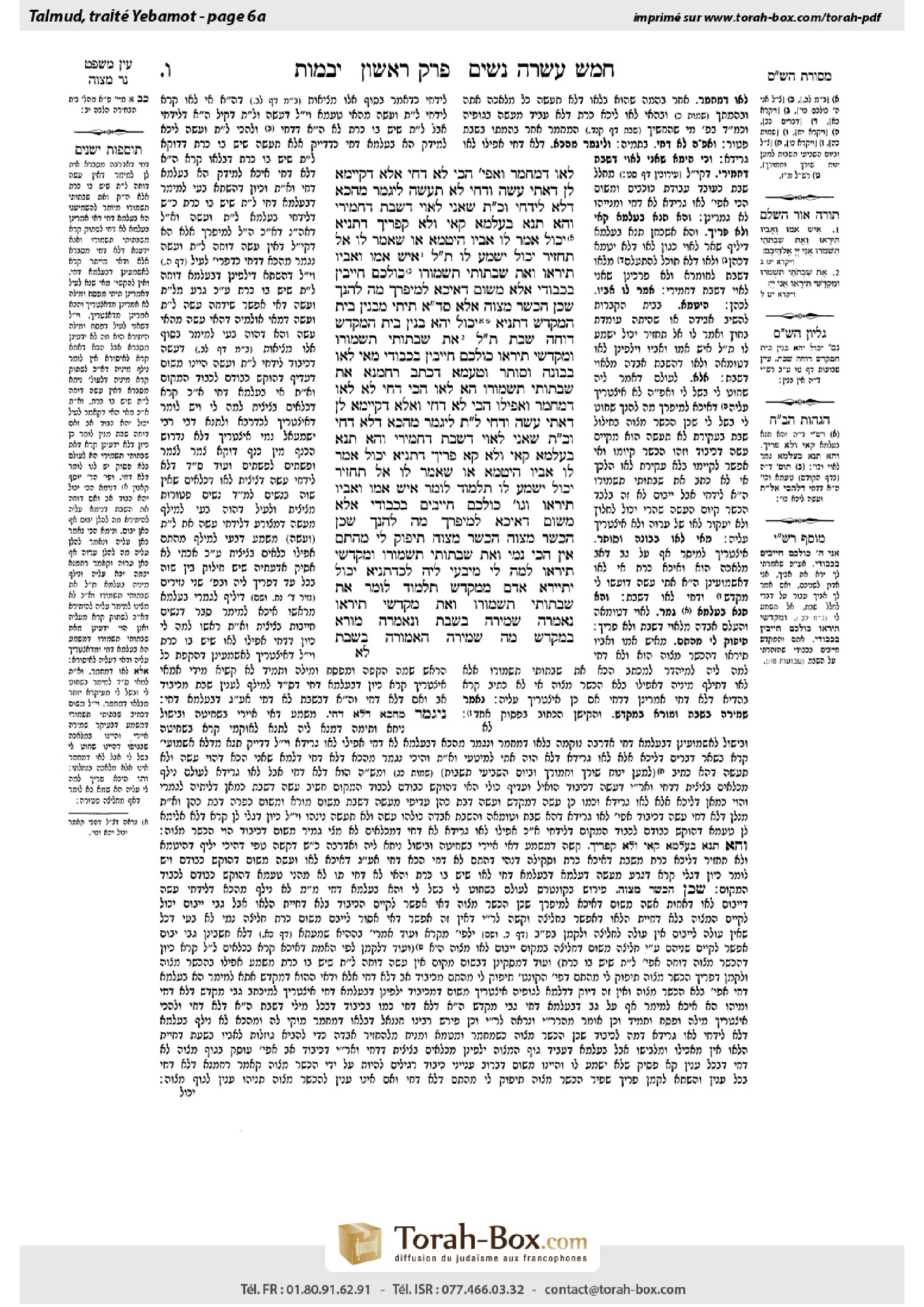
Yevamot 6a: Talmud study for Daf Yomi
Daf Yomi is the daily study of one Talmud folio. Explore 37 tractates with scans, Hebrew text, Sefaria English and AI-generated French translations where annotated.
Passage selection and English or AI-generated French translation are available where the scan has annotations. Daf Study is independent of Torah-Box and Sefaria.
Browse Yevamot · יבמות · All tractatesYevamot 6a text and translations
This page of Yevamot includes the Aramaic text, an English translation and an AI-generated French translation, alongside the scan above.
יבמות ו׳ א · Aramaic and Hebrew text
לָאו דִּמְחַמֵּר, וַאֲפִילּוּ הָכִי לָא דָּחֵי.
אֶלָּא דְּקַיְימָא לַן דְּאָתֵי עֲשֵׂה וְדָחֵי לֹא תַעֲשֶׂה, לִיגְמַר מֵהָכָא דְּלָא לִידְחֵי!
וְכִי תֵּימָא, שָׁאנֵי לָאוֵי דְּשַׁבָּת דַּחֲמִירִי — וְהָא תַּנָּא בְּעָלְמָא קָאֵי, וְלָא קָפָרֵיךְ!
דְּתַנְיָא, יָכוֹל אָמַר לוֹ אָבִיו: הִיטַּמֵּא, אוֹ שֶׁאָמַר לוֹ: אַל תַּחְזִיר, יָכוֹל יִשְׁמַע לוֹ? תַּלְמוּד לוֹמַר: ״אִישׁ אִמּוֹ וְאָבִיו תִּירָאוּ וְאֶת שַׁבְּתוֹתַי תִּשְׁמוֹרוּ״, כּוּלְּכֶם חַיָּיבִין בִּכְבוֹדִי.
אֶלָּא, מִשּׁוּם דְּאִיכָּא לְמִיפְרַךְ:
מָה לְהָנָךְ שֶׁכֵּן הֶכְשֵׁר מִצְוָה.
אֶלָּא, סָלְקָא דַּעְתָּךְ אָמֵינָא: תֵּיתֵי מִבִּנְיַן בֵּית הַמִּקְדָּשׁ. דְּתַנְיָא: יָכוֹל יְהֵא בִּנְיַן בֵּית הַמִּקְדָּשׁ דּוֹחֶה שַׁבָּת — תַּלְמוּד לוֹמַר: ״אֶת שַׁבְּתוֹתַי תִּשְׁמוֹרוּ וּמִקְדָּשִׁי תִּירָאוּ״ — כּוּלְּכֶם חַיָּיבִין בִּכְבוֹדִי.
מַאי לָאו, בְּבוֹנֶה וְסוֹתֵר, וְטַעְמָא דִּכְתַב רַחֲמָנָא ״אֶת שַׁבְּתוֹתַי תִּשְׁמוֹרוּ״, הָא לָאו הָכִי — דָּחֵי!
לָא, לָאו דִּמְחַמֵּר, וַאֲפִילּוּ הָכִי לָא דָּחֵי. וְאֶלָּא דְּקַיְימָא לַן דְּאָתֵי עֲשֵׂה וְדָחֵי לֹא תַעֲשֶׂה, לִיגְמַר מֵהָכָא דְּלָא דָּחֵי!
וְכִי תֵּימָא, שָׁאנֵי לָאוֵי דְּשַׁבָּת דַּחֲמִירִי — וְהָא תַּנָּא בְּעָלְמָא קָאֵי, וְלָא קָא פָרֵיךְ! דְּתַנְיָא, יָכוֹל אָמַר לוֹ אָבִיו: הִיטַּמֵּא, אוֹ שֶׁאָמַר לוֹ: אַל תַּחְזִיר, יָכוֹל יִשְׁמַע לוֹ — תַּלְמוּד לוֹמַר: ״אִישׁ אִמּוֹ וְאָבִיו תִּירָאוּ וְגוֹ׳״ — כּוּלְּכֶם חַיָּיבִים בִּכְבוֹדִי.
אֶלָּא, מִשּׁוּם דְּאִיכָּא לְמִיפְרַךְ: מָה לְהָנָךְ שֶׁכֵּן הֶכְשֵׁר מִצְוָה. הֶכְשֵׁר מִצְוָה תִּיפּוֹק לִי מֵהָתָם?
אִין הָכִי נָמֵי. וְ״אֶת שַׁבְּתוֹתַי תִּשְׁמוֹרוּ וּמִקְדָּשִׁי תִּירָאוּ״ לְמָה לִי? מִיבְּעֵי לֵיהּ, לְכִדְתַנְיָא: יָכוֹל יִתְיָירֵא אָדָם מִמִּקְדָּשׁ, תַּלְמוּד לוֹמַר: ״אֶת שַׁבְּתוֹתַי תִּשְׁמוֹרוּ וְאֶת מִקְדָּשִׁי תִּירָאוּ״. נֶאֶמְרָה שְׁמִירָה בַּשַּׁבָּת, וְנֶאֶמְרָה מוֹרָא בַּמִּקְדָּשׁ. מָה שְׁמִירָה הָאֲמוּרָה בַּשַּׁבָּת —
Yevamot 6a · English translation
the reference is not to a situation where a father demanded that his child perform prohibited labor on Shabbat that entails karet. Rather, he instructed him to transgress the prohibition against driving a laden animal. Although it is prohibited to cause animals to work on Shabbat, this does not entail the penalty of karet, as it has the status of a regular prohibition. And this shows that if one’s father told him to desecrate Shabbat by driving a donkey, even so, the positive mitzva to honor one’s parents does not override the prohibition against driving a laden animal.
§ The Gemara asks: If so, rather than that principle in which we maintain that a positive mitzva comes and overrides a prohibition, let us derive from here that it does not override even a regular prohibition. Just as it was inferred above from the case of ritual fringes, in which the positive mitzva overrides the prohibition against diverse kinds, that all other positive mitzvot similarly override any prohibition, perhaps one should infer from the case of honoring one’s parents that positive mitzvot do not override prohibitions at all.
And if you say that one should not infer this from here, as the prohibitions of Shabbat are different in that they are more serious, and for this reason the mitzva to honor one’s parents does not override these prohibitions, this cannot be the case, as the tanna speaks generally of a father who instructs a son to perform a regular prohibition, not to desecrate Shabbat, and he does not raise any difficulty of this kind.
As it is taught in a different baraita: One might have thought that if one’s father said to his son, who is a priest or nazirite: Be rendered ritually impure with impurity imparted by a corpse, so as to bring me an item from a ritually impure place, or if he said to him: Do not return this lost item, it might have been supposed that his son should obey him. Therefore, the verse states: “You shall fear every man his mother and his father and you shall keep My Shabbatot, I am the Lord your God” (Leviticus 19:3). This verse teaches: All of you are obligated in My honor. This proves that the tanna does not differentiate between desecrating Shabbat, which is a severe prohibition, and a priest becoming ritually impure with impurity imparted by a corpse, which is a lighter prohibition.
§ Rather, the Gemara rejects this line of reasoning and accepts the claim that the baraita does not speak of one whose father asked him to desecrate Shabbat by performing a prohibited labor that entails karet, but of a father who instructed his son to drive a laden animal. As for the difficulty that this apparently indicates that a positive mitzva does not override any type of prohibition, the reason that this is not the case is because there is room to refute this argument.
The Gemara explains how the previous claim can be countered: What about the fact that these instructions of a father are different, as when one drives an animal on Shabbat in honor of his parents this is merely preparation for the mitzva of honoring one’s parents, since the son is not actually feeding or clothing his father at the time. Consequently, this is not a proper fulfillment of a positive mitzva, and therefore the case of a father who instructs his son to drive an animal cannot be used as a source with regard to other instances.
Rather, it could enter your mind to say: The principle that a positive mitzva overrides even a prohibition that entails karet is derived from the building of the Temple. As it is taught in a baraita: One might have thought that the building of the Temple should override Shabbat; therefore, the verse states: “You shall keep My Shabbatot and revere My Sanctuary, I am the Lord” (Leviticus 19:30), which means that all of you are obligated in My honor. God is honored when Shabbat is observed, and He demands the observance of Shabbat even when the Temple is being built.
The Gemara analyzes this baraita: What, is it not referring to building the Temple by performing prohibited labors on Shabbat whose violation entails karet, such as building and demolishing? And the reason the building of the Temple does not override Shabbat is that the Merciful One specifically writes: “Keep My Shabbatot,” from which it may be inferred that if that were not so, the positive mitzva would override Shabbat. It is therefore possible to deduce from here that in general, positive mitzvot override even prohibitions that entail karet.
The Gemara responds: No, here too the reference is to the prohibition against driving a laden animal, and even so the positive mitzva to build the Temple does not override the prohibition against driving a laden animal on Shabbat. The Gemara asks again, as before: If so, rather than that principle in which we maintain that a positive mitzva comes and overrides a prohibition, let us derive from here that it does not override even a regular prohibition.
And if you say that prohibitions of Shabbat are different in that they are more severe, this cannot be the case, as the tanna speaks generally and he does not raise any difficulty of this kind as it is taught in the aforementioned baraita: One might have thought that if one’s father said to his son who is a priest or nazirite: Be rendered ritually impure, or if he said to him: Do not return this lost item, it might have been supposed that his son should obey him. Therefore, the verse states: “You shall fear every man his mother and his father and you shall keep My Shabbatot, I am the Lord your God” (Leviticus 19:3), which means: All of you are obligated in My honor.
Rather, there is no proof from here with regard to all Torah prohibitions, because there is room to refute that argument as follows: What about the fact that these instances of driving an animal on Shabbat are merely a preparation for the mitzva of building the Temple, and are not a mitzva in itself? The Gemara raises a difficulty: Let the halakha that preparation for a mitzva does not override a prohibition be derived from there, the case of honoring one’s parents, as stated previously. Why repeat this matter with regard to the building of the Temple?
The Gemara responds: Yes, it is indeed so. And why do I need the verse: “You shall keep My Shabbatot, and revere My Sanctuary” (Leviticus 19:30)? After all, the halakha that the building of the Temple does not override the prohibition against driving an animal on Shabbat is derived from the case of honoring one’s parents. The Gemara answers: It is necessary to derive that which is taught in a baraita: One might have thought that a person should be in reverence of the Temple and turn the Temple itself into an object of worship. Therefore, the verse states: “You shall keep My Shabbatot, and revere My Sanctuary.” The term keeping is stated with regard to Shabbat, and the term reverence is stated with regard to the Temple. Just as in the case of keeping stated with regard to Shabbat,
Yevamot 6a · Traduction française (IA)
La référence ne concerne pas une situation où un père aurait demandé à son enfant d’accomplir pendant Chabbat un travail interdit entraînant le karet. Il lui a plutôt ordonné de conduire une bête chargée. Bien qu’il soit interdit de faire travailler des animaux pendant Chabbat, cette transgression n’entraîne pas la peine de karet, car elle relève d’une interdiction ordinaire. Il en ressort que si le père de quelqu’un lui dit de profaner Chabbat en conduisant un âne, la mitsva positive d’honorer ses parents ne l’emporte pas pour autant sur l’interdiction de conduire une bête chargée.
§ La Guemara demande : Dans ce cas, plutôt que de retenir le principe selon lequel une mitsva positive vient l’emporter sur une interdiction, ne déduirions-nous pas d’ici qu’elle ne l’emporte même pas sur une interdiction ordinaire ? De même qu’on a déduit plus haut du cas des franges rituelles, où la mitsva positive l’emporte sur l’interdiction des mélanges d’espèces, que toutes les autres mitsvot positives l’emportent pareillement sur toute interdiction, on pourrait peut-être déduire du cas de l’honneur dû aux parents que les mitsvot positives ne l’emportent jamais sur les interdictions.
Et si tu dis qu’il ne faut pas le déduire d’ici, car les interdictions de Chabbat sont différentes en ce qu’elles sont plus graves et que, pour cette raison, la mitsva d’honorer ses parents ne l’emporte pas sur elles, cela ne peut être le cas : le tanna parle de manière générale d’un père qui ordonne à son fils de transgresser une interdiction ordinaire, et non de profaner Chabbat, sans soulever de difficulté de ce genre.
Comme il est enseigné dans une autre baraïta : On aurait pu penser que si le père d’un homme disait à son fils, qui est prêtre ou nazir, de se rendre impur au contact d’un cadavre afin de lui apporter un objet provenant d’un lieu impur, ou lui disait de ne pas rapporter un objet perdu, son fils devait lui obéir. C’est pourquoi le verset dit : « Que chacun craigne sa mère et son père, et gardez Mes Chabbatot ; Je suis le Seigneur votre Dieu » (Lévitique 19:3). Ce verset enseigne : Vous êtes tous tenus d’honorer Mon Nom. Cela prouve que le tanna ne fait pas de différence entre la profanation de Chabbat, qui est une interdiction grave, et le fait, pour un prêtre, de devenir impur au contact d’un cadavre, qui est une interdiction moins grave.
§ La Guemara rejette plutôt ce raisonnement et accepte l’affirmation selon laquelle la baraïta ne parle pas d’un père qui aurait demandé à son fils de profaner Chabbat en accomplissant un travail interdit entraînant le karet, mais d’un père qui lui a ordonné de conduire une bête chargée. Quant à la difficulté selon laquelle cela semble indiquer qu’une mitsva positive ne l’emporte sur aucun type d’interdiction, voici pourquoi ce n’est pas le cas : on peut réfuter cet argument.
La Guemara explique comment réfuter l’affirmation précédente : ces instructions d’un père sont-elles comparables ? Lorsqu’on conduit un animal pendant Chabbat en l’honneur de ses parents, il ne s’agit que d’une préparation à la mitsva d’honorer ses parents, puisque le fils ne nourrit ni ne vêt effectivement son père à ce moment-là. Par conséquent, ce n’est pas l’accomplissement proprement dit d’une mitsva positive, et le cas d’un père qui ordonne à son fils de conduire un animal ne peut donc servir de source pour d’autres cas.
On pourrait plutôt penser que le principe selon lequel une mitsva positive l’emporte même sur une interdiction entraînant le karet se déduit de la construction du Temple. Comme il est enseigné dans une baraïta : On aurait pu penser que la construction du Temple devait l’emporter sur Chabbat ; c’est pourquoi le verset dit : « Gardez Mes Chabbatot et révérez Mon Sanctuaire, Je suis le Seigneur » (Lévitique 19:30), ce qui signifie que vous êtes tous tenus d’honorer Mon Nom. Dieu est honoré lorsque Chabbat est observé, et Il exige que Chabbat soit observé même pendant la construction du Temple.
La Guemara analyse cette baraïta : ne s’agit-il pas de construire le Temple en accomplissant pendant Chabbat des travaux interdits dont la transgression entraîne le karet, comme construire et démolir ? Si la construction du Temple ne l’emporte pas sur Chabbat, c’est que le Miséricordieux a expressément écrit : « Gardez Mes Chabbatot », d’où l’on peut déduire que, sans cela, la mitsva positive l’emporterait sur Chabbat. On peut donc en déduire qu’en général, les mitsvot positives l’emportent même sur les interdictions entraînant le karet.
La Guemara répond : Non, ici aussi, il s’agit de l’interdiction de conduire une bête chargée, et même ainsi, la mitsva positive de construire le Temple ne l’emporte pas sur l’interdiction de conduire une bête chargée pendant Chabbat. La Guemara demande de nouveau, comme précédemment : dans ce cas, plutôt que de retenir le principe selon lequel une mitsva positive vient l’emporter sur une interdiction, ne déduirions-nous pas d’ici qu’elle ne l’emporte même pas sur une interdiction ordinaire ?
Et si tu dis que les interdictions de Chabbat sont différentes en ce qu’elles sont plus graves, cela ne peut être le cas : le tanna parle de manière générale et ne soulève aucune difficulté de ce genre, comme il est enseigné dans la baraïta mentionnée plus haut : On aurait pu penser que si le père d’un homme disait à son fils, qui est prêtre ou nazir, de se rendre impur, ou lui disait de ne pas rapporter un objet perdu, son fils devait lui obéir. C’est pourquoi le verset dit : « Que chacun craigne sa mère et son père, et gardez Mes Chabbatot ; Je suis le Seigneur votre Dieu » (Lévitique 19:3), ce qui signifie : Vous êtes tous tenus d’honorer Mon Nom.
Il n’y a donc pas de preuve à tirer d’ici concernant l’ensemble des interdictions de la Torah, car on peut réfuter cet argument ainsi : conduire un animal dans ces cas, pendant Chabbat, n’est qu’une préparation à la mitsva de construire le Temple, et non une mitsva en soi. La Guemara soulève une difficulté : déduisons de là, du cas de l’honneur dû aux parents mentionné précédemment, que la préparation à une mitsva ne l’emporte pas sur une interdiction. Pourquoi répéter ce point à propos de la construction du Temple ?
La Guemara répond : Oui, c’est bien le cas. Pourquoi donc faut-il le verset : « Gardez Mes Chabbatot et révérez Mon Sanctuaire » (Lévitique 19:30) ? Après tout, la halakha selon laquelle la construction du Temple ne l’emporte pas sur l’interdiction de conduire un animal pendant Chabbat se déduit du cas de l’honneur dû aux parents. La Guemara répond : Ce verset est nécessaire pour enseigner ce qui est énoncé dans une baraïta : On aurait pu penser qu’une personne devait révérer le Temple et faire du Temple lui-même un objet de culte. C’est pourquoi le verset dit : « Gardez Mes Chabbatot et révérez Mon Sanctuaire. » Le terme « garder » est employé à propos de Chabbat, et le terme « révérer » à propos du Temple. De même que, dans le cas de « garder » employé à propos de Chabbat,
Traduction française générée par IA à partir de l’édition anglaise de Sefaria. Vérifie toujours un passage avec le texte source.
Text from Sefaria: William Davidson Edition - Vocalized Aramaic (CC BY NC); William Davidson Edition - English (CC BY NC).