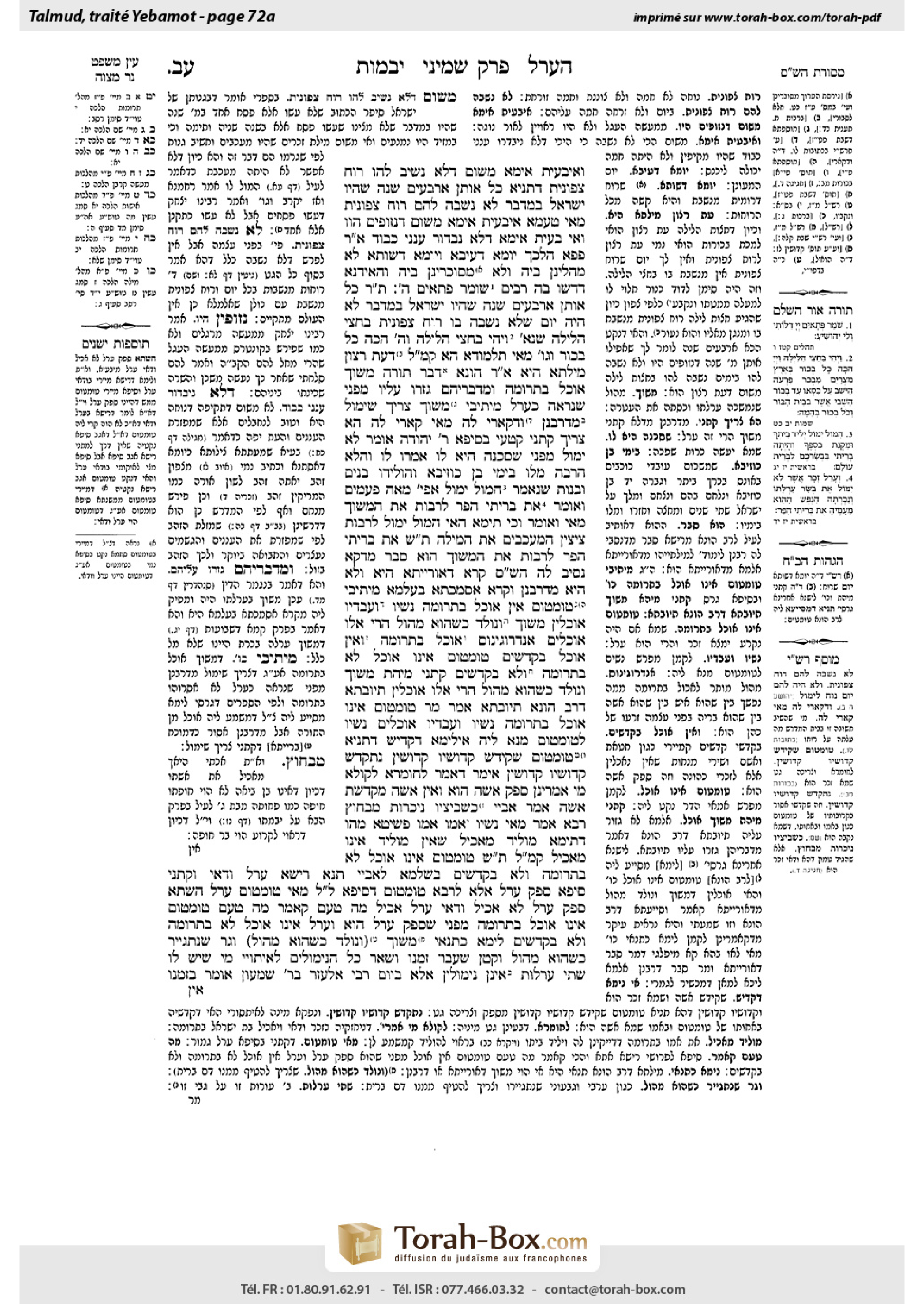
Yevamot 72a: Talmud study for Daf Yomi
Daf Yomi is the daily study of one Talmud folio. Explore 37 tractates with scans, Hebrew text, Sefaria English and AI-generated French translations where annotated.
Passage selection and English or AI-generated French translation are available where the scan has annotations. Daf Study is independent of Torah-Box and Sefaria.
Browse Yevamot · יבמות · All tractatesYevamot 72a text and translations
This page of Yevamot includes the Aramaic text, an English translation and an AI-generated French translation, alongside the scan above.
יבמות ע״ב א · Aramaic and Hebrew text
וְאִיבָּעֵית אֵימָא: מִשּׁוּם דְּלָא נְשִׁיב לְהוּ רוּחַ צְפוֹנִית. דְּתַנְיָא: כׇּל אוֹתָן אַרְבָּעִים שָׁנָה שֶׁהָיוּ יִשְׂרָאֵל בַּמִּדְבָּר לֹא נָשְׁבָה לָהֶם רוּחַ צְפוֹנִית.
מַאי טַעְמָא? אִיבָּעֵית אֵימָא מִשּׁוּם דִּנְזוּפִים הָווּ, וְאִי בָּעֵית אֵימָא דְּלָא נִבַּדּוּר עַנְנֵי כָבוֹד.
אָמַר רַב פָּפָּא: הִלְכָּךְ יוֹמָא דְעֵיבָא וְיוֹמָא דְשׁוּתָא — לָא מָהֲלִינַן בֵּיהּ, וְלָא מְסוֹכְרִינַן בֵּיהּ. וְהָאִידָּנָא דְּדָשׁוּ בַּהּ רַבִּים, ״שׁוֹמֵר פְּתָאִים ה׳״.
תָּנוּ רַבָּנַן: כׇּל אוֹתָן אַרְבָּעִים שָׁנָה שֶׁהָיוּ יִשְׂרָאֵל בַּמִּדְבָּר, לֹא הָיָה יוֹם שֶׁלֹּא נָשְׁבָה בּוֹ רוּחַ צְפוֹנִית בַּחֲצִי הַלַּיְלָה, שֶׁנֶּאֱמַר: ״וַיְהִי בַּחֲצִי הַלַּיְלָה וַה׳ הִכָּה כׇל בְּכוֹר וְגוֹ׳״ מַאי תַּלְמוּדָא? הָא קָא מַשְׁמַע לַן דְּעֵת רְצוֹן מִילְּתָא הִיא.
אָמַר רַב הוּנָא: דְּבַר תּוֹרָה, מָשׁוּךְ — אוֹכֵל בִּתְרוּמָה, וּמִדִּבְרֵיהֶם גָּזְרוּ עָלָיו, מִפְּנֵי שֶׁנִּרְאֶה כְּעָרֵל.
מֵיתִיבִי: מָשׁוּךְ צָרִיךְ שֶׁיָּמוּל! מִדְּרַבָּנַן. וּדְקָאָרֵי לַהּ, מַאי קָאָרֵי לַהּ? הָא ״צָרִיךְ״ קָתָנֵי!
קָטָעֵי בְּסֵיפָא, רַבִּי יְהוּדָה אוֹמֵר: לֹא יִמּוֹל, מִפְּנֵי שֶׁסַּכָּנָה הִיא לוֹ. אָמְרוּ לוֹ: וַהֲלֹא הַרְבֵּה מָלוּ בִּימֵי בֶּן כּוֹזֵיבָא וְהוֹלִידוּ בָּנִים וּבָנוֹת, שֶׁנֶּאֱמַר: ״הִמּוֹל יִמּוֹל״, אֲפִילּוּ מֵאָה פְּעָמִים, וְאוֹמֵר: ״אֶת בְּרִיתִי הֵפַר״ — לְרַבּוֹת אֶת הַמָּשׁוּךְ.
מַאי ״וְאוֹמֵר״? וְכִי תֵּימָא: הַאי ״הִמּוֹל יִמּוֹל״ לְרַבּוֹת צִיצִין הַמְעַכְּבִים אֶת הַמִּילָה — ״תָּא שְׁמַע: ״אֶת בְּרִיתִי הֵפַר״, לְרַבּוֹת אֶת הַמָּשׁוּךְ.
הוּא סָבַר: מִדְּקָא נָסֵיב לַהּ תַּלְמוּדָא (קְרָא) — דְּאוֹרָיְיתָא הִיא. וְלָא הִיא: מִדְּרַבָּנַן, וּקְרָא אַסְמַכְתָּא בְּעָלְמָא.
מֵיתִיבִי: טוּמְטוּם — אֵין אוֹכֵל בִּתְרוּמָה, נָשָׁיו וַעֲבָדָיו — אוֹכְלִין. מָשׁוּךְ, וְנוֹלַד כְּשֶׁהוּא מָהוּל — הֲרֵי אֵלּוּ אוֹכְלִים. אַנְדְּרוֹגִינוֹס — אוֹכֵל בִּתְרוּמָה, וְאֵין אוֹכֵל בְּקָדָשִׁים. טוּמְטוּם — אֵינוֹ אוֹכֵל לֹא בִּתְרוּמָה וְלֹא בְּקָדָשִׁים.
קָתָנֵי מִיהַת: מָשׁוּךְ, וְנוֹלַד כְּשֶׁהוּא מָהוּל — הֲרֵי אֵלּוּ אוֹכְלִין, תְּיוּבְתָּא דְרַב הוּנָא! תְּיוּבְתָּא.
אָמַר מָר: טוּמְטוּם — אֵינוֹ אוֹכֵל בִּתְרוּמָה, נָשָׁיו וַעֲבָדָיו — אוֹכְלִים. נָשָׁיו לְטוּמְטוּם מְנָא לֵיהּ? אִילֵּימָא דְּקַדֵּישׁ, דְּתַנְיָא: טוּמְטוּם שֶׁקִּידֵּשׁ — קִדּוּשָׁיו קִדּוּשִׁין, נִתְקַדֵּשׁ — קִדּוּשָׁיו קִדּוּשִׁין,
אֵימַר דְּאָמַר לְחוּמְרָא, לְקוּלָּא מִי אָמְרִינַן? סְפֵק אִשָּׁה הוּא, וְאֵין אִשָּׁה מְקַדֶּשֶׁת אִשָּׁה?
אָמַר אַבָּיֵי: כְּשֶׁבֵּיצָיו נִיכָּרוֹת מִבַּחוּץ.
רָבָא אָמַר: מַאי ״נָשָׁיו״ — אִמּוֹ. אִמּוֹ, פְּשִׁיטָא! מַהוּ דְּתֵימָא: מוֹלִיד — מַאֲכִיל, שֶׁאֵין מוֹלִיד — אֵינוֹ מַאֲכִיל, קָא מַשְׁמַע לַן.
תָּא שְׁמַע: טוּמְטוּם — אֵינוֹ אוֹכֵל לֹא בִּתְרוּמָה וְלֹא בְּקָדָשִׁים. בִּשְׁלָמָא לְאַבָּיֵי, תְּנָא רֵישָׁא עָרֵל וַדַּאי, וְקָתָנֵי סֵיפָא סְפֵק עָרֵל.
אֶלָּא לְרָבָא, טוּמְטוּם דְּסֵיפָא לְמָה לִי? מַאי טוּמְטוּם — עָרֵל.
הַשְׁתָּא סְפֵק עָרֵל לָא אָכֵיל — וַדַּאי עָרֵל אָכֵיל?! מָה טַעַם קָאָמַר: מָה טַעַם טוּמְטוּם אֵינוֹ אוֹכֵל בִּתְרוּמָה? מִפְּנֵי שֶׁסְּפֵק עָרֵל הוּא, וְעָרֵל אֵינוֹ אוֹכֵל לֹא בִּתְרוּמָה וְלֹא בְּקָדָשִׁים.
לֵימָא כְּתַנָּאֵי: מָשׁוּךְ (וְנוֹלַד כְּשֶׁהוּא מָהוּל), וְגֵר שֶׁנִּתְגַּיֵּיר כְּשֶׁהוּא מָהוּל, וְקָטָן שֶׁעָבַר זְמַנּוֹ, וּשְׁאָר כׇּל הַנִּימּוֹלִים, לְאֵיתוֹיֵי מִי שֶׁיֵּשׁ לוֹ שְׁתֵּי עֲרָלוֹת — אֵינָן נִימּוֹלִין אֶלָּא בַּיּוֹם. רַבִּי אֶלְעָזָר בַּר שִׁמְעוֹן אוֹמֵר: בִּזְמַנּוֹ —
Yevamot 72a · English translation
And if you wish, say instead that it was because the north wind did not blow for them, and the hot weather was likely to lead to medical complications following the procedure. As it is taught in a baraita: All those forty years that the Jewish people were in the wilderness, the north wind did not blow for them.
The Gemara asks: What is the reason that this wholesome wind did not blow all those years? If you wish, say it was because they were under censure following the sin of the spies and were therefore undeserving of this salutary wind. And if you wish, say instead that it was so that the clouds of glory covering the Tabernacle should not disperse.
Rav Pappa said: Therefore, learn from here that on a cloudy day or on a day that a south wind [shuta] blows, we may neither circumcise nor let blood [mesokhrinan], owing to the danger involved. But nowadays, when many are accustomed to ignoring these safeguards, the verse “The Lord preserves the simple” (Psalms 116:6) is applied, and it is assumed that they will come to no harm.
The Sages taught in a baraita: All those forty years that the Jewish people were in the wilderness there was not a day in which the north wind did not blow at midnight, as it is stated: “And it came to pass at midnight, that the Lord smote all the firstborn in the land of Egypt” (Exodus 12:29). The Gemara asks: What is the biblical derivation? How is it derived from this verse that speaks of the exodus from Egypt that a north wind blew at midnight during the forty years that the Jewish people wandered in the wilderness? The Gemara answers: This comes to teach us that a time of favor is a significant matter. Since midnight had once been a time of divine favor at the beginning of the exodus from Egypt, it continued to be a time of favor throughout the forty years that the Jewish people sojourned in the wilderness.
§ Rav Huna said: By Torah law, if one had been circumcised, but subsequently the residual foreskin was drawn forward by itself or manually so that it covered the corona, he may partake of teruma, as he is considered circumcised. However, from the words of the Sages, they decreed that he must be circumcised again because he looks as if he were uncircumcised.
The Gemara raises an objection based on the following baraita: One whose residual foreskin was drawn forward so that it covers the corona requires a second circumcision, indicating that he is not considered circumcised. The Gemara explains: This requirement is by rabbinic law, and by Torah law he is considered circumcised. The Gemara asks: And the amora who asked this question, why did he ask it in the first place? The baraita merely teaches that such an individual requires circumcision, and does not indicate that it is a Torah obligation.
The Gemara explains: The amora who raised the question erred due to the latter clause of that same baraita, which states: Rabbi Yehuda says: He should not be circumcised because it would be dangerous for him to do so. His colleagues said to him: But weren’t there many who had drawn their residual foreskins forward and subsequently were circumcised a second time in the days of ben Koziva, otherwise known as bar Kokheva, and they fathered sons and daughters. Such re-circumcision is necessary, as it is stated: “He must surely be circumcised [himmol yimmol]” (Genesis 17:13), the double verb form indicating: Even one hundred times. And furthermore, it says: “He has broken My covenant” (Genesis 17:14), which comes to include one whose foreskin was drawn forward.
The Gemara comments: What is the meaning of: And furthermore, it says? Why was it necessary to cite two verses in support of the same halakha? The Gemara answers: The additional verse is necessary, lest you say that this first verse: “He shall surely be circumcised,” comes only to include the shreds of flesh that invalidate the circumcision if they are not cut and to indicate that they must be removed. If so, come and hear a second verse: “He has broken My covenant,” which comes to include one whose foreskin was drawn forward.
Now he, the amora who raised an objection based on the first part of the baraita, thought that since at the end of the baraita the tanna brings a derivation from a verse, this halakha must be by Torah law. But in fact that is not so. It is only by rabbinic law, and the verse quoted is a mere support but not the source of the halakha.
The Gemara raises an objection from a different source: A priest who is a tumtum may not partake of teruma, but his wives and slaves may partake of it. A priest who had been circumcised, but subsequently the residual foreskin was drawn forward, and similarly one who was born circumcised, i.e., without a foreskin, may partake of teruma. A priest who is a hermaphrodite [androginos], possessing both male and female genitals, and was circumcised may partake of teruma, as whether he is male or female he is entitled to eat teruma, but he may not partake of sacrificial food, which is permitted only to male priests, as he might not be a male. A priest who is a tumtum may not partake of teruma or sacrificial food, as he might be a male, and since his member is hidden he cannot be circumcised.
In any event, this baraita teaches that a priest whose foreskin was drawn forward and one who was born circumcised may partake of teruma. This would seem to be a conclusive refutation of the opinion of Rav Huna that a priest whose foreskin was drawn forward may not eat teruma at least by rabbinic law. The Gemara concludes: This is in fact a conclusive refutation of his opinion.
The Master said above in the baraita: A priest who is a tumtum may not partake of teruma, but his wives [nashav] and slaves may partake of it. The Gemara is puzzled by this teaching: From where does a tumtum have wives? If he does not have a visible male organ, how can he marry a woman? If we say that he merely betrothed a woman, as it is taught in another baraita: If a tumtum betrothed a woman his betrothal is considered a valid betrothal, as he might be a male, and similarly if he was betrothed by a man, his betrothal is deemed a valid betrothal as he might be a female, there is a difficulty.
One could say that the tanna said that the betrothal of a tumtum is valid only as a stringency, i.e., out of concern that he might be a male, and therefore the woman cannot leave without a proper bill of divorce. But should we say that his betrothal is valid also as a leniency, to allow his wife to eat teruma? There is an uncertainty here that perhaps he is a woman, and one woman cannot betroth another woman.
Abaye said: The tanna is referring to a tumtum whose male organ is hidden, but he is speaking of a situation where his testicles are visible externally. Since it is evident that he is a male, he can betroth a woman even though he cannot have relations with her.
Rava said a different answer: What is meant here by the word nashav, which was translated earlier as his wives, but which can also be understood as his women? It refers here to the priest’s mother, who, after her husband the priest has passed away, may continue to eat teruma by virtue of her son. The Gemara questions this interpretation of the baraita: His mother? It is obvious that she may eat teruma on his account, as he is her offspring by a priest. The Gemara explains: This statement is nevertheless necessary, lest you say that only if the priest is capable of having children does he enable his mother to eat teruma, but if he is incapable of having children he does not enable his mother to eat teruma, and therefore a tumtum, who cannot have children, should not enable his mother to eat teruma. Therefore, the tanna teaches us that this is not so, as a woman may eat teruma by virtue of the child she bore a priest, even if that child is incapable of having children.
Come and hear a proof in support of Abaye’s opinion from that which is taught in the latter part of the baraita: A priest who is a tumtum may not partake of teruma or sacrificial food. There is a difficulty here, as the halakha that a tumtum may not partake of teruma was already taught in the first part of the baraita. Granted, according to Abaye, the tanna teaches in the first clause of the baraita the halakha governing a tumtum who is definitely uncircumcised, i.e., one whose testicles are visible externally, so that he is definitely male but cannot undergo circumcision because his member itself is hidden. And then he teaches in the latter clause of the baraita the halakha governing a tumtum about whom there is uncertainty as to whether he is uncircumcised, i.e., one whose genitalia are completely hidden, so that he might not even be a male.
But according to Rava, why do I need the repetition of the halakha governing a tumtum in the latter clause? The tanna already stated this halakha in the first part of the baraita. The Gemara answers: What is this tumtum referred to in the latter clause? It is a man who is definitely uncircumcised.
The Gemara asks: Now, if a tumtum, about whom there is uncertainty as to whether he is uncircumcised, may not partake of teruma, as stated in the first clause of the baraita, can it be supposed that a man who is definitely uncircumcised may eat teruma, so that it was necessary for the baraita to teach in the latter clause that he may not do so? The Gemara answers: He is saying: What is the reason. The baraita should be understood as follows: What is the reason that a tumtum may not partake of teruma? It is because there is uncertainty as to whether he is uncircumcised, and an uncircumcised priest may not partake of teruma or sacrificial food.
The Gemara suggests: Let us say that this amoraic dispute as to whether or not one who had been circumcised but his residual foreskin was drawn forward is considered uncircumcised by Torah law is parallel to the following dispute between tanna’im. As it is taught in the Tosefta (Shabbat 16:7): One whose foreskin was drawn forward, and similarly, one who was born circumcised, and a convert who converted when he was already circumcised, and a child whose appropriate time for circumcision already passed and he was still uncircumcised, and all others who require circumcision, which, as the Gemara parenthetically adds, comes to include one who has two foreskins, both of which must be removed, may be circumcised only during the day. Rabbi Elazar bar Shimon says: If the circumcision is performed at its appropriate time, i.e., on the eighth day,
Yevamot 72a · Traduction française (IA)
Et si tu préfères, dis que c’était parce que le vent du nord ne soufflait pas pour eux et que la chaleur risquait d’entraîner des complications médicales après l’intervention. En effet, il est enseigné dans une baraïta : Pendant les quarante années où le peuple juif se trouvait dans le désert, le vent du nord ne souffla pas pour eux.
La Guemara demande : Pourquoi ce vent salutaire ne souffla-t-il pas pendant toutes ces années ? Si tu le souhaites, dis que c’était parce qu’ils étaient sous le coup de la réprobation après la faute des explorateurs et qu’ils ne méritaient donc pas ce vent salutaire. Et si tu le souhaites, dis plutôt que c’était afin que les nuées de gloire qui couvraient le Tabernacle ne se dissipent pas.
Rav Pappa dit : On apprend donc d’ici que, par temps nuageux ou un jour où souffle un vent du sud [shuta], il ne faut ni circoncire ni pratiquer de saignée [mesokhrinan], en raison du danger que cela comporte. Mais de nos jours, comme beaucoup ont l’habitude de ne pas tenir compte de ces précautions, le verset « Le Seigneur protège les simples » (Psaumes 116:6) s’applique, et l’on considère qu’ils ne subiront aucun dommage.
Les Sages ont enseigné dans une baraïta : Pendant les quarante années où le peuple juif se trouvait dans le désert, il ne se passa pas un seul jour sans que le vent du nord souffle à minuit, comme il est dit : « Or, il arriva qu’à minuit, le Seigneur frappa tous les premiers-nés du pays d’Égypte » (Exode 12:29). La Guemara demande : Quelle est la déduction biblique ? Comment déduit-on de ce verset, qui parle de la sortie d’Égypte, que le vent du nord soufflait à minuit pendant les quarante années où le peuple juif erra dans le désert ? La Guemara répond : Cela vient nous enseigner qu’un moment de faveur est une chose importante. Puisque minuit avait été un moment de faveur divine au début de la sortie d’Égypte, il continua de l’être pendant les quarante années où le peuple juif séjourna dans le désert.
§ Rav Houna dit : Selon la Torah, si quelqu’un a été circoncis, mais que le prépuce résiduel a ensuite recouvert le gland, de lui-même ou manuellement, il peut consommer la terouma, car il est considéré comme circoncis. Toutefois, les Sages ont décrété qu’il devait être circoncis une nouvelle fois, parce qu’il a l’apparence d’un incirconcis.
La Guemara soulève une objection à partir de la baraïta suivante : Celui dont le prépuce résiduel a recouvert le gland doit subir une seconde circoncision, ce qui indique qu’il n’est pas considéré comme circoncis. La Guemara explique : Cette obligation relève de la loi rabbinique ; selon la Torah, il est considéré comme circoncis. La Guemara demande : Mais pourquoi l’amora qui a soulevé cette question l’a-t-il posée au départ ? La baraïta enseigne simplement qu’un tel homme doit être circoncis, sans indiquer qu’il s’agit d’une obligation de la Torah.
La Guemara explique : L’amora qui a soulevé la question s’est trompé à cause de la dernière clause de cette même baraïta, où il est dit : Rabbi Yehouda dit : Il ne faut pas le circoncire, car cela serait dangereux pour lui. Ses collègues lui dirent : Pourtant, nombreux furent ceux dont le prépuce résiduel avait recouvert le gland et qui furent ensuite circoncis une seconde fois à l’époque de ben Koziva, également appelé bar Kokheva ; ils eurent des fils et des filles. Une telle nouvelle circoncision est nécessaire, comme il est dit : « Il doit être circoncis [himmol yimmol] » (Genèse 17:13), la forme verbale redoublée indiquant : même cent fois. Et de plus, il est dit : « Il a rompu Mon alliance » (Genèse 17:14), ce qui vient inclure celui dont le prépuce a recouvert le gland.
La Guemara fait remarquer : Que signifie « et de plus, il est dit » ? Pourquoi était-il nécessaire de citer deux versets à l’appui de la même halakha ? La Guemara répond : Le verset supplémentaire est nécessaire, de peur que tu ne dises que le premier verset, « Il doit être circoncis », ne vient inclure que les lambeaux de chair qui invalident la circoncision s’ils ne sont pas coupés, et indiquer qu’ils doivent être retirés. Dans ce cas, viens entendre un second verset : « Il a rompu Mon alliance », qui vient inclure celui dont le prépuce a recouvert le gland.
Or, l’amora qui avait soulevé une objection à partir de la première partie de la baraïta pensait que, puisque le tanna apporte à la fin de la baraïta une déduction tirée d’un verset, cette halakha devait relever de la Torah. Mais en réalité, ce n’est pas le cas. Elle relève uniquement de la loi rabbinique, et le verset cité n’est qu’un appui, non la source de la halakha.
La Guemara soulève une objection à partir d’une autre source : Un prêtre qui est un tumtum ne peut pas consommer la terouma, mais ses épouses et ses esclaves peuvent en consommer. Un prêtre qui a été circoncis, mais dont le prépuce résiduel a ensuite recouvert le gland, ainsi qu’un homme né circoncis, c’est-à-dire sans prépuce, peuvent consommer la terouma. Un prêtre androgyne [androginos], possédant à la fois des organes génitaux masculins et féminins, peut consommer la terouma s’il a été circoncis, car, qu’il soit homme ou femme, il a le droit d’en manger ; mais il ne peut pas consommer les aliments sacrificiels, réservés aux seuls prêtres de sexe masculin, puisqu’il se peut qu’il ne soit pas un homme. Un prêtre qui est un tumtum ne peut consommer ni la terouma ni les aliments sacrificiels, car il se peut qu’il soit un homme et, son membre étant caché, il ne peut pas être circoncis.
Quoi qu’il en soit, cette baraïta enseigne qu’un prêtre dont le prépuce a recouvert le gland et un homme né circoncis peuvent consommer la terouma. Cela semblerait réfuter définitivement l’opinion de Rav Houna selon laquelle un prêtre dont le prépuce a recouvert le gland ne peut pas consommer la terouma, du moins selon la loi rabbinique. La Guemara conclut : Cela réfute effectivement définitivement son opinion.
Le Maître a dit plus haut, dans la baraïta : Un prêtre qui est un tumtum ne peut pas consommer la terouma, mais ses épouses [nashav] et ses esclaves peuvent en consommer. La Guemara s’interroge sur cet enseignement : D’où un tumtum aurait-il des épouses ? S’il n’a pas d’organe masculin visible, comment peut-il épouser une femme ? Si l’on dit qu’il a seulement fiancé une femme, comme il est enseigné dans une autre baraïta : Si un tumtum a fiancé une femme, ses fiançailles sont considérées comme valides, puisqu’il se peut qu’il soit un homme ; de même, s’il a été fiancé par un homme, ses fiançailles sont considérées comme valides, puisqu’il se peut qu’il soit une femme, une difficulté se pose.
On pourrait dire que le tanna a enseigné que les fiançailles d’un tumtum sont valides uniquement par rigueur, c’est-à-dire par crainte qu’il soit un homme, de sorte que la femme ne peut pas le quitter sans acte de divorce en bonne et due forme. Mais peut-on dire que ses fiançailles sont également valides par indulgence, afin d’autoriser son épouse à consommer la terouma ? Il subsiste une incertitude : il se peut qu’il soit une femme, et une femme ne peut pas fiancer une autre femme.
Abayé dit : Le tanna parle d’un tumtum dont l’organe masculin est caché, mais il évoque une situation où ses testicules sont visibles à l’extérieur. Puisqu’il est évident qu’il est un homme, il peut fiancer une femme, même s’il ne peut pas avoir de relations avec elle.
Rava donne une autre réponse : Que signifie ici le mot nashav, traduit plus haut par « ses épouses », mais qui peut aussi se comprendre comme « ses femmes » ? Il désigne ici la mère du prêtre, qui, après le décès de son mari, le prêtre, peut continuer à consommer la terouma en vertu de son fils. La Guemara remet en question cette interprétation de la baraïta : Sa mère ? Il est évident qu’elle peut consommer la terouma grâce à lui, puisqu’il est le fils qu’elle a eu d’un prêtre. La Guemara explique : Cette précision est néanmoins nécessaire, de peur que tu ne dises que le prêtre ne permet à sa mère de consommer la terouma que s’il est capable d’avoir des enfants, mais que, s’il en est incapable, il ne le lui permet pas ; un tumtum, qui ne peut pas avoir d’enfants, ne permettrait donc pas à sa mère de consommer la terouma. Le tanna nous enseigne donc que ce n’est pas le cas : une femme peut consommer la terouma en vertu de l’enfant qu’elle a eu d’un prêtre, même si cet enfant est incapable d’avoir des enfants.
Viens entendre une preuve à l’appui de l’opinion d’Abayé, tirée de ce qui est enseigné dans la dernière partie de la baraïta : Un prêtre qui est un tumtum ne peut consommer ni la terouma ni les aliments sacrificiels. Il y a là une difficulté, car l’interdiction faite à un tumtum de consommer la terouma a déjà été enseignée dans la première partie de la baraïta. Selon Abayé, cela se comprend : dans la première clause de la baraïta, le tanna enseigne la halakha concernant un tumtum certainement incirconcis, c’est-à-dire quelqu’un dont les testicules sont visibles à l’extérieur, de sorte qu’il est certainement un homme, mais ne peut pas être circoncis parce que son membre lui-même est caché. Puis, dans la dernière clause de la baraïta, il enseigne la halakha concernant un tumtum dont on ne sait pas s’il est incirconcis, c’est-à-dire quelqu’un dont les organes génitaux sont entièrement cachés, de sorte qu’il se peut même qu’il ne soit pas un homme.
Mais selon Rava, pourquoi faut-il répéter la halakha concernant un tumtum dans la dernière clause ? Le tanna a déjà énoncé cette halakha dans la première partie de la baraïta. La Guemara répond : De quel tumtum parle-t-on dans la dernière clause ? D’un homme certainement incirconcis.
La Guemara demande : Or, si un tumtum dont on ne sait pas s’il est incirconcis ne peut pas consommer la terouma, comme l’énonce la première clause de la baraïta, peut-on supposer qu’un homme certainement incirconcis puisse consommer la terouma, au point qu’il ait été nécessaire d’enseigner dans la dernière clause de la baraïta qu’il ne le peut pas ? La Guemara répond : Il veut dire : « Quelle en est la raison ? » Il faut comprendre la baraïta ainsi : Quelle est la raison pour laquelle un tumtum ne peut pas consommer la terouma ? C’est parce qu’on ne sait pas s’il est incirconcis, et qu’un prêtre incirconcis ne peut consommer ni la terouma ni les aliments sacrificiels.
La Guemara propose : Disons que le désaccord entre les amoraïm sur la question de savoir si celui qui a été circoncis mais dont le prépuce résiduel a recouvert le gland est considéré comme incirconcis selon la Torah correspond au désaccord suivant entre tannaïm. En effet, il est enseigné dans la Tossefta (Chabbat 16:7) : Celui dont le prépuce a recouvert le gland, de même qu’un homme né circoncis, un converti qui s’est converti alors qu’il était déjà circoncis, un enfant dont le moment approprié pour la circoncision est déjà passé et qui est toujours incirconcis, ainsi que tous les autres qui doivent être circoncis — ce qui, ajoute incidemment la Guemara, inclut celui qui a deux prépuces, qu’il faut tous deux retirer — ne peuvent être circoncis que pendant la journée. Rabbi Elazar bar Shimon dit : Si la circoncision est effectuée au moment approprié, c’est-à-dire le huitième jour,
Traduction française générée par IA à partir de l’édition anglaise de Sefaria. Vérifie toujours un passage avec le texte source.
Text from Sefaria: William Davidson Edition - Vocalized Aramaic (CC BY NC); William Davidson Edition - English (CC BY NC).