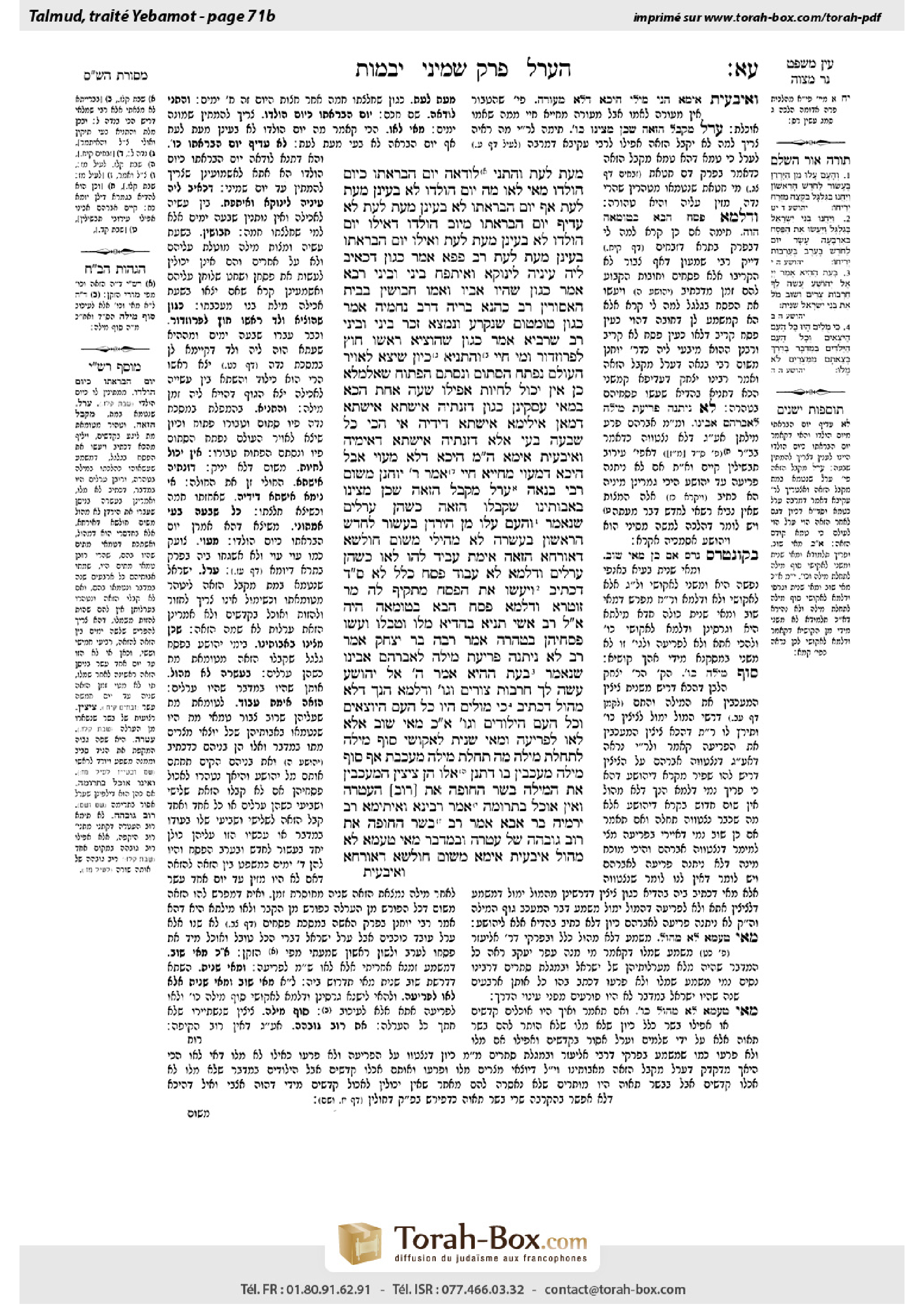
Yevamot 71b: Talmud study for Daf Yomi
Daf Yomi is the daily study of one Talmud folio. Explore 37 tractates with scans, Hebrew text, Sefaria English and AI-generated French translations where annotated.
Passage selection and English or AI-generated French translation are available where the scan has annotations. Daf Study is independent of Torah-Box and Sefaria.
Browse Yevamot · יבמות · All tractatesYevamot 71b text and translations
This page of Yevamot includes the Aramaic text, an English translation and an AI-generated French translation, alongside the scan above.
יבמות ע״א ב · Aramaic and Hebrew text
מֵעֵת לְעֵת.
וְהָתָנֵי לוּדָאָה: יוֹם הַבְרָאָתוֹ כְּיוֹם הִוָּלְדוֹ. מַאי לָאו: מָה יוֹם הִוָּלְדוֹ לָא בָּעֵינַן מֵעֵת לְעֵת, אַף יוֹם הַבְרָאָתוֹ לָא בָּעֵינַן מֵעֵת לְעֵת?
לָא, עֲדִיף יוֹם הַבְרָאָתוֹ מִיּוֹם הִוָּלְדוֹ. דְּאִילּוּ יוֹם הִוָּלְדוֹ לָא בָּעֵינַן מֵעֵת לְעֵת, וְאִילּוּ יוֹם הַבְרָאָתוֹ בָּעֵינַן מֵעֵת לְעֵת.
רַב פָּפָּא אָמַר: כְּגוֹן דְּכָאֵיב לֵיהּ עֵינֵיהּ לְיָנוֹקָא וְאִיתְּפַח בֵּינֵי וּבֵינֵי.
רָבָא אָמַר: כְּגוֹן שֶׁהָיוּ אָבִיו וְאִמּוֹ חֲבוּשִׁין בְּבֵית הָאֲסוּרִין.
רַב כָּהֲנָא בְּרֵיהּ דְּרַב נְחֶמְיָה אָמַר: כְּגוֹן טוּמְטוּם שֶׁנִּקְרַע, וְנִמְצָא זָכָר בֵּינֵי וּבֵינֵי.
רַב שֵׁרֵבְיָא אָמַר: כְּגוֹן שֶׁהוֹצִיא רֹאשׁוֹ חוּץ לַפְּרוֹזְדוֹר.
וּמִי חָיֵי? וְהָתַנְיָא: כֵּיוָן שֶׁיָּצָא לַאֲוִיר הָעוֹלָם, נִפְתַּח הַסָּתוּם וְנִסְתַּם הַפָּתוּחַ. שֶׁאִלְמָלֵא כֵּן, אֵין יָכוֹל לִחְיוֹת אֲפִילּוּ שָׁעָה אַחַת!
הָכָא בְּמַאי עָסְקִינַן, כְּגוֹן דְּזַנְתֵּיהּ אִישָּׁתָא. אִישָּׁתָא דְּמַאן? אִילֵימָא אִישָּׁתָא דִּידֵיהּ, אִי הָכִי כֹּל שִׁבְעָה בָּעֵי? אֶלָּא דְּזַנְתֵּיהּ אִישָּׁתָא דְּאִימֵּיהּ. וְאִיבָּעֵית אֵימָא: הָנֵי מִילֵּי הֵיכָא דְּלָא מְעַוֵּי, אֲבָל הֵיכָא דִּמְעַוֵּי, מִחְיָיא חָיֵי.
אָמַר רַבִּי יוֹחָנָן מִשּׁוּם רַבִּי בְּנָאָה: עָרֵל מְקַבֵּל הַזָּאָה, שֶׁכֵּן מָצִינוּ בַּאֲבוֹתֵינוּ שֶׁקִּבְּלוּ הַזָּאָה כְּשֶׁהֵן עֲרֵלִים, שֶׁנֶּאֱמַר: ״וְהָעָם עָלוּ מִן הַיַּרְדֵּן בֶּעָשׂוֹר לַחֹדֶשׁ הָרִאשׁוֹן״.
בַּעֲשָׂרָה לָא מְהִילִי, מִשּׁוּם חוּלְשָׁא דְאוֹרְחָא. הַזָּאָה אֵימַת עָבֵיד לְהוּ?! לָאו כְּשֶׁהֵן עֲרֵלִים?
וְדִלְמָא לָא עֲבוּד פֶּסַח כְּלָל? לָא סָלְקָא דַּעְתָּךְ, דִּכְתִיב: ״וַיַּעֲשׂוּ אֶת הַפֶּסַח״.
מַתְקֵיף לַהּ מָר זוּטְרָא: וְדִלְמָא פֶּסַח הַבָּא בְּטוּמְאָה הָיָה? אֲמַר לֵיהּ רַב אָשֵׁי, תַּנְיָא בְּהֶדְיָא: מָלוּ, וְטָבְלוּ, וְעָשׂוּ פִּסְחֵיהֶן בְּטׇהֳרָה.
אָמַר רַבָּה בַּר יִצְחָק אָמַר רַב: לֹא נִיתְּנָה פְּרִיעַת מִילָה לְאַבְרָהָם אָבִינוּ, שֶׁנֶּאֱמַר: ״בָּעֵת הַהִיא אָמַר ה׳ אֶל יְהוֹשֻׁעַ עֲשֵׂה לְךָ חַרְבוֹת צֻרִים וְגוֹ׳״.
וְדִלְמָא הָנָךְ דְּלָא מְהוּל, דִּכְתִיב: ״כִּי מֻלִים הָיוּ כׇּל הָעָם הַיֹּצְאִים וְכׇל הָעָם הַיִּלֹּדִים וְגוֹ׳״.
אִם כֵּן, מַאי ״שׁוּב״? אֶלָּא לָאו לִפְרִיעָה. וּמַאי ״שֵׁנִית״ —
לְאַקּוֹשֵׁי סוֹף מִילָה לִתְחִלַּת מִילָה: מָה תְּחִלַּת מִילָה מְעַכֶּבֶת — אַף סוֹף מִילָה מְעַכְּבִין בּוֹ. דִּתְנַן: אֵלּוּ הֵן צִיצִין הַמְעַכְּבִין אֶת הַמִּילָה — בָּשָׂר הַחוֹפֶה אֶת [רוֹב] הָעֲטָרָה, וְאֵין אוֹכֵל בִּתְרוּמָה.
אָמַר רָבִינָא, וְאִיתֵּימָא רַב יִרְמְיָה בַּר אַבָּא אָמַר רַב: בָּשָׂר הַחוֹפֶה אֶת רוֹב גּוֹבְהָהּ שֶׁל עֲטָרָה.
וּבַמִּדְבָּר מַאי טַעְמָא לָא מְהוּל? אִיבָּעֵית אֵימָא מִשּׁוּם חוּלְשָׁא דְּאוֹרְחָא,
Yevamot 71b · English translation
that during the recovery period one must wait from the time the seven days began to the exact same time seven days later, i.e., seven complete twenty-four-hour periods. Therefore, if the child recovered in the afternoon of a particular day, one is required to wait until that same time of day a week later, and only then is he circumcised.
The Gemara asks: Didn’t the Sage from Lod teach that the day of his healing is like the day of his birth? What, is it not that just as with regard to the day of his birth we need not wait from the time he is born to the same time on the eighth day to circumcise him, so too, with regard to the day of his healing we need not wait from the time he heals to the same time seven days later?
The Gemara refutes this argument: No, the day of his healing is superior to the day of his birth: While from the day of his birth until circumcision we need not wait from the time he is born to the same time on the eighth day to circumcise him, i.e., the child may be circumcised already at the start of the eighth day, from the day of his healing we need to wait seven complete days from the time he heals to the same time seven days later.
The Gemara suggests other circumstances where a male child may be present at the time of the eating of the Paschal lamb but absent at the time of its preparation. Rav Pappa said: This would take place, for example, if the baby’s eye hurt him on the eighth day following his birth, which occurred on the eve of Passover, and he recovered in the meantime between the time of the preparation of the Paschal lamb and the time of its eating. In the case of a minor ailment such as eye pain, circumcision is not performed as long as the pain persists, but it may be performed as soon as the child has recovered, without first waiting seven days.
Rava said: This would occur, for example, if the infant’s father and mother were incarcerated in a prison at the time of the preparation of the Paschal lamb, and they slaughtered their offering by way of an agent, and there was no one available to circumcise the infant, and the parents were released from prison before the time for eating the Paschal lamb arrived.
Rav Kahana, son of Rav Neḥemya, said: This would occur, for example, if the infant was a tumtum, one whose external sexual organs are indeterminate and it is unclear whether the infant is male or female, and in the meantime between the time of the preparation of the Paschal lamb and the time of its eating, he was torn open, his gender was revealed, and he was found to be a male, so that the obligation to circumcise him went into effect.
Rav Sherevya said: This would occur, for example, if seven days earlier the baby had already extended his head, but not the rest of his body, out of the corridor to his mother’s womb. In such a situation he is considered born, but he is fit for circumcision only after his entire body has emerged. If this occurs between the time of the preparation of the Paschal lamb and the time of its eating, the child’s father may not eat of the offering until he has circumcised his son.
The Gemara poses a question: But in a case such as this, can the child live for such a long period with only his head outside? Isn’t it taught in a baraita: Once a baby emerges into the air of the world, that which had been closed, the mouth and nostrils, open, and that which had been open, the umbilical cord, from which the child had previously received its sustenance, closes, as, if this did not occur it could not live for even an hour, as it has no other way to receive nutrition. If so, this child whose head alone emerged from his mother’s womb would certainly starve, as it cannot take in any sustenance.
The Gemara answers: With what case are we dealing here? It is, for example, a case where he was sustained by the heat of a fever and therefore did not need to eat. The Gemara asks: Whose fever? If we say it is his own fever, i.e., the baby himself had a fever, if so, it should be necessary to wait a full seven days after his entire body exits the womb before he can be circumcised, in accordance with the halakha governing an infant who was ill. Rather, it must be that he was sustained by his mother’s fever. And if you wish, say that this principle that a child cannot survive in such conditions applies only when he does not cry, but when he cries he can live, as his crying indicates that he has already started to breathe.
§ Rabbi Yoḥanan said in the name of Rabbi Bena’a: An uncircumcised man may receive the sprinkling of the water mixed with the ashes of a red heifer in order to purify himself from ritual impurity imparted by a human corpse, as we do not say that this sprinkling is ineffective as long as he is uncircumcised. As we found that our forefathers received the sprinkling when they were uncircumcised, as it is stated: “And the people came up out of the Jordan on the tenth day of the first month” (Joshua 4:19), and the verses go on to relate that the men were all later circumcised before sacrificing the Paschal lamb on the fourteenth (see Joshua 5:10).
The Gemara clarifies: On the tenth day itself they did not circumcise themselves due to the weariness caused by their journey. When, then, was the sprinkling done to them in order to remove the ritual impurity resulting from contact with a corpse, so that they would be fit to bring the Paschal lamb on the fourteenth? The first sprinkling must have taken place no later than the tenth, as there is a four-day waiting period between the first and second sprinklings. In that case, wasn’t the initial sprinkling performed when they were still uncircumcised? This proves that one who is uncircumcised may receive the sprinkling of the purification waters.
The Gemara counters: But perhaps they did not sacrifice the Paschal lamb at all. The Gemara answers: This cannot enter your mind, as it is written: “And they kept the Passover” (Joshua 5:10), meaning they brought the Paschal lamb.
Mar Zutra strongly objects to this: But perhaps it was a Paschal lamb that comes in a state of impurity? If the majority of the community is ritually impure due to contact with a corpse, they may all sacrifice their Paschal lambs even though they are ritually impure, and there is no need for any sprinkling. Rav Ashi said to him: It is taught explicitly in a baraita that they circumcised themselves, immersed in a ritual bath, and performed the ritual of their Paschal lambs in a state of purity.
Rabba bar Yitzḥak said that Rav said: The mitzva of uncovering the corona during circumcision was not given to our Patriarch Abraham. The command given to Avraham included only the mitzva of circumcision itself, i.e., the removal of the foreskin, but not the uncovering of the corona, i.e., the folding back of the thin membrane that lies under the foreskin. As it is stated: “At that time the Lord said to Joshua: Make yourself knives of flint, and circumcise again the children of Israel a second time” (Joshua 5:2). Why was it necessary to circumcise them? Apparently, it is because before the Torah was given on Mount Sinai, some of them had been circumcised in the manner of Abraham, without uncovering the corona, and therefore they needed to be circumcised a second time in accordance with the Torah law that requires uncovering the corona.
The Gemara asks: How may it be inferred that those who were already circumcised required a second circumcision? Perhaps the verse is referring to those who had not been circumcised at all, as it is written: “For all the people who came out were circumcised; but all the people who were born in the wilderness…had not been circumcised” (Joshua 5:5)?
The Gemara responds: If so, that it was only those who had never been circumcised who required circumcision, what is the meaning of “circumcise again,” which indicates that they had to be circumcised a second time? Rather, is it not referring to uncovering the corona? And what is the meaning of “a second time,” stated in the same verse? This phrase appears redundant, as the verse already stated: “Circumcise again.”
The Gemara explains: It comes to equate the end of circumcision, when it is necessary to circumcise a second time in order to correct an improperly performed circumcision, with the beginning of circumcision: Just as an incomplete performance at the beginning of circumcision invalidates the circumcision, so too, incomplete performance at the end of circumcision, i.e., the foreskin not being fully removed, invalidates the circumcision. As we learned in a mishna (Shabbat 137a): These are the shreds of flesh that invalidate the circumcision if they are not cut. The essential element of circumcision is the removal of the flesh that covers most of the corona, and a child who was not circumcised in this manner is considered uncircumcised, and he does not partake of teruma.
With regard to this issue Ravina said, and some say it was Rav Yirmeya bar Abba who said that Rav said: When the mishna mentioned most of the corona, it meant the flesh that covers most of the height of the corona as well as most of its circumference.
The Gemara returns to the incident involving Joshua. And what is the reason that they did not circumcise themselves in the wilderness after the Torah had already been given? The Gemara answers: If you wish, say it was due to the weariness caused by their journey. Since they were traveling continuously, they were too weak to undergo circumcision.
Yevamot 71b · Traduction française (IA)
Pendant la période de convalescence, il faut donc attendre sept jours complets de vingt-quatre heures, à compter du moment où les sept jours ont commencé. Ainsi, si l’enfant guérit dans l’après-midi d’un jour donné, il faut attendre jusqu’à la même heure une semaine plus tard ; ce n’est qu’alors qu’on peut le circoncire.
La Guemara demande : Le Sage de Lod n’a-t-il pas enseigné que le jour de sa guérison est comme le jour de sa naissance ? Cela ne signifie-t-il pas que, de même que, pour le jour de sa naissance, il n’est pas nécessaire d’attendre jusqu’à la même heure du huitième jour pour le circoncire, de même, pour le jour de sa guérison, il n’est pas nécessaire d’attendre jusqu’à la même heure sept jours plus tard ?
La Guemara réfute cet argument : Non, le jour de sa guérison est plus strict que le jour de sa naissance. En effet, tandis qu’après sa naissance il n’est pas nécessaire d’attendre jusqu’à la même heure du huitième jour pour le circoncire — autrement dit, on peut circoncire l’enfant dès le début du huitième jour —, après sa guérison, il faut attendre sept jours complets, jusqu’à la même heure sept jours plus tard.
La Guemara propose d’autres circonstances dans lesquelles un enfant mâle pourrait être présent au moment de la consommation de l’agneau pascal, mais absent au moment de sa préparation. Rav Pappa dit : Cela pourrait se produire, par exemple, si l’enfant avait mal à l’œil le huitième jour après sa naissance, laquelle aurait eu lieu la veille de Pessa’h, et qu’il guérissait entre le moment de la préparation de l’agneau pascal et celui de sa consommation. Dans le cas d’une affection bénigne telle qu’une douleur à l’œil, on ne pratique pas la circoncision tant que la douleur persiste, mais on peut la pratiquer dès que l’enfant a guéri, sans attendre d’abord sept jours.
Rava dit : Cela pourrait se produire, par exemple, si le père et la mère du nourrisson étaient emprisonnés au moment de la préparation de l’agneau pascal, s’ils faisaient abattre leur sacrifice par un mandataire, si personne n’était disponible pour circoncire l’enfant et si les parents étaient libérés avant l’heure de la consommation de l’agneau pascal.
Rav Kahana, fils de Rav Neḥemya, dit : Cela pourrait se produire, par exemple, si le nourrisson était un tumtum, c’est-à-dire si ses organes sexuels externes étaient indéterminés et qu’on ne savait pas s’il était mâle ou femelle, puis si, entre le moment de la préparation de l’agneau pascal et celui de sa consommation, on l’incisait et que son sexe se révélait : il s’avérait alors être mâle, et l’obligation de le circoncire entrait en vigueur.
Rav Sherevya dit : Cela pourrait se produire, par exemple, si, sept jours auparavant, le bébé avait déjà passé la tête hors du passage menant à l’utérus de sa mère, mais pas le reste du corps. Dans une telle situation, il est considéré comme né, mais ne peut être circoncis qu’après la sortie de tout son corps. Si cela se produit entre le moment de la préparation de l’agneau pascal et celui de sa consommation, le père de l’enfant ne peut pas manger du sacrifice avant d’avoir circoncis son fils.
La Guemara pose une question : Mais, dans un cas comme celui-ci, l’enfant peut-il vivre aussi longtemps avec seulement la tête à l’extérieur ? N’est-il pas enseigné dans une baraïta : Dès qu’un bébé apparaît à l’air du monde, ce qui était fermé — la bouche et les narines — s’ouvre, et ce qui était ouvert — le cordon ombilical, par lequel l’enfant recevait jusque-là sa nourriture — se ferme. En effet, si cela ne se produisait pas, il ne pourrait pas vivre ne serait-ce qu’une heure, puisqu’il n’aurait aucun autre moyen de se nourrir. Dans ce cas, cet enfant dont seule la tête est sortie du ventre de sa mère mourrait certainement de faim, puisqu’il ne peut absorber aucune nourriture.
La Guemara répond : De quel cas s’agit-il ici ? Par exemple, il était maintenu en vie par la chaleur d’une fièvre et n’avait donc pas besoin de manger. La Guemara demande : De qui était cette fièvre ? Si l’on dit qu’il s’agissait de sa propre fièvre, c’est-à-dire que le bébé lui-même avait de la fièvre, il faudrait alors attendre sept jours complets après la sortie de tout son corps du ventre avant de pouvoir le circoncire, conformément à la halakha concernant un nourrisson malade. Il faut donc plutôt dire qu’il était maintenu en vie par la fièvre de sa mère. Et, si tu le souhaites, dis que le principe selon lequel un enfant ne peut survivre dans de telles conditions ne s’applique que s’il ne pleure pas ; s’il pleure, il peut vivre, car ses pleurs indiquent qu’il a déjà commencé à respirer.
§ Rabbi Yoḥanan dit au nom de Rabbi Bena’a : Un homme non circoncis peut recevoir l’aspersion de l’eau mêlée aux cendres d’une vache rousse afin de se purifier de l’impureté rituelle transmise par un cadavre humain ; on ne dit pas que cette aspersion est sans effet tant qu’il n’est pas circoncis. Nous trouvons en effet que nos ancêtres reçurent l’aspersion alors qu’ils n’étaient pas circoncis, comme il est dit : « Le peuple monta du Jourdain le dixième jour du premier mois » (Josué 4,19). Les versets racontent ensuite que les hommes furent tous circoncis avant d’offrir l’agneau pascal le quatorzième jour (voir Josué 5,10).
La Guemara précise : Le dixième jour même, ils ne se circoncirent pas, en raison de la fatigue causée par leur voyage. Quand donc leur fit-on l’aspersion pour éliminer l’impureté rituelle résultant du contact avec un cadavre, afin qu’ils soient aptes à offrir l’agneau pascal le quatorzième jour ? La première aspersion devait avoir lieu au plus tard le dixième jour, puisqu’il faut attendre quatre jours entre la première et la seconde aspersion. Dans ce cas, la première aspersion n’a-t-elle pas été faite alors qu’ils étaient encore incirconcis ? Cela prouve qu’un homme non circoncis peut recevoir l’aspersion des eaux de purification.
La Guemara objecte : Mais peut-être n’ont-ils pas offert l’agneau pascal du tout. La Guemara répond : Cela ne saurait te venir à l’esprit, car il est écrit : « Ils célébrèrent Pessa’h » (Josué 5,10), c’est-à-dire qu’ils offrirent l’agneau pascal.
Mar Zutra s’y oppose vivement : Mais peut-être s’agissait-il d’un sacrifice pascal offert en état d’impureté ? Si la majorité de la communauté est rituellement impure à la suite d’un contact avec un cadavre, tous peuvent offrir leur agneau pascal alors même qu’ils sont rituellement impurs, et aucune aspersion n’est nécessaire. Rav Ashi lui dit : Une baraïta enseigne explicitement qu’ils se circoncirent, s’immergèrent dans un bain rituel et accomplirent le rituel de leur sacrifice pascal en état de pureté.
Rabba bar Yitzḥak dit au nom de Rav : La mitsva de découvrir le gland lors de la circoncision n’a pas été donnée à notre patriarche Abraham. Le commandement donné à Avraham ne comprenait que la mitsva de la circoncision proprement dite, c’est-à-dire l’ablation du prépuce, mais pas le dévoilement du gland, c’est-à-dire le retroussement de la fine membrane située sous le prépuce. Comme il est dit : « En ce temps-là, le Seigneur dit à Josué : Fais-toi des couteaux de silex et circoncis de nouveau les enfants d’Israël, une seconde fois » (Josué 5,2). Pourquoi fallait-il les circoncire ? Apparemment, c’est parce qu’avant que la Torah ne soit donnée au mont Sinaï, certains avaient été circoncis à la manière d’Abraham, sans dévoilement du gland ; il fallait donc les circoncire une seconde fois, conformément à la loi de la Torah qui exige le dévoilement du gland.
La Guemara demande : Comment peut-on déduire qu’il fallait circoncire une seconde fois ceux qui l’avaient déjà été ? Peut-être le verset parle-t-il de ceux qui n’avaient pas été circoncis du tout, comme il est écrit : « Tout le peuple qui était sorti était circoncis ; mais tout le peuple né dans le désert […] n’avait pas été circoncis » (Josué 5,5).
La Guemara répond : Dans ce cas, si seuls ceux qui n’avaient jamais été circoncis avaient dû l’être, que signifie « circoncis de nouveau », ce qui indique qu’ils devaient être circoncis une seconde fois ? Cela ne désigne-t-il pas le dévoilement du gland ? Et que signifie « une seconde fois », dans le même verset ? Cette expression semble redondante, puisque le verset a déjà dit : « Circoncis de nouveau ».
La Guemara explique : Cette expression vient mettre en parallèle la fin de la circoncision, lorsqu’il faut circoncire une seconde fois pour corriger une circoncision mal exécutée, et le début de la circoncision : de même qu’une exécution incomplète au début de la circoncision invalide celle-ci, de même, une exécution incomplète à la fin de la circoncision — c’est-à-dire si le prépuce n’a pas été entièrement retiré — l’invalide. En effet, nous avons appris dans une Michna (Chabbat 137a) : « Voici les lambeaux de chair qui invalident la circoncision s’ils ne sont pas coupés. » L’essentiel de la circoncision consiste à retirer la chair qui recouvre la majeure partie du gland ; un enfant qui n’a pas été circoncis de cette manière est considéré comme non circoncis et ne peut pas consommer de terouma.
À ce sujet, Ravina dit — et certains disent que c’est Rav Yirmeya bar Abba qui rapporte les paroles de Rav : Lorsque la Michna mentionne la majeure partie du gland, elle désigne la chair qui recouvre la majeure partie de sa hauteur ainsi que la majeure partie de sa circonférence.
La Guemara revient à l’épisode concernant Josué. Pourquoi ne se circoncirent-ils pas dans le désert après que la Torah eut déjà été donnée ? La Guemara répond : Si tu le souhaites, dis que c’était en raison de la fatigue causée par leur voyage. Comme ils voyageaient sans cesse, ils étaient trop faibles pour subir la circoncision.
Traduction française générée par IA à partir de l’édition anglaise de Sefaria. Vérifie toujours un passage avec le texte source.
Text from Sefaria: William Davidson Edition - Vocalized Aramaic (CC BY NC); William Davidson Edition - English (CC BY NC).